
- Home
- »
- Energy & Power
- »
-
Gravity Battery Market Size, Share Report, 2026-2033GVR Report cover

Gravity Battery Market (2026 - 2033) Size, Share & Trends Analysis Report By Type (Less than 30 MWh, More than 30 MWh), By Application (Utilities, Business & Industry), By Region (North America, Europe, Asia Pacific, Latin America, Middle East & Africa), And Segment Forecasts
Market Size, 2025
$42.7MMarket Estimate, 2026
$68.7MMarket Forecast, 2033
$1,965.4MCAGR, 2026–2033
61.5%Gravity Battery Market Summary
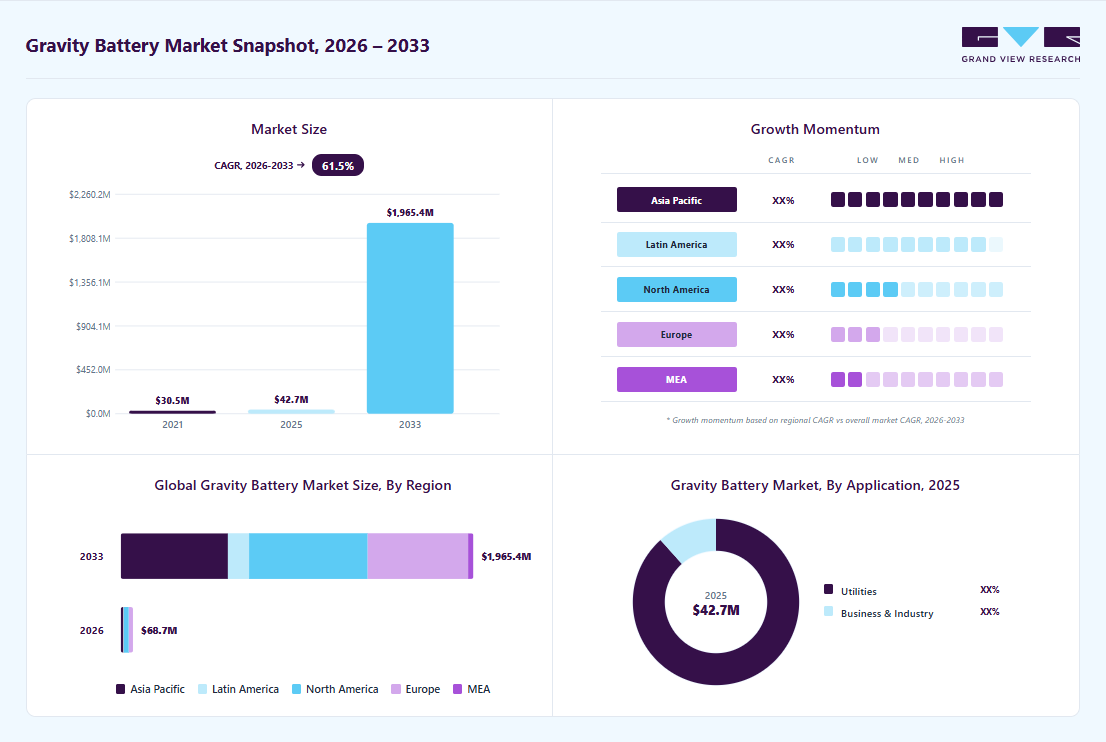
The global gravity battery market size was valued at USD 42.7 million in 2025 and is projected to grow from USD 68.7 million in 2026 to USD 1,965.4 million by 2033, at a CAGR of 61.5% from 2026 to 2033. North America held the dominating position in the global gravity battery market with 38.3% share in 2025.. The market is gaining traction due to the increasing need for long-duration, sustainable, and low-maintenance energy storage solutions.
 Source: Grand View Research, IR Documents, Primary Interviews, Paid DatabasesTo learn more about this report,
 Download Free Sample Report
 Key Market Trends & Insights
- By type: Gravity battery systems with capacities of more than 30 MWh accounted for the largest revenue share of 57.7% in 2025
- By appllication: The utilities segment dominated the gravity battery market, accounting for the largest revenue share of 88.4% in 2025.
Regional Highlights
- Largest regional market: North America (38.3% revenue share, 2025)
- Fastest-growing regional market: Asia-Pacific (highest CAGR, 2026-2033)
- By country: The U.S gravity battery industry is a major contributor to the global market.
Market Size & Forecast
- Market size in 2025: USD 42.7 Million
- Estimated market size in 2026: USD 68.7 Million
- Projected market size by 2033: USD 1,965.4 Million
- CAGR (2026-2033): 61.5%
Three ways to get this report
Buy it, customize it, or ask a question.Ask an Analyst
A direct answer, usually in 1 working day
- AccessReport author, directly
- Reply timeWithin 1 working day
- No sales callDirect answer only
- FormatEmail reply
- CostFree, no cost
Get the Full Report
What the study covers
- FormatsPDF · Excel · Dashboard
- Timeline2026–2033 annual, 2025 base
- Coverage20+ countries, 5 regions
- Companies10+ key players profiled
Customize the Report
20% free customization
- IncludeCountries, segments, points
- TailorTo your product definition
- ExtendDeeper competitor detail
- OrA fully bespoke study
- Turnaround5–10 working days
Unlike conventional battery technologies, gravity-based systems rely on mechanical energy storage, reducing dependence on critical raw materials such as lithium, cobalt, and nickel. Growing investments in clean energy infrastructure and grid modernization projects are further accelerating the deployment of gravity battery systems, particularly in regions with high renewable energy penetration.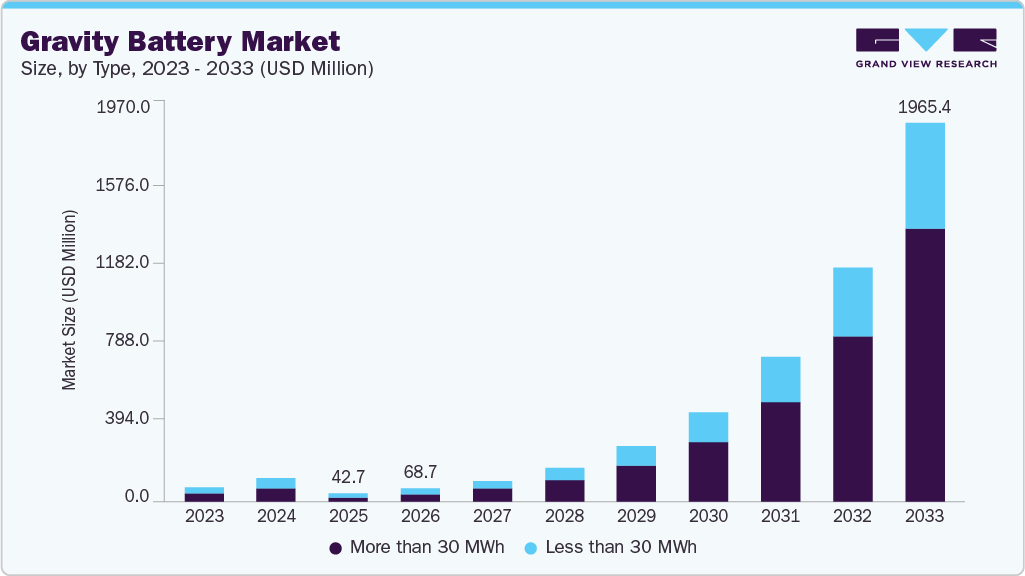 To learn more about this report, Download Free Sample Report
 Gravity batteries operate by storing energy through the elevation of heavy masses and releasing it by lowering them to generate electricity when required. This technology offers key advantages, such as a long operational life, minimal degradation, and enhanced safety, compared to chemical batteries. Its applicability in utility-scale energy storage, renewable integration, and grid stabilization is driving pilot projects and commercial-scale developments globally. As countries continue to expand solar and wind capacity, the need for reliable, cost-efficient, and environmentally friendly storage solutions is expected to fuel the adoption of gravity-based energy storage systems across both developed and emerging markets.
Drivers, Opportunities & Restraints
The primary driver of the gravity battery market is the rising demand for safe, long-duration, and cost-efficient energy storage solutions, particularly as renewable energy integration accelerates across global power grids. Unlike conventional lithium-ion batteries, gravity-based systems rely on mechanical principles, eliminating the risks of thermal runaway, chemical degradation, and raw material scarcity. As solar and wind generation continue to expand, grid operators are increasingly seeking reliable storage technologies to stabilize intermittent energy supply. Additionally, growing investments in grid modernization, decarbonization initiatives, and infrastructure resilience are supporting pilot projects and early-stage deployments of gravity energy storage systems, especially in North America and Europe.
A significant opportunity lies in the large-scale deployment of gravity batteries for utility-scale and long-duration energy storage applications. As the need for multi-hour to multi-day storage increases, gravity-based systems are emerging as a viable alternative due to their long lifespan, low operating costs, and minimal environmental impact. Opportunities are also expanding across applications such as renewable energy integration, repurposing abandoned mines, microgrids, and industrial backup power. Furthermore, advancements in engineering design, digital control systems, and material handling technologies are improving system efficiency and scalability. Increasing investments from both public and private sectors, along with pilot installations in regions such as the Asia Pacific and Europe, are expected to unlock new growth avenues.
However, the market faces several restraints, primarily related to high initial capital investment and limited commercial maturity. Gravity battery systems require significant upfront infrastructure development, including land-use planning, structural construction, and site-specific customization, which can limit rapid adoption. Additionally, the technology is still in the early stages of commercialization, with limited large-scale operational data and standardized performance benchmarks. Competition from well-established energy storage technologies, such as lithium-ion and pumped hydro storage, further poses a challenge. Regulatory uncertainties, permitting complexities, and location constraints may also hinder widespread deployment, particularly in densely populated or land-constrained regions.
Type Insights
Gravity battery systems with capacities of more than 30 MWh accounted for the largest revenue share of 57.7% in 2025, driven by their strong suitability for utility-scale and long-duration energy storage applications. These large-capacity systems are increasingly being deployed for grid stabilization, renewable energy integration, and peak load management, particularly in regions with high solar and wind penetration. Their ability to deliver consistent performance over extended durations, coupled with long operational life and minimal degradation, makes them an attractive solution for large-scale energy infrastructure projects. Additionally, growing investments in grid modernization and decarbonization initiatives are further supporting the adoption of high-capacity gravity battery systems across developed markets.
Gravity battery systems with capacities of more than 30 MWh are also expected to register the fastest CAGR of 65.8% over the forecast period, owing to the rising demand for scalable and long-duration storage solutions. As energy systems increasingly shift toward renewable sources, the need for bulk energy storage capable of handling multi-hour to multi-day storage is accelerating. These systems are particularly gaining traction in applications such as utility-scale storage, repurposed mining infrastructure, and large industrial energy management. Advancements in engineering design, increased project funding, and supportive policy frameworks are expected to drive further the rapid expansion of this segment across key regions, including North America, Europe, and the Asia Pacific.
Application Insights
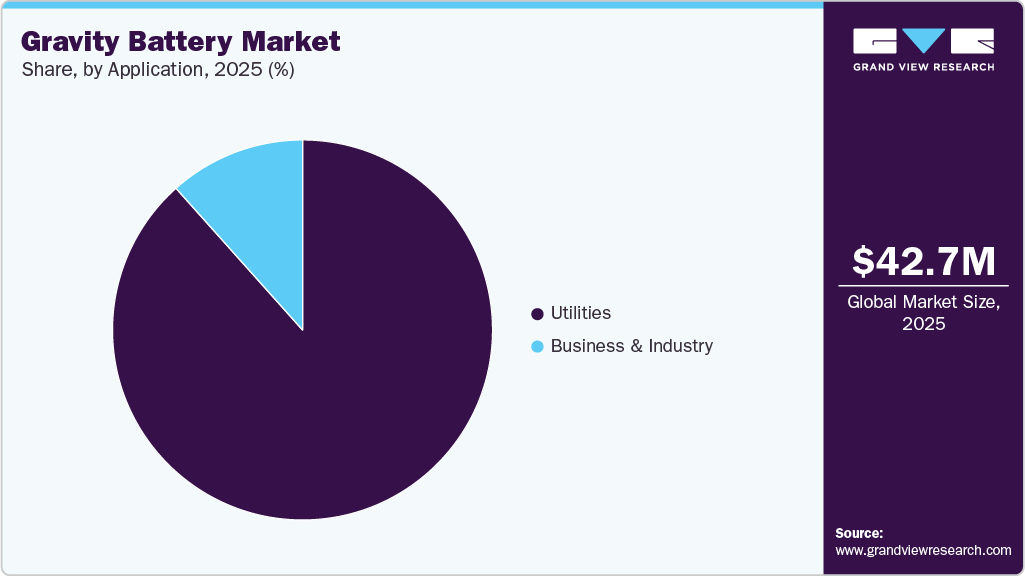
The utilities segment dominated the gravity battery market, accounting for the largest revenue share of 88.4% in 2025, driven by the increasing deployment of gravity battery systems for grid-scale energy storage and renewable integration. Utilities are actively adopting gravity-based storage solutions to address intermittency challenges associated with solar and wind energy, ensuring grid stability and a reliable power supply. These systems offer advantages such as long-duration storage, low operational costs, and minimal degradation, making them highly suitable for large-scale infrastructure projects. Additionally, rising investments in grid modernization, decarbonization initiatives, and energy transition strategies across regions such as North America and Europe are further supporting the dominance of the utilities segment.
 To learn more about this report, Download Free Sample Report
 The business & industry segment is expected to register the fastest CAGR of 73.5% over the forecast period, owing to the growing demand for reliable and cost-efficient energy storage solutions across commercial and industrial operations. Industries are increasingly adopting gravity battery systems for applications such as backup power, peak load management, and energy cost optimization. The rising focus on sustainability, along with the need to reduce dependence on conventional energy sources, is further accelerating adoption in sectors such as manufacturing, mining, and large commercial facilities. Moreover, advancements in system design and increased awareness of the benefits of long-duration storage are expected to drive significant growth in this segment globally.
Regional Insights
North America Gravity Battery Market Trends
North America accounted for the largest revenue share of 38.3% in 2025, driven by strong investments in grid modernization, long-duration energy storage, and renewable energy integration. The region is witnessing increasing deployment of gravity battery systems to support grid stability and manage intermittency from solar and wind power. Favorable government policies, funding programs, and the presence of advanced research ecosystems are accelerating pilot projects and early-stage commercialization. Additionally, the growing focus on decarbonization and infrastructure resilience is further strengthening the adoption of gravity-based energy storage solutions across the region.
 To learn more about this report, Download Free Sample Report
 U.S. Gravity Battery Market Trends
The United States represents a key contributor to the North America gravity battery industry, supported by significant investments in clean energy infrastructure and energy storage innovation. Federal and state-level initiatives aimed at enhancing grid reliability and achieving net-zero emission targets are driving demand for long-duration storage technologies. The presence of leading technology developers, utility-scale renewable projects, and increasing adoption of alternative storage solutions are further supporting market growth. Moreover, the expansion of solar and wind capacity across the country is creating strong demand for scalable and sustainable storage systems such as gravity batteries.
Europe Gravity Battery Market Trends
Europe is witnessing substantial growth in the gravity battery industry, driven by ambitious climate goals and strong regulatory frameworks that promote clean energy adoption. The region is focusing on reducing dependence on conventional battery materials while accelerating the deployment of sustainable storage technologies. Increasing investments in renewable energy projects, along with the presence of innovative startups and pilot installations, are driving the adoption of gravity battery systems. Supportive policies and funding mechanisms from the European Union are further advancing technological development and commercialization.
Asia Pacific Gravity Battery Market Trends
Asia Pacific is projected to register the fastest CAGR of 69.8% during the forecast period, driven by rapid industrialization, rising electricity demand, and large-scale expansion of renewable energy. Governments across countries such as China, India, Japan, and Australia are investing heavily in energy storage infrastructure to ensure grid stability and energy security. The growing need for cost-effective, scalable long-duration storage solutions is accelerating the adoption of gravity battery technologies. Additionally, ongoing infrastructure development and favorable policy support are expected to position the Asia Pacific as the fastest-growing regional market.
Latin America Gravity Battery Market Trends
Latin America is gradually emerging as a promising market for gravity battery systems, driven by growing investments in renewable energy and grid infrastructure. Countries in the region are increasingly focusing on improving energy reliability and integrating renewable sources such as solar and wind. Gravity batteries offer a sustainable and low-maintenance solution for long-duration energy storage, making them suitable for remote and underserved areas. Government initiatives and international investments are expected to support gradual market expansion.
Middle East & Africa Gravity Battery Market Trends
The Middle East & Africa gravity battery industry is experiencing steady growth, driven by efforts to diversify energy sources and enhance energy storage capabilities. The region is investing in renewable energy projects, particularly solar power, creating demand for efficient and reliable storage solutions. Gravity battery systems are gaining attention due to their durability, low environmental impact, and suitability for large-scale applications. Increased infrastructure development and strategic energy initiatives are expected to drive long-term market growth across the region.
Key Gravity Battery Company Insights
Some of the key players operating in the global gravity battery market include Energy Vault, Gravitricity, Gravity Power, Advanced Rail Energy Storage (ARES), Heindl Energy, Green Gravity, RheEnergise, and Renewell Energy. These companies are primarily focused on developing innovative gravity-based energy storage technologies that use mechanical systems, such as elevated masses, underground shafts, rail-based systems, and fluid-displacement mechanisms, to store and release energy efficiently. Their solutions aim to address the growing need for long-duration, safe, and sustainable energy storage, particularly for utility-scale and renewable energy integration applications.
Their strategic initiatives largely revolve around pilot project deployments, infrastructure innovation, and partnerships with utilities, governments, and renewable energy developers. Companies are investing in engineering advancements, system optimization, and digital control technologies to enhance efficiency, scalability, and cost-effectiveness. Additionally, many players are leveraging existing infrastructure such as abandoned mines, oil wells, and hilly terrains to reduce capital costs and accelerate commercialization. Collaborations with public and private stakeholders are playing a critical role in validating technology performance and enabling early-stage adoption across key markets.
As global demand for long-duration and environmentally sustainable energy storage solutions continues to rise, these companies are positioning gravity battery systems as a viable alternative to lithium-ion and pumped hydro storage. Increasing focus on grid stability, renewable energy expansion, and decarbonization is driving innovation in this space. Continued investments in project development, infrastructure integration, and strategic partnerships are expected to support technological maturity and contribute to the long-term growth of the gravity battery industry globally.
Key Gravity Battery Companies:
The following key companies have been profiled for this study on the gravity battery market.
- Energy Vaul
- Gravitricity
- Gravity Power
- Advanced Rail Energy Storage (ARES)
- Heindl Energy
- Green Gravity
- RheEnergise
- Renewell Energy
Recent Developments
-
In October 2025, Energy Vault announced a partnership with Enel Green Power to develop the first gravity-based energy storage plant in a Western country (Texas, U.S.), marking a major milestone in the commercialization of gravity battery technology. The project focuses on deploying large-scale gravity storage to support renewable energy integration and grid stability, highlighting the transition of gravity systems from pilot to utility-scale deployment.
Gravity Battery Market Report Scope
Report Attribute
Details
Market Definition
The gravity battery market refers to the global revenue generated from the development and deployment of gravity-based energy storage systems that use mechanical principles such as lifting and lowering heavy masses to provide long-duration, safe, and sustainable energy storage across utility, renewable, and industrial applications.
Market size in 2025
USD 42.7 million
Estimated Market size in 2026
USD 68.7 million
Projected Market size by 2033
USD 1,965.4 million
Growth rate
CAGR of 61.5% from 2026 to 2033
Base year for estimation
2025
Historical data
2021 - 2024
Forecast period
2026 - 2033
Quantitative Units
Revenue in USD million and CAGR from 2026 to 2033
Report coverage
Revenue forecast, competitive landscape, growth factors, and trends
Segments covered
Type, application, region
Regional scope
North America; Europe; Asia Pacific; Latin America; Middle East & Africa
Country scope
U.S.; Canada; Mexico; Germany; UK; France; Italy; Spain; China; India; Japan; South Korea; Brazil; Saudi Arabia; UAE; Australia; Argentina; South Africa
Key companies profiled
Energy Vault; Gravitricity; Gravity Power; Advanced Rail Energy Storage (ARES); Heindl Energy; Green Gravity; RheEnergise; Renewell Energy
Customization scope
Free report customization (equivalent up to 8 analysts working days) with purchase. Addition or alteration to country, regional & segment scope.
Pricing and purchase options
Avail customized purchase options to meet your exact research needs. Explore purchase options
Global Gravity Battery Market Report Segmentation
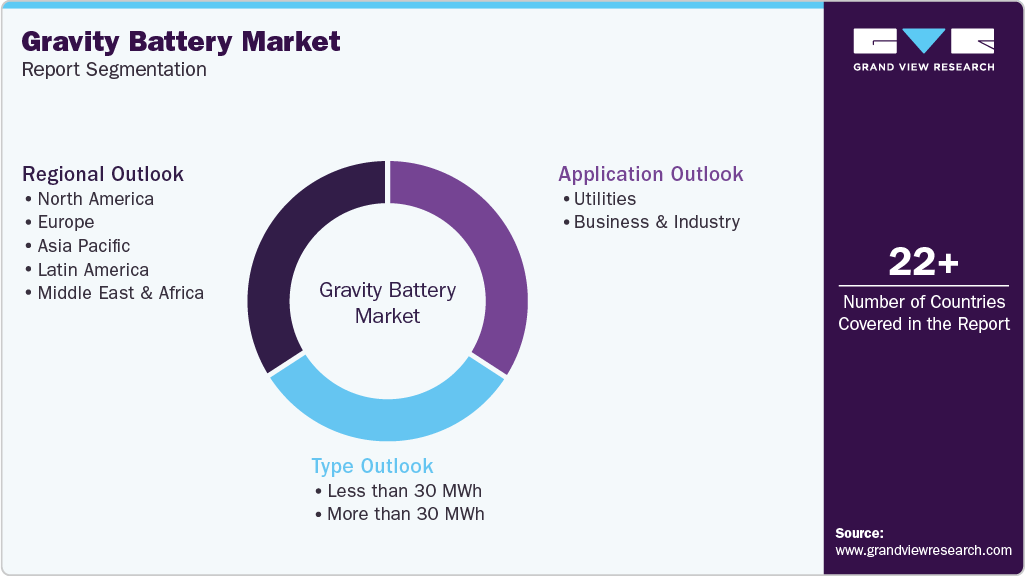
This report forecasts revenue growth at the global, regional, and country levels and provides an analysis of the latest industry trends in each of the sub-segments from 2021 to 2033. For this study, Grand View Research has segmented the global gravity battery market report based on type, application, and region:
 To learn more about this report, Download Free Sample Report
 -
Type Outlook (Revenue, USD Million, 2021 - 2033)
-
Less than 30 MWh
-
More than 30 MWh
-
-
Application Outlook (Revenue, USD Million, 2021 - 2033)
-
Utilities
-
Business & Industry
-
-
Regional Outlook (Revenue, USD Million, 2021 - 2033)
-
North America
-
U.S.
-
Canada
-
Mexico
-
-
Europe
-
Germany
-
UK
-
France
-
Italy
-
Spain
-
-
Asia Pacific
-
China
-
India
-
Japan
-
South Korea
-
Australia
-
-
Latin America
-
Brazil
-
Argentina
-
-
Middle East & Africa
-
Saudi Arabia
-
UAE
-
South Africa
-
-
Frequently Asked Questions About This Report
North America dominated with a 38.3% revenue share in 2025.
Asia Pacific is the fastest-growing region over the forecast period.
The utilities segment accounting for the largest revenue share of 88.4% in 2025, while business & industry is the fastest-growing application.
The global gravity battery market size was valued at USD 42.7 million in 2025 and is expected to reach USD 68.7 million in 2026.
The global gravity battery market is expected to grow at a compound annual growth rate of 61.5% from 2026 to 2033 to reach USD 1,965.4 million by 2033.
Gravity battery systems with capacities of more than 30 MWh held the largest revenue share of 57.7% in 2025 and is fastest-growing type.
Some of the key players operating in the global gravity battery market include Energy Vault, Gravitricity, Gravity Power, Advanced Rail Energy Storage (ARES), Heindl Energy, Green Gravity, RheEnergise, and Renewell Energy, among others.
The key factors driving the growth of the gravity battery market include increasing demand for long-duration, safe, and cost-effective energy storage solutions, rising integration of renewable energy sources, and growing focus on grid stability and decarbonization.
About the Author(s)
Energy & Power Research Team
Research · Energy & PowerThis report was authored by the energy & power research team at Grand View Research - comprising two research analysts, one senior research analyst, and one industry expert - with specialized expertise in the energy & power segment of the research industry. All findings are based on proprietary research databases, executive interviews, and regulatory analysis, subject to internal peer review prior to publication.
Last Updated:
Speak to Analyst

Customize this report to your needs - add regions, segments, or data points, with 20% free customization.
Or view our licence options:


ISO 9001:2015 & 27001:2022 Certified
We are GDPR and CCPA compliant! Your transaction & personal information is safe and secure. For more details, please read our privacy policy.


