
- Home
- »
- Distribution & Utilities
- »
-
Green Power Transformer Market Size Report, 2026-2033GVR Report cover

Green Power Transformer Market (2026 - 2033)
Size, Share & Trends Analysis Report By Voltage (Low Voltage, Medium Voltage, High Voltage), By Phase (Three Phase, Single Phase), By Application (Renewable Energy Integration, Energy Transmission & Distribution), By Region, And Segment Forecasts
Market Size, 2025
$1.3BMarket Estimate, 2026
$1.4BMarket Forecast, 2033
$2.2BCAGR, 2026–2033
7.1%Green Power Transformer Market Summary
The global green power transformer market size was valued at USD 1.3 billion in 2025 and is projected to grow from USD 1.4 billion in 2026 to USD 2.2 billion by 2033, at a CAGR of 7.1% from 2026 to 2033. The market in Asia Pacific dominated with a revenue share of 41.1% in 2025. The demand for green power transformers is likely to grow significantly in the coming years, driven by the modernization of power grids.
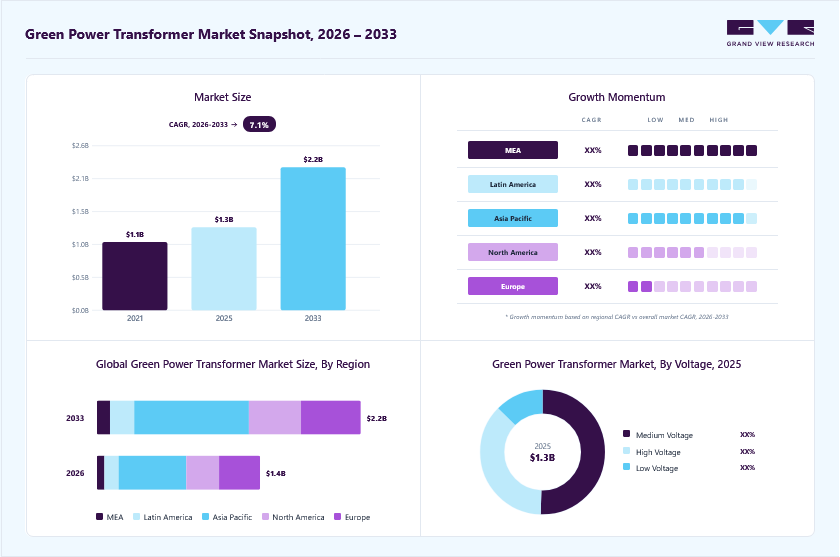 Source: Grand View Research, IR Documents, Primary Interviews, Paid DatabasesTo learn more about this report,
 Download Free Sample Report
Key Market Trends & Insights
- By phase: Three phase segment held the largest market share of 92.0% in 2025.
- By voltage: Medium voltage segment held the largest market share of 50.4% in 2025.
- By application: Renewable energy integration segment held the largest market share of 42.2% in 2025.
Regional Highlights
- Largest regional market: Asia Pacific (41.1% revenue share, 2025)
- By country: China held the largest market share in 2025
Market Size & Forecast
- Market size in 2025: USD 1.3 Billion
- Estimated market size in 2026: USD 1.4 Billion
- Projected market size by 2033: USD 2.2 Billion
- CAGR (2026-2033): 7.1%
Prism AI by Grand View Research Free to tryAsk a question about the green power transformer marketTry asking✓Every figure cited from GVR research Prefer the report? Download free sample →
The integration of renewable energy sources such as wind and solar, and the rising need for energy-efficient transmission and distribution infrastructure. Governments worldwide are introducing robust emission regulations and offering incentives for clean energy solutions, further boosting the need for sustainable and low-loss transformer technologies.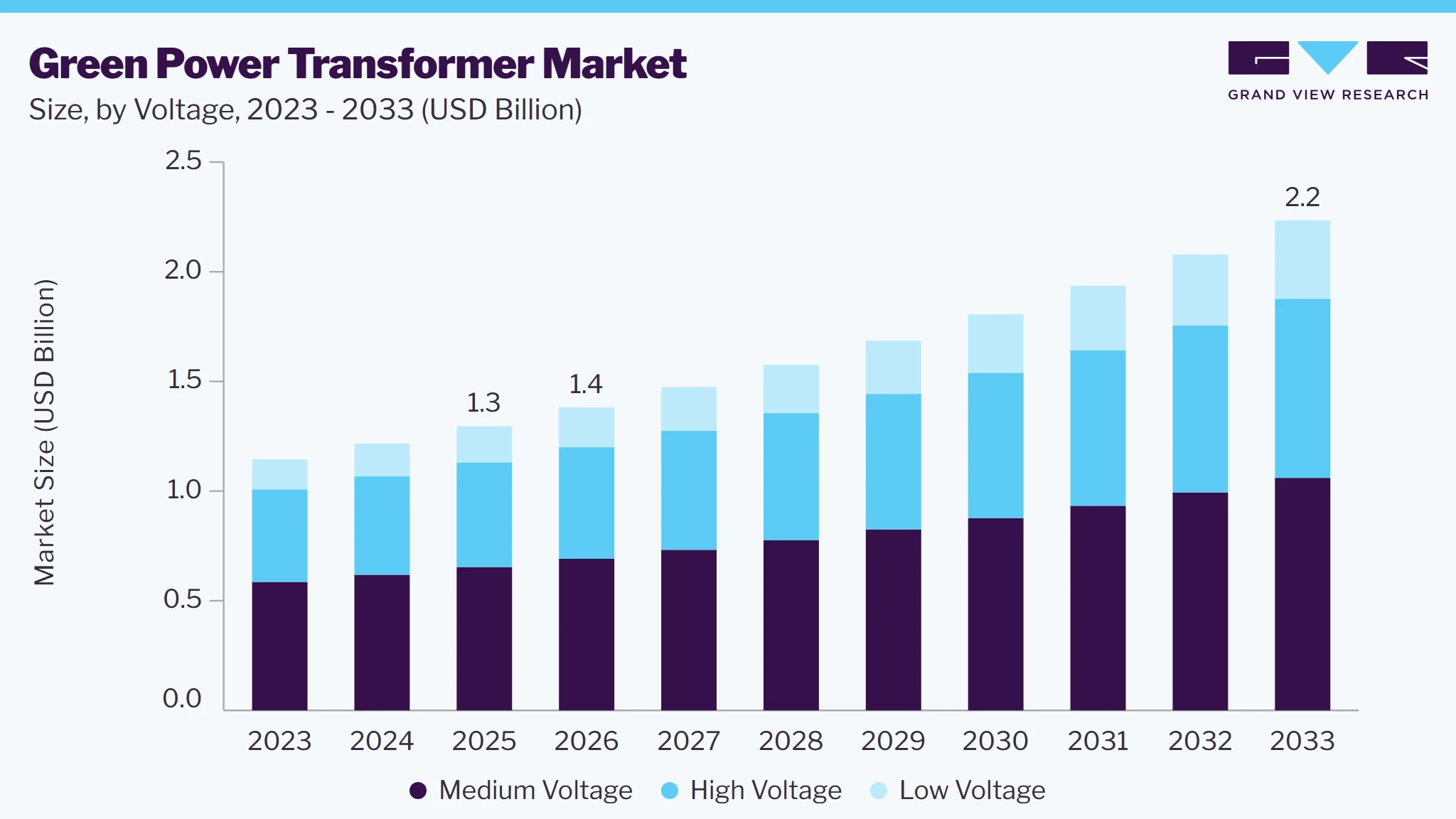 To learn more about this report, Download Free Sample Report
In addition, advancements in transformer materials and smart grid technologies improve energy efficiency and operational reliability, making green power transformers more viable for widespread deployment. This growth is expected to be particularly strong in regions like Asia Pacific, North America, and Europe, where grid modernization efforts and large-scale renewable energy projects are accelerating.
Market Dynamics
The green power transformer market is being shaped by the rapid expansion of renewable energy infrastructure and increasing investments in grid modernization. As utilities work to integrate larger volumes of solar and wind power into electricity networks, demand for energy-efficient transformers continues to rise. Advanced transformer technologies are helping improve grid reliability, reduce transmission losses, and support decarbonization goals. Government-backed clean energy initiatives and transmission network upgrades are creating favorable conditions for market growth. However, fluctuations in raw material prices and supply chain challenges remain key concerns for industry participants.
The rapid expansion of renewable energy projects is a major driver for the green power transformer market. As solar farms, wind parks, and decentralized microgrids are deployed at a larger scale, utilities require advanced transformers to connect renewable generation assets to transmission and distribution networks efficiently. Green power transformers help manage fluctuating power flows, improve grid stability, reduce energy losses, and support the integration of clean energy sources. The growing focus on decarbonization and grid modernization is further increasing demand for energy-efficient transformer solutions across both developed and emerging economies.
According to the International Energy Agency in its Renewables 2025 report, global renewable power capacity is projected to increase by nearly 4,600 GW between 2025 and 2030, with solar and wind accounting for the majority of new additions. This unprecedented expansion of renewable energy infrastructure is expected to significantly increase investments in grid connection equipment, substations, and power transformers required to transmit and distribute clean electricity efficiently across power networks.
The high upfront cost of green power transformers remains a significant challenge for market growth. Compared to conventional transformers, green power transformers utilize advanced insulation systems, energy-efficient designs, and environmentally friendly materials, resulting in higher manufacturing and installation costs. While these transformers offer long-term operational and sustainability benefits, the initial investment can be difficult to justify for utilities and industrial users operating under tight capital budgets. This challenge is particularly evident in developing regions, where cost considerations often take priority over lifecycle efficiency and environmental performance. According to the IEA's Electricity 2026 report, annual grid investment must increase by approximately 50% from the current USD 400 billion level by 2030, highlighting the funding pressures that can limit the adoption of higher-cost green power transformers in many markets.
The growing shift from conventional mineral oil-based transformers to transformers using biodegradable and non-toxic natural ester fluids is creating a significant opportunity in the green power transformer market. Utilities are increasingly seeking safer and more environmentally sustainable solutions that reduce fire risks, improve transformer performance, and minimize environmental damage in the event of leaks. Natural ester fluids are particularly attractive for installations in urban areas, renewable energy projects, water protection zones, and other environmentally sensitive locations. As aging transformer fleets require upgrades and replacements, the adoption of eco-friendly insulating fluids is expected to generate substantial retrofit and aftermarket demand. In May 2025, Hitachi Energy successfully tested the world's first 765 kV natural ester-filled transformer, highlighting the growing adoption of biodegradable insulating fluids to improve environmental safety and support sustainable grid modernization.
Analyst Perspective
Green power transformers are becoming increasingly important as power systems transition toward cleaner and more sustainable energy infrastructure. Their key advantage lies in improving energy efficiency, reducing transmission losses, and supporting the integration of renewable energy sources into the grid. Market demand is rising as utilities invest in grid modernization, renewable energy expansion, and the replacement of aging electrical infrastructure. Manufacturers are also introducing eco-friendly materials and advanced monitoring technologies to enhance transformer performance and sustainability. While higher upfront costs remain a challenge, green power transformers are expected to play a critical role in supporting the global energy transition and long-term grid reliability.
Drivers, Opportunities & Restraints
The global transition to renewable energy and the push for grid modernization are key market drivers. Governments and utilities are investing in sustainable infrastructure to meet net-zero targets, leading to the widespread integration of solar, wind, and other renewable energy sources. This shift requires efficient and environmentally friendly transformers to handle variable power loads while minimizing energy loss. Furthermore, urbanization and industrial electrification create new demand for low-emission, high-efficiency transformer systems.
Emerging opportunities lie in developing smart transformers integrated with digital monitoring systems and eco-friendly insulating materials such as ester fluids. These innovations enhance grid reliability, reduce maintenance costs, and align with environmental regulations. Expansion into underserved and developing regions with aging power infrastructure also offers significant growth potential for green transformer manufacturers.
However, the high initial cost of green power transformers compared to conventional models remains a notable restraint. This is compounded by limited awareness and adoption in cost-sensitive markets. Challenges in raw material procurement and the need for specialized manufacturing capabilities may also limit short-term scalability and affect producers' profit margins.
Voltage Insights
Based on voltage, the medium voltage segment led the market with the largest revenue share of 50.4% in 2025. Medium voltage transformers are the cornerstone of the market, driven primarily by their critical role in renewable energy integration and urban grid distribution. These transformers are widely used in solar and wind energy projects, enabling efficient, clean power transmission from generation sites to distribution networks. Supportive government policies focused on clean energy expansion, grid modernization, and reduced transmission losses continue to drive adoption across developed and emerging economies.
High voltage transformers also play a vital role, particularly in long-distance power transmission and large industrial applications, where efficiency and reliability are paramount. Their growing use in inter-regional grid connectivity strengthens their market position. Meanwhile, low-voltage transformers are gaining traction in residential and small commercial installations, especially as rooftop solar systems and smart home technologies become more prevalent. Together, these segments reflect a global shift toward energy-efficient infrastructure and sustainable power delivery.
Phase Insights
Based on phase, the three phase segment led the market with the largest revenue share of 92.0% in 2025. The three-phase green power transformer segment is the largest, supported by its wide use in utility-scale renewable energy projects, industrial operations, and commercial infrastructure. Its ability to handle higher loads with greater efficiency makes it the preferred choice for large-scale power transmission and distribution, particularly in wind and solar farms where stable and reliable energy flow is essential.
Meanwhile, the single-phase segment has emerged as the fastest-growing category. This trend is driven by increasing deployment in residential and small commercial renewable energy systems, where compact design and lower capacity needs align with the benefits of single-phase transformers. The rising popularity of rooftop solar installations, localized power solutions, and supportive government policies continues to bolster the segment’s rapid expansion.
Application Insights
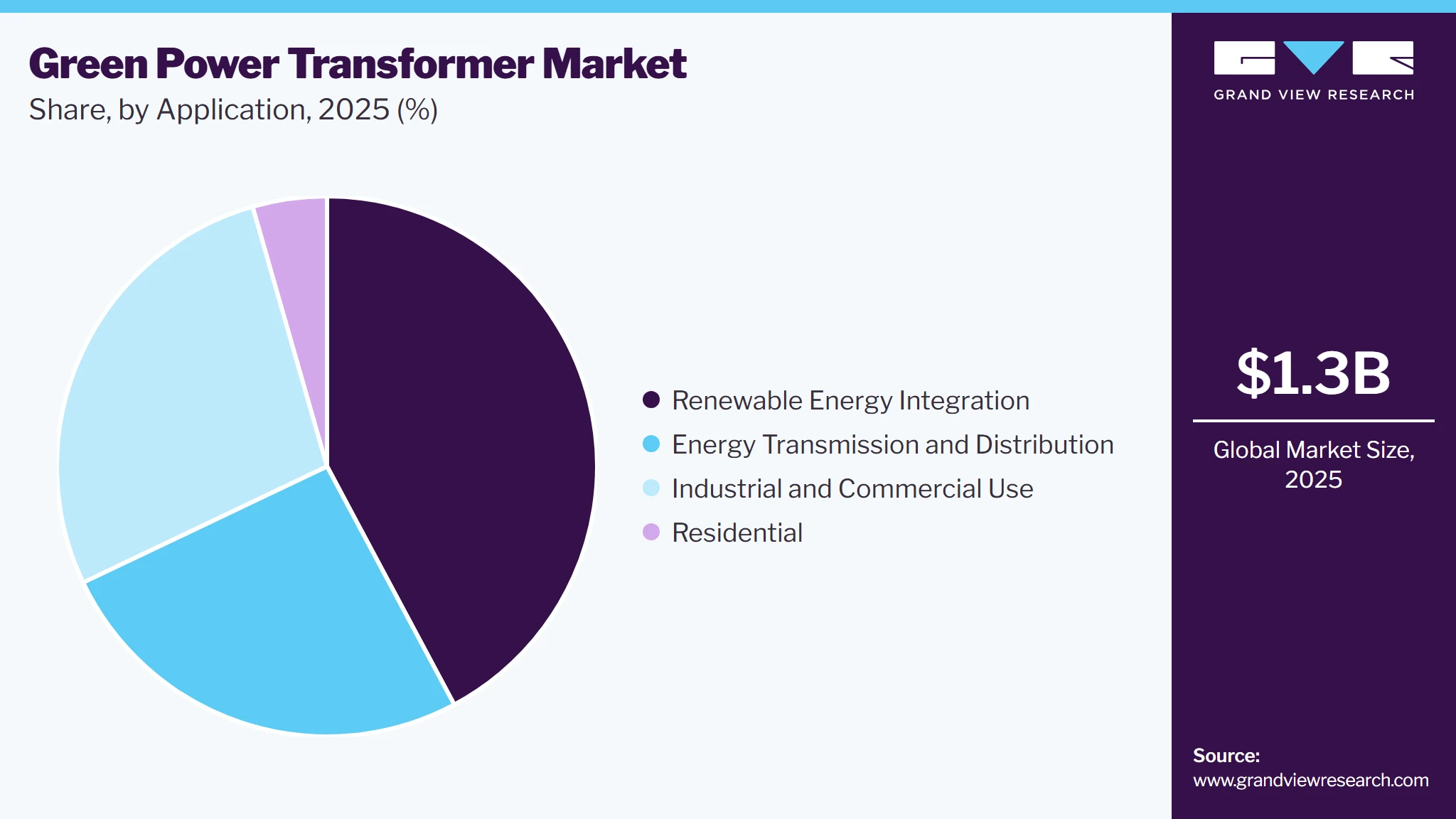
Based on application, the renewable energy integration segment led the market with the largest revenue share of 42.2% in 2025. The demand for green power transformers is driven by the accelerating integration of renewable energy sources such as solar and wind into national grids. As countries aim to reduce carbon emissions and increase reliance on clean energy, the need for efficient transformers that can handle variable loads and reduce energy loss has become critical. Green power transformers connect renewable generation to transmission infrastructure while maintaining grid stability and improving overall efficiency.
 To learn more about this report, Download Free Sample Report
In parallel, the energy transmission and distribution sector is witnessing steady growth as utilities upgrade aging infrastructure to meet modern performance standards. These transformers help reduce transmission losses and comply with increasingly strict environmental regulations. Demand is also rising across industrial and commercial sectors, where businesses seek to lower energy costs and meet sustainability targets. Adopting rooftop solar systems and smart energy networks in the residential segment creates new opportunities for compact and eco-friendly transformer solutions.
Regional Insights
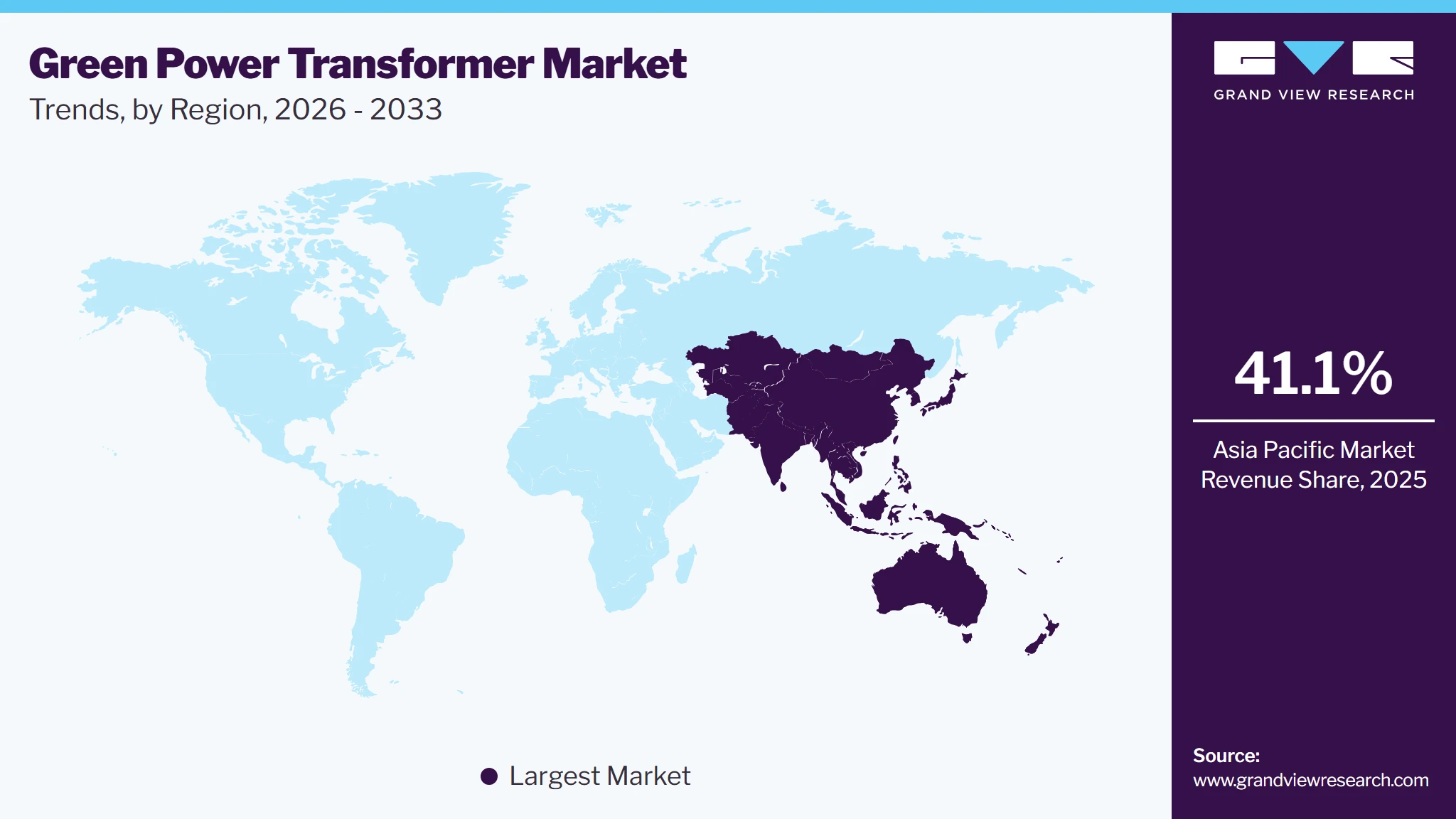
Asia Pacific dominated the green power transformer market with the largest revenue share of 41.1% in 2025. Large-scale investments in renewable energy infrastructure and ongoing grid modernization efforts in countries like China, India, and Japan primarily drive the Asia Pacific (APAC) market. Governments across the region are aggressively promoting clean energy through policy support, emission reduction targets, and incentives for energy-efficient technologies. As a result, demand for environmentally friendly, high-efficiency transformers is rising sharply. The region also benefits from a strong manufacturing base and the presence of leading transformer producers, positioning APAC as a key contributor to global market growth.
 To learn more about this report, Download Free Sample Report
China Green Power Transformer Market Trends
The green power transformer market in China held the largest share in the Asia Pacific region in 2025. China’s green power transformer market is being driven by rapid renewable energy deployment and ongoing grid modernization. Demand is increasing for high-efficiency transformers that reduce energy losses and support reliable power transmission. The expansion of solar and wind power projects is creating additional opportunities for advanced transformer technologies. Growing emphasis on energy conservation and low-carbon power infrastructure is further encouraging the adoption of environmentally friendly transformer solutions.
North America Green Power Transformer Market Trends
The green power transformer market in North America is expected to grow significantly over the forecast period. Large-scale grid modernization initiatives and the accelerating shift toward renewable energy sources such as wind and solar drive the North American green power transformer market. Government incentives, clean energy mandates, and rising environmental awareness push utilities and industries to adopt energy-efficient, low-emission transformer solutions. The region is also experiencing increased investment in smart grid infrastructure and interconnection upgrades, fueling the demand for green power transformers supporting reliable and sustainable electricity transmission.
Europe Green Power Transformer Market Trends
The green power transformer market in Europe is driven by the region’s aggressive decarbonization targets and strong policy support for clean energy infrastructure. The European Union’s Green Deal and Net-zero commitments are accelerating investments in renewable energy projects, particularly wind and solar, requiring efficient and eco-friendly power transmission systems. Moreover, Enhanced efficiency regulations and grid reliability standards push utilities to replace conventional transformers with low-loss, sustainable alternatives. The presence of key transformer manufacturers and a growing emphasis on energy efficiency across industrial and commercial sectors further strengthens the region’s market growth.
Latin America Green Power Transformer Market Trends
The green power transformer market in Latin America is driven by the region’s growing investment in renewable energy projects, particularly solar and wind, which require efficient and reliable transmission infrastructure. As countries aim to expand clean energy capacity and reduce grid losses, demand for low-loss, environmentally friendly transformers is rising. Government initiatives supporting energy transition and efforts to modernize outdated grid systems are further propelling the adoption of green power transformers across the region.
Middle East & Africa Green Power Transformer Market Trends
The green power transformer market in the Middle East and Africa (MEA) is driven by the region’s growing focus on diversifying energy sources through large-scale solar and wind projects. As countries seek to reduce reliance on fossil fuels and improve energy security, investments in clean energy infrastructure are accelerating. Green power transformers are increasingly deployed to support efficient power transmission and grid stability across these renewable installations. Government-backed initiatives to modernize aging grid systems and enhance energy efficiency also create strong demand for sustainable transformer technologies throughout the region.
Key Green Power Transformer Insights
Some key players operating in the market include Siemens Energy, Schneider Electric, ABB Ltd, and General Electric. These companies actively invest in research and development, enhance manufacturing capabilities, and enter strategic collaborations to meet rising demand and comply with evolving energy efficiency standards.
Key Green Power Transformer Companies:
The following are the leading companies in the green power transformer market.
- Siemens Energy
- Schneider Electric
- ABB Ltd
- General Electric
- Eaton Corporation
- Mitsubishi Electric Corporation
- Hitachi Energy
- Wilson Transformer Company
- Crompton Greaves (CG Power and Industrial Solutions)
- SPX Transformer Solutions, Inc.
Competitive Benchmarking
Category
Operating Strategies
Competitive Edge
Weakness
Established Players (Siemens Energy, Schneider Electric, ABB Ltd, General Electric, Eaton Corporation, Mitsubishi Electric Corporation, Hitachi Energy, CG Power and Industrial Solutions)
- Focus on developing energy-efficient transformers with low-loss core technologies and eco-friendly insulating materials.
- Strengthen participation in renewable energy integration, grid modernization, and transmission infrastructure projects.
- Expand digital monitoring, predictive maintenance, and smart transformer capabilities to enhance asset performance.
- Strong global presence and long-standing relationships with utilities, industries, and grid operators.
- Extensive R&D capabilities and broad product portfolios across voltage classes and applications.
- Large manufacturing capacity and financial strength support execution of large-scale infrastructure projects.
- Higher operating and manufacturing costs compared to smaller competitors.
- Exposure to raw material price fluctuations and supply chain disruptions.
- Large organizational structures can result in slower decision-making and reduced flexibility.
Specialized Players (Wilson Transformer Company, SPX Transformer Solutions, Inc.)
- Focus on customized transformer solutions tailored to utility, industrial, and renewable energy requirements.
- Strengthen regional market presence through specialized engineering expertise and customer support.
- Emphasize operational flexibility and faster delivery for project-specific applications.
- Strong expertise in selected transformer segments and regional markets.
- Greater agility in responding to customer requirements and market changes.
- Ability to offer specialized solutions for niche applications and local grid needs.
- Limited geographic reach and smaller customer base compared to global manufacturers.
- Lower financial and R&D resources may constrain technology development.
- Dependence on regional projects can increase exposure to local market fluctuations.
Recent Developments
- In February 2025, Siemens Energy announced the opening of a new power transformer manufacturing facility in Charlotte, North Carolina. The facility will focus on producing eco-friendly, low-loss transformers designed to support renewable energy integration and grid modernization across the U.S. This expansion is expected to help utilities and industries meet growing clean energy demands while creating over 500 new jobs in the region.
Green Power Transformer Report Scope
Report Attribute
Details
Market Definition
The Global Green Power Transformer market represents revenue generated from the sale of energy-efficient and environmentally sustainable transformers used to support renewable energy integration, grid modernization, and low-carbon power transmission and distribution.
Market size in 2025
USD 1.3 billion
Estimated market size in 2026
USD 1.4 billion
Projected market size by 2033
USD 2.2 billion
Growth rate
CAGR of 7.1% from 2026 to 2033
Base year for estimation
2025
Historical data
2021 - 2024
Forecast period
2026 - 2033
Quantitative units
Revenue in USD Million and CAGR from 2026 to 2033
Report coverage
Revenue forecast, company ranking, competitive landscape, growth factors, and trends
Segments covered
Voltage, Application, Phase, Region
Regional scope
North America; Europe; Asia Pacific; Latin America; Middle East & Africa
Country scope
U.S.; Canada; Mexico; Germany; UK; France; China; India; Japan; South Korea; Brazil; Saudi Arabia; UAE
Key companies profiled
Siemens Energy; Schneider Electric; ABB Ltd; General Electric; Eaton Corporation; Mitsubishi Electric Corporation; Hitachi Energy; Wilson Transformer Company; Crompton Greaves (CG Power and Industrial Solutions); SPX Transformer Solutions, Inc.
Customization scope
Free report customization (equivalent up to 8 analysts' working days) with purchase. Addition or alteration to country, regional & segment scope.
Pricing and purchase options
Avail customized purchase options to meet your exact research needs. Explore purchase options
Global Green Power Transformer Market Report Segmentation
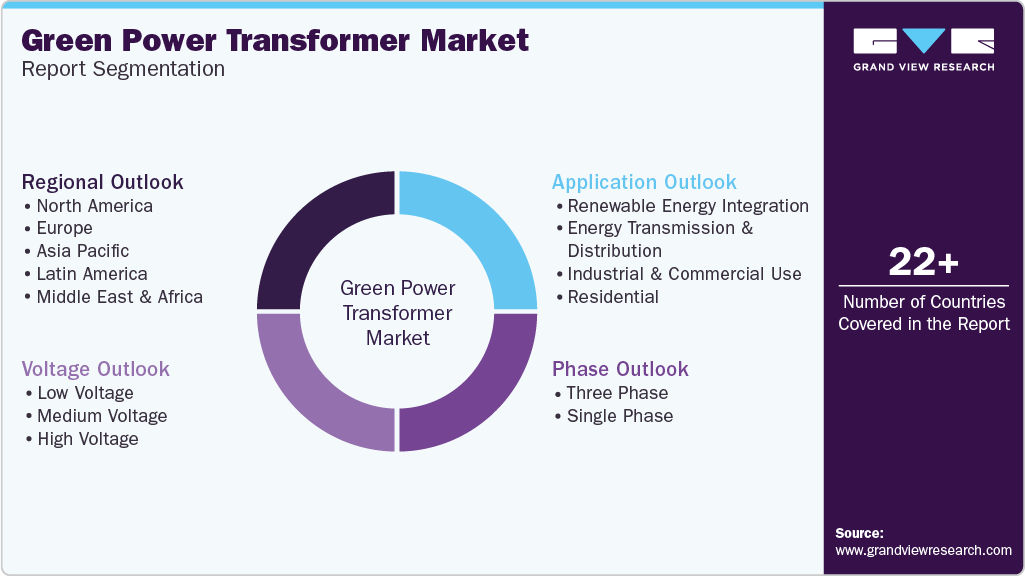
This report forecasts revenue growth at the global, regional, and country levels and provides an analysis of the latest industry trends in each of the sub-segments from 2021 to 2033. For this study, Grand View Research has segmented the global green power transformer market report based on voltage, application, phase, and region:
 To learn more about this report, Download Free Sample Report
-
Voltage Outlook (Revenue, USD Million, 2021 - 2033)
-
Low Voltage
-
Medium Voltage
-
High Voltage
-
-
Application Outlook (Revenue, USD Million, 2021 - 2033)
-
Renewable Energy Integration
-
Energy Transmission & Distribution
-
Industrial & Commercial Use
-
Residential
-
-
Phase Outlook (Revenue, USD Million, 2021 - 2033)
-
Three Phase
-
Single Phase
-
-
Regional Outlook (Revenue, USD Million, 2021 - 2033)
-
North America
-
U.S.
-
Canada
-
Mexico
-
-
Europe
-
Germany
-
UK
-
Spain
-
France
-
Italy
-
-
Asia Pacific
-
China
-
India
-
Japan
-
South Korea
-
-
Latin America
-
Brazil
-
Argentina
-
-
Middle East & Africa
-
Saudi Arabia
-
UAE
-
-
Research Methodology
The green power transformer market figures in this report are based on a proven research process that combines executive interviews with secondary research from proprietary databases, company filings, and recognized regulatory and institutional sources. Market size is built through value-chain sizing - reconciling supply-side and demand-side estimates - and triangulated with bottom-up and top-down approaches. Every estimate passes multiple levels of expert validation before publication, with each green power transformer segment quantified using the revenue-capture definitions in the table below.
Segment Definition
Segment - Voltage
Revenue capture definition
Low Voltage
Low voltage green power transformers are used in distributed renewable energy systems, commercial buildings, residential installations, and small-scale industrial facilities to efficiently transfer electricity generated from renewable sources. Revenue is generated through the sale of transformers, installation services, replacement demand, monitoring solutions, and maintenance activities supporting low-voltage renewable power networks.
Medium Voltage
Medium voltage green power transformers are deployed across renewable energy plants, industrial facilities, microgrids, and utility distribution networks to enable efficient power transmission and distribution with reduced environmental impact. Market revenue includes transformer sales, engineering services, grid integration projects, modernization programs, and ongoing maintenance contracts associated with medium-voltage power infrastructure.
High Voltage
High voltage green power transformers are utilized in large-scale renewable energy projects, transmission networks, substations, and grid interconnection systems to support long-distance electricity transfer. Revenue is derived from transformer manufacturing, substation installations, grid expansion projects, renewable energy integration programs, refurbishment activities, and related technical services.
Segment - Application
Revenue capture definition
Renewable Energy Integration
Green power transformers are widely used in solar farms, wind power projects, hydropower facilities, and other renewable energy installations to efficiently connect clean energy generation assets to the electrical grid. Revenue capture includes transformer sales, project-based deployments, grid connection infrastructure, installation services, and maintenance activities supporting renewable energy integration.
Energy Transmission and Distribution
This segment includes the deployment of green power transformers across transmission and distribution networks to improve energy efficiency, reduce environmental impact, and support grid modernization initiatives. Revenue is generated through equipment procurement, utility infrastructure upgrades, substation projects, replacement demand, and related engineering and service activities.
Industrial and Commercial Use
Industrial and commercial facilities utilize green power transformers to enhance energy efficiency, support sustainability goals, and integrate renewable power sources into operations. Revenue is attributed to transformer sales, facility electrification projects, energy management programs, retrofitting activities, and ongoing operational support services.
Residential
Residential applications involve the use of green power transformers within local distribution systems and renewable energy-enabled housing developments to ensure reliable and efficient electricity delivery. Revenue includes transformer installations, residential grid upgrades, renewable energy connectivity projects, and associated maintenance and replacement services.
Segment - Phase
Revenue capture definition
Three Phase
Three-phase green power transformers are extensively used in utility networks, renewable energy plants, industrial facilities, and commercial infrastructure where higher power capacity and operational efficiency are required. Market revenue is generated through transformer sales, large-scale project deployments, grid expansion initiatives, installation services, and long-term maintenance contracts.
Single Phase
Single-phase green power transformers are primarily deployed in residential areas, small commercial establishments, and localized renewable energy systems requiring lower power loads. Revenue is derived from equipment sales, distribution network installations, replacement demand, service agreements, and integration with decentralized energy systems.
Estimation Model
Layer Name
Key Question
Description
Electricity Infrastructure Demand Base Layer
What forms the demand base?
Identify demand for power transformers across renewable energy projects, transmission networks, distribution systems, industrial facilities, commercial infrastructure, and residential electricity networks. Assess electricity consumption trends, grid expansion plans, electrification initiatives, and renewable energy investments to establish the addressable market for green power transformers.
Grid Modernization & Sustainable Transformer Infrastructure Layer
Where are green power transformers deployed?
Evaluate deployment across transmission and distribution networks, substations, renewable energy installations, smart grid projects, and grid modernization programs. Assess adoption of energy-efficient transformer technologies, biodegradable insulating fluids, and low-loss transformer designs to determine installation potential.
Application & Voltage Adoption Layer
How extensively are green power transformers adopted across applications?
Analyze utilization across renewable energy integration, energy transmission and distribution, industrial and commercial facilities, and residential networks. Assess adoption trends across low-, medium-, and high-voltage systems, along with single-phase and three-phase installations, to understand market penetration.
Revenue Layer
How is market revenue generated?
Market revenue is quantified through the sale of green power transformers across major applications and voltage categories. Transformer deployment volumes, project investments, technology specifications, and average selling prices collectively determine the overall market value.
Delivered Customizations
This report has been delivered with the following In-depth customizations
Client Request
Customization Delivered
Value Adds
Growth Opportunity Assessment
Identification of growth opportunities across renewable energy integration, grid modernization projects, smart grid deployment, industrial electrification, and replacement of aging transformer infrastructure. Included assessment of regional investment trends, policy support, and emerging demand centers.
Enabled identification of high-growth markets, supported expansion planning, and highlighted future revenue opportunities across the green power transformer value chain.
Competitive Landscape Assessment
Detailed analysis of transformer manufacturers based on product portfolio, geographic presence, manufacturing capabilities, technology offerings, renewable energy project participation, strategic initiatives, and sustainability-focused innovations.
Supported evaluation of competitive positioning, technology leadership, partnership opportunities, and market expansion strategies.
Country-Level Market Assessment
Comprehensive assessment of green power transformer demand across individual countries, covering grid modernization initiatives, renewable energy investments, transmission and distribution infrastructure development, regulatory frameworks, and competitive dynamics.
Enabled deeper market visibility, supported country-specific growth strategies, and identified high-potential markets for investment and business expansion.
Frequently Asked Questions About This Report
The Asia Pacific region dominated the green power transformer market with a revenue share of 41.1% in 2025.
Some of the key players operating in the green power transformer market are Siemens Energy; Schneider Electric; ABB Ltd; General Electric; Eaton Corporation; Mitsubishi Electric Corporation; Hitachi Energy; Wilson Transformer Company; Crompton Greaves (CG Power and Industrial Solutions); SPX Transformer Solutions, Inc.; and others.
The green power transformer market is driven by expanding renewable energy installations, increasing grid modernization investments, and growing demand for energy-efficient power transmission and distribution infrastructure.
China dominated the Asia Pacific region market with a revenue share of 49.9% in 2025.
Latin America is anticipated to register the second-fastest CAGR of 7.9% over the forecast period.
Based on voltage, the medium voltage segment accounted for largest revenue share of 50.4% in 2025.
Based on application, the renewable energy integration segment accounted for largest revenue share of 42.2% in 2025.
The three phase segment led with a 92.0% revenue share in 2025.
The global green power transformer market size was valued at USD 1.3 billion in 2025 and is estimated at USD 1.4 billion for 2026.
The global green power transformer market is expected to grow at a CAGR of 7.1% from 2026 to 2033, reaching USD 2.2 billion by 2033.
About the Author(s)
Distribution & Utilities Research Team
Energy & Power · Distribution & UtilitiesThis report was authored by the distribution & utilities research team at Grand View Research - comprising two research analysts, one senior research analyst, and one industry expert - with specialized expertise in the distribution & utilities segment of the energy & power industry. All findings are based on proprietary energy & power databases, executive interviews, and regulatory analysis, subject to internal peer review prior to publication.
Last Updated:
Speak to Analyst

Customize this report to your needs - add regions, segments, or data points, with 20% free customization.
Or view our licence options:


ISO 9001:2015 & 27001:2022 Certified
We are GDPR and CCPA compliant! Your transaction & personal information is safe and secure. For more details, please read our privacy policy.


