
- Home
- »
- Next Generation Technologies
- »
-
Greenhouse Irrigation System Market Report, 2026-2033GVR Report cover

Greenhouse Irrigation System Market (2026 - 2033)
Size, Share & Trends Analysis Report By Component (Controllers, Valves, Sensors, Pumps, Pipes & Tubing), By Type (Sprinkler, Micro, Boom, Drip, Capillary), By Application, By Crop Type, By End Use, By Region, And Segment Forecasts
Market Size, 2025
$2.4BMarket Estimate, 2026
$2.6BMarket Forecast, 2033
$5.2BCAGR, 2026–2033
10.2%Greenhouse Irrigation System Market Summary
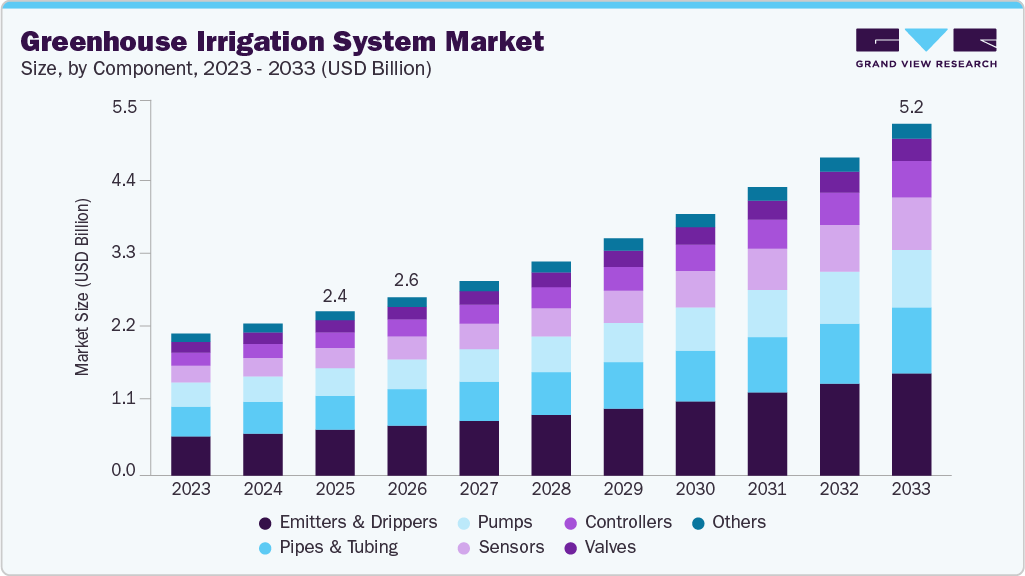
The global greenhouse irrigation system market size was valued at USD 2.4 billion in 2025 and is projected to grow from USD 2.6 billion in 2026 to USD 5.2 billion by 2033, at a CAGR of 10.2% from 2026 to 2033. Europe dominated the global market, accounting for the largest revenue share of 31.4% in 2025. Rising adoption of protected cultivation and controlled environment agriculture is driving the market.
 Source: Grand View Research, IR Documents, Primary Interviews, Paid DatabasesTo learn more about this report,
 Download Free Sample Report
 Key Market Trends & Insights
- By component: Emitters & dippers held the largest revenue share of 27.8% in 2025.
- By type: Drip irrigation segment held the largest revenue share in 2025.
- By application: Soil-based irrigation held the largest revenue share in 2025.
Regional Highlights
- Largest regional market: Europe (31.4% revenue share, 2025)
- Fastest-growing regional market: Asia Pacific (highest CAGR, 2026-2033)
- By country: The U.K. held the largest market share in 2025.
Market Size & Forecast
- Market size in 2025: USD 2.4 Billion
- Estimated market size in 2026: USD 2.6 Billion
- Projected market size by 2033: USD 5.2 Billion
- CAGR (2026-2033): 10.2%
Three ways to get this report
Buy it, customize it, or ask a question.Ask an Analyst
Analyst response in 1 business day
- AccessReport author, directly
- Reply timeWithin 1 working day
- No sales callDirect answer only
- FormatEmail reply
- CostFree, no cost
Get the Full Report
What the study covers
- FormatsPDF · Excel · Dashboard
- Timeline2026–2033 annual, 2025 base
- Coverage20+ countries, 5 regions
- Companies10+ key players profiled
Customize the Report
20% free customization
- IncludeCountries, segments, points
- TailorTo your product definition
- ExtendDeeper competitor detail
- OrA fully bespoke study
- Turnaround5–10 working days
The increasing global demand for high-yield and high-quality agricultural production is driving market growth. As populations continue to grow and urbanization reduces the availability of arable land, greenhouse farming provides a controlled environment to maximize output per square meter. Efficient irrigation systems are essential in these settings because water delivery must be precisely managed to optimize plant growth and nutrient absorption. Advanced drip and micro-irrigation systems help maintain consistent soil moisture levels, reducing plant stress and improving crop uniformity. Growers rely on automated irrigation technologies to achieve predictable yields and minimize resource waste. As food security concerns intensify worldwide, investment in greenhouse infrastructure and associated irrigation systems continues to expand.
 To learn more about this report, Download Free Sample Report
 The expansion of commercial horticulture and high-value crop cultivation represents another major driver. Crops such as tomatoes, peppers, cucumbers, herbs, and ornamental plants require precise irrigation management to maintain quality standards. Greenhouses enable year-round production of these crops, but consistent irrigation control is critical for maintaining plant health and maximizing profitability. Export-oriented growers depend on uniform crop quality to meet international market requirements. Efficient irrigation systems reduce the risk of overwatering, nutrient imbalance, and disease outbreaks. As global trade in fresh produce and ornamental plants increases, demand for advanced greenhouse irrigation solutions grows correspondingly.
Urban agriculture and vertical farming trends also contribute to market expansion. Rapid urbanization has encouraged the development of greenhouse facilities in peri-urban and urban areas to reduce transportation costs and improve food freshness. These compact farming environments require highly efficient irrigation technologies due to space constraints and controlled production cycles. Hydroponic and soilless cultivation systems, which are often integrated into greenhouse structures, depend entirely on precise water and nutrient delivery mechanisms. Automated irrigation ensures optimal performance in high-density production settings. As cities seek resilient local food systems, greenhouse irrigation technologies play a central role in enabling sustainable urban farming.
Climate variability and unpredictable weather patterns also strengthen the demand for controlled-environment agriculture and associated irrigation systems. Extreme temperatures, droughts, and irregular rainfall increasingly disrupt open-field farming. Greenhouses provide protection against these uncertainties, but effective irrigation remains essential for maintaining optimal growing conditions. Automated systems help growers respond quickly to fluctuations in temperature and humidity. By ensuring a consistent water supply regardless of external conditions, irrigation technologies enhance crop resilience. As climate risks intensify globally, greenhouse-based agriculture becomes more attractive, driving parallel growth in demand for irrigation systems.
Market Dynamics
Increasing water scarcity and the growing need for efficient water management are driving the greenhouse irrigation system market. Agriculture accounts for a substantial share of global freshwater consumption, and many regions are facing declining groundwater levels, irregular rainfall, and stricter water-use regulations. As a result, greenhouse operators are under increasing pressure to adopt irrigation systems that minimize water wastage while maintaining optimal crop growth. Advanced greenhouse irrigation technologies, including drip irrigation, micro-sprinklers, and automated fertigation systems, enable the precise delivery of water and nutrients directly to the plant root zone, significantly minimizing evaporation losses, runoff, and overwatering. This enables growers to achieve higher water-use efficiency and sustain production even in water-stressed regions.
This trend directly supports the growth of the greenhouse irrigation system market by increasing demand for irrigation infrastructure that can monitor and control water application in real time. Growers are investing in sensor-based controllers, soil moisture monitoring systems, and climate-integrated irrigation solutions to optimize every drop of water used inside the greenhouse. These systems not only lower water consumption and operating costs but also improve crop yield, quality, and nutrient uptake. As governments and agricultural organizations continue to promote sustainable water management practices and provide incentives for adopting efficient irrigation technologies, the need for greenhouse irrigation systems is expanding rapidly across commercial horticulture, vegetable production, and high-value crop cultivation.
The lack of technical knowledge and a skilled workforce is a significant restraint in the greenhouse irrigation system market, particularly in developing agricultural regions. Modern greenhouse irrigation systems incorporate advanced components, including automated controllers, fertigation units, soil moisture sensors, climate-based monitoring systems, and cloud-connected software platforms. Operating these systems effectively requires an understanding of irrigation scheduling, nutrient dosing, sensor calibration, and troubleshooting. Many growers, especially small- and medium-sized operators, may lack the technical expertise to configure and manage these technologies, raising concerns about misuse, reduced efficiency, and crop damage.
This challenge limits market growth by slowing the adoption of advanced irrigation solutions and increasing dependence on external technical support. Growers who lack trained personnel may continue to rely on manual or semi-automated irrigation methods rather than investing in sophisticated systems that appear complex to operate. In addition, shortages of qualified technicians for installation, maintenance, and after-sales service can reduce customer confidence and delay implementation. As a result, despite the long-term benefits of automated greenhouse irrigation, inadequate technical capabilities and workforce limitations remain significant barriers to broader market penetration.
The expansion of smart irrigation and IoT-enabled systems presents a major growth opportunity for the greenhouse irrigation system market. Greenhouse operators are increasingly seeking technologies that can automate irrigation decisions using real-time data from soil moisture sensors, EC and pH monitors, weather stations, and climate control systems. These connected solutions enable precise water and nutrient delivery based on crop requirements, reducing water consumption, labor costs, and human error while improving yield and crop quality. As commercial growers adopt digital agriculture and remote farm management, demand is rising for integrated irrigation platforms that combine sensors, controllers, analytics, and cloud-based monitoring, creating significant opportunities for manufacturers to offer higher-value, technology-driven solutions.
For instance, in September 2024, Netafim, the precision agriculture business of Orbia, announced the successful deployment of GrowSphere, an all-in-one irrigation operating system that integrates connected devices, automation, agronomic insights, and cloud-based analytics into a single platform. The solution enables growers to monitor and optimize irrigation and fertigation in real time, improving water-use efficiency, crop performance, and operational control. This development highlights how major irrigation technology providers are expanding their smart, IoT-enabled product portfolios to meet the growing demand for advanced digital irrigation solutions in greenhouse and controlled environment agriculture applications.
Market Concentration & Characteristics
The greenhouse irrigation system market shows a moderately fragmented competitive landscape, with several multinational irrigation technology companies alongside a broad base of regional and niche suppliers. Leading participants compete through integrated offerings that include drip irrigation, fertigation, climate-linked irrigation controls, and water monitoring systems. However, greenhouse designs, crop requirements, and local water conditions vary significantly across regions, creating strong demand for customized solutions and enabling smaller companies to maintain a competitive presence. As a result, no single company commands a dominant market share, and competition remains dispersed across multiple vendors.
 To learn more about this report, Download Free Sample Report
 The degree of innovation in the greenhouse irrigation system market is rated medium to high, driven by increasing adoption of precision agriculture and water-efficient cultivation technologies. Manufacturers are introducing sensor-based irrigation controllers, automated fertigation units, IoT-enabled monitoring systems, and AI-supported decision tools that optimize water and nutrient delivery based on crop growth conditions. Continuous advancements in smart valves, dosing systems, and cloud-connected analytics are helping growers improve productivity while reducing water and fertilizer consumption. This steady pace of technological development is enhancing system performance and supporting the market’s accelerating growth trajectory.
Component Insights
The emitters & drippers segment dominated the market with a share of 27.8% in 2025. The integration of hardware with Internet of Things (IoT) and cloud technologies is propelling the hardware market segment. Retailers are deploying connected display systems that can communicate with sensors, cameras, and management platforms to deliver personalized and adaptive content. For instance, IoT-enabled hardware can adjust display brightness based on ambient light conditions or change advertisements depending on audience demographics captured by in-store cameras. Cloud-based connectivity allows centralized control and synchronization of multiple displays across different store locations, ensuring consistent branding and real-time campaign updates. The convergence of hardware and connectivity solutions enhances operational efficiency, scalability, and the ability to execute targeted advertising at scale.
The sensors segment is projected to grow significantly during the forecast period. The rising adoption of fertigation practices is a major driver supporting this segment. Fertigation involves delivering nutrients directly through irrigation systems, and emitters play a critical role in ensuring uniform nutrient distribution. Precise dosing prevents nutrient imbalance and reduces fertilizer waste. Drippers enable consistent mixing and controlled application rates that align with plant growth cycles. This approach improves nutrient absorption efficiency and enhances overall crop health. As greenhouse growers increasingly integrate fertigation into their production strategies, demand for high-performance emitters continues to grow.
Type Insights
The drip irrigation systems segment dominated the market in 2025. The expansion of commercial greenhouse farming and high-value crop production accelerates market growth. Crops such as tomatoes, cucumbers, peppers, berries, herbs, and ornamental plants demand consistent moisture levels for optimal productivity. Even minor inconsistencies in watering can lead to yield variability or reduced quality grades. Drip irrigation ensures each plant receives a controlled quantity of water and nutrients, maintaining crop uniformity across large cultivation areas. Commercial greenhouse operators prioritize reliability and scalability, which drip systems effectively provide. As global demand for fresh produce and specialty crops rises, investment in drip irrigation infrastructure continues to increase.
The micro irrigation systems segment is projected to be the fastest-growing segment from 2026 to 2033. The expansion of high-value horticultural crops within greenhouse facilities also strongly stimulates segment growth. Crops such as berries, leafy greens, herbs, flowers, and specialty vegetables require delicate and consistent moisture management. Micro irrigation systems offer flexible configurations that can be adapted to diverse plant spacing and root structures. This adaptability is especially important in greenhouse environments where multiple crop varieties may be cultivated simultaneously. Consistent micro-level watering improves nutrient uptake efficiency and reduces plant stress. As global demand for premium-quality produce and ornamental plants rises, micro irrigation systems become essential for meeting strict quality standards.
Application Insights
The soil-based irrigation segment dominated the market in 2025. The gradual modernization of traditional greenhouse operations drives ongoing upgrades in soil irrigation infrastructure. Many existing greenhouse facilities are transitioning from manual watering methods to automated drip and micro-irrigation systems designed specifically for soil applications. These upgrades enhance operational efficiency and improve yield predictability. Investors and agribusiness stakeholders increasingly recognize the value of structured irrigation systems in boosting long-term profitability. Standardized soil irrigation frameworks also support expansion into larger greenhouse complexes. As the market continues to evolve, the soil-based irrigation segment remains a stable and strategically significant contributor to overall growth.
The aeroponic irrigation segment is projected to grow at a significant CAGR from 2026 to 2033. The expansion of urban agriculture and vertical greenhouse farming strongly supports the growth of aeroponic irrigation. Urban greenhouse facilities often face severe space constraints and prioritize highly efficient growing systems. Aeroponic setups allow dense vertical stacking of crops, optimizing space utilization without compromising plant health. The lightweight nature of aeroponic systems makes them particularly suitable for rooftop or multi-level greenhouse installations. Efficient irrigation delivery reduces structural load compared to soil-based systems. As cities increasingly invest in local food production to enhance food security, aeroponic irrigation becomes an attractive solution within greenhouse infrastructure.
Crop Type Insights
The fruits & vegetables segment dominated the market in 2025. The expansion of organized retail and global supply chains supports growth in this segment. Supermarkets and export markets demand standardized produce with consistent size, color, and shelf life. Greenhouse irrigation systems provide the precision required to achieve uniform crop development across large cultivation areas. Proper irrigation scheduling enhances fruit firmness, sugar content, and overall marketability. Reliable irrigation also reduces the incidence of physiological disorders caused by inconsistent watering. As international trade in fresh produce intensifies, growers increasingly adopt advanced irrigation systems to meet strict quality benchmarks.
The herbs & medicinal plants segment is projected to be the fastest-growing segment from 2026 to 2033. The rapidly growing global demand for plant-based healthcare products and natural remedies is driving segment expansion. Consumers are increasingly turning toward herbal supplements, functional foods, and botanical extracts as part of preventive healthcare practices. This shift is fueled by rising awareness of holistic wellness and concerns over synthetic pharmaceutical side effects. Greenhouse cultivation allows controlled production of medicinal plants with consistent quality and potency. Precise irrigation systems are essential for maintaining optimal moisture levels, which directly influence the concentration of active phytochemicals. As demand for standardized, high-quality herbal raw materials increases, greenhouse irrigation systems become indispensable for maintaining consistent crop performance.
End Use Insights
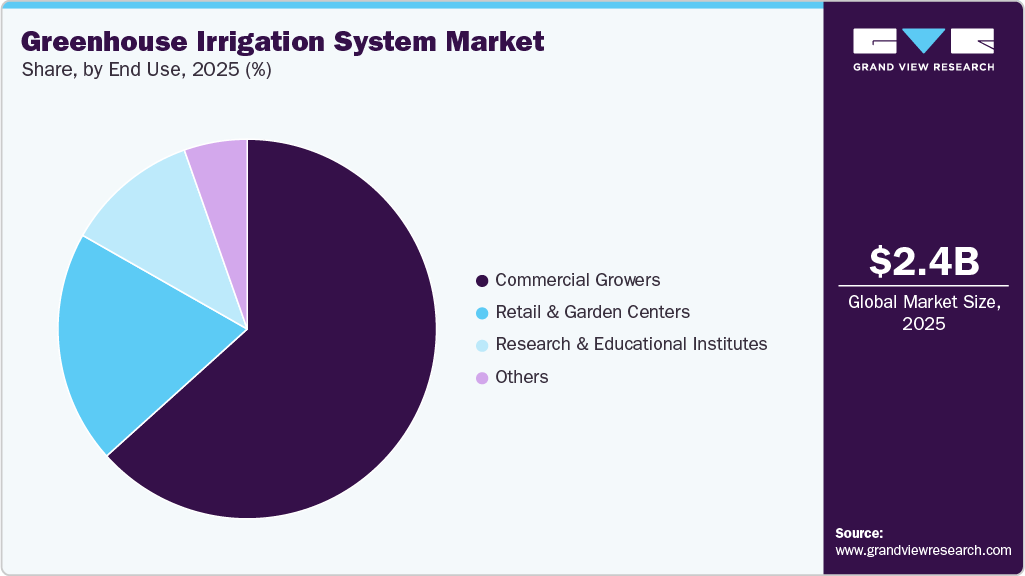
The commercial growers segment dominated the market in 2025. The expansion of export-oriented greenhouse production is another important driver. Commercial growers targeting international markets must comply with strict quality, phytosanitary, and sustainability standards. Controlled irrigation ensures that crops meet export-grade specifications for appearance and moisture content. Precise watering also reduces the risk of disease outbreaks that could jeopardize export shipments. Reliable irrigation systems help maintain consistent output volumes necessary for bulk export contracts. As global trade in greenhouse-grown produce grows, commercial growers invest heavily in irrigation reliability.
 To learn more about this report, Download Free Sample Report
 The retail & garden centers segment is expected to grow significantly from 2026 to 2033. The growing consumer interest in home gardening and decorative plants is driving segment adoption. Urban households are increasingly adopting indoor and balcony gardening as part of lifestyle enhancement and wellness trends. Retail nurseries and garden centers must maintain a wide variety of plants in optimal condition to attract and retain customers. Greenhouse irrigation systems enable consistent watering schedules that preserve plant freshness, color vibrancy, and structural integrity. Proper irrigation ensures that ornamental plants, flowering species, and seedlings remain market-ready throughout their display period. As home gardening continues to gain popularity across urban and suburban areas, retail and garden centers are investing more heavily in reliable greenhouse irrigation infrastructure.
Regional Insights
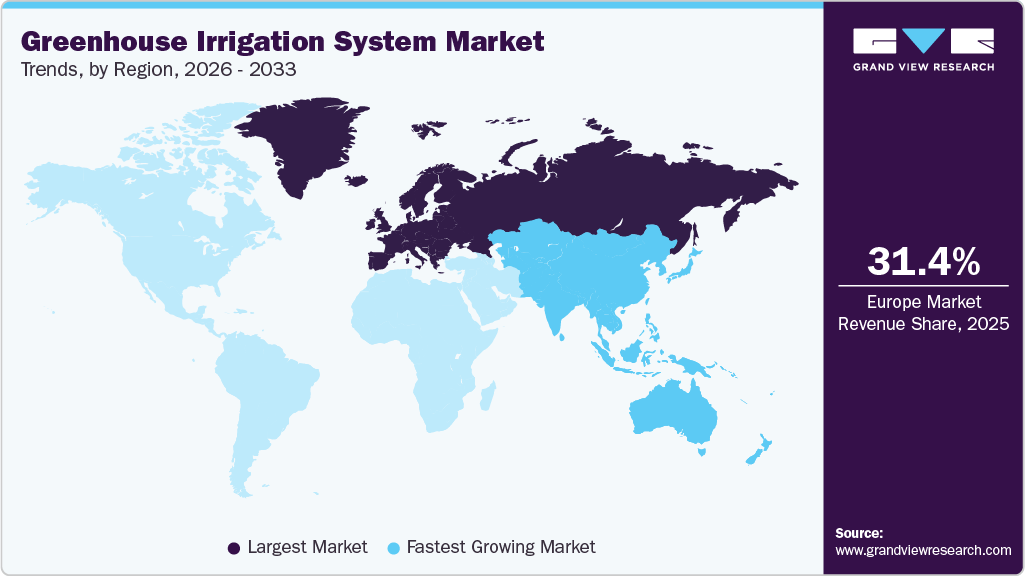
Europe dominated the greenhouse irrigation system market with a market share of 31.4% in 2025. Consumer preference for locally produced, traceable food is driving growth in Europe. The farm-to-table movement has gained considerable traction in Europe, with consumers preferring produce that is not only fresh but also has a transparent production history. Local greenhouse cultivation allows growers to meet these preferences by shortening supply chains and ensuring traceability throughout the production process. High-performance irrigation systems contribute to this traceability by documenting water use, nutrient delivery, and environmental conditions, which can be shared with buyers and regulatory bodies. This transparency supports premium pricing and consumer confidence in local produce. As demand for locally sourced food increases, greenhouse facilities equipped with sophisticated irrigation infrastructure are better positioned to serve both domestic and regional markets.
 To learn more about this report, Download Free Sample Report
 UK Greenhouse Irrigation System Market Trends
The greenhouse irrigation system market in the UK is projected to grow during the forecast period. The expansion of high-value crop cultivation within UK greenhouses further drives demand for advanced irrigation systems. Crops such as tomatoes, cucumbers, salad greens, strawberries, and herbs command premium prices in domestic supermarkets, farmers’ markets, and foodservice channels. These crops are sensitive to inconsistent soil moisture, which can negatively affect quality attributes such as firmness, flavor, and shelf life. Reliable greenhouse irrigation systems help ensure uniform moisture delivery, reducing crop stress and improving post-harvest performance. Retailers and buyers often set high-quality standards, and growers must meet these standards to maintain market access and command premium pricing. As demand for high-quality produce grows, greenhouse irrigation infrastructure becomes a strategic investment for commercial growers.
Asia Pacific Greenhouse Irrigation System Market Trends
The greenhouse irrigation system market in the Asia Pacific is expected to be the fastest-growing segment, with a CAGR of 11.7% over the forecast period. The penetration of modern agricultural technologies and the digital transformation of farming practices in the Asia Pacific is driving the demand in the market. Emerging economies in the region are rapidly adopting precision agriculture tools, including IoT sensors, automated irrigation controllers, and data analytics platforms, to improve efficiency and productivity. These technologies provide real-time insights into soil moisture, crop water requirements, and environmental conditions, enabling growers to automate irrigation scheduling and resource allocation. Integration of irrigation systems with climate control systems, nutrient dosing units, and remote monitoring apps further enhances operational efficiency, especially in large commercial greenhouses. As precision agriculture becomes more mainstream, greenhouse operators recognize that irrigation automation is no longer an optional upgrade but a core component of competitive cultivation strategy. These technological advancements lower labor requirements and enable growers to make data-driven decisions that optimize crop performance.
China greenhouse irrigation system market is projected to grow during the forecast period. The rising cost of agricultural inputs, particularly fertilizers and crop protection chemicals, is another distinct driver. In greenhouse environments, irrigation systems are closely integrated with fertigation technology, which delivers nutrients precisely with water. By optimizing nutrient absorption and minimizing leaching, advanced irrigation systems significantly reduce input wastage. This precision not only lowers operational expenses but also improves crop growth efficiency and nutrient uptake rates. As input costs fluctuate and margins tighten, greenhouse operators increasingly recognize the financial value of irrigation systems that enhance resource efficiency.
North America Greenhouse Irrigation System Market Trends
The greenhouse irrigation system market in North America is projected to grow during the forecast period. The expansion of high-tech greenhouse projects backed by institutional investors and agribusiness corporations is driving market adoption. North America has seen significant growth in large-scale greenhouse developments designed to supply metropolitan markets with fresh produce. These projects typically integrate climate control systems, fertigation units, and digital monitoring platforms alongside sophisticated irrigation infrastructure. Investors prioritize predictable yields, resource efficiency, and operational transparency, all of which depend heavily on advanced irrigation performance. Precision irrigation systems support consistent production and improve return on investment by optimizing water and nutrient delivery. As capital continues to flow into controlled-environment agriculture, irrigation systems remain a central component of greenhouse design and competitiveness.
The U.S. greenhouse irrigation system market is expected to grow during the forecast period. The expansion of high-value crop cultivation is another important market driver. Crops such as tomatoes, cucumbers, strawberries, leafy greens, and herbs are highly sensitive to inconsistent irrigation, which can affect size, flavor, and shelf life. Precision irrigation ensures uniform moisture levels across all plants, reducing stress and enhancing quality attributes critical for retail and foodservice markets. Controlled water delivery also supports better fertigation management, improving nutrient uptake and crop health. With high-value crops commanding premium prices, the investment in advanced irrigation systems is justified by improved productivity and consistent quality. As consumer preference for fresh, high-quality produce continues to rise, greenhouse operators increasingly rely on sophisticated irrigation infrastructure.
Key Greenhouse Irrigation System Company Insights
Some of the key companies operating in the market include Netafim and The Toro Company, among others, which are some of the leading participants in the market.
-
Netafim is a global precision irrigation solutions company with a strong focus on enabling sustainable agriculture through efficient water management technologies. Netafim offers a comprehensive portfolio of precision irrigation technologies that support controlled-environment agriculture. Its solutions include drip irrigation lines, micro-sprinklers, fertigation systems, automated irrigation controllers, and sensors that monitor soil moisture, climate conditions, and plant health. Netafim’s greenhouse irrigation solutions also integrate with digital platforms that allow remote monitoring, scheduling, and analytics, enabling growers to manage irrigation processes efficiently and respond dynamically to changing conditions within greenhouses.
-
The Toro Company is a global provider of innovative irrigation, turf, and landscape solutions. Toro offers a comprehensive portfolio of precision irrigation products and solutions designed to enhance controlled-environment agriculture. Its offerings include drip irrigation lines, micro-sprinklers, overhead and under-canopy systems, automated irrigation controllers, fertigation equipment, and soil moisture and climate monitoring sensors. These systems are engineered to deliver accurate water and nutrient distribution, ensuring that plants receive the right amount of resources at the right time, which improves crop quality and yield while reducing waste.
Nelson Irrigation and AvidWater, LLC are some of the emerging market participants.
-
Nelson Irrigation is a global manufacturer of advanced irrigation solutions. Nelson Irrigation offers a comprehensive range of products for greenhouses of different sizes, crop types, and operational requirements. Its product portfolio includes precision microsprinklers, drip emitters, misting systems, overhead and under-canopy irrigation solutions, and advanced fertigation equipment that delivers water and nutrients simultaneously. These systems are engineered to provide consistent water distribution, maintain optimal humidity levels, and support plant health, all of which are essential for controlled-environment agriculture.
-
AvidWater, LLC is a specialized provider of irrigation solutions, focusing on precision water management for agriculture, landscaping, and greenhouse operations. AvidWater’s product portfolio includes a wide range of precision irrigation technologies tailored for controlled-environment agriculture. Its offerings feature drip irrigation lines, micro-sprinklers, misting systems, overhead irrigation units, and fertigation solutions that allow for the simultaneous delivery of water and nutrients. These systems are engineered to provide uniform distribution, maintain optimal moisture levels, and support healthy plant growth.
Key Greenhouse Irrigation System Companies:
The following key companies have been profiled for this study on the greenhouse irrigation system market.
- Aranet
- AvidWater, LLC
- Cherry Creek Systems
- Climate Control Systems
- Horti Future
- Hunter Irrigation
- Irrigatia Limited
- Nelson Irrigation
- Netafim
- Priva
- Richel Group
- Solar Innovations
- The Toro Company
- VB-Greenhouses
- Williamson Greenhouses
Competitive Benchmarking
Operating Strategies
Competitive Edge
Weakness
Mature Players: Netafim; Priva; The Toro Company; Hunter Irrigation; Nelson Irrigation; Richel Group; Climate Control Systems; Williamson Greenhouses
- Invest heavily in integrated greenhouse automation platforms that combine irrigation, fertigation, climate control, and data analytics into a single operating system.
- Pursue partnerships with greenhouse builders and horticulture consultants to deliver turnkey projects for commercial growers.
- Comprehensive product portfolios covering emitters, valves, dosing systems, sensors, software, and greenhouse infrastructure enable one-stop solution delivery.
- Strong global distribution networks and established after-sales service teams support long-term customer relationships.
- High capital costs and premium pricing can limit adoption among small and mid-sized greenhouse growers.
- Complex systems often require specialized training, technical support, and regular maintenance.
Emerging Players: Aranet; AvidWater, LLC; Cherry Creek Systems; Horti Future; Irrigatia Limited; Solar Innovations; VB-Greenhouses
- Target underserved customer segments, including small-scale growers, research facilities, and urban agriculture operators.
- Emphasize easy-to-install, modular products that can retrofit existing greenhouse infrastructure.
- Ability to provide cost-effective and highly customized systems tailored to specific crop and greenhouse needs.
- Greater flexibility to respond quickly to changing customer requirements and market trends.
- Limited product portfolios compared with established full-service competitors.
- Lower brand recognition may reduce trust among large commercial growers.
Recent Developments
-
In February 2025, Aranet launched new sensors for greenhouse irrigation monitoring: the Slab Weight Sensor, the EC & pH Sensor, and the Horticulture Drainage Sensor. These additions seamlessly complement our existing Soil Sensor WET150, creating a complete solution for comprehensive irrigation management. Aranet’s greenhouse irrigation monitoring system integrates multiple sensors to enable precise irrigation control, supporting optimal plant health throughout fertigation, application, and drainage. Through the Aranet Cloud platform, users can monitor and analyze irrigation cycles, assess their effectiveness, and make data-driven decisions to achieve precise water and nutrient management, promoting healthier plants and greater resource efficiency.
-
In February 2025, Netafim launched its patented Hybrid Dripline system, the integral dripline with a built-in outlet. This cutting-edge technology combines the benefits of both integral and online dripper systems into a single solution that is leak-proof, clog-resistant, and designed to minimize labor for growers worldwide. The Hybrid Dripline simplifies irrigation by providing a pre-installed outlet, eliminating the need for labor-intensive tasks like manual hole punching or installing migration rings, while offering a fixed water delivery point that adapts to different stages of tree growth. This innovative system delivers targeted benefits for growers in vineyards, greenhouses, and orchards, ensuring uniform water distribution and significantly reducing manual labor.
Greenhouse Irrigation System Market Report Scope
Report Attribute
Details
Market size in 2025
USD 2.4 billion
Estimated market size in 2026
USD 2.6 billion
Projected market size by 2033
USD 5.2 billion
Growth rate
CAGR of 10.2% from 2026 to 2033
Actual data
2021 - 2025
Forecast period
2026 - 2033
Quantitative units
Revenue in USD million/billion and CAGR from 2026 to 2033
Report coverage
Revenue forecast, company share, competitive landscape, growth factors, and trends
Segments covered
Component, type, application, crop type, end use, region
Regional scope
North America; Europe; Asia Pacific; Latin America; MEA
Country scope
U.S.; Canada; Mexico; UK; Germany; France; China; India; Japan; Australia; South Korea; Brazil; UAE; Saudi Arabia; South Africa
Key companies profiled
Aranet; AvidWater, LLC; Cherry Creek Systems; Climate Control Systems; Horti Future; Hunter Irrigation; Irrigatia Limited; Nelson Irrigation; Netafim; Priva; Richel Group; Solar Innovations; The Toro Company; VB-Greenhouses; Williamson Greenhouses
Customization scope
Free report customization (equivalent to 8 analysts working days) with purchase. Addition or alteration to country, regional & segment scope.
Pricing and purchase options
Avail customized purchase options to meet your exact research needs. Explore purchase options
Global Greenhouse Irrigation System Market Report Segmentation
This report forecasts revenue growth at global, regional, and country levels and provides an analysis of the latest industry trends in each of the sub-segments from 2021 to 2033. For this study, Grand View Research has segmented the global greenhouse irrigation system market report based on component, type, application, crop type, end use, and region:
-
Component Outlook (Revenue, USD Billion, 2021 - 2033)
-
Controllers
-
Valves
-
Sensors
-
Pumps
-
Pipes & Tubing
-
Emitters & Drippers
-
Others
-
-
Type Outlook (Revenue, USD Billion, 2021 - 2033)
-
Drip Irrigation Systems
-
Sprinkler Irrigation Systems
-
Boom Irrigation Systems
-
Capillary Irrigation Systems
-
Micro Irrigation Systems
-
-
Application Outlook (Revenue, USD Billion, 2021 - 2033)
-
Soil-Based Irrigation
-
Hydroponic Irrigation
-
Aeroponic Irrigation
-
Mist & Fog Irrigation Systems
-
Others
-
-
Crop Type Outlook (Revenue, USD Billion, 2021 - 2033)
-
Fruits & Vegetables
-
Flowers & Ornamentals
-
Nursery Crops
-
Herbs & Medicinal Plants
-
-
End Use Outlook (Revenue, USD Billion, 2021 - 2033)
-
Commercial Growers
-
Research & Educational Institutes
-
Retail & Garden Centers
-
Others
-
-
Regional Outlook (Revenue, USD Billion, 2021 - 2033)
-
North America
-
U.S.
-
Canada
-
Mexico
-
-
Europe
-
Germany
-
UK
-
France
-
-
Asia Pacific
-
China
-
India
-
Japan
-
South Korea
-
Australia
-
-
Latin America
-
Brazil
-
-
Middle East & Africa
-
UAE
-
Saudi Arabia
-
South Africa
-
-
Delivered Customizations
This report has been delivered with the following In-depth customizations
Client Request
Customization Delivered
Value Adds
Assessment of demand for solar-powered and off-grid greenhouse irrigation systems
- Analysis of adoption potential for solar-powered pumps, battery-backed controllers, and low-energy irrigation systems.
- Review of product offerings and technological feasibility.
- Identified niche opportunities in off-grid and sustainable greenhouse applications.
- Supported innovation and product differentiation strategies.
Assessment of hydroponic and soilless cultivation opportunities for irrigation solution providers
- Analysis of irrigation and fertigation requirements in hydroponic, coco coir, rockwool, and NFT-based greenhouse systems.
- Evaluation of nutrient dosing, recirculation, and monitoring technologies used in soilless cultivation.
- Identified high-potential opportunities in fast-growing hydroponic segments.
- Highlighted technology requirements for precision nutrient management.
Evaluation of government policies and sustainability initiatives supporting greenhouse irrigation adoption
- Analysis of subsidy programs, water conservation mandates, and sustainable agriculture initiatives promoting efficient irrigation technologies.
- Review of policy-driven demand for drip irrigation, fertigation, and automation systems.
- Identified policy-driven market opportunities.
- Supported strategic targeting of incentive-backed regions.
- Highlighted regulatory trends accelerating the adoption of advanced irrigation systems.
Frequently Asked Questions About This Report
The global greenhouse irrigation system market size was estimated at USD 2.4 billion in 2025 and is expected to reach USD 2.6 billion in 2026.
The emitters & drippers segment dominated the greenhouse irrigation system market with market share of 27.8% in 2025. The integration of hardware with Internet of Things (IoT) and cloud technologies is propelling the hardware segment of the greenhouse irrigation system market.
Some key players operating in the market include Aranet, Netafim, The Toro Company, Priva, Solar Innovations, Nelson Irrigation, AvidWater, LLC, Williamson Greenhouses, Cherry Creek Systems, Hunter Irrigation, Richel Group, Climate Control Systems, Irrigatia Limited, Horti Future, VB-Greenhouses.
Factors such as the rising adoption of protected cultivation and controlled environment agriculture and increasing focus on precision farming and resource optimization are the key factors driving the market growth.
The global greenhouse irrigation system market is expected to grow at a compound annual growth rate of 10.2% from 2026 to 2033 to reach USD 5.2 billion by 2033.
The drip irrigation systems segment held the largest revenue share in 2025, while micro irrigation systems is the fastest-growing segment.
Soil-based irrigation held the largest revenue share in 2025.
Fruits & vegetables held the largest share in 2025 and herbs & medicinal plants is the fastest-growing market.
Europe dominated with a 31.4% revenue share in 2025.
About the Author(s)
Next Generation Technologies Research Team
Technology · Next Generation TechnologiesThis report was authored by the next generation technologies research team at Grand View Research - comprising two research analysts, one senior research analyst, and one industry expert - with specialized expertise in the next generation technologies segment of the technology industry. All findings are based on proprietary technology databases, executive interviews, and regulatory analysis, subject to internal peer review prior to publication.
Last Updated:
Speak to Analyst

Customize this report to your needs - add regions, segments, or data points, with 20% free customization.
Or view our licence options:


ISO 9001:2015 & 27001:2022 Certified
We are GDPR and CCPA compliant! Your transaction & personal information is safe and secure. For more details, please read our privacy policy.


