
- Home
- »
- Consumer Goods
- »
-
Halal Products Market Size, Share & Trends Report, 2033GVR Report cover

Halal Products Market (2026 - 2033)
Size, Share & Trends Analysis Report By Product (Food & Beverage, Fashion, Cosmetics & Personal Care), By Distribution Channel (Hypermarkets & Supermarkets, Online/E-commerce), By Region, And Segment Forecasts
Market Size, 2025
$2,086.0BMarket Estimate, 2026
$2,209.9BMarket Forecast, 2033
$3,311.6BCAGR, 2026–2033
5.9%Halal Products Market Summary
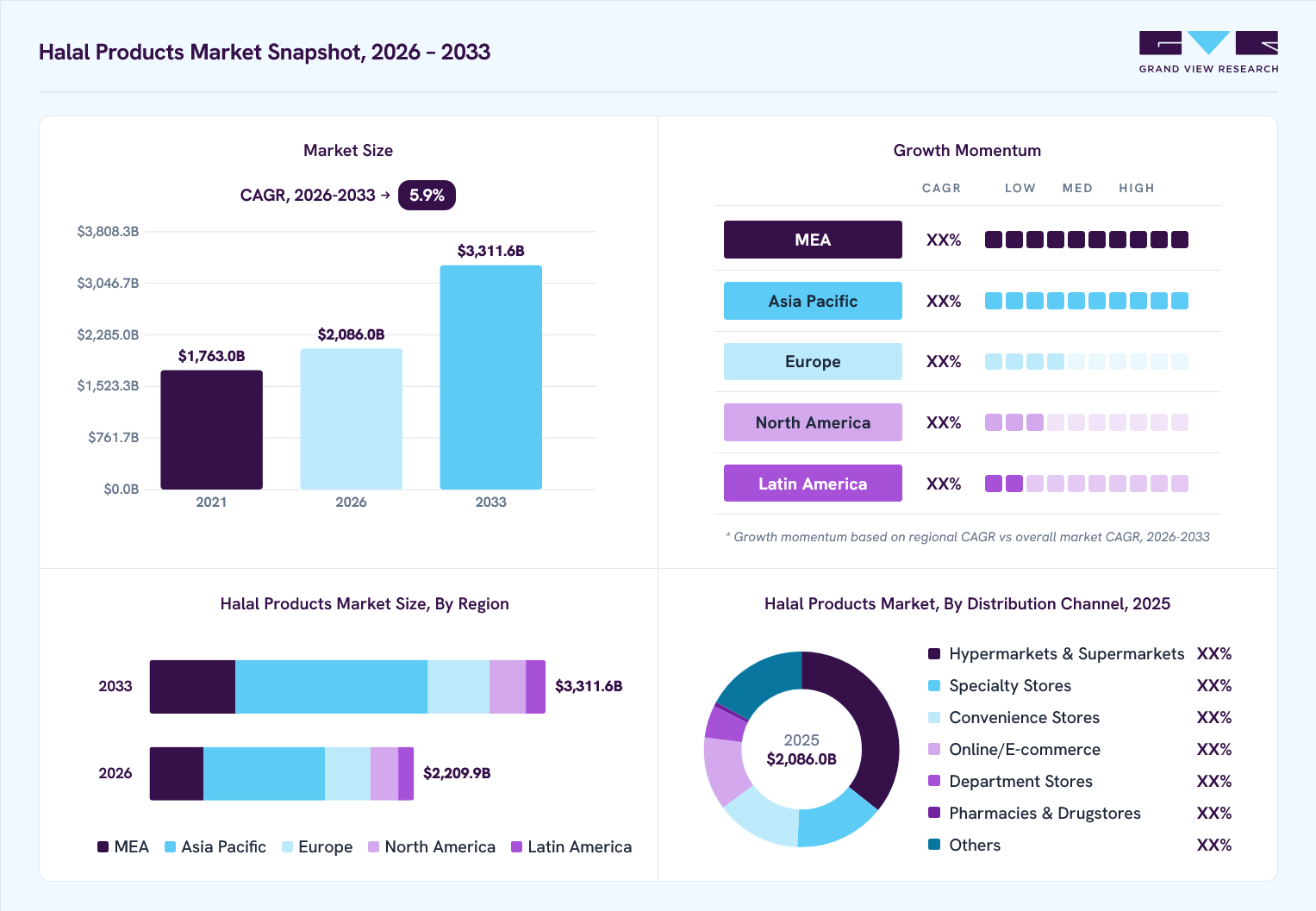
The global halal products market size was valued at USD 2,086.0 billion in 2025 and is projected to grow from USD 2,209.9 billion in 2026 to USD 3,311.6 billion by 2033, at a CAGR of 5.9% from 2026 to 2033. Asia Pacific dominated the market, accounting for a revenue share of 45.6% in 2025. Market growth is driven by the expanding Muslim consumer population, increasing awareness of halal certification and ingredient transparency, rising demand for ethically produced and compliant consumer goods, and broader availability of halal products across international retail and e-commerce channels.
 Source: Grand View Research, IR Documents, Primary Interviews, Paid DatabasesTo learn more about this report,
 Download Free Sample Report
 Key Market Trends & Insights
- By product: Food & beverage segment held the largest market share of 77.8% in 2025.
- By distribution channel: Hypermarkets & supermarkets segment held the largest share of 35.7% in 2025
Regional Highlights
- Largest regional market: Asia Pacific (45.6% revenue share, 2025)
- Fastest-growing regional market: Middle East & Africa (fastest CAGR, 2026-2033)
Market Size & Forecast
- Market Size in 2025: USD 2,086.0 Billion
- Estimated Market Size in 2026: USD 2,209.9 Billion
- Projected Market Size by 2033: USD 3,311.6 Billion
- CAGR (2026-2033): 5.9%
Three ways to get this report
Buy it, customize it, or ask a question.Ask an Analyst
Analyst response in 1 business day
- AccessReport author, directly
- Reply timeWithin 1 working day
- No sales callDirect answer only
- FormatEmail reply
- CostFree, no cost
Get the Full Report
What the study covers
- FormatsPDF · Excel · Dashboard
- Timeline2026–2033 annual, 2025 base
- Coverage20+ countries, 5 regions
- Companies10+ key players profiled
Customize the Report
20% free customization
- IncludeCountries, segments, points
- TailorTo your product definition
- ExtendDeeper competitor detail
- OrA fully bespoke study
- Turnaround5–10 working days
Asia Pacific is the largest regional market for halal products, supported by its substantial Muslim consumer base and expanding halal food, fashion, and personal care industries, while the Middle East & Africa is expected to record the fastest growth through 2033. The market is also broadening beyond traditional food categories, with halal-certified apparel, cosmetics, personal care, and other consumer products gaining greater acceptance as manufacturers and retailers expand their halal-certified portfolios.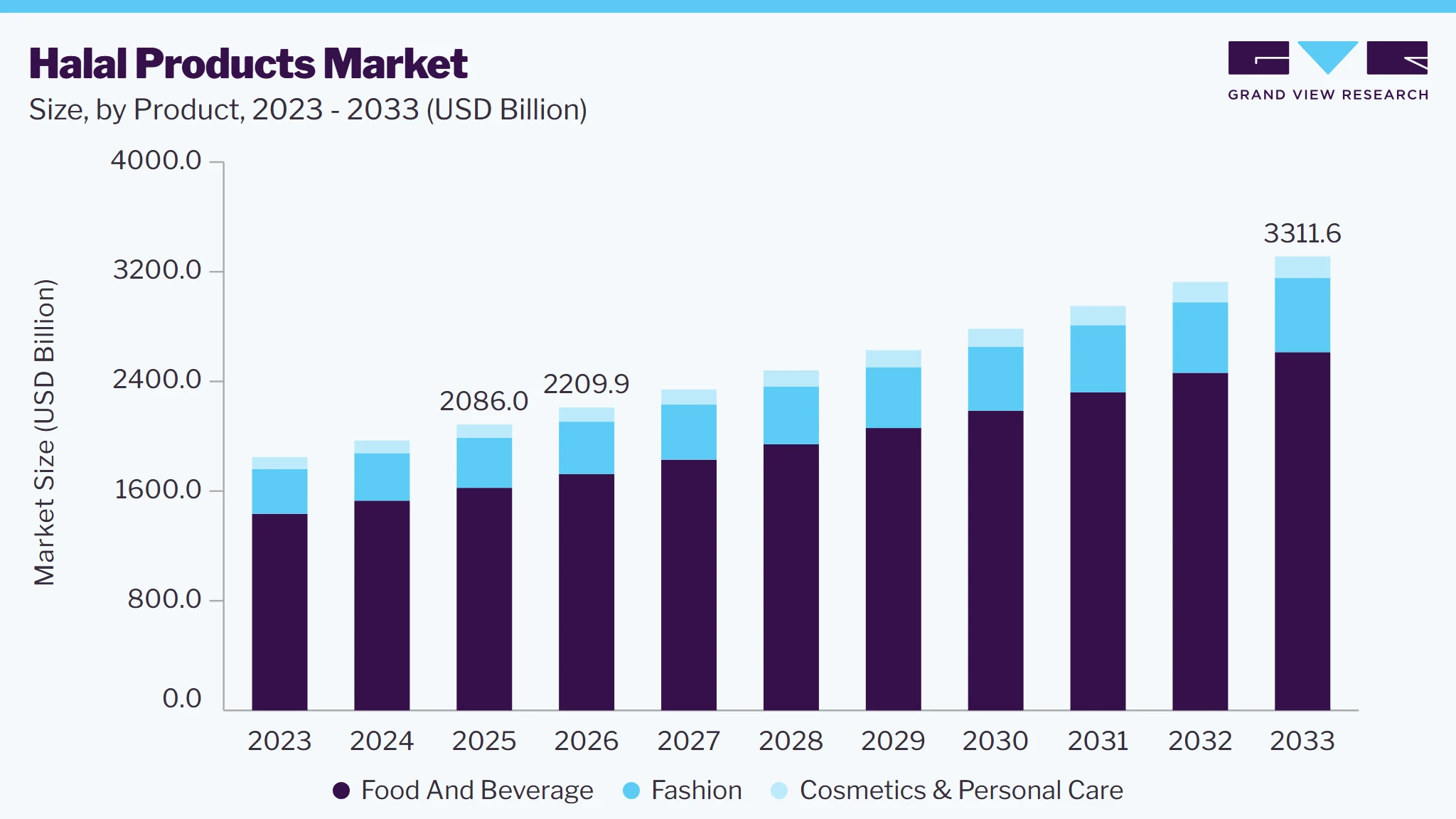 To learn more about this report, Download Free Sample Report
 The halal products industry is increasingly being shaped by the expansion of halal requirements beyond traditional food and beverages into cosmetics, pharmaceuticals, chemicals, healthcare products, apparel, household goods, and other consumer categories. While the halal food market remains a major component of the broader ecosystem, regulatory developments are increasingly expanding the addressable market across non-food categories. Indonesia provides a particularly important regulatory example, with BPJPH confirming that from 18 October 2026, mandatory halal certification will extend to cosmetics, natural medicines, quasi-drugs and health supplements, chemical and genetically engineered products, food ingredients, clothing and accessories, household equipment, office supplies, and certain medical devices. The policy also covers relevant micro and small enterprises as well as imported products, materially expanding the addressable certification base. BPJPH has been preparing the market through a nationwide awareness initiative conducted across 2,183 locations, illustrating the scale of the regulatory transition. From a market perspective, this creates a structural demand driver because manufacturers that previously treated halal certification as optional will increasingly need to incorporate halal-compliant sourcing, production, documentation, and certification into their operating models.
The halal products market is also moving toward greater traceability, transparency, and certification-led differentiation, which is changing halal from a compliance attribute into a broader commercial proposition. BPJPH describes halal in terms of transparency, traceability, and trust, and specifically positions certification as a means of increasing consumer confidence, strengthening competitiveness, and opening wider market access. This is particularly relevant as halal supply chains become more complex across ingredients, processing, logistics, packaging, and international trade. The broader Islamic economy is showing similar structural momentum: DinarStandard estimates that consumer spending across six Islamic-economy sectors reached USD 2.60 trillion in 2024 and could reach USD 3.56 trillion by 2029, while its latest analysis highlights the increasing importance of stronger halal value chains and digital trust infrastructure. For manufacturers, this creates an opportunity to compete not simply through certification but through verifiable sourcing, digital product information, transparent ingredient lists, recognized certifications, and consistent quality. These attributes are particularly relevant to emerging categories such as the halal cosmetic products market and the halal skincare products market, where consumers increasingly evaluate ingredient origin, formulation practices, and product safety alongside halal status. This can support premium positioning and strengthen consumer trust.
At the industry level, investment is increasingly moving toward localization, technology, and non-food halal categories, particularly in the Middle East. Saudi Arabia's Public Investment Fund established the Halal Products Development Company (HPDC) to strengthen domestic capabilities and develop Saudi Arabia as a global halal hub, with its mandate spanning food, pharmaceuticals, cosmetics, technology, knowledge, and innovation. A notable commercial example is HPDC's 2024 investment in Believe, a halal cosmetics and personal-care company. The agreement included plans to relocate Believe's headquarters to Saudi Arabia and to establish a manufacturing facility to build local production capacity and eventually serve international markets. This illustrates how halal is evolving into a broader industrial ecosystem encompassing manufacturing localization, contract production, R&D, technology transfer, and exports, rather than remaining primarily a certification service attached to food products. The same localization trend can benefit specialized categories such as the halal meat market and the halal dairy products market by encouraging investment in certified processing, manufacturing, cold-chain infrastructure, and regional supply capabilities.
The competitive opportunity, therefore, extends across food and beverage, cosmetics and personal care, pharmaceuticals, fashion, ingredients, logistics, certification, and halal-enabled technology, with companies increasingly able to differentiate through the depth and credibility of their halal value proposition. Saudi Arabia's HPDC is explicitly targeting localization and global exports, while Indonesia's regulatory expansion is creating a much wider requirement for certified products and inputs. At the same time, BPJPH increasingly presents halal certification as an investment in competitiveness rather than simply a regulatory obligation. This combination of regulatory enforcement, rising consumer trust requirements, supply-chain formalization, digital verification, and strategic investment should support continued diversification of the halal products market and create opportunities for manufacturers that can integrate certification with quality, traceability, innovation, and international market access.
Market Dynamics
The growing scale of halal-certified manufacturing by multinational companies is an important demand driver because it is increasing the availability of halal products beyond predominantly Muslim markets. Nestlé Malaysia, for example, currently operates six factories and produces more than 500 halal-certified products, including major brands such as Milo, Maggi, Nescafé, and KitKat. Nestlé identifies Malaysia as its Halal Centre of Excellence, and its Malaysian operations have developed sufficient halal manufacturing capabilities to supply products internationally. The company has previously reported that its halal products were exported to more than 50 countries, demonstrating that halal production is increasingly being integrated into international manufacturing and export strategies rather than being restricted to domestic Muslim markets.
This trend is also extending into newer product categories. Nestlé has invested in plant-based protein production in Asia, with its Shah Alam, Malaysia, facility certified halal, illustrating how halal assurance is being incorporated into emerging categories such as meat and dairy alternatives. Such developments can further broaden the addressable consumer base for halal meat market alternatives and halal dairy products market offerings as manufacturers apply halal assurance to new protein and dairy-substitute categories. Similarly, dsm-firmenich lists individual fragrance ingredients such as DREAMWOOD BASE and PARMANTHEME as halal-certified, demonstrating that halal compliance is increasingly moving upstream into specialty ingredients used in fragrances, shampoos, shower gels, soaps, detergents, and other personal-care applications. As more multinational companies build halal-certified manufacturing and ingredient portfolios, consumers gain access to a broader assortment, while retailers and distributors have greater incentives to dedicate shelf space and procurement capacity to halal products.
A major restraint is the lack of complete uniformity in halal certification requirements across countries and certification bodies, which can increase compliance complexity for companies operating internationally. The scale of the issue is visible in BPJPH's database of recognized foreign halal institutions: the database includes certification bodies from countries such as the United States, Pakistan, China, Mexico, and Australia, with different bodies covering different combinations of food, beverages, pharmaceuticals, cosmetics, chemical products, biological products, and slaughtering services. This means that a multinational manufacturer may need to manage different certification relationships and product scopes depending on the destination market and product category.
For large companies, the challenge is not simply obtaining a certificate but maintaining consistent halal assurance throughout complex supply networks. Nestlé, for example, operates a supplier-assurance system in which supplier risk is assessed based on factors such as the country of operation and the origin of materials and ingredients, and higher-risk materials may require upstream supply chain mapping and additional assessments. In halal manufacturing, comparable scrutiny can extend to ingredient origin, processing aids, production equipment, storage, and logistics. This creates greater administrative and verification requirements, particularly for smaller manufacturers that lack dedicated halal teams and established supplier audit systems. Consequently, certification complexity can slow international product launches and increase the cost of maintaining a single product formulation across multiple markets.
A significant opportunity lies in extending halal positioning into higher-value non-food categories, particularly cosmetics, personal care, pharmaceuticals, and specialty ingredients. The opportunity is already visible at the ingredient level: dsm-firmenich has halal-certified fragrance ingredients designed for applications ranging from fine fragrance to shampoo, shower gel, soap, detergent, and fabric softener. This creates an opportunity for downstream brands to develop halal-certified formulations without being limited to conventional food-related categories. In particular, the growing halal cosmetic products market can benefit from increasing availability of certified ingredients and manufacturing capabilities, while the halal skincare products market can leverage halal certification alongside transparency, clean formulations, ethical sourcing, and traceability.
Companies are also investing directly in halal-oriented non-food businesses. Saudi Arabia's Halal Products Development Company (HPDC), a Public Investment Fund company, is developing capabilities across multiple halal sectors, while its investment activities have included the cosmetics industry. At the regulatory level, BPJPH has been working with Indonesia's National Standardization Agency, BPOM, the Ministry of Industry, the Ministry of Health, and other institutions to establish halal certification guidance for cosmetics. The commercial implications are significant: cosmetics and personal-care companies can combine halal certification with premium attributes such as ingredient transparency, clean formulations, ethical sourcing, and traceability. This allows halal status to become a brand and product-differentiation tool, rather than merely a compliance label, while opening additional revenue pools beyond the comparatively mature halal food market.
Analyst Perspective
The global halal products market is expanding beyond halal food into modest fashion, halal cosmetics, personal care, and wellness products, creating a more diversified consumer ecosystem. Growth is particularly supported by Muslim consumer spending in Southeast Asia, the Middle East, and South Asia, while non-Muslim consumers increasingly associate halal certification with traceability, ethical sourcing, and product safety. In food, demand is shifting toward certified, processed, and convenience products, while fashion platforms and halal beauty brands are broadening the reach among younger consumers. Certification credibility, supply-chain traceability, and cross-category brand portfolios are becoming key competitive factors, while fragmented certification standards remain a major barrier to global market integration.
Consumer Insights
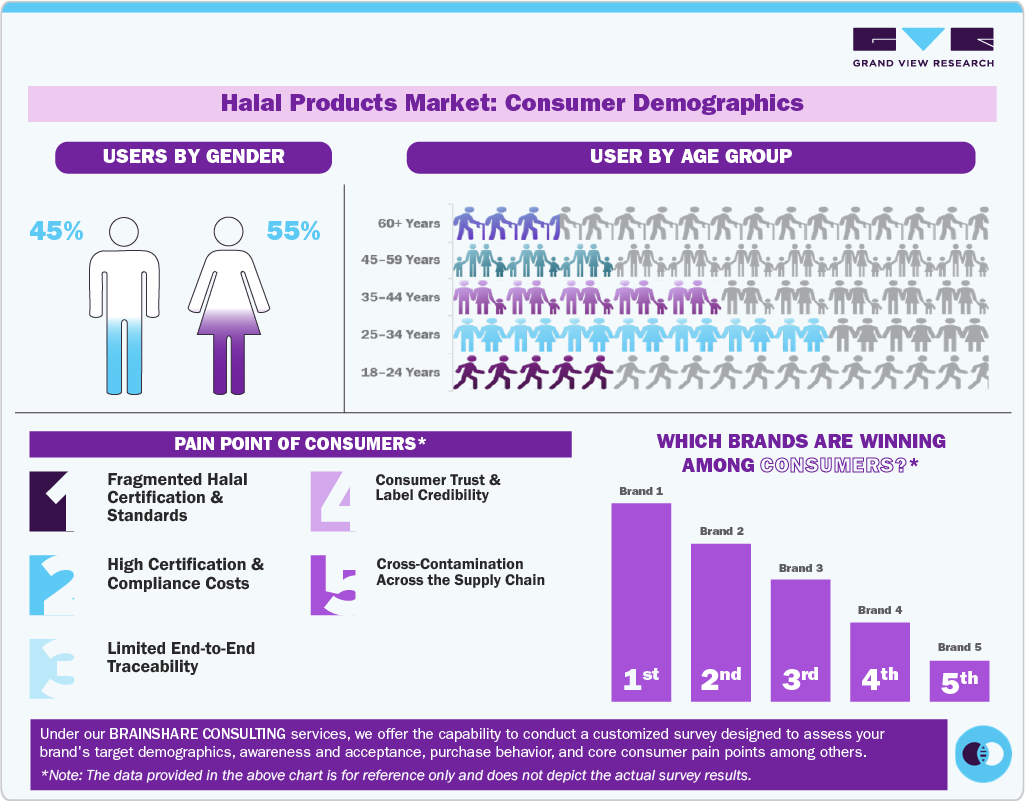
Consumer behavior in the global halal products market is increasingly moving beyond a simple “halal or non-halal” purchase decision. Consumers are evaluating certification credibility, ingredient transparency, health and quality attributes, convenience, digital information, and brand reputation alongside religious compliance. A 2024 consumer perception study found that 60% of respondents had full trust in halal labels, 30% had partial trust, and 10% expressed doubts, while religious reasons accounted for 50% of purchase motivations, followed by health benefits at 30% and quality assurance at 20%. This indicates that halal remains the fundamental purchase criterion for many consumers, but health, quality, and trust are increasingly influencing the final brand choice.
 To learn more about this report, Download Free Sample Report
 -
Halal certification remains the primary trust signal, but consumers increasingly scrutinize its credibility: Certification is becoming an important mechanism for reducing uncertainty around ingredients and production processes. A 2026 study of 410 non-Muslim Indian consumers found that halal certification, health consciousness, attitudes, and trust significantly influenced attitudes and purchase-related outcomes toward halal food. This is particularly relevant for brands seeking to extend halal products beyond Muslim consumers, as certification can serve as a third-party assurance mechanism rather than merely a religious identifier. For example, companies such as Nestlé operate dedicated halal manufacturing and assurance systems in Malaysia, where halal certification is integrated into production and export processes.
-
Health and perceived product quality are important secondary purchase motivations: Consumer interest is increasingly extending from religious compliance toward attributes such as safety, quality, ingredients, and health. The 2024 consumer study found that 30% of respondents identified health benefits as a purchasing motivation and another 20% cited quality assurance, demonstrating that a meaningful portion of consumers attach functional value to halal products. This creates opportunities, particularly in halal cosmetics, personal care, pharmaceuticals, and food products, where manufacturers can combine halal certification with clean-label, natural-ingredient, quality, and safety positioning. Companies such as dsm-firmenich already offer halal-certified fragrance ingredients used across applications, including fine fragrance, shampoo, shower gel, soap, and detergents, illustrating how halal assurance is moving into ingredient-level product development.
-
Consumers are increasingly looking for halal options across non-food categories: The purchasing journey is no longer concentrated exclusively around meat and packaged food. Indonesia's forthcoming mandatory certification framework covering cosmetics, medicines, supplements, chemicals, clothing, household products, and other consumer categories is likely to increase consumer awareness and availability across these segments. This is consistent with the broader trend toward halal lifestyles, in which consumers increasingly expect faith-compatible options in beauty, fashion, personal care, and healthcare. HPDC's investment in halal cosmetics company Believe, alongside Saudi Arabia's broader halal-industry development strategy, illustrates how companies are responding to this diversification of consumer demand.
-
Younger consumers are increasingly digital in their discovery and evaluation of halal offerings: Digital platforms are becoming important sources of information for Muslim consumers, particularly when comparing products, locating certified offerings, and validating claims. Crescent Rating’s 2025 research found that social media accounted for 40% of brand discovery among Indonesian Muslim consumers, compared with 22.5% for word-of-mouth. Although this research covers the broader Muslim consumer economy rather than halal packaged products alone, it demonstrates the importance of digital discovery in reaching consumers. This favors brands that make certification status, ingredients, product attributes, and halal credentials easily discoverable through websites, social platforms, marketplaces, and digital product pages.
-
Trust and assurance are becoming more important as consumers encounter halal products through digital channels: Crescent Rating’s 2026 research highlights a growing “assurance gap,” with 90% of Muslim travelers expecting assurance while only 70% feel those expectations are being met. Although the statistic relates specifically to Muslim-friendly travel, the underlying consumer behavior is relevant to the broader halal economy: consumers increasingly expect businesses to provide visible and credible evidence of faith-aligned compliance rather than relying on generic halal positioning. This reinforces the importance of recognizable certification marks, transparent ingredient information, accessible certification records, and consistent communication across online and offline channels.
-
Female Muslim consumers represent an increasingly influential premium-oriented segment: Mastercard-Crescent Rating’s 2026 research covering more than 1,700 Muslim women across 20+ source markets found that Muslim women accounted for 90 million international arrivals in 2025, or 48% of global Muslim visitor arrivals, while 56% indicated willingness to pay a premium for faith-based services. While the study focuses on travel, it demonstrates the purchasing power of female Muslim consumers and their willingness to pay for products and services that appropriately address faith-related requirements. For halal cosmetics, skincare, modest fashion, personal care, and wellness products, this supports opportunities for premium positioning rather than competing exclusively on affordability.
-
Convenience is increasingly becoming part of the halal purchase proposition: Consumers increasingly expect halal products to be as accessible and convenient as mainstream alternatives. The expansion of halal-certified restaurants, hotels, retail outlets, cosmetics, and consumer goods demonstrates that availability itself is becoming an important competitive factor. In Hong Kong, for example, the 2025 Mastercard-Crescent Rating GMTI reported 153 halal-certified restaurants and 61 Crescent Rating-accredited hotels, showing how businesses in a non-Muslim-majority market are expanding halal offerings to capture Muslim demand. Similar availability improvements across supermarkets, pharmacies, e-commerce platforms, and specialty retailers can reduce the need for consumers to compromise between halal compliance and convenience.
-
Consumers are increasingly willing to use technology to identify and evaluate halal options: The broader Muslim consumer journey is becoming increasingly technology-assisted. Mastercard-Crescent Rating’s 2026 research found that 80% of Muslim travelers use AI tools for travel purposes, while Crescent Rating’s research indicates that consumers are increasingly discovering brands through social and digital channels. This points toward a wider opportunity for halal brands to provide machine-readable certification information, digital product verification, QR-based authentication, ingredient databases, and AI-search-friendly product information. For example, a consumer comparing two skincare products could increasingly verify halal status, ingredients, certification body, and product claims digitally before purchasing rather than relying solely on physical packaging.
-
Non-Muslim consumers represent an incremental addressable audience when halal is linked with trust, health, and quality: Halal products are not necessarily confined to Muslim consumers. The 2026 study involving 410 non-Muslim Indian consumers specifically found significant relationships between halal certification, health consciousness, trust, attitudes, and purchase-related behavior. This suggests that brands can potentially broaden their customer base by communicating halal certification alongside attributes such as ingredient transparency, quality control, hygiene, ethical sourcing, and safety. The implication is particularly relevant for packaged food, cosmetics, personal care, and pharmaceuticals, where halal certification can become one component of a broader quality proposition rather than the sole reason for purchase.
Overall, consumer decision-making is becoming more assurance-led and value-driven: the evidence suggests that consumers increasingly expect halal products to deliver three layers of value: religious compliance, credible assurance, and functional product benefits. Certification establishes the baseline, but health, quality, convenience, transparency, brand reputation, and increasing digital accessibility influence differentiation. For manufacturers, this means the strongest consumer proposition is unlikely to be “halal certified”; instead, brands can gain stronger engagement by communicating what makes the product halal, who certified it, what ingredients are used, how the product is produced, and what additional functional or lifestyle benefits the consumer receives.
Product Insights
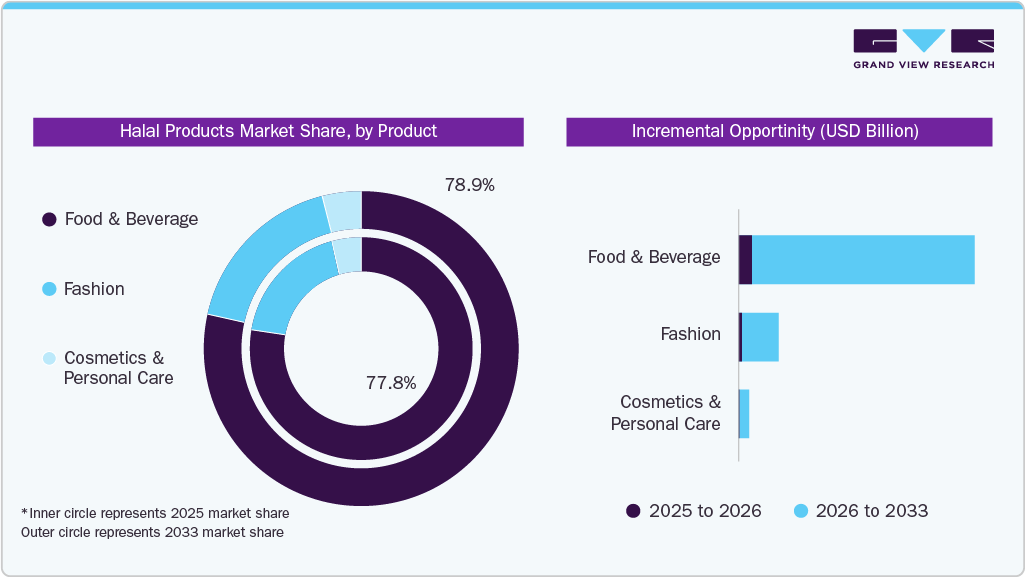
The food & beverage segment dominated the global halal products industry, accounting for a revenue share of 77.8% in 2025, equivalent to approximately USD 1,623.8 billion. Its dominance reflects the fundamental role of halal certification in everyday food consumption, particularly across Muslim-majority markets where halal compliance is an important purchasing requirement. The segment also benefits from the breadth of categories covered, including meat and alternatives, dairy, fruits and vegetables, grains, processed foods, and beverages. Large food manufacturers are increasingly incorporating halal assurance into international production and supply chains. For example, Nestlé Malaysia operates six halal-certified factories and produces more than 500 halal products, with its halal manufacturing capabilities supporting exports to international markets. The segment is expected to remain the largest through 2033, reaching approximately USD 2,613.4 billion, although its share is projected to increase only moderately to 78.9%.
 To learn more about this report, Download Free Sample Report
 The cosmetics & personal care segment is projected to grow at the fastest CAGR of 6.2% during the forecast period. Although the segment accounted for only 4.7% of global revenue in 2025, approximately USD 97.7 billion, its growth reflects growing consumer interest in halal-certified skincare, haircare, makeup, fragrances, and personal care formulations. The opportunity is particularly relevant because consumers increasingly associate halal certification with ingredient transparency, permissible sourcing, and production assurance. Companies are also extending halal credentials into the ingredient supply chain; for example, dsm-firmenich offers halal-certified fragrance ingredients used in applications such as fine fragrance, shampoo, shower gel, soap, and detergents.
Distribution Channel Insights
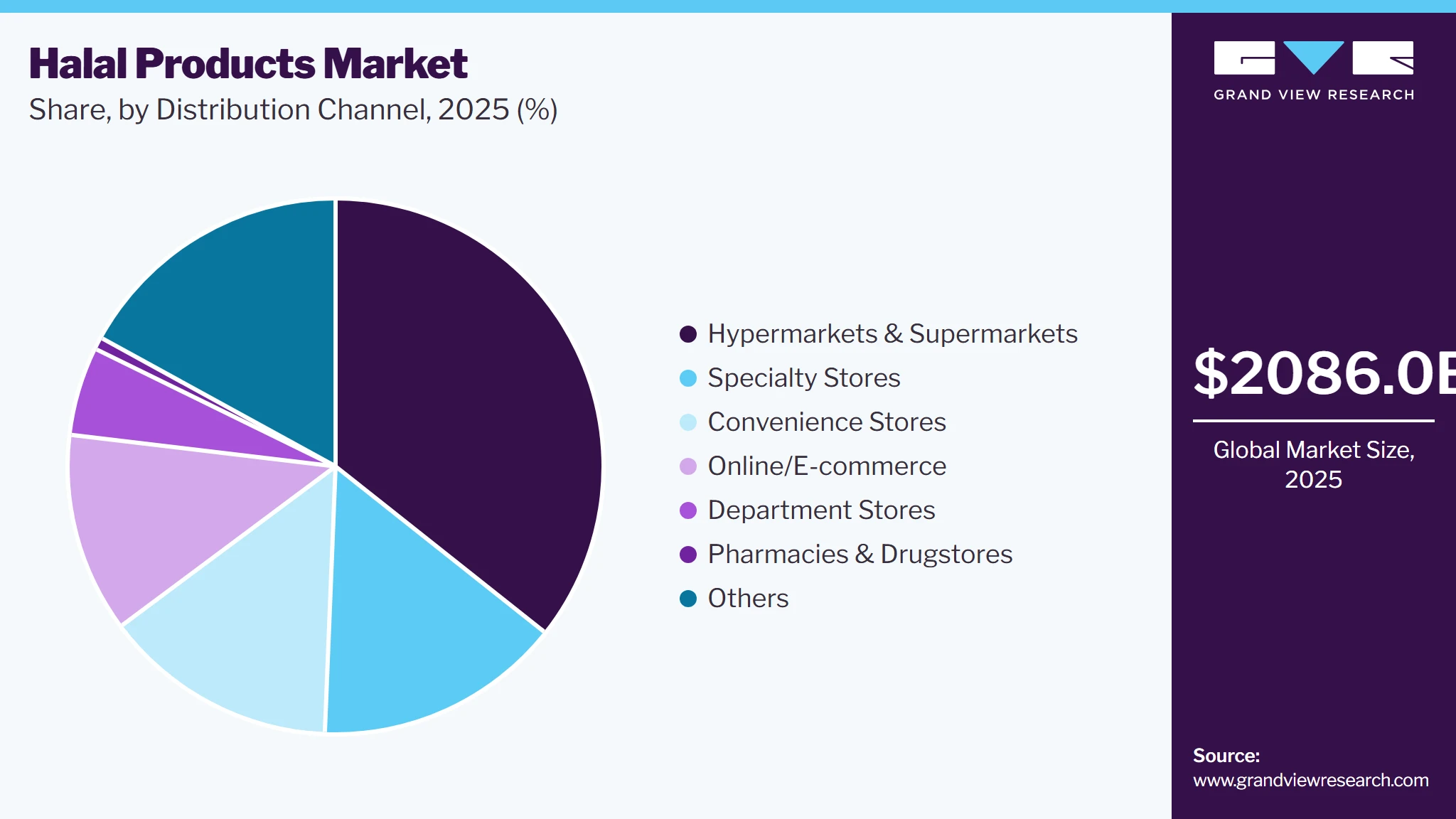
The hypermarkets & supermarkets dominated the global halal products market, accounting for a revenue share of 35.7% in 2025, equivalent to approximately USD 744.0 billion. Their leadership is supported by the high frequency of food and beverage purchases, broad product assortment, established halal sections, and consumers' preference for purchasing multiple certified products during a single shopping trip. Large retailers can also provide visible certification information and accommodate halal products across packaged foods, beverages, personal care, and household categories. The continued strength of modern grocery retail is particularly important in markets such as Malaysia, Indonesia, the Gulf countries, and parts of Europe, where organized retailers increasingly integrate halal products into mainstream supermarket assortments.
 To learn more about this report, Download Free Sample Report
 The online/e-commerce segment is projected to grow at the fastest CAGR of 6.6% over the forecast period. The channel represented 12.1% of global halal-products revenue in 2025, equivalent to approximately USD 251.9 billion, and is projected to reach USD 420.1 billion by 2033. Online channels benefit from their ability to offer consumers a wider product selection, detailed ingredient information, certification credentials, customer reviews, and access to halal products that may not be readily available in local stores. The channel is also particularly relevant for specialized categories such as halal cosmetics, skincare, fragrances, supplements, and fashion, where consumers may actively search for specific certified products. Digital discovery is becoming increasingly important among Muslim consumers; Crescent Rating’s research, for example, found social media to be a major source of brand discovery among Indonesian Muslim consumers, reinforcing the opportunity for halal brands to combine e-commerce availability with digital certification and product education.
Regional Insights
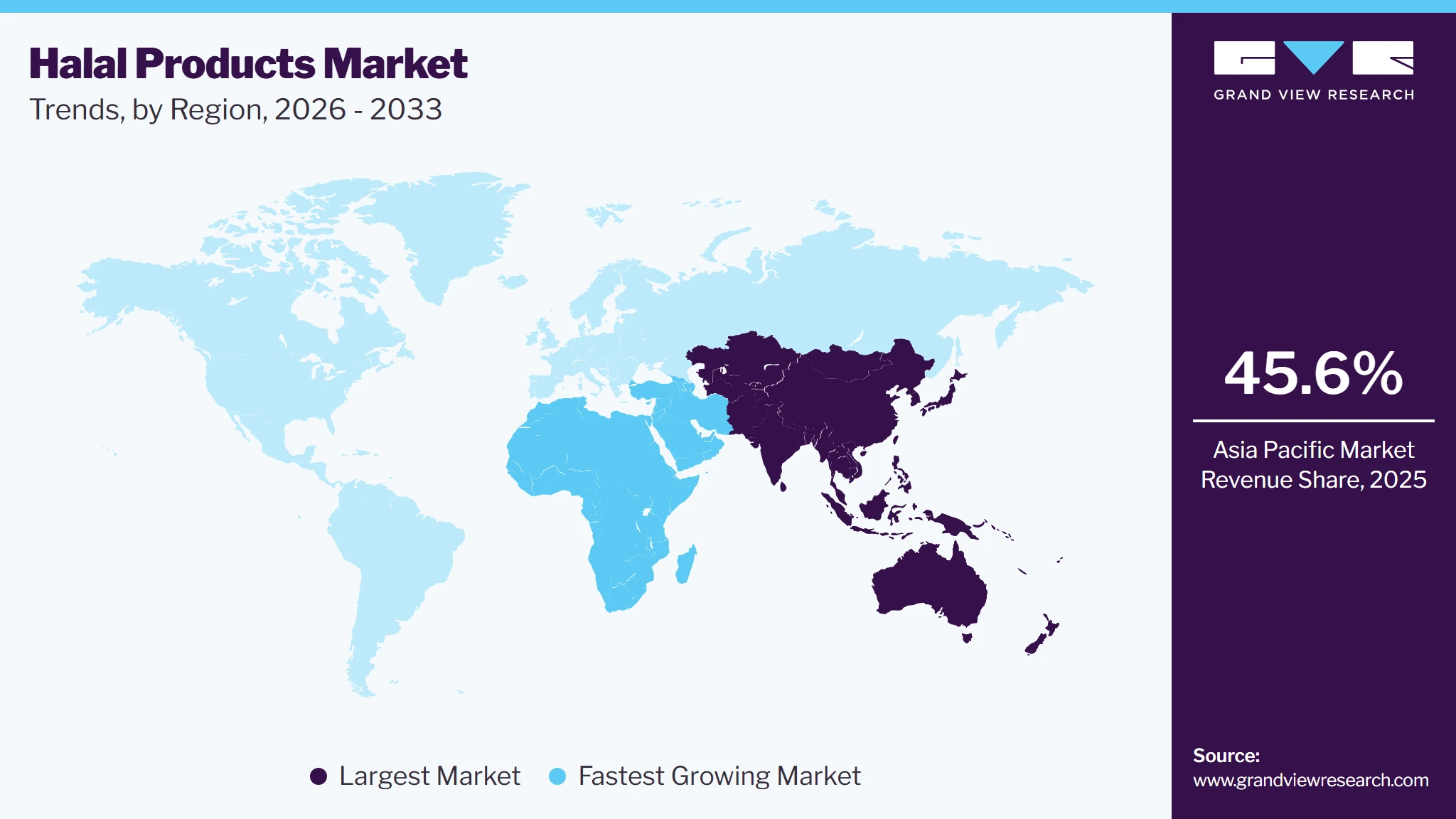
The Asia Pacific halal products industry accounted for the largest global revenue share of 45.6% in 2025, reaching approximately USD 950.2 billion. Asia Pacific is also the second-fastest-growing region, expanding at a 6.8% CAGR during 2026 to 2033, well above the global 5.9% rate. The region's leadership is supported by its large Muslim consumer base, established halal manufacturing ecosystems, expanding domestic consumption, and growing halal exports. Muslim consumers in the region are particularly important for food and beverages, while halal cosmetics, pharmaceuticals, modest fashion, and personal-care products are broadening the addressable market. Indonesia alone recorded USD 165.4 billion in Muslim consumer food spending in 2024, while Malaysia has developed one of the world's most sophisticated halal certification and manufacturing ecosystems.
 To learn more about this report, Download Free Sample Report
 The Indonesia halal products market held approximately 17.4% revenue share of Asia Pacific in 2025. Its position is supported by the world's largest Muslim consumer population, substantial domestic consumption, expanding halal certification infrastructure, and growing local manufacturing. Muslim consumers in Indonesia spent approximately USD 165.4 billion on food and beverages in 2024, the largest national market globally. Indonesia has also established 92 halal recognition arrangements across 24 countries, strengthening its ability to integrate domestic halal producers into international markets.
The halal products market in India held approximately 8.0% revenue share of Asia Pacific in 2025. The market is supported by India's large Muslim population, extensive food-processing industry, substantial pharmaceutical and cosmetics manufacturing base, and growing demand for certified products in domestic and export markets. India's importance is particularly significant on the supply side, as Indian companies participate extensively in halal food exports to OIC markets. The opportunity is gradually extending beyond food into pharmaceuticals, cosmetics, personal care, ingredients, and modest fashion.
Middle East & Africa Halal Products Market Trends
The Middle East & Africa halal products industry was the second-largest regional market in 2025, accounting for 20.2% of global revenue, equivalent to approximately USD 422.3 billion. It is projected to reach USD 718.9 billion by 2033, while its share rises to approximately 21.7%. Importantly, the region is the fastest-growing market globally, registering a 6.9% CAGR during 2026-2033. Growth is supported by a high concentration of Muslim consumers, government-led halal-economy development, domestic manufacturing initiatives, halal certification infrastructure, and increasing cross-border trade. Saudi Arabia, the UAE, Türkiye, Egypt, Nigeria, and other Gulf and African markets are increasingly investing in halal food production, cosmetics, pharmaceuticals, tourism, and consumer products.
The South Africa halal products market accounted for approximately 9.0% revenue share of the MEA in 2025. South Africa represents an important secondary market in MEA, supported by a well-established halal ecosystem and broad certification infrastructure. The South African National Halaal Authority (SANHA) certifies around 3,000 establishments and several hundred thousand products, spanning food, beverages, cosmetics, pharmaceuticals, dairy, snacks, and personal care categories. The country also serves as a regional supply and export hub, with SANHA-recognized certification facilitating access to markets across Africa, the Middle East, Southeast Asia, and other regions. Demand is therefore supported not only by domestic Muslim consumers but also by mainstream halal consumption, retail availability, manufacturing, and export-oriented production, although its revenue potential remains below that of the major Gulf markets.
The halal products market in Saudi Arabia accounted for approximately 22.5% revenue share of MEA in 2025, making it the region's largest country-level market. Demand is supported by a large Muslim consumer base, high purchasing power, government-backed development of the halal industry, and investment in domestic food and consumer-product manufacturing. The country's Halal Products Development Company (HPDC) is tasked with developing the national halal-products ecosystem, while Saudi Vision 2030 supports localization, investment, exports, and diversification across halal categories. Saudi Arabia's food market alone generated approximately USD 97.7 billion of Muslim consumer spending in 2024.
Europe Halal Products Market Trends
Europe represented the third-largest regional market in 2025, accounting for 17.4% of global halal products revenue, equivalent to approximately USD 363.0 billion. The market is projected to reach approximately USD 514.6 billion by 2033, with a 4.5% CAGR during 2026-2033. European demand is supported by a large Muslim consumer population, established halal food retail infrastructure, strong international tourism, growing halal cosmetics and pharmaceuticals, and increasing availability through mainstream supermarkets and e-commerce. The region also serves as an important halal import and certification market, with France, Germany, the UK, Italy, Spain, and the Netherlands as key demand centers. The broader Islamic economy is increasingly moving beyond food into pharmaceuticals, cosmetics, modest fashion, and Muslim-friendly travel, supporting category diversification in Europe.
The Germany halal products market accounted for approximately 18.5% of Europe in 2025. The market benefits from a sizeable Muslim population, established Turkish and Middle Eastern food retail networks, strong supermarket penetration, and an increasingly diverse consumer base. Germany also has potential in halal pharmaceuticals, cosmetics, and personal care products because of its strong healthcare, chemicals, and consumer products industries. The country's logistics infrastructure further supports imports and distribution of halal products across continental Europe.
The halal products market in France held approximately 25.0% revenue share of Europe in 2025, making it the largest country-level market in the region. Demand is supported by a sizeable Muslim consumer population, extensive availability of halal food, established specialty retail, supermarkets, restaurants, and growing online distribution. Halal food remains the principal category, but demand is increasingly extending into cosmetics, personal care, pharmaceuticals, and fashion. France's mature retail structure also allows halal products to move from specialist outlets into mainstream consumer channels.
North America Halal Products Market Trends
North America accounted for the regional share of 10.7% in 2025, representing approximately USD 223.5 billion. The region is projected to reach USD 303.0 billion by 2033, growing at a 3.9% CAGR during 2026-2033. Although North America is comparatively smaller than Asia Pacific, the market benefits from high consumer purchasing power, an established halal-food distribution network, significant Muslim communities, and increasing availability of halal products through mainstream retailers and e-commerce. The U.S. accounts for the overwhelming majority of regional demand, while Canada is a smaller but well-established market.
U.S. Halal Products Market Trends
The U.S. accounted for approximately 81.0% of North America's halal products industry in 2025, making it the dominant country in the region. Demand is supported by a large and diverse Muslim consumer base, established halal meat and food distribution, growing halal-certified packaged foods, and increasing availability of halal cosmetics and personal-care products. The U.S. is also an important supplier to OIC markets; according to the 2025/26 halal-food ecosystem data, the country ranked among the largest exporters of food to OIC markets, demonstrating that its importance extends beyond domestic consumption.
The Canada halal products marketaccounted for approximately 12.0% of North America in 2025. Demand is concentrated in Ontario, Quebec, Alberta, and British Columbia, supported by sizeable Muslim communities, multicultural population growth, and established halal food retail. Toronto and Montreal are particularly important demand centers. Canada's food-processing and agricultural industries also create opportunities for halal exports, while the country's developed supermarket and e-commerce infrastructure facilitates wider distribution of halal-certified packaged foods, cosmetics, and personal-care products.
Central & South America Halal Products Market Trends
Central & South America was the smallest regional market in 2025, accounting for 6.1% of global revenue, equivalent to approximately USD 127.0 billion. The region is projected to reach USD 167.3 billion by 2033, corresponding to a 3.5% CAGR during 2026-2033. Despite its relatively low regional share, the region remains strategically important because Brazil is one of the world's major exporters of halal food. OIC countries imported approximately USD 293.6 billion in halal-related food in 2023, with Brazil among the largest suppliers. Brazilian companies, therefore, participate in the halal economy not only through domestic consumption but also through export-oriented production.
The Brazil halal products market accounted for approximately 54.8% of Central & South America in 2025, making it the region's dominant market. Its position is driven primarily by its enormous food-processing and meat-production industry and its role as a major supplier to Muslim-majority countries. Brazilian exporters are particularly important in poultry and beef, while companies such as JBS continue investing in halal production capacity overseas; JBS committed USD 50 million to a Saudi processing facility intended to quadruple production, illustrating the importance of Brazil-linked companies in the international halal supply chain.
Key Halal Products Company Insights
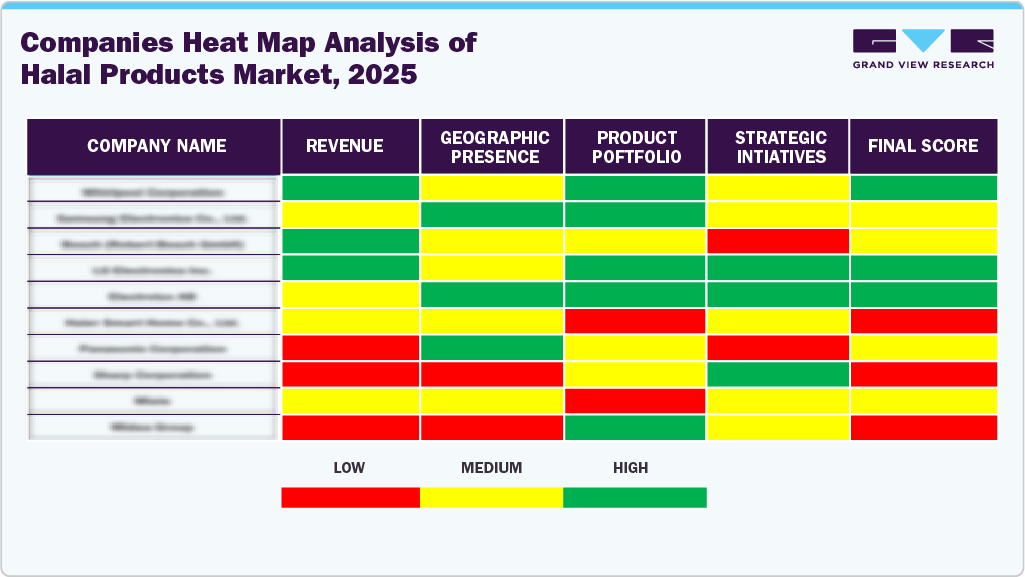
The global halal products market is highly fragmented across food & beverages, fashion, cosmetics & personal care, with competition spanning multinational consumer-goods companies, regional halal specialists, certified manufacturers, and local brands. Unlike in a conventional single-category market, halal products are supplied across multiple product groups, so company-level market shares are generally not disclosed separately. Competitive positioning is instead influenced by halal certification coverage, breadth of product portfolio, manufacturing footprint, brand trust, distribution reach, product quality, and ability to comply with different national halal standards.
-
Leading multinational consumer-goods companies: Large multinational companies such as Nestlé, Unilever, PepsiCo, Mondelez International, Danone, and The Coca-Cola Company participate in halal markets through certified products and localized portfolios. Nestlé provides one of the strongest examples: its Malaysian operation has historically been identified by the company as its Halal Centre of Excellence, with halal products exported to more than 50 countries and halal-certified manufacturing extending across its global network. Nestlé also generated CHF 89.5 billion in group sales in 2025, sells products in 185 countries, and operates 335 factories across 75 countries, giving it substantial distribution and manufacturing advantages.
-
Halal-specialist and regional manufacturers: Regional companies and halal-focused producers remain important competitive forces, particularly in Southeast Asia, the Middle East, South Asia, and Africa. These players can compete more effectively based on local taste preferences, certification requirements, pricing, and culturally relevant product positioning than global companies can. In Malaysia, for example, Nestlé's halal manufacturing ecosystem demonstrates how local certification infrastructure can support international export operations; its Malaysia business has historically operated seven halal factories and has exported to more than 50 countries.
-
Food & beverage remains the principal competitive battlefield: Food and beverages represented the overwhelming majority of the market. Consequently, companies with large food portfolios and established halal manufacturing capabilities possess the greatest opportunity to capture market share. Nestlé's portfolio alone spans beverages, prepared foods, dairy, confectionery, nutrition, and other categories, while Unilever competes through foods and food-service products alongside its personal-care portfolio.
-
Cosmetics & personal care is becoming a distinct competitive arena: Cosmetics & personal care is strategically important because halal requirements increasingly extend beyond food into ingredients, processing, formulation, and product safety. Multinationals such as Unilever can leverage established brands and global R&D capabilities, while specialist halal cosmetics companies compete through certification, ingredient transparency, modest-beauty positioning, and Muslim-focused branding. Unilever's 2025 Beauty & Wellbeing and Personal Care businesses together generated approximately €26 billion, illustrating the scale of the broader categories in which halal-certified offerings can be developed.
-
Certification and regulatory compliance as a competitive moat: Halal certification is becoming an important source of differentiation because requirements and certification practices can vary between countries. Unilever has explicitly highlighted the lack of harmonization between halal standards as a barrier to international trade and supports mutual recognition of halal standards. This creates an advantage for large manufacturers with dedicated compliance teams, established certification relationships, and the ability to maintain consistent traceability across multiple production facilities.
-
Competitive advantage is shifting toward scale plus localization: Large multinationals possess advantages in manufacturing, R&D, distribution, and certification management, while regional halal specialists can differentiate through local consumer knowledge and culturally relevant products. The most defensible competitive positions are therefore likely to come from a combination of halal certification credibility, extensive product portfolios, localized formulation, supply chain traceability, retail reach, and export capability, rather than manufacturing scale alone.
The global market is evolving into a diversified consumer base spanning food & beverages, modest fashion, and halal cosmetics & personal care. Food & beverages remain the largest segment, but fashion and beauty are becoming increasingly important as consumers seek halal-compliant products across their broader lifestyles. Competition is correspondingly spread across different types of companies, from global food manufacturers such as Nestlé, BRF, Cargill, QL Foods, and Al Islami Foods to modest fashion specialists such as Modanisa and Aab Collection, and halal beauty players including Wardah and INIKA Organic. The growth is expected to be driven by the rising halal consumer awareness, product diversification, expanding e-commerce, premiumization, stronger certification infrastructure, and increasing availability of halal products beyond traditional food categories.
 To learn more about this report, Download Free Sample Report
 Key Halal Products Companies
The following key companies have been profiled for this study of the halal products market.
-
Nestlé
-
BRF
-
Cargill
-
QL Resources / QL Foods
-
Al Islami Foods
-
Modanisa
-
Aab Collection
-
Paragon Technology and Innovation / Wardah
-
INIKA Organic
-
Saffron Road
Competitive Benchmarking
Category
Operating Strategies
Competitive Edge
Weakness
Established Players (Nestlé; BRF; Cargill; QL Resources / QL Foods; Al Islami Foods)
- Expand halal-certified product portfolios across processed foods, poultry, meat, convenience foods, snacks, beverages, and packaged food categories. Strengthen halal supply chains, certification capabilities, regional manufacturing, and distribution networks to serve Muslim-majority and halal-export markets. Invest in product innovation, localized formulations, and retail partnerships while leveraging established brands to increase penetration across supermarkets, hypermarkets, foodservice, and e-commerce channels.
- Strong global or regional manufacturing capabilities, established brand recognition, extensive distribution networks, and deep supplier relationships. Large-scale operations enable cost efficiencies, consistent product availability, and the ability to comply with halal certification requirements across multiple markets. Established players also benefit from broad product portfolios and stronger financial resources for capacity expansion, marketing, and international market entry.
- Large organizations may face longer product development and decision-making cycles, limiting their ability to respond rapidly to niche halal consumer preferences. Dependence on complex international supply chains can increase exposure to raw material costs, logistics disruptions, regulatory differences, and varying halal certification requirements across countries.
Emerging & Specialty Players (Modanisa; Aab Collection; Paragon Technology and Innovation / Wardah; INIKA Organic; Saffron Road)
- Focus on specialized halal and Muslim-oriented consumer segments across modest fashion, halal cosmetics, personal care, organic beauty, and specialty food products. Leverage e-commerce, social commerce, influencer marketing, community-driven branding, and digital-first distribution to reach younger and increasingly affluent halal consumers. Emphasize halal certification, ethical sourcing, clean-label formulations, modest fashion, sustainability, and culturally relevant product development to differentiate from mainstream competitors.
- Strong understanding of Muslim consumer preferences, niche market positioning, product specialization, and greater flexibility in responding to emerging consumer trends. Digital-first strategies enable these companies to reach international consumers without requiring extensive physical retail infrastructure. Strong community engagement and specialized brand identities also support customer loyalty and premium positioning.
- Smaller scale and narrower product portfolios compared with multinational consumer goods companies. Greater dependence on e-commerce platforms, niche consumer segments, and discretionary spending can increase vulnerability to changes in consumer demand. Limited manufacturing capacity and geographic reach may also constrain international expansion and create greater dependence on third-party suppliers and certification partners.
Recent Developments
-
In June 2026, L’Oréal signed an agreement to acquire a majority stake in India-based personal care company Innovist, which includes brands such as Bare Anatomy and Chemist at Play. The transaction expands L’Oréal’s access to fast-growing digital-first personal care platforms, where halal-compliant, clean-label, and ingredient-transparent product lines can be developed in parallel, reflecting the increasing convergence between halal requirements and broader ethical and natural beauty trends.
-
In March 2026, ASOS launched IYAL, a new modest-wear brand, becoming its exclusive UK and European wholesale partner. The initial collection comprised 64 styles spanning occasion wear, tailoring, and everyday clothing, along with coordinated hijabs, demonstrating the growing integration of modest and halal-oriented fashion into mainstream international fashion platforms.
-
In October 2025, MBRF expanded its partnership with Saudi Arabia’s Halal Products Development Company (HPDC) to establish Sadia Halal, a multi-protein halal business combining production units, distribution centers, and commercial operations. The initiative aims to create the world’s largest halal chicken company and reflects growing institutional investment and consolidation in the global halal food supply chain.
-
In October 2025, Indonesian modest-fashion brand Buttonscarves opened its first Singapore store at Jewel Changi Airport as part of its international expansion strategy. The move extends the brand beyond its established presence in Indonesia and Malaysia and demonstrates how premium modest-fashion companies are increasingly using international retail locations to reach consumers beyond their core domestic markets.
-
In March 2025, South Korea’s SPC Group highlighted its newly completed manufacturing facility in Malaysia as a strategic hub for expanding its bakery and food operations across Southeast Asia and the Middle East. The facility increases production capacity and streamlines international distribution, supporting the company’s efforts to participate more extensively in halal-oriented markets in Muslim-majority regions.
-
In March 2025, Indian modest-fashion brand Mashroo expanded its offline footprint by opening five new stores across Mumbai and Hyderabad, bringing its total store count to nine. The expansion strengthens the availability of culturally rooted modest clothing through physical retail and illustrates the increasing movement of modest and halal-oriented fashion brands from predominantly digital channels toward dedicated retail networks.
-
In January 2025, France-based Isla Délice Group acquired German halal meat company Gurkan, expanding its presence into Germany and increasing its operations to seven European markets. The acquisition strengthens Isla Délice’s premium halal portfolio and demonstrates continued consolidation and cross-border expansion among established halal consumer-product companies in Europe.
-
In March 2025, Haldiram’s attracted strategic investment from Alpha Wave Global and International Holding Company (IHC), following Temasek’s participation, to support its international expansion, particularly in the U.S. and Middle East. The investment strengthens the financial capacity of a major Indian packaged-food brand to expand its international consumer base, including demand from halal-consuming markets.
Halal Products Market Report Scope
Report Attribute
Details
Market size in 2025
USD 2,086.0 billion
Estimated market size in 2026
USD 2,209.9 billion
Projected market size by 2033
USD 3,311.6 billion
Growth rate
CAGR of 5.9% from 2026 to 2033
Base year
2025
Actuals
2021 - 2025
Forecast period
2026 - 2033
Quantitative units
Revenue in USD billion, and CAGR from 2026 to 2033
Report coverage
Revenue forecast, company ranking, competitive landscape, growth factors, and trends
Segments covered
Product, distribution channel, regional
Regional scope
North America; Europe; Asia Pacific; Central & South America; Middle East & Africa
Country scope
U.S.; Canada; Mexico, UK; Germany; France; Italy; Spain; China; India; Japan; Australia & New Zealand; South Korea; Indonesia; Brazil; South Africa; Saudi Arabia
Key companies profiled
Nestlé; BRF; Cargill; QL Resources / QL Foods; Al Islami Foods; Modanisa; Aab Collection; Paragon Technology and Innovation / Wardah; INIKA Organic; Saffron Road
Customization scope
Free report customization (equivalent up to 8 analysts’ working days) with purchase. Addition or alteration to country, regional & segment scope.
Pricing and purchase options
Avail customized purchase options to meet your exact research needs. Explore purchase options
Global Halal Products Market Report Segmentation
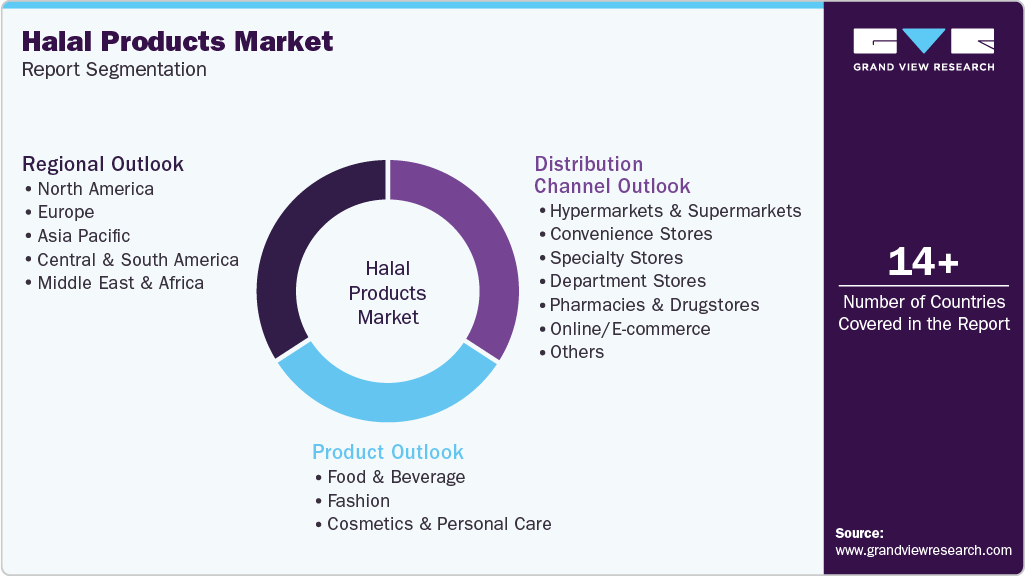
This report forecasts revenue growth at the global, regional & country levels and provides an analysis of the latest trends and opportunities in each of the sub-segments from 2026 to 2033. For this study, Grand View Research has segmented the global halal products market report based on product, distribution channel, and region:
 To learn more about this report, Download Free Sample Report
 -
Product Outlook (Revenue, USD Billion, 2021 - 2033)
-
Food & Beverage
-
Meat & Alternatives
-
Milk & Milk Products
-
Fruits & Vegetables
-
Grain Products
-
Others
-
-
Fashion
-
Apparel
-
Footwear
-
Accessories
-
-
Cosmetics & Personal Care
-
Skincare
-
Haircare
-
Makeup
-
Fragrances
-
Oral care
-
-
-
Distribution Channel Outlook (Revenue, USD Billion, 2021 - 2033)
-
Hypermarkets & Supermarkets
-
Convenience Stores
-
Specialty Stores
-
Department Stores
-
Pharmacies & Drugstores
-
Online/E-commerce
-
Others
-
-
Regional Outlook (Revenue, USD Billion, 2021 - 2033)
-
North America
-
U.S.
-
Canada
-
Mexico
-
-
Europe
-
Germany
-
UK
-
France
-
Italy
-
Spain
-
-
Asia Pacific
-
China
-
India
-
Japan
-
Australia & New Zealand
-
Indonesia
-
South Korea
-
-
Central & South America
-
Brazil
-
-
Middle East & Africa
-
South Africa
-
Saudi Arabia
-
-
Segment Definition
Segment - Product
Revenue capture definition
Food & Beverage
Covers halal-certified and halal-compliant food and beverage products across packaged foods, processed foods, meat and poultry, seafood, dairy, bakery products, confectionery, snacks, ready-to-eat meals, beverages, and other consumables. The scope includes products sold through organized retail, specialty halal outlets, foodservice-linked retail formats, and online channels.
Fashion
Covers halal-oriented and modest fashion products, including apparel, modest wear, abayas, hijabs, scarves, Islamic clothing, modest activewear, footwear, accessories, and related fashion merchandise. The scope includes branded, private-label, designer, and specialized halal or modest-fashion offerings distributed through physical retail stores, specialty outlets, and e-commerce platforms.
Cosmetics & Personal Care
Covers halal-certified or halal-compliant cosmetics and personal care products, including skincare, makeup, haircare, fragrances, toiletries, oral care, body care, and grooming products. The scope includes products formulated, manufactured, marketed, or certified in accordance with applicable halal requirements and sold through pharmacies, specialty stores, retailers, department stores, and online channels.
Segment - Distribution Channel
Revenue capture definition
Hypermarkets & Supermarkets
Covers halal products sold through large-format grocery and general merchandise retailers, including hypermarkets, supermarkets, supercenters, and supermarket chains. The scope includes dedicated halal sections, halal-certified product ranges integrated within conventional aisles, private-label offerings, and food, fashion, cosmetics, and personal care products available through these retail formats.
Convenience Stores
Covers halal products distributed through convenience stores, neighborhood stores, forecourt retail outlets, and small-format chain retailers. The scope includes packaged food, beverages, snacks, personal care products, and other fast-moving halal merchandise stocked in limited-assortment retail environments, including independently operated and chain-affiliated convenience formats.
Specialty Stores
Covers specialized retail outlets focused on halal products, Islamic products, modest fashion, halal food, cosmetics, personal care, or related categories. The scope includes independent stores, specialty chains, branded halal retailers, ethnic retailers, and niche concept stores offering certified or halal-compliant products across relevant product categories.
Department Stores
Covers halal products sold through department stores and large multi-category retail establishments offering fashion, beauty, personal care, accessories, and selected food products. The scope includes dedicated halal or modest-fashion sections, halal-certified branded products, department-store private labels, and merchandise distributed through physical and integrated omnichannel retail networks.
Pharmacies & Drugstores
Covers halal cosmetics, personal care, toiletries, wellness-related consumer products, and other applicable halal merchandise sold through pharmacies and drugstores. The scope includes independent pharmacies, pharmacy chains, drugstore formats, health and beauty retailers with pharmacy operations, and products available through their physical and online retail channels.
Online / E-commerce
Covers halal products purchased through digital retail channels, including brand-owned websites, online marketplaces, retailer websites, social-commerce platforms, and specialized halal e-commerce stores. The scope includes food and beverages, fashion, cosmetics, personal care, and related products sold through direct-to-consumer and third-party digital storefronts.
Others
Covers halal products distributed through channels outside the defined hypermarket, supermarket, convenience, specialty, department store, pharmacy, and e-commerce formats. The scope includes direct sales, institutional and community-based outlets, wholesalers, distributors, vending, traditional retail, duty-free channels, and other applicable routes to consumers.
Estimation Model
01
Halal Consumer Base Layer02
Halal Product Eligibility & Market Access Layer03
Category Adoption & Purchase Layer04
Monetisation LayerWho represents the core demand for halal products?
Which consumers and product categories have meaningful access to halal offerings?
What proportion of the addressable base actually purchases halal products?
How much revenue is generated?
Global Muslim population by country, age, income, and urbanization provides the primary consumer base. Additional demand is associated with non-Muslim consumers seeking products aligned with ethical sourcing, ingredient transparency, modesty, animal welfare, and sustainability. The framework covers food & beverages, cosmetics & personal care, pharmaceuticals, and halal-oriented fashion/apparel.
Regional Muslim consumption patterns, halal certification penetration, availability of certified products, import dependence, retail infrastructure, e-commerce penetration, and national halal regulations define the commercially addressable market. Certification is particularly relevant to food, cosmetics, and pharmaceuticals, while fashion is more strongly influenced by modesty and lifestyle preferences.
Category-specific purchase incidence and spending intensity are assessed across halal food & beverages, cosmetics & personal care, pharmaceuticals, and modest/halal-oriented fashion. Muslim consumer spending, household expenditure, category penetration, product availability, and repeat-purchase behavior provide the principal demand indicators.
Annual category consumption is valued using product-specific retail prices, category ASPs, household spending, and regional purchasing-power differences. Revenue is aggregated across halal food & beverages, cosmetics & personal care, pharmaceuticals, and halal/modest fashion, with premium certified products, branded offerings, and higher-value imported products reflected through category-specific pricing.
Delivered Customizations
This report has been delivered with the following In-depth customizations
Client Request
Customization Delivered
Value Adds
Cross-Category Analysis of Halal Food, Fashion & Cosmetics by Consumer Need and Market Maturity
Developed a cross-segment analysis comparing Food & Beverage, Fashion, and Cosmetics & Personal Care, with further analysis at the third level: meat & alternatives, dairy, fruits & vegetables, grains; apparel, footwear, accessories; and skincare, haircare, makeup, fragrances, and oral care. The analysis maps each category against purchase drivers such as halal compliance, product quality, price, ethical sourcing, modesty, ingredient transparency, brand trust, and lifestyle positioning across major geographic markets.
Identifies that halal demand is not uniform across categories. Food is more directly linked to formal halal compliance and certification, while fashion is more closely associated with modesty and lifestyle preferences, and cosmetics increasingly combine halal positioning with clean beauty, ingredient transparency, and ethical sourcing. This enables companies to prioritize categories based on both consumer needs and market maturity, rather than treating the halal market as a homogeneous opportunity.
Halal Certification, Ingredient & Compliance Opportunity Mapping
Detailed assessment of the halal compliance intensity across product categories, examining certification requirements, ingredient scrutiny, processing practices, supply-chain traceability, animal-derived ingredients, alcohol-related concerns, manufacturing segregation, and labeling requirements. The analysis differentiates between mandatory/regulatory certification environments and consumer-driven halal claims, particularly across food, cosmetics, and personal care.
Highlights where certification represents a market-access requirement versus a brand-trust differentiator. It can identify potential barriers for international brands entering Muslim-majority markets and opportunities for companies that can provide transparent sourcing, recognized certification, traceability, and halal-compliant manufacturing. Certification is increasingly relevant to international market access across food and cosmetics.
Halal Brand Positioning & Competitive Benchmarking Across Food, Fashion & Beauty
Comprehensive benchmarking of global conglomerates, regional halal specialists, Muslim-founded brands, modest-fashion labels, halal beauty companies, and mainstream brands with halal-certified portfolios. Competitors are evaluated across halal credentials, product portfolio, price positioning, geographic presence, brand heritage, ingredient/material transparency, innovation, digital presence, and distribution reach.
Separates halal-first brands from mainstream companies using halal as a portfolio or market-access strategy. It also identifies competitive white spaces where brands can differentiate through premium halal positioning, clean beauty, modest fashion, ethical sourcing, culturally relevant product design, and localized portfolios.
Frequently Asked Questions About This Report
Key factors include increasing consumer demand for halal-certified food and beverages, meat and meat alternatives, milk and milk products, fashion and apparel, cosmetics and personal care products, along with expanding availability through supermarkets, specialty stores, and online/e-commerce channels.
Asia-Pacific dominated the market with a 45.6% revenue share in 2025.
Middle East & Africa is the fastest-growing regional market, with a projected 6.9% CAGR from 2026 to 2033.
The Food and Beverage segment led the market with a 77.84% revenue share in 2025 and is projected to grow at a 6.1% CAGR from 2026 to 2033.
Cosmetics & Personal Care is the fastest-growing segment and is projected to grow at a 6.2% CAGR from 2026 to 2033.
Hypermarkets & Supermarkets held the largest revenue share of 35.7% in 2025, while Online/E-commerce is projected to be the fastest-growing distribution channel, with a 6.6% CAGR from 2026 to 2033.
Key players include Nestlé, Unilever, Cargill, Archer Daniels Midland Company (ADM), JBS S.A., BRF S.A., Almarai, Al Islami Foods, Amara Cosmetics, and Saffron Road.
The global halal products market size was valued at USD 2,086.0 billion in 2025 and is estimated at USD 2,209.9 billion in 2026.
The global halal products market is expected to grow at a CAGR of 5.9% from 2026 to 2033, reaching USD 3,311.6 billion by 2033.
About the Author(s)
Consumer Goods Research Team
Research · Consumer GoodsThis report was authored by the consumer goods research team at Grand View Research - comprising two research analysts, one senior research analyst, and one industry expert - with specialized expertise in the consumer goods segment of the research industry. All findings are based on proprietary research databases, executive interviews, and regulatory analysis, subject to internal peer review prior to publication.
Last Updated:
Speak to Analyst

Customize this report to your needs - add regions, segments, or data points, with 20% free customization.
Or view our licence options:


ISO 9001:2015 & 27001:2022 Certified
We are GDPR and CCPA compliant! Your transaction & personal information is safe and secure. For more details, please read our privacy policy.


