
- Home
- »
- Beauty & Personal Care
- »
-
Hand Cream Market Size And Share Report, 2026 - 2033GVR Report cover

Hand Cream Market (2026 - 2033)
Size, Share & Trends Analysis Report By Product (Moisturizing Hand Creams, Anti-Aging Hand Creams), By End-use, By Distribution Channel, By Region, And Segment Forecasts
Market Size, 2025
$871.3MMarket Estimate, 2026
$923.3MMarket Forecast, 2033
$1,457.7MCAGR, 2026–2033
6.7%Hand Cream Market Summary
The global hand cream market size was valued at USD 871.3 million in 2025 and is projected to grow from USD 923.3 million in 2026 to USD 1,457.7 million by 2033, growing at a CAGR of 6.7% from 2026 to 2033. North America dominated the market, accounting for the largest global share of 36.4% in 2025. The market growth is majorly driven by the increased consumer awareness of hand hygiene and the benefits of moisturizing, growing demand for natural and organic products, and the introduction of innovative products with added features like SPF or aromatherapy.
 Source: Grand View Research, IR Documents, Primary Interviews, Paid DatabasesTo learn more about this report,
 Download Free Sample Report
 Key Market Trends & Insights
- By product: Moisturizing hand cream segment held the largest share of 40.3% in 2025.
- By end-use: Women segment held the largest revenue share of 74.5% in 2025.
- By distribution channel: Supermarkets & hypermarkets segment held the largest share of 34.0% in 2025
Regional Highlights
- Largest regional market: North America (36.4% revenue share, 2025)
- By country: The U.S. held the largest share of North America in 2025.
Market Size & Forecast
- Market size in 2025: USD 871.3 Million
- Estimated market size in 2026: USD 923.3 Million
- Projected market size by 2033: USD 1,457.7 Million
- CAGR (2026-2033): 6.7%
Three ways to get this report
Buy it, customize it, or ask a question.Ask an Analyst
A direct answer, usually in 1 working day
- AccessReport author, directly
- Reply timeWithin 1 working day
- No sales callDirect answer only
- FormatEmail reply
- CostFree, no cost
Get the Full Report
What the study covers
- FormatsPDF · Excel · Dashboard
- Timeline2026–2033 annual, 2025 base
- Coverage20+ countries, 5 regions
- Companies10+ key players profiled
Customize the Report
20% free customization
- IncludeCountries, segments, points
- TailorTo your product definition
- ExtendDeeper competitor detail
- OrA fully bespoke study
- Turnaround5–10 working days
With the rise of the COVID-19 pandemic, there has been a heightened focus on handwashing and the use of sanitizers, leading consumers to seek moisturizing solutions that can counteract the drying effects of frequent hand cleansing. This shift in consumer behavior has expanded the demand for hand creams that not only provide hydration but also enhance skin health. As a result, brands have responded by innovating their product lines, incorporating advanced formulations that include natural ingredients, vitamins, and soothing agents to attract health-conscious consumers.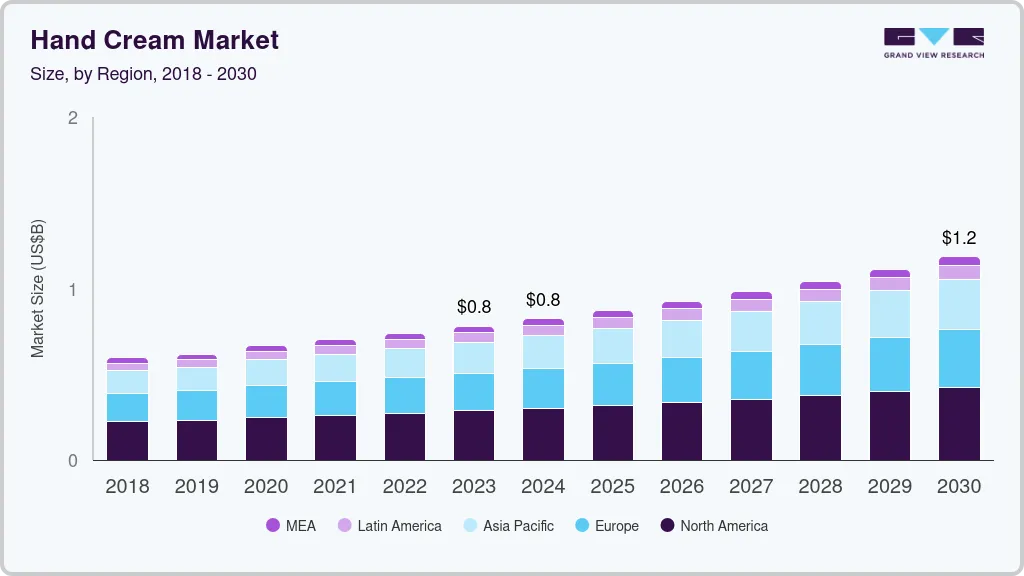 To learn more about this report, Download Free Sample Report
 In addition to the pandemic's influence, the growth of the e-commerce sector has revolutionized the way consumers purchase personal care products, including hand creams. Online retail platforms have made it easier for consumers to access a wide variety of products from global brands, facilitating informed purchasing decisions through product reviews and detailed descriptions. The convenience of home delivery and the ability to compare prices across different platforms have further boosted sales. As a result, traditional brick-and-mortar retailers are increasingly adopting omnichannel strategies, blending physical and digital experiences to reach a broader audience and enhance customer engagement.
The market has witnessed a significant shift with the growing inclusion of active ingredients such as retinol and niacinamide in product formulations. This trend is driven by increasing consumer demand for multifunctional skincare solutions that go beyond basic moisturization. Retinol, known for its anti-aging properties, and niacinamide, recognized for its ability to improve skin texture and tone, are being incorporated into hand creams to offer enhanced benefits. These active ingredients appeal to consumers who are increasingly seeking products that deliver visible results, such as reducing signs of aging, brightening skin, and improving overall skin health.
Manufacturers are responding to this trend by innovating their product lines to include these potent ingredients, positioning their offerings as advanced skincare solutions for the hands. For example, Nécessaire Inc., a prominent player in the personal care industry, offers a hand cream named The Hand Retinol | 0.25% Retinol. This product is formulated with 0.25% pure retinol and is complemented by AHA, peptides, vitamins, and glycerin. It is specifically designed to address and prevent common signs of aging, such as crepiness, lines, wrinkles, spots, and marks, thereby promoting younger-looking hands. Moreover, the use of active ingredients like retinol and niacinamide is expanding the demographic reach of hand creams. While traditionally marketed towards older consumers concerned with anti-aging, these advanced formulations are now attracting younger audiences who are interested in preventive skin care.
Sustainability is also a key factor propelling growth in the hand cream market. With consumers becoming more environmentally conscious, there is a growing preference for products that utilize eco-friendly packaging and sustainably sourced ingredients. Brands that prioritize sustainability in their business models are not only appealing to eco-conscious consumers but are also setting trends within the industry. For example, L'Occitane offers its Shea Butter Hand Cream as a key product within its portfolio. This nourishing and softening hand cream, formulated with 20% organic shea butter, is highly effective in addressing dry hands. Widely trusted by consumers, this best-selling hand cream ensures hands remain supple, hydrated, and protected year-round, making it a cornerstone of L'Occitane's skincare offerings. As companies respond to this demand by reformulating products and adopting responsible sourcing practices, the hand cream segment is witnessing an influx of natural and organic options that cater to this emerging consumer base.
The market is seeing an increasing segmentation of product offerings to cater to diverse consumer needs. Specialized formulations targeting specific skin concerns, such as anti-aging, sensitive skin, or irritation relief, are becoming more prevalent. Additionally, the emergence of premium and luxury hand creams, often featuring unique textures and fragrances, has attracted affluent consumers willing to invest in high-quality skincare products. This segmentation is further supported by targeted marketing campaigns that educate consumers about the benefits of these specialized formulations, thus enhancing brand loyalty and encouraging repeat purchases.
The market's growth trajectory is also bolstered by strategic partnerships and collaborations among key industry players. Brands are increasingly engaging in mergers and acquisitions to expand their product portfolios and market reach. Collaborations with influencers and skincare experts have become commonplace, driving brand awareness and consumer trust. These strategies enable companies to capitalize on emerging trends and adapt to shifting consumer preferences, ensuring that they remain competitive in an increasingly crowded marketplace. As a result, the hand cream market is poised for continued growth, supported by a combination of consumer demand, innovative product development, and effective marketing strategies.
Market Dynamics
The hand cream market is gaining momentum as consumers increasingly prioritize skin hydration, protection, and overall hand care as part of their daily skincare routines. Growing concerns regarding dry skin, premature aging, frequent hand washing, and environmental damage have accelerated demand for specialized hand creams with moisturizing, repairing, and anti-aging benefits. The rising popularity of products formulated with natural ingredients, advanced skincare actives, and sustainable packaging, coupled with expanding online retail channels and premium product offerings, is expected to continue driving market growth globally.
The increasing prevalence of dry skin, skin sensitivity, and hand-related skin concerns is a key factor driving demand in the hand cream market. Frequent hand washing, extensive use of alcohol-based sanitizers, exposure to harsh weather conditions, pollution, and prolonged contact with cleaning chemicals have contributed to growing cases of skin dryness, irritation, cracking, and premature aging of the hands. Consumers are becoming more aware of the importance of maintaining the skin barrier and preventing moisture loss, leading to higher adoption of moisturizing and repairing hand care products.
The growing emphasis on personal grooming and skincare routines has further accelerated demand for hand creams enriched with nourishing ingredients such as shea butter, glycerin, hyaluronic acid, ceramides, and natural botanical extracts. In addition, rising interest in anti-aging skincare has encouraged the use of specialized hand creams that address pigmentation, fine lines, and loss of skin elasticity. As consumers increasingly seek preventive and long-term skin health solutions, demand for premium and multifunctional hand cream products continues to expand globally.
The hand cream market faces challenges due to the widespread availability of low-cost substitutes and increasing competition from broader skincare products. Many consumers use general body lotions, moisturizers, petroleum jelly-based products, and multipurpose creams as alternatives to dedicated hand creams, limiting product penetration in price-sensitive markets. In addition, the market is highly fragmented, with numerous international, regional, and private-label brands offering similar formulations and benefits, making product differentiation difficult.
Rising competition places pressure on manufacturers to continuously innovate through new ingredients, fragrances, textures, and packaging formats while maintaining competitive pricing. Furthermore, premium hand creams often face resistance from consumers who perceive hand care products as non-essential compared to facial skincare products. Economic uncertainties and inflationary pressures can also influence discretionary spending, prompting consumers to shift toward lower-priced alternatives. These factors may constrain revenue growth and create challenges for brands seeking to establish strong customer loyalty and premium positioning within the global hand cream market.
The increasing consumer preference for premium skincare solutions presents a significant growth opportunity for the hand cream market. Consumers are becoming more ingredient-conscious and are actively seeking hand creams formulated with natural, organic, plant-based, and dermatologist-recommended ingredients that provide enhanced moisturizing, repairing, and protective benefits. This trend is encouraging manufacturers to develop innovative formulations incorporating ingredients such as shea butter, hyaluronic acid, ceramides, botanical extracts, and vitamins.
The rising demand for multifunctional products is further expanding market opportunities. Consumers increasingly prefer hand creams that offer multiple benefits, including hydration, anti-aging protection, skin brightening, SPF protection, and barrier repair within a single product. In addition, the growing popularity of clean beauty, sustainable packaging, and premium self-care routines is creating opportunities for brands to differentiate their offerings and capture higher-value consumer segments. The continued expansion of e-commerce platforms and direct-to-consumer channels is also enabling manufacturers to reach a broader customer base and accelerate global market penetration.
Analyst Perspective
The hand cream market benefits from a favorable convergence of skincare premiumization, rising consumer focus on skin health, and growing demand for multifunctional personal care products. While moisturization remains the core purchase driver, the next phase of market growth will be led by brands that successfully combine hydration, barrier repair, anti-aging, brightening, and clean-label formulations within a single product offering. The strongest competitive advantage will belong to companies that leverage dermatological expertise, natural ingredients, and sustainable packaging to build brand loyalty and justify premium pricing in an increasingly crowded and innovation-driven hand care landscape.
Product Insights
Based on product, the moisturizing hand cream segment led the market with the largest revenue share of 40.3% in 2025. The demand for moisturizing hand creams is growing due to increasing consumer awareness of skin health, heightened exposure to environmental stressors, and rising incidences of skin dryness. Urban lifestyles, frequent hand washing, and exposure to harsh weather conditions further contribute to skin hydration needs. Additionally, the trend toward multifunctional products offering hydration, protection, and anti-aging benefits is driving market expansion. Brands are responding with innovative formulations that incorporate natural ingredients, vitamins, and botanicals, appealing to consumers seeking effective and sustainable skincare solutions. This convergence of factors positions moisturizing hand creams as essential products in contemporary personal care routines.
The anti-aging hand creams are expected to grow at the fastest CAGR of 8.2% over the forecast period. The demand for these products is growing due to the increasing consumer focus on comprehensive skincare, extending beyond the face to include the hands, which are often the first to show signs of aging. As awareness rises about the impact of environmental factors, UV exposure, and frequent hand washing on skin aging, consumers are seeking targeted solutions to combat wrinkles, age spots, and loss of skin elasticity. The inclusion of active ingredients like retinol, peptides, and antioxidants in anti-aging hand creams has further fueled demand, offering consumers products that not only moisturize but also provide long-term benefits. This trend is particularly strong among aging populations and skincare-conscious consumers, driving market growth in this segment.
End Use Insights
Based on end-user, the women segment led the market with the largest revenue share of 74.5% in 2025. The growing demand for hand creams among women is driven by heightened awareness of skincare and the increasing emphasis on personal grooming. As women increasingly prioritize maintaining youthful and healthy skin, hand creams, particularly those enriched with active ingredients like retinol and niacinamide, are becoming essential in daily skincare routines. The rise of remote work and frequent handwashing due to health concerns has also spurred demand, as women seek solutions to combat dryness and maintain skin softness. Additionally, the expanding range of targeted products catering to specific needs, such as anti-aging or hydration, further propels market growth, aligning with women's evolving preferences and lifestyles.
The men’s demand for hand creams is anticipated to grow with a CAGR of 7.4% from 2026 to 2033. Modern men are more conscious of maintaining healthy skin, leading to greater adoption of hand creams that offer moisturizing, anti-aging, and protective benefits. Additionally, the rise of targeted marketing campaigns and product formulations specifically designed for men has contributed to this trend. The shift towards a more holistic approach to personal care, coupled with the growing availability of male-focused skincare products, has further fueled the demand for hand creams in this demographic. This trend reflects a broader societal change where male grooming is increasingly normalized and valued.
Distribution Channel Insights
Based on distribution channel, the supermarkets and hypermarkets segment led the market with the largest revenue share of 34.0% in 2025. The growth in hand cream sales through supermarkets and hypermarkets is attributed to their high visibility and convenience, enabling consumers to purchase these products during regular shopping trips. These retail channels offer extensive product variety, allowing customers to easily compare brands and formulations. Additionally, frequent promotions and discounts make hand creams more appealing to price-sensitive buyers. The strong reputation of supermarkets and hypermarkets as reliable one-stop shopping destinations enhances consumer trust, driving higher sales volumes for hand creams in these settings.
 To learn more about this report, Download Free Sample Report
 The e-commerce sales channels are projected to grow at a CAGR of 7.9% over the forecast period of 2024 to 2030. The convenience and accessibility offered by online platforms enable consumers to shop from the comfort of their homes, allowing for easy access to a vast array of hand cream products without the constraints of geographical location. This shift in shopping behavior has been further accelerated by an increase in overall online spending, as consumers have developed greater confidence in purchasing personal care items online, bolstered by secure payment systems and reliable delivery options.
Companies are increasingly leveraging online platforms to launch their product lines, recognizing the strategic advantages offered by digital marketplaces. In December 2023, Rare Beauty, a brand founded by Selena Gomez, successfully launched the Find Comfort Body Collection through the Sephora app. This collection includes a hand cream, body lotion, and fragrance mist, with prices ranging from $18 to $28.
Regional Insights
North America dominated the hand cream market with the largest revenue share of 36.4% in 2025. The growth of the regional market is driven on account of the heightened awareness of skincare routines, particularly following the increased focus on hand hygiene during the COVID-19 pandemic, which has led to a significant rise in the usage of hand creams. Consumers are now prioritizing moisturizing products that protect against dryness, resulting in an uptick in demand for products that offer both functional benefits and sensory experiences.
 To learn more about this report, Download Free Sample Report
 U.S. Hand Cream Market Trends
The hand cream market in the U.S. is expected to grow at a significant CAGR over the forecast period. The growing trend of self-care has prompted consumers to invest in premium hand creams that offer soothing and nourishing properties, leading to an expansion in product offerings. Brands are capitalizing on this trend by introducing formulations with innovative ingredients, such as hyaluronic acid and botanical extracts, appealing to consumers seeking effective and luxurious hand care solutions.
Asia Pacific Hand Cream Market Trends
Asia Pacific accounted for a revenue share of around 23.5% in the year 2025. As consumers in countries like China and India adopt Western beauty standards, there is a noticeable shift towards skincare products that enhance personal grooming and overall wellness. The popularity of K-beauty products is also contributing to this growth, as consumers are drawn to the innovative formulations and packaging aesthetics. Furthermore, the increasing awareness of skincare routines among younger demographics is driving demand for specialized hand creams that address specific concerns, such as anti-aging and hydration.
Europe Hand Cream Market Trends
The European market is projected to grow at a CAGR of 7.0% from 2026 to 2033. The regional demand is being significantly influenced by the growing emphasis on sustainability and clean beauty. European consumers are becoming increasingly conscious of the ingredients in their personal care products, opting for hand creams that are formulated with natural and organic components. This shift towards ethical consumption is prompting brands to develop products that not only deliver performance but also align with eco-friendly practices, including sustainable sourcing and biodegradable packaging.
Key Hand Cream Company Insights
The competitive landscape of the market is characterized by a dynamic mix of established brands and emerging players, each vying for market share through innovation and differentiation. Major players, including industry leaders like L'Oréal, Unilever, and Beiersdorf AG, dominate the market with extensive product portfolios that cater to diverse consumer preferences. These companies leverage their strong distribution networks and brand recognition to maintain a competitive edge.
Emerging brands, particularly those focused on clean beauty and sustainability, are gaining traction by appealing to environmentally conscious consumers. This trend has led to a proliferation of niche players that offer specialized formulations, often emphasizing natural and organic ingredients. The rise of e-commerce has further intensified competition, allowing smaller brands to reach global audiences without the constraints of traditional retail channels.
Key Hand Cream Companies:
The following key companies have been profiled for this study on the hand cream market.
-
L'Occitane Groupe S.A.
-
Natura & Co
-
Johnson & Johnson
-
Nécessaire Inc.
-
The Clorox Company
-
Beiersdorf AG
-
L'Oréal S.A.
-
Kao Corporation
-
Unilever PLC
-
Pierre Fabre S.A
Competitive Benchmarking
Category
Operating Strategies
Competitive Edge
Weakness
Established Players (L'Oréal S.A., Beiersdorf AG, Unilever PLC, Johnson & Johnson, Kao Corporation, L'Occitane Groupe S.A., Pierre Fabre S.A.)
- Expand premium and mass-market hand care portfolios through continuous product innovation, natural ingredient incorporation, sustainability initiatives, omnichannel distribution, and global retail expansion. Invest in R&D to develop moisturizing, repairing, anti-aging, and multifunctional hand creams with clinically validated benefits.
- Strong global brand recognition, extensive distribution networks, significant R&D capabilities, large marketing budgets, and established consumer trust. Ability to leverage economies of scale and cross-category skincare expertise.
- High operational and marketing costs, complex global supply chains, increasing regulatory and sustainability compliance requirements, and slower innovation cycles compared to smaller niche brands.
Emerging Players (Nécessaire Inc., Natura & Co's emerging brands, independent clean beauty and natural skincare brands)
- Focus on clean-label formulations, vegan and sustainable products, direct-to-consumer sales, premium positioning, and targeted marketing around natural ingredients, wellness, and environmentally conscious consumers. Emphasize digital engagement and social media-driven brand building.
- Faster product innovation, stronger appeal among clean beauty consumers, ability to respond quickly to emerging skincare trends, and differentiated brand positioning in premium and natural hand care segments.
- Limited financial resources, lower global brand awareness, smaller distribution networks, higher customer acquisition costs, and challenges in scaling production and international market presence.
Recent Developments
-
In March 2024, TATA Harper Skincare entered into a partnership with Sky High Farm Universe, a nonprofit organization based in Hudson Valley, New York, dedicated to addressing food insecurity. This collaboration aimed to develop a distinctive hand cream specifically designed to rejuvenate the rough and fatigued hands of gardeners, farmers, and urban dwellers. The initiative underscored TATA Harper’s commitment to social responsibility, as 100% of the proceeds from the hand cream were directed towards supporting Sky High Farm’s food sovereignty mission. This partnership not only enhanced the brand's product offerings but also contributed to a meaningful cause, reinforcing TATA Harper’s position as a leader in sustainable and purpose-driven skincare.
-
In April 2023, Almora Botanica unveiled its latest skincare line, blending Ayurvedic principles with contemporary science and adaptogenic elements. The new offerings include a Purifying Gel Cleanser, Nourishing Night Face Oil, Hydrating & Resilience Face Lotion, Restorative Night Face Oil, Radiance Day Face Oil, Serum for Fine Lines, and Restorative Hand Cream.
Hand Cream MarketReport Scope
Report Attribute
Details
Market size value in 2025
USD 871.3 million
Market size value in 2026
USD 923.3 million
Revenue forecast in 2033
USD 1,457.7 million
Growth rate
CAGR of 6.7% from 2026 to 2033
Base year for estimation
2025
Historical data
2021 - 2024
Forecast period
2026 - 2033
Quantitative units
Revenue in USD million/billion, and CAGR from 2026 to 2033
Report coverage
Revenue forecast, company ranking, competitive landscape, growth factors, and trends
Segments covered
Product, end-use, distribution channel, region
Regional scope
North America; Europe; Asia Pacific; CSA; MEA
Country scope
U.S.; Canada; Mexico; UK; Germany; France; Italy; Spain; China; India; Japan; Australia & New Zealand; South Korea; Brazil; South Africa
Key companies profiled
L'Occitane Groupe S.A.; Natura & Co; Johnson & Johnson; Nécessaire Inc.; The Clorox Company; Beiersdorf AG; L'Oréal S.A.; Kao Corporation; Unilever PLC; Pierre Fabre S.A
Customization scope
Free report customization (equivalent up to 8 analysts' working days) with purchase. Addition or alteration to country, regional & segment scope.
Pricing and purchase options
Avail customized purchase options to meet your exact research needs. Explore purchase options
Global Hand Cream Market Report Segmentation
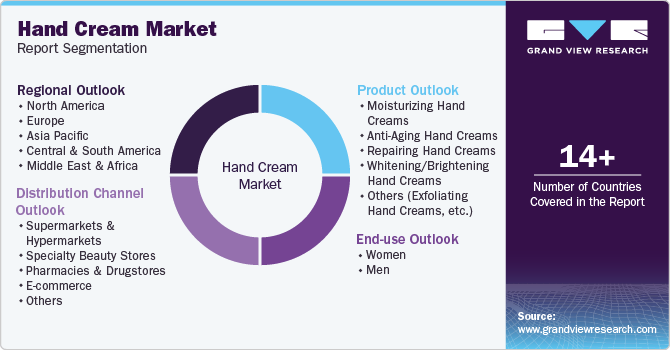
This report forecasts revenue growth at global, regional & country levels and provides an analysis of the latest trends and opportunities in each of the sub-segments from 2021 to 2033. For this study, Grand View Research has segmented the global hand cream market report based on the product, end use, distribution channel, and region:
 To learn more about this report, Download Free Sample Report
 -
Product Outlook (Revenue, USD Million, 2021 - 2033)
-
Moisturizing Hand Creams
-
Anti-Aging Hand Creams
-
Repairing Hand Creams
-
Whitening/Brightening Hand Creams
-
Others (Exfoliating Hand Creams, etc.)
-
-
End Use Outlook (Revenue, USD Million, 2021 - 2033)
-
Women
-
Men
-
-
Distribution Channel Outlook (Revenue, USD Million, 2021 - 2033)
-
Supermarkets & Hypermarkets
-
Specialty Beauty Stores
-
Pharmacies & Drugstores
-
E-commerce
-
Others
-
-
Regional Outlook (Revenue, USD Million, 2021 - 2033)
-
North America
-
U.S.
-
Canada
-
Mexico
-
-
Europe
-
UK
-
Germany
-
France
-
Italy
-
Spain
-
-
Asia Pacific
-
China
-
India
-
Japan
-
Australia & New Zealand
-
South Korea
-
-
Central & South America
-
Brazil
-
-
Middle East & Africa (MEA)
-
South Africa
-
-
Research Methodology
The hand cream market figures in this report are based on a proven research process that combines executive interviews with secondary research from proprietary databases, company filings, and recognized regulatory and institutional sources. Market size is built through value-chain sizing - reconciling supply-side and demand-side estimates - and triangulated with bottom-up and top-down approaches. Every estimate passes multiple levels of expert validation before publication, with each hand cream segment quantified using the revenue-capture definitions in the table below.
Segment Definition
Segment - Type
Revenue capture definition
Moisturizing Hand Creams
This segment covers the revenues generated through the sales of hand creams designed to hydrate and nourish the skin by replenishing moisture and preventing dryness. These products typically contain ingredients such as glycerin, hyaluronic acid, shea butter, aloe vera, and natural oils that help maintain skin softness and improve moisture retention. Moisturizing hand creams are widely used for daily hand care and protection against environmental stressors.
Anti-Aging Hand Creams
This segment covers the revenues generated through the sales of hand creams formulated to reduce visible signs of aging, including fine lines, wrinkles, age spots, and loss of skin elasticity. These products often incorporate active ingredients such as retinol, peptides, niacinamide, vitamin C, collagen boosters, and antioxidants to improve skin texture and firmness.
Repairing Hand Creams
This segment covers the revenues generated through the sales of hand creams specifically developed to restore damaged, cracked, rough, or irritated skin. These products are commonly enriched with ceramides, panthenol, allantoin, urea, and intensive moisturizers that support skin barrier repair and healing. Repairing hand creams are frequently used by individuals exposed to harsh weather, frequent hand washing, or occupational skin stress.
Whitening/Brightening Hand Creams
This segment covers the revenues generated through the sales of hand creams formulated to improve skin radiance, reduce pigmentation, and promote a more even skin tone. These products often contain ingredients such as niacinamide, vitamin C, licorice extract, alpha arbutin, and other brightening agents that help minimize the appearance of dark spots and discoloration.
Others (Exfoliating Hand Creams, etc.)
This segment covers the revenues generated through the sales of specialized hand creams that provide additional benefits beyond moisturization, anti-aging, repairing, or brightening functions. These include exfoliating hand creams, soothing hand creams, protective barrier creams, fragranced hand creams, and hand treatments targeting specific skin concerns. Exfoliating variants commonly contain alpha hydroxy acids (AHAs), lactic acid, or gentle exfoliating agents to remove dead skin cells and improve skin smoothness.
Estimation Model
Consumer Need Layer
Who needs hand cream products?
Product Adoption Layer
Who purchases hand cream regularly?
Distribution Access Layer
Where do consumers buy hand creams?
Monetisation Layer
How much revenue is generated?Identify the addressable consumer base by evaluating the prevalence of dry skin, frequent hand washing, exposure to harsh weather conditions, and growing skincare awareness. Assess demand among women and the rapidly expanding male grooming segment to establish the potential consumer population.
Apply adoption rates based on consumer preference for moisturizing, anti-aging, repairing, whitening/brightening, and other specialized hand cream products. Evaluate premium skincare trends and repeat purchases.
Estimate sales through supermarkets & hypermarkets, specialty beauty stores, e-commerce, and other retail channels. Assess omnichannel expansion and accessibility.
Calculate revenue by combining product category sales, purchasing frequency, regional demand, product innovation, clean-label formulations, sustainable packaging, premium pricing, and e-commerce channels.
Delivered Customizations
This report has been delivered with the following In-depth customizations
CLIENT REQUEST
CUSTOMIZATION DELIVERED
VALUE ADDS
Moisturizing & Anti-Aging Hand Cream Trends
Conducted a focused analysis of hand cream products covering moisturizing, anti-aging, repairing, whitening/brightening, and multifunctional formulations with active ingredients such as retinol, niacinamide, botanical extracts, SPF, and natural ingredients.
Helps stakeholders identify high-growth product categories, understand evolving consumer skincare preferences, and evaluate innovation opportunities in multifunctional and premium hand cream formulations.
Consumer Adoption & Distribution Channel Assessment
Evaluated purchasing trends across supermarkets & hypermarkets, specialty beauty stores, pharmacies & drugstores, e-commerce, and other retail channels, along with demand patterns among women and men and the influence of omnichannel retail strategies.
Provides insights into consumer buying behavior, channel performance, and retail expansion opportunities, enabling companies to optimize distribution strategies and strengthen market penetration.
Natural, Sustainable & Premium Hand Care Opportunity Assessment
Assessed demand for natural and organic ingredients, sustainable packaging, premium skincare formulations, eco-friendly products, and advanced hand creams offering hydration, anti-aging, and skin protection benefits across key regional markets.
Supports investment and product development strategies by identifying emerging consumer trends, premiumization opportunities, sustainability initiatives, and long-term growth areas in the global hand cream market
Frequently Asked Questions About This Report
The global hand cream market is expected to grow at a CAGR of 6.7% from 2026 to 2033, reaching USD 1,457.7 million by 2033.
North America dominated with a 36.4% revenue share in 2025.
Some of the key players operating in the hand cream market include L'Occitane Groupe S.A., Natura & Co, Johnson & Johnson, Nécessaire Inc., The Clorox Company, Beiersdorf AG, L'Oréal S.A., Kao Corporation, Unilever PLC, and Pierre Fabre S.A.
The global hand cream market's growth is majorly driven by the increased consumer awareness of hand hygiene and the benefits of moisturizing, growing demand for natural and organic products, and the introduction of innovative products with added features like SPF or aromatherapy.
The global hand cream market size was valued at USD 871.3 million in 2025 and is estimated at USD 923.3 million for 2026.
About the Author(s)
Beauty & Personal Care Research Team
Consumer Goods · Beauty & Personal CareThis report was authored by the beauty & personal care research team at Grand View Research - comprising two research analysts, one senior research analyst, and one industry expert - with specialized expertise in the beauty & personal care segment of the consumer goods industry. All findings are based on proprietary consumer goods databases, executive interviews, and regulatory analysis, subject to internal peer review prior to publication.
Last Updated:
Speak to Analyst

Customize this report to your needs - add regions, segments, or data points, with 20% free customization.
Or view our licence options:


ISO 9001:2015 & 27001:2022 Certified
We are GDPR and CCPA compliant! Your transaction & personal information is safe and secure. For more details, please read our privacy policy.


