
- Home
- »
- Advanced Interior Materials
- »
-
Hand Tools Market Size, Share & Growth Report, 2026-2033GVR Report cover

Hand Tools Market (2026 - 2033)
Size, Share & Trends Analysis Report By Product (Wrenches & Spanners, Pliers & Pincers), By Distribution Channel (Offline, Online), By End Use (Automotive & Transportation, Construction), By Region, And Segment Forecasts
Market Size, 2025
$25.2BMarket Estimate, 2026
$26.6BMarket Forecast, 2033
$40.0BCAGR, 2026–2033
6.0%Hand Tools Market Summary
The global hand tools market size was valued at USD 25.2 billion in 2025 and is projected to grow from USD 26.6 billion in 2026 to USD 40.0 billion by 2033, at a CAGR of 6.0% from 2026 to 2033. Asia Pacific dominated the market, accounting for a revenue share of 38.0% in 2025. The market is driven by construction and infrastructure investment, automotive production, manufacturing output, and recurring MRO expenditure.
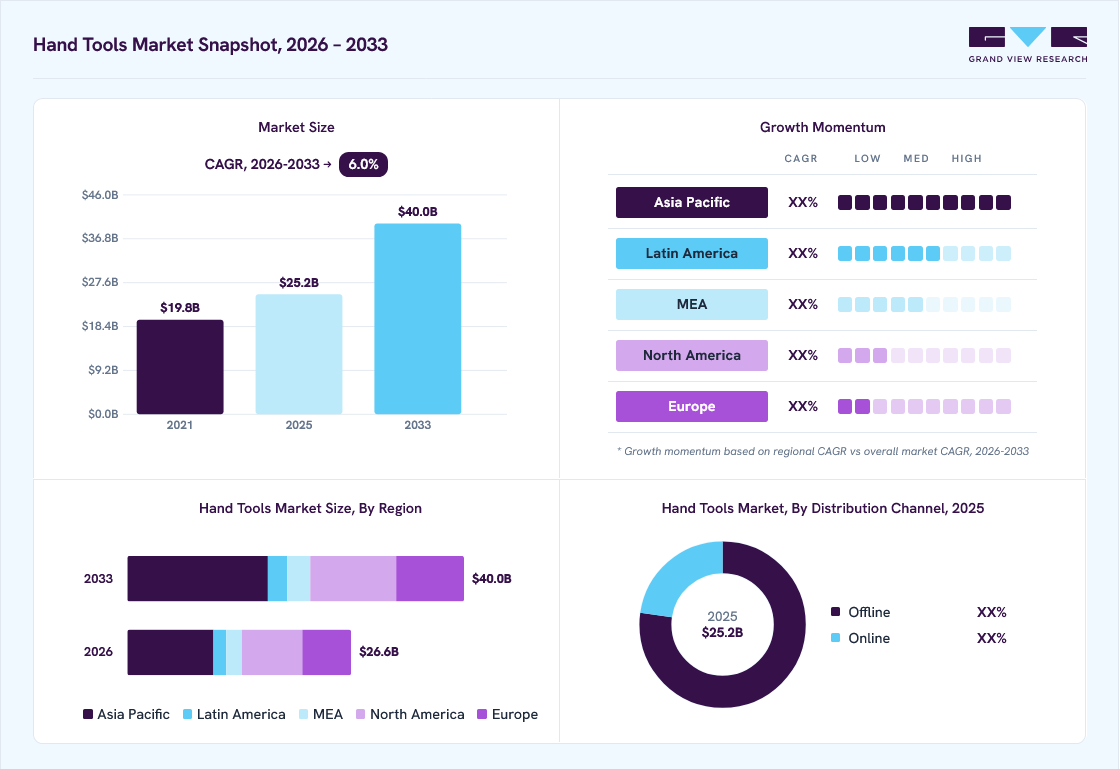 Source: Grand View Research, IR Documents, Primary Interviews, Paid DatabasesTo learn more about this report,
 Download Free Sample Report
Key Market Trends & Insights
- By product: Wrenches & spanners segment dominated the market in 2025, accounting for 22.4% share.
- By distribution channel: Online segment is projected to grow at a 5.4% CAGR during the forecast period.
- By end use: Automotive & transportation segment is expected to grow at the fastest CAGR of 6.6% from 2026 to 2033.
Regional Highlights
- Largest regional market: Asia Pacific (38.0% revenue share, 2025)
- By country: China held the largest share in the Asia Pacific region in 2025.
Market Size & Forecast
- Market size in 2025: USD 25.2 Billion
- Estimated market size in 2026: USD 26.6 Billion
- Projected market size by 2033: USD 40.0 Billion
- CAGR (2026-2033): 6.0%
Three ways to get this report
Buy it, customize it, or ask a question.Ask an Analyst
Analyst response in 1 business day
- AccessReport author, directly
- Reply timeWithin 1 working day
- No sales callDirect answer only
- FormatEmail reply
- CostFree, no cost
Get the Full Report
What the study covers
- FormatsPDF · Excel · Dashboard
- Timeline2026–2033 annual, 2025 base
- Coverage20+ countries, 5 regions
- Companies10+ key players profiled
Customize the Report
20% free customization
- IncludeCountries, segments, points
- TailorTo your product definition
- ExtendDeeper competitor detail
- OrA fully bespoke study
- Turnaround5–10 working days
Expansion of industrial facilities and vehicle production sustains procurement across fastening, cutting, gripping, assembly, and striking tool categories. Construction activity further generates demand across installation, fabrication, and finishing applications, while tool replacement arising from wear, damage, and service-life limitations provides a recurring revenue base.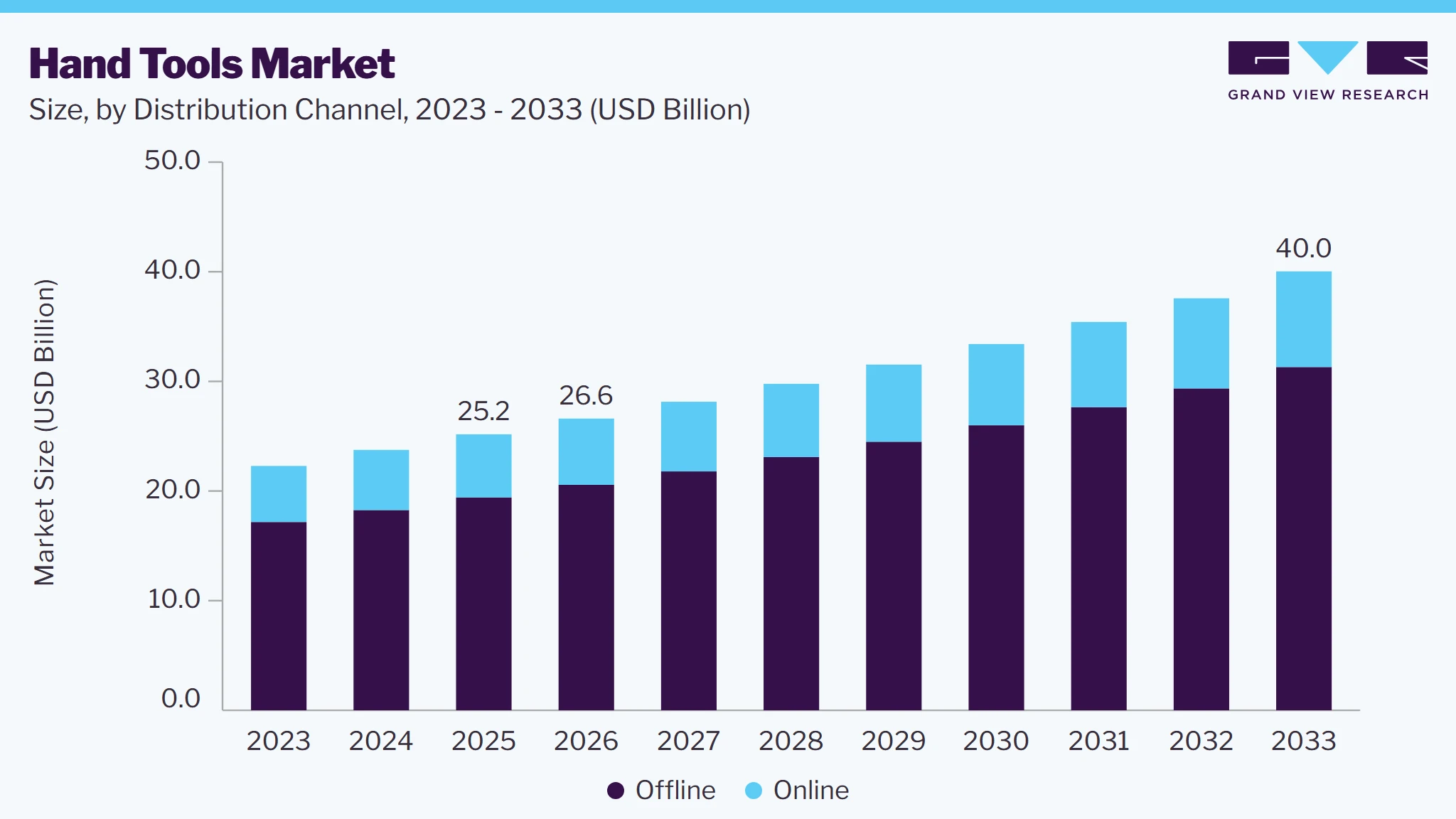 To learn more about this report, Download Free Sample Report
Additionally, the market is supported by increasing residential renovation, home improvement, and DIY participation, which is expanding demand beyond professional users. E-commerce penetration has broadened access to branded and specialized tool portfolios, enabling manufacturers to reach fragmented customer groups across geographic markets. Product development is also shifting toward higher-strength materials, improved grip configurations, precision-engineered components, corrosion resistance, and application-specific designs, encouraging replacement and upgrading among professional users.
Market Dynamics
Market development varies across applications based on production intensity, project activity, replacement intervals, tool specifications, procurement structures, and channel accessibility. Competitive positioning is determined by product engineering, material characteristics, manufacturing precision, portfolio breadth, brand positioning, and the ability to address professional, industrial, and consumer requirements.
Rising construction investment, industrial capacity, vehicle production, and equipment servicing are expanding requirements for hand tools across assembly, installation, fabrication, fastening, cutting, and repair activities. Construction and infrastructure projects generate recurring procurement across multiple trades, while automotive and manufacturing facilities require specialized tools throughout production, servicing, and maintenance processes. The extensive installed base of machinery, vehicles, and infrastructure further sustains replacement purchases as tools undergo wear, damage, or functional deterioration.
The proliferation of low-priced products from regional and unorganized manufacturers can exert pressure on pricing and limit premium product penetration, particularly in cost-sensitive markets. Lower acquisition prices may attract buyers despite differences in material integrity, dimensional precision, durability, and warranty coverage. Established manufacturers, therefore, need to substantiate premium positioning through engineering quality, quality-control standards, product longevity, and after-sales provisions.
Advancements in alloy composition, heat treatment, precision manufacturing, surface engineering, and ergonomic design are creating opportunities for higher-value hand tool development. Manufacturers can address demanding professional applications through products offering enhanced torque transmission, wear resistance, corrosion protection, dimensional accuracy, and grip performance. Application-specific configurations and specialized tool sets can further address requirements in automotive servicing, industrial maintenance, construction, and precision assembly.
Market Concentration & Characteristics
The industry exhibits a fragmented-to-moderately concentrated competitive structure, comprising multinational manufacturers, established regional suppliers, and specialized tool producers. Competitive positioning is shaped by portfolio breadth, metallurgical quality, dimensional precision, manufacturing consistency, product certification, brand equity, and distribution depth. Leading participants maintain extensive product ranges spanning fastening, gripping, cutting, striking, and specialized applications, while niche manufacturers compete through category expertise, application-specific engineering, and professional-grade specifications.
Demand is characterized by a substantial recurring replacement component across automotive workshops, construction operations, manufacturing facilities, and MRO environments. Procurement behavior varies considerably by customer profile, with industrial and professional buyers emphasizing service life, reliability, safety compliance, tool performance, and compatibility with established workflows. Residential and DIY purchases are more closely associated with accessibility, multifunctionality, price positioning, and product availability. Tool kits and coordinated product assortments also contribute to purchasing consolidation among professional and institutional buyers.
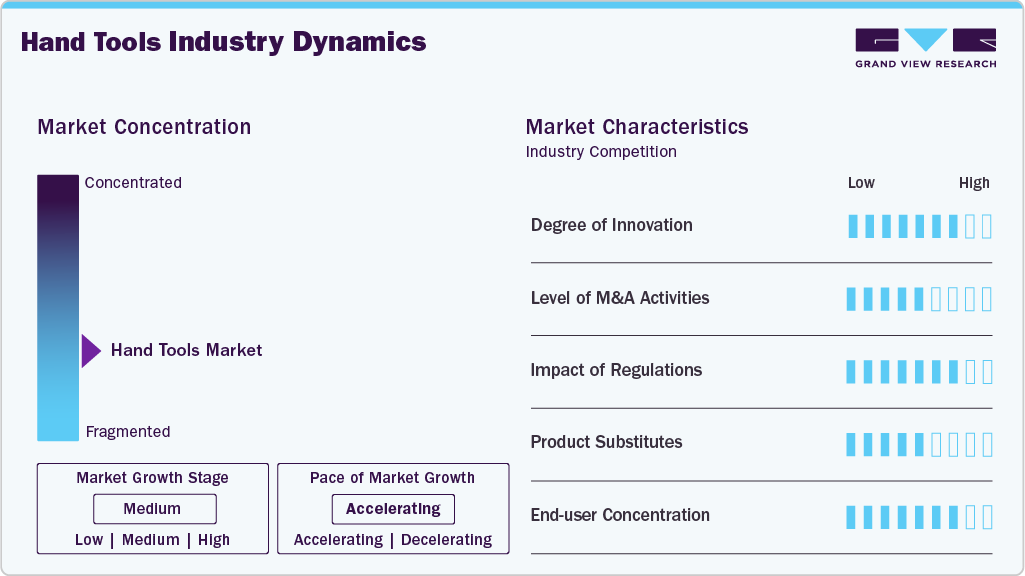 To learn more about this report, Download Free Sample Report
The competitive environment is further influenced by channel diversification and regional differences in industrialization, construction expenditure, automotive output, and retail infrastructure. Distributor networks remain important for professional and bulk procurement, whereas e-commerce has expanded market access for standardized and specialized products across fragmented customer groups. Manufacturers are strengthening differentiation through advanced alloys, heat-treatment processes, corrosion-resistant finishes, ergonomic configurations, precision manufacturing, and application-oriented designs, while portfolio localization and channel-specific offerings enable suppliers to address variations in technical requirements and purchasing behavior across markets.
Analyst Perspective
The industry is supported by recurring requirements across automotive & transportation, construction, manufacturing, MRO, and residential/DIY activities, creating a diverse customer base with varying specifications and purchasing priorities. Professional buyers typically emphasize dimensional accuracy, material strength, service life, safety, and compatibility with established workflows, whereas residential consumers place greater emphasis on affordability, accessibility, and multipurpose functionality. Product portfolios span standardized tools and application-specific designs, allowing manufacturers to address requirements ranging from routine fastening and assembly to specialized industrial tasks. Offline distribution retains relevance for bulk and professional procurement, while e-commerce has expanded access to broader product assortments and facilitates direct purchasing and price comparison.
Product Insights
The wrenches & spanners segment represented the leading product category in the market, accounting for the highest revenue share in 2025. Their extensive deployment across automotive servicing, construction, industrial assembly, equipment maintenance, and general mechanical applications underpins their broad commercial penetration. Demand encompasses combination, adjustable, open-end, box-end, and application-specific configurations, reflecting the category’s relevance across professional and general-purpose requirements.
The pliers & pincers segment is anticipated to record the fastest CAGR of 6.9% during the forecast period. Their application across automotive repair, electrical installation, fabrication, construction, and industrial maintenance supports expanding uptake across professional trades. Increasing availability of specialized jaw geometries, enhanced gripping mechanisms, ergonomic configurations, and multifunctional designs is also broadening the category’s applicability and supporting higher replacement and upgrade activity.
Distribution Channel Insights
The offline channels segment accounted for the largest revenue share of 77.1% in 2025, retaining a strong position within the global market. Physical distribution benefits from established relationships between manufacturers, distributors, wholesalers, specialty retailers, and professional buyers. Product availability, immediate procurement, technical assistance, and the ability to physically assess tool construction remain relevant considerations, particularly for trade and industrial purchases.
The online channels segment is projected to register a robust CAGR during the forecast period, supported by expanding e-commerce infrastructure and changing procurement practices. Digital platforms provide broader assortment visibility, specification-level comparison, price transparency, and access to specialized products that may have limited physical distribution. Greater adoption among individual professionals, small businesses, and residential buyers is also strengthening the role of online purchasing within the market.
End Use Insights
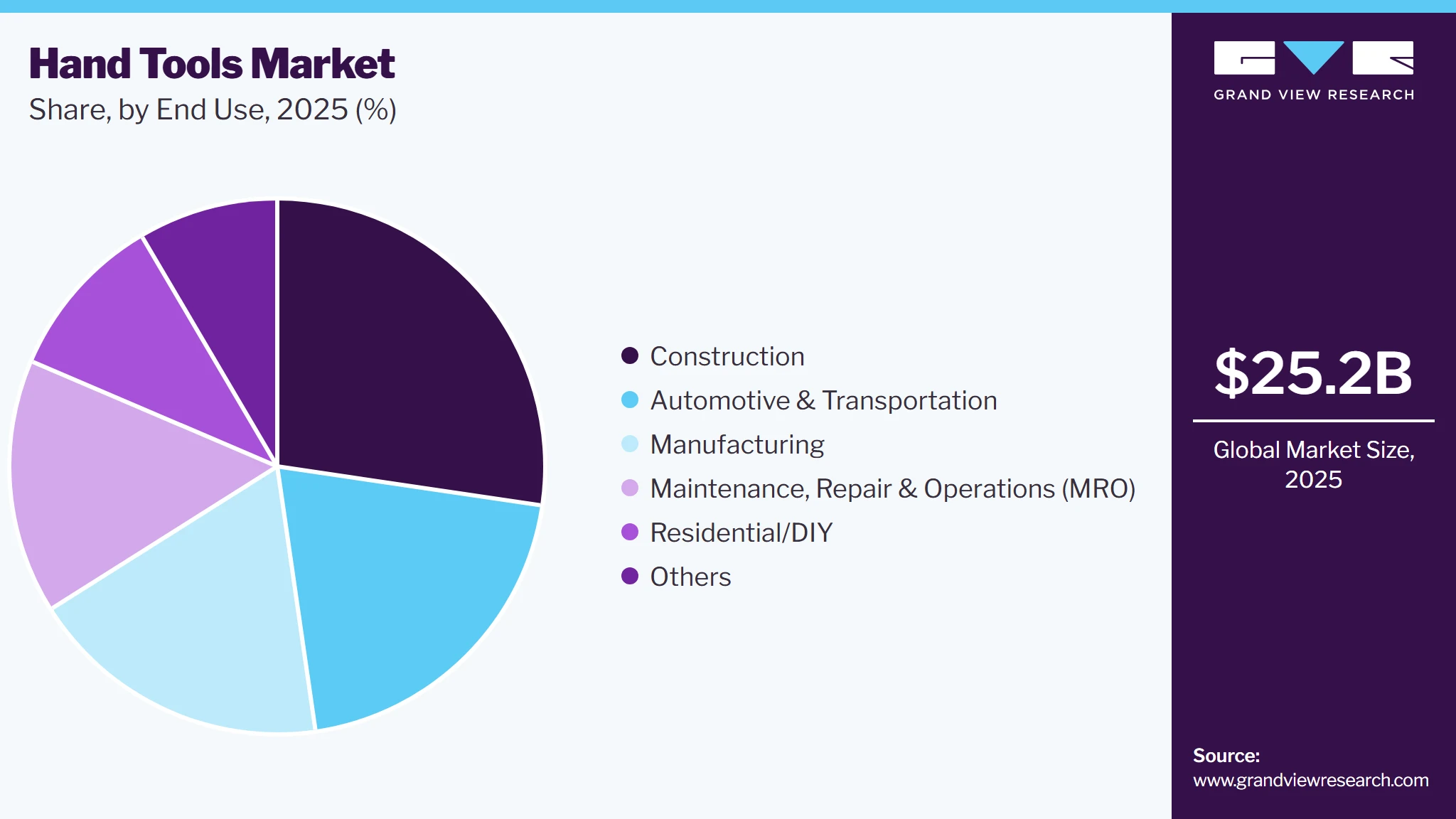
The construction segment represented the largest share in 2025, accounting for 27.3% of global revenue. Hand tools are required across carpentry, masonry, plumbing, electrical installation, structural assembly, finishing, and general site maintenance, creating demand for hammers, pliers, screwdrivers, wrenches, cutting tools, and socket sets. Residential construction, commercial development, infrastructure projects, and renovation activities generate procurement across contractors, subcontractors, skilled tradespeople, and project-based maintenance teams.
 To learn more about this report, Download Free Sample Report
The automotive & transportation sector is growing rapidly due to increasing vehicle production, rising automotive maintenance and repair activities, and the growing complexity of modern vehicles. Automotive manufacturers, component suppliers, repair workshops, and transportation fleet operators rely on hand tools such as wrenches, socket sets, screwdrivers, pliers, torque tools, and cutting tools for vehicle assembly, component installation, inspection, and maintenance. The growing adoption of electric vehicles (EVs) is also driving demand for specialized insulated hand tools for electrical systems, battery assembly, and servicing.
Regional Insights
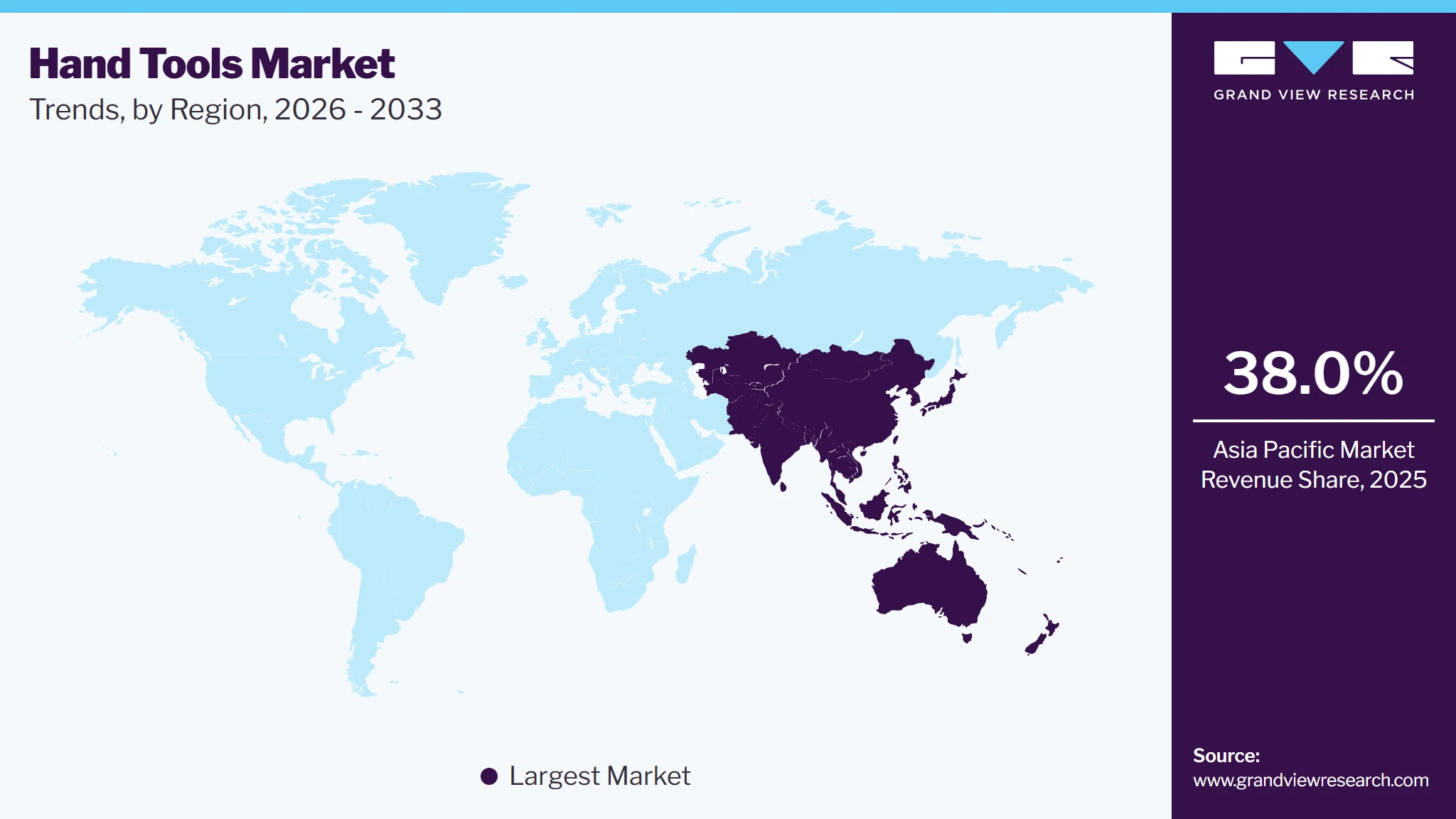
The Asia Pacific hand tools market dominated, accounting for a revenue share of 38.0% in 2025 and is also expected to grow at the fastest CAGR from 2026 to 2033. Asia Pacific represents a heterogeneous industry, ranging from highly industrialized economies with precision-oriented procurement practices to rapidly industrializing markets where construction and general trade activity remain important demand generators. The regional requirement base extends across vehicle production, machinery fabrication, electronics assembly, infrastructure development, shipbuilding, energy projects, and industrial servicing. Differences in manufacturing intensity, workforce composition, tool replacement practices, and purchasing power create distinct product preferences across economies.
 To learn more about this report, Download Free Sample Report
The hand tools market in China represented the largest revenue share of the Asia Pacific in 2025. Its extensive manufacturing ecosystem generates demand across machinery assembly, metalworking, automotive production, equipment servicing, construction, and fabrication activities. Large production facilities procure hand tools for assembly stations, maintenance departments, and technical workshops, while contractors, hardware outlets, and industrial distributors sustain demand for standardized and application-specific products.
The India hand tools market is projected to register the fastest CAGR of 8.1% during the forecast period in the Asia Pacific. Demand is shaped by infrastructure development, automotive manufacturing, engineering industries, utilities, fabrication, and a large network of independent workshops. The expansion of organized manufacturing and formal automotive service networks is increasing requirements for standardized and professional-grade tools, while widespread contractor and technician activity continues to support demand across regional retail and distribution channels.
North America Hand Tools Market Trends
The hand tools market in North America represents a mature and highly commercialized market in which professional, industrial, and consumer purchasing channels are well established. Demand is reinforced by a large installed base of vehicles, buildings, machinery, production equipment, and household assets requiring periodic servicing or repair. Professional users generally differentiate products according to quality, precision, durability, and compatibility, while consumer purchasing is more closely associated with accessibility, versatility, brand familiarity, and price. Established distributors and specialty retailers coexist with large-format retail and digital marketplaces.
The hand tools market in the U.S. is supported by its extensive automotive aftermarket, construction industry, industrial manufacturing base, utilities, facilities management, and DIY culture. Automotive workshops generate sustained requirements for sockets, ratchets, wrenches, pliers, and specialty tools, while contractors and maintenance professionals purchase broader assortments according to trade requirements. A large residential repair and renovation market adds a separate consumer demand stream, allowing manufacturers to serve both highly specialized professional applications and multipurpose household requirements.
The Canada hand tools market exhibits stronger exposure to resource industries, infrastructure, transportation, and heavy equipment maintenance. Mining and energy operations require hand tools for mechanical servicing, field maintenance, equipment adjustment, and repair under demanding operating conditions. Construction and utility activities provide additional procurement channels, while household and automotive maintenance contribute to consumer demand. Geographic dispersion of industrial and commercial activity also increases the importance of dependable distribution and product availability.
Europe Hand Tools Market Trends
The hand tools market in Europe has a technically mature market with established professional standards, sophisticated manufacturing capabilities, and extensive trade-oriented distribution infrastructure. Demand is closely connected with automotive engineering, industrial machinery, metalworking, construction trades, utilities, and building maintenance. Product differentiation is often based on metallurgy, dimensional accuracy, ergonomics, corrosion resistance, certification, and application-specific engineering. The replacement market is well established, while professional buyers frequently seek coordinated tool sets and specialized configurations for defined trades.
The Germany hand tools market forms a core industrial demand center owing to its concentration of automotive manufacturing, mechanical engineering, metal fabrication, industrial automation, and skilled trades. Hand tools are embedded in vehicle assembly, machinery installation, component fabrication, workshop servicing, and plant maintenance. The prevalence of engineering-intensive applications creates comparatively strong requirements for precision products and specialized tool configurations rather than purely general-purpose assortments.
The hand tools market in the UK has a diversified demand profile spanning construction trade, automotive repair, building maintenance, utilities, manufacturing, and household renovation. Plumbing, electrical installation, carpentry, mechanical servicing, and general property maintenance generate distinct requirements across product categories. The country's established DIY culture provides an additional consumer base, while specialist retailers and online platforms facilitate access to both mainstream and trade-specific products.
Middle East & Africa Hand Tools Market Trends
The hand tools market in the Middle East & Africa presents a project-oriented and structurally diverse market. Construction programs, industrial facilities, energy infrastructure, transportation projects, and property maintenance form the principal commercial application base. Large projects can generate concentrated procurement of tool sets and professional equipment, whereas independent workshops, contractors, and maintenance personnel create recurring requirements for individual tools. Market development is also influenced by the availability of established distributors and the extent of organized retail infrastructure.
Latin America Hand Tools Market Trends
The hand tools market in Latin America is a diversified but price-sensitive market. The aftermarket and small-enterprise segments are particularly relevant because workshops and tradespeople frequently purchase individual replacement tools rather than large, standardized inventories. Brazil represents the region's broadest demand base, supported by automotive production and servicing, mining, agriculture, and industrial maintenance. Automotive workshops and industrial facilities generate requirements for fastening and mechanical tools, while construction and agricultural activities create demand for broader assortments suited to field and site work. The country's extensive geographic market also creates a substantial role for wholesalers, regional distributors, hardware stores, and digital sales channels.
Key Hand Tools Company Insights
Some of the key players operating in the market include Stanley Black & Decker, Inc., Apex Tool Group, LLC, among others.
-
Stanley Black & Decker, Inc. is a U.S.-based industrial company headquartered in New Britain, Connecticut, with operations across tools, outdoor products, and related industrial solutions. The company serves professional, industrial, and consumer markets through a portfolio of globally recognized brands and an extensive international distribution network. Its tools business encompasses hand tools, power tools, accessories, and equipment serving construction, automotive, manufacturing, maintenance, and consumer applications.
-
Apex Tool Group, LLC is a global manufacturer of professional tools and equipment headquartered in Sparks, Maryland. The company serves industrial, automotive, aerospace, construction, electronics, energy, and other commercial sectors through an international network of manufacturing, engineering, sales, and distribution operations. Its portfolio includes hand and power tools, tool storage, and precision fastening solutions, supported by brands such as GEARWRENCH, Crescent, SATA, and APEX. The company maintains a strong position in professional and industrial tool markets through application-specific products and established distribution relationships.
Key Hand Tools Companies
Some prominent players in the hand tools market include:
-
Stanley Black & Decker, Inc.
-
Apex Tool Group, LLC
-
GEDORE Holding GmbH
-
GreatStar Industrial Co., Ltd.
-
Klein Tools, Inc.
-
KNIPEX-Werk C. Gustav Putsch KG
-
Snap-on Incorporated
-
Robert Bosch GmbH
-
Techtronic Industries Co. Ltd.
-
The L.S. Starrett Company
-
Taparia Tools Ltd.
-
Magadh Hand Tools
-
Groz Engineering Tools Pvt. Ltd.
-
Alok Tools
-
ROTHENBERGER AG
Competitive Benchmarking
Category
Operating Strategies
Competitive Edge
Weakness
Established Players (e.g., Stanley Black & Decker, Inc.; Apex Tool Group, LLC; Snap-on Incorporated; KNIPEX-Werk C. Gustav Putsch KG; GEDORE Holding GmbH; Robert Bosch GmbH; Techtronic Industries Co. Ltd.; GreatStar Industrial Co., Ltd.)
- Diversify across professional and industrial tool categories while strengthening global distribution and application-specific portfolios.
- Invest in precision manufacturing, material engineering, brand development, and long-term relationships with automotive, construction, manufacturing, and MRO customers.
- Strong brand equity, extensive category coverage, manufacturing scale, and established multinational distribution infrastructure.
Deep penetration across professional and institutional procurement channels with broad geographic reach.
- Higher structural and operating costs can constrain price competitiveness in cost-sensitive markets.
Multinational operating complexity and established positions in mature markets can limit flexibility in localized segments.
Emerging & Regional Players (e.g., Taparia Tools Ltd.; Groz Engineering Tools Pvt. Ltd.; Magadh Hand Tools; Alok Tools)
- Prioritize cost-efficient manufacturing, localized assortments, regional distribution, and application-oriented products aligned with domestic purchasing requirements.
- Leverage flexible supply structures and regional customer relationships to penetrate price-sensitive professional and consumer segments.
- Competitive cost structures, regional market familiarity, and responsiveness to localized specifications and procurement practices.
- Greater flexibility in product positioning and channel development within targeted geographic markets.
- Comparatively limited international brand recognition and narrower geographic penetration.
- Smaller product portfolios and more constrained resources for advanced engineering, R&D, and multinational procurement programs.
Recent Developments:
-
In March 2025, Bosch Power Tools strengthened its hand tools offering in India by introducing a portfolio of more than 100 products, spanning pliers, screwdrivers, wrenches, ratchet sets, hammers, saws, knives, and spirit levels. The company also added VDE-certified tools with protection ratings of up to 1,000 V, including pliers, screwdrivers, and hammers designed for electrical installation, power distribution, and industrial maintenance work.
-
In July 2025, KNIPEX expanded its hand tools portfolio with the launch of new products for electrical, photovoltaic, and installation applications. The new range included the ErgoStrip PV, MultiCrimp PV, EvoStrip, and ComStrip, along with additional Cobra ES plier sizes and the DPT50 pipe cutter. The products combine functions such as cable stripping, cutting, and crimping, addressing specialized requirements across electrical installation and renewable energy applications.
Hand Tools Market Report Scope
Report Attribute
Details
Market size in 2025
USD 25.2 billion
Estimated market size in 2026
USD 26.6 billion
Projected market size in 2033
USD 40.0 billion
Growth rate
CAGR of 6.0% from 2026 to 2033
Base year for estimation
2025
Historical data
2021 - 2024
Forecast period
2026 - 2033
Quantitative units
Revenue in USD billion and CAGR from 2026 to 2033
Report coverage
Revenue forecast, company market position analysis, competitive landscape, growth factors, and trends
Segments covered
Product, distribution channel, end use, region
Regional scope
North America; Europe; Asia Pacific; Latin America; Middle East & Africa
Country scope
U.S.; Canada; Mexico; Germany; UK; Italy; Spain; France; China; Japan; India; Australia; South Korea; Brazil; Argentina; Saudi Arabia; UAE; South Africa
Key companies profiled
Stanley Black & Decker, Inc.; Apex Tool Group, LLC; GEDORE Holding GmbH.; GreatStar Industrial Co., Ltd.; Klein Tools, Inc.; KNIPEX-Werk C. Gustav Putsch KG; Snap-on Incorporated; Robert Bosch GmbH; Techtronic Industries Co. Ltd.; The L.S. Starrett Company; Taparia Tools Ltd.; Magadh Hand Tools; Groz Engineering Tools Pvt. Ltd.; Alok Tools; ROTHENBERGER AG.
Customization scope
Free report customization (equivalent up to 8 analysts working days) with purchase. Addition or alteration to country, regional & segment scope.
Pricing and purchase options
Avail customized purchase options to meet your exact research needs. Explore purchase options
Hand Tools Market Report Segmentation
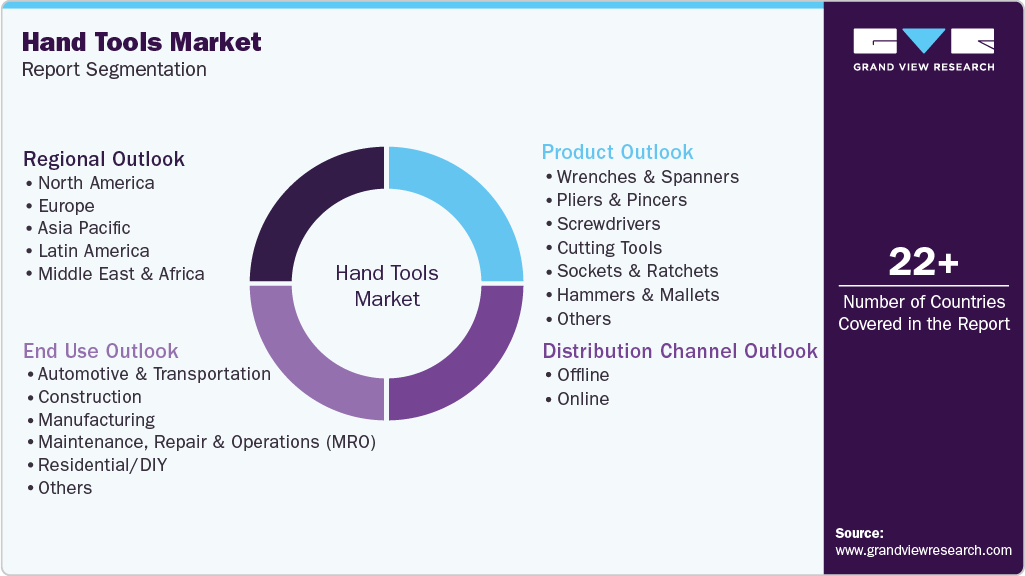
This report forecasts revenue growth at global, regional & country levels and provides an analysis on the industry trends & opportunities in each of the sub-segments from 2021 to 2033. For this study, Grand View Research has segmented the global hand tools market report based on product, distribution channel, end use, and region:
 To learn more about this report, Download Free Sample Report
-
Product Outlook (Revenue, USD Billion, 2021 - 2033)
-
Wrenches & Spanners
-
Pliers & Pincers
-
Screwdrivers
-
Cutting Tools
-
Sockets & Ratchets
-
Hammers & Mallets
-
Others
-
-
Distribution Channel Outlook (Revenue, USD Billion, 2021 - 2033)
-
Offline
-
Online
-
-
End Use Outlook (Revenue, USD Billion, 2021 - 2033)
-
Automotive & Transportation
-
Construction
-
Manufacturing
-
Maintenance, Repair & Operations (MRO)
-
Residential/DIY
-
Others
-
-
Regional Outlook (Revenue, USD Billion, 2021 - 2033)
-
North America
-
U.S.
-
Canada
-
Mexico
-
-
Europe
-
Germany
-
France
-
UK
-
Spain
-
Italy
-
-
Asia Pacific
-
China
-
India
-
Japan
-
South Korea
-
Australia
-
-
Latin America
-
Brazil
-
Argentina
-
-
Middle East & Africa
-
Saudi Arabia
-
UAE
-
South Africa
-
-
Research Methodology
The hand tools market figures in this report are based on a proven research process that combines executive interviews with secondary research from proprietary databases, company filings, and recognized regulatory and institutional sources. Market size is built through value-chain sizing—reconciling supply-side and demand-side estimates—and triangulated with bottom-up and top-down approaches. Every estimate passes multiple levels of expert validation before publication, with each hand tools segment quantified using the revenue-capture definitions in the table below.
Segment Definition
Product
Revenue Capture Definition
Wrenches & Spanners
Revenue generated from the sale of manually operated tools used for tightening, loosening, holding, and adjusting threaded fasteners, including open-end, box-end, combination, adjustable, and specialty wrenches and spanners.
Pliers & Pincers
Revenue generated from the sale of hand-operated tools designed for gripping, holding, bending, twisting, extracting, and manipulating workpieces, including combination, long-nose, locking, slip-joint pliers, and pincers.
Screwdrivers
Revenue generated from the sale of hand-operated tools used for installing, removing, and adjusting screws and similar fasteners, covering standard, precision, insulated, and application-specific screwdriver designs.
Cutting Tools
Revenue generated from the sale of manual tools used to cut, trim, shear, or separate wire, cable, metal, plastic, and other materials, including cutters, snips, shears, and bolt cutters.
Sockets & Ratchets
Revenue generated from the sale of socket and ratchet-based hand tools used for tightening and loosening nuts, bolts, and other fasteners, including sockets, ratchets, extensions, adapters, and socket sets.
Hammers & Mallets
Revenue generated from the sale of hand-operated striking tools used for driving, fitting, shaping, breaking, assembly, and demolition applications, including claw hammers, ball-peen hammers, sledgehammers, and mallets.
Others
Revenue generated from the sale of hand tools outside the defined product categories, including files, chisels, punches, clamps, hex keys, pry bars, and other specialized manual tools.
Distribution Channel
Revenue Capture Definition
Offline
Revenue generated from hand tools sold through physical sales channels, including hardware stores, specialty tool retailers, wholesalers, distributors, home improvement stores, and other brick-and-mortar outlets.
Online
Revenue generated from hand tools sold through digital sales channels, including manufacturer-owned e-commerce platforms, online marketplaces, and third-party e-commerce retailers.
End Use
Revenue Capture Definition
Automotive & Transportation
Revenue generated from the sale of hand tools to automotive manufacturers, vehicle assembly plants, repair workshops, dealerships, fleet operators, and transportation service providers.
Construction
Revenue generated from the sale of hand tools to construction contractors, builders, infrastructure companies, civil engineering firms, and other construction-related businesses.
Manufacturing
Revenue generated from the sale of hand tools to manufacturing companies, industrial production facilities, fabrication businesses, assembly operations, and component manufacturers.
Maintenance, Repair & Operations (MRO)
Revenue generated from the sale of hand tools to industrial facilities, commercial establishments, maintenance contractors, service providers, and organizations procuring tools for routine maintenance and repair requirements.
Residential/DIY
Revenue generated from the sale of hand tools to individual consumers, households, hobbyists, and DIY customers through retail and e-commerce channels.
Others
Revenue generated from the sale of hand tools to end users across agriculture, utilities, government institutions, education, and other sectors outside the defined automotive and transportation, construction, manufacturing, MRO, and residential/DIY categories.
Estimation Model
Layer No.
Layer Name
Key Question
Description
01
Hand Tools Demand Layer
Where does demand for hand tools originate?
Quantify addressable demand across automotive & transportation, construction, manufacturing, MRO, residential/DIY, and other sectors. Assess demand associated with vehicle production and servicing, construction and infrastructure projects, industrial production, equipment upkeep, household maintenance, professional trade activities, and replacement of worn or obsolete tools.
02
Hand Tools Procurement Layer
What determines hand tools purchasing decisions?
Evaluate procurement criteria including product specifications, material quality, dimensional accuracy, durability, ergonomics, safety requirements, brand reputation, pricing, warranty coverage, availability, and compatibility with intended applications. Assess purchasing structures across manufacturers, distributors, wholesalers, specialty retailers, hardware outlets, and e-commerce platforms.
03
Product & Distribution Adoption Layer
Which hand tools and sales channels capture purchases?
Analyze demand across wrenches & spanners, pliers & pincers, screwdrivers, cutting tools, sockets & ratchets, hammers & mallets, and other hand tools, alongside offline and online distribution channels. Examine category preferences based on professional and consumer requirements, purchase frequency, replacement cycles, product specialization, and channel accessibility.
04
Revenue Generation Layer
What constitutes market revenue from hand tools?
Calculate annual revenue attributable to hand tool sales across product type, distribution channel, end use, and region. Include revenues from new purchases, replacement tools, tool sets, and individual products sold through direct and indirect channels. Exclude revenue from repair, maintenance, rental, training, consulting, and other non-product services to maintain alignment with the core hand tools market.
Customization Table
CLIENT REQUEST
CUSTOMIZATION DELIVERED
VALUE ADDS
Competitive Benchmarking
A comprehensive competitive assessment was undertaken to examine leading hand tool manufacturers across product portfolio depth, category specialization, material and engineering specifications, application coverage, channel architecture, end-use exposure, manufacturing footprint, geographic penetration, and product development activity.
Establishes a comparative framework for evaluating supplier capabilities, portfolio breadth, category positioning, channel penetration, and geographic coverage. The analysis facilitates identification of competitive advantages, underserved product categories, portfolio white spaces, and potential areas for differentiation.
Regional Segmentation
Regional market assessment encompassed North America, Europe, Asia Pacific, Latin America, and the Middle East & Africa, supplemented by selected country-level analysis. The evaluation incorporated automotive production, construction and infrastructure activity, industrial manufacturing intensity, MRO expenditure, household consumption patterns, retail infrastructure, e-commerce development, procurement structures, and replacement demand to determine variations in market potential across geographies.
Provides a granular understanding of regional demand formation, purchasing behavior, and channel maturity. The assessment enables stakeholders to benchmark geographic attractiveness, determine market-entry priorities, identify distribution gaps, and formulate region-specific expansion strategies.
Opportunity Assessment
Commercial opportunities were assessed across wrenches & spanners, pliers & pincers, screwdrivers, cutting tools, sockets & ratchets, hammers & mallets, and other hand tools, with further differentiation by offline and online distribution. The assessment incorporated professional and industrial procurement, vehicle manufacturing and servicing, construction activity, manufacturing operations, MRO requirements, residential/DIY consumption, product replacement cycles, and evolving purchasing patterns.
Provides a structured assessment of revenue pools and whitespace opportunities across product categories, channels, and end-use groups. The analysis assists stakeholders in prioritizing high-potential categories, refining product portfolios, strengthening channel allocation, targeting specific buyer groups, and directing investment toward commercially attractive segments.
About the Author(s)
Advanced Interior Materials Research Team
Advanced Materials · Advanced Interior MaterialsThis report was authored by the advanced interior materials research team at Grand View Research - comprising two research analysts, one senior research analyst, and one industry expert - with specialized expertise in the advanced interior materials segment of the advanced materials industry. All findings are based on proprietary advanced materials databases, executive interviews, and regulatory analysis, subject to internal peer review prior to publication.
Last Updated:
Speak to Analyst

Customize this report to your needs - add regions, segments, or data points, with 20% free customization.
Or view our licence options:


ISO 9001:2015 & 27001:2022 Certified
We are GDPR and CCPA compliant! Your transaction & personal information is safe and secure. For more details, please read our privacy policy.


