
- Home
- »
- Advanced Interior Materials
- »
-
Hardness Testing Equipment Market Size Report, 2026-2033GVR Report cover
![Hardness Testing Equipment Market (2026 - 2033)Report]()
Hardness Testing Equipment Market (2026 - 2033)
Size, Share & Trends Analysis Report By Equipment Configuration (Single-Method Systems, Multi-Method (Universal) Systems), By Mobility (Portable, Stationary), By Material, By Region, And Segment Forecasts
Market Size, 2025
$384.5MMarket Estimate, 2026
$407.2MMarket Forecast, 2033
$626.4MCAGR, 2026–2033
6.3%Hardness Testing Equipment Market Summary
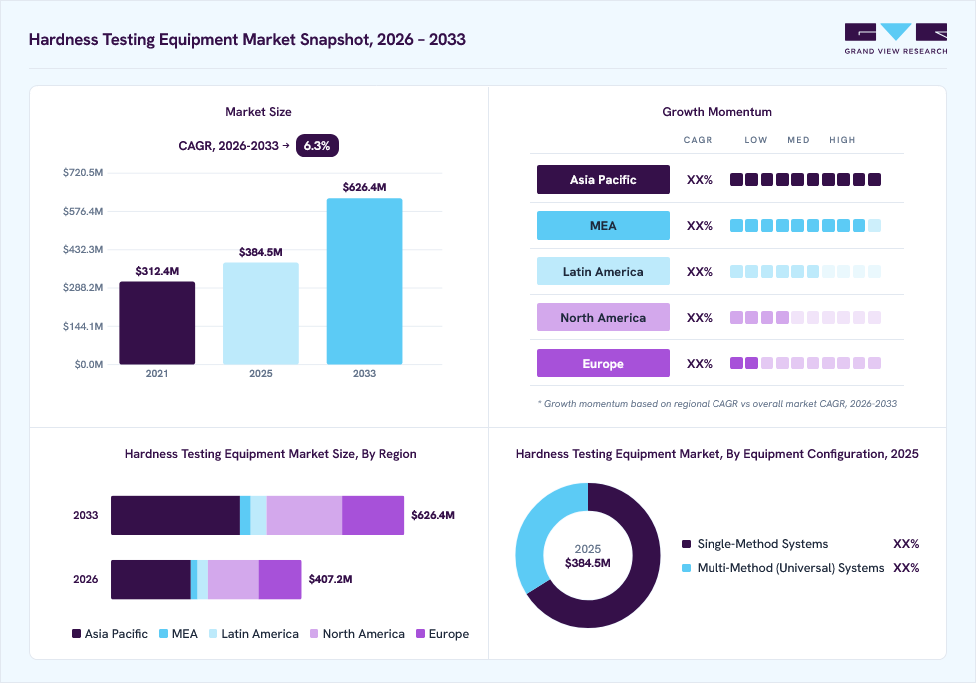
The global hardness testing equipment market size was valued at USD 384.5 million in 2025 and is projected to grow from USD 407.2 million in 2026 to USD 626.4 million by 2033, at a CAGR of 6.3% from 2026 to 2033. Asia Pacific dominated the market, accounting for a revenue share of 41.5% in 2025. The market is driven by stringent quality assurance requirements across automotive, aerospace, metalworking, machinery, electronics, and other manufacturing industries, where hardness measurement is integral to verifying material properties, heat-treatment quality, component performance, and production consistency.
Key Market Trends & Insights
- By equipment configuration: The single-method systems segment accounted for the largest revenue share of 66.0% in 2025.
- Based on material: The metals & alloys segment dominated the market in 2025, accounting for 51.5% market share.
- Based on mobility: Portable segment held the largest revenue share of 65.9% in 2025 .
Regional Highlights
- Largest regional market: Asia Pacific (41.5% revenue share, 2025)
- By country: China held the largest market share in 2025.
Market Size & Forecast
- Market Size in 2025: USD 384.5 Million
- Estimated Market Size in 2026: USD 407.2 Million
- Projected Market Size by 2033: USD 626.4 Million
- CAGR (2026-2033): 6.3%
The adoption of advanced alloys, composites, polymers, and engineered materials is increasing the need for testing systems that can accommodate diverse material characteristics and measurement requirements.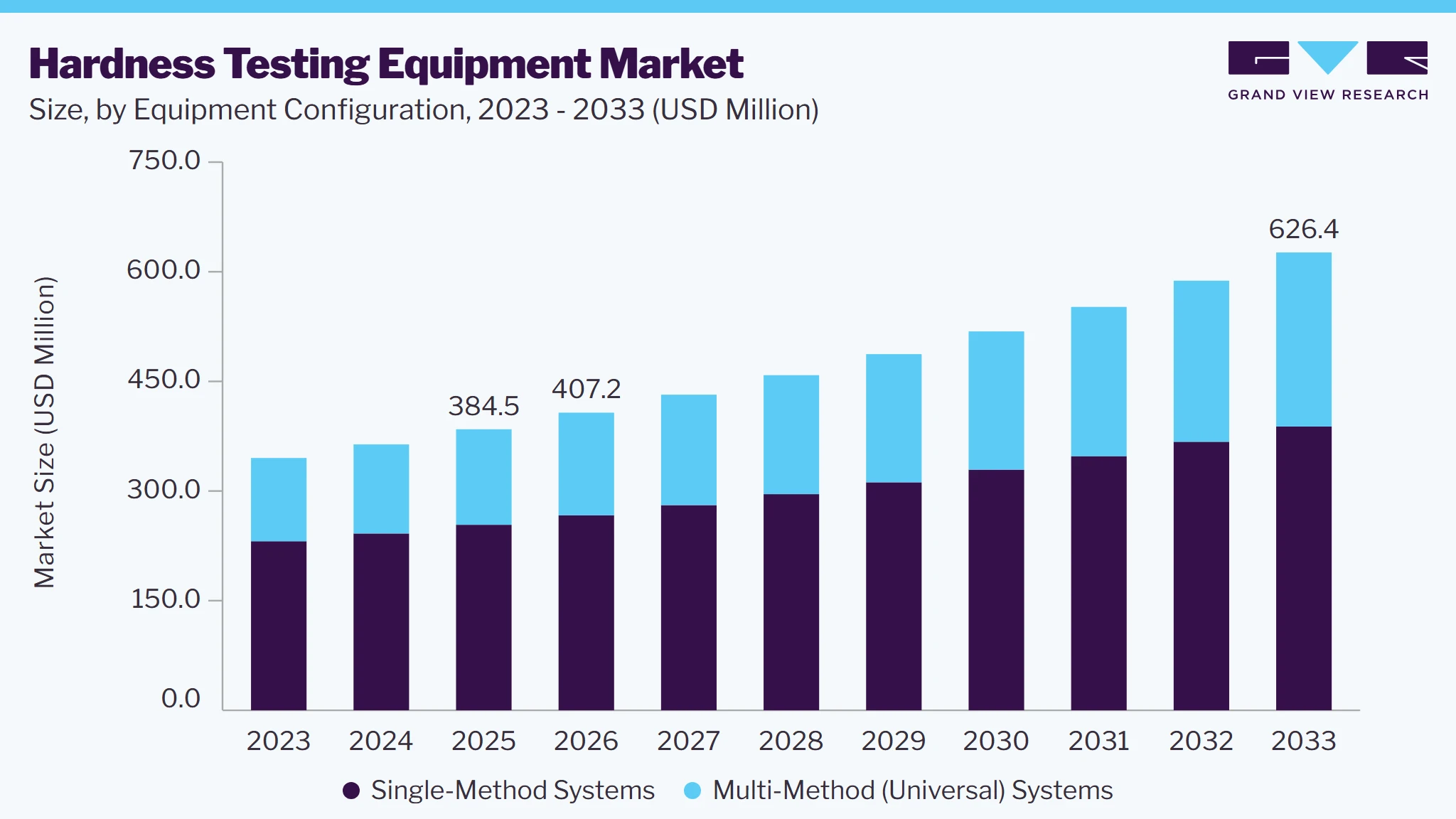
Additionally, investments in manufacturing capacity, laboratory modernization, and the replacement of aging test instruments are driving sustained equipment demand. The integration of automated measurement, digital data management, software-based analysis, and traceable testing capabilities is further encouraging manufacturers and testing laboratories to upgrade conventional systems, while a greater emphasis on standardized and repeatable material evaluation is strengthening the procurement of precision hardness testing equipment.
Market Dynamics
The global hardness testing equipment market is influenced by evolving material-testing requirements, quality-control practices, equipment replacement cycles, and technological development in measurement systems. Demand varies according to testing method, material characteristics, component geometry, testing frequency, and required measurement precision. The transition toward automated measurement and digitally enabled testing is also influencing equipment specifications, while calibration requirements, technical complexity, and capital expenditure remain important considerations in procurement decisions.
The growing need to verify material consistency, heat-treatment outcomes, wear resistance, and component properties is driving demand for hardness-testing equipment across manufacturing and materials-processing environments. Increased emphasis on repeatable measurement and standardized inspection procedures is encouraging the integration of hardness testing into production and laboratory quality-control processes, particularly where material characteristics must be verified across batches and finished components.
Advanced hardness testing systems can require substantial investment, particularly where automated measurement, optical analysis, multi-method functionality, or specialized configurations are involved. Ownership requirements also extend to calibration, periodic verification, maintenance, replacement of precision components, and operator training. These considerations can lengthen procurement cycles and limit technology upgrades among smaller manufacturers and laboratories with comparatively lower testing volumes.
Automation and digital integration are creating opportunities for higher-value hardness testing equipment through automated measurement, image analysis, digital data acquisition, software-based reporting, and multi-method testing capabilities. These technologies can improve measurement consistency, increase testing throughput, reduce manual intervention, and strengthen data traceability. Integration with broader laboratory and production-quality systems can further expand the adoption of connected hardness testing equipment in advanced manufacturing environments.
Market Concentration & Characteristics
The global hardness testing equipment market exhibits a moderately concentrated competitive landscape, with established suppliers maintaining strong positions through broad equipment portfolios, comprehensive testing-method coverage, technical expertise, and robust distribution and service capabilities. Competition extends across conventional, portable, automated, and universal testing systems, with differentiation based on measurement accuracy, repeatability, testing range, equipment configuration, and compatibility with diverse material requirements.
The market is characterized by diverse purchasing requirements across industrial and laboratory environments. Equipment selection is influenced by material type, component geometry, testing frequency, required precision, throughput, portability, and the degree of automation required. Stationary systems are generally suited to controlled laboratory and production inspection environments, while portable equipment is suited to on-site assessment of large, heavy, or difficult-to-access components. Universal and multi-method systems provide broader testing flexibility where multiple hardness scales or material categories need to be evaluated.
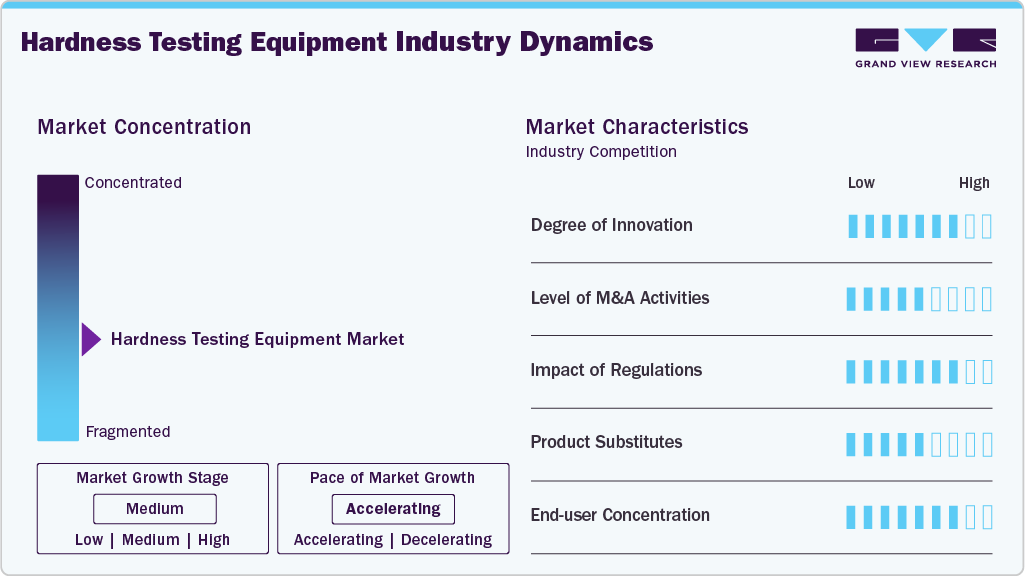
Technological development is increasingly centered on automated measurement, digital image analysis, integrated software, data acquisition, multi-sample testing, and connectivity. These capabilities improve testing consistency, reduce operator dependency, accelerate inspection workflows, and facilitate traceable digital records. Standardized testing procedures and calibration requirements remain important market characteristics, while equipment replacement, laboratory modernization, and integration of testing systems into automated quality-control processes continue to influence purchasing patterns.
Analyst Perspective
The global hardness testing equipment market represents a mature industrial measurement segment with continued scope for value expansion through product specialization, capability enhancement, and diversification of testing requirements. Market development is increasingly influenced by demand for systems capable of addressing micro-scale measurements, complex geometries, advanced alloys, composites, polymers, and engineered surfaces, creating opportunities beyond conventional hardness assessment. Developed manufacturing economies are likely to generate demand primarily through equipment replacement, capability upgrades, and laboratory modernization, while expanding industrial bases create opportunities for new testing infrastructure and the first deployment of equipment.
Equipment Configuration Insights
The single-method systems segment accounted for the largest revenue share of 66.0% in the global hardness testing equipment market in 2025. Their dominant position is attributed to established demand for dedicated testing systems optimized for specific hardness measurement methods, particularly where testing procedures are standardized, and equipment utilization is focused on consistent measurement requirements. Their relatively straightforward configuration also supports adoption across routine industrial inspection and laboratory testing.
The multi-method (universal) systems segment is projected to register the fastest CAGR during the forecast period. Their growth is driven by the flexibility to perform multiple hardness testing methods through a single equipment platform, allowing users to evaluate different materials, specimen geometries, and hardness ranges without maintaining separate dedicated systems. This broader testing capability is particularly attractive for facilities with diverse inspection requirements and supports the transition toward a more versatile testing infrastructure.
Mobility Insights
The portable segment accounted for the largest revenue share of 65.9% in the global market in 2025. Its leading position reflects strong commercial demand for mobile testing systems that offer flexible measurement capabilities across production, inspection, and maintenance environments. The segment benefits from equipment designs that reduce the need to transfer large or difficult-to-handle components to dedicated testing facilities, broadening the addressable market for hardness measurement equipment.
The stationary segment is projected to register the fastest CAGR during the forecast period. Growth is associated with continued investment in dedicated laboratory and production inspection infrastructure, where higher testing throughput, controlled measurement conditions, and consistent results are required. The increasing adoption of automated measurement and advanced testing configurations is further enhancing the value proposition of stationary systems, particularly for facilities with recurring, high-volume hardness testing requirements.
Material Insights
The metals & alloys segment accounted for the largest revenue share of 51.5% in 2025. Their dominant position reflects the extensive requirement for hardness measurement across a broad range of ferrous and non-ferrous materials, where testing is used to evaluate material consistency, treatment quality, and mechanical characteristics. The established use of standardized hardness measurements for metal inspection provides a substantial, recurring demand for equipment.
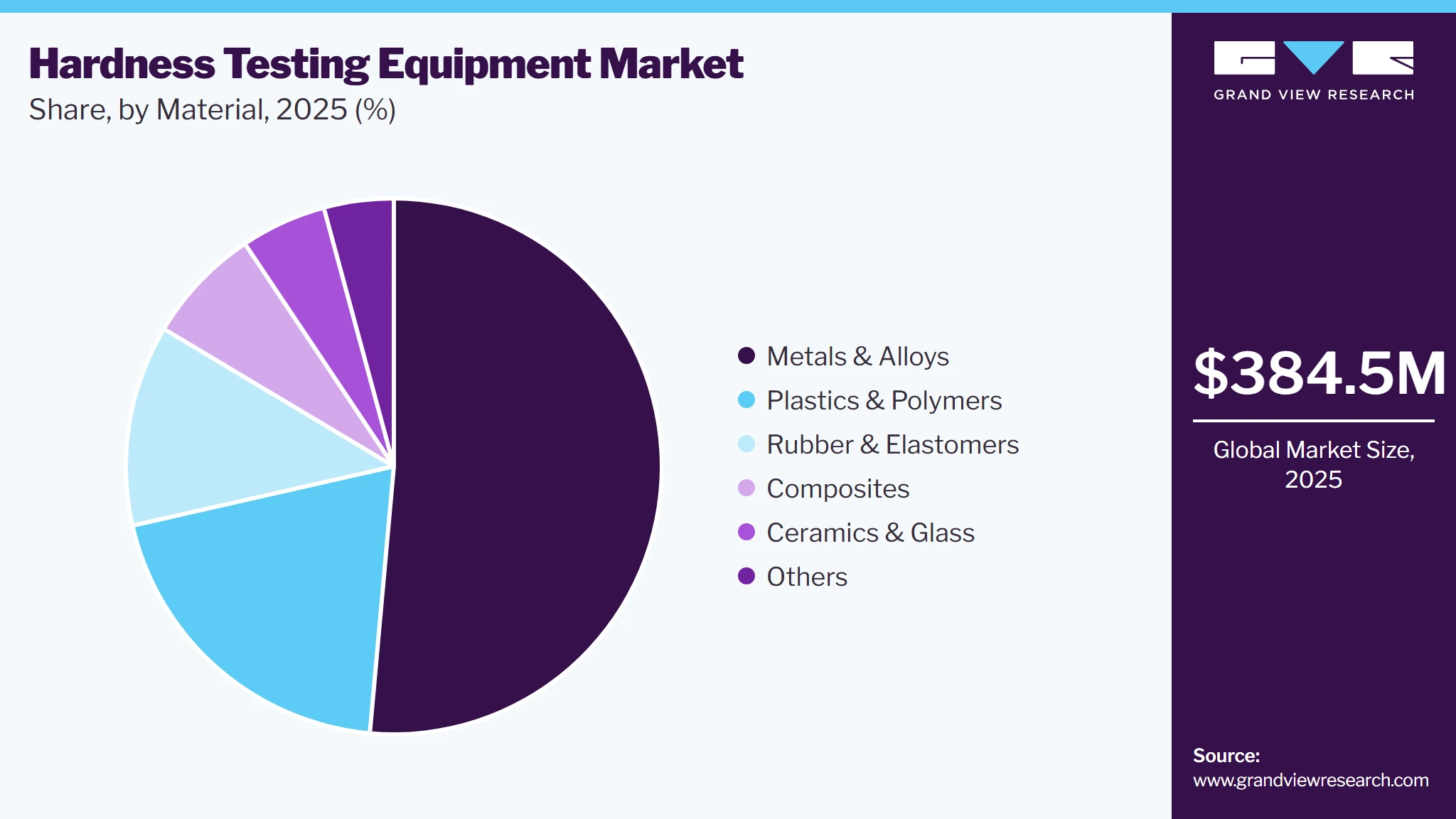
The composites segment is projected to register the fastest CAGR of 7.7% during the forecast period. Their growth is associated with the increasing development of engineered composite materials with varied constituent structures and localized property profiles, creating demand for testing systems with greater measurement sensitivity and flexibility. The expanding need to characterize heterogeneous material structures is also encouraging the adoption of equipment capable of delivering consistent hardness measurements across different composite formulations and component configurations.
Regional Insights
The hardness testing equipment market in the Asia Pacific dominated the global industry, accounting for the largest revenue share of 41.5% in 2025, and it is expected to grow at the fastest CAGR over the forecast period. The dominance is attributed to the region’s extensive metal-processing capacity, high-volume component production, and expanding precision-engineering activities. The region has a broad base of industries requiring hardness evaluation across raw materials, intermediate products, and finished components. Growth in electronics, automotive components, machinery, and engineered materials is broadening the requirement for testing systems with different load ranges, measurement scales, and levels of automation.

The China hardness testing equipment market accounted for the largest share of the Asia Pacific industry in 2025, supported by its substantial metals and alloys, automotive, machinery, and electronics production. The scale and diversity of component manufacturing create a broad customer base for hardness measurement systems, ranging from routine production inspection to specialized material characterization. The increasing emphasis on manufacturing precision and process consistency is also driving demand for higher-performance testing instruments.
The hardness testing equipment market in India is projected to register strong growth during the forecast period, supported by expansion across automotive components, aerospace, electronics, engineering goods, and metal fabrication. Increasing localization of industrial production is creating new requirements for inspection and testing infrastructure. Growing investment in laboratories and production testing capabilities is expected to support the procurement of portable, stationary, and multi-method hardness testing systems.
North America Hardness Testing Equipment Market Trends
The hardness testing equipment market in North America is mature with a well-established installed base and sophisticated material-testing infrastructure. Demand is driven by high-value manufacturing activities that require precise characterization of materials and components. Aerospace, defense, automotive, machinery, and specialty metals remain important sources of demand for equipment, while the presence of established testing laboratories supports recurring requirements for precision instruments.
U.S. Hardness Testing Equipment Market Trends
The hardness testing equipment market in the U.S. accounted for the largest share of the North America market in 2025, alluding to its extensive aerospace, defense, automotive, machinery, and specialty manufacturing activities. Demand is influenced by stringent inspection requirements for critical components and the need for reliable measurement across different material grades. Increased adoption of automated inspection processes is also creating demand for equipment capable of handling higher testing volumes with limited operator intervention.
The Canada hardness testing equipment market is projected to maintain steady growth during the forecast period, with demand concentrated across aerospace, automotive, metal fabrication, energy equipment, and machinery manufacturing. The country's industrial testing requirements are creating opportunities for equipment capable of assessing a wide range of metallic materials and finished components. Demand from specialized laboratories and smaller production facilities is also supporting the adoption of flexible testing configurations.
Europe Hardness Testing Equipment Market Trends
The hardness testing equipment market in Europe benefits from its concentration of precision manufacturing, specialty materials production, and engineering-intensive industries. The region maintains established testing practices across automotive, aerospace, machinery, metals, electronics, and industrial components. Demand is increasingly influenced by the need to characterize advanced materials and maintain consistent mechanical properties throughout increasingly sophisticated production processes.
The Germany hardness testing equipment market held a prominent share of the European hardness market in 2025, underpinned by its strong automotive, machinery, metalworking, and engineering industries. High requirements for component precision and material consistency create sustained demand for reliable hardness measurement. The country's sophisticated industrial ecosystem also supports the uptake of automated and digitally enabled testing platforms.
The hardness testing equipment market in France is expected to grow steadily during the forecast period, supported by the aerospace, automotive, machinery, and specialized engineering sectors. Requirements for precise material characterization across manufactured parts and assemblies are supporting demand for laboratory and production testing equipment. Increasing use of engineered materials is also creating scope for systems capable of accommodating varied testing requirements.
Middle East & Africa Hardness Testing Equipment Market Trends
The hardness testing equipment market in the Middle East & Africa remains at an earlier stage of development with demand closely associated with the expansion of metal processing, fabrication, machinery production, and localized industrial capabilities. The development of manufacturing clusters and testing facilities is gradually broadening the addressable customer base. Demand is also emerging from organizations seeking to establish in-house inspection capabilities rather than relying entirely on external testing services.
The Saudi Arabia hardness testing equipment market accounted for a prominent share of the Middle East & Africa industry in 2025, reflecting industrial diversification and development of domestic production capabilities. Investments across metal processing, fabrication, machinery, and industrial equipment are creating new requirements for hardness measurement during production and component inspection. The establishment of dedicated testing facilities is expected to strengthen demand for both portable and laboratory-based systems.
Latin America Hardness Testing Equipment Market Trends
The hardness testing equipment market in Latin America is supported by its established metals processing, automotive, machinery, fabrication, and industrial component sectors. Equipment demand varies considerably across countries based on manufacturing intensity and the availability of testing infrastructure. Greater emphasis on local production quality and expansion of industrial inspection capabilities is creating incremental demand for hardness measurement systems.
The Brazil hardness testing equipment market accounted for a major share of the Latin America industry in 2025, supported by its diversified industrial structure and sizeable automotive, metalworking, machinery, aerospace, and engineering sectors. The breadth of material-processing and component-production activities creates demand for multiple hardness-testing methods and equipment formats. The expansion of industrial laboratories and the greater use of in-house inspection are expected to provide additional avenues for market development.
Key Hardness Testing Equipment Company Insights
Some of the key players operating in the market include ZwickRoell Group and Buehler, among others.
-
ZwickRoell Group is a Germany-based testing technology manufacturer specializing in systems for determining the mechanical and physical properties of materials and components. For hardness testing, the company offers equipment that supports multiple standardized methods and configurations, including automated solutions designed for consistent measurement and higher testing throughput. Its portfolio is complemented by testing software, measurement systems, and laboratory solutions, enabling the company to address both conventional hardness evaluation and more advanced automated testing requirements.
-
Buehler is a materials characterization and metallography equipment manufacturer focused on solutions for specimen preparation, hardness measurement, and microscopic analysis. Its hardness testing activities are closely aligned with metallographic workflows, providing instruments for macro-, micro-, and conventional hardness evaluation. The company's product offering emphasizes controlled testing conditions, precise indentation measurement, and integration with material analysis processes, making its equipment relevant to laboratories and quality-control environments where hardness results are assessed alongside broader metallurgical characteristics.
Key Hardness Testing Equipment Companies
The following key companies have been profiled for this study on the hardness testing equipment market.
-
ZwickRoell Group
-
Buehler
-
Mitutoyo Corporation
-
LECO Corporation
-
AFFRI
-
INNOVATEST
-
Struers
-
EMCO-TEST
-
Starrett
-
Phase II Plus
-
Hegewald & Peschke
-
Bareiss
-
Foundrax
-
Ernst
-
Matsuzawa Co., Ltd.
Competitive Benchmarking
Category
Operating Strategies
Competitive Edge
Weakness
Established Players (e.g., ZwickRoell Group; Buehler; Mitutoyo Corporation; LECO Corporation; AFFRI; INNOVATEST; Struers)
- Develop comprehensive portfolios spanning macrohardness, microhardness, universal, portable, and automated testing systems.
- Allocate resources to measurement accuracy, automated indentation and evaluation, software capabilities, calibration, and expansion of testing functionality.
- Extensive coverage of hardness testing methods and equipment configurations.
- Strong technical expertise, established customer relationships, service capabilities, and ability to address complex testing requirements.
- Higher development and acquisition costs associated with sophisticated testing platforms.
- Complex systems can require specialized training, calibration, maintenance, and technical support.
Emerging & Regional Players (e.g., EMCO-TEST; Starrett; Phase II Plus; Hegewald & Peschke; Bareiss; Foundrax; Ernst; Matsuzawa Co., Ltd)
- Concentrate on selected hardness testing methods, portable instruments, benchtop systems, and specialized material-testing requirements.
- Strengthen market presence through focused product development, regional distribution, customization, and application-specific solutions.
- Greater specialization in targeted testing categories and material groups.
- Flexible product offerings, competitive pricing, and faster response to specific customer requirements.
- Comparatively narrower product breadth across testing methods and equipment categories.
- Smaller geographic coverage and service networks can constrain access to international customers.
Recent Developments
-
In September 2025, Mitutoyo launched the Pocket Vick HH-V400, a rebound-type portable hardness tester designed for on-site metal hardness measurement. The device supports multiple hardness scales, including Rockwell, Vickers, Brinell, and Shore, and features automatic angle correction and a color LCD display. Its compact design enables testing of large or difficult-to-move components, expanding the use of portable hardness testing across industrial inspection applications.
-
In March 2026, LECO Corporation launched the AMH6 Automated Hardness Testing System, designed to improve testing throughput, measurement consistency, and laboratory efficiency. The system supports Vickers and Knoop testing across a broad force range and incorporates automated load application, a six-position turret, self-leveling sample holder, and Cornerstone software for automated measurement and data management.
Hardness Testing Equipment Market Report Scope
Report Attribute
Details
Market size in 2025
USD 384.5 million
Estimated market size in 2026
USD 407.2 million
Projected market size by 2033
USD 626.4 million
Growth rate
CAGR of 6.3% from 2026 to 2033
Base year for estimation
2025
Historical data
2021 - 2024
Forecast period
2026 - 2033
Quantitative units
Revenue in USD million and CAGR from 2026 to 2033
Report coverage
Revenue forecast, company market position analysis, competitive landscape, growth factors, and trends
Segments covered
Equipment configuration, mobility, material, region
Regional scope
North America; Europe; Asia Pacific; Latin America; Middle East & Africa
Country Scope
U.S.; Canada; Mexico; Germany; UK; Italy; Spain; France; China; Japan; India; Australia; South Korea; Brazil; Argentina; Saudi Arabia; UAE; South Africa
Key companies profiled
ZwickRoell Group; Buehler; Mitutoyo Corporation; LECO Corporation; AFFRI; INNOVATEST; Struers; EMCO-TEST; Starrett; Phase II Plus; Hegewald & Peschke; Bareiss; Foundrax; Ernst; Matsuzawa Co., Ltd.
Customization scope
Free report customization (equivalent up to 8 analysts working days) with purchase. Addition or alteration to country, regional & segment scope.
Pricing and purchase options
Avail customized purchase options to meet your exact research needs. Explore purchase options
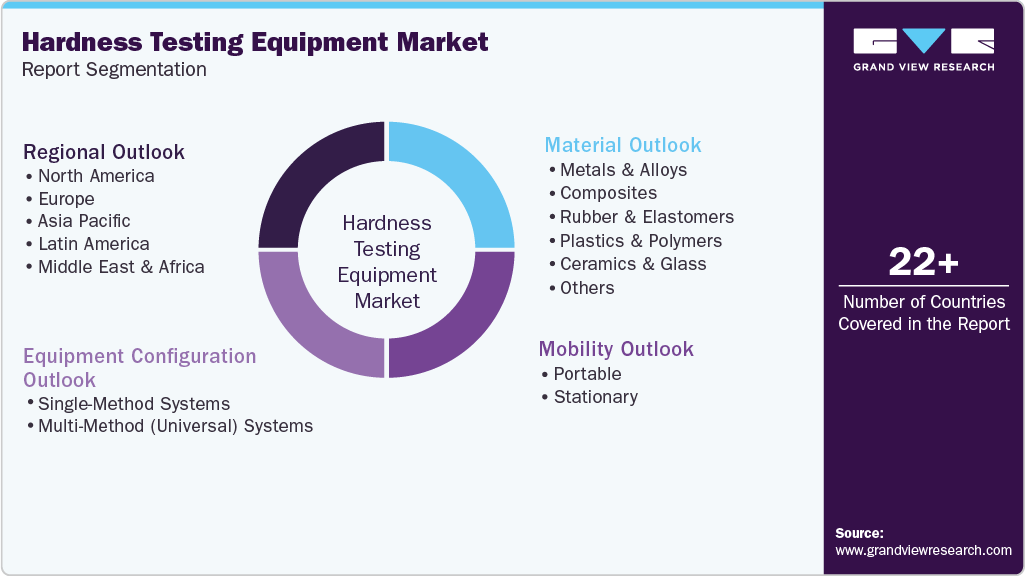
Global Hardness Testing Equipment Market Report Segmentation
This report forecasts revenue growth at global, regional & country levels and provides an analysis on the industry trends in each of the sub-segments from 2021 to 2033. For this study, Grand View Research has segmented the global hardness testing equipment market report on the basis of equipment configuration, mobility, material, and region:
-
Equipment Configuration Outlook (Revenue, USD Million, 2021 - 2033)
-
Single-Method Systems
-
Multi-Method (Universal) Systems
-
-
Mobility Outlook (Revenue, USD Million, 2021 - 2033)
-
Portable
-
Stationary
-
-
Material Outlook (Revenue, USD Million, 2021 - 2033)
-
Metals & Alloys
-
Composites
-
Rubber & Elastomers
-
Plastics & Polymers
-
Ceramics & Glass
-
Others
-
-
Regional Outlook (Revenue, USD Million, 2021 - 2033)
-
North America
-
U.S.
-
Canada
-
Mexico
-
-
Europe
-
Germany
-
France
-
UK
-
Spain
-
Italy
-
-
Asia Pacific
-
China
-
India
-
Japan
-
South Korea
-
Australia
-
-
Latin America
-
Brazil
-
Argentina
-
-
Middle East & Africa
-
Saudi Arabia
-
UAE
-
South Africa
-
-
Research Methodology
The hardness testing equipment market figures in this report are based on a proven research process that combines executive interviews with secondary research from proprietary databases, company filings, and recognized regulatory and institutional sources. Market size is built through value-chain sizing-reconciling supply-side and demand-side estimates-and triangulated with bottom-up and top-down approaches. Every estimate passes multiple levels of expert validation before publication, with each hardness testing equipment segment quantified using the revenue-capture definitions in the table below.
Segment Definition
Equipment Configuration
Revenue Capture Definition
Single-Method Systems
Revenue from equipment sales for hardness testing based on a single measurement method, covering the realized selling value of the complete system.
Multi-Method (Universal) Systems
Revenue from equipment sales for universal hardness testing systems supporting multiple measurement methods, based on the realized selling value per unit.
Mobility
Revenue Capture Definition
Portable
Revenue from sales of mobile hardness testing equipment intended for field and on-site measurements, valued at the equipment transaction price.
Stationary
Revenue from sales of fixed hardness testing systems intended for permanent laboratory or production installation, measured at the equipment transaction value.
Material
Revenue Capture Definition
Metals & Alloys
Revenue from hardness testing equipment sales serving metals and alloy testing requirements, based on the value of equipment sold for these material applications.
Composites
Revenue from hardness testing equipment sales designed for composite material evaluation, measured through the corresponding equipment sales value.
Rubber & Elastomers
Revenue from sales of hardness testing equipment intended for rubber and elastomer evaluation, based on the commercial value of applicable equipment units.
Plastics & Polymers
Revenue from hardness testing equipment sales serving plastics and polymer evaluation, measured according to the transaction value of relevant systems.
Ceramics & Glass
Revenue from sales of hardness testing equipment intended for ceramic and glass material evaluation, based on the commercial value of applicable testing systems.
Others
Revenue from hardness testing equipment sales serving material categories outside the defined segments, measured according to the transaction value of relevant equipment.
Estimation Model
Layer Name
Key Question
Description
Hardness Testing Equipment Demand Layer
Where is hardness testing equipment required?
Assess demand for hardness testers across manufacturing facilities, laboratories, quality-control operations, and material testing facilities. Evaluate testing requirements, equipment replacement cycles, production activity, and inspection needs to establish addressable equipment demand.
Industrial Testing Demand Layer
Where is new equipment demand being created?
Evaluate manufacturing activity and quality-control investments across automotive, aerospace, metals & alloys, machinery, electronics, plastics, and other industries. Assess capacity expansion, production modernization, inspection requirements, and laboratory investments that generate demand for new hardness testing equipment.
Product Adoption Layer
Which hardness testing equipment technologies are being deployed?
Segment equipment demand by configuration, mobility, testing method, material category, automation level, and application requirements. Assess adoption based on measurement accuracy, testing speed, material characteristics, portability, automation, and digital integration.
Revenue Generation Layer
How much market revenue is generated?
Estimate revenue from the sale of new hardness testing equipment by configuration, mobility, material category, testing method, end-use industry, and region. The calculation covers equipment sales to manufacturers, laboratories, distributors, testing facilities, and industrial users.
Delivered Customizations
This report has been delivered with the following In-depth customizations
CLIENT REQUEST
CUSTOMIZATION DELIVERED
VALUE ADDS
Competitive Benchmarking
A competitive benchmarking analysis was conducted across prominent hardness testing equipment manufacturers, assessing product portfolios, testing methods, equipment configurations, measurement capabilities, automation, material compatibility, portability, digital integration, service capabilities, geographic presence, and strategic initiatives.
The benchmarking provides a structured view of competitive positioning, product differentiation, technological capabilities, equipment versatility, and supplier strengths, supporting informed procurement decisions and competitive strategy development.
Regional Segmentation
A comprehensive regional assessment was conducted by analyzing hardness testing equipment demand across manufacturing output, laboratory infrastructure, quality-control requirements, equipment replacement, and industrial testing activity. Regional differences in equipment adoption, testing requirements, and market development were also evaluated.
The assessment enables stakeholders to identify high-potential markets, compare regional demand conditions, prioritize expansion opportunities, and align commercial strategies with regional hardness testing equipment requirements.
Opportunity Assessment
A detailed opportunity assessment was conducted by evaluating demand generated through equipment replacement, testing laboratory modernization, automated hardness measurement, portable testing, multi-method systems, and digital integration. Opportunities associated with manufacturing capacity expansion and increasing material inspection requirements were also assessed.
The assessment enables stakeholders to identify addressable revenue opportunities, prioritize product and technology investments, strengthen portfolio planning, and align expansion strategies with evolving hardness testing equipment requirements.
About the Author(s)
Advanced Interior Materials Research Team
Advanced Materials · Advanced Interior MaterialsThis report was authored by the advanced interior materials research team at Grand View Research - comprising two research analysts, one senior research analyst, and one industry expert - with specialized expertise in the advanced interior materials segment of the advanced materials industry. All findings are based on proprietary advanced materials databases, executive interviews, and regulatory analysis, subject to internal peer review prior to publication.
Last Updated:
Speak to Analyst


Customize this report to your needs — add regions, segments, or data points, with 20% free customization.
Or view our licence options:


ISO 9001:2015 & 27001:2022 Certified
We are GDPR and CCPA compliant! Your transaction & personal information is safe and secure. For more details, please read our privacy policy.


