
- Home
- »
- IT Services & Applications
- »
-
Headless Content Management System Software Market Report, 2026-2033GVR Report cover

Headless Content Management System Software Market (2026 - 2033)
Size, Share, & Trends Analysis Report By Component (Software, Services), By Deployment (Cloud, On-premise), By Application (Web Content Management, Mobile Content Management), By End Use, By Region, And Segment Forecasts
Market Size, 2025
$1.8BMarket Estimate, 2026
$2.0BMarket Forecast, 2033
$6.2BCAGR, 2026–2033
17.5%Headless Content Management System Software Market Summary
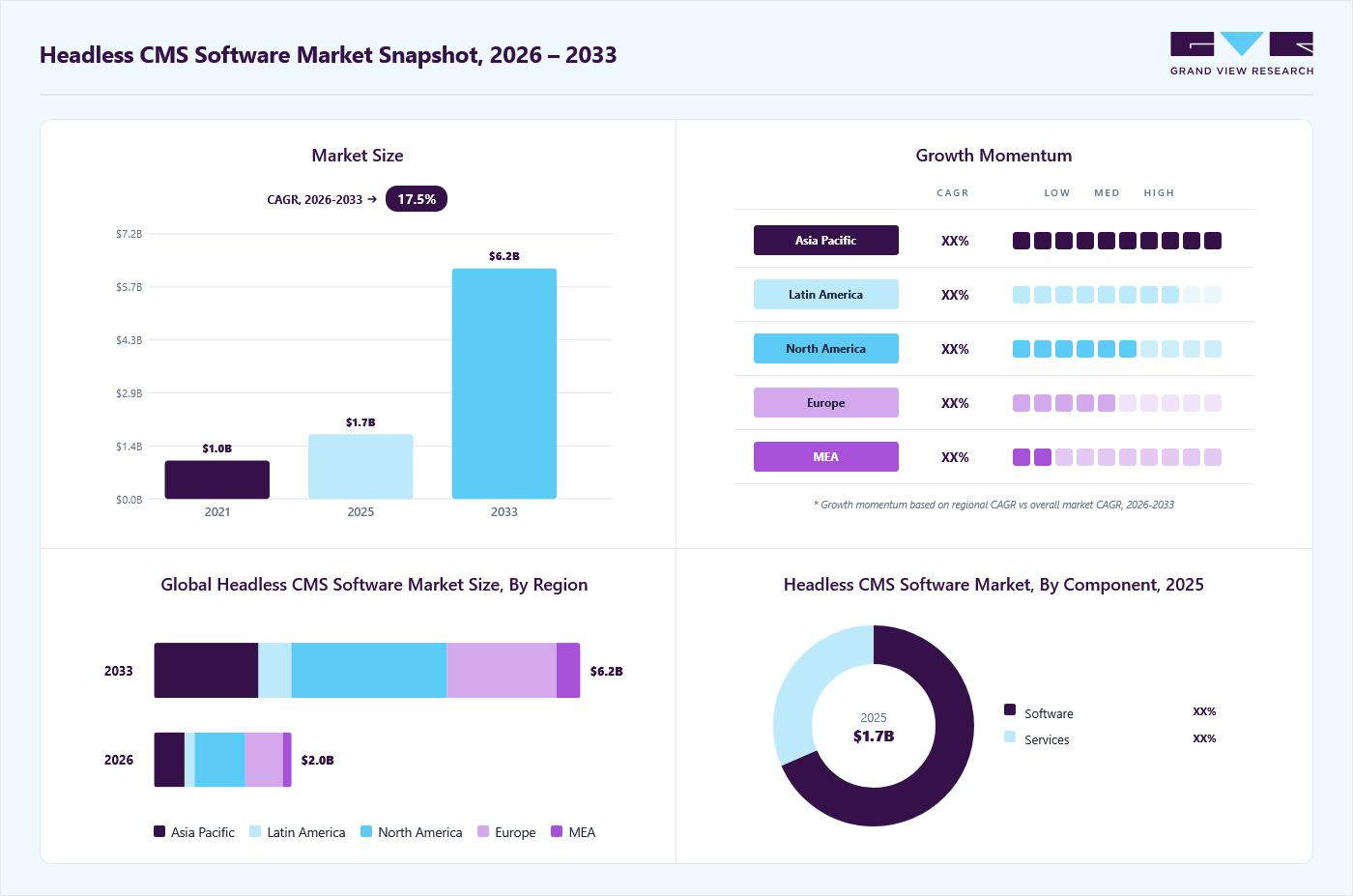
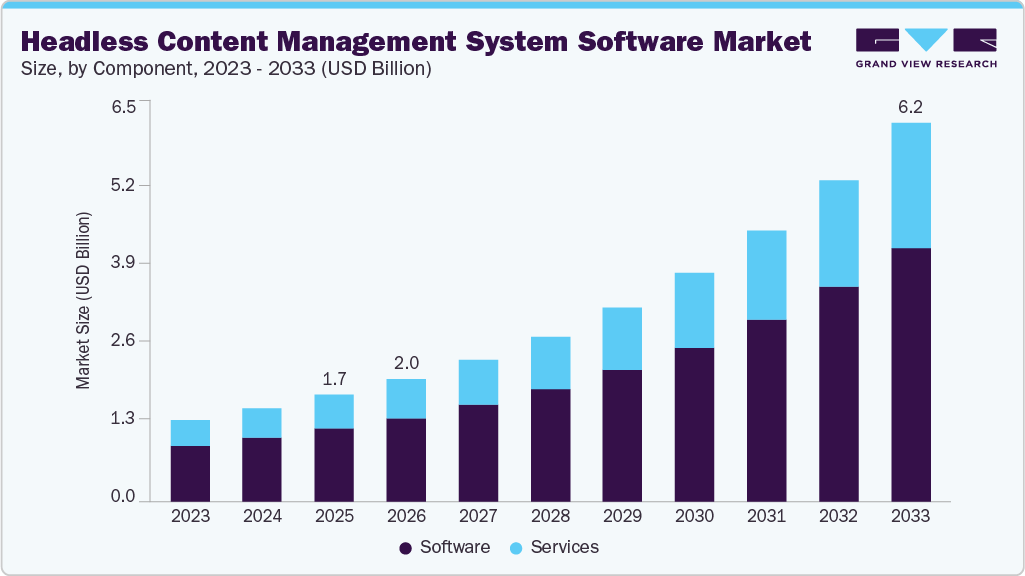
The global headless content management system software market size was valued at USD 1.8 billion in 2025 and is projected to grow from USD 2.0 billion in 2026 to USD 6.2 billion by 2033, at a CAGR of 17.5% from 2026 to 2033. The North America held the largest share of 36.9% of the global market in 2025. The increasing demand for omnichannel digital experiences is driving market growth.
 Source: Grand View Research, IR Documents, Primary Interviews, Paid DatabasesTo learn more about this report,
 Download Free Sample Report
 Key Market Trends & Insights
- By component: Software segment held the largest market share of 68.0% in 2025.
- By deployment: Cloud segment held the largest market share in 2025.
- By application: Web content management segment held the largest market share in 2025.
- By end use: Retail & e-commerce segment held the largest market share in 2025.
Regional Highlights
- Largest regional market: North America (36.9% revenue share, 2025)
- Fastest-growing regional market: Asia Pacific (highest CAGR, 2026-2033)
- By country: The U.S. held the largest share in 2025
Market Size & Forecast
- Market size in 2025: USD 1.8 Billion
- Estimated market size in 2026: USD 2.0 Billion
- Projected market size by 2033: USD 6.2 Billion
- CAGR (2026-2033): 17.5%
Three ways to get this report
Buy it, customize it, or ask a question.Ask an Analyst
Analyst response in 1 business day
- AccessReport author, directly
- Reply timeWithin 1 working day
- No sales callDirect answer only
- FormatEmail reply
- CostFree, no cost
Get the Full Report
What the study covers
- FormatsPDF · Excel · Dashboard
- Timeline2026–2033 annual, 2025 base
- Coverage20+ countries, 5 regions
- Companies10+ key players profiled
Customize the Report
20% free customization
- IncludeCountries, segments, points
- TailorTo your product definition
- ExtendDeeper competitor detail
- OrA fully bespoke study
- Turnaround5–10 working days
The increasing reliance on APIs and microservices architecture is driving the headless CMS software market growth. Modern digital ecosystems are built using modular components that communicate through APIs. A Headless CMS Software aligns perfectly with this architecture by providing content via API endpoints that can be consumed by various applications. This approach enables developers to build scalable and flexible systems without being constrained by monolithic platforms. It also allows businesses to integrate content management seamlessly with other enterprise systems. The use of microservices improves system resilience and simplifies updates and maintenance. As organizations continue to modernize their technology stacks, the adoption of headless CMS software is expected to grow significantly.The growing need for enhanced website and application performance is also driving the adoption of headless content management systems. Performance plays a critical role in user satisfaction, search engine rankings, and conversion rates. Headless CMS software enables faster content delivery by leveraging content delivery networks (CDNs) and optimized APIs. This reduces page load times and improves overall responsiveness. From the user perspective, faster performance leads to better experiences and higher engagement. From the business perspective, improved performance translates into higher retention, better SEO outcomes, and increased revenue opportunities. The impact on the market is the rising demand for CMS solutions that prioritize speed and efficiency.
 To learn more about this report, Download Free Sample Report
 The rising focus on security and risk management in digital content delivery is also contributing to market growth. Traditional CMS platforms, being tightly coupled, often present larger attack surfaces and vulnerabilities. Headless CMS software reduces these risks by separating the content repository from the presentation layer. This architectural approach limits direct access to the backend, enhancing overall security. From the user perspective, improved security builds trust and confidence in digital platforms. From the organizational perspective, it reduces the risk of data breaches and ensures compliance with security standards. The impact on the market is the increasing adoption of headless CMS software solutions as organizations prioritize secure and resilient digital infrastructure.
The growing trend of digital-first business models is another important driver influencing the headless CMS software market. Many organizations are shifting their focus toward digital channels as primary revenue streams rather than supplementary ones. This requires robust content management systems that can support continuous digital engagement. Headless CMS software enables businesses to deliver content quickly and efficiently across multiple digital touchpoints. For users, this results in more engaging and interactive online experiences. For businesses, it supports scalability, innovation, and long-term growth. The impact on the market is the accelerated adoption of headless CMS software as a critical enabler of digital transformation strategies.
The increasing need for seamless integration with third-party tools and platforms is also driving the adoption of headless CMS software solutions. Businesses rely on a wide range of tools, including analytics platforms, marketing automation systems, and customer data platforms. A headless CMS software, with its API-first approach, enables easy integration with these tools. This enables organizations to create a connected ecosystem where data flows seamlessly between systems. From the user perspective, this results in more personalized and relevant content experiences. From the business perspective, it improves operational efficiency and enhances decision-making capabilities. The impact on the market is the growing demand for interoperable CMS solutions that can integrate with diverse technology stacks.
Component Insights
The software segment accounted for the largest market share of over 68% in 2025 in the headless content management system (CMS) software market. The growing importance of microservices-based software architecture is driving the adoption of headless CMS software in the software segment. Many organizations are transitioning from monolithic systems to microservice architectures to improve scalability and flexibility. In such environments, each service performs a specific function and communicates with other services via APIs. A Headless CMS Software fits naturally into this architecture by serving as a dedicated content service accessible by multiple applications. This allows software systems to remain modular and easier to manage.
The services segment is anticipated to grow at the fastest CAGR during the forecast period. The growing importance of customization and development services is driving the services segment growth. Headless CMS software platforms provide flexibility, but this often requires custom development to fully realize their potential. Organizations need tailored solutions that align with their specific workflows, branding requirements, and customer engagement strategies. Development service providers build custom APIs, front-end applications, and integrations that extend the functionality of headless CMS software platforms. This enables businesses to create unique digital experiences that differentiate them in the market.
Deployment Insights
The cloud segment dominated the market in 2025. The growing integration of advanced technologies, such as artificial intelligence and analytics, into cloud environments is contributing to the market growth. Cloud platforms provide the computational power and infrastructure needed to support AI-driven content personalization, predictive analytics, and automation. Headless CMS Software solutions integrated with these technologies enable organizations to deliver more intelligent and data-driven content experiences. This allows for real-time adaptation of content based on user behavior and preferences.
The on-premise segment is expected to register a significant CAGR from 2026 to 2033. The demand for high levels of customization and system control is contributing to the growth of the on-premise segment. On-premises solutions give organizations complete control over system configuration, performance tuning, and feature development. This enables the creation of highly tailored content management environments that align with specific business needs. Organizations can modify system components, integrate proprietary tools, and optimize performance based on their unique requirements. This level of customization is often difficult to achieve in standardized cloud environments. The flexibility to design and control every aspect of the system makes an on-premises headless CMS software an optimal option for complex, specialized use cases.
Application Insights
The web content management segment dominated the industry in 2025. The increasing integration of web platforms with third-party tools and services drives market growth. Modern websites rely on a variety of external systems, including analytics platforms, customer data platforms, and marketing automation tools. A headless CMS software, with its API-first approach, enables seamless integration with these systems. This enables the creation of connected digital ecosystems where data and content flow efficiently between platforms. It also supports advanced functionalities such as real-time analytics and automated content delivery. The need for interoperability and integration is pushing organizations toward headless CMS software solutions for web content management.
The omnichannel content management segment is expected to register the fastest CAGR from 2026 to 2033. The increasing proliferation of digital touchpoints is a major driver in the omnichannel content management segment of the headless content management software market. Organizations today must manage content across websites, mobile applications, social media platforms, digital kiosks, wearables, and emerging interfaces such as voice assistants. This expansion of channels creates complexity in ensuring that content is consistent, relevant, and synchronized across all touchpoints. A Headless CMS Software provides a centralized content repository that can distribute content seamlessly via APIs to multiple endpoints. This eliminates the need to create and manage separate content silos for each channel. It also enables faster deployment of content across new and existing platforms. As the number of digital channels continues to grow, the need for efficient omnichannel content management solutions is driving adoption.
End Use Insights
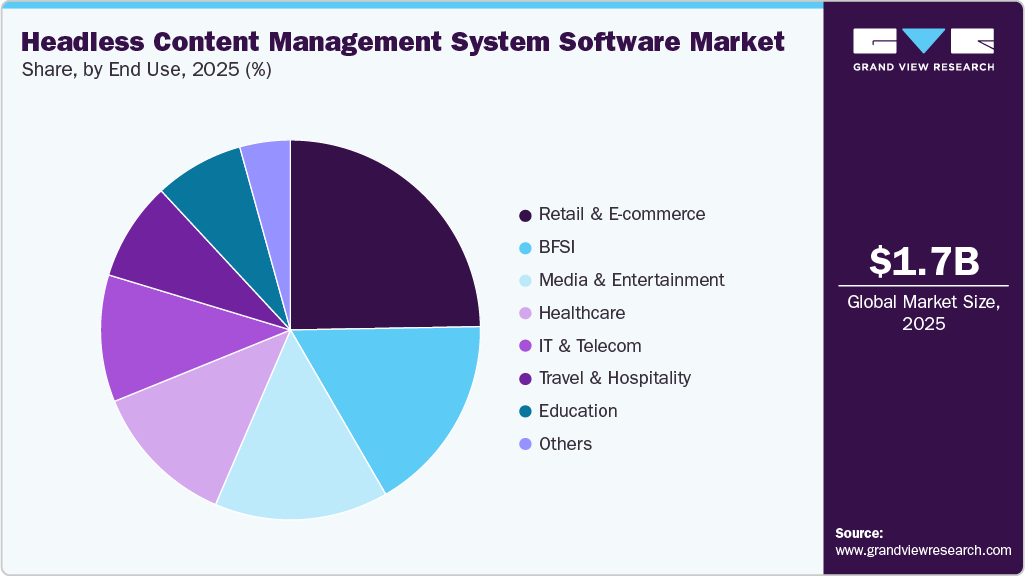
The retail & e-commerce segment accounted for the largest market share of the headless CMS software industry in 2025. The growing demand for personalized shopping experiences is driving market growth. Retailers are leveraging customer data to tailor product recommendations, promotions, and content to individual preferences. Headless CMS Software integrates with personalization engines and analytics platforms to enable dynamic content delivery. This allows retailers to adjust content in real time based on browsing behavior, purchase history, and user interactions. Personalized experiences are becoming a key differentiator in competitive retail markets. The flexibility of headless architecture makes it easier to implement and scale personalization strategies. As personalization becomes more sophisticated, its role in driving headless CMS software adoption continues to expand.
 To learn more about this report, Download Free Sample Report
 The BFSI segment is anticipated to register the fastest CAGR during the forecast period. The growing emphasis on delivering seamless, unified digital banking experiences across multiple channels is driving segment growth. Banks and financial service providers are expected to provide consistent experiences across websites, mobile apps, ATMs, and emerging digital interfaces. A Headless CMS Software enables centralized content management and distribution via APIs, allowing the same content to be delivered across multiple channels without duplication. This ensures that product information, financial services content, and customer communications remain consistent and up to date. It also supports rapid deployment of new services across channels without extensive redevelopment. As omnichannel banking becomes the standard, financial institutions are increasingly adopting headless CMS software solutions to manage content more efficiently.
Regional Insights
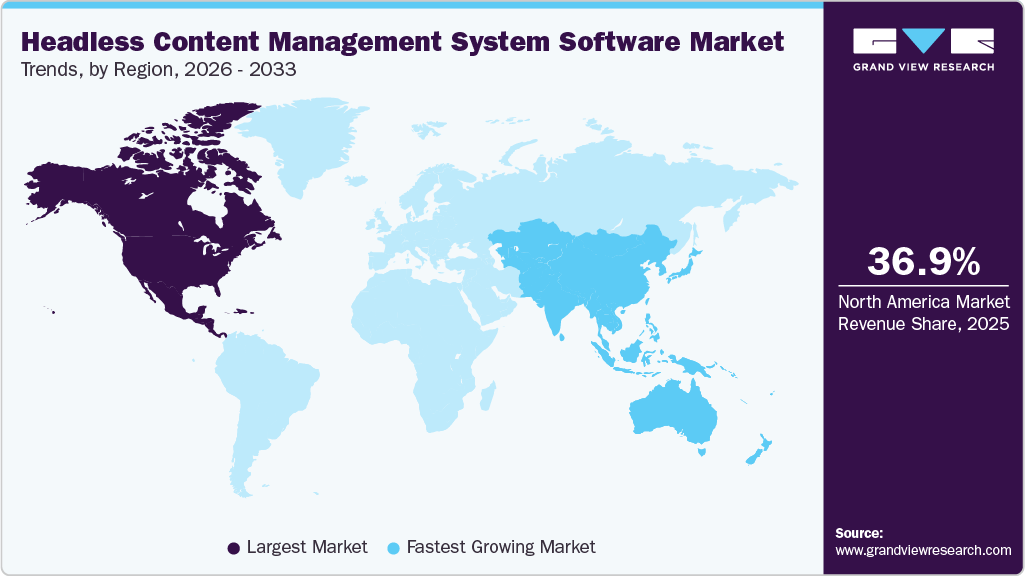
The North America headless Content Management System (CMS) software industry dominated with a revenue share of over 36.9% in 2025. The high demand for personalized, data-driven digital experiences is driving significant market expansion. Organizations are leveraging advanced analytics and customer data platforms to deliver tailored content across digital touchpoints. Headless CMS Software enables seamless integration with these systems, allowing for dynamic content delivery based on real-time insights. This supports the creation of highly relevant and engaging user experiences. Personalization has become a critical factor in differentiating digital offerings across industries. The flexibility of headless architecture allows organizations to scale personalization efforts efficiently. This growing focus on data-driven engagement is a strong driver in the region.
 To learn more about this report, Download Free Sample Report
 U.S. Headless Content Management System Software Market Trends
The headless Content Management System (CMS) software industry in the U.S. is projected to grow significantly during the forecast period. The widespread adoption of composable architecture strategies is a key driver shaping the market in the U.S. Enterprises are moving away from monolithic systems toward modular, API-driven ecosystems that allow them to select best-of-breed solutions for each function. A Headless CMS Software plays a central role in this architecture, acting as a content hub that integrates with various tools and platforms. This approach provides greater flexibility in designing and managing digital experiences. It also enables organizations to replace or upgrade individual components without affecting the entire system. The composable model supports continuous innovation and reduces long-term technology constraints. This shift toward modular digital ecosystems is significantly driving demand for headless content management solutions.
Asia Pacific Headless Content Management System Software Market Trends
The headless Content Management System (CMS) software industry in the Asia Pacific is expected to grow at the fastest CAGR from 2026 to 2033. The increasing focus on mobile-first strategies is shaping the market landscape in the Asia Pacific. Many users in the region primarily access digital services through mobile devices rather than desktops. This requires content management systems that are optimized for mobile delivery and performance. Headless CMS Software supports mobile-first development by enabling seamless integration with mobile applications and responsive web platforms. It also enables faster loading times and a better user experience on mobile devices. Businesses are prioritizing mobile optimization to enhance engagement and reach a wider audience. This shift toward mobile-first strategies is a strong driver for headless CMS software adoption.
The China headless content management system software industry is projected to grow significantly during the forecast period. The dominance of super apps and integrated digital platforms is a key driver shaping the market in China. Users frequently interact with multi-functional platforms that combine messaging, payments, e-commerce, and services within a single interface. This creates a need for content systems that can seamlessly integrate with complex and interconnected digital environments. Headless CMS Software enables API-driven content delivery, allowing businesses to push content into these ecosystems efficiently. It also supports rapid updates and real-time content distribution across integrated services. The ability to operate within such unified platforms requires high flexibility and adaptability. This environment is driving the adoption of headless content management solutions.
Europe Headless Content Management System Software Market Trends
The headless Content Management System (CMS) software industry in Europe is anticipated to grow steadily from 2026 to 2033. The growing demand for seamless integration with financial technology and digital services ecosystems is contributing to market growth. The UK has a well-developed fintech landscape, with organizations integrating multiple digital services, including payments, banking, and financial analytics. Managing content across these interconnected systems requires a flexible and API-driven approach. Headless CMS Software enables seamless integration with various platforms, ensuring efficient content delivery across services. This supports the creation of unified digital ecosystems that enhance operational efficiency. It also allows organizations to introduce new services without disrupting existing systems. The need for integration within complex digital environments is a strong driver for headless CMS software adoption.
The UK headless Content Management System software industry is expected to grow significantly during the forecast period. The growing need for agile development and faster deployment cycles is driving market growth. Organizations are under pressure to launch new features, campaigns, and digital services quickly. A headless CMS software enables development and content teams to work independently, reducing bottlenecks and improving efficiency. This separation supports continuous integration and delivery practices. It also enables organizations to experiment with new technologies and user experiences without major disruptions. The ability to adapt quickly to changing market conditions is becoming increasingly important. This demand for agility is driving the growth of headless content management solutions in the UK.
Key Headless Content Management System Software Company Insights
Some prominent players in the market include Radixweb and Agility CMS.
-
Radixweb is an India-based software development and IT consulting company that provides custom digital solutions to enterprises, startups, and technology firms worldwide. Radixweb provides development, integration, and consulting services to help organizations transition from traditional content management systems to API-first, decoupled architectures. The company works with modern headless CMS software platforms to design and implement systems that manage content independently of the front-end presentation layer, enabling businesses to deliver content seamlessly across websites, mobile applications, IoT devices, and other digital touchpoints.
-
Agility CMS is a digital experience platform that specializes in delivering headless content management solutions for enterprises seeking flexible, scalable content delivery architectures. Agility CMS provides a robust platform that decouples content management from presentation layers, allowing content to be created once and delivered across websites, mobile applications, e-commerce platforms, and other digital interfaces. The system offers content modeling, workflow management, and API-based content delivery, enabling organizations to maintain consistency while adapting content for different channels. Its hybrid approach allows marketers to use visual page management tools while developers leverage APIs and modern frameworks to build customized front-end experiences, bridging the gap between usability and technical flexibility.
Key Headless Content Management System Software Companies:
The following key companies have been profiled for this study on the headless content management system software market.
- Agility CMS
- Contentstack Inc.
- CoreMedia GmbH
- Culture Foundry
- Kontent.ai
- Liferay Inc.
- Radixweb
- SANITY
- Strapi
- Uniform Systems, Inc.
Recent Developments
-
In April 2026, Liferay launched Liferay CMS, a headless CMS designed to enable marketing, development, and IT teams to efficiently create, manage, and distribute digital content across multiple channels through a centralized platform. The solution features Spaces, which serve as the core organizational units for managing headless content, allowing teams to structure asset repositories, control access permissions, and enhance collaboration across different departments and projects. Each Space functions as a dedicated workspace for content creation and administration, offering capabilities such as advanced AI-driven localization, thereby simplifying multilingual content management for global organizations.
-
In August 2025, Alloy partnered with Strapi to provide brands with the ability to create modern, scalable websites using a flexible headless CMS software. Strapi offers a strong balance between an intuitive content editing experience and a powerful backend system for managing structured data. This combination makes it well-suited for marketing teams that require simple content management, as well as developers who need a reliable platform capable of handling complex relational data structures.
-
In January 2025, Contentstack announced the acquisition of Lytics, strengthening its platform with advanced audience intelligence, content analytics, and unified profile management capabilities. This integration enables real-time personalization for both known and anonymous users at scale, enhancing the overall digital experience delivery. With this acquisition, Contentstack differentiates itself from traditional headless CMS software vendors that lack the ability to activate customer data dynamically for personalized engagement. The acquisition also sends a strong signal to legacy suite providers, highlighting the emergence of a modern, composable digital experience platform (DXP) that prioritizes flexibility, agility, and customer-centric innovation.
Headless Content Management System Software Market Report Scope
Report Attribute
Details
Market size in 2025
USD 1.8 billion
Estimated market size in 2026
USD 2.0 billion
Projected market size by 2033
USD 6.2 billion
Growth rate
CAGR of 17.5% from 2026 to 2033
Actual data
2021 - 2025
Forecast period
2026 - 2033
Quantitative units
Revenue in USD million/billion and CAGR from 2026 to 2033
Report coverage
Revenue forecast, company share, competitive landscape, growth factors, and trends
Segments covered
Component, deployment, application, end use, region
Regional scope
North America; Europe; Asia Pacific; Latin America; Middle East & Africa
Country scope
U.S.; Canada; Mexico; UK; Germany; France; China; India; Japan; Australia; South Korea; Brazil; UAE; Saudi Arabia; South Africa
Key companies profiled
Agility CMS; Contentstack Inc.; CoreMedia GmbH; Culture Foundry; Kontent.ai; Liferay Inc.; Radixweb; SANITY; Strapi; Uniform Systems, Inc.
Customization scope
Free report customization (equivalent to 8 analysts working days) with purchase. Addition or alteration to country, regional & segment scope.
Pricing and purchase options
Avail customized purchase options to meet your exact research needs. Explore purchase options
Global Headless Content Management System Software Market Report Segmentation
This report forecasts revenue growth at global, regional, and country levels and provides an analysis of the latest industry trends in each of the sub-segments from 2021 to 2033. For this study, Grand View Research has segmented the global headless Content Management System (CMS) software market report based on component, deployment, application, end use, and region.
-
Component Outlook (Revenue, USD Million, 2021 - 2033)
-
Software
-
Services
-
-
Deployment Outlook (Revenue, USD Million, 2021 - 2033)
-
Cloud
-
On-premise
-
-
Application Outlook (Revenue, USD Million, 2021 - 2033)
-
Web Content Management
-
Mobile Content Management
-
E-commerce Content Management
-
Digital Experience Management
-
Omnichannel Content Delivery
-
Others
-
-
End Use Outlook (Revenue, USD Million, 2021 - 2033)
-
Retail & E-commerce
-
Media & Entertainment
-
BFSI
-
Healthcare
-
IT & Telecom
-
Travel & Hospitality
-
Education
-
Others
-
-
Regional Outlook (Revenue, USD Million, 2021 - 2033)
-
North America
-
U.S.
-
Canada
-
Mexico
-
-
Europe
-
Germany
-
UK
-
France
-
-
Asia Pacific
-
China
-
India
-
Japan
-
South Korea
-
Australia
-
-
Latin America
-
Brazil
-
-
Middle East & Africa
-
UAE
-
Saudi Arabia
-
South Africa
-
-
Frequently Asked Questions About This Report
North America dominated with a 36.9% revenue share in 2025.
The cloud segment held the largest revenue share in 2025, while the on-premise segment is expected to register a significant CAGR from 2026 to 2033.
The web content management segment held the largest revenue share in 2025, while the omnichannel content management segment is the fastest-growing.
The retail & e-commerce segment held the largest revenue share in 2025, while the BFSI segment is the fastest-growing.
The global headless content management system software market size was estimated at USD 1.8 billion in 2025 and is expected to reach USD 2.0 billion in 2026.
The global headless content management system software market is expected to grow at a compound annual growth rate of 17.5% from 2026 to 2033 to reach USD 6.2 billion by 2033.
The software segment accounted for the largest revenue share in 2025 in the headless content management system software market, driven by the increasing demand for integrated platforms that streamline core operations such as team management, scheduling, performance analytics, and fan engagement.
Some key players operating in the market include Agility CMS; Contentstack Inc.; CoreMedia GmbH; Culture Foundry; Kontent.ai; Liferay Inc.; Radixweb; SANITY; Strapi; Uniform Systems, Inc., and Others.
Factors such as the growing demand for omnichannel content delivery across web, mobile, and IoT platforms, increasing adoption of API-first and microservices-based architectures for greater flexibility and scalability, and the rising need for faster content personalization and seamless digital experiences play a key role in accelerating the headless content management system software market.
About the Author(s)
IT Services & Applications Research Team
Technology · IT Services & ApplicationsThis report was authored by the it services & applications research team at Grand View Research - comprising two research analysts, one senior research analyst, and one industry expert - with specialized expertise in the it services & applications segment of the technology industry. All findings are based on proprietary technology databases, executive interviews, and regulatory analysis, subject to internal peer review prior to publication.
Last Updated:
Speak to Analyst

Customize this report to your needs - add regions, segments, or data points, with 20% free customization.
Or view our licence options:


ISO 9001:2015 & 27001:2022 Certified
We are GDPR and CCPA compliant! Your transaction & personal information is safe and secure. For more details, please read our privacy policy.


