
- Home
- »
- Communications Infrastructure
- »
-
Content Delivery Network Market Size Report, 2026-2033GVR Report cover

Content Delivery Network Market (2026 - 2033)
Size, Share, & Trends Analysis Report By Service (Standard CDN, Video CDN), By Solution (Web Performance Optimization, Media Delivery, Cloud Security), By Service Provider, By End Use, By Region, And Segment Forecasts
Market Size, 2025
$31.5BMarket Estimate, 2026
$37.4BMarket Forecast, 2033
$164.9BCAGR, 2026–2033
23.6%Content Delivery Network Market Summary
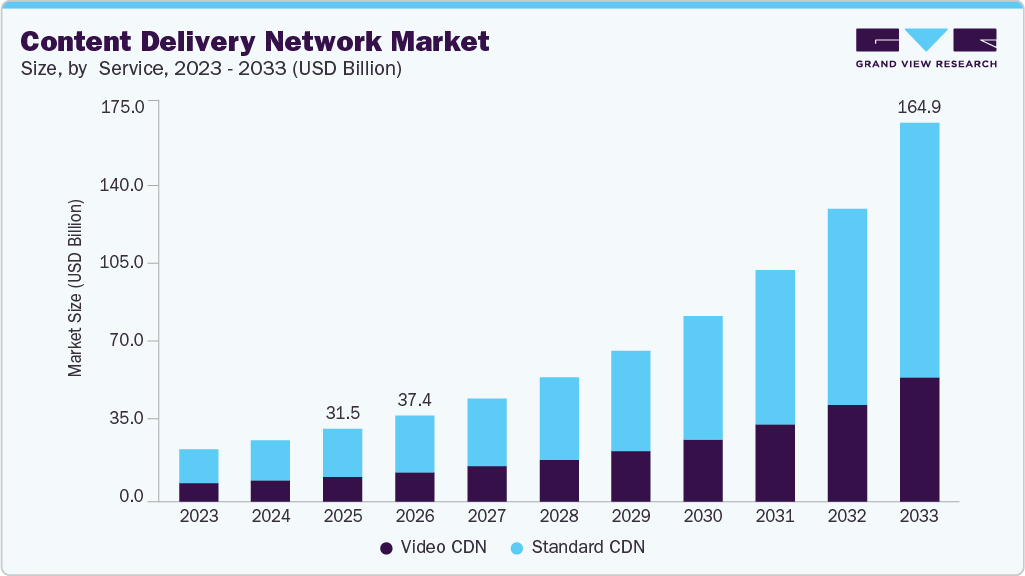
The global content delivery network market size was valued at USD 31.5 billion in 2025 and is projected to grow from USD 37.4 billion in 2026 to USD 164.9 billion by 2033, at a CAGR of 23.6% from 2026 to 2033. North America dominated the market, accounting for 38.7% of revenue in 2025. This growth is driven by growing adoption of cloud-native applications, OTT streaming, AI workloads, and edge computing for low-latency, secure content delivery services.
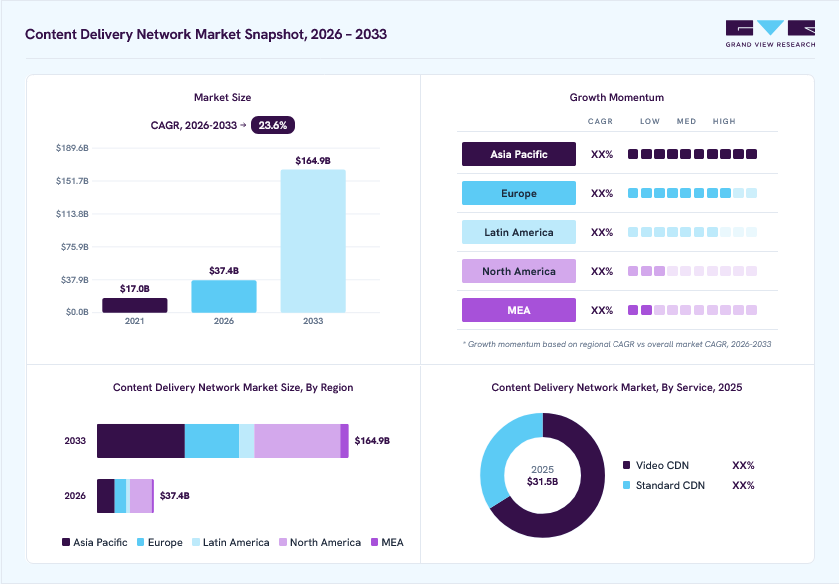 Source: Grand View Research, IR Documents, Primary Interviews, Paid DatabasesTo learn more about this report,
 Download Free Sample Report
 Key Market Trends & Insights
- By service: Video CDN segment dominated the market, with a revenue share of 66.0% in 2025
- By solution: Web performance optimization segment dominated the market, with a revenue share of 40.0% in 2025
- By service provider: Traditional commercial CDN segment dominated the market, with a revenue share of 48.9% in 2025
- By end use: Media and entertainment segment held the largest revenue share in 2025
Regional Highlights
- Largest regional market: North America (38.7% revenue share, 2025)
- Fastest-growing regional market: Asia Pacific (highest CAGR, 2026–2033)
- By country: The U.S. held the largest market share in 2025.
Market Size & Forecast
- Market size in 2025: USD 31.5 Billion
- Estimated market size in 2026: USD 37.4 Billion
- Projected market size by 2033: USD 164.9 Billion
- CAGR (2026–2033): 23.6%
Three ways to get this report
Buy it, customize it, or ask a question.Ask an Analyst
Analyst response in 1 business day
- AccessReport author, directly
- Reply timeWithin 1 working day
- No sales callDirect answer only
- FormatEmail reply
- CostFree, no cost
Get the Full Report
What the study covers
- FormatsPDF · Excel · Dashboard
- Timeline2026–2033 annual, 2025 base
- Coverage20+ countries, 5 regions
- Companies10+ key players profiled
Customize the Report
20% free customization
- IncludeCountries, segments, points
- TailorTo your product definition
- ExtendDeeper competitor detail
- OrA fully bespoke study
- Turnaround5–10 working days
The increasing global penetration of the internet, particularly in emerging regions, is further strengthening demand for CDN services to deliver optimal performance. Growing expectations for fast, high-quality online experiences are driving greater reliance on CDNs to enhance site and app performance. In the media and entertainment industry, CDNs are widely used to deliver audio and video more smoothly. As content consumption continues to evolve and demand for high-quality, original content grows, companies increasingly rely on efficient CDN solutions to improve network performance and deliver content quickly.The growing demand for Over-the-Top (OTT) and Video-on-Demand (VOD) services is increasing the need for reliable, high-speed content delivery and is expected to support market growth. The global e-commerce industry is also developing as consumer behavior continues to change. CDN solutions play an important role in e-commerce by ensuring smooth platform performance and giving customers quick access to the information they need to make informed purchase decisions. In addition, more consumers are shifting from traditional television to video content delivered over cellular networks, driving greater adoption of CDN solutions to improve streaming quality. Meanwhile, the growing use of IoT- and AI-based digital solutions across industries is encouraging market players to develop customized, industry-specific CDN offerings.
 To learn more about this report, Download Free Sample Report
 The growing use of OTT and VOD services requires broadcasters to deliver low-latency data and improve the quality of video streaming. Continued investments in network infrastructure worldwide, particularly in emerging markets such as India, have strengthened connectivity, bandwidth, and coverage. For instance, in August 2025, Nokia announced that Netplus had deployed Nokia’s latest 400G routing technology and SDAN platform to scale its high-speed broadband and IPTV services across Punjab and other cities, enabling more immersive services for nearly two million users while ensuring long-term network efficiency. These improvements ensure that consumers can stay connected, receive real-time updates, and easily access ready-to-use media content. As a result, broadcasters are increasingly focused on enhancing content delivery and providing diverse data across multiple applications. The market has also expanded significantly in recent years due to increasing demand for online content delivery, driven by the growth of digital media consumption, the expansion of e-commerce, and the increasing importance of web performance optimization for businesses. In addition, trends such as 5G adoption, the rise of IoT, and the continued development of cloud-based services are expected to further accelerate market growth.
Market Dynamics
The global content delivery network (CDN) market is witnessing strong growth as organizations increasingly prioritize high-performance, secure, and reliable digital content delivery across geographically distributed users. Enterprises are adopting advanced CDN solutions to accelerate the delivery of web content, video streaming, software downloads, APIs, and cloud applications while minimizing latency and improving user experience. Modern CDN platforms leverage intelligent traffic routing, edge caching, load balancing, and edge computing capabilities to optimize application performance, enhance scalability, and ensure high availability during peak traffic periods. The rapid growth of video-on-demand, OTT platforms, e-commerce, online gaming, cloud services, and digital transformation initiatives is further accelerating demand for CDN solutions, as businesses seek faster content delivery, enhanced cybersecurity through DDoS protection and web application firewalls, and seamless digital experiences across increasingly distributed and bandwidth-intensive environments.
The growing demand for low-latency digital experiences, coupled with the rapid expansion of edge computing, AI-driven applications, and bandwidth-intensive content, is a significant driver of the global CDN market. Organizations are increasingly deploying advanced CDN platforms to accelerate the delivery of websites, video streaming, APIs, software updates, and cloud-native applications across globally distributed users. Enterprises are integrating edge caching, intelligent traffic routing, load balancing, real-time analytics, and edge computing capabilities to improve application performance, optimize network efficiency, and ensure seamless user experiences. For instance, in March 2026, Akamai launched AI Grid Intelligent Orchestration for Distributed Inference Across 4,400 Edge Locations, expanding its Akamai Inference Cloud with thousands of NVIDIA RTX PRO 6000 Blackwell Server Edition GPUs. The platform enables AI inference workloads to be processed closer to end users through intelligent workload routing across edge, regional, and core infrastructure, highlighting the evolution of CDN platforms into AI-enabled edge computing networks that deliver low-latency digital experiences
The significant investment required to build and maintain globally distributed edge infrastructure is a major restraint on the CDN market. CDN providers must continuously expand points of presence (PoPs), upgrade network capacity, and invest in edge servers, high-speed connectivity, and cybersecurity capabilities to meet growing traffic demands. Integrating CDN services across hybrid cloud environments, multi-cloud platforms, and legacy IT systems can also introduce deployment complexities and increase operational costs. Additionally, ensuring consistent content synchronization, regulatory compliance with regional data sovereignty requirements, and maintaining service quality across geographically dispersed networks remain challenging. Small and medium-sized enterprises often face budget constraints and limited technical expertise, which slows CDN adoption despite growing demand for high-performance digital content delivery.
The rapid evolution of edge computing and AI-driven network optimization presents a significant growth opportunity for the global CDN market. Organizations are increasingly investing in intelligent CDN platforms that combine machine learning, predictive traffic management, edge computing, and real-time analytics to optimize content delivery and application performance. Modern CDN solutions are evolving beyond traditional caching to support edge application hosting, serverless computing, API acceleration, video optimization, and AI inference at the network edge. The growing adoption of 5G networks, immersive digital experiences, cloud gaming, OTT streaming, IoT ecosystems, and enterprise digital transformation initiatives is further accelerating demand for next-generation CDN platforms. Additionally, increasing emphasis on application security through integrated DDoS mitigation, Web Application Firewalls (WAF), bot management, and Zero Trust networking is creating opportunities for CDN providers to deliver unified performance and security solutions across globally distributed digital environments.
Analyst Perspective
The content delivery network (CDN) market sits at the intersection of accelerating digital transformation, rapid growth in cloud-native applications, and increasing demand for low-latency digital experiences. Organizations are increasingly required to deliver websites, video streaming, APIs, software updates, and cloud applications seamlessly to globally distributed users, driving strong demand for scalable, edge-enabled content delivery platforms. Traditional centralized content delivery architectures are becoming insufficient, prompting enterprises to adopt advanced CDN solutions that leverage distributed edge infrastructure, intelligent traffic routing, edge computing, and integrated security capabilities to optimize application performance, ensure high availability, and provide secure, real-time content delivery across increasingly distributed digital ecosystems.
Service Insights
Based on service, the video CDN segment led the market with the largest revenue share of 66.0% in 2025, driven by the fast growth in online video consumption and the expanding popularity of OTT and VOD platforms. As millions of users stream HD, 4K, and live video content daily, broadcasters and streaming providers increasingly rely on video CDNs to ensure low-latency delivery, minimal buffering, and consistent playback quality. Developments further support this trend, for example, when building its support for live streaming, Netflix extended its Open Connect CDN to deliver live content to millions of viewers globally by placing thousands of CDN servers close to users and optimizing how video segments are delivered so that playback remains smooth even under high demand. This involved using personalized manifests and edge caching to balance load and maintain high quality across devices and network conditions. At the same time, improvements in global connectivity, including broadband upgrades and 5G rollouts, are enabling faster data transmission and higher-quality streaming across devices. The rise in mobile video usage, with advancements such as edge computing and expanded PoP deployments by CDN providers, is further strengthening the need for strong video CDN services capable of handling massive traffic volumes and delivering seamless viewing experiences worldwide.
The standard CDN segment is anticipated to grow at a significant CAGR during the forecast period, driven by the increasing need for efficient and reliable web content delivery across websites, applications, and enterprise platforms. Standard CDNs help distribute static content, images, scripts, and software downloads closer to end users, reducing latency, improving website load times, and enhancing the overall user experience. Key market drivers include the rapid growth of e-commerce platforms, online education, and corporate web services, where consistent performance and uptime are critical to business operations. In addition, the rise in mobile internet use and cloud services has increased the need for standard CDN solutions, as businesses require networks that can easily scale and handle higher traffic during peak periods.
Solution Insights
Based on the solution, the web performance optimization segment led the market with the largest revenue share of 40.0% in 2025, driven by the growing need to protect data, applications, and content as they move across distributed CDN environments. As more businesses shift their workloads and media delivery pipelines to the cloud, securing these assets against breaches, unauthorized access, and evolving cyberattacks has become a top priority. Growth in this segment is further driven by factors such as the increasing volume of online traffic, the increase in DDoS attacks targeting high-visibility websites, stricter data protection regulations, and the need to safeguard edge locations where CDN nodes operate. The expansion of streaming services, online gaming, and e-commerce also adds pressure on CDN providers to integrate strong security layers, ensuring safe and uninterrupted content delivery for users worldwide.
The media delivery segment accounted for a significant share of revenue in 2025. As online content consumption continues to grow, CDNs have become important for delivering large media files smoothly and ensuring that viewers can stream videos without interruptions. New formats such as AR, VR, and ultra-high-resolution content are raising expectations for speed and quality, pushing CDNs to handle much higher bandwidth and maintain low latency. This growth is supported by several drivers, including the rising popularity of streaming platforms, the shift toward real-time and interactive content, and increasing demand for consistent viewing experiences across devices and regions. Expanding internet penetration and improvements in mobile networks also contribute to the stronger need for reliable media delivery solutions.
Service Provider Insights
Based on service provider, the traditional commercial CDN segment led the market with the largest revenue share of 48.9% in 2025. Traditional CDN providers offer a wide range of solutions that help speed up network performance, accelerate content delivery, and support efficient media distribution, capabilities that many large enterprises still depend on for reliable digital experiences. The ongoing global growth in data consumption, especially for high-quality video, gaming, and dynamic web content, has further pushed these providers to optimize delivery and expand their infrastructure to meet demand. For example, established CDN leaders like Akamai and Cloudflare continue to invest in global points of presence and advanced routing technologies to serve traffic faster and more reliably. In September 2024, Cloudflare launched the Speed Brain, which was designed to make millions of web pages load up to 45% faster by preloading likely next pages into the browser cache, resulting in near instant loading and smoother browsing experiences for users worldwide. These ongoing innovations show how traditional CDN providers remain central to supporting fast, reliable, and scalable digital experiences in growing global traffic demands.
The cloud CDN segment is anticipated to grow at a significant CAGR during the forecast period. This growth is driven by the growing need to deliver websites, apps, and digital media quickly and reliably, especially as more businesses shift their operations online. Cloud CDN providers use large networks of distributed servers to store and deliver content from locations closer to users, reducing delays and ensuring smoother performance. In recent years, cloud CDNs have also adopted smarter technologies, such as improved caching of dynamic content and predictive prefetching, to keep up with heavier traffic and rising expectations for fast, uninterrupted digital experiences.
End Use Insights
Based on end use, media and entertainment segment led the market with the largest revenue share of 41.4% in 2025. This is mainly because the media & entertainment industry is rapidly moving to digital delivery, with a growing need for online streaming, video-on-demand (VOD), and other high-quality content that must be delivered quickly and smoothly to viewers everywhere. As people spend more time watching online videos and live broadcasts, CDN providers are focusing on technology that supports high-resolution streams, low latency, and reliable playback across devices. For instance, in November 2025, Telefónica partnered with Ateme to roll out a cloud-native media processing platform built on Google Cloud, enabling more scalable and higher-quality delivery of its VOD library. The new setup allows Telefónica to stream large volumes of content, including 4K titles, more efficiently across mobile devices, smart TVs, and other platforms, improving both agility and viewing quality.
 To learn more about this report, Download Free Sample Report
 The e-commerce segment is anticipated to grow at a significant CAGR during the forecast period. This growth is mainly due to the need for faster, more dependable online shopping experiences as customers expect quick page loads and smooth checkouts, no matter where they are. CDNs help e-commerce sites achieve this by caching website content, such as images and product pages, closer to users, which speeds up loading times and improves overall site performance. They also keep platforms stable during peak traffic periods, such as festive sales, while protecting them from cyberattacks that could disrupt shopping and erode customer trust. Improved site speed can boost search rankings and increase conversion rates, making CDNs a valuable tool for online retailers aiming to improve the customer experience and grow sales. As online shopping becomes more dynamic and interactive, the demand for fast, secure CDN-backed delivery continues to increase across the e-commerce sector.
Regional Insights
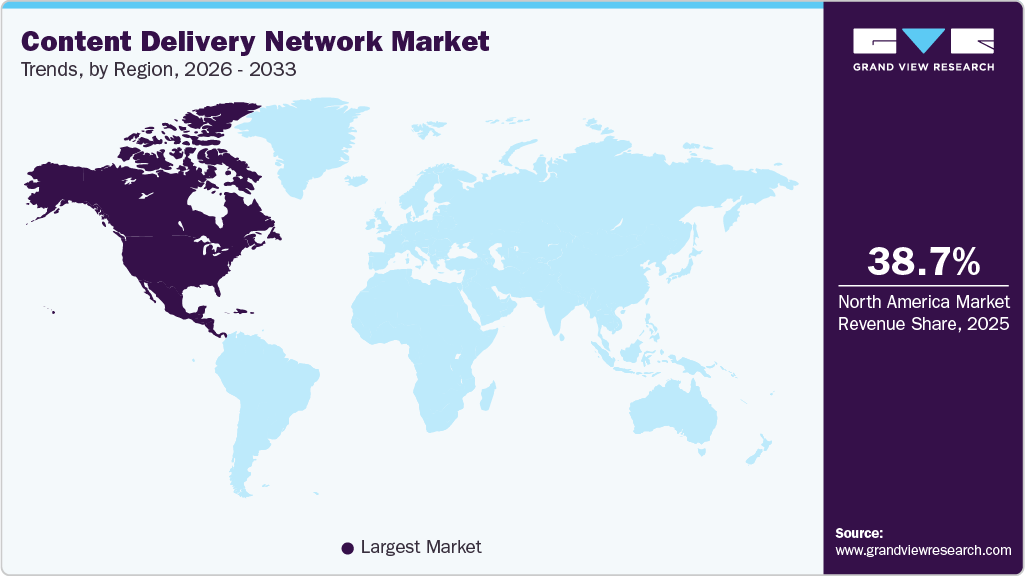
North America dominated the global content delivery network market with the largest revenue share of 38.7% in 2025. This strong position is mainly due to the growing use of 4K displays and the region’s high internet penetration, both of which provide a solid foundation for fast, efficient content delivery. The widespread adoption of cloud services, the rollout of faster data networks, and the growing use of smartphones also continue to drive demand for CDN solutions. In addition, rising leisure spending, especially on streaming, gaming, and online entertainment, has played a key role in boosting CDN adoption across the region.
 To learn more about this report, Download Free Sample Report
 U.S. Content Delivery Network Market Trends
The content delivery network market in the U.S. held the largest share in the North America region in 2025. In the U.S., CDN adoption continues to grow as businesses across sectors seek faster, more reliable ways to deliver digital content. The growth of streaming platforms, online gaming, e-learning, and large-scale enterprise applications has made it increasingly important to move data quickly and smoothly over long distances. For instance, in November 2025, Amazon Web Services announced it would invest up to USD 50 billion to enhance AI and supercomputing resources for U.S. federal agencies.
This includes building new data centers and offering advanced cloud services such as AWS GovCloud and Amazon SageMaker AI, demonstrating strong support for the country’s cloud and computing infrastructure. As audiences expect high-quality video, real-time updates, and uninterrupted access, CDNs have become a core part of the digital ecosystem, helping companies reduce delays, manage heavy traffic, and improve user experiences. The strong technology infrastructure in the U.S., along with steady investments in cloud services and edge computing, further supports the growing reliance on CDN solutions.
Europe Content Delivery Network Market Trends
The content delivery network market in Europe is expected to grow at a significant CAGR over the forecast period. There is an increasing demand for high-quality digital content delivery across various industries in Europe, including media and entertainment, e-commerce, gaming, and enterprise services. This demand stems from the growing popularity of online streaming services, the proliferation of e-commerce platforms, and the growing dependence on digital solutions for business operations.
The UK content delivery network market is expected to grow at a significant CAGR over the forecast period. The rise of high-definition video streaming, live events, and cloud-based services has driven the need for robust CDN solutions that ensure seamless delivery of digital assets to end users.
The content delivery network market in Germany is expected to register a significant CAGR over the forecast period. The proliferation of mobile devices and the growing adoption of cloud-based services have contributed to the surge in data consumption, fueling the need for strong CDN infrastructure and thereby supporting market growth.
Asia Pacific Content Delivery Network Market Trends
The content delivery network market in the Asia Pacific is anticipated to witness the fastest CAGR of 21.6% over the forecast period, due to the presence of emerging economies, such as India and China. The growing number of people and viewers engaging with online gaming has boosted the need for better networking technology to handle increased media consumption. Regional government initiatives, such as Digital India, have supported faster, more secure data delivery, which is expected to drive greater adoption of CDN solutions.
The Japan content delivery network market is expected to grow significantly in the coming years. The domestic market has witnessed significant developments in recent times, reflecting the country's growing reliance on digital infrastructure. With a strong technological landscape and increasing internet penetration, Japanese businesses across various sectors are turning to CDNs to optimize digital content and service delivery.
The content delivery network market in China held a significant market share in 2025. CDNs are witnessing high demand in China for optimizing content delivery across the country’s expansive geographical expanse. Enterprises use their distributed network infrastructure and local caching capabilities to ensure faster, more responsive user experiences while reducing bandwidth and server hosting costs.
Key Content Delivery Network Company Insights
Key players in the content delivery network industry include Akamai Technologies, Alibaba Cloud, Amazon Web Services, Inc., ARYAKA NETWORKS, INC., CacheFly, CDNsun s.r.o., Cloudflare, Inc., Fastly, Gcore, Google LLC, Imperva, and others. The companies are focusing on various strategic initiatives, including new product development, partnerships & collaborations, and agreements to gain a competitive advantage over their rivals.
-
Akamai Technologies is a U.S. internet and cloud services company known for one of the world’s largest content delivery networks (CDNs), helping deliver web content, media streaming, and applications quickly and securely across the globe. It offers content delivery, cloud computing, and cybersecurity solutions to enterprises, supported by a vast edge infrastructure in more than 130 countries. Akamai plays a major role in accelerating and protecting digital experiences worldwide.
-
Alibaba Cloud, also known as Aliyun, is the cloud computing arm of the Alibaba Group, offering a wide range of services such as elastic computing, data storage, databases, big data, security, and content delivery network (CDN) solutions to businesses worldwide. It operates global data centers and serves e-commerce, gaming, media, and enterprise customers. Alibaba Cloud’s CDN helps speed up and secure the delivery of digital content across regions.
Key Content Delivery Network Companies
The following key companies have been profiled for this study on the content delivery network market.
-
Akamai Technologies
-
Alibaba Cloud
-
Amazon Web Services, Inc.
-
ARYAKA NETWORKS, INC.
-
CacheFly
-
CDNsun s.r.o.
-
Cloudflare, Inc.
-
Fastly
-
Gcore.
-
Google LLC
-
Imperva
-
Lumen Technologies
-
Microsoft Corporation
-
proinity LLC
-
Tencent Cloud.
Competitive Benchmarking
Operating Strategies
Competitive Edge
Weaknesses
Established Players (Akamai Technologies, Amazon Web Services, Inc., Cloudflare, Inc., Fastly, Google LLC, Microsoft Corporation)
- Expand global edge infrastructure with integrated CDN, cloud security, edge computing, and AI-driven traffic optimization to deliver low-latency, secure digital experiences.
- Strengthen cloud ecosystem partnerships and continuously invest in PoPs, application acceleration, and managed services for enterprise-scale content delivery.
- Extensive global PoP networks ensure high availability, low latency, and scalable content delivery across diverse digital applications and geographic regions.
- Comprehensive portfolios combining CDN, edge computing, cloud security, analytics, and developer services provide strong enterprise value and customer retention.
- High infrastructure investments increase operational costs and premium pricing compared with regional or niche CDN providers.
- Multi-cloud integration, vendor lock-in concerns, and regulatory compliance requirements can complicate deployment and migration for enterprise customers.
Emerging Players (ARYAKA NETWORKS, INC., Gcore, Imperva, Alibaba Cloud, Tencent Cloud)
- Focus on regional expansion, competitive pricing, and integrated edge computing, security, and application acceleration for growing enterprise and digital platform customers.
- Differentiate through specialized CDN services supporting gaming, media streaming, cloud applications, and AI-enabled workloads across targeted geographic markets.
- Strong regional presence, flexible deployment models, and competitive pricing attract cloud-native enterprises and digital businesses seeking scalable CDN services.
- Rapid innovation in edge computing, application security, and cloud integration enables faster response to evolving customer requirements.
- Smaller global infrastructure and fewer edge locations limit worldwide coverage compared with leading CDN providers.
- Lower enterprise recognition and partner ecosystems reduce competitiveness for multinational contracts requiring large-scale global content delivery.
Recent Developments
-
In May 2026, Cloudflare migrated its cache infrastructure to its Pingora-based proxy architecture, improving connection reuse, reducing latency and cache misses, and enabling additional caching capabilities. The new architecture strengthens the performance and scalability of Cloudflare's global CDN infrastructure.
-
In September 2025, Orange and Synamedia announced a partnership to expand multi-CDN delivery by combining Orange’s telco-grade CDN with Synamedia’s Quortex Switch platform. The solution helps content providers seamlessly integrate multiple CDNs, extend coverage into new markets, especially the Middle East and Africa, and improve streaming quality with intelligent traffic routing and low-latency delivery.
-
In March 2025, Qwilt partnered with Corix to improve content delivery in North America and Europe using Qwilt’s Open Edge technology. The partnership adds more than 6.2 Tbps of network capacity and brings faster, high-quality edge delivery to millions of users. It also helps Qwilt expand globally, reduce network congestion, lower delays, and provide smoother, more reliable online experiences.
-
In February 2024, Akamai launched its Gecko initiative to bring cloud computing directly to its edge network, allowing companies to run workloads closer to users and improve performance for latency-sensitive applications. This move embeds generalized compute across Akamai’s global edge footprint to support use cases such as gaming, streaming, and real-time data processing, thereby strengthening its CDN and edge cloud offerings.
Content Delivery Network Market Report Scope
Report Attribute
Details
Market Size in 2025
USD 31.5 billion
Estimated Market Size in 2026
USD 37.4 billion
Projected Market Size by 2033
USD 164.9 billion
Growth rate
CAGR of 23.6% from 2026 to 2033
Base year for estimation
2025
Historical data
2021 - 2024
Forecast period
2026 - 2033
Quantitative units
Revenue in USD million/billion and CAGR from 2026 to 2033
Report coverage
Revenue forecast, company market share analysis, competitive landscape, growth factors, and trends
Segments covered
Service, solution, service provider, end use, region
Regional scope
North America; Europe; Asia Pacific; Latin America; MEA
Country scope
U.S.; Canada; Mexico; Germany; UK; France; China; Japan; India; South Korea; Australia; Brazil; Saudi Arabia; South Africa; UAE
Key companies profiled
Akamai Technologies; Alibaba Cloud; Amazon Web Services, Inc.; ARYAKA NETWORKS, INC.; CacheFly; CDNsun s.r.o.; Cloudflare, Inc.; Fastly; Gcore.; Google LLC; Imperva; Lumen Technologies; Microsoft Corporation; proinity LLC; Tencent Cloud
Customization scope
Free report customization (equivalent up to 8 analysts' working days) with purchase. Addition or alteration to country, regional & segment scope.
Pricing and purchase options
Avail customized purchase options to meet your exact research needs. Explore purchase options
Global Content Delivery Network Market Report Segmentation
This report forecasts revenue growth at the global, regional, and country levels and provides an analysis of the latest industry trends in each of the sub-segments from 2021 to 2033. For this study, Grand View Research has segmented the content delivery network market report based on service, solution, service provider, end use, and region:
-
Service Outlook (Revenue, USD Billion, 2021 - 2033)
-
Standard CDN
-
Video CDN
-
-
Solution Outlook (Revenue, USD Billion, 2021 - 2033)
-
Web Performance Optimization
-
Media Delivery
-
Cloud Security
-
-
Service Provider Outlook (Revenue, USD Billion, 2021 - 2033)
-
Traditional Commercial CDN
-
Cloud CDN
-
Peer to Peer CDN
-
Telecom CDN
-
-
End Use Outlook (Revenue, USD Billion, 2021 - 2033)
-
Advertising
-
E-Commerce
-
Media and Entertainment
-
Gaming
-
Others
-
-
Regional Outlook (Revenue, USD Billion, 2021 - 2033)
-
North America
-
U.S.
-
Canada
-
Mexico
-
-
Europe
-
UK
-
Germany
-
France
-
-
Asia Pacific
-
China
-
India
-
Japan
-
South Korea
-
Australia
-
-
Latin America
-
Brazil
-
-
Middle East & Africa
-
UAE
-
Saudi Arabia
-
South Africa
-
-
Research Methodology
The content delivery network market figures in this report are based on a proven research process that combines executive interviews with secondary research from proprietary databases, company filings, and recognized regulatory and institutional sources. Market size is built through value-chain sizing, reconciling supply-side and demand-side estimates, and triangulated with bottom-up and top-down approaches. Every estimate passes multiple levels of expert validation before publication, with each content delivery network segment quantified using the revenue-capture definitions in the table below.
Segment Definition
Segment – Service
Revenue capture definition
Standard CDN
Revenue is generated from CDN services that accelerate the delivery of static and dynamic web content through distributed edge servers, caching, intelligent traffic routing, and load balancing. Vendors monetize through subscription- or usage-based pricing based on bandwidth consumption, requests, data transfer, and geographic coverage.
Video CDN
Revenue is generated from CDN platforms optimized for live streaming, video-on-demand (VoD), OTT services, adaptive bitrate streaming, media transcoding, edge caching, and video delivery acceleration. Revenue includes traffic-based pricing, streaming subscriptions, and premium media delivery services.
Segment - Solution
Revenue capture definition
Web Performance Optimization
Revenue is generated from solutions that improve website and application performance through image optimization, content compression, browser caching, HTTP/3 optimization, dynamic content acceleration, DNS optimization, and intelligent routing, typically offered on a subscription or consumption-based model.
Media Delivery
Revenue is generated from solutions that deliver high-volume digital media, including video, audio, gaming content, software downloads, and live events, using edge caching, streaming optimization, and global content distribution infrastructure. Revenue is derived from bandwidth usage, storage, and delivery services.
Cloud Security
Revenue is generated from integrated security services offered through CDN platforms, including DDoS protection, Web Application Firewall (WAF), bot management, API security, Zero Trust access, SSL/TLS management, and secure content delivery. Vendors monetize through subscription-based security packages and managed security services.
Segment – Service Provider
Revenue capture definition
Traditional Commercial CDN
Revenue is generated by independent CDN providers that own or operate globally distributed edge infrastructure to deliver web content, applications, software downloads, and media services for enterprise customers through subscription and usage-based pricing.
Cloud CDN
Revenue is generated from CDN services integrated with public cloud platforms, enabling customers to accelerate cloud-hosted applications, APIs, storage, and websites. Revenue is typically consumption-based, including data transfer, request volume, and edge service utilization.
Peer to Peer CDN
Revenue is generated from decentralized content delivery networks that leverage end-user devices to distribute content, reducing bandwidth costs and improving scalability. Vendors monetize through licensing, software platforms, and managed P2P content delivery services.
Telecom CDN
Revenue is generated by telecommunications operators that provide CDN services using their network infrastructure to optimize content delivery, video streaming, and application performance for enterprise, media, and OTT customers through managed service contracts and network-based pricing models.
Segment – End Use
Revenue capture definition
Advertising
Revenue includes CDN services that accelerate digital advertising delivery, real-time bidding platforms, rich-media advertisements, and personalized advertising content, all while ensuring low latency and high availability.
E-commerce
Revenue includes CDN solutions deployed by online retailers and marketplaces to optimize website performance, secure online transactions, accelerate product content delivery, and improve customer experience during high-traffic events.
Media and Entertainment
Revenue includes CDN services supporting OTT platforms, broadcasters, publishers, live-streaming providers, music streaming services, and digital media companies for high-quality video, audio, and multimedia content delivery.
Gaming
Revenue includes CDN solutions used by gaming companies to accelerate game downloads, patches, cloud gaming, live events, multiplayer content delivery, and real-time game updates with minimal latency.
Others
Revenue includes CDN deployments across education, healthcare, BFSI, government, software & SaaS providers, manufacturing, and other industries requiring secure, scalable, and high-performance content and application delivery.
Estimation Model
Layer Name
Key Question
Description
Digital Content Delivery Demand Layer
Who can benefit from CDN solutions?
Identify organizations delivering latency-sensitive digital content, applications, APIs, software downloads, and streaming media to geographically distributed users. These include enterprises operating websites, OTT platforms, cloud-native applications, gaming services, e-commerce platforms, digital publishers, SaaS providers, and online education platforms that require faster content delivery, improved scalability, high availability, and enhanced user experience. Organizations experiencing rapid growth in internet traffic, mobile usage, and global digital engagement benefit significantly from CDN infrastructure.
Infrastructure & Cloud Readiness Layer
Who can access CDN solutions?
Evaluate organizations based on their digital infrastructure maturity, cloud adoption, application modernization, and global content delivery requirements. Enterprises utilizing public cloud, hybrid cloud, multi-cloud, edge computing, containerized applications, and API-driven architectures represent the primary addressable market. Organizations expanding internationally or supporting high-volume digital services possess the network and operational readiness to integrate CDN platforms with cloud infrastructure, security services, and edge computing capabilities.
Adoption & Utilization Layer
Who actively uses CDN solutions?
Analyze the actual deployment of CDN platforms for website acceleration, video streaming, media delivery, API acceleration, software distribution, edge computing, cloud security, and application performance optimization. Active users include OTT providers, media companies, e-commerce retailers, gaming companies, financial institutions, SaaS providers, healthcare organizations, government agencies, and enterprises that require secure, scalable, low-latency digital service delivery across global markets.
Monetization Layer
How much revenue is generated?
Assess revenue generation through subscription- and usage-based CDN services, including bandwidth consumption, data transfer, request volume, edge caching, video delivery, cloud security services, DDoS protection, Web Application Firewall (WAF), bot management, API acceleration, DNS services, and edge computing. Additional revenue streams include managed CDN services, professional consulting, implementation, performance optimization, analytics, and enterprise contracts for global application delivery, edge infrastructure, and integrated security solutions.
Delivered Customizations
This report has been delivered with the following In-depth customizations
Client Request
Customization Delivered
Value Adds
Edge Computing & AI-Powered Content Delivery Trends
Conducted a structured analysis of CDN capabilities focused on edge computing, AI-driven traffic optimization, edge caching, intelligent routing, and edge application delivery across distributed digital environments.
Helps stakeholders understand evolving edge delivery requirements, identify high-demand AI-enabled CDN capabilities, and evaluate commercialization opportunities in low-latency application delivery and edge computing services.
Video Streaming & OTT Delivery Optimization Trends
Conducted a comprehensive analysis of CDN solutions supporting live streaming, video-on-demand (VoD), adaptive bitrate streaming, media acceleration, and global content distribution for OTT platforms and digital media providers.
Helps stakeholders identify emerging demand for high-performance media delivery, evaluate monetization opportunities in video streaming infrastructure, and assess investments in scalable, high-quality digital content delivery.
Cloud Security & Secure Application Delivery Trends
Conducted a comprehensive analysis of CDN platforms integrating DDoS protection, Web Application Firewall (WAF), bot management, API security, Zero Trust access, and secure edge services for cloud-native applications.
Helps stakeholders understand growing demand for integrated performance and security solutions, evaluate opportunities in secure application delivery, and assess enterprise adoption of cloud-native CDN security services across distributed digital ecosystems.
Frequently Asked Questions About This Report
The global content delivery network market is expected to grow at a compound annual growth rate of 23.6% from 2026 to 2033 to reach USD 164.9 billion by 2033.
Asia Pacific is the fastest-growing region over the forecast period.
Key growth drivers include growing demand for low-latency digital experiences, edge computing, AI applications, and bandwidth-intensive content
North America dominated with a 38.7% revenue share in 2025.
The video CDN segment led with a 66.0% revenue share in 2025, while the standard CDN segment is the fastest-growing segment.
The global content delivery network market was valued at USD 31.5 billion in 2025 and is expected to reach USD 37.4 billion in 2026.
Some key players operating in the content delivery network market include Akamai Technologies; Alibaba Cloud; Amazon Web Services, Inc.; ARYAKA NETWORKS, INC.; CacheFly; CDNsun s.r.o.; Cloudflare, Inc.; Fastly; Gcore.; Google LLC; Imperva; Lumen Technologies; Microsoft Corporation; proinity LLC; Tencent Cloud
The traditional commercial CDN segment led with a 48.9% revenue share in 2025, while the cloud CDN segment is the fastest-growing segment.
The media and entertainment segment led with a 41.4% revenue share in 2025, while the E-commerce segment is the fastest-growing segment.
The web performance optimization segment led with a 40.0% revenue share in 2025, while the media delivery segment is the fastest-growing segment.
Content Delivery Network Market By Country
- U.S. Content Delivery Network Market
- Canada Content Delivery Network Market
- Mexico - North America Content Delivery Network Market
- Germany Content Delivery Network Market
- France Content Delivery Network Market
- Japan Content Delivery Network Market
- China Content Delivery Network Market
- India Content Delivery Network Market
- Australia Content Delivery Network Market
- South Korea Content Delivery Network Market
- Brazil Content Delivery Network Market
- South Africa Content Delivery Network Market
- Saudi Arabia Content Delivery Network Market
- Uae Content Delivery Network Market
- U.K. Content Delivery Network Market
About the Author(s)
Communications Infrastructure Research Team
Technology · Communications InfrastructureThis report was authored by the communications infrastructure research team at Grand View Research - comprising two research analysts, one senior research analyst, and one industry expert - with specialized expertise in the communications infrastructure segment of the technology industry. All findings are based on proprietary technology databases, executive interviews, and regulatory analysis, subject to internal peer review prior to publication.
Last Updated:
Speak to Analyst

Customize this report to your needs - add regions, segments, or data points, with 20% free customization.
Or view our licence options:


ISO 9001:2015 & 27001:2022 Certified
We are GDPR and CCPA compliant! Your transaction & personal information is safe and secure. For more details, please read our privacy policy.


