
- Home
- »
- Healthcare IT
- »
-
Healthcare Smart Card Reader Market Share Report, 2030GVR Report cover

Healthcare Smart Card Reader Market (2023 - 2030) Size, Share & Trends Analysis Report By Interface Type (Contact-based, Contactless-based, Dual Interface-based, Others), By Application, By End-use, By Region, And Segment Forecasts
Healthcare Smart Card Reader Market Summary
The global healthcare smart card reader market size was valued at USD 922.9 million in 2022 and is projected to reach USD 2.65 billion by 2030, growing at a CAGR of 14.7% from 2023 to 2030. Demands for highly secure smart cards are expected to increase, which will ultimately increase the need for smart card readers and related terminals.
Key Market Trends & Insights
- Europe dominated the healthcare smart card reader market with a share of over 30% in 2022.
- By interface type, contactless- based segment contributed to the largest revenue share over 25% of the market in 2022.
- By end-use, the general practitioners & patients category is expected to witness significant growth in the coming years.
- By application, the identity & other sensitive information management segment is anticipated to see considerable growth in the near future.
Market Size & Forecast
- 2022 Market Size: USD 922.9 Million
- 2030 Projected Market Size: USD 2.65 Billion
- CAGR (2023-2030): 14.7%
- North America: Largest market in 2022
Three ways to get this report
Buy it, customize it, or ask a question.Ask an Analyst
Analyst response in 1 business day
- AccessReport author, directly
- Reply timeWithin 1 working day
- No sales callDirect answer only
- FormatEmail reply
- CostFree, no cost
Get the Full Report
What the study covers
- FormatsPDF · Excel · Dashboard
- Timeline2023–2030 annual, 2022 base
- Coverage20+ countries, 5 regions
- Companies10+ key players profiled
Customize the Report
20% free customization
- IncludeCountries, segments, points
- TailorTo your product definition
- ExtendDeeper competitor detail
- OrA fully bespoke study
- Turnaround5–10 working days
Increasing information security requirements relating to user credentials in the healthcare area are likely to fuel this need. The growing availability of small-sized IC chips with enhanced functionality built into them is anticipated to assist hospitals and other organizations in providing technology-enabled smart cards to their staff members and patients, necessitating the use of readers to facilitate system access. Furthermore, the adoption of cutting-edge technology and a rise in new entrants by companies are both contributing to market expansion.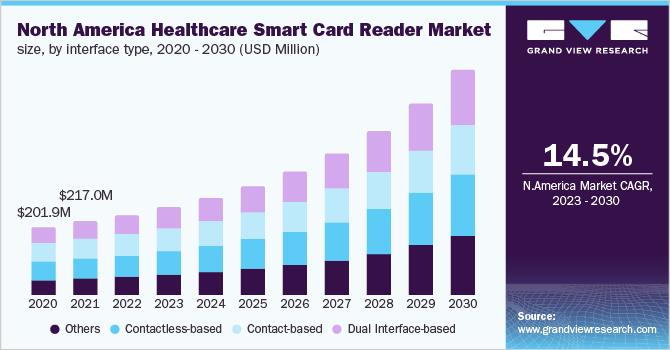 Source: Grand View Research, IR Documents, Primary Interviews, Paid DatabasesTo learn more about this report,
 Download Free Sample Report
 Due to supply chain interruption and other healthcare budget constraints, COVID-19 has had an impact on smart card reader suppliers in 2020 to some extent. Since the market for cash transactions is under increasing pressure and because contactless transactions are outperforming everyone's expectations, financial information encryption is in demand. In the healthcare industry, financial encoding on smart cards can provide secure verification or checkout, facilitating market growth for readers and terminals in the upcoming years. The market is also expected to grow since contactless payments from the healthcare smart card and the use of readers can automate the processing of patient data and bill payments.
The market is also supported due to the rising adoption of digitalized healthcare systems like electronic health records (EHR), which can be converted into searchable medical databases and create an "advanced communication infrastructure" for the medical field that will enhance clinical practice as well as stimulate drug research. This would ultimately influence new competitors to penetrate the market. For instance, Advanced Card Systems Ltd., a well-known provider of PC-linked smart card readers in Asia Pacific, entered the healthcare industry by releasing the eH880 health card reader along with its Software Development Kit (SDK) for the global e-Health market. This move was taken in response to the rising potential for revenue growth in the healthcare industry as a result of the paradigm shift toward digitization.
Interface type Insights
Based on the interface type, the market is segmented into contact-based, contactless-based, dual interface-based (combination of contact and contactless models), and others. Contactless- based segment contributed to the largest revenue share over 25% of the market in 2022. This is a result of both the benefits of contactless smart cards reader over traditional contact-based ones and the market's growing adoption of contactless smart cards. In order to create a wireless connection between the contactless smart card and the location, it operates by utilizing radio frequencies or NFC technology.
On the other hand, the other's category, which includes developing technologies like bluetooth-enabled, mobile-enabled smart card readers, etc., is anticipated to attain the fastest CAGR of 16.9% from 2023 to 2030, owing to the ongoing improvement of technology and the increased demand for advanced technology products by consumers. This has encouraged a number of competitors to diversify their product lines by releasing products that are in high demand. For instance, well-known companies like Identiv, Inc., Advanced Card Systems Ltd., and IDENTOS Inc. already have mobile-based smart card readers on the market, most often in response to the growing demand from its customers.
End-use Insights
Based on the end-use, the market is segmented into General Practitioners & Patients, Other (Pharmacists, Nurses, etc.). The General Practitioners & Patients category is expected to witness significant growth in the coming years, with a revenue share of more than 60% in 2022, due to the increased usage of related smart healthcare cards, which allow patients and physicians to bypass the paperwork, clipboards, and lineups characteristic of in-patient admittance offices or ASC Units.
Application Insights
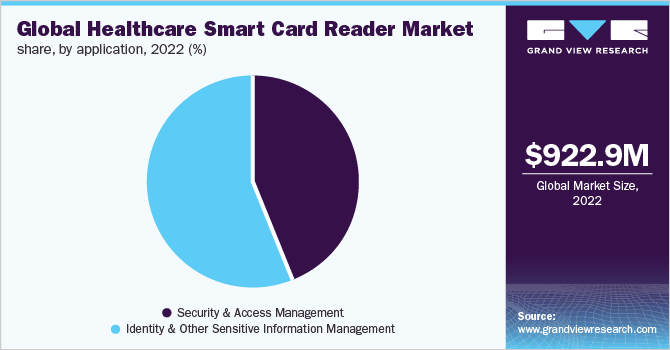
Based on the application, the market is segmented into identity & other sensitive information management, security & access management.
 To learn more about this report, Download Free Sample Report
 With a revenue share of more than 55% in 2022, the identity & other sensitive information management segment is anticipated to see considerable growth in the near future as a result of the expansion of contactless payments in the healthcare system, followed by an increase in clinical settings where hospitals and affiliated research organizations are gradually digitizing.
Regional Insights
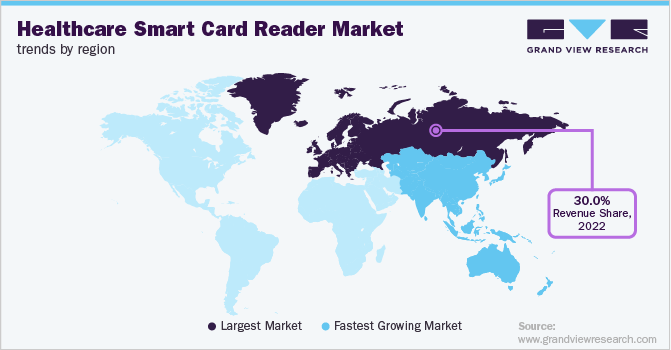
In 2022, Europe's revenue share was the highest at over 30%. Demand for products in this region is anticipated to be driven by expanding efforts by various governments and private organizations to offer high-quality healthcare services. The European Health Insurance Cards could be obtained free of charge by citizens of 32 countries, which will eventually drive the market for smart card readers and terminals to develop. Numerous European countries have their own distinctive national healthcare ID cards, which will eventually encourage new companies to offer new products in Europe and support the market during the forecast period. It is projected that these factors would hasten market expansion.
 To learn more about this report, Download Free Sample Report
 The market in Asia Pacific is anticipated to expand at the fastest rate of over 15.5%, due to the forecast period due to factors including advanced technological services and supporting government actions. Additionally, it is anticipated that the regional market would surpass all other markets by 2030.
Key Companies & Market Share Insights
The market is competitive with the presence of many companies. These are involved in implementing strategic initiatives that include new product launch, partnerships, strategic collaborations, and acquisitions. For instance, in March 2022, WISeKey strengthened its operations in smart card reader chips and renewed its contract with prominent US competitor Identiv, Inc. High-end smart card reader chips worth over USD 1 million will be provided by WISeKey to Identiv.
Targeting applications in the healthcare, government, pharmaceutical, and educational sectors, and the agreement also includes Identiv's dual-interface, contactless, and contact smart card readers. Additionally, WISeKey's position in the market is strengthened by resonance as both public and private businesses use Identiv's identity verification devices when looking for the greatest level of security and performance in access control. Some of the key players in the global healthcare smart card reader market include:
-
Identiv, Inc.
-
Advanced Card Systems Ltd.
-
WISeKey
-
Ingenico (Worldline)
-
Thales Group
-
rf IDEAS Inc.
-
HID Global Corporation, part of ASSA ABLOY
-
CHERRY
-
FEITIAN Technologies Co., Ltd.
-
IDENTOS Inc
-
SecuGen Corporation.
-
IDEMIA
-
Advantech Co., Ltd.
-
Rayton Solutions Pte Ltd.
-
Zebra Technologies
-
ELATEC GmbH
-
NXP Semiconductors
-
gt german telematics gesellschaft für telematikdienste mbH
Healthcare Smart Card Reader Market Report Scope
Report Attribute
Details
The market size value in 2023
USD 1,015.4 million
The revenue forecast in 2030
USD 2.65 billion
Growth Rate
CAGR of 14.7% from 2023 to 2030
Base year for estimation
2022
Actual estimates/Historical data
2018 - 2021
Forecast period
2023 - 2030
Quantitative units
Revenue in USD million/billion, CAGR from 2023 to 2030
Report coverage
Revenue forecast, company ranking, competitive landscape, growth factors, and trends
Segments covered
Interface type, application, end-use, region
Regions covered
North America; Europe; Asia Pacific; Latin America; MEA
Country Scope
U.S.; Canada; U.K.; Germany; Italy; France; Spain; Japan; China; India; Australia; South Korea; Brazil; Mexico; Argentina; South Africa; Saudi Arabia
Key companies profiled
Identiv, Inc.; Advanced Card Systems Ltd.; WISeKey, Ingenico (Worldline); Thales Group; rf IDEAS Inc.; HID Global Corporation; part of ASSA ABLOY; CHERRY; FEITIAN Technologies Co., Ltd.; IDENTOS Inc.; SecuGen Corporation; IDEMIA; Advantech Co., Ltd.; Rayton Solutions Pte Ltd.; Zebra Technologies; ELATEC GmbH; NXP Semiconductors; gt german telematics gesellschaft für telematikdienste mbH
Customization scope
Free report customization (equivalent up to 8 analysts’ working days) with purchase. Addition or alteration to country, regional & segment scope.
Pricing and purchase options
Avail customized purchase options to meet your exact research needs. Explore purchase options
Global Healthcare Smart Card Reader Market Segmentation
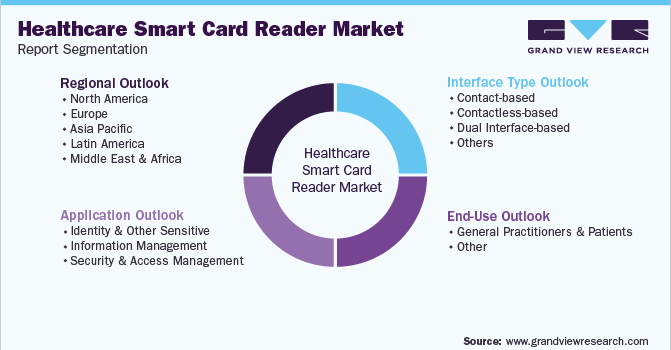
This report forecasts revenue growth at the regional & country level and provides an analysis of the latest trends and opportunities in each of the sub-segments from 2018 to 2030. For this study, Grand View Research has segmented the healthcare smart card reader market report based on interface type, application, end-use, and region:
 To learn more about this report, Download Free Sample Report
 -
Interface Type Outlook (Revenue, USD Million, 2018 - 2030)
-
Contact-based
-
Contactless-based
-
Dual Interface-based (Combination of contact and contactless models)
-
Others
-
-
Application Outlook (Revenue, USD Million, 2018 - 2030)
-
Identity & Other Sensitive Information Management (Inclusive of Payment Process Management, etc.)
-
Security & Access Management
-
-
End-Use Outlook (Revenue, USD Million, 2018 - 2030)
-
General Practitioners & Patients
-
Other (Pharmacists, Nurses, etc.)
-
-
Regional Outlook (Revenue, USD Million, 2018 - 2030)
-
North America
-
U.S.
-
Canada
-
-
Europe
-
U.K.
-
Germany
-
France
-
Italy
-
Spain
-
-
Asia Pacific
-
Japan
-
China
-
India
-
Australia
-
South Korea
-
-
Latin America
-
Brazil
-
Mexico
-
Argentina
-
-
Middle East & Africa
-
South Africa
-
Saudi Arabia
-
-
Frequently Asked Questions About This Report
The global healthcare smart card reader market size was estimated at USD 922.9 million in 2022 and is expected to reach USD 1,015.4 million in 2023.
The global healthcare smart card reader market is expected to grow at a compound annual growth rate of 14.7% from 2023 to 2030 to reach USD 2,652.3 million by 2030
Europe dominated the healthcare smart card reader market with a share of over 30% in 2022. This is attributable to expanding efforts by various governments and private organizations to offer high-quality healthcare services.
Some key players operating in the healthcare smart card reader market include Identiv, Inc.; Advanced Card Systems Ltd.; WISeKey, Ingenico (Worldline); Thales Group; rf IDEAS Inc.; HID Global Corporation; part of ASSA ABLOY; CHERRY; FEITIAN Technologies Co., Ltd.; IDENTOS Inc.; SecuGen Corporation; IDEMIA; Advantech Co., Ltd.; Rayton Solutions Pte Ltd.; Zebra Technologies; ELATEC GmbH; NXP Semiconductors; and gt german telematics gesellschaft für telematikdienste mbH.
Key factors that are driving the healthcare smart card reader market growth include the rising adoption of digital healthcare systems, rise in new launches by companies, the growing demand for secure and efficient healthcare data management, and increasing government initiatives for the implementation of smart cards
About the Author(s)
Healthcare IT Research Team
Healthcare · Healthcare ITThis report was authored by the healthcare it research team at Grand View Research - comprising two research analysts, one senior research analyst, and one industry expert - with specialized expertise in the healthcare it segment of the healthcare industry. All findings are based on proprietary healthcare databases, executive interviews, and regulatory analysis, subject to internal peer review prior to publication.
Last Updated:
Speak to Analyst

Customize this report to your needs - add regions, segments, or data points, with 20% free customization.
Or view our licence options:


ISO 9001:2015 & 27001:2022 Certified
We are GDPR and CCPA compliant! Your transaction & personal information is safe and secure. For more details, please read our privacy policy.


