
- Home
- »
- Healthcare IT
- »
-
Digital Healthcare Supply Chain Management Market Report, 2026-2033GVR Report cover

Digital Healthcare Supply Chain Management Market (2026 - 2033)
Size, Share & Trends Analysis Report By Product (Hardware, Software, Services), By Deployment (Web-Based, Cloud-Based), By End Use (Medical Device, Pharmaceutical), By Region, And Segment Forecasts
Market Size, 2025
$3.5BMarket Estimate, 2026
$3.8BMarket Forecast, 2033
$6.7BCAGR, 2026–2033
8.4%Digital Healthcare Supply Chain Management Market Summary
The global digital healthcare supply chain management market size was valued at USD 3.5 billion in 2025 and is projected to grow from USD 3.8 billion in 2026 to USD 6.7 billion by 2033, at a CAGR of 8.4% from 2026 to 2033. The North America held the largest share of 32.8% of the global market in 2025. The market growth is attributed to the increasing investments in next-generation technologies such as control towers and digital twin technology, the rising adoption of dashboards to enhance analytics, execution, and visibility, and government initiatives to enhance medical supply.
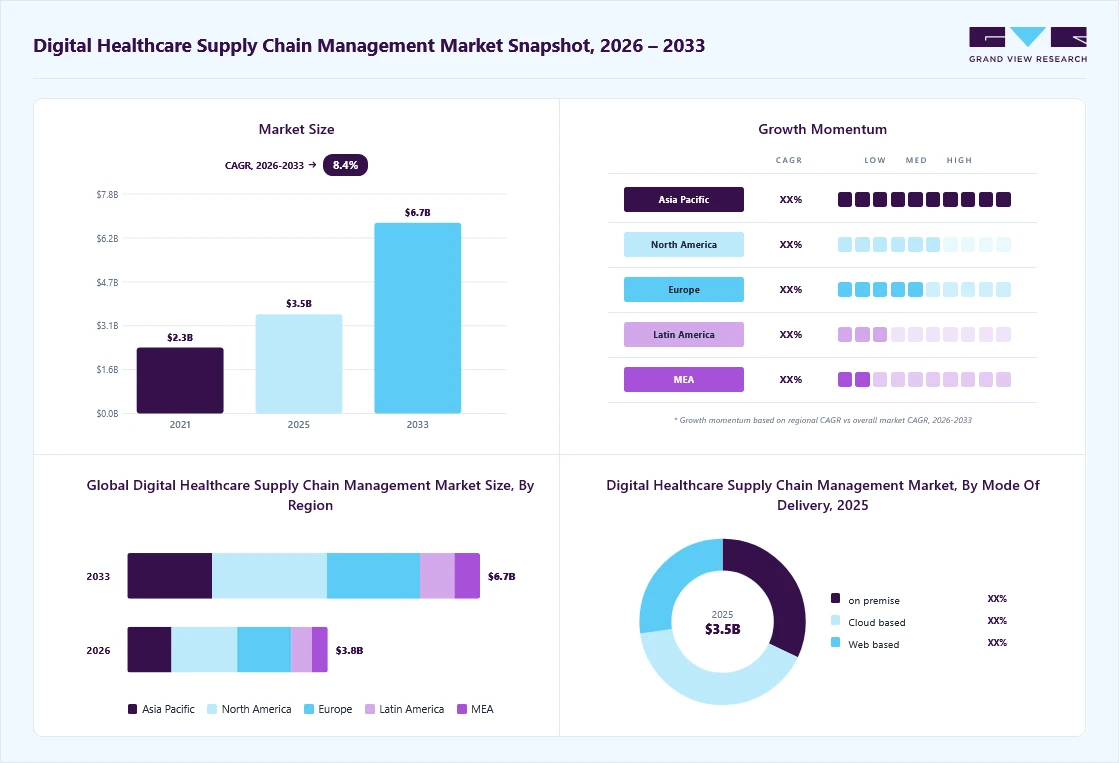 Source: Grand View Research, IR Documents, Primary Interviews, Paid DatabasesTo learn more about this report,
 Download Free Sample Report
 Key Market Trends & Insights
- By product: Software segment held the largest market share in 2025.
- By deployment: Cloud-based segment held the largest market share in 2025.
- By end use: Pharmaceutical segment held the largest market share of 35.7% in 2025.
Regional Highlights
- Largest regional market: North America (32.8% revenue share, 2025)
- Fastest-growing regional market: Asia Pacific (highest CAGR, 2026-2033)
- By country: The U.S. held the largest share in 2025
Market Size & Forecast
- Market size in 2025: USD 3.5 Billion
- Estimated market size in 2026: USD 3.8 Billion
- Projected market size by 2033: USD 6.7 Billion
- CAGR (2026-2033): 8.4%
Three ways to get this report
Buy it, customize it, or ask a question.Ask an Analyst
Analyst response in 1 business day
- AccessReport author, directly
- Reply timeWithin 1 working day
- No sales callDirect answer only
- FormatEmail reply
- CostFree, no cost
Get the Full Report
What the study covers
- FormatsPDF · Excel · Dashboard
- Timeline2026–2033 annual, 2025 base
- Coverage20+ countries, 5 regions
- Companies10+ key players profiled
Customize the Report
20% free customization
- IncludeCountries, segments, points
- TailorTo your product definition
- ExtendDeeper competitor detail
- OrA fully bespoke study
- Turnaround5–10 working days
Moreover, the emergence of cloud-based solutions and the rising demand for limiting large-scale drug counterfeiting in the pharmaceutical industry are anticipated to fuel market growth over the forecast period. The increasing adoption of cloud computing has significantly transformed the healthcare industry, with supply chain management (SCM) software enabling improved visibility, efficiency, and integration across operations. Manufacturers and healthcare providers are increasingly focusing on cloud-based platforms to enhance supplier quality and optimize inventory management.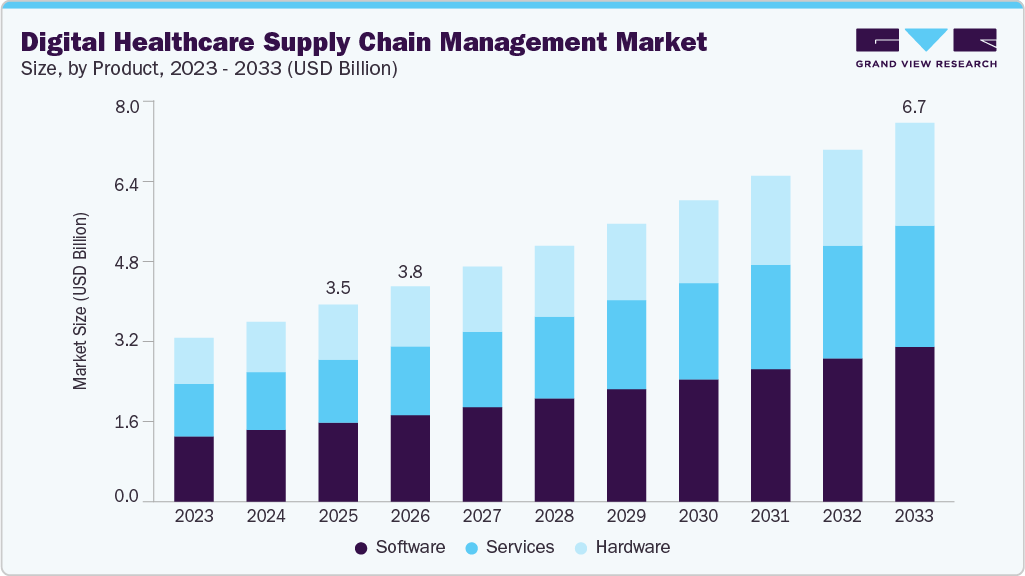 To learn more about this report, Download Free Sample Report
 These solutions also support seamless integration with ERP and EMR systems, to reduce costs associated with supply variability, stockouts, and inefficiencies. For instance, in January 2026, SAP SE expanded its cloud-based supply chain solutions by integrating advanced AI and analytics capabilities into its Business Network platform, enabling real-time tracking, enhanced traceability, and improved risk management across global supply chains. Such advancements highlight the growing role of cloud-enabled technologies in strengthening transparency and mitigating risks such as counterfeit drugs and product recalls.
Moreover, increasing transportation costs have resulted in higher operating costs incurred by healthcare facilities. Operating costs are mainly governed by inventory storage, production, and manufacturing. Poor inventory control is a major issue companies face, leading to substantial losses. According to a study published by NCBI in December 2022, hospitals in the U.S. waste 25.4 billion every year on unnecessary supply chain spending. In order to counter such challenges, companies have adopted various inventory management tools, such as inventory management software, Kanban, and industrialized barcode terminals.
GVR Survey Insights
The challenges of data privacy and high costs are constraining the growth of the digital healthcare supply chain management (SCM) market. A survey by Grand View Research revealed that respondents facing these challenges cited the high implementation costs (38.5% rated it the highest at “4”), inadequate training of specialized personnel (30.8% rated it the highest at “4”), and cybersecurity risks (30.8% rated it the highest at “4”) as their primary concerns.
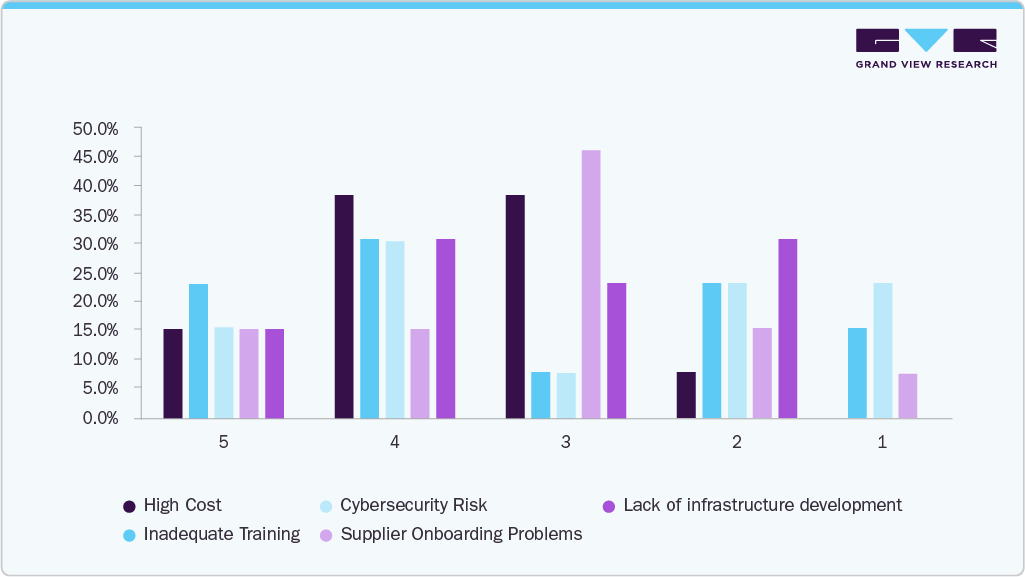 To learn more about this report, Download Free Sample Report
 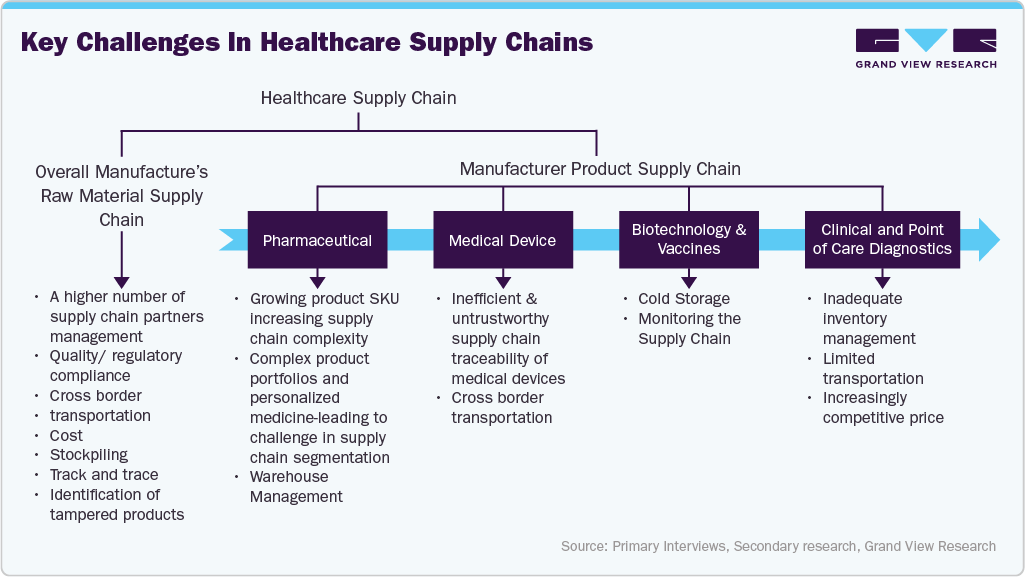 To learn more about this report, Download Free Sample Report
 Market Concentration & Characteristics
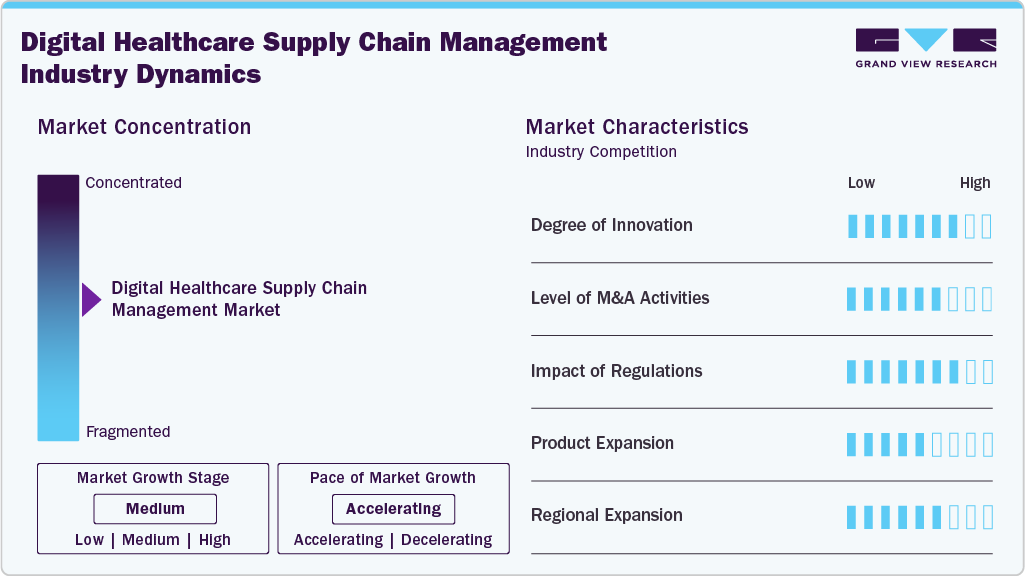
The degree of innovation in the digital healthcare supply chain management market is high, driven by the continuous integration of advanced technologies aimed at improving operational efficiency and supply chain visibility. Market players are actively investing in emerging technologies such as artificial intelligence (AI), machine learning (ML), and advanced analytics to enhance demand forecasting, automate procurement processes, and optimize inventory management across healthcare systems.
For instance, in February 2026, Premier, Inc., a technology-driven healthcare improvement company, announced the launch of a major multi-year strategic initiative aimed at transforming the healthcare supply chain. The initiative focuses on delivering real-time intelligence and advanced data capabilities to enhance operational efficiency, strengthen supply chain resilience, and improve overall performance, ultimately supporting better financial margins and improved clinical outcomes for healthcare organizations.
 To learn more about this report, Download Free Sample Report
 “Together with our partners, we’re accelerating that legacy by turning complexity into clarity and data into action. This strengthens supply chain execution, immediately enhances GPO value and equips our advisory teams with deeper intelligence to help members manage risk and drive measurable performance over both the short and the long term.”
-Bruce Radcliff, Premier’s President of Supply Chain Services.
The level of M&A activities in the market is high, leading players are actively taking such initiative to gain the market share. For instance, in September 2024, IBM acquired Accelalpha, a global Oracle services provider, to strengthen its consulting capabilities in supply chain, logistics, and cloud-based enterprise solutions. This acquisition reflects the growing consolidation trend in the digital supply chain and healthcare IT ecosystems.
Healthcare providers are obligated to adhere to stringent regulations governing the storage and transportation of medical supplies. Digital supply chain management (SCM) solutions offer a valuable means for ensuring compliance by effectively tracking the movement of these supplies and documenting their storage conditions. These regulatory requirements are driving the adoption of advanced digital SCM solutions, which also increases implementation complexity and operational costs for healthcare organizations.
Regional expansion in the digital healthcare supply chain management market involves leveraging advanced technologies to streamline procurement, distribution, and inventory management across multiple geographic locations. The adoption of cloud-based platforms, real-time tracking, and data analytics enables organizations to enhance logistics efficiency, ensure the timely delivery of medical supplies, and maintain supply chain visibility. This expansion supports improved healthcare accessibility and operational performance across regions.
Product Insights
The software segment dominated the market in 2025 and is expected to witness the fastest growth over the forecast period. The growth is primarily driven by the increasing adoption of software-as-a-service (SaaS) platforms, which offer cloud-based applications for supply chain management, enterprise resource planning (ERP), and procurement optimization across healthcare organizations. In addition, the rising need for efficient management of organizational workflows, improved data visibility across supply chains, and the growing demand for accurate and timely procurement information are key factors supporting segment growth. Healthcare providers are increasingly adopting digital supply chain solutions to enhance inventory tracking, vendor coordination, and procurement planning.
Moreover, the growing focus on reducing healthcare operational costs and the ongoing shift toward value-based care models in developed economies are further accelerating software adoption. Government initiatives and investments by private players to strengthen healthcare IT infrastructure are also contributing to market expansion. For instance, in March 2026, Oracle Corporation launched an AI Customer Excellence Centre in Sydney to accelerate the adoption of AI-powered cloud solutions. The initiative supports the integration of advanced analytics, automation, and real-time supply chain capabilities, improving procurement efficiency and operational decision-making across healthcare systems.
The services segment is expected to grow at a significant CAGR over the forecast period. This growth is attributed to the rising demand for implementation, integration, consulting, and managed services to support digital healthcare supply chain platforms. Healthcare organizations increasingly rely on service providers to optimize workflows, ensure system interoperability, and manage cloud-based supply chain infrastructure, improving procurement efficiency and operational performance.
Deployment Insights
The cloud-based segment dominated the market in 2025 and is expected to register the fastest growth, with a CAGR of 8.7% over the forecast period. The growth is primarily driven by the increasing adoption of digital healthcare infrastructure and cloud-native platforms among hospitals, pharmaceutical companies, and healthcare distributors to improve supply chain visibility, inventory optimization, and procurement efficiency.
Healthcare organizations are increasingly shifting toward cloud-based supply chain management systems to enable real-time data access, centralized procurement tracking, and seamless coordination with suppliers and distributors. The growing complexity of healthcare supply chains, rising demand for data-driven inventory planning, and the need to minimize stockouts and excess inventory are further accelerating adoption.
Moreover, the expansion of integrated healthcare IT ecosystems, including ERP, electronic health records (EHR), and procurement platforms, is encouraging organizations to adopt cloud-based solutions for improved interoperability and data sharing. Cloud deployment also enables remote access, scalable infrastructure, and advanced analytics capabilities, allowing healthcare providers to monitor supply chain performance and forecast demand more accurately
The web based segment is expected to grow significantly over the forecast period, driven by the increasing demand for accessible, browser-based healthcare supply chain management platforms that enable real-time system access without requiring complex installations or dedicated IT infrastructure. Web-based solutions allow healthcare organizations to manage procurement, inventory tracking, and supplier coordination through centralized online platforms, improving operational efficiency. In addition, the growing need for multi-location access across hospitals, clinics, distributors, and procurement teams is accelerating the adoption of web-enabled systems.
End Use Insights
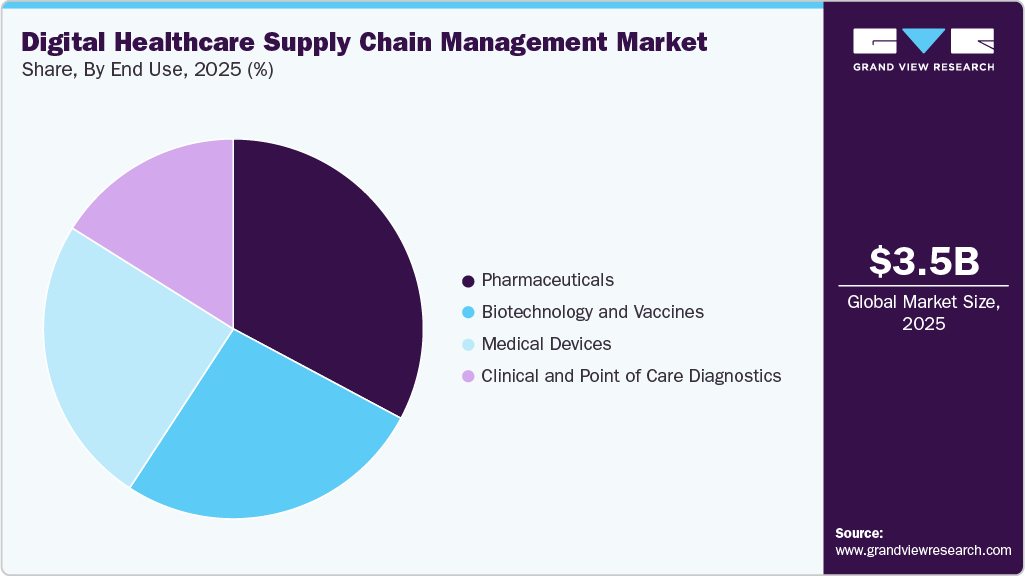
The pharmaceutical segment held the largest market share of 35.7% in 2025, primarily driven by the need to comply with stringent product tracking and traceability regulations across the supply chain. In addition, the increasing focus on supply chain efficiency and cost optimization is encouraging the adoption of digital supply chain management solutions to enhance visibility and reduce inventory-related costs in the pharmaceutical sector.
 To learn more about this report, Download Free Sample Report
 The medical devices segment is expected to witness the fastest growth at a CAGR of 9.1% from 2026 to 2033. This growth is attributed to the rising demand for technologically advanced supply chain systems for medical devices, which involve complex processes from manufacturing to end use delivery. Furthermore, the integration of Master Data Management (MDM) enables companies to make informed decisions and implement targeted actions during supply chain disruptions. It also supports organizations in addressing financial challenges, improving operational efficiency, and strengthening cybersecurity frameworks, thereby driving segment growth over the forecast period.
Regional Insights
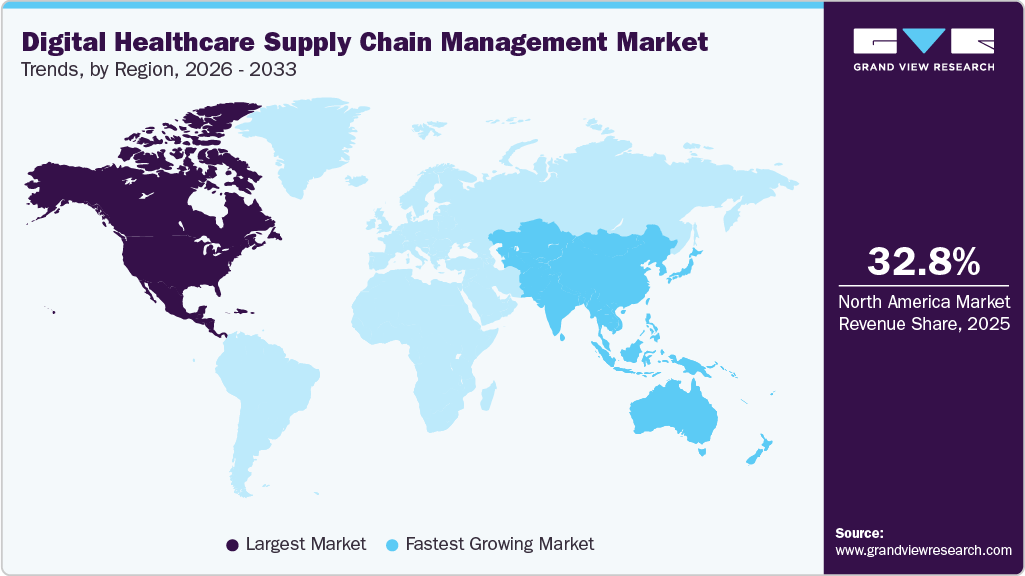
North America digital healthcare supply chain management market dominated the global market with a market share of 32.8% in 2025, owing to the need for enhanced digital supply chain efficiencies, the adoption of technological advances facilitating overall cost reduction, and the integration of machine learning and AI to analyze and predict supply chain management outcomes. Moreover, the presence of many pharmaceutical & medical device manufacturers and logistics companies. These players are investing in R&D of supply chain management solutions that are efficient and cost-effective. For instance, in January 2023, Palantir Technologies Inc. launched a Quality Management System for Foundry’s life science customers, enabling them to achieve GXP requirements.
 To learn more about this report, Download Free Sample Report
 U.S. Digital Healthcare Supply Chain Management Market Trends
The digital healthcare supply chain management market in the U.S. held the largest share in 2025. This growth is attributed to factors such as the presence of leading pharmaceutical companies in the country, which account for nearly 45% of global pharmaceutical revenue, along with increasing efforts to curb large-scale drug counterfeiting and enhance supply chain transparency. Furthermore, the rising adoption of digital technologies, including AI, cloud computing, and real-time data analytics, is significantly improving supply chain visibility and operational efficiency across healthcare systems. For instance, in 2025, Oracle Corporation expanded its AI-driven cloud supply chain solutions across the U.S., enabling healthcare organizations to enhance demand forecasting, optimize inventory management, and support real-time decision-making, thereby strengthening overall supply chain performance.
Europe Digital Healthcare Supply Chain Management Market Trends
Digital healthcare supply chain management market in Europe is expected to grow significantly. The presence of a large number of healthcare providers and a high number of pharmaceutical & medical device companies enables the adoption of cloud-based solutions, and the mandatory implementation of the UDI system on medical devices by the European regulation has propelled the market growth in the region.
Asia Pacific Digital Healthcare Supply Chain Management Market Trends
Digital healthcare supply chain management market in Asia Pacific is anticipated to show the fastest growth at a CAGR of 9.8% from 2026 to 2033, owing to the increased adoption of technologically advanced solutions in Asian countries such as China, India, and Japan. Moreover, the rising number of government initiatives to encourage healthcare providers and other healthcare organizations to adopt cloud-based software solutions for improving the inventory management system in hospitals, clinics, manufacturing hubs, & others is also expected to propel the market growth in the region over the forecast period.
The digital healthcare supply chain management market in China is held second largest share in 2025. The growing adoption of GS1 standards in the region to track visibility of pharmaceutical products is expected to further boost the market in the region. In addition, rising investments in healthcare digital infrastructure and government initiatives promoting pharmaceutical traceability systems are further accelerating market growth across the country.
The digital healthcare supply chain management market in Japan held the third-largest share in 2025. Japan is an emerging market for the pharmaceutical and medical device industries. The presence of a large number of medical device industries is boosting the adoption of cloud-based software solutions to maintain the supply chain with ease, to promote the establishment of regional health information exchange networks, and to ameliorate the quality of medical services in Japan.
Latin America Digital Healthcare Supply Chain Management Market Trends
Digital healthcare supply chain management market in Latin America is primarily driven by the ongoing digital transformation of healthcare systems and increasing government initiatives to modernize healthcare infrastructure. Countries such as Brazil, Mexico, and Chile are investing in healthcare IT platforms to improve procurement transparency, reduce operational inefficiencies, and enhance inventory management across hospitals and public healthcare networks. In addition, the growing burden on public healthcare systems and rising demand for cost optimization are encouraging healthcare providers to adopt digital supply chain solutions for better demand forecasting, procurement planning, and supplier management.
Middle East & Africa Digital Healthcare Supply Chain Management Market Trends
Digital healthcare supply chain management market in Middle East & Africa is driven by increasing investments in healthcare infrastructure and national healthcare digitalization initiatives across countries such as Saudi Arabia, the UAE, and South Africa. Government-led programs such as Saudi Vision 2030 and the UAE’s healthcare digital transformation strategies are accelerating the adoption of advanced healthcare IT systems, including digital supply chain platforms. In addition, the rapid expansion of hospital networks, medical cities, and specialized healthcare facilities is creating a strong need for efficient inventory management, procurement automation, and supply chain visibility solutions.
Key Digital Healthcare Supply Chain Management Company Insights
The digital healthcare supply chain management market is moderately concentrated, with a mix of large healthcare IT providers, enterprise software companies, and specialized supply chain solution vendors competing to strengthen their market presence. Competition in the market is driven by technological innovation, cloud-based platform development, and the integration of advanced analytics, automation, and AI-powered supply chain solutions.
Major companies are increasingly focusing on strategic collaborations, mergers & acquisitions, and partnerships to expand their geographical footprint and enhance product capabilities. In addition, the growing demand for real-time supply chain visibility, inventory optimization, and procurement automation across healthcare organizations is encouraging companies to continuously invest in product innovation and platform integration.
Key Digital Healthcare Supply Chain Management Companies:
The following key companies have been profiled for this study on the digital healthcare supply chain management market.
- Palantir Technologies, Inc.
- InterSystems Corporation
- Tecsys
- LogiTag Systems
- Mckesson Corporation
- Oracle
- SAP
- Infor
- Terso Solutions
- CenTrak (HALMA plc)
- Biolog-ID
- Blue Yonder Group, Inc.
- Kinaxis Inc.
- Global Healthcare Exchange, LLC.
- Epicor Software Corporation
Recent Developments
-
In April 2024, Oracle Corporation and Palantir Technologies, Inc. announced a strategic partnership to deliver secure cloud and AI solutions, enabling enhanced data integration and real-time decision-making across supply chains and healthcare systems.
-
In January 2023, Palantir Technologies Inc. partnered with Cardinal Health. Under this collaboration, Cardinal Health’s solution would be integrated into Palantir’s Foundry platform, which would further amalgamate real-time clinical data, diagnosis, customer purchasing, and consumption data for pharmaceutical & life sciences products. This collaboration was anticipated to enhance the company's purchasing decisions using predictive inventory needs.
-
In February 2022, Global Healthcare Exchange (GHX) announced acquiring Syft AI-enabled inventory management and SCM solutions. The acquisition is expected to enable GHX expand and digitalize its supply chain segment.
Digital Healthcare Supply Chain Management Market Report Scope
Report Attribute
Details
Market size in 2025
USD 3.5 billion
Estimated market size in 2026
USD 3.8 billion
Projected market size by 2033
USD 6.7 billion
Growth rate
CAGR of 8.4% from 2026 to 2033
Actual data
2021 - 2025
Forecast period
2026- 2033
Quantitative units
Revenue in USD Million/Billion & CAGR from 2026 to 2033
Report coverage
Revenue forecast, company share, competitive landscape, growth factors, and trends
Segments covered
Product, deployment, end use, region
Regional Scope
North America; Europe; Asia Pacific; Latin America; Middle East & Africa
Country Scope
U.S.; Canada; Mexico; Germany; UK; France; Italy; Spain; Norway; Denmark; Sweden; Japan; China; India; Australia; Thailand; South Korea; Brazil; Argentina; South Africa; Saudi Arabia; UAE; Kuwait
Key companies profiled
Palantir Technologies, Inc.; InterSystems Corporation; Tecsys; LogiTag Systems; Mckesson Corporation; Oracle; SAP; Infor; Terso Solutions; CenTrak (HALMA plc); Biolog-ID; Blue Yonder Group, Inc.; Kinaxis Inc.; Global Healthcare Exchange, LLC.; Epicor Software Corporation
Customization scope
Free report customization (equivalent up to 8 analysts’ working days) with purchase. Addition or alteration to country, regional & segment scope.
Pricing and purchase options
Avail customized purchase options to meet your exact research needs. Explore purchase options
Global Digital Healthcare Supply Chain Management Market Report Segmentation
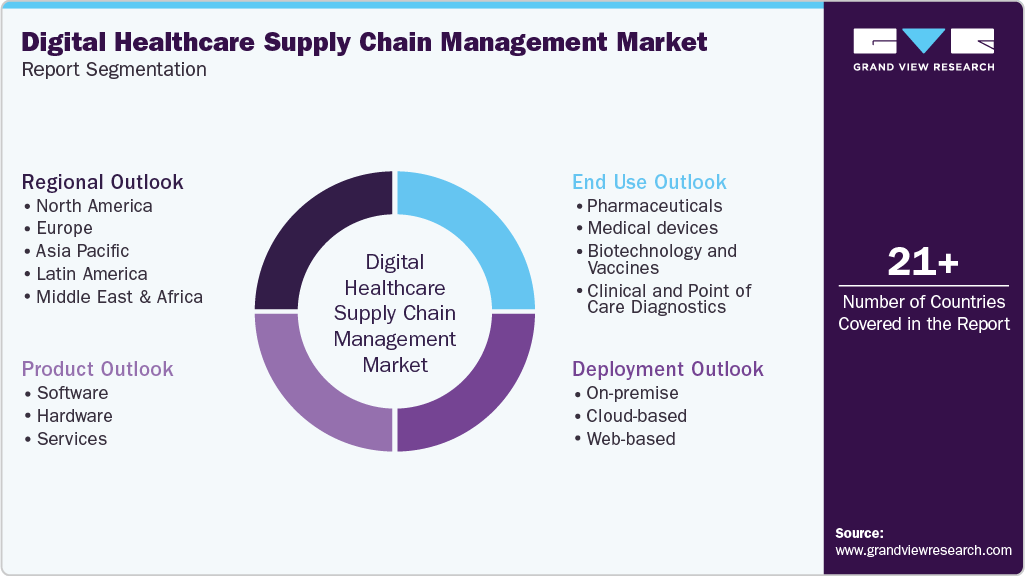
This report forecasts revenue growth at global, regional & country levels and provides an analysis of the industry trends in each of the sub-segments from 2021 to 2033. For this study, Grand View Research has segmented the global digital healthcare supply chain management market report based on product, deployment, end use, and region:
 To learn more about this report, Download Free Sample Report
 -
Product Outlook (Revenue, USD Million, 2021 - 2033)
-
Software
-
Hardware
-
Services
-
-
Deployment Outlook (Revenue, USD Million, 2021 - 2033)
-
On-premise
-
Cloud-based
-
Web-based
-
-
End Use Outlook (Revenue, USD Million, 2021 - 2033)
-
Pharmaceuticals
-
Medical devices
-
Biotechnology and Vaccines
-
Clinical and Point of Care Diagnostics
-
-
Regional Outlook (Revenue, USD Million, 2021 - 2033)
-
North America
-
U.S.
-
Canada
-
Mexico
-
-
Europe
-
UK
-
Germany
-
France
-
Italy
-
Spain
-
Norway
-
Denmark
-
Sweden
-
-
Asia Pacific
-
Japan
-
China
-
India
-
Australia
-
South Korea
-
Thailand
-
-
Latin America
-
Brazil
-
Argentina
-
-
Middle East & Africa
-
South Africa
-
Saudi Arabia
-
UAE
-
Kuwait
-
-
Frequently Asked Questions About This Report
The cloud-based segment held the largest revenue share in 2025 and is expected to witness the fastest growth.
The cloud-based segment held the largest revenue share in 2025 and is expected to register the fastest growth, with a CAGR of 8.7% over the forecast period.
The pharmaceutical segment led with a 35.7% revenue share in 2025, while the medical devices segment is the fastest-growing.
Asia Pacific is the fastest-growing region over the forecast period.
The global digital healthcare supply chain management market size was estimated at USD 3.5 billion in 2025 and is expected to reach USD 3.8 billion in 2026.
The global digital healthcare supply chain management market is expected to grow at a compound annual growth rate of 8.4% from 2026 to 2033 to reach USD 6.7 billion by 2033.
The North America held the largest market with a share of 32.8% in 2025, owing to the need for enhanced digital supply chain efficiencies, the adoption of technological advances facilitating overall cost reduction, and the integration of machine learning and AI to analyze and predict supply chain management outcomes.
Some key players operating in the digital healthcare supply chain management market include Palantir Technologies, Inc.; InterSystems Corporation; Tecsys; LogiTag Systems; Mckesson Corporation; Oracle; SAP; Infor; Terso Solutions; CenTrak (HALMA plc); Biolog-ID; Blue Yonder Group, Inc.; Kinaxis Inc.; Global Healthcare Exchange, LLC.; Epicor Software Corporation
Key factors driving the market growth includethe increasing investments in next-generation technologies such as control towers and digital twin technology, the rising adoption of dashboards to enhance analytics, execution, and visibility, and government initiatives to enhance medical supply.
About the Author(s)
Healthcare IT Research Team
Healthcare · Healthcare ITThis report was authored by the healthcare it research team at Grand View Research - comprising two research analysts, one senior research analyst, and one industry expert - with specialized expertise in the healthcare it segment of the healthcare industry. All findings are based on proprietary healthcare databases, executive interviews, and regulatory analysis, subject to internal peer review prior to publication.
Last Updated:
Speak to Analyst

Customize this report to your needs - add regions, segments, or data points, with 20% free customization.
Or view our licence options:


ISO 9001:2015 & 27001:2022 Certified
We are GDPR and CCPA compliant! Your transaction & personal information is safe and secure. For more details, please read our privacy policy.


