
- Home
- »
- Consumer F&B
- »
-
Healthy Vegetable Chips Market Size Report, 2026-2033GVR Report cover

Healthy Vegetable Chips Market (2026 - 2033)
Size, Share & Trends Analysis Report By Product (Root Vegetable Chips, Leafy Green Chips), By Nature (Organic, Conventional), By Flavor, By Processing, By Distribution Channel, By Region, And Segment Forecasts
Market Size, 2025
$4.0BMarket Estimate, 2026
$4.3BMarket Forecast, 2033
$7.7BCAGR, 2026–2033
8.5%Healthy Vegetable Chips Market Summary
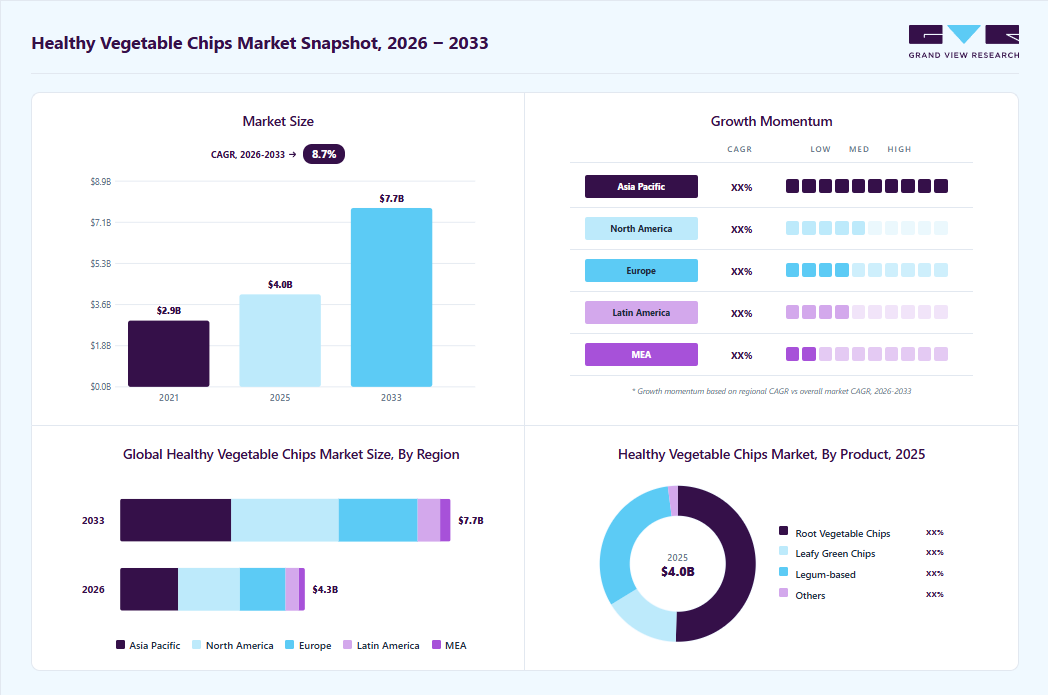
The global healthy vegetable chips market size was valued at USD 4.0 billion in 2025 and is projected to grow from USD 4.3 billion in 2026 to USD 7.7 billion by 2033, at a CAGR of 8.5% from 2026 to 2033. North America dominated the healthy vegetable chips market with the largest revenue share of 33.3% in 2025. Increasing urbanization, fast-paced lifestyles, and evolving dietary preferences are driving the demand for convenient and on-the-go snack products.
 Source: Grand View Research, IR Documents, Primary Interviews, Paid DatabasesTo learn more about this report,
 Download Free Sample Report
Key Market Trends & Insights
- By product: Root vegetable chips segment held the largest market share of 50.4% in 2025.
- By nature: Conventional healthy vegetable chips segment held the largest market share of 81.3% in 2025.
- By flavor: Plain & salted healthy vegetable chips segment held the largest market share of 46.6% in 2025.
- By processing: Fried healthy vegetable chips segment held the largest market share of 38.0% in 2025.
Regional Highlights
- Largest regional market: North America (33.3% revenue share, 2025)
- Fastest-growing regional market: Asia Pacific (highest CAGR, 2026-2033)
- By country: U.S. held the largest market share in 2025.
Market Size & Forecast
- Market size in 2025: USD 4.0 Billion
- Estimated market size in 2026: USD 4.3 Billion
- Projected market size by 2033: USD 7.7 Billion
- CAGR (2026-2033): 8.5%
Prism AI by Grand View Research Free to tryAsk a question about the healthy vegetable chips marketTry asking✓Every figure cited from GVR research Prefer the report? Download free sample →
Consumers are increasingly preferring snacks that are portable, easy to consume, and aligned with their dietary choices. Furthermore, the growing adoption of gluten-free, vegan, and organic diets is encouraging manufacturers to diversify and expand their product offerings to address changing consumer requirements. The healthy vegetable chips market is benefiting from the growing influence of premium snacking trends and evolving consumer expectations regarding product variety and ingredient quality. Manufacturers are increasingly focusing on innovative seasoning profiles and differentiated texture experiences to strengthen product appeal among consumers. In addition, increasing emphasis on sustainable packaging solutions and product transparency is supporting brand differentiation across competitive retail environments. Expanding product availability across supermarkets, convenience stores, and digital commerce platforms is further contributing to the long-term growth of the healthy vegetable chips market. To learn more about this report, Download Free Sample Report
The healthy vegetable chips market is witnessing steady growth as consumers increasingly prefer nutritious snack alternatives to conventional fried snacks. Rising awareness of balanced diets, plant-based nutrition, and clean-label food products is driving the consumption of vegetable-based chips across consumer groups. Products made from ingredients such as sweet potatoes, beetroot, kale, lentils, and chickpeas are gaining strong popularity due to their perceived nutritional value and healthier product positioning.
Changing consumer preferences toward minimally processed and naturally derived snack products are further supporting market expansion. Consumers are increasingly seeking snacks with recognizable ingredients, lower oil content, and reduced artificial additives, encouraging manufacturers to focus on transparent labeling and improved product formulations. This shift is also driving demand for baked, air-dried, and dehydrated vegetable chips that align with wellness-oriented consumption habits.
The industry is further supported by ongoing developments in flavor innovation, seasoning blends, and vegetable ingredient combinations to address changing consumer taste preferences. Manufacturers are strengthening their portfolios with gluten-free, non-GMO, and naturally positioned snack products to improve product differentiation across retail channels. Moreover, advancements in manufacturing methods and packaging technologies are helping companies maintain product freshness, nutritional quality, and shelf stability, contributing to broader consumer acceptance.
 To learn more about this report, Download Free Sample Report
The growth of e-commerce grocery platforms, wellness-oriented retail stores, and organized distribution networks is improving the accessibility of healthy vegetable chips across international markets. Rising consumer demand for premium-quality snacks, eco-conscious packaging solutions, and convenient purchasing options is also driving market expansion.
Market Dynamics
The healthy vegetable chips market is witnessing steady growth as consumers increasingly seek nutritious snack alternatives that align with health-conscious lifestyles. Products made from vegetables such as sweet potato, beetroot, carrot, kale, and other plant-based ingredients are gaining popularity due to their perceived nutritional benefits, clean-label positioning, and lower reliance on artificial additives. Continuous innovation in baking, air-drying, and dehydration technologies, coupled with rising demand for convenient, better-for-you snacking options, is supporting market expansion. Furthermore, growing awareness of balanced dietary habits and the shift toward natural and minimally processed foods are expected to sustain the growth momentum of the healthy vegetable chips market.
Growing consumer preference for healthier snack options is a primary factor driving the healthy vegetable chips market. Increasing awareness regarding the impact of excessive consumption of conventional fried snacks, coupled with a stronger focus on balanced nutrition, has encouraged consumers to seek snacks made from vegetables, natural ingredients, and minimally processed formulations. Demand is particularly increasing for products that offer clean-label attributes such as gluten-free, non-GMO, preservative-free, and artificial additive-free claims, aligning with broader wellness and preventive health trends. Vegetable-based chips made from sweet potato, beetroot, carrot, kale, and other nutrient-rich ingredients are increasingly being positioned as better-for-you alternatives within the savory snacks category.
In November 2025, To Be Honest (TBH), a healthy snacking brand under Ghodawat Consumer Limited, launched Mix Veggie Chips made from sweet potato, purple sweet potato, beetroot, okra, and jackfruit. The product was developed using vacuum-cooking technology, contains 40% less fat, is free from palm oil, and uses only rock salt seasoning, reflecting the growing consumer demand for clean-label, vegetable-based, and better-for-you snack alternatives.
The higher retail price of healthy vegetable chips compared to conventional potato chips remains a significant barrier to broader consumer adoption. Production of vegetable chips often involves premium raw materials, specialized processing methods such as vacuum frying, air drying, or dehydration, and stricter quality standards to maintain product texture and nutritional attributes. These factors increase manufacturing costs and result in premium shelf prices, restricting penetration among price-sensitive consumer groups, particularly in emerging economies where affordability remains a key purchase criterion. Additionally, fluctuations in vegetable supply and input costs can further impact pricing consistency and profit margins.
Consumer expectations in the healthy snacking category are evolving beyond natural ingredients and vegetable-based formulations toward products that retain more of the original nutritional properties of raw vegetables. This is creating opportunities for manufacturers to invest in advanced processing technologies such as vacuum frying, air drying, freeze-drying, and low-temperature dehydration, which help preserve vitamins, antioxidants, natural colors, and flavors while reducing oil absorption. These technologies enable brands to strengthen their premium positioning, support clean-label claims, and offer products that align more closely with consumer wellness objectives. As nutritional transparency becomes increasingly important in purchasing decisions, technology-driven product innovation is expected to emerge as a key differentiator within the healthy vegetable chips market.
In November 2025, To Be Honest (TBH) launched its Mix Veggie Chips range utilizing vacuum-cooking technology, a process designed to reduce fat absorption while preserving the natural characteristics of vegetables such as beetroot, sweet potato, okra, and jackfruit. The launch reflects growing industry investment in processing methods that enhance both product quality and nutritional appeal.
Analyst Perspective
The healthy vegetable chips market is transitioning from a simple "better-for-you" snack category into a credibility-driven nutrition segment, where ingredient transparency alone is no longer sufficient to sustain premium pricing. The next phase of value creation will favor manufacturers that can demonstrate measurable nutritional advantages through advanced processing technologies, functional formulations, and clinically relevant health benefits. As mainstream snack brands increasingly enter the category, long-term competitive differentiation will depend less on vegetable variety and more on a company's ability to combine superior nutrient retention, clean-label integrity, and scalable distribution into a proposition that consumers perceive as genuinely healthier rather than merely healthier-looking.
Consumer Insights
Consumers across the globe are increasingly shifting toward nutritious, better-for-you snack products as awareness of health and balanced diets continues to grow. The rising popularity of vegetable-based snacks made from beetroot, sweet potato, kale, lentils, and chickpeas is supporting stronger consumer interest in healthy vegetable chips. Demand is also increasing for snacks with natural ingredients, reduced oil content, and clean-label positioning, reflecting changing preferences toward mindful and wellness-oriented eating habits.
 To learn more about this report, Download Free Sample Report
Taste variety, crisp texture, and nutritional value are becoming key factors influencing purchasing decisions among consumers of healthy vegetable chips. Buyers are increasingly attracted to snacks containing naturally sourced ingredients, limited processing methods, and clearly identifiable ingredient compositions.
The growing adoption of digital grocery shopping platforms and specialized wellness retail channels is improving consumer access to healthy vegetable chip products globally. Consumers are also increasingly preferring brands that emphasize ingredient clarity, environmentally responsible packaging, and strong product quality standards.
Product Insights
Based on product, root vegetable chips segment led the market with the largest revenue share of 50.4% in 2025 and is expected to grow at a CAGR of 8.2% over the forecast period. The demand for root vegetable chips is increasing as consumers increasingly prefer healthier snack alternatives with natural ingredients. Additionally, their unique flavors, high fiber content, and gluten-free appeal attract health-conscious consumers.
 To learn more about this report, Download Free Sample Report
The legume-based healthy vegetable chips are projected to expand at a CAGR of 9.2% during 2026-2033. The demand for legume-based chips is increasing as consumers increasingly prefer protein-rich and plant-based snack alternatives that align with health-conscious eating habits. Products made from lentils, chickpeas, and peas are gaining popularity due to their higher protein and fiber content compared to conventional snack products. In addition, the growing preference for gluten-free, clean-label, and minimally processed snacks is supporting the wider adoption of legume-based healthy vegetable chips across retail and online distribution channels.
Nature Insights
Based on nature, conventional segment led the market with the largest revenue share of 81.2% in 2025. The demand for conventional healthy vegetable chips is rising as consumers seek nutritious, low-calorie snack alternatives. Their natural ingredients and better-for-you appeal align with growing health and wellness trends.
 To learn more about this report, Download Free Sample Report
The non-GMO healthy vegetable chips are projected to grow at a CAGR of 11.1% from 2026 to 2033. The demand for non-GMO healthy vegetable chips is increasing as consumers increasingly prefer transparent ingredient sourcing and naturally positioned snack products. Non-GMO vegetable chips are gaining popularity among health-conscious consumers seeking snacks free of genetically engineered ingredients and artificial additives.
Flavor Insights
Based on flavor, plain & salted segment led the market with the largest revenue share of 46.6% in 2025 and is expected to grow at a CAGR of 7.6% over the forecast period. The demand for plain and salted healthy vegetable chips is increasing as consumers seek simple, flavorful snacks with fewer additives. Their familiar taste, combined with healthier ingredients, appeals to those looking for a balanced, guilt-free option.These chips offer a lower-calorie, higher-fiber alternative that satisfies cravings for crunchy, savory snacks while supporting healthier choices.
 To learn more about this report, Download Free Sample Report
The spiced and seasoned healthy vegetable chips segment is the fastest-growing category, projected to expand at a CAGR of 9.6% from 2026 to 2033. The demand for spiced and seasoned healthy vegetable chips is increasing as consumers seek flavorful snack options made with natural ingredients, vegetable blends, and clean-label seasonings. The growing preference for bold taste profiles, minimally processed snacks, and plant-based products is further driving the adoption of spiced and seasoned vegetable chips across supermarkets, specialty stores, and online retail platforms.
Processing Insights
Based on processing, fried segment led the market with the largest revenue share of 38.0% in 2025. The demand for healthy fried vegetable chips is increasing as consumers crave crispy, indulgent snacks with a healthier twist. Their rich taste and satisfying crunch appeal to those seeking a more wholesome alternative to traditional fried snacks. The rising demand for gluten-free, nutrient-dense snacks, along with the appeal of a crispy, satisfying treat, has made fried, healthy vegetable chips a popular choice for consumers seeking a more wholesome snacking experience.
Air-dried & dehydrated healthy vegetable chips are projected to grow at a CAGR of 9.6% from 2026 to 2033. The demand for air-dried and dehydrated healthy vegetable chips is increasing as consumers increasingly prefer low-oil, minimally processed, and nutrient-retaining snack products. These chips are gaining popularity due to their lighter texture, extended shelf life, and ability to preserve the natural taste and nutritional value of vegetables. In addition, rising interest in clean-label snacks and healthier snacking alternatives is further supporting the adoption of air-dried and dehydrated vegetable chips across retail and online distribution channels.
Distribution Channel Insights
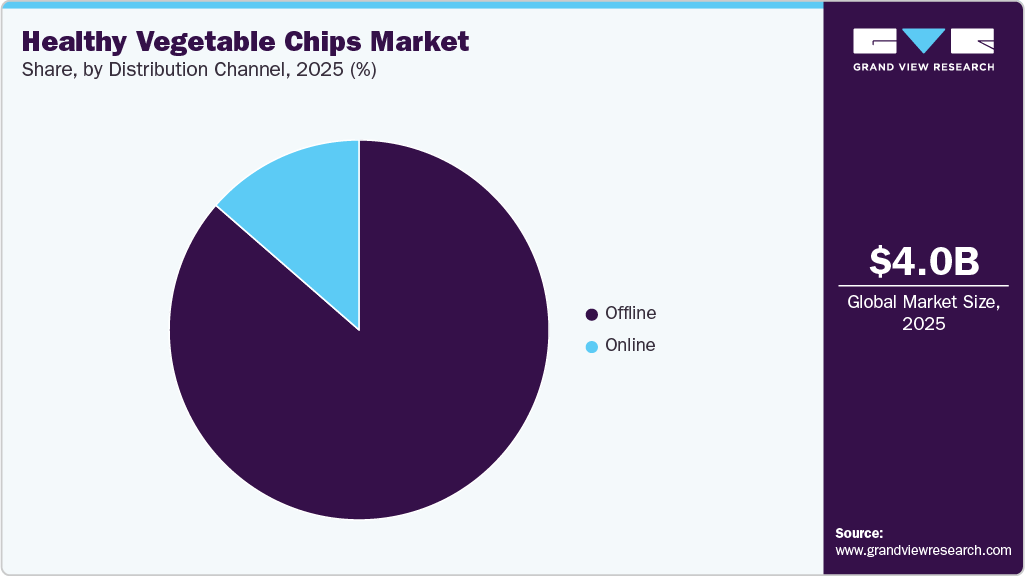
Based on distribution channel, offline segment led the market with the largest revenue share of 86.4% in 2025 and is expected to grow at a CAGR of 8.4% over the forecast period. As offline stores offer easy access to a range of items under one roof, consumers can choose from a variety of options. Additionally, these stores offer the advantage of catering to a single large consumer base, simplifying the operations compared to dealing with numerous smaller independent customers.
 To learn more about this report, Download Free Sample Report
The sale of healthy vegetable chips through online channels is projected to expand at a CAGR of 10.7% during 2026-2033. Growth is driven by increasing consumer preference for digital shopping platforms that offer product variety, convenience, and easy accessibility to health-focused snack products. Online retailers and direct-to-consumer brands are expanding product visibility through promotional campaigns, subscription-based purchasing options, and personalized recommendations. The segment is also supported by rising smartphone penetration, expanding e-commerce infrastructure, and growing consumer demand for convenient purchasing experiences across global markets.
Regional Insights
North America dominated the healthy vegetable chips market with the largest revenue share of 33.3% in 2025. The market in this region is driven by a strong snacking culture, with 73% of Americans snacking at least once daily. The shift toward plant-based diets (motivated by health concerns among 55% of Americans) is accelerating demand for vegetable chips. In the U.S., consumers actively seek low-calorie, gluten-free, and clean-label options that are high in fiber and vitamins. Germany mirrors this trend with an additional focus on sustainability and eco-friendly practices, while Mexico is seeing an influx of innovative vegetable chips that align with traditional local flavors, such as beetroot and sweet potato chips, appealing to a younger, health-conscious demographic.
 To learn more about this report, Download Free Sample Report
U.S. Healthy Vegetable Chips Market Trends
The healthy vegetable chips market in the U.S. held the largest share in the North America region in 2025. The rise of health clubs, fitness awareness, and concerns over obesity affecting four out of ten Americans according to the CDC are pushing consumers away from traditional fried snacks toward better-for-you alternatives. Consumers are actively seeking low-calorie, gluten-free, and clean-label options that offer nutritional benefits such as high fiber and vitamins. Major food corporations like PepsiCo are also responding by innovating with baked and air-dried vegetable chip varieties, further accelerating repeat consumption and market expansion.
The Canada healthy vegetable chips market is projected to expand at a CAGR of 10.1% from 2026 to 2033. Market growth is being driven by a strong consumer focus on sustainability and environmental impact, with Canadian shoppers increasingly preferring brands that prioritize eco-friendly practices and ethical sourcing. Similar to the U.S., rising health consciousness and the popularity of plant-based diets are fueling demand for nutritious snack alternatives.
Europe Healthy Vegetable Chips Market Trends
The Europe healthy vegetable chips market is projected to expand at a CAGR of 8.1% from 2026 to 2033. Market growth is driven by the region's strong emphasis on health and wellness, with consumers snacking for nourishment and sustained energy. Germany leads demand for organic and functional chips made with kale and beetroot, while the UK benefits from a rise in vegan lifestyles. In France and Italy, a strong culinary heritage drives demand for premium, artisanal vegetable chips. Additionally, younger consumers favor low-calorie options, while older consumers seek low-sugar snacks, creating diverse growth pockets.
The Spain healthy vegetable chips market is projected to expand at the largest CAGR of 8.7% from 2026 to 2033. Market growth is driven by the country's strong culinary heritage, where gourmet flavors and high-quality ingredients play a pivotal role. Spanish consumers are increasingly drawn to premium vegetable chips that showcase local vegetables and artisanal snacking options. The growing awareness of health and wellness, coupled with a younger demographic inclined to explore innovative food products, is accelerating the shift from traditional fried snacks. Initiatives aimed at reducing unhealthy fats have further spurred interest in vegetable chips as a nutritious alternative.
The Italy healthy vegetable chips market accounted for a revenue share of 8.2% in 2025 and is projected to be the fastest-growing market in the region. Market growth is driven by a strong culinary heritage that values high-quality, authentic ingredients. Italian consumers are increasingly seeking premium vegetable chips that showcase local vegetables and artisanal production methods. The rise of health-conscious eating habits, combined with a growing preference for plant-based and organic snacks, is accelerating demand. The convenience of ready-to-eat, better-for-you snacks appeals to busy consumers looking for quick yet nutritious options.
Additionally, Germany's multicultural population promotes diverse flavor profiles and unique vegetable chip varieties, encouraging product innovation. The presence of supportive trade associations, such as health Germany and agriculture and agri-food Germany, along with growing consumer preference for organic and non-GMO verified products, is strengthening market penetration across both retail and online channels.
Asia Pacific Healthy Vegetable Chips Market Trends
The Asia Pacific healthy vegetable chips market accounted for a market share of 31.1% in 2025. Market growth is supported by rising focus on health and wellness across China and India, where developing economies are experiencing evolving food consumption behavior. In China, expanding urban populations and rising disposable incomes have increased the preference for healthier and convenient snack products, with 87% of consumers aiming to improve their eating habits. India’s market is supported by younger populations seeking better for alternatives to traditional fried snacks, while ingredients including lentils and chickpeas are witnessing growing popularity among consumers. Moreover, Australia and New Zealand are observing stronger demand for organic and responsibly sourced snack products, encouraging the introduction of innovative vegetable-based chip products.
The China healthy vegetable chips market accounted for a significant share of 30.5% in 2025. Market growth is driven by rapid urbanization and a growing middle class seeking convenient yet healthy snacking options. According to the document, about 87% of Chinese consumers plan to improve dietary habits to enhance health and wellness, while 41% consume specific nutritional products to manage health. Brands that cater to local tastes, incorporating familiar vegetables and flavors, are gaining strong traction in this competitive market. The influence of fitness and wellness influencers promoting healthy eating habits further propels demand for vegetable chips.
The India healthy vegetable chips market is projected to expand at a CAGR of 10.7% from 2026 to 2033. Market growth is driven by a growing demand for healthier snacks, particularly among younger consumers, and the rise of health clubs and fitness awareness. Vegetable chips made from local ingredients, such as lentils and chickpeas, resonate well with Indian consumers by combining health benefits with cultural preferences. The document highlights that 67% of Indians prefer healthier options like makhana, but 58% cite high retail costs as a barrier, presenting an opportunity for affordable innovation. Companies such as Graminway offer high-protein beetroot chips to cater to this health-conscious demographic.
Middle East & Africa Healthy Vegetable Chips Market Trends
The Middle East & Africa healthy vegetable chips market is projected to expand at a CAGR of 7.4% from 2026 to 2033. Market growth is driven by a growing awareness of health and nutrition, particularly in urban areas of South Africa. Young people are actively participating in tackling unhealthy lifestyles through health campaigns, boosting demand for nutritious snacks. Local brands offering vegetable chips made from indigenous ingredients like beetroot and sweet potato are gaining popularity by combining health benefits with support for local economies. The multicultural demographics encourage diverse flavor profiles, and the trend of clean eating and avoiding artificial additives is paramount.
Central & South America India Healthy Vegetable Chips Market Trends
The Central & South America healthy vegetable chips market is projected to expand at a CAGR of 8.1% from 2026 to 2033. Market growth is driven by an increasing focus on health and wellness, particularly in Brazil, with consumers actively seeking snacks that align with their dietary goals. The rise of organic and non-GMO products is shaping consumer choices, as individuals prioritize transparency and sustainability in food sourcing. Vegetable chips made from native ingredients such as cassava and sweet potatoes are gaining traction among health-conscious consumers. A younger demographic that is more inclined to explore innovative food products is further accelerating the shift from traditional fried snacks to healthier alternatives.
Key Healthy Vegetable Chips Company Insights
Established and emerging players in the healthy vegetable chips market operate in a highly competitive environment, driven by continuous innovation in ingredients, flavors, and healthier processing techniques. Companies are increasingly focusing on baked, air-dried, and dehydrated chip formats made from vegetables such as sweet potatoes, beetroot, kale, lentils, and chickpeas to meet rising consumer demand for nutritious and minimally processed snacks. Manufacturers are also emphasizing clean-label formulations, non-GMO ingredients, and plant-based offerings to strengthen product differentiation and appeal among health-conscious consumers seeking convenient better-for-you snacking options.
Key companies in the healthy vegetable chips market are actively expanding their product portfolios through flavor innovation, premium ingredient sourcing, and sustainable packaging solutions to enhance brand positioning and consumer engagement. In addition, market participants are strengthening their presence across supermarkets, specialty health stores, online retail platforms, and direct-to-consumer channels to improve accessibility and broaden their customer base. Strategic investments in advanced processing technologies, shelf-life enhancement, and transparent labeling practices are further helping companies maintain product quality, improve nutritional retention, and align with evolving consumer preferences for natural and functional snack products.
 To learn more about this report, Download Free Sample Report
Key Healthy Vegetable Chips Companies
The following key companies have been profiled for this study on the healthy vegetable chips market.
-
Hain Celestial Group
-
TERRA
-
PepsiCo
-
Kibo Foods
-
Hunter Foods Private Ltd
-
Rare Fare Foods, LLC
-
Lantev Industries
-
Calbee Harvest Snaps
-
GoPure
-
Troovy
Competitive Benchmarking
Category
Operating Strategies
Competitive Edge
Weakness
Established Players (PepsiCo, Hain Celestial Group, Calbee Harvest Snaps, TERRA)
- Focus on portfolio diversification, extensive retail penetration, product innovation, and strategic brand expansion across health-focused snack categories.
- Strong brand recognition, established distribution networks, economies of scale, and significant marketing capabilities.
- Slower response to niche consumer trends and higher exposure to competition from agile health-focused brands.
Emerging Players (Kibo Foods, Hunter Foods Private Ltd, Rare Fare Foods LLC, Lantev Industries, GoPure, Troovy)
- Emphasize clean-label formulations, vegetable-based innovation, premium positioning, and targeted expansion through specialty retail and e-commerce channels.
- Ability to address niche consumer demands, faster innovation cycles, and stronger differentiation through unique ingredients and health claims.
- Limited geographic presence, lower brand awareness, and constrained resources for large-scale marketing and distribution.
Recent Developments
-
In December 2025, CJ Foods launched the “Basak” healthy snack range featuring baked high-protein chips made from upcycled rice grains. The new products were introduced as part of the company’s expansion of its sustainable, healthier snacking portfolio. The launch also included baked chips and popcorn varieties focused on nutrition, taste, and eco-friendly product innovation.
-
In November 2025, PepsiCo launched Red Rock Deli gourmet chips in India featuring kettle-cooked, baked, and popped varieties. The products were introduced with globally inspired flavors and made using sunflower oil to target premium snacking consumers. The launch reflects the company’s focus on expanding its healthier and premium snack portfolio in the Indian market.
-
In June 2025, Troovy expanded its healthy snacks portfolio with products including Healthy Moong Dal Chips and Healthy Protein Puffs. The newly promoted snack range featured protein-rich and vegetable-based ingredients such as moong dal, chickpeas, quinoa, and ragi, targeting younger and fitness-focused consumers. The launches focused on clean-label positioning with no preservatives, no palm oil, and gluten-free formulations.
Healthy Vegetable Chips Market Report Scope
Report Attribute
Details
Market size in 2025
USD 4.0 billion
Estimated market size in 2026
USD 4.3 billion
Projected market size by 2033
USD 7.7 billion
Growth rate
CAGR of 8.5% from 2026 to 2033
Base year for estimation
2025
Historical data
2021 - 2024
Forecast period
2026 - 2033
Quantitative units
Revenue in USD million/billion and CAGR from 2026 to 2033
Report coverage
Revenue forecast, company ranking, competitive landscape, growth factors, and trends
Segments covered
Product, nature, flavor, processing, distribution channel, and region
Regional scope
North America; Europe; Asia Pacific; Central & South America; Middle East & Africa
Country scope
U.S.; Canada; Mexico; Germany; UK; France; Italy; Spain; China; India; Japan; Australia & New Zealand; South Korea; South Africa; Brazil
Key companies profiled
Hain Celestial Group; TERRA; PepsiCo; Kibo Foods; Hunter Foods Private Ltd; Rare Fare Foods, LLC; Lantev Industries; Calbee Harvest Snaps; GoPure; Troovy
Customization scope
Free report customization (equivalent up to 8 analysts' working days) with purchase. Addition or alteration to country, regional & segment scope.
Pricing and purchase options
Avail customized purchase options to meet your exact research needs. Explore purchase options
Global Healthy Vegetable Chips Market Report Segmentation
This report forecasts revenue growth at the global, regional, and country levels and provides an analysis of the latest industry trends and opportunities in each of the sub-segments from 2021 to 2033. For this study, Grand View Research has segmented the global healthy vegetable chips market report on the basis of product, nature, flavor, processing, distribution channel and region:
-
Product Outlook (Revenue, USD Billion, 2021 - 2033)
-
Root Vegetable Chips
-
Leafy Green Chips
-
Legume-Based
-
Others
-
-
Nature Outlook (Revenue, USD Billion, 2021 - 2033)
-
Organic
-
Conventional
-
Non-GMO
-
-
Flavor Outlook (Revenue, USD Billion, 2021 - 2033)
-
Plain & Salted
-
Spiced & Seasoned
-
Cheese-flavored
-
Others
-
-
Processing Outlook (Revenue, USD Billion, 2021 - 2033)
-
Baked
-
Air-dried & Dehydrated
-
Fried
-
Others
-
-
Distribution Channel Outlook (Revenue, USD Billion, 2021 - 2033)
-
Offline
-
Online
-
-
Regional Outlook (Revenue, USD Billion, 2021 - 2033)
-
North America
-
U.S.
-
Canada
-
Mexico
-
-
Europe
-
Germany
-
UK
-
France
-
Italy
-
Spain
-
-
Asia Pacific
-
China
-
India
-
Japan
-
South Korea
-
Australia & New Zealand
-
-
Middle East & Africa
-
South Africa
-
-
Central & South America
-
Brazil
-
-
Research Methodology
The healthy vegetable chips market figures in this report are based on a proven research process that combines executive interviews with secondary research from proprietary databases, company filings, and recognized regulatory and institutional sources. Market size is built through value-chain sizing - reconciling supply-side and demand-side estimates - and triangulated with bottom-up and top-down approaches. Every estimate passes multiple levels of expert validation before publication, with each healthy vegetable chips segment quantified using the revenue-capture definitions in the table below.
Segment Definition
Segment - Type
Revenue capture definition
Root Vegetable Chips
This segment includes the sales of chips made from root vegetables such as sweet potato, beetroot, carrot, cassava, and taro. Revenue is generated through retail, foodservice, and online channels, with products positioned as healthier alternatives to conventional potato chips due to their natural nutrient content and clean-label appeal.
Leafy Green Chips
This segment includes the sales of chips produced from leafy vegetables such as kale, spinach, cabbage, and seaweed. Revenue is generated through premium health-focused snack products marketed for their nutrient density, plant-based positioning, and wellness-oriented attributes.
Legume-based Chips
This segment includes the sales of chips manufactured from legumes such as chickpeas, lentils, peas, and beans. Revenue is generated through products emphasizing higher protein and fiber content, catering to consumers seeking functional and satiating snack alternatives.
Others
This segment includes the sales of chips derived from ingredients such as okra, lotus root, jackfruit, mushroom, zucchini, and mixed vegetables. Revenue is generated through innovative snack offerings that provide unique flavors, textures, and ingredient diversity within the healthy snacking category.
Segment - Nature
Revenue capture definition
Organic
This segment includes the sales of healthy vegetable chips produced from organically cultivated vegetables without the use of synthetic pesticides, fertilizers, or genetically modified ingredients. Revenue is generated through premium retail and online channels, targeting consumers seeking clean-label, sustainable, and naturally sourced snack products.
Conventional
This segment includes the sales of healthy vegetable chips manufactured using conventionally grown vegetables and standard agricultural practices. Revenue is generated through mass-market retail, convenience stores, and foodservice channels, offering consumers affordable and widely accessible snacking options.
Non-GMO
This segment includes the sales of healthy vegetable chips made from ingredients that are not genetically modified and comply with non-GMO certification standards. Revenue is generated through health-focused retail and e-commerce channels, catering to consumers seeking transparency, natural ingredient sourcing, and enhanced food quality assurance.
Estimation Model
Consumer Base Layer
Accessibility Layer Purchase Behaviour Layer Revenue Layer Who consumes healthy snack products?
Who can access healthy vegetable chips?
Who actively purchases healthy vegetable chips?
How much revenue is generated?
Identify the population of health-conscious consumers, fitness enthusiasts, clean-label snack buyers, and individuals seeking better-for-you alternatives to conventional chips.
Apply retail and distribution penetration across supermarkets, hypermarkets, convenience stores, specialty stores, and e-commerce channels to determine the addressable consumer base.
Apply healthy snack adoption rates, consumption frequency, flavor preferences, and repeat purchase patterns to estimate active category buyers.
Multiply active consumers by average annual spending on healthy vegetable chips across retail and online channels to derive market revenue potential.
Delivered Customizations
This report has been delivered with the following In-depth customizations
Client Request
Customization Delivered
Value Adds
Product Innovation & Ingredient Opportunity Assessment
Evaluated opportunities across functional ingredients, nutrient-retention technologies, organic formulations, non-GMO products, protein-enriched chips, and emerging vegetable varieties.
Supports product development strategies by identifying whitespace opportunities, premiumization potential, and differentiated value propositions.
Advanced Processing Technology & Nutrient Retention Analysis
Assessed the commercial impact of vacuum frying, air drying, freeze-drying, and low-temperature dehydration technologies on product quality and market competitiveness.
Helps manufacturers identify technology-driven differentiation opportunities and strengthen premium product positioning.
Competitive Benchmarking & Brand Differentiation Analysis
Analyzed leading brands based on product portfolio, pricing strategy, ingredient sourcing, processing technologies, sustainability initiatives, and market positioning.
Provides actionable insights for competitive differentiation, portfolio optimization, and long-term market share expansion.
Frequently Asked Questions About This Report
The global healthy vegetable chips market size was estimated at USD 4.0 billion in 2025 and is expected to reach USD 4.3 billion in 2026.
The global healthy vegetable chips market is expected to grow at a CAGR of 8.5% from 2026 to 2033, reaching USD 7.7 billion by 2033.
North America dominated with a 33.3% revenue share in 2025.
Asia Pacific is the fastest-growing region over the forecast period.
Key players include Hain Celestial Group; TERRA; PepsiCo; Kibo Foods; Hunter Foods Private Ltd; Rare Fare Foods, LLC; Lantev Industries; Calbee Harvest Snaps; GoPure; Troovy
The global healthy vegetable chips market is driven by increasing urbanization, fast-paced lifestyles, and evolving dietary preferences across the globe.
The root vegetable chips segment led with a 50.4% revenue share in 2025, while the legume-based healthy vegetable chips segment is the fastest-growing.
The conventional healthy vegetable chips segment led with a 81.3% revenue share in 2025, while the non-gmo healthy vegetable chips segment is the fastest-growing.
The plain & salted healthy vegetable chips segment led with a 46.6% revenue share in 2025, while the spiced and seasoned healthy vegetable chips segment is the fastest-growing.
The fried healthy vegetable chips segment led with a 38.0% revenue share in 2025, while the air-dried & dehydrated healthy vegetable chips segment is the fastest-growing.
About the Author(s)
Consumer F&B Research Team
Consumer Goods · Consumer F&BThis report was authored by the consumer f&b research team at Grand View Research - comprising two research analysts, one senior research analyst, and one industry expert - with specialized expertise in the consumer f&b segment of the consumer goods industry. All findings are based on proprietary consumer goods databases, executive interviews, and regulatory analysis, subject to internal peer review prior to publication.
Last Updated:
Speak to Analyst

Customize this report to your needs - add regions, segments, or data points, with 20% free customization.
Or view our licence options:


ISO 9001:2015 & 27001:2022 Certified
We are GDPR and CCPA compliant! Your transaction & personal information is safe and secure. For more details, please read our privacy policy.


