
- Home
- »
- Advanced Interior Materials
- »
-
High Speed Steel Cutting Tools Market Size Report, 2033GVR Report cover

High Speed Steel Cutting Tools Market (2026 - 2033)
Size, Share & Trends Analysis Report By Product Type (Drilling, Gear Cutting Tools), By Type (Computer Numerical Control, Conventional), By End-use (Oil & Gas, Automotive, Medical Devices, Aerospace), By Region, And Segment Forecasts
Market Size, 2025
$16.2BMarket Estimate, 2026
$17.1BMarket Forecast, 2033
$25.7BCAGR, 2026–2033
6.0%High Speed Steel Cutting Tools Market Summary
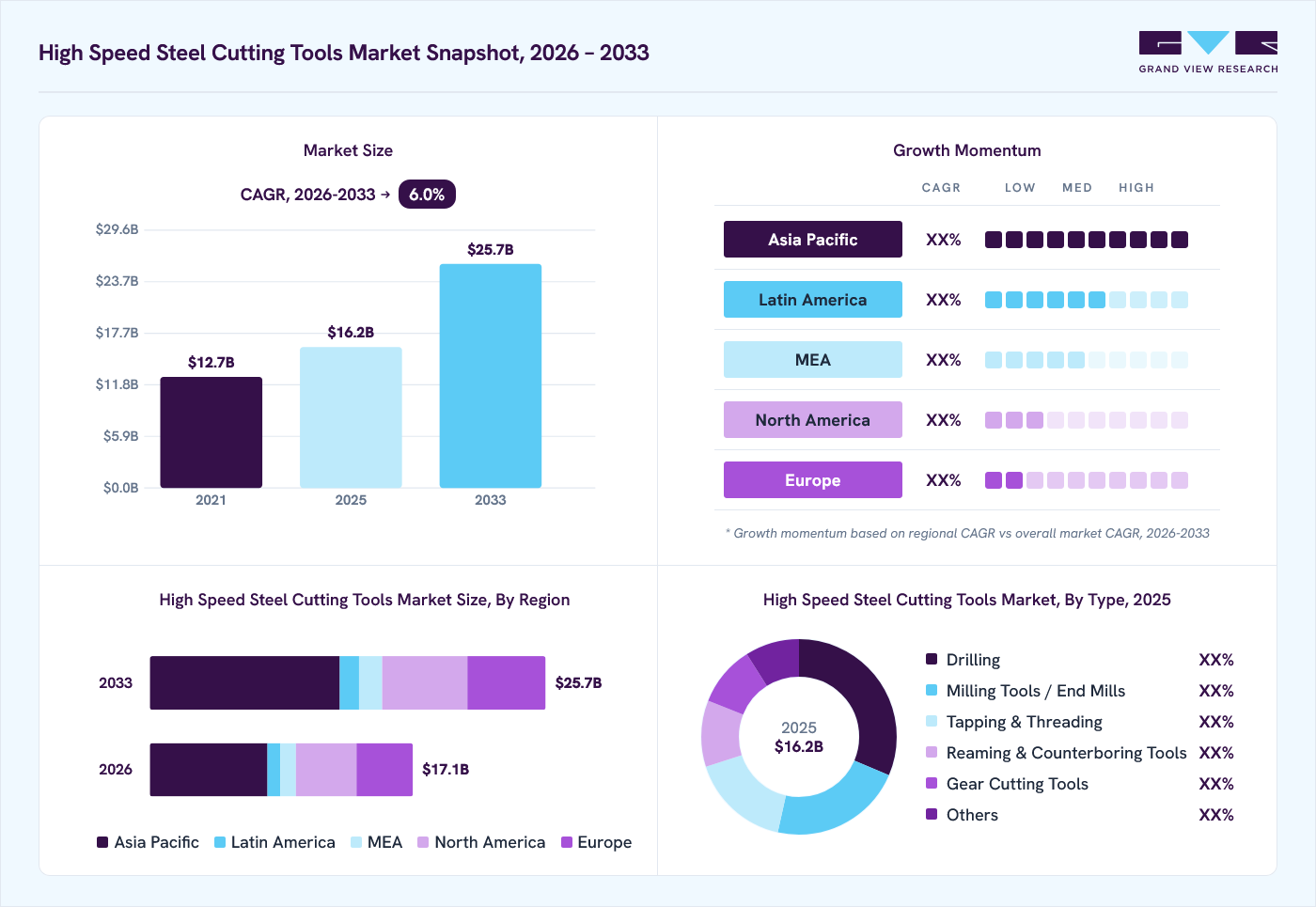
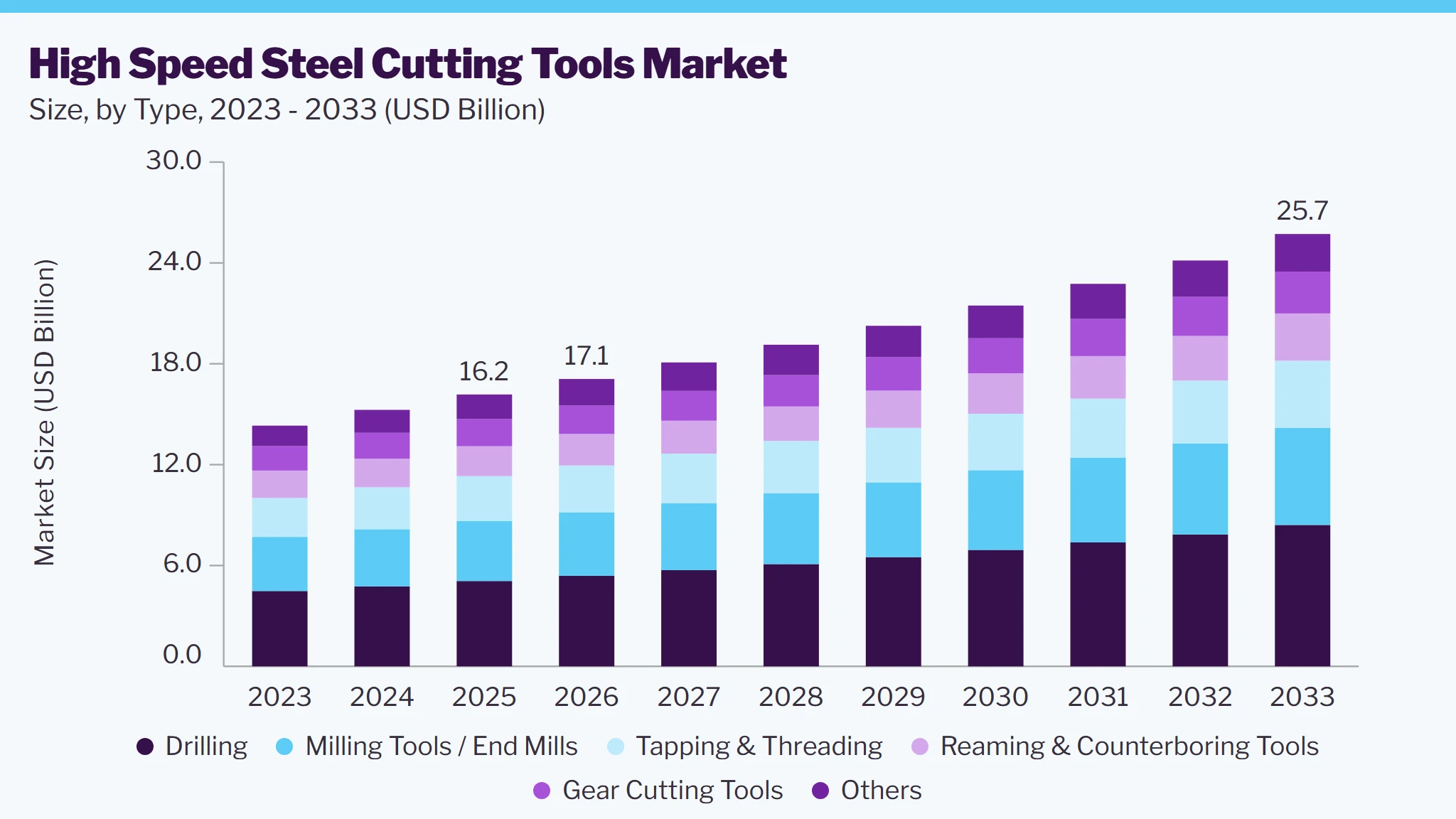
The global high speed steel cutting tools market size was valued at USD 16.2 billion in 2025 and is projected to grow from USD 17.1 billion in 2026 to USD 25.7 billion by 2033, at a CAGR of 6.0% from 2026 to 2033. Asia Pacific dominated the market, accounting for the largest revenue share of 44.2% in 2025. The global high speed steel cutting tools market is driven by sustained consumption of HSS tooling across machining operations where tool durability, regrindability, dimensional stability, and acquisition cost influence material selection.
 Source: Grand View Research, IR Documents, Primary Interviews, Paid DatabasesTo learn more about this report,
 Download Free Sample Report
 Key Market Trends & Insights
- By product type: Drilling segment dominated the market with revenue share of 31.4% in 2025.
- By type: Conventional segment is projected to grow at 5.5% CAGR during the forecast period.
- By end-use: Automotive segment accounted for the largest revenue share of 28.7% in 2025.
Regional Highlights
- Largest regional market: Asia Pacific (44.2% revenue share, 2025)
- By country: China held the largest market share in 2025.
Market Size & Forecast
- Market size in 2025: USD 16.2 Billion
- Estimated market size in 2026: USD 17.1 Billion
- Projected market size by 2033: USD 25.7 Billion
- CAGR (2026-2033): 6.0%
Three ways to get this report
Buy it, customize it, or ask a question.Ask an Analyst
A direct answer, usually in 1 working day
- AccessReport author, directly
- Reply timeWithin 1 working day
- No sales callDirect answer only
- FormatEmail reply
- CostFree, no cost
Get the Full Report
What the study covers
- FormatsPDF · Excel · Dashboard
- Timeline2026–2033 annual, 2025 base
- Coverage20+ countries, 5 regions
- Companies10+ key players profiled
Customize the Report
20% free customization
- IncludeCountries, segments, points
- TailorTo your product definition
- ExtendDeeper competitor detail
- OrA fully bespoke study
- Turnaround5–10 working days
Drills, taps, end mills, reamers, and gear-cutting tools remain established components of industrial machining, with recurring demand arising from tool wear, replacement cycles, and reconditioning requirements. The continued use of conventional machine tools alongside CNC equipment further maintains demand for HSS products across varied machining environments.
 To learn more about this report, Download Free Sample Report
 Additionally, manufacturers are expanding the technical range of HSS cutting tools through powder-metallurgy grades, surface coatings, controlled heat treatment, and application-specific geometries. These developments are enabling suppliers to address tighter machining tolerances, demanding workpiece materials, and more specific cutting conditions. The shift toward engineered HSS products is creating opportunities for higher-value tooling based on tool configuration, grade, coating, and intended machining application rather than standard product dimensions alone.
Market Dynamics
The global high speed steel cutting tools market is shaped by the economics of tooling, material selection, tool life, resharpening practices, and the technical evolution of cutting products. HSS remains relevant where users balance initial tool cost with durability, versatility, and the ability to reuse tooling. At the same time, advances in carbide and other cutting materials are changing tool-selection criteria across demanding machining environments.
Continuous machining subjects cutting edges to wear, chipping, and dimensional deterioration, creating recurring requirements for replacement and reconditioning. HSS tools have an established position in this cycle because many drills, taps, end mills, and reamers can be reground and reused. This extends tool serviceability while maintaining demand for replacement products as tools reach the end of their usable life. The resulting recurring consumption provides a stable demand base across machine shops and manufacturing operations.
The adoption of carbide and other advanced cutting materials is creating substitution pressure for HSS products. Carbide tools are increasingly selected for operations requiring higher cutting speeds, greater resistance to heat, or extended performance under demanding conditions. This shift is particularly relevant in automated and high-volume machining, where production targets can favor faster cutting rates over the lower acquisition cost and reconditioning potential of HSS tools. Consequently, some applications that traditionally relied on HSS are gradually moving toward alternative tool materials.
Advances in powder-metallurgy HSS, coatings, and cutting-edge designs are expanding the performance range available from HSS tooling. HSS-PM grades can provide improved wear resistance and edge stability, while coatings can improve resistance to abrasion and heat during selected machining operations. Manufacturers can use these developments to introduce application-specific drills, taps, end mills, reamers, and other tools for materials and cutting conditions that place greater demands on conventional HSS. This creates scope for higher-value HSS products while retaining the material's established advantages in toughness and regrindability.
Market Concentration & Characteristics
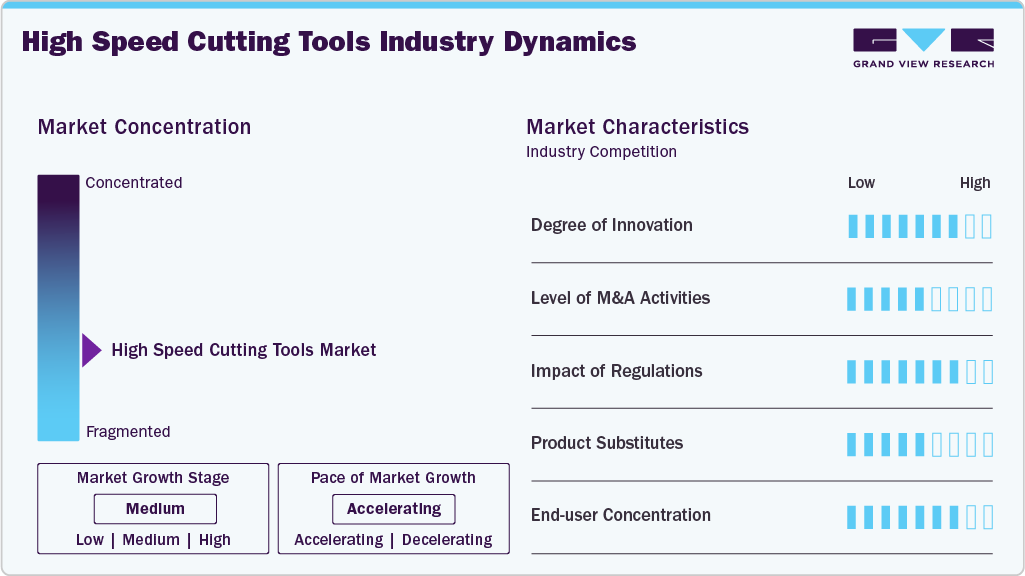
The global high speed steel cutting tools market exhibits a differentiated competitive structure, with multinational tooling manufacturers operating alongside specialized HSS producers and regional suppliers. Market concentration is influenced by the breadth of product offerings, in-house metallurgical capabilities, manufacturing precision, and established relationships with industrial buyers. Companies with extensive catalogs can address multiple machining requirements through a single supplier, while focused manufacturers compete through expertise in particular tool categories, geometries, or workpiece applications.
Technology differentiation extends beyond the underlying HSS grade. Manufacturers compete through powder-metallurgy formulations, alloy selection, heat treatment, edge preparation, flute configuration, coatings, and dimensional control. These factors determine the suitability of a tool for particular cutting conditions and workpiece materials. Consequently, procurement decisions for technically demanding applications can involve detailed comparison of tool specifications rather than price alone, while standardized HSS products remain more exposed to price and availability considerations.
 To learn more about this report, Download Free Sample Report
 The market operates through a combination of direct manufacturer sales, authorized distributors, industrial tooling suppliers, and specialized machining channels. Standard products can move through established distribution networks, whereas customized or application-specific tools generally involve closer interaction between manufacturers and end users. Switching costs are relatively limited for commonly available tools, but supplier continuity can be stronger where tooling specifications have been incorporated into established machining processes. This creates room for both large-scale manufacturers and specialized producers to maintain distinct positions within the market.
Analyst Perspective
The global high speed steel (HSS) cutting tools market maintains a broad industrial demand base, with consumption spanning drilling, milling, threading, reaming, and gear-cutting applications. Product requirements vary according to workpiece material, machining specifications, tool geometry, dimensional tolerances, and machine configuration, creating differentiated demand across CNC and conventional equipment. Automotive and metalworking provide established application bases, while aerospace, oil & gas, medical devices, and power generation contribute through component machining and specialized production requirements. Recurring tool replacement, machining activity, and additions to manufacturing capacity influence procurement volumes, while sales are conducted through direct manufacturer relationships, distributors, and specialized tooling channels.
Product Type Insights
The drilling segment dominated the global high speed steel cutting tools market in 2025. Its leading position reflects the high frequency of hole-making operations across component fabrication and industrial production, where drill selection varies according to diameter, depth, workpiece composition, and required hole quality. HSS drills also cover a wide range of standard and specialized configurations, making drilling one of the more established categories within industrial cutting-tool procurement.
The milling tools/end mills segment is projected to expand at a CAGR of 6.2% during the forecast period. Growth is associated with the use of milling cutters for slots, pockets, shoulders, profiles, and contoured surfaces across different component designs. Demand within the segment is differentiated by flute configuration, cutter diameter, helix geometry, cutting length, and workpiece characteristics, allowing suppliers to address application-specific requirements rather than relying solely on standard cutter designs.
Type Insights
The Computer Numerical Control (CNC) segment accounted for the largest revenue share of 74.5% in 2025. CNC equipment is widely incorporated into production environments requiring programmed tool movement, repeatable machining sequences, and controlled dimensional output. HSS tooling remains applicable to selected CNC operations, particularly where drilling, tapping, reaming, or related processes can be performed within the cutting parameters suited to HSS grades.
The conventional segment is projected to grow at 5.5% CAGR during the forecast period. Conventional machines continue to serve workshops and industrial facilities undertaking repair work, component modification, maintenance machining, prototypes, and smaller production batches. Their continued operation sustains demand for readily available HSS products that can be selected and changed according to the immediate machining requirement without the programming and setup procedures associated with automated equipment.
End-use Insights
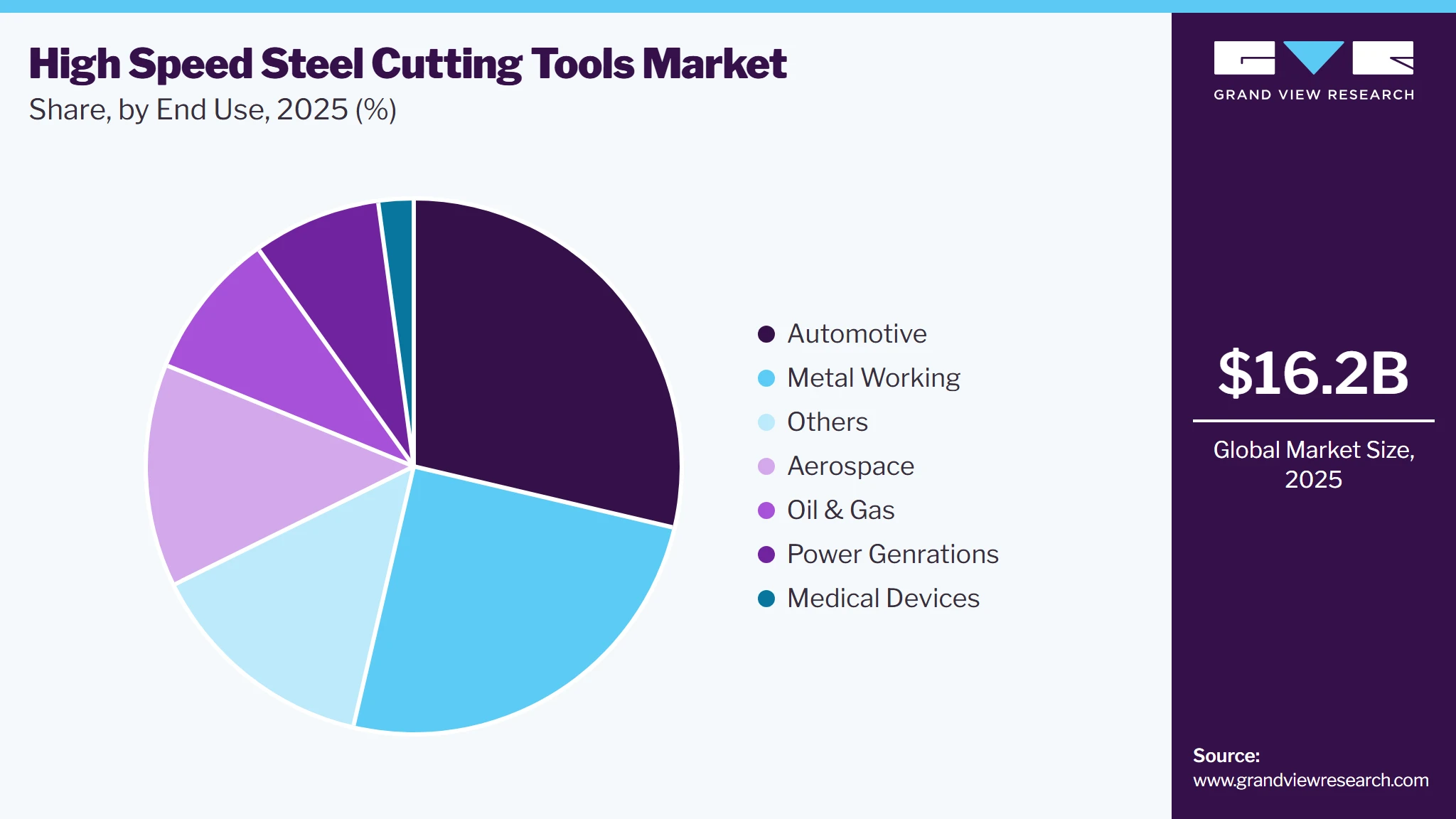
The automotive segment accounted for the largest revenue share of 28.7% in 2025. Vehicle production involves numerous machined parts across powertrain, transmission, chassis, steering, braking, fastening, and ancillary systems. The volume of components processed throughout automotive supply chains creates recurring requirements for different cutting-tool categories, while production specifications and component tolerances influence the selection of individual HSS products.
 To learn more about this report, Download Free Sample Report
 The aerospace segment is projected to register the fastest CAGR from 2026 to 2033. Aerospace component manufacturing involves structural parts, propulsion components, fittings, landing-system elements, and other engineered assemblies with closely controlled dimensional requirements. Material characteristics, component geometry, and machining tolerances influence tooling specifications in these applications, increasing demand for HSS products configured for particular drilling, threading, reaming, and related operations where their mechanical properties are suited to the process.
Regional Insights
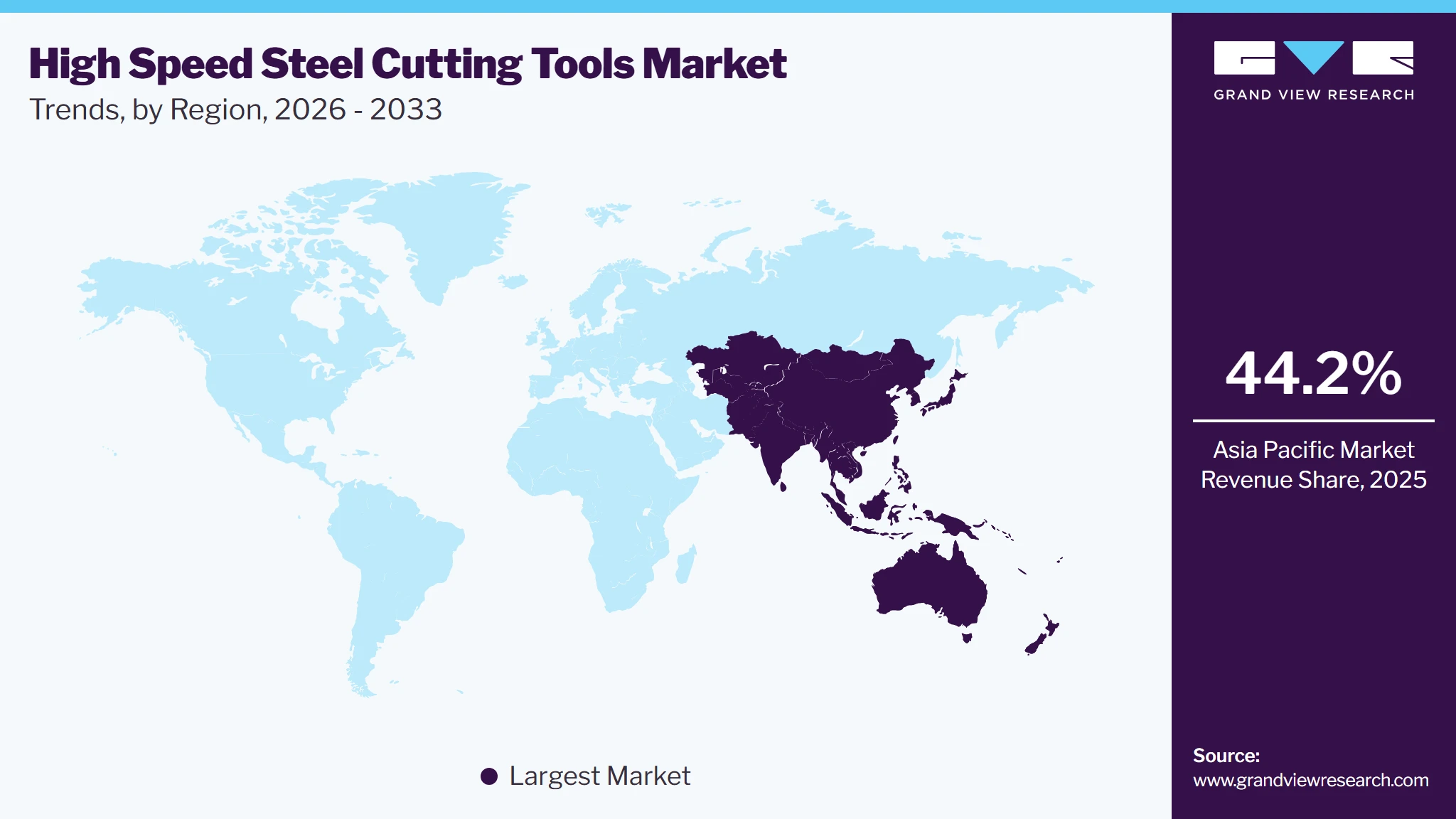
Asia Pacific dominated the market, accounting for the largest revenue share of 44.2% in 2025. The region forms a substantial manufacturing base for high speed steel (HSS) cutting tools, underpinned by automotive production, machinery manufacturing, metal fabrication, electronics, and general engineering. The region encompasses both high-volume production environments and conventional machine shops, creating demand across standard and application-specific tooling. Local tool manufacturing capacity, industrial distribution networks, and expansion of machining infrastructure further shape regional procurement.
 To learn more about this report, Download Free Sample Report
 China High Speed Steel Cutting Tools Market Trends
China represents the largest country-level market in Asia Pacific, reflecting the scale of its machine-building, automotive, metalworking, and industrial equipment sectors. HSS tooling is incorporated across component production and equipment manufacturing, with domestic manufacturers supplying a wide range of drilling, milling, threading, and other cutting products. The country's extensive industrial supply chain also supports high-volume procurement through distributors and direct industrial channels.
The India high speed steel cutting tools market is projected to record the fastest CAGR of 7.9% during the forecast period. Market expansion is associated with increasing automotive localization, engineering production, industrial machinery output, and development of manufacturing clusters. The growing number of component suppliers and machining workshops is widening demand for general-purpose and production-grade HSS tooling across varied workpiece requirements.
North America High Speed Steel Cutting Tools Market Trends
North America has a diversified tooling demand base spanning aerospace, automotive, medical devices, industrial equipment, defense manufacturing, and metal fabrication. Procurement patterns vary between high-precision component manufacturers and general-purpose machining facilities, resulting in differentiated requirements for HSS grades, dimensions, coatings, and geometries. Replacement of worn tools within the installed machining base provides a recurring component of regional demand.
The U.S. accounts for the largest share of regional demand, with aerospace and defense manufacturing generating requirements for controlled machining of complex components and assemblies. Medical-device production adds demand for smaller and precision-oriented tooling, while automotive and industrial machinery manufacturing provide higher-volume requirements across established production lines. The country's large machine-shop base further sustains consumption of standardized HSS products.
The Canada high speed steel cutting tools market demand is shaped by aerospace production, industrial machinery, automotive manufacturing, and resource-related equipment. HSS tooling is used across component fabrication and machining operations associated with heavy equipment and industrial parts. Demand is also influenced by the maintenance and refurbishment of machinery used across geographically distributed industrial operations.
Europe High Speed Steel Cutting Tools Market Trends
Europe maintains a mature HSS cutting-tool market supported by established automotive, machinery, aerospace, industrial engineering, and precision-manufacturing industries. Tool consumption is influenced by the region's extensive installed base of machining equipment, replacement cycles, and requirements for controlled dimensional performance. Domestic tooling manufacturers and specialized distributors also provide established procurement channels for industrial users.
The Germany high speed steel cutting tools market represents a core European market, supported by automotive component manufacturing, machine-tool production, industrial machinery, and mechanical engineering. The country's manufacturing structure generates demand for HSS products used in precision component production, gear manufacturing, and industrial equipment machining. Strong integration between equipment manufacturers and component suppliers also supports recurring tooling requirements.
The France high speed steel cutting tools market has a differentiated demand profile shaped by aerospace, transportation equipment, automotive production, and industrial engineering. Aerospace manufacturing creates requirements for specialized cutting operations involving aircraft structures and components, while automotive and machinery producers contribute demand for general industrial tooling. This combination sustains both precision-oriented and standard HSS product requirements.
Middle East & Africa High Speed Steel Cutting Tools Market Trends
Middle East & Africa represents a developing demand base, with HSS cutting-tool consumption associated with industrial fabrication, equipment servicing, machinery production, and expanding manufacturing capabilities. Procurement is influenced by the scale of local machining activity, availability of industrial tooling channels, and reliance on imported cutting products. Growth in non-energy manufacturing is gradually widening the addressable customer base.
The Saudi Arabia high speed steel cutting tools market is a principal market within the region, where industrial diversification is increasing activity in machinery fabrication, metal processing, equipment production, and engineering services. HSS tools are required across workshop-based machining and industrial component production, while the expansion of manufacturing capacity is creating additional demand for production tooling. Procurement is increasingly linked to the development of localized industrial supply chains.
Latin America High Speed Steel Cutting Tools Market Trends
Latin America's demand is distributed across automotive, agricultural machinery, mining equipment, industrial fabrication, and general engineering. The market combines organized manufacturing operations with independent machine shops, resulting in differentiated purchasing patterns between production tooling and general-purpose products. Import dependence and distributor networks remain relevant to product availability in several markets.
The Brazil high speed steel cutting tools market represents the region's principal industrial demand center, supported by automotive manufacturing, agricultural equipment, mining machinery, industrial engineering, and metal processing. HSS cutting tools are incorporated into the production and repair of components used across these industries. The breadth of Brazil's machinery and equipment base creates demand across drilling, milling, threading, and other machining categories without relying on a single end-use sector.
Key High Speed Steel Cutting Tools Company Insights
Some of the key players operating in the market include OSG Corporation, NACHI-FUJIKOSHI CORP., among others.
-
OSG Corporation is a Japan-based manufacturer specializing in cutting tools and precision machining solutions for industrial manufacturing. The company offers a broad range of products, including drills, taps, end mills, thread mills, dies, and other cutting tools, with HSS tooling included within its product portfolio. Its tools are used for machining metal components across automotive, aerospace, energy, machinery, mold and die, and other industrial applications. OSG also maintains manufacturing, sales, and distribution operations across multiple international markets, supporting the supply of cutting tools to industrial customers and tooling distributors.
-
NACHI-FUJIKOSHI CORP. is a Japan-based industrial manufacturer with a diversified portfolio covering cutting tools, machine tools, industrial robots, bearings, hydraulic equipment, and other machinery products. Its cutting-tool portfolio includes HSS drills, end mills, taps, gear cutters, broaches, and other precision tools used in metalworking operations. The company supplies tooling for component manufacturing across automotive, aerospace, machinery, and other industrial sectors. Its integration of cutting-tool manufacturing with broader machine and industrial equipment capabilities provides exposure to different stages of manufacturing and machining operations.
Key High Speed Steel Cutting Tools Companies:
The following key companies have been profiled for this study on the high speed steel cutting tools market.
-
OSG Corporation
-
NACHI-FUJIKOSHI CORP.
-
YG-1 Co., Ltd.
-
Gühring KG
-
Dormer Pramet
-
Kennametal Inc.
-
Sandvik AB
-
Walter AG
-
Tivoly S.A.
-
Greenfield Industries, Inc.
-
Niagara Cutter, Inc.
-
Tiangong International Co., Ltd.
-
LMT Tools
-
Morse Cutting Tools
-
Mitsubishi Materials Corporation
Competitive Benchmarking
Category
Operating Strategies
Competitive Edge
Weakness
Established Players (e.g., OSG Corporation; NACHI-FUJIKOSHI CORP.; YG-1 Co., Ltd.; Gühring KG; Dormer Pramet; Kennametal Inc.; Sandvik AB; Walter AG; Mitsubishi Materials Corporation)
- Expand HSS cutting-tool portfolios across drills, end mills, taps, reamers, and other machining applications, while developing application-specific geometries and tool grades.
- Strengthen global distribution, technical support, product engineering, and relationships with industrial manufacturers and machine-tool customers.
- Broad product coverage and established technical capabilities enable suppliers to address diverse machining requirements across multiple industries.
- Recognized brands, established customer relationships, and international distribution networks support recurring industrial tooling demand.
- Large product portfolios can increase inventory, product-management, and distribution complexity.
- Global operating structures may be less flexible for highly customized, low-volume, or region-specific tooling requirements.
Emerging & Regional Players (e.g., Tivoly S.A.; Greenfield Industries, Inc.; Niagara Cutter, Inc.; LMT Tools; Tiangong International Co., Ltd.; Morse Cutting Tools)
- Concentrate on selected HSS categories and application-specific tooling while adapting product specifications to particular machining requirements.
- Expand through specialized product portfolios, regional distributors, direct industrial sales, and targeted customer segments.
- Focused manufacturing expertise enables closer alignment with specific drilling, milling, tapping, reaming, and other machining applications.
- Specialized brands and regional market knowledge can support responsive product development and customer servicing within selected segments.
- More focused product and geographic coverage can restrict access to large multinational procurement programs.
- Limited portfolio breadth or distribution infrastructure may constrain cross-selling and expansion across wider industrial markets.
Recent Developments
-
In May 2025, YG-1 Co., Ltd. expanded its tapping portfolio with the HSS-PM Synchro Tap with internal coolant for the American market. The product is manufactured from powder-metallurgy high-speed steel and is available in configurations aligned with DIN-length and ANSI-shank standards. The range covers multiple tap geometries and is designed for machining applications involving steel, stainless steel, cast iron, and cast aluminum.
-
In 2025, LMT Tools introduced EASYTap, a universal tapping solution produced from HSS-E and finished with a TiN coating. The tap features an updated cutting profile, optimized flute geometry, and a 45° helix angle, enabling use in both blind-hole and through-hole threading operations. It is designed for machining applications involving steel, stainless steel, cast iron, aluminum, and other commonly processed workpiece materials.
High Speed Steel Cutting Tools Market Report Scope
Report Attribute
Details
Market size in 2025
USD 16.2 billion
Estimated market size in 2026
USD 17.1 billion
Projected market size by 2033
USD 25.7 billion
Growth rate
CAGR of 6.0% from 2026 to 2033
Base year for estimation
2025
Historical data
2021 - 2024
Forecast period
2026 - 2033
Quantitative units
Revenue in USD billion and CAGR from 2026 to 2033
Report coverage
Revenue forecast, company market position analysis, competitive landscape, growth factors, and trends
Segments covered
Product type, type, end-use, region
Regional scope
North America; Europe; Asia Pacific; Latin America; Middle East & Africa
Country Scope
U.S.; Canada; Mexico; Germany; UK; Italy; Spain; France; China; Japan; India; Australia; South Korea; Brazil; Argentina; Saudi Arabia; UAE; South Africa
Key companies profiled
OSG Corporation; NACHI-FUJIKOSHI CORP.; YG-1 Co., Ltd.; Gühring KG; Dormer Pramet; Kennametal Inc.; Sandvik AB; Walter AG; Tivoly S.A.; Greenfield Industries, Inc.; Niagara Cutter, Inc.; Tiangong International Co., Ltd.; LMT Tools; Morse Cutting Tools; Mitsubishi Materials Corporation
Customization scope
Free report customization (equivalent up to 8 analysts working days) with purchase. Addition or alteration to country, regional & segment scope.
Pricing and purchase options
Avail customized purchase options to meet your exact research needs. Explore purchase options
Global High Speed Cutting Tools Market Report Segmentation
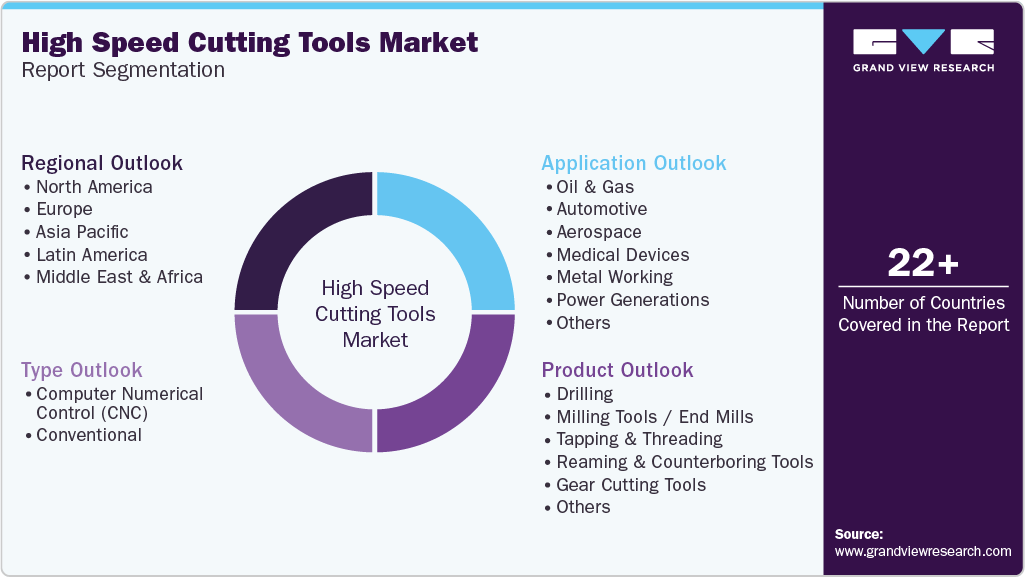
This report forecasts revenue growth at global, regional & country levels and provides an analysis on the industry trends in each of the sub-segments from 2021 to 2033. For the purpose of this study, Grand View Research has segmented the high speed steel cutting tools market on the basis of product type, type, end-use, and region:
 To learn more about this report, Download Free Sample Report
 -
Product Type Outlook (Revenue, USD Billion, 2021 - 2033)
-
Drilling
-
Milling Tools / End Mills
-
Tapping & Threading
-
Reaming & Counterboring Tools
-
Gear Cutting Tools
-
Others
-
-
Type Outlook (Revenue, USD Billion, 2021 - 2033)
-
Computer Numerical Control (CNC)
-
Conventional
-
-
End-use Outlook (Revenue, USD Billion, 2021 - 2033)
-
Oil & Gas
-
Automotive
-
Aerospace
-
Medical Devices
-
Metal Working
-
Power Generations
-
Others
-
-
Regional Outlook (Revenue, USD Billion, 2021 - 2033)
-
North America
-
U.S.
-
Canada
-
Mexico
-
-
Europe
-
Germany
-
France
-
UK
-
Spain
-
Italy
-
-
Asia Pacific
-
China
-
India
-
Japan
-
South Korea
-
Australia
-
-
Latin America
-
Brazil
-
Argentina
-
-
Middle East & Africa
-
Saudi Arabia
-
UAE
-
South Africa
-
-
Research Methodology
The high speed steel cutting tools market figures in this report are based on a proven research process that combines executive interviews with secondary research from proprietary databases, company filings, and recognized regulatory and institutional sources. Market size is built through value-chain sizing-reconciling supply-side and demand-side estimates-and triangulated with bottom-up and top-down approaches. Every estimate passes multiple levels of expert validation before publication, with each high speed steel cutting tools segment quantified using the revenue-capture definitions in the table below.
Segment Definition
Product Type
Revenue Capture Definition
Drilling
Revenue captured from the sale of HSS drilling tools as finished cutting-tool products, including twist drills and specialized drilling configurations, with value determined by the product price invoiced to customers or distributors.
Milling Tools / End Mills
Revenue captured from sales of HSS milling tools and end mills, covering commercially supplied cutter geometries, flute configurations, sizes, and other product specifications included in the invoiced tool value.
Tapping & Threading
Revenue captured from the sale of HSS taps and threading tools, including different thread profiles, dimensions, and tool configurations offered as individual products or tooling sets.
Reaming & Counterboring Tools
Revenue captured from HSS reamer and counterboring tool sales, encompassing the invoiced value of finished products supplied across specified diameters, cutting geometries, and configurations.
Gear Cutting Tools
Revenue captured from the sale of HSS gear cutting tools, including gear hobs, gear cutters, and other specialized gear-machining tools, based on the commercial value of products supplied.
Others
Revenue captured from HSS cutting-tool products outside the drilling, milling and end mill, tapping and threading, reaming and counterboring, and gear cutting categories, including specialized cutting-tool configurations.
Type
Revenue Capture Definition
Computer Numerical Control (CNC)
Revenue captured from HSS cutting tools supplied under CNC-compatible tooling categories, with segment value reflecting the selling price of drills, milling tools, taps, reamers, gear cutters, and other HSS products designated for CNC equipment.
Conventional
Revenue captured from HSS cutting tools supplied for conventional machine tools, including commercially sold drilling, milling, threading, reaming, and other HSS tooling configurations intended for non-CNC equipment.
End Use
Revenue Capture Definition
Oil & Gas
Revenue generated from HSS cutting-tool sales allocated to the oil and gas segment, including drilling, milling, threading, and other tooling products supplied for industry-related equipment and component production.
Automotive
Revenue generated from HSS cutting-tool sales within automotive manufacturing, covering tools supplied for vehicle components, assemblies, and related production requirements.
Aerospace
Revenue generated from HSS cutting-tool transactions within aerospace manufacturing, including products supplied for aircraft components, aerospace equipment, and associated machined parts.
Medical Devices
Revenue generated from HSS cutting-tool sales to the medical-device segment, covering tooling products supplied for medical instruments, devices, and related components.
Metal Working
Revenue generated from HSS cutting-tool sales across metalworking activities, encompassing drilling, milling, tapping, reaming, and other HSS tooling products sold for metal-component production.
Power Generations
Revenue generated from HSS cutting-tool sales associated with power-generation equipment and component manufacturing, including tooling products supplied under relevant industrial orders.
Others
Revenue generated from HSS cutting-tool sales across end-use categories outside oil and gas, automotive, aerospace, medical devices, metalworking, and power generation.
Estimation Model
Layer Name
Key Question
Description
HSS Cutting Tool Demand Layer
Where is demand for HSS cutting tools generated?
Assess the addressable requirement for HSS cutting tools across automotive, aerospace, oil & gas, medical devices, metalworking, power generation, and other industrial manufacturing segments. Evaluate demand arising from machining volumes, production capacity additions, replacement of worn tooling, and recurring tool consumption.
Procurement & Specification Layer
What determines HSS cutting tool procurement?
Analyze purchasing requirements based on HSS material grade, tool dimensions, cutting geometry, flute configuration, tolerance, coating or surface treatment where applicable, and compatibility with the specified machine. Consider purchasing through manufacturers, distributors, tooling specialists, and industrial procurement networks.
Product & Machine-Type Adoption Layer
Which HSS cutting tools and machine types are being adopted?
Determine the commercial adoption of drilling, milling tools and end mills, tapping and threading tools, reaming and counterboring tools, gear cutting tools, and other HSS products across CNC and conventional machine categories. Examine product selection according to machining specifications, component requirements, and tooling configurations.
Revenue Generation Layer
How much revenue is generated from HSS cutting tool sales?
Quantify annual revenue attributable to finished HSS cutting-tool sales across product type, machine type, end use, and geography. Include manufacturer and channel sales of HSS tooling and the invoiced value of products supplied, while excluding machine tools, machining services, workpieces, and other non-tooling revenue.
Delivered Customizations
This report has been delivered with the following In-depth customizations
Client Request
Customization Delivered
Value Adds
Competitive Benchmarking
Leading HSS cutting tool manufacturers were compared across product portfolios, HSS grades, tool geometries, machine compatibility, application focus, manufacturing capabilities, distribution networks, and recent product developments. Company positioning and areas of specialization were also examined.
Provides a structured view of supplier capabilities, portfolio breadth, application focus, and market presence. The comparison helps identify product gaps, areas of specialization, and differences in competitive positioning.
Regional Segmentation
Market conditions were examined across North America, Europe, Asia Pacific, Latin America, and the Middle East & Africa, with selected country-level coverage. The review incorporated manufacturing activity, machining requirements, industrial production, tooling procurement patterns, distribution structures, and replacement demand.
Clarifies differences in regional demand and purchasing conditions. The findings support geographic expansion planning, channel development, and assessment of market-entry requirements across individual regions.
Opportunity Assessment
Commercial opportunities were mapped across drilling, milling tools and end mills, tapping and threading, reaming and counterboring, gear cutting, and other HSS tools, with separate consideration of CNC and conventional machining environments. Demand was also examined across automotive, aerospace, oil & gas, medical devices, metalworking, power generation, and other industrial applications.
Helps identify areas with relevant demand across product and application segments. The findings can inform portfolio planning, application targeting, distribution priorities, and potential areas for product development.
Frequently Asked Questions About This Report
The computer numerical control (CNC) segment accounted for the largest revenue share of 74.5% in 2025, while conventional segment is the fastest-growing segment.
The global high speed steel cutting tools market was valued at USD 16.2 billion in 2025 and is estimated to reach USD 17.1 billion in 2026.
The global high speed steel cutting tools market is expected to grow at a CAGR of 6.0% from 2026 to 2033, reaching USD 25.7 billion by 2033.
Asia Pacific dominated the market, accounting for the largest revenue share of 44.2% in 2025.
The drilling segment dominated the global high speed steel cutting tools market in 2025, while milling tools/end mills segment is the fastest-growing segment.
The automotive segment accounted for the largest revenue share of 28.7% in 2025, while aerospace segment is the fastest-growing segment.
Key players include OSG Corporation, NACHI-FUJIKOSHI CORP., YG-1 Co., Ltd., Gühring KG, Dormer Pramet, Kennametal Inc., Sandvik AB, Walter AG, Tivoly S.A., Greenfield Industries, Inc., Niagara Cutter, Inc., Tiangong International Co., Ltd., LMT Tools, Morse Cutting Tools, and Mitsubishi Materials Corporation.
The market is driven by recurring tool replacement and reconditioning requirements, continued machining activity, expansion of manufacturing capacity, and demand for durable and regrindable tooling. Advances in powder-metallurgy HSS, coatings, and specialized tool geometries are also expanding the application range of HSS cutting tools.
About the Author(s)
Advanced Interior Materials Research Team
Advanced Materials · Advanced Interior MaterialsThis report was authored by the advanced interior materials research team at Grand View Research - comprising two research analysts, one senior research analyst, and one industry expert - with specialized expertise in the advanced interior materials segment of the advanced materials industry. All findings are based on proprietary advanced materials databases, executive interviews, and regulatory analysis, subject to internal peer review prior to publication.
Last Updated:
Speak to Analyst

Customize this report to your needs - add regions, segments, or data points, with 20% free customization.
Or view our licence options:


ISO 9001:2015 & 27001:2022 Certified
We are GDPR and CCPA compliant! Your transaction & personal information is safe and secure. For more details, please read our privacy policy.


