
- Home
- »
- Green Building Materials
- »
-
Hollow Concrete Blocks Market Size Report, 2023-2030GVR Report cover

Hollow Concrete Blocks Market (2023 - 2030)
Size, Share & Trends Analysis Report By Product (Split-faced, Smooth-faced), By Application (Residential, Non-residential), By Region, And Segment Forecasts
Market Size, 2022
$247.1BMarket Estimate, 2026
$302.1BMarket Forecast, 2030
$371.8BCAGR, 2023–2030
5.2%Hollow Concrete Blocks Market Summary
The global hollow concrete blocks market size was valued at USD 247.1 billion in 2022 and is projected to grow from USD 302.1 billion in 2026 to USD 371.8 billion by 2030, at a CAGR of 5.2% from 2023 to 2030. Asia Pacific dominated the market, accounting for a revenue share of 58.5% in 2022. Hollow concrete block compared to solid concrete blocks, require less maintenance and offer better thermal and acoustical insulation.
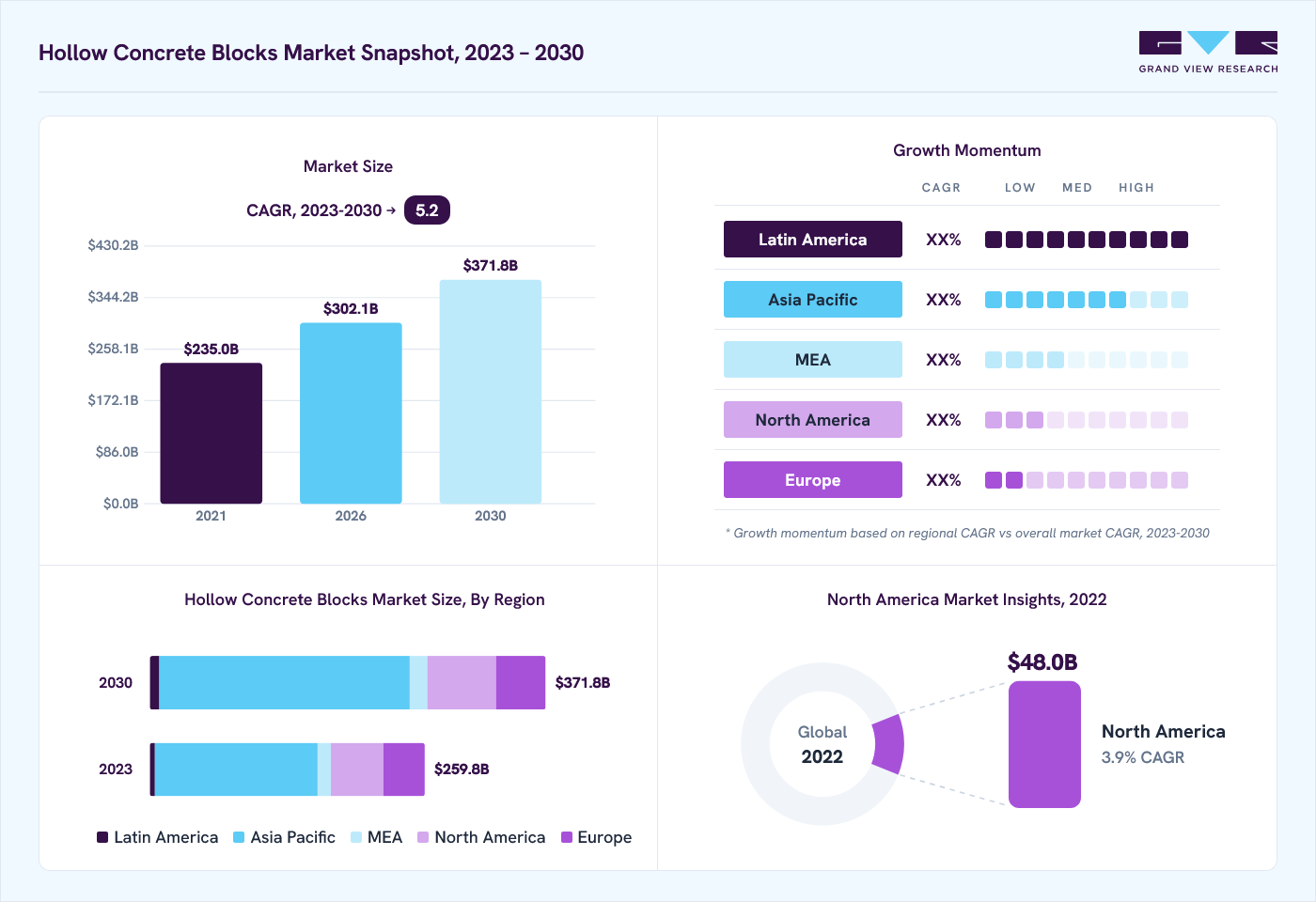 Source: Grand View Research, IR Documents, Primary Interviews, Paid DatabasesTo learn more about this report,
 Download Free Sample Report
Key Market Trends & Insights
- By product, split-faced hollow concrete blocks were the largest and fastest growing market segment and accounted for 63.1% of the revenue share in 2022.
- Based on application, residential applications segment accounted for a revenue share of over USD 96.24 in 2022.
Market Size & Forecast
- 2022 Market Size: USD 247.1 Billion
- 2030 Projected Market Size: USD 371.8 Billion
- CAGR (2023-2030): 5.2%
- Asia Pacific: Largest market in 2022
Three ways to get this report
Buy it, customize it, or ask a question.Ask an Analyst
Analyst response in 1 business day
- AccessReport author, directly
- Reply timeWithin 1 working day
- No sales callDirect answer only
- FormatEmail reply
- CostFree, no cost
Get the Full Report
What the study covers
- FormatsPDF · Excel · Dashboard
- Timeline2023–2030 annual, 2022 base
- Coverage20+ countries, 5 regions
- Companies10+ key players profiled
Customize the Report
20% free customization
- IncludeCountries, segments, points
- TailorTo your product definition
- ExtendDeeper competitor detail
- OrA fully bespoke study
- Turnaround5–10 working days
These properties also encourage easy and fast construction of buildings and infrastructure along with cost reduction, which in turn is expected to boost product demand. Hollow concrete blocks are primarily used in residential and non-residential buildings such as load-bearing structures, low-rise residential, institutional buildings, office buildings, warehouses, and shelter units for rural housing. The hollow concrete block have a consistent finish and offer high dimensional accuracy which makes them an ideal building material for building partition walls and load-bearing structures. These hollow concrete blocks are eco-friendly and lightweight and are also used in the construction of homes in earthquake-prone areas.
 To learn more about this report, Download Free Sample Report
The U.S. is one of the major markets for hollow concrete blocks on account of its highly developed economy, growing construction spending combined with a highly skilled workforce, and R&D initiatives to encourage product innovation. The development of residential and Non-residential structures coupled with the rising preference for single-family houses is expected to positively influence the growth of the industry in the country.
Prominent companies engaged in the production of hollow concrete blocks including Acme Brick Company, Brampton Brick, and Magicrete Building Solutions Pvt. Ltd, MIDLAND BRICK, and Taylor Concrete Products Inc. The manufacturers supply their products to the market through several distribution channels including third-party agreements with wholesalers and vendors, direct supply agreements with construction companies, and e-commerce portals. Moreover, some players including CEMEX SAB de CV, CRH plc, and UltraTech Cement Ltd have transportation facilities through which distribution operations are handled.
Hollow concrete blocks are light-weighted thus reducing the overall weight of the structures. As a result, less percentage of steel or light member structure is required for a given R.C.C. building. In addition, hollow concrete block is highly durable as the concrete used in the production is compacted by high pressure & vibration, which gives significant strength to the hollow blocks. In addition, adequate curing increases the compressive strength of the blocks.
However, it costs more when compared to traditional bricks. The concrete price fluctuates constantly which further gets affected by regional variation including raw-material and transportation costs. Although being an eco-friendly option, it results in saving energy costs, however, the economic advantage achieved in saving energy costs would be partially balanced by the above cost as buildings and homes made from hollow concrete block cost higher when compared to the ones constructed by conventional clay bricks.
Product Insights
Split-faced hollow concrete blocks were the largest and fastest growing market segment and accounted for 63.1% of the revenue share in 2022 as these are one of the most non-residentially used architectural concrete masonry unit (CMU) finishes. They offer an authentic textured face that can be manufactured as a paint-grade product. The product appears to have been split or hand-chiseled to give it a textured look. However, practical manufacturing includes pouring the concrete slurry into a form with the texture already build into it.
Split-faced hollow concrete block are thermally efficient, fire-resistant, and sound-absorbing which makes them an ideal product in the construction of non-residential projects including municipal buildings, schools, and theaters. In addition, they are used as load-bearing walls or veneers that can blend well with other architectural block finishes, especially in non-residential or non-residential applications.
Smooth-faced concrete blocks are expected to grow at a CAGR of 4.8% over the forecast period owing to their rising demand in residential and non-residential application segments. They are fabricated under molds that result in a smooth finish on all sides of the blocks. These blocks are used in both exterior and interior applications and exhibit a fine natural finish.
The product finds wide application in internal & external load-bearing and non-load-bearing walls including outer & inner leaves for cavity walls, partition walls, party walls, and boundary walls. The blocks are suitable for an environment where durable, and robust finishing is required. Smooth-faced concrete blocks are water & frost resistant, which helps the blocks to retain their clean & fresh appearance.
Application Insights
The industry is segmented into residential and non-residential based on applications. The residential application segment holds a comparatively small share when compared to non-residential applications which accounted for 61.1% of the market. Significant investments in infrastructure and real estate development are offering lucrative market opportunities for the hollow concrete block industry.
Hollow concrete block structures are suitable for the construction of noise-cancellation walls as their surface is designed to minimize ambient noise in theaters, stadiums, and highways. In addition, the design flexibility offered by concrete makes it apt for outdoor applications involving climbing walls, skate parks, and fences. A rising focus on energy-efficient construction practices and life-cycle management is projected to benefit the demand for hollow concrete blocks growth over the forecast period.
 To learn more about this report, Download Free Sample Report
Residential applications accounted for a revenue share of over USD 96.24 in 2022 due to the increase in demand for advanced residential structures with available common amenities including shops, parks, parking areas, and sports complexes. The design flexibility and excellent quality assurance offered by both split-faced & smooth-faced concrete blocks are projected to fuel its demand in the residential application segment.
In addition, hollow concrete block offer all the benefits of concrete while eliminating many difficulties that are associated with on-site casting including weather fluctuations, job site impacts, and extended duration of the construction period. The above-mentioned factors are expected to boost market demand over the forecast period.
Regional Insights
Asia-Pacific accounted for the largest consumer of the hollow concrete market with a revenue share of 58.5% in 2022 and is anticipated to ascend at a higher rate of 6.3% from 2023 to 2030. Strong demand from applications such as residential and non-residential segments is further likely to support the demand for different hollow concrete block such as split-faced and smooth-faced concrete blocks.
North America accounted for a revenue share of 19.4% in 2022, owing to the increased number of construction and renovation projects in the region. In addition, rising demand for housing coupled with increased government aid for residential construction in countries including the U.S., and Canada is anticipated to further benefit the demand for hollow concrete blocks in the residential application segment.
 To learn more about this report, Download Free Sample Report
Europe is the third-largest market for hollow concrete block which accounted for USD 37.97 billion in 2022 and is anticipated to reach USD 47.05 billion by 2030. The growth in the region is attributed to the increasing private investments in various economies. The prospective recovery of the construction industry post-pandemic coupled with rising penetration of concrete blocks including split-faced & smooth-faced concrete blocks in the region is expected to drive the market growth on a positive note.
The construction sector in the Middle East & Africa is expected to observe a rebound growth over the forecast period owing to factors such as an increase in investments, expansion of oil production, and improved weather conditions. Rising public investment in the construction sector of regional economies such as Saudi Arabia, UAE, and Qatar is expected to positively influence the demand for hollow concrete blocks over the forecast period.
Key Companies & Market Share Insights
The market is characterized by strong competition on account of the presence of prominent manufacturers serving major geographies across the region. These prominent manufacturers compete based on product quality and prices to increase their applications in residential and non-residential constructions. These players focus on achieving long-term contracts with players in the application industry to gain a competitive advantage.
Increasing investments and continuous R&D have led to the introduction of different types of hollow concrete block including concrete stretcher blocks, lintel blocks, partition concrete blocks, concrete pillar blocks, corner concrete blocks, jamb concrete blocks, bullnose concrete blocks, frogged brick blocks with enhanced durability and strength. Some prominent players in the global hollow concrete blocks market include:
-
Acme Brick Company
-
Brampton Brick Ltd.
-
CEMEX SAB de C.V.
-
CRH plc
-
Magicrete Building Solutions Pvt. Ltd.
-
BGC (Australia) PTY Ltd
-
Taylor Concrete Products Inc.
-
Tristar Brick and Block Ltd.
-
UltraTech Cement Ltd.
-
Ublok
Hollow Concrete Blocks Market Report Scope
Report Attribute
Details
Market size in 2022
USD 247.1 billion
Estimated market size in 2026
USD 302.1 billion
Projected market size by 2030
USD 371.8 billion
Growth rate
CAGR of 5.2% from 2023 to 2030
Base year for estimation
2022
Historical data
2018 - 2021
Forecast period
2023 - 2030
Quantitative units
Revenue in USD billion, and CAGR from 2023 to 2030
Report coverage
Revenue forecast, company ranking, competitive landscape, growth factors, and trends
Segments covered
Product, application, region
Regional scope
North America; Europe; Asia Pacific; Central & South America; Middle East & Africa
Country scope
U.S.; Canada; Mexico; UK; Germany; France; Russia; Turkey; China; India; Australia; Indonesia; Singapore; Brazil; Argentina; Saudi Arabia; UAE
Key companies profiled
Acme Brick Company; Brampton Brick Ltd.; CEMEX SAB de C.V.; CRH plc; Magicrete Building Solutions Pvt. Ltd.; BGC (Australia)PTY Ltd; Taylor Concrete Products Inc.; Tristar Brick and Block Ltd.; UltraTech Cement Ltd.; Ublok
Customization scope
Free report customization (equivalent up to 8 analysts working days) with purchase. Addition or alteration to country, regional & segment scope.
Pricing and purchase options
Avail customized purchase options to meet your exact research needs. Explore purchase options
Global Hollow Concrete Blocks Market Report Segmentation
This report forecasts revenue growth at global, regional, and country levels and provides an analysis of the industry trends in each of the sub-segments from 2018 to 2030. For this study, Grand View Research has segmented the global hollow concrete blocksmarket report based on product, application, and region:
 To learn more about this report, Download Free Sample Report
-
Product Outlook (Revenue, USD Billion, 2018 - 2030)
-
Split-faced
-
Smooth-faced
-
-
Application Outlook (Revenue, USD Billion, 2018 - 2030)
-
Residential
-
Non-residential
-
-
Regional Outlook (Revenue, USD Billion, 2018 - 2030)
-
North America
-
U.S.
-
Canada
-
Mexico
-
-
Europe
-
Germany
-
UK
-
France
-
Russia
-
Turkey
-
-
Asia Pacific
-
China
-
India
-
Australia
-
Indonesia
-
Singapore
-
-
Central & South America
-
Brazil
-
Argentina
-
-
Middle East & Africa
-
Saudi Arabia
-
UAE
-
-
Frequently Asked Questions About This Report
The global hollow concrete blocks market size was valued at USD 247.1 billion in 2022 and is estimated at USD 302.1 billion for 2026.
The global hollow concrete blocks market is expected to grow at a CAGR of 5.2% from 2023 to 2030, reaching USD 371.8 billion by 2030.
Asia Pacific dominated with a revenue share of 58.5% in 2022.
Some of the key players operating in the hollow concrete blocks market include Acme Brick Company, Brampton Brick Ltd., CEMEX SAB de C.V., CRH plc, Magicrete Building Solutions Pvt. Ltd., and BGC (Australia) PTY Ltd.
The key factor which is driving the hollow concrete blocks market is their primary use in residential and non-residential buildings such as load-bearing structures, low-rise residential, institutional buildings, office buildings, warehouses, and shelter units.
About the Author(s)
Green Building Materials Research Team
Advanced Materials · Green Building MaterialsThis report was authored by the green building materials research team at Grand View Research - comprising two research analysts, one senior research analyst, and one industry expert - with specialized expertise in the green building materials segment of the advanced materials industry. All findings are based on proprietary advanced materials databases, executive interviews, and regulatory analysis, subject to internal peer review prior to publication.
Last Updated:
Speak to Analyst

Customize this report to your needs - add regions, segments, or data points, with 20% free customization.
Or view our licence options:


ISO 9001:2015 & 27001:2022 Certified
We are GDPR and CCPA compliant! Your transaction & personal information is safe and secure. For more details, please read our privacy policy.


