
- Home
- »
- Automotive & Transportation
- »
-
Warehousing Market Size, Share & Growth Report, 2033GVR Report cover

Warehousing Market (2026 - 2033)
Size, Share & Trends Analysis Report By Warehouse Type (General Warehousing, Specialized Warehousing, Cold Storage Warehousing), By End Use (Retail, Food & Beverages), By Region (North America, Europe), And Segment Forecasts
Market Size, 2025
$1,155.3BMarket Estimate, 2026
$1,240.4BMarket Forecast, 2033
$2,298.4BCAGR, 2026–2033
9.2%Warehousing Market Summary
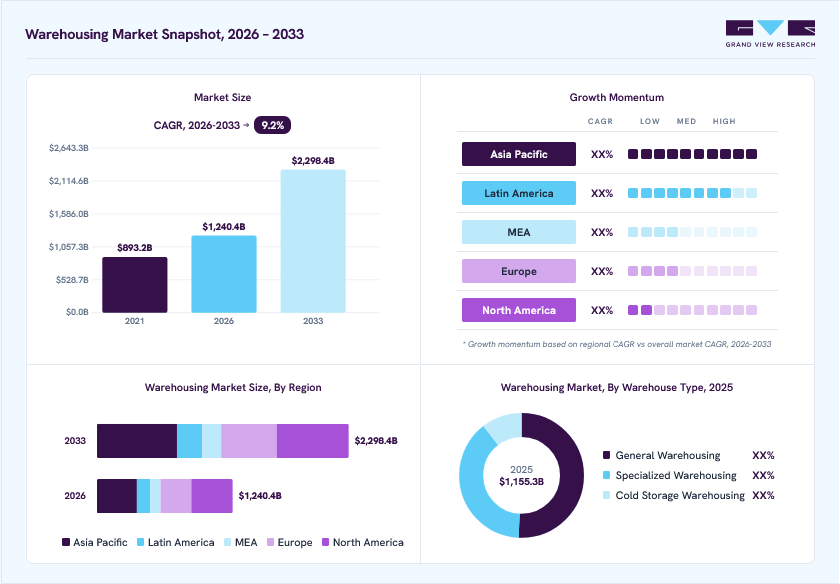
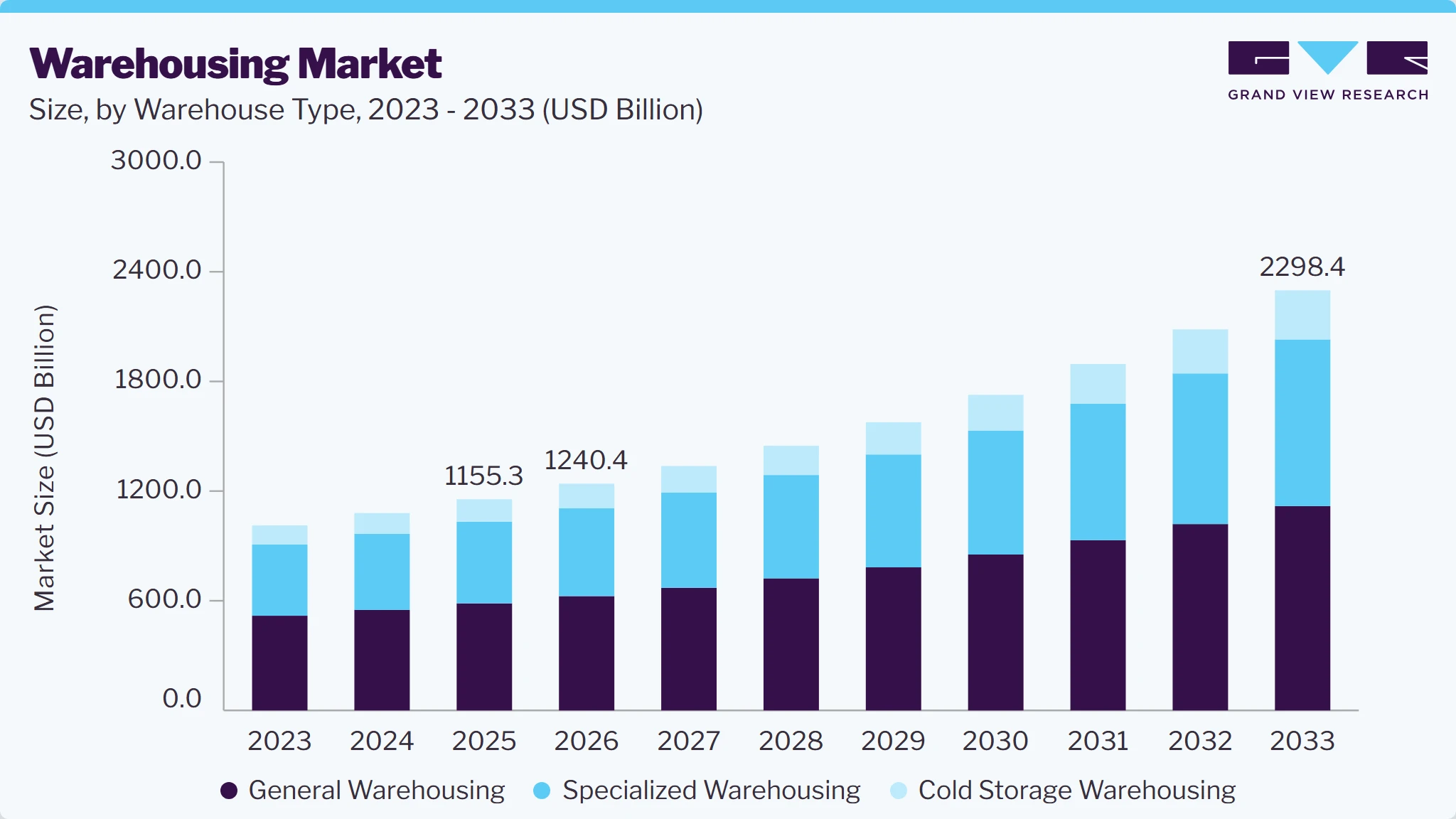
The global warehousing market size was valued at USD 1,155.3 billion in 2025 and is projected to grow from USD 1,240.4 billion in 2026 to USD 2,298.4 billion by 2033, at a CAGR of 9.2% from 2026 to 2033. The market in North America dominated with a revenue share of 30.8% in 2025. Various factors, including e-commerce expansion and increasing globalization & supply chain complexity, drive the growth of the market.
 Source: Grand View Research, IR Documents, Primary Interviews, Paid DatabasesTo learn more about this report,
 Download Free Sample Report
 Key Market Trends & Insights
- By warehouse type: General warehousing segment held the largest market share of 50.7% in 2025.
- By end use: Retail segment held the largest market share of 31.8% in 2025.
Regional Highlights
- Largest regional market: North America (30.8% revenue share, 2025)
- Fastest-growing regional market: Asia Pacific (highest CAGR, 2026-2033)
- By country: The U.S. held the largest market share in 2025
Market Size & Forecast
- Market size in 2025: USD 1,155.3 Billion
- Estimated market size in 2026: USD 1,240.4 Billion
- Projected market size by 2033: USD 2,298.4 Billion
- CAGR (2026-2033): 9.2%
Three ways to get this report
Buy it, customize it, or ask a question.Ask an Analyst
Analyst response in 1 business day
- AccessReport author, directly
- Reply timeWithin 1 working day
- No sales callDirect answer only
- FormatEmail reply
- CostFree, no cost
Get the Full Report
What the study covers
- FormatsPDF · Excel · Dashboard
- Timeline2026–2033 annual, 2025 base
- Coverage20+ countries, 5 regions
- Companies10+ key players profiled
Customize the Report
20% free customization
- IncludeCountries, segments, points
- TailorTo your product definition
- ExtendDeeper competitor detail
- OrA fully bespoke study
- Turnaround5–10 working days
Moreover, technological advancements in the sector offer significant growth opportunities for the market. Warehousing is a critical component of supply chain management, ensuring that inventory is managed efficiently and is readily available to meet demand. Inventory management, storage, and order fulfillment are some of the key aspects of warehousing.Warehousing provides essential benefits that enhance operational efficiency, reduce costs, improve customer satisfaction, and support overall business growth. By optimizing storage, inventory management, and distribution processes, warehousing plays a vital role in the modern supply chain. The growing environmental concerns are prompting warehouse operators to adopt green practices. Modern warehouses often incorporate energy-efficient technologies and practices, reducing environmental impact. Moreover, implementing recycling and waste management practices within warehouses promotes sustainability.
 To learn more about this report, Download Free Sample Report
 E-commerce is driving the growth of the warehousing market by increasing the demand for storage space and accelerating the need for rapid order fulfillment. According to the U.S. Department of Commerce of the International Trade Administration (ITA), global Business-to-Business (B2B) e-commerce will reach a market value of over USD 36 trillion by 2026. E-commerce businesses need to maintain higher inventory levels to ensure product availability and meet rapid order fulfillment demands. This necessitates larger storage spaces. Moreover, consumers expect quick delivery times, sometimes within the same day. Warehouses close to urban centers are essential to meet these expectations.
Innovations in Warehouse Management Systems (WMS), automation, robotics, and the Internet of Things (IoT) have enhanced efficiency and operational capabilities in warehousing. These technologies enable better inventory management, faster order processing, and improved accuracy. Companies are introducing solutions for automated warehouses. For instance, in March 2024, LG Business Solutions USA, a division of South Korea-based LG Electronics, announced the launch of the LG CLOi CarryBot, a family of autonomous mobile robots designed to enhance warehouse efficiency by intelligently navigating complex floor plans and transporting payloads. These robots feature advanced technology, including an AMR platform, intuitive fleet management, and integration with warehouse systems. They offer reliable, on-time movements and reduce physical strain on workers, thus improving productivity and operational efficiency.
Market Dynamics
The warehousing market is undergoing a structural transformation driven by shifts in global trade patterns, accelerating e-commerce penetration, and increasing supply chain complexity. Rising inventory localization, omnichannel distribution models, and demand for faster order fulfillment are reshaping warehouse design, location strategies, and service offerings. Technological advancements such as warehouse automation, robotics, and warehouse management systems are improving operational efficiency and throughput while reducing dependency on manual labor. Collectively, these macro and technological forces are repositioning warehousing from a passive storage function to a strategic logistics infrastructure that supports resilience, speed, and scalability.
The rapid expansion of e-commerce has significantly altered inventory management and distribution requirements across retail and consumer goods supply chains. Online retail models demand high Stock Keeping Units (SKUs) diversity, rapid order processing, and proximity to end consumers, thereby increasing the need for decentralized, strategically located warehouses. Traditional centralized distribution centers are increasingly insufficient to support same-day or next-day delivery expectations, particularly in urban and high-density regions. This shift has elevated warehousing from a cost center to a core enabler of customer experience and revenue growth.
Warehousing solutions address this driver through multi-node fulfillment networks, automated picking systems, and flexible space configurations tailored to high-volume, low-lot-size order flows. Advanced WMS platforms enable real-time inventory visibility and faster order turnaround, supporting omnichannel integration across online and offline sales channels. As retailers and brands outsource these capabilities to third-party logistics providers, demand for scalable and technology-enabled warehousing facilities continues to accelerate, directly contributing to market expansion.
Warehousing operations are characterized by significant upfront capital requirements, including land acquisition, facility construction, material handling equipment, and technology integration. Rising real estate prices in urban and peri-urban areas further increase the cost of establishing modern distribution centers. In addition, automation investments, while improving efficiency, require long payback periods, limiting adoption among small and mid-sized operators. These financial barriers constrain rapid capacity expansion in cost-sensitive markets.
The impact of this restraint is most pronounced in emerging economies and secondary logistics corridors where access to capital and institutional financing remain limited. Small logistics providers and regional warehouse operators face challenges in upgrading infrastructure to meet evolving service-level expectations. As a result, market growth is uneven across geographies, with higher adoption concentrated in developed regions where economies of scale and stronger demand fundamentals justify capital deployment.Advancements in robotics, artificial intelligence, and data analytics are creating significant opportunities for the adoption of smart warehousing. Labor shortages, rising wages, and productivity pressures are pushing operators to automate repetitive tasks such as picking, sorting, and pallet movement. Cloud-based WMS, IoT enabled asset tracking, and predictive analytics are increasingly accessible, lowering technological entry barriers. These enablers are transforming warehouses into data-driven, high-throughput logistics hubs.
The growth potential is particularly strong for large scale third party logistics providers and cold storage operators that handle high volume or time-sensitive goods. Vendors with integrated automation capabilities and digital platforms are well positioned to capture enterprise contracts from retail, food, and pharmaceutical customers. As return on automation investments improves through scale and standardization, smart warehousing is expected to emerge as a key competitive differentiator across the market.
Analyst Perspective
The warehousing market is transitioning toward a technology-driven logistics backbone supporting speed, resilience, and omnichannel fulfillment. Demand is being reinforced by e-commerce growth, inventory decentralization, and increasing reliance on third-party logistics providers. Automation, data-driven warehouse management, and energy-efficient facility design are reshaping competitive dynamics. Investment activity is increasingly focused on urban fulfillment centers, cold storage assets, and smart warehouse platforms. Strategically, market leaders are expanding through network densification and enhancements in digital capabilities to strengthen customer lock-in.
Warehouse Type Insights
Based on warehouse type, the general warehousing segment led the market with the largest revenue share of 50.7% in 2025. The segment's growth can be attributed to the ability of general warehouses to accommodate a wide variety of goods. They are used across various industries and support the storage and distribution of products, materials, and equipment. These warehouses are used to store goods that do not require specific temperatures for storage, such as apparel and other non-perishable products. Consumer goods, such as electronics, furniture, and apparel, are witnessing rapid growth in online sales. According to the U.S. Department of Commerce of the International Trade Administration (ITA), consumer electronics, furniture, and fashion are among the top Business-to-Consumer (B2C) e-commerce categories. This is driving the growth of the general warehouses segment.
The cold storage warehousing segment is expected to register the fastest CAGR over the forecast period. The segment's growth can be attributed to the growing demand for perishable food products, such as fruits, vegetables, and dairy products, which is driving the demand for cold storage warehouses. Moreover, the need to comply with stringent food safety regulations is driving the need for cold storage warehouses. Companies operating cold storage facilities are expanding their presence. For instance, in April 2024, Americold Logistics, Inc. announced the start of construction on a USD 127 million refrigerated storage facility in Missouri, U.S., which is projected to create nearly 190 jobs. This facility will boost cold storage capabilities and support the region's only single-line rail service for refrigerated shippers between Mexico and the U.S. Midwest.
End-use Insights
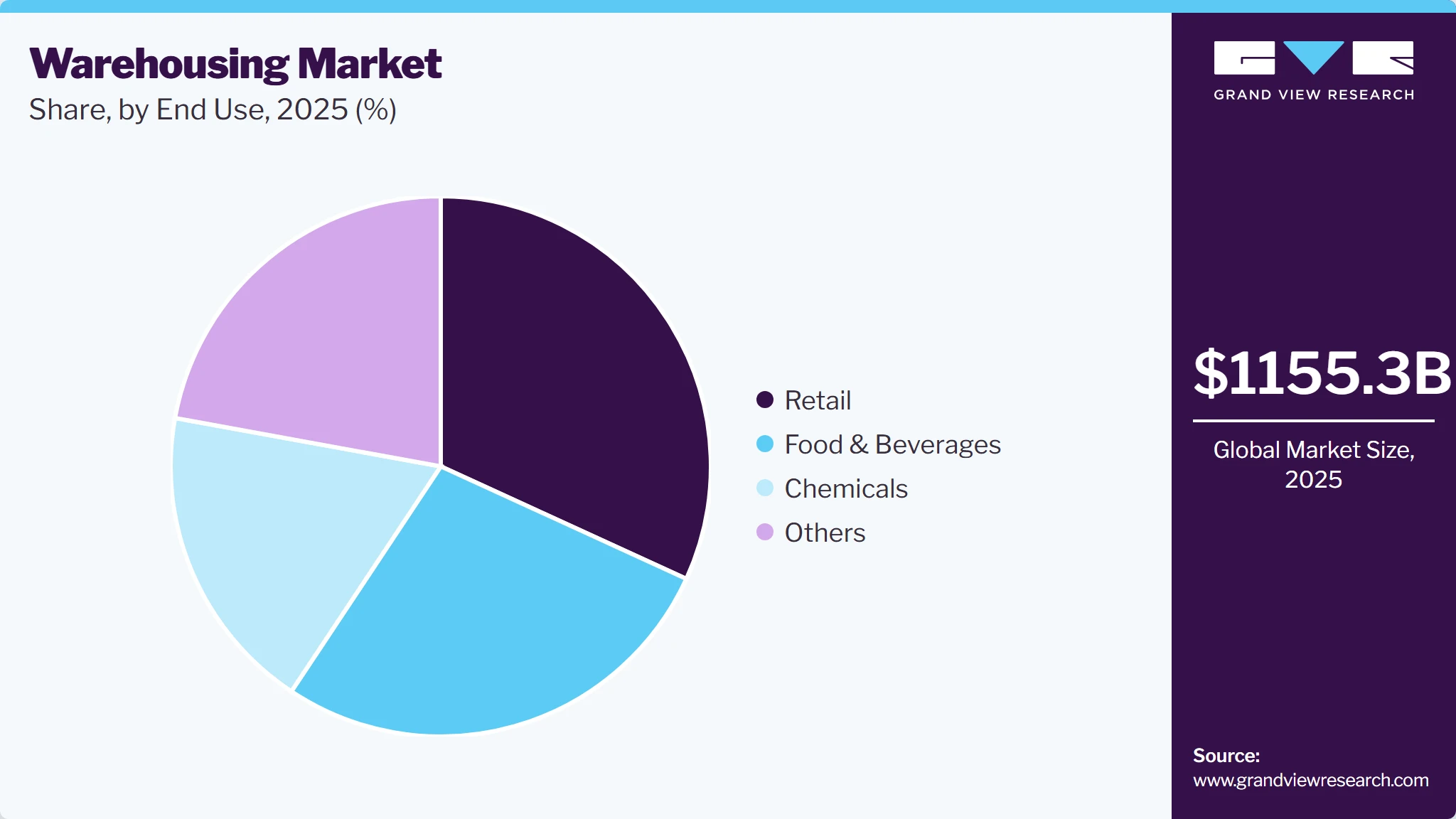
Based on end use, the retail segment led the market with the largest revenue share of 31.8% in 2025. The segment’s growth is attributed to the growing adoption of omni-channel retailing and growing consumer expectations for fast delivery. Retailers are increasingly adopting omnichannel strategies, which integrate online and offline sales channels. This approach requires robust warehousing solutions to manage inventory across multiple platforms and ensure seamless customer experiences. The share of online retail sales in overall retail sales is witnessing growth worldwide. According to the Office of National Statistics (ONS) of the UK, the percentage of internet sales in total retail sales in the UK has grown from 17.9% in December 2017 to 27.9% in December 2023.
 To learn more about this report, Download Free Sample Report
 The food & beverages segment is expected to register the fastest CAGR over the forecast period. The growth of the food & beverages segment is driven by an increasing demand for a diverse range of food and beverage products, driven by population growth, rising incomes, and changing dietary preferences. This necessitates more warehousing space to store these products. Moreover, the need to maintain the quality of perishable food products is driving the demand for temperature-controlled cold storage warehouses.
Regional Insights
North America dominated the global warehousing market with the largest revenue share of 30.8% in 2025. The growth of the market in the region is driven by various key factors, such as the adoption of advanced technologies in warehouses in the region and the developed technological and logistics infrastructure. According to the Government of Canada, in 2023, over 262,000 businesses were operating in the transportation and warehousing sector in Canada.
 To learn more about this report, Download Free Sample Report
 U.S. Warehousing Market Trends
The warehousing market in the U.S. held the largest share in the North America region in 2025. The growth of the market in the country can be attributed to the growing number of warehouses in the country to meet the growing demand. According to WarehousingAndFulfillment.com, a division of insightQuote.com, the number of warehouses in the country has grown from about 14,600 in 2007 to around 22,000 in 2023. Changes in consumer buying habits, like the preference for fast deliveries, influence the demand for strategically located warehouses.
Europe Warehousing Market Trends
The market in Europe is projected to grow at a CAGR of 8.8% from 2026 to 2033. The market’s growth is driven by government initiatives to boost the supply chain resiliency. Moreover, the expansion of retail chains, supermarkets, and wholesale distributors has increased the need for warehousing space to support their operations and ensure a steady supply of products. For instance, in July 2023, Claire’s (CBI Distributing Corp.), a U.S.-based retailer, announced plans to open 50 stores in the European Union (EU).
Asia Pacific Warehousing Market Trends
Asia Pacific is expected to witness the fastest CAGR of 10.4% from 2026 to 2033. The target market’s growth in the region can be attributed to the e-commerce boom in the region. The rapid expansion of e-commerce in the Asia Pacific region has significantly increased the demand for warehousing space. Moreover, rapid urbanization and population growth in countries like China, India, and Southeast Asian nations have led to increased demand for warehousing facilities to support retail, e-commerce, and industrial activities. According to The World Bank Group, the percentage of urban population in South Asia has grown from 31% in 2010 to 36% in 2023.
Key Warehousing Company Insights
Some of the key companies operating in the market include Deutsche Post AG, GEODIS, A.P. Moller - Maersk, and FedEx, among others.
-
A.P. Moller - Maersk is a Danish integrated shipping and logistics company. The company operates in three business segments, namely, Ocean, Terminals, and Logistics & Services. It offers end-to-end warehousing and distribution services. With its extensive global presence and network, the company offers facilities prepared to manage the supply chain needs, whether at the starting point or the final destination. The company has a presence in 130 countries and has a workforce of more than 110,000 employees.
Lineage, Inc. and NewCold are some of the emerging companies in the target market.
- Lineage, Inc. offers comprehensive warehousing and logistics services across diverse industries. Its facilities specialize in temperature-controlled storage and accommodate a wide range of food commodities, such as beef, pork, poultry, fruits, vegetables, bakery products, ice cream, seafood, and more.
Key Warehousing Companies:
The following key companies have been profiled for this study on the warehousing market.
- Deutsche Post AG
- BrightKey, Inc.
- GEODIS
- NIPPON EXPRESS HOLDINGS, INC.
- FedEx
- RXO Inc.
- XPO, Inc.
- Ryder System, Inc.
- Mitsubishi Logistics Corporation
- C.H. Robinson Worldwide, Inc.
- Americold Logistics, Inc.
- Lineage, Inc.
- Kuehne+Nagel
- A.P. Moller - Maersk
- NewCold
Competitive Benchmarking
Category
Operating Strategies
Competitive Edge
Weakness
Established Players (Deutsche Post AG, FedEx, GEODIS, NIPPON EXPRESS HOLDINGS, INC.)
• These players are focused on operating large-scale global warehousing networks integrated with transportation and value-added logistics services.
• Focus on automation, network optimization, and enterprise contracts.
• These players have extensive geographic reach, diversified customer base, and strong capital resources for infrastructure investment.
• High operational complexity and slower adaptability to niche or highly customized warehousing needs.
Emerging Players (XPO, Inc., Ryder System, Inc., C.H. Robinson Worldwide, Inc.)
• These players are focused on asset-light models, contract warehousing, and technology-enabled solutions tailored to specific industries.
• Emphasize flexibility and customer-specific configurations.
• Strong digital platforms, flexible service offerings, and targeted industry expertise.
• Limited owned infrastructure and lower control over long-term capacity compared to asset heavy players.
Recent Developments
-
In June 2024, A.P. Moller - Maersk unveiled a low-greenhouse gas emission warehouse at Taulov Dry Port in Fredericia, Denmark. This facility marks the company’s forefront initiative in low-emission warehousing, establishing new global standards in line with its ambition to achieve net-zero CO2 emissions company-wide by 2040. It strengthens its logistics capabilities in the Nordics, enhancing the handling of cargo across sea, road, and air networks.
-
In May 2024, Lineage, Inc. expanded its facility in Lębork, Pomorskie, Northern Poland, increasing pallet space capacity by about 30% to over 40,000 pallet spaces. This expansion supports Lineage, Inc.'s commitment to meeting growing demands in Central and Eastern Europe (CEE) following the establishment of a new regional headquarters in Warsaw in November 2023.
Warehousing Market Report Scope
Report Attribute
Details
Market size in 2025
USD 1,155.3 billion
Estimated market size in 2026
USD 1,240.4 billion
Projected market size by 2040
USD 2,298.4 billion
Growth rate
CAGR of 9.2% from 2026 to 2040
Base year for estimation
2025
Historical data
2021 - 2024
Forecast period
2026 - 2040
Quantitative units
Revenue in USD billion and CAGR from 2026 to 2040
Report coverage
Revenue forecast, company market share, competitive landscape, growth factors, and trends
Segments covered
Warehouse type, end use, region
Regional scope
North America; Europe; Asia Pacific; Central & South America; MEA
Country scope
U.S.; Canada; Mexico; Germany; U.K.; France; China; Japan; India; South Korea; Australia; Brazil; Saudi Arabia; UAE; and South Africa
Key companies profiled
Deutsche Post AG; BrightKey, Inc.; GEODIS; NIPPON EXPRESS HOLDINGS, INC.; FedEx; RXO Inc.; XPO Inc.; Ryder System, Inc.; Mitsubishi Logistics Corporation; C.H. Robinson Worldwide, Inc.
Customization scope
Free report customization (equivalent up to 8 analysts' working days) with purchase. Addition or alteration to country, regional & segment scope.
Pricing and purchase options
Avail customized purchase options to meet your exact research needs. Explore purchase options
Global Warehousing Market Report Segmentation
This report forecasts revenue growth at global, regional, and country levels and provides an analysis of the latest industry trends in each of the sub-segments from 2021 to 2033. For this study, Grand View Research has segmented the global warehousing market report based on warehouse type, end-use, and region:
-
Warehouse Type Outlook (Revenue, USD Million; 2021 - 2033)
-
General Warehousing
-
Specialized Warehousing
-
Cold Storage Warehousing
-
-
End-use Outlook (Revenue, USD Million; 2021 - 2033)
-
Retail
-
Food & Beverages
-
Chemicals
-
Others
-
-
Regional Outlook (Revenue, USD Million, 2021 - 2033)
-
North America
-
U.S.
-
Canada
-
Mexico
-
-
Europe
-
UK
-
Germany
-
France
-
-
Asia Pacific
-
India
-
China
-
Japan
-
South Korea
-
Australia
-
-
Latin America
-
Brazil
-
-
Middle East and Africa (MEA)
-
Kingdom of Saudi Arabia (KSA)
-
UAE
-
South Africa
-
-
Research Methodology
The warehousing market figures in this report are based on a proven research process that combines executive interviews with secondary research from proprietary databases, company filings, and recognized regulatory and institutional sources. Market size is built through value-chain sizing - reconciling supply-side and demand-side estimates - and triangulated with bottom-up and top-down approaches. Every estimate passes multiple levels of expert validation before publication, with each warehousing segment quantified using the revenue-capture definitions in the table below.
Segment Definition
Segment - Warehouse Type
Revenue capture definition
General Warehousing
General warehousing refers to standard storage facilities for non-temperature-sensitive goods such as consumer products, electronics, textiles, and industrial items, offering services including storage, handling, loading and unloading, inventory management, and basic value added distribution across multiple industries.
Specialized Warehousing
Specialized warehousing refers to purpose built storage facilities designed for hazardous, high-value, or regulated goods such as chemicals, pharmaceuticals, and sensitive materials, offering customized storage, compliance management, enhanced security, and industry specific infrastructure in line with strict safety and regulatory requirements.
Cold Storage Warehousing
Cold storage warehousing refers to temperature-controlled facilities used to store perishable and pharmaceutical goods such as food, beverages, dairy, meat, and medicines, offering refrigerated handling, blast freezing, and continuous monitoring, and specialized operations to preserve product quality and extend shelf life.
Segment - End use
Revenue capture definition
Retail
Retail warehousing refers to warehousing services that support inventory storage, order fulfillment, and reverse logistics for both brick and mortar and e-commerce channels, enabling retailers to efficiently manage stock and support fast order processing and last mile delivery operations.
Food & Beverages
Food and beverage warehousing involves storage and handling of raw materials and finished food products under strict hygiene standards, temperature control, and regulatory compliance, using a combination of dry storage and cold storage facilities for processed foods and beverages.
Chemicals
Chemical warehousing involves the storage of industrial and specialty chemicals under strict safety protocols, segregation requirements, and regulatory compliance, using facilities equipped with specialized infrastructure to manage hazardous and sensitive materials.
Others
The other end-use segment includes warehousing demand from pharmaceuticals, automotive, electronics, agriculture, and industrial manufacturing sectors, where storage facilities are used to support inventory management, production continuity, and distribution operations across diverse supply chains.
Estimation Model
Layer Name
Key Question
Description
Macro Logistics Demand
What are the overall logistics and trade activity driving storage needs?
This layer assesses trade volumes, manufacturing output, retail sales growth, and e-commerce penetration influencing warehousing demand. It establishes the total addressable logistics footprint requiring storage infrastructure. Regional trade intensity and consumption patterns are key inputs.
Warehousing Penetration
How much logistics activity translates into warehousing demand?
This layer evaluates inventory holding cycles, outsourcing rates, and distribution models to estimate warehousing intensity. It distinguishes between in-house storage and third-party warehousing adoption.
Service & Facility Mix
What types of warehouses and services are utilized?
The model segments demand by warehouse type, automation level, and value-added services. It captures differences between general, specialized, and cold storage facilities across industries.
Revenue Realization
How is value monetized across the warehousing ecosystem?
This layer converts capacity and utilization into revenue using pricing benchmarks, contract duration, and service complexity. It reflects realized market revenue across operators and geographies.
Delivered Customizations
This report has been delivered with the following In-depth customizations
Client Request
Customization Delivered
Value Adds
Regional Warehousing Market Opportunity Assessment
Evaluated regional warehousing demand for drivers and infrastructure maturity
Assessed regulatory and land availability impacts on capacity expansion
Identified high-growth logistics corridors and urban fulfillment hubs
Supported region-specific investment prioritization
Improved market entry and expansion planning
Enabled informed capacity deployment decisions
Cross-Segmentation Analysis for the Warehousing Market
Analyzed demand across warehouse type, end-use
Benchmarked segment-level adoption and utilization patterns
Assessed relative segment attractiveness
Improved segment targeting strategies
Enhanced service portfolio alignment
Supported demand-driven resource allocation
Competitive Benchmarking and Strategic Positioning in the Warehousing Market
Compared competitors across scale, automation, and service breadth
Identified capability gaps and differentiation levers
Assessed strategic positioning within the value chain
Revealed competitive white spaces
Supported differentiation strategy development
Enabled data-backed competitive planning
Frequently Asked Questions About This Report
Some key players operating in the warehousing market include Deutsche Post AG; BrightKey, Inc.; GEODIS; NIPPON EXPRESS HOLDINGS, INC.; FedEx; RXO Inc.; XPO Inc.; Ryder System, Inc.; Mitsubishi Logistics Corporation; C.H. Robinson Worldwide, Inc.
Various factors, including e-commerce expansion and increasing globalization & supply chain complexity, drive the growth of the market.
North America dominated the market with the largest revenue share of 30.8% in 2025.
Asia Pacific is the fastest-growing region over the forecast period.
The U.S. held the largest market share in 2025.
Retail segment held the largest market share of 31.8% in 2025, while food & beverages is the fastest growing segment.
The global warehousing market is expected to grow at a CAGR of 9.2% from 2026 to 2033, reaching USD 2,298.4 billion by 2033.
The general warehousing segment led with a 50.7% revenue share in 2025, while cold storage warehousing is the fastest-growing segment.
The global warehousing market size was valued at USD 1,155.3 billion in 2025 and is estimated at USD 1,240.4 billion for 2026.
About the Author(s)
Automotive & Transportation Research Team
Technology · Automotive & TransportationThis report was authored by the automotive & transportation research team at Grand View Research - comprising two research analysts, one senior research analyst, and one industry expert - with specialized expertise in the automotive & transportation segment of the technology industry. All findings are based on proprietary technology databases, executive interviews, and regulatory analysis, subject to internal peer review prior to publication.
Last Updated:
Speak to Analyst

Customize this report to your needs - add regions, segments, or data points, with 20% free customization.
Or view our licence options:


ISO 9001:2015 & 27001:2022 Certified
We are GDPR and CCPA compliant! Your transaction & personal information is safe and secure. For more details, please read our privacy policy.


