
- Home
- »
- Alcohol & Tobacco
- »
-
Honey Wine Market Size, Share & Trends Report, 2026-2033GVR Report cover

Honey Wine Market (2026 - 2033)
Size, Share & Trends Analysis Report By Product (Fruits, Spices, Herbs, Others), By Distribution Channel (On Trade, Off Trade), By Region (North America, Asia Pacific, Europe, Latin America), And Segment Forecasts
Market Size, 2025
$817.1MMarket Estimate, 2026
$904.2MMarket Forecast, 2033
$1,869.2MCAGR, 2026–2033
10.9%Honey Wine Market Size & Trends
The global honey wine market size was valued at USD 817.1 million in 2025 and is projected to grow from USD 904.2 million in 2026 to USD 1,869.2 million by 2033, at a CAGR of 10.9% from 2026 to 2033. Europe dominated the market, accounting for the largest revenue share of 36.8% in 2025. Honey wine has a high nutritional content and provides anti-oxidants and anti-inflammatory benefits. It also helps with gastrointestinal issues. These dietary contents allow the honey wine market to grow over the forecast period. Furthermore, rapid innovations in flavors and growing popularity among food enthusiasts are expected to boost product demand.
 Source: Grand View Research, IR Documents, Primary Interviews, Paid DatabasesTo learn more about this report,
 Download Free Sample Report
 Key Market Trends & Insights
- By product: Fruits segment led the market with the largest revenue share of 54.4% in 2025.
- By distribution channel: Off trade channel segment led the market with the largest revenue share of 66.7% in 2025.
Regional Highlights
- Largest regional market: Europe (36.8% revenue share, 2025)
- By country: The U.S. held the largest share of North America in 2025.
Market Size & Forecast
- Market Size in 2025: USD 817.1 Million
- Estimated Market Size in 2026: USD 904.2 Million
- Projected Market Size by 2033: USD 1,869.2 Million
- CAGR (2026-2033): 10.9%
Three ways to get this report
Buy it, customize it, or ask a question.Ask an Analyst
Analyst response in 1 business day
- AccessReport author, directly
- Reply timeWithin 1 working day
- No sales callDirect answer only
- FormatEmail reply
- CostFree, no cost
Get the Full Report
What the study covers
- FormatsPDF · Excel · Dashboard
- Timeline2026–2033 annual, 2025 base
- Coverage20+ countries, 5 regions
- Companies10+ key players profiled
Customize the Report
20% free customization
- IncludeCountries, segments, points
- TailorTo your product definition
- ExtendDeeper competitor detail
- OrA fully bespoke study
- Turnaround5–10 working days
Consumers strongly prefer beverages made with raw, natural, and wholesome ingredients, and honey wine is emerging as a natural and authentic option. This shift in consumer preference is driven by a growing demand for healthier and more natural alcoholic beverages. With an alcohol content ranging from 7% to 20%, honey wine is the preferred choice for many consumers. The increasing popularity of fruit-based cocktails is also significant in driving market growth. To learn more about this report, Download Free Sample Report
 The innovation of different flavors of honey wines, such as Melomel, a honey wine flavored with fruits; Cyser, a type of honey wine flavored with apple cider; metheglin, a honey wine infused with herbs and spices; and many other types of honey wine, is attracting new customers. Innovative packaging, development, and marketing strategies create hype among customers. The strong distribution channel, digital marketing, and e-commerce platforms are also helping the honey wine industry reach a broader consumer base and ensure further growth.
Market Dynamics
The honey wine market is expanding steadily, supported by changing consumer preferences toward fermented beverages with natural ingredients, distinctive flavor profiles, and premium positioning. Increasing commercialization of traditional mead, wider availability through specialty beverage retailers and digital sales channels, and product diversification featuring fruit-infused, botanical, sparkling, and barrel-aged variants are strengthening market demand. Furthermore, the emergence of craft alcohol producers and growing consumer interest in heritage-based alcoholic beverages continue to support market expansion across both mature and developing regions.
The growing inclination toward premium alcoholic beverages is accelerating demand for honey wine worldwide. Consumers are increasingly favoring products that emphasize authenticity, ingredient transparency, and small-batch production, creating favorable conditions for mead producers. Rising expenditure on premium beverages, particularly among millennials and Gen Z consumers, has encouraged manufacturers to expand premium product offerings with differentiated flavor combinations and limited-edition variants.
In addition, the expansion of craft beverage establishments, tasting rooms, and experiential alcohol tourism has enhanced product visibility and consumer engagement. Product innovation incorporating regional honey varieties, exotic fruits, herbs, and oak maturation techniques is further improving market competitiveness while attracting consumers seeking alternatives to conventional wines, beers, and spirits.
Reliance on honey as the primary fermentable ingredient remains a key challenge for the honey wine industry. Honey production is significantly affected by climatic conditions, bee population health, flowering cycles, and agricultural practices, leading to fluctuations in raw material availability and pricing. These supply-side uncertainties increase production costs and reduce profit margins for manufacturers.
Additionally, the relatively small production scale of many honey wine producers limits manufacturing efficiency and distribution reach compared to established wine and beer companies. Limited consumer awareness in several regions, coupled with complex alcohol taxation and licensing regulations, continues to restrict broader market penetration.
Rising demand for clean-label, organic, and naturally fermented alcoholic beverages is creating attractive opportunities for honey wine manufacturers. Producers are expanding their portfolios with products made from certified organic honey, locally sourced ingredients, and sustainable production methods to strengthen premium market positioning. The introduction of low-alcohol formulations, sparkling honey wine, and fruit-infused variants is also broadening consumer appeal.
Furthermore, the expansion of direct-to-consumer sales channels, subscription-based beverage services, and winery tourism is generating new revenue opportunities. Strategic partnerships with hospitality providers, specialty restaurants, gourmet retailers, and craft beverage festivals are improving product accessibility and brand visibility. These developments are expected to support long-term market growth and accelerate the commercialization of honey wine across global markets.
Analyst Perspective
The honey wine market is transitioning from a niche craft beverage category to a premium alcoholic beverage segment, supported by growing consumer preference for authentic, naturally fermented, and small-batch products. Long-term success will depend on manufacturers' ability to differentiate through flavor innovation, premium honey sourcing, and strong brand storytelling rather than competing on price. Companies that expand distribution beyond specialty outlets into mainstream retail, e-commerce, and hospitality channels while maintaining product quality and regional authenticity are expected to strengthen their competitive position as consumer interest in premium craft alcoholic beverages continues to rise globally.
Product Insights
Based on product, the fruits segment led the market with the largest revenue share of 54.4% in 2025. Fruit flavors, such as apples, berries, grapes, pineapples, and more exotic options, offer a wide variety of honey wines, making them more flavorful and enjoyable. This segment also caters to a large consumer base enjoying unique fruit honey wine combinations. Fruit honey wines have potential health benefits compared to other alcoholic beverages, which have antioxidant properties and improve blood flow.
The spices segment is expected to register the fastest CAGR during the forecast period. Spiced honey wines are rich in tradition and taste. It offers uniqueness and distinct flavor compared to other honey wines. Spiced honey wine has a broader scope for creativity and experimentation. It allows honey winemakers to innovate unique combinations and stand out in the market. Spice wine can be served in many cuisines, making it a more versatile drink option, hence driving market growth.
Distribution Channel Insights
Based on distribution channel, the off trade channel led the market with the largest revenue share of 66.7% in 2025. Off trade distribution channels, including liquor stores, hypermarkets, supermarkets, convenience stores, wine and spirits shops, and others, have a broad market reach and cater to a large consumer base. These channels offer a diverse range of products and provide convenience for customers to purchase drinks for take-away and future consumption.
 To learn more about this report, Download Free Sample Report
 The on trade sector is projected to grow at the fastest CAGR over the forecast period. The on trade distribution channel encompasses establishments where food and beverages are consumed on the premises, such as clubs, pubs, bars, restaurants, hotels, and coffee shops. This channel offers a unique customer experience and serves as a direct sales platform for craft beer and alcoholic beverages within these establishments. Products sold through the on-trade channel are typically priced higher than those sold through the off-trade distribution. Honey wines are gaining popularity in hotels and bars due to the growing trend of socializing in these venues. These establishments are ideal for social gatherings, celebrations, and relaxation, attracting a large adult clientele and contributing to the anticipated growth of the on-trade channel.
Regional Insights
North America honey wine market is expected to grow fastest at a CAGR of 11.8% over the forecast period. The North American region, especially the U.S., is home to the highest number of honey wine producers. The region is a hub for huge bars, clubs, and restaurants serving honey wines with different cuisines, providing a unique experience to consumers.
U.S. Honey Wine Market Trends
The honey wine market in the U.S. held the largest share in the North America region in 2025. The U.S. honey wine market is growing significantly in North America due to the rising craft and artisan beverage trend. Several small-scale wine producers across the country are contributing to the growing popularity of honey wine, fueling the region's market growth.
Europe Honey Wine Market Trends
Europe dominated the honey wine market with the largest revenue share of 36.8% in 2025. The honey wine market in France held the largest share in the Europe region in 2025. Europe strongly prefers authentic and artisanal alcoholic beverages, and traditional honey wine serves this purpose. The region has numerous honey wine producers, ranging from large-scale operations to small producers, which cater to the worldwide demand for honey wine.
 To learn more about this report, Download Free Sample Report
 Germany has a large number of on-trade distribution channels that contribute to the growth of the market. Moreover, the millennials comprise approximately 33% of the country's population, contributing more to the honey wine market.
Asia Pacific Honey Wine Market Trends
The Asia Pacific honey wine market is expected to witness significant growth over the forecast period. Honey wine is readily available in the region because of the presence of both domestic producers and international brands. The region has a large evolving consumer base due to major countries' young demographics.
China and Australia have major craft breweries, and consumer interest is shifting more towards artisanal products. Additionally, the standard of living is increased in the region, which allows consumers to spend more on experiences rather than necessities
Key Honey Wine Company Insights
Some of the key companies in the honey wine market are Redstone; Brothers Drake Meadery; Medovina Meadery; Kuhnhenn Brewing Co. LLC; Schramm’s Mead; and Winery Kuhnhenn. The major players in the market are launching new products. Various organizations are taking several strategic initiatives to open more mead stores across countries.
-
Brothers Drake Meadery is one of the oldest establishments in the U.S. The company uses local honey and ingredients in its mead to keep the taste authentic and raw. It now offers a full bar, live music, and mead in the U.S.
-
Moonshine Meadery is Asia’s and India’s first mead producer. Their offerings include apple mead, traditional mead, coffee mead, grilled pineapple mead, guava chili mead, and many more.
Key Honey Wine Companies
The following key companies have been profiled for this study on the honey wine market.
-
Medovina Meadery
-
Kuhnhenn Brewing Co. LLC
-
Redstone
-
Brothers Drake Meadery
-
Schramm’s Mead
-
Winery Kuhnhenn Brewing Co LLC
-
The Honey Wine Company
-
Martin Brothers Winery
-
Moonshine Meadery
-
Talon Wines.
Competitive Benchmarking
Operating Strategies
Competitive Edge
Weaknesses
Established Players (Redstone; Brothers Drake Meadery; Medovina Meadery; Kuhnhenn Brewing Co. LLC; Schramm’s Mead)
- Expand premium honey wine portfolios through new flavor introductions and seasonal editions.
- Strengthen distribution via specialty liquor retailers, restaurants, wineries, e-commerce platforms, and beverage tourism initiatives.
- Strong brand recognition within the craft beverage industry with established production capabilities and loyal customer bases.
- Extensive product portfolios supported by experienced brewing expertise and established distribution relationships.
- Higher production costs due to dependence on premium-quality honey and small-batch manufacturing.
- Limited penetration in mainstream retail channels compared to conventional wine, beer, and spirits brands.
Emerging Players (The Honey Wine Company; Martin Brothers Winery; Moonshine Meadery; Talon Wines)
- Focus on regional market expansion through innovative flavor combinations, locally sourced honey, and direct-to-consumer sales.
- Increase brand visibility through digital marketing, tasting events, and collaborations with hospitality partners.
- Greater flexibility in product development and faster introduction of niche honey wine varieties.
- Strong local brand identity with the ability to respond quickly to evolving consumer preferences.
- Limited production capacity and constrained financial resources for large-scale expansion.
- Lower brand awareness and restricted distribution networks compared to established honey wine producers.
Recent Developments
-
In August 2023, Moonshine Meadery, one of the major mead producers, expanded its flagship mead series by launching a new Lemon Tea Mead. The new mead offering combines the traditional honey-based mead with the refreshing flavors of lemon and tea, providing consumers with a unique and innovative mead experience.
-
In July 2023, Ronin Wines, the maker of Moonshine Meads, in a pre-Series A funding round raised USD 675,000. The funds are expected to expand the brand's meadery business in existing markets and support the Moonshine Honey Project, which focuses on bee conservation and honey sales.
Honey Wine Market Report Scope
Report Attribute
Details
Market size in 2025
USD 817.1 million
Estimated Market size in 2026
USD 904.2 million
Projected Market size by 2033
USD 1,869.2 million
Growth rate
CAGR of 10.9% from 2026 to 2033
Base year for estimation
2025
Historical data
2021 - 2024
Forecast period
2026 - 2033
Quantitative units
Revenue in USD million/billion and CAGR from 2026 to 2033
Report coverage
Revenue forecast, company ranking, competitive landscape, growth factors, and trends
Segments covered
Product, distribution channel, region
Regional scope
North America; Europe; Asia Pacific; Central & South America; MEA
Country scope
U.S., U.K., France, Italy, China, Australia, Brazil
Key companies profiled
Redstone; Brothers DrakeMaedery; Medovina Meadery; Kuhnhenn Brewing Co. LLC; Schramm’s Mead; Winery Kuhnhenn Brewing Co LLC; The Honey Wine Company; Martin Brothers Winery; Moonshine Meadery; Talon Wines.
Customization scope
Free report customization (equivalent up to 8 analysts' working days) with purchase. Addition or alteration to country, regional & segment scope.
Pricing and purchase options
Avail customized purchase options to meet your exact research needs. Explore purchase options
Global Honey Wine Market Report Segmentation
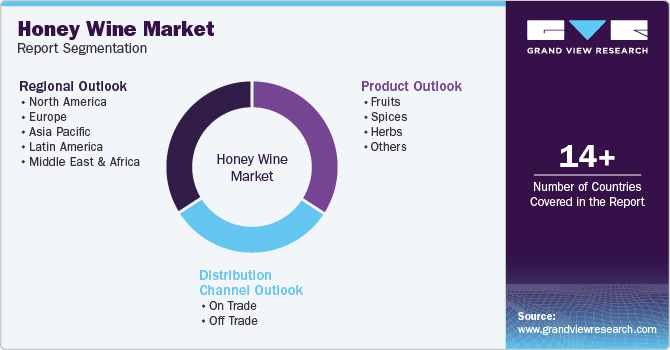
This report forecasts revenue growth at global, regional, and country levels and provides an analysis of the latest industry trends in each of the sub-segments from 2018 to 2030. Grand View Research has segmented the global honey wine market report based on product, distribution channel, and region:
 To learn more about this report, Download Free Sample Report
 -
Product Outlook (Revenue, USD Million, 2021 - 2033)
-
Fruits
-
Spices
-
Herbs
-
Others
-
-
Distribution Channel Outlook (Revenue, USD Million, 2021 - 2033)
-
On Trade
-
Off Trade
-
-
Regional Outlook (Revenue, USD Million, 2021 - 2033)
-
North America
-
U.S.
-
-
Europe
-
UK
-
France
-
Italy
-
-
Asia Pacific
-
China
-
Australia
-
-
Latin America
-
Brazil
-
-
Research Methodology
The honey wine market figures in this report are based on a proven research process that combines executive interviews with secondary research from proprietary databases, company filings, and recognized regulatory and institutional sources. Market size is built through value-chain sizing-reconciling supply-side and demand-side estimates-and triangulated with bottom-up and top-down approaches. Every estimate passes multiple levels of expert validation before publication, with each cryptocurrency payment apps segment quantified using the revenue-capture definitions in the table below.
Segment Definition
Segment - Product
Revenue capture definition
Fruits
This segment includes the sales of honey wine made with fruits to provide different flavors and aromas. These products appeal to consumers looking for sweeter and fruit-forward alcoholic beverages.
Spices
This segment includes the sales of honey wine prepared using spices to create rich and distinctive taste profiles. These varieties are commonly introduced as premium and seasonal offerings.
Herbs
This segment includes the sales of honey wine infused with herbs to offer botanical flavors and unique drinking experiences. They are increasingly available through craft beverage producers and specialty retailers.
Others
This segment includes the sales of honey wine made using ingredients other than fruits, spices, or herbs, including flowers and other natural flavoring components. These products cater to consumers seeking innovative and specialty honey wine varieties.
Estimation Model
Layer Name
Key Questions
Description
Production Layer
How much honey supports wine production?
Assesses global honey production suitable for fermentation by evaluating honey availability, quality standards, and production volumes to estimate the potential raw material base.
Commercial Supply Layer
How much honey wine is supplied?
Estimates the share of honey processed into commercially available honey wine and distributed through wineries, retailers, online platforms, and hospitality establishments globally.
Industrial Demand Layer
Who purchases honey wine products?
Applies adoption rates for premium and craft alcoholic beverages to estimate the addressable consumer base purchasing honey wine across key regional markets.
Monetisation Layer
How much revenue is generated?
Multiplies honey wine sales volumes by average selling prices across product categories and distribution channels to estimate the total market value.
Delivered Customizations
This report has been delivered with the following In-depth customizations
Client Request
Customization Delivered
Value Adds
Honey Wine Product Mix Evaluation
Reviewed commercially available honey wine products across fruit, spice, herb, and specialty formulations, highlighting ingredient composition, flavor positioning, packaging formats, and new product introductions across major brands.
Supports portfolio optimization by identifying underserved product categories, evolving flavor preferences, and areas for product differentiation.
Sales Channel & Consumption Pattern Analysis
Examined purchasing behavior across retail outlets, online platforms, wineries, tasting venues, and foodservice establishments, with emphasis on pricing trends, purchasing frequency, and consumer preferences by region.
Helps businesses prioritize high-performing sales channels, refine pricing strategies, and improve market reach across target customer groups.
Competitive Positioning & Market Entry Assessment
Analyzed manufacturer positioning, brand portfolios, distribution approaches, export activities, and regional market attractiveness to evaluate opportunities for business expansion and competitive differentiation.
Provides actionable inputs for expansion planning, partnership development, portfolio positioning, and entry into high-potential regional markets.
Frequently Asked Questions About This Report
The global honey wine market size was valued at USD 817.1 million in 2025 and is estimated at USD 904.2 million in 2026.
The global honey wine market size is expected to grow at a CAGR of 10.9% from 2026 to 2033, reaching USD 1869.2 million by 2033.
The fruits segment led with a 54.4% revenue share in 2025, while spices is the fastest-growing segment.
Key players include Redstone; Brothers DrakeMaedery; Medovina Meadery; Kuhnhenn Brewing Co. LLC; Schramm’s Mead; Winery Kuhnhenn Brewing Co LLC; The Honey Wine Company; Martin Brothers Winery; Moonshine Meadery; Talon Wines.
Key factors include rising consumer interest in craft alcoholic beverages, growing demand for premium and flavored drinks, increasing awareness of traditional fermented beverages, and expanding distribution through specialty retailers and online channels.
Europe dominated with a 36.8% revenue share in 2025.
The Middle East & Africa is the fastest-growing region over the forecast period
Off trade channel held the largest revenue share in 2025, while on trade is the fastest-growing segment.
About the Author(s)
Alcohol & Tobacco Research Team
Consumer Goods · Alcohol & TobaccoThis report was authored by the alcohol & tobacco research team at Grand View Research - comprising two research analysts, one senior research analyst, and one industry expert - with specialized expertise in the alcohol & tobacco segment of the consumer goods industry. All findings are based on proprietary consumer goods databases, executive interviews, and regulatory analysis, subject to internal peer review prior to publication.
Last Updated:
Speak to Analyst

Customize this report to your needs - add regions, segments, or data points, with 20% free customization.
Or view our licence options:


ISO 9001:2015 & 27001:2022 Certified
We are GDPR and CCPA compliant! Your transaction & personal information is safe and secure. For more details, please read our privacy policy.


