
- Home
- »
- Homecare & Decor
- »
-
Hot Tub Market Size, Share And Trends Report, 2026-2033GVR Report cover

Hot Tub Market (2026 - 2033)
Size, Share & Trends Analysis Report By Type (Above-Ground Hot Tubs, In-Ground Hot Tubs), By Seating Capacity (4-5 Persons, 6-8 Persons), By End Use, By Price Tier, By Distribution Channel, By Region, And Segment Forecasts
Market Size, 2025
$5.6BMarket Estimate, 2026
$5.9BMarket Forecast, 2033
$7.9BCAGR, 2026–2033
4.4%in larger seating configurations and reinforces demand for products designed around shared experiences.
Hot Tub Market Summary
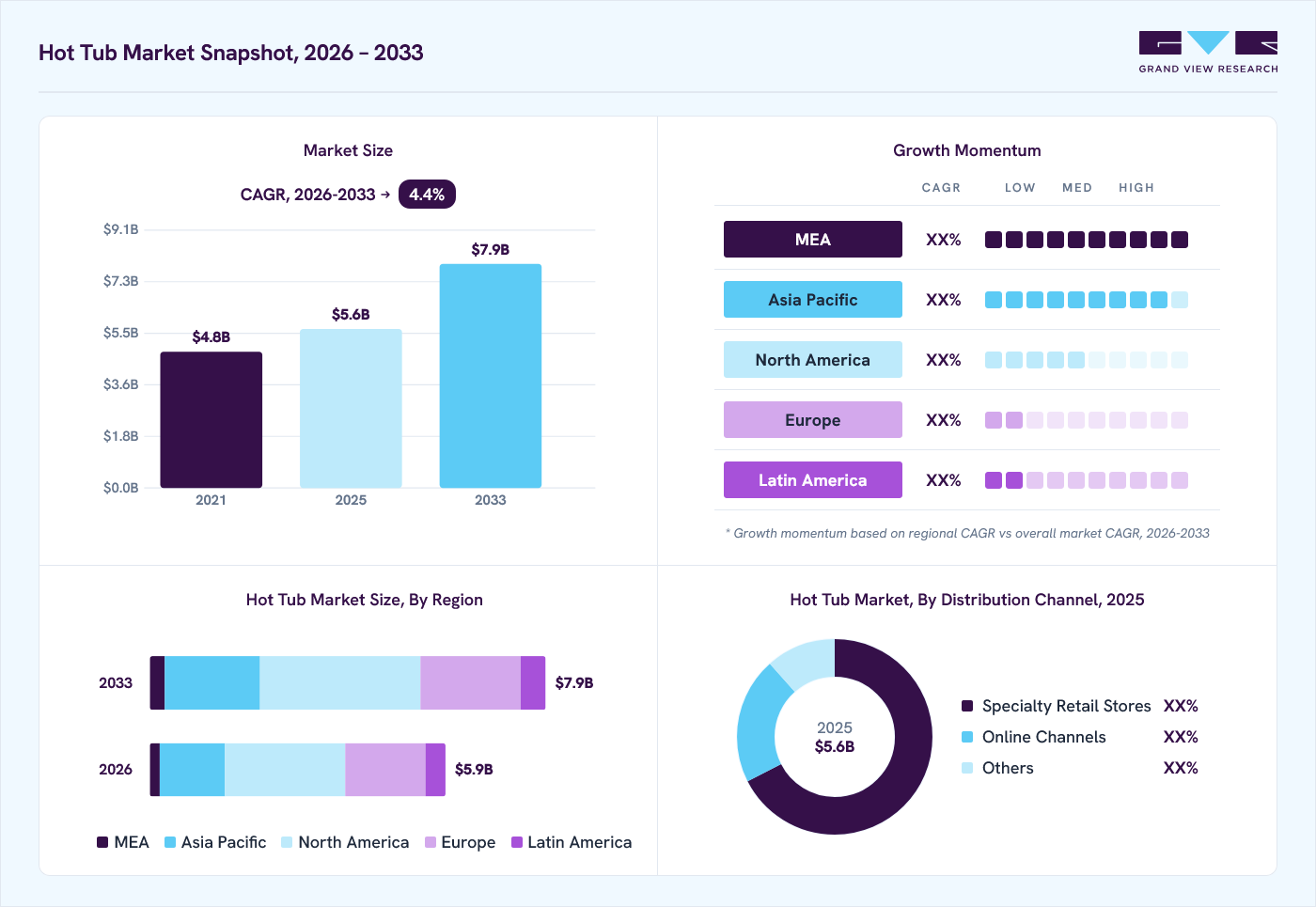
The global hot tub market size was valued at USD 5.6 billion in 2025 and is projected to grow from USD 5.9 billion in 2026 to USD 7.9 billion by 2033, at a CAGR of 4.4% from 2026 to 2033. North America dominated the market, accounting for a revenue share of 41.7% in 2025. The industry is supported by increasing adoption of home-based wellness products, continued investment in outdoor living spaces, growth in premium residential construction, and rising demand for hydrotherapy and recovery-oriented leisure products.
 Source: Grand View Research, IR Documents, Primary Interviews, Paid DatabasesTo learn more about this report,
 Download Free Sample Report
Key Market Trends & Insights
- By type: Above-ground hot tubs segment dominated with a 64.8% share in 2025.
- By seating capacity: The 4-5 person segment dominated with a 43.1% share in 2025.
- By price-tier: Mid-range segment accounted for the largest share of 46.2% in 2025.
- By end use: Residential applications segment dominated with a 75.0% share in 2025.
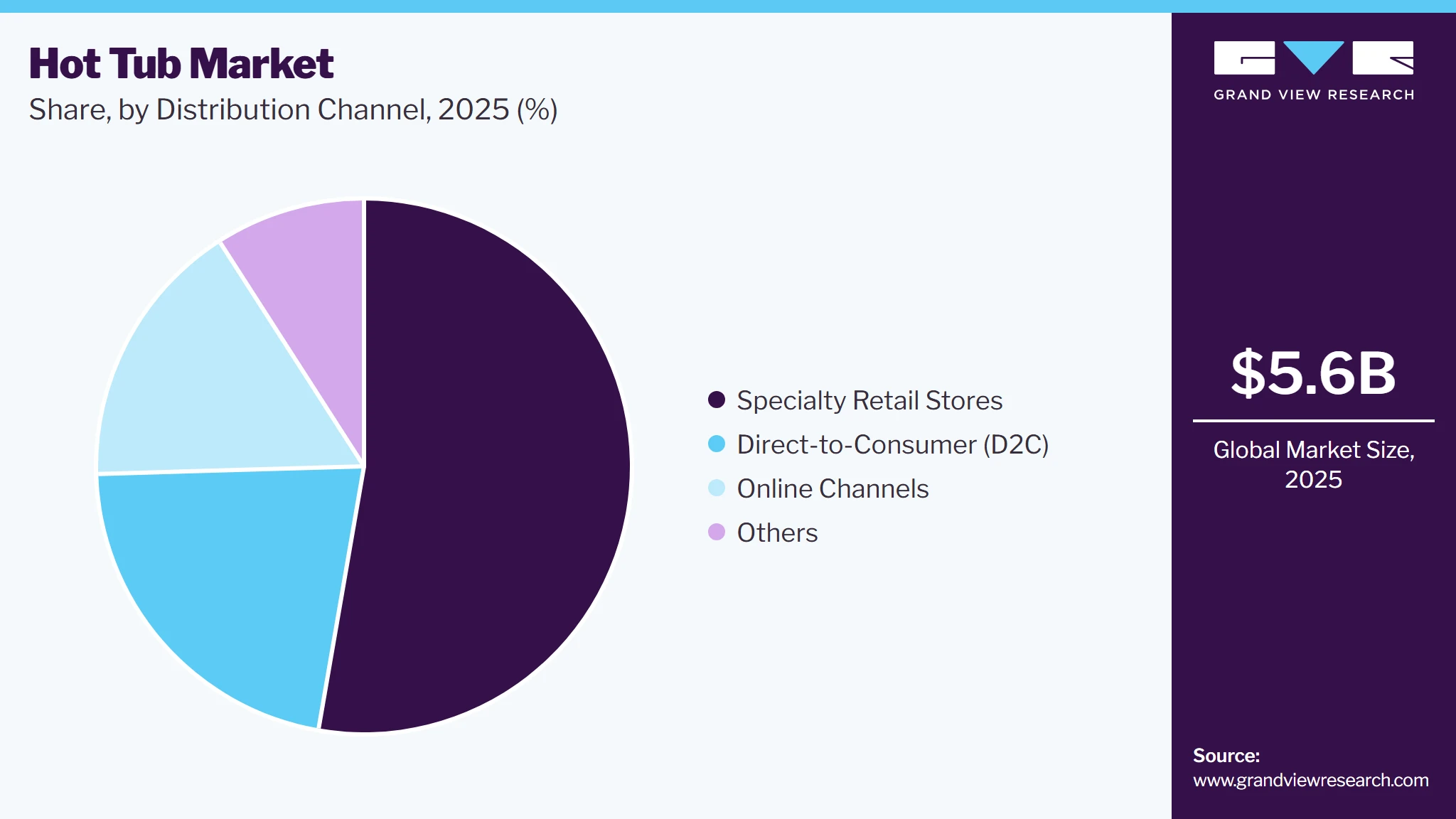
- By distribution channel: Specialty retail stores segment held the largest share of 52.1% in 2025.
Regional Highlights
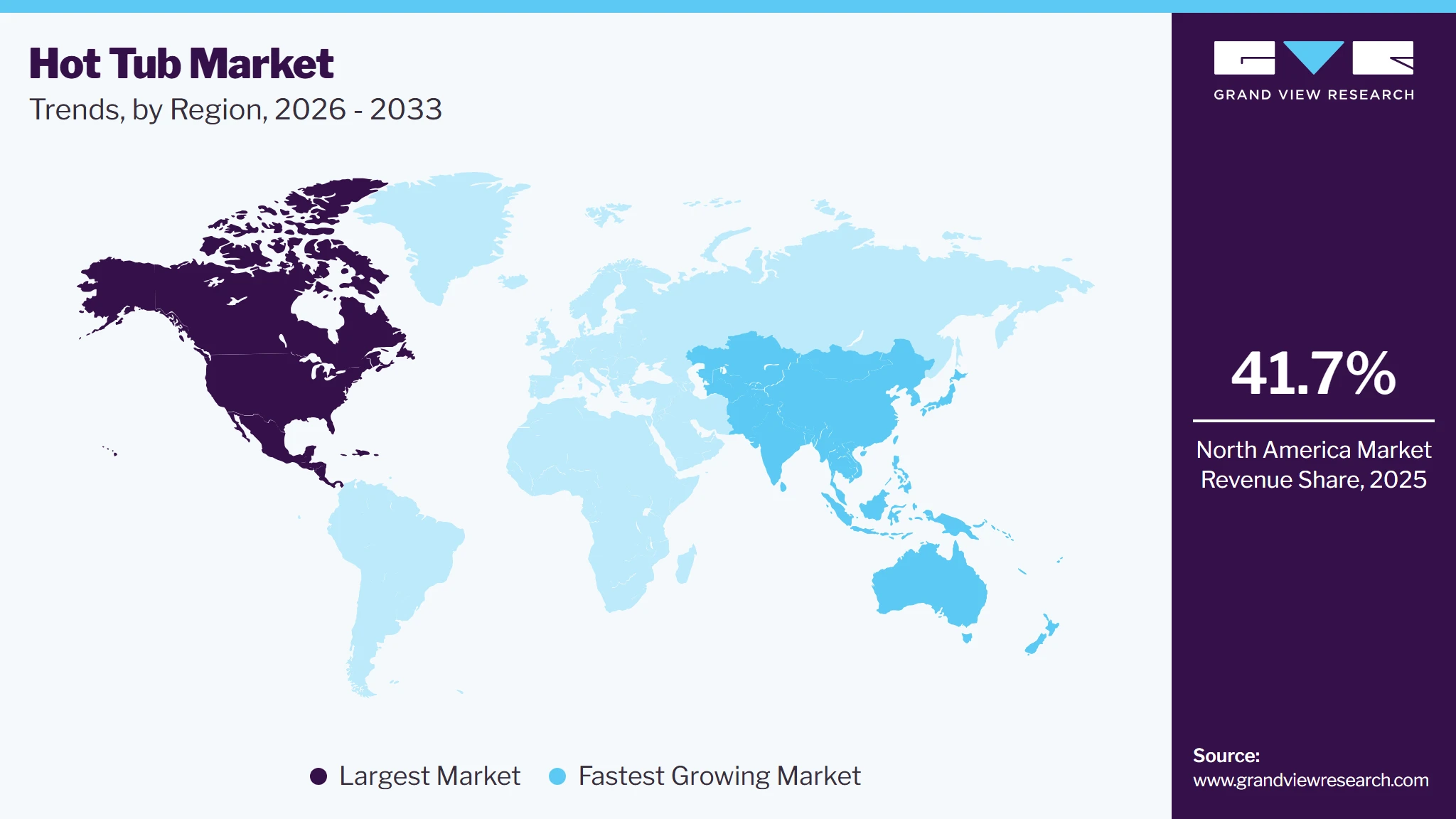
- Largest Regional Market: North America (41.7% revenue share, 2025)
- Fastest-Growing Regional Market: Asia Pacific (highest CAGR, 2026-2033)
- By country: The U.S. held the largest market share in 2025.
Market Size & Forecast
- Market size in 2025: USD 5.6 Billion
- Estimated market size in 2026: USD 5.9 Billion
- Projected market size in 2033: USD 7.9 Billion
- CAGR (2026-2033): 4.4%
Prism AI by Grand View Research Free to tryAsk a question about the hot tub marketTry asking✓Every figure cited from GVR research Prefer the report? Download free sample →
The U.S. remains the principal demand center because of its large installed base and established dealer ecosystem, while Asia Pacific represents an important growth opportunity as premium residential developments, hospitality projects, wellness facilities, and high-income consumer segments expand. The market is also becoming more technology-oriented, with manufacturers increasingly incorporating energy-efficient insulation, automated water management, smart controls, and connected monitoring to address ownership costs and maintenance concerns.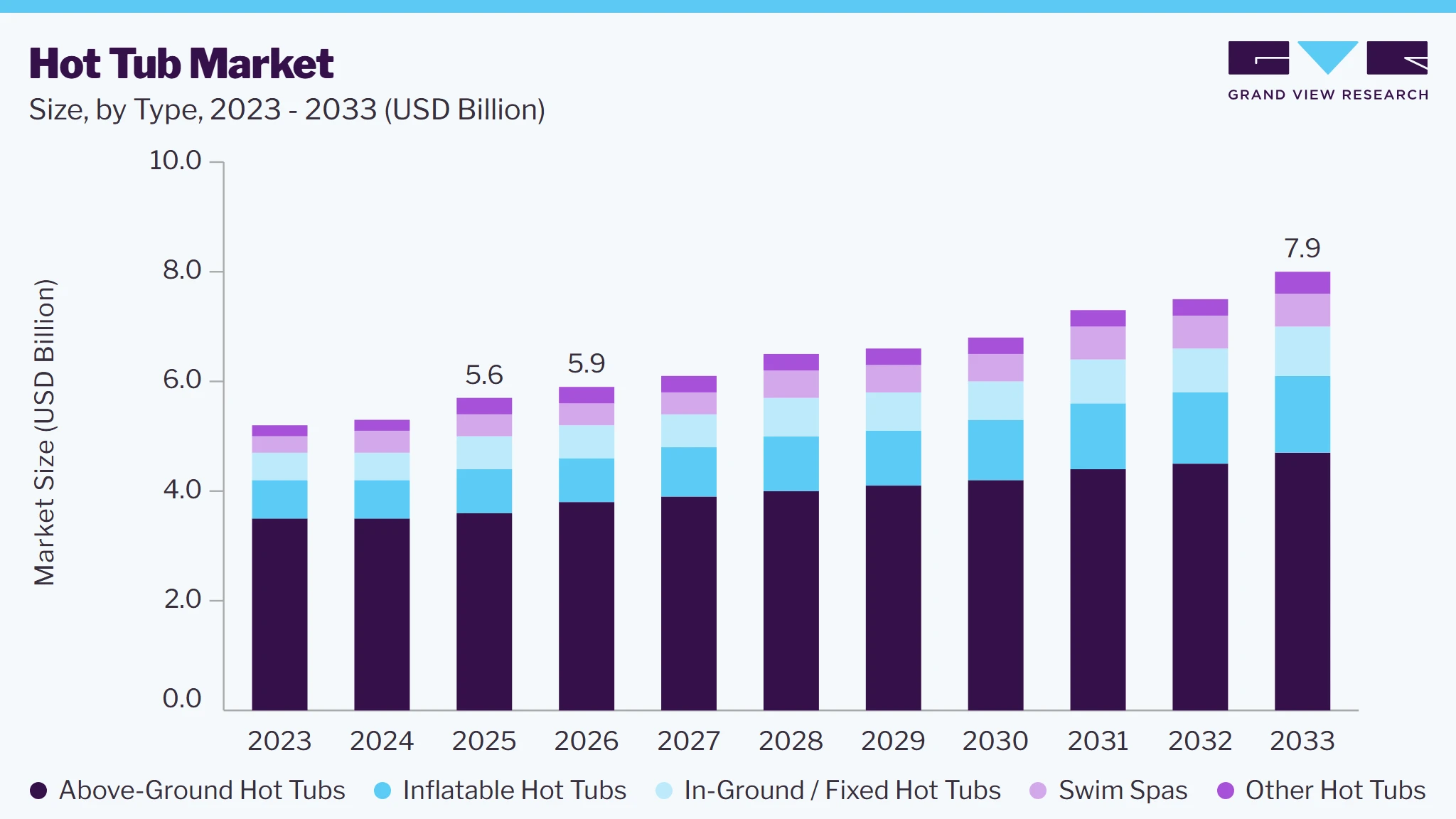 To learn more about this report, Download Free Sample Report
The industry is also being shaped by the rising importance of energy efficiency and operating economics. Approximately 34% of retailers surveyed by AQUA Magazine reported increased customer demand for green alternatives, with energy-efficient hot tubs, chlorine-free systems, solar-powered equipment, and low-chemical water-care solutions specifically identified among areas of interest. This is commercially important because hot tubs are heated products with recurring energy and water requirements. EPA WaterSense estimates that a typical commercial spa contains approximately 1,100 gallons of water and can lose around 6,300 gallons annually through evaporation, illustrating the scale of resource management involved in heated spa operation. EPA further notes that each degree increase in pool/spa water temperature can increase energy costs by 10-30%, reinforcing the importance of insulation, covers, efficient heating, and temperature management.
Product competition is consequently shifting toward technology-enabled efficiency and simplified ownership, rather than relying only on jet count, size, or exterior design. For instance, Jacuzzi's SmartTub system provides real-time energy monitoring, remote temperature and jet controls, maintenance alerts, automated scheduling, and a Smart Heat mode that the company states can reduce standby power consumption by up to 25%. Such features demonstrate how leading manufacturers are responding directly to consumer concerns around operating cost, maintenance, and convenience. This also creates a premiumization pathway: manufacturers can justify higher prices through measurable ownership benefits such as energy management, automated maintenance notifications, remote diagnostics, and optimized heating rather than through cosmetic upgrades alone.
The competitive structure remains relatively fragmented, with established manufacturers competing alongside regional producers and specialist spa brands. Companies such as Jacuzzi Brands, Watkins Wellness, Master Spas, Bullfrog International, Cal Spas, Sundance Spas, Arctic Spas, Artesian Spas, Coast Spas, and Canadian Spa Company differentiate through hydrotherapy configurations, seating layouts, insulation performance, energy efficiency, smart functionality, design, and dealer service. Product segmentation is increasingly influenced by the intended use case: compact models target couples and space-constrained households, larger models address family and social use, while premium configurations increasingly incorporate advanced hydrotherapy and connected features. This creates room for manufacturers to move beyond basic product competition and position hot tubs as integrated home wellness and outdoor-living systems.
Market Dynamics
The market opportunity extends beyond conventional residential use into wellness, hospitality, vacation rentals, and multifunctional aquatic products. Hot tubs are increasingly positioned alongside swim spas and other wellness products, while retailers are broadening their portfolios around wellness-oriented categories. AQUA Magazine reported that 55% of surveyed retailers currently sell swim spas, reflecting the overlap between consumers seeking relaxation and those seeking exercise or recovery functionality. At the same time, hot tub manufacturers are integrating connected controls and energy-management technologies to make products more suitable for frequent or remote use. This supports demand from luxury residences, vacation properties, hotels, resorts, and wellness facilities, while creating opportunities for manufacturers to differentiate through hydrotherapy, smart controls, energy efficiency, and low-maintenance water management.
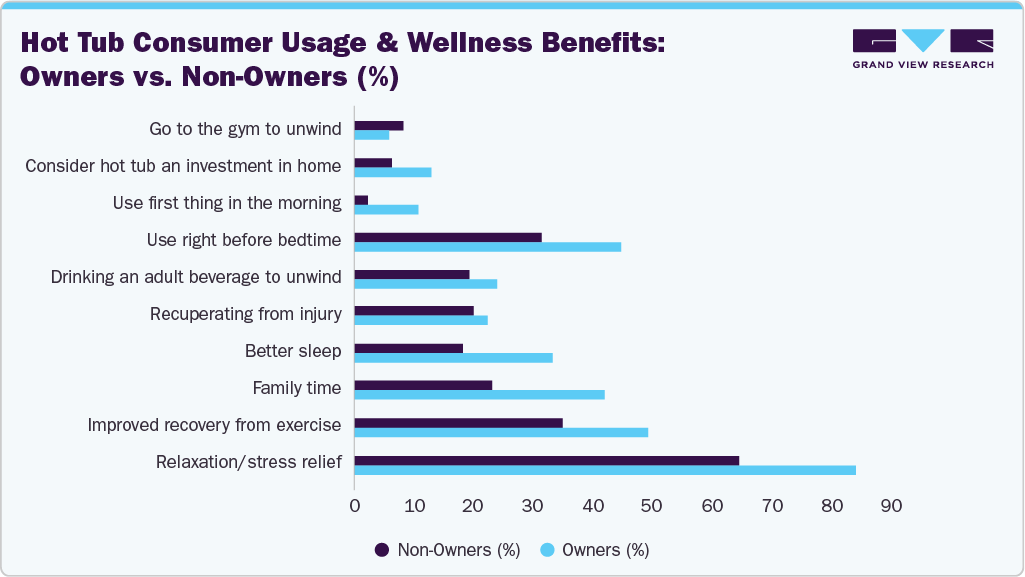
Consumer behavior is increasingly supporting hot tubs as a home-wellness product rather than a purely recreational outdoor appliance. The strongest evidence comes from Hot Spring's consumer survey of more than 700 respondents, where 83.9% of existing owners cited relaxation/stress relief as a reason for using their hot tub, compared with 64.5% of non-owners. Wellness-related usage was also materially higher among owners for better sleep (33.3% vs. 18.3%) and exercise recovery (49.0% vs. 34.8%). Importantly, 16.7% of owners reported using their hot tub four or more times per week and 8.9% reported daily use, indicating that ownership can translate into a recurring wellness routine rather than occasional leisure consumption.
The trend is being reinforced by broader outdoor-living and wellness behavior. AQUA Magazine's 2025 retailer survey found that 23% of retailers identified hot tubs as a growth category, while retailers reported increasing consumer interest in hydrotherapy and wellness-oriented functionality. Bather capacity was identified as the leading consideration when consumers selected a hot tub, followed by hydrotherapy/rehabilitation and ease of use. This indicates that consumers are increasingly evaluating products based on the experience they deliver, such as massage, recovery, relaxation, and family use, rather than simply comparing specifications. Manufacturers such as Jacuzzi, Watkins Wellness, Master Spas, and Bullfrog International can therefore capture premium demand by positioning hydrotherapy, ergonomic seating, wellness routines, and smart controls as integrated lifestyle benefits rather than standalone features.
The relatively high total cost of acquiring and operating a hot tub remains one of the principal barriers to broader penetration. Consumers must consider more than the advertised tub price: delivery, electrical installation, foundation preparation, cover, steps, water-care equipment, and accessories can increase the initial investment. The ownership cost continues after installation through electricity, water treatment, chemicals, filtration, repairs, and periodic component replacement. This makes hot tubs more difficult to justify for price-sensitive households than lower-cost outdoor leisure products.
Energy requirements are particularly relevant because the product must continuously maintain a large volume of heated water. The U.S. Environmental Protection Agency's guidance for commercial spas highlights substantial water and energy requirements and notes that higher water temperatures increase energy consumption. Although residential products can have substantially different operating characteristics, the underlying principle remains important: insulation, covers, heating efficiency, and circulation systems directly affect operating costs. Consumer research also shows that price remains a major part of the purchase conversation; analysis of more than 14,000 customer interactions by Epic Hot Tubs found that price or quotation requests represented approximately 12% of website messages. Consequently, manufacturers need to demonstrate lifetime value and operating efficiency rather than relying exclusively on premium features to justify higher purchase prices.
The industry's strongest product-development opportunity is to reduce the cost and effort associated with ownership. Consumer interest is already moving toward efficiency-oriented products: AQUA Magazine's 2025 retailer research found that 34% of retailers reported increased consumer demand for green alternatives, including energy-efficient hot tubs and lower-chemical water-care solutions. This creates an opportunity for manufacturers to compete on measurable lifetime operating costs rather than simply increasing jet counts or adding cosmetic features. Improved insulation, high-efficiency pumps, intelligent heating schedules, thermal covers, automated filtration, salt/mineral water systems, and remote monitoring can collectively reduce the friction associated with owning a hot tub.
Smart technology can further strengthen this proposition by allowing owners to monitor temperature, water chemistry, filtration, and operating schedules through connected controls. For example, a consumer who previously avoided a hot tub because of concerns about maintenance could be targeted with a model offering automated water management and smartphone alerts. Similarly, in colder markets such as Canada and the northern U.S., manufacturers can emphasize insulation and energy-management systems as direct solutions to winter operating costs. This gives established players such as Jacuzzi Brands, Watkins Wellness, Bullfrog International, and Master Spas an opportunity to move premiumization away from purely aesthetic differentiation toward measurable convenience, efficiency, and ownership economics.
Analyst Perspective
The market is shifting from discretionary luxury toward wellness-led residential spending, with demand increasingly tied to hydrotherapy, home relaxation, and outdoor living. Above-ground and fixed hot tubs remain the core revenue pools, while inflatable models are expanding the addressable customer base through lower upfront costs and easier installation. Premium manufacturers are differentiating through energy-efficient heating, water-management systems, app connectivity, and ergonomic hydrotherapy features.
Consumer Insights
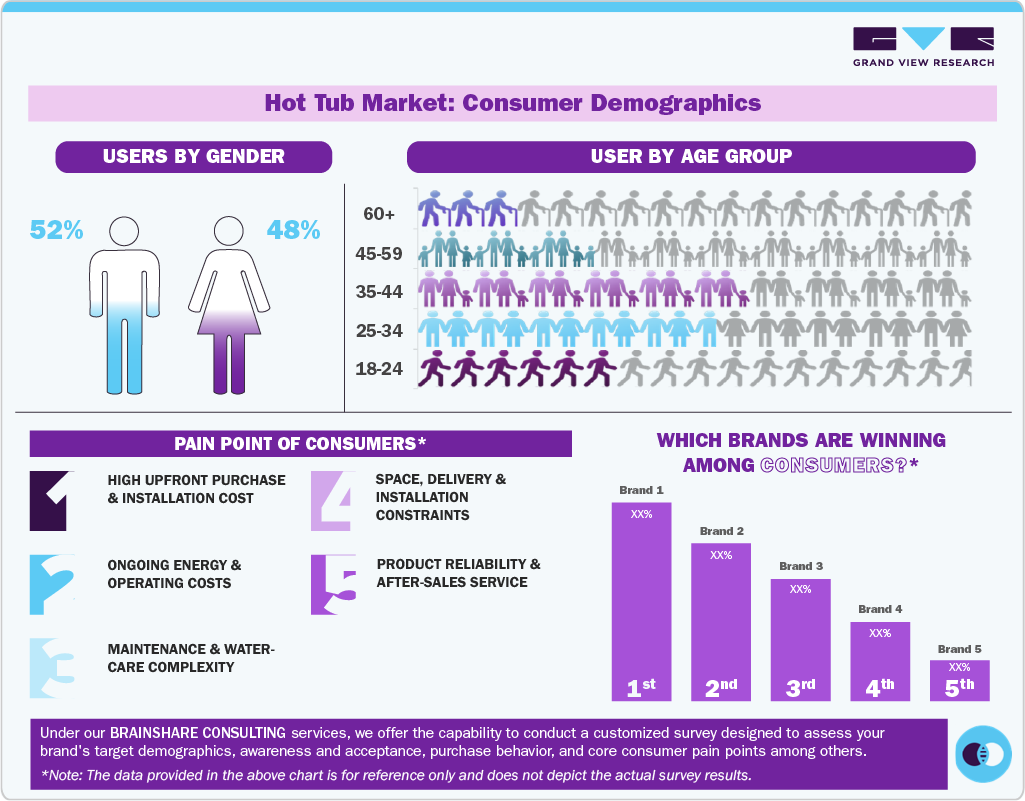
Consumer behavior in the global market is moving toward a wellness-led, experience-oriented purchase, but the buying decision remains highly practical. Consumers are not simply choosing the tub with the highest number of jets or the lowest price; they are evaluating whether the product fits their available space, household size, intended usage, maintenance capability, and long-term ownership budget. Recent evidence from more than 14,000 customer interactions shows that size and seating are among the first questions raised by active shoppers, while price and quotations remain major conversation triggers.
 To learn more about this report, Download Free Sample Report
Relaxation is the core consumer proposition, but wellness is broadening the use case: Consumers increasingly perceive hot tubs as an accessible home-wellness solution for unwinding after work, improving sleep routines, recovering after exercise, and spending time with family. Earlier consumer research found relaxation/stress relief was the dominant motivation among both owners and prospective buyers, while more recent industry commentary continues to position wellness as a major driver of spa demand. For example, a consumer considering a hot tub after work may prioritize comfortable seating, quiet operation, and hydrotherapy rather than maximum jet count.
Household size and intended users strongly determine the model selected: Capacity has become one of the most important purchase filters. Retailers reported bather capacity as the No. 1 priority when consumers select a hot tub, while recent customer-interaction data similarly shows that size and seating questions are particularly prominent among active shoppers. This creates clear differentiation between a couple purchasing a compact 2-3-person model for relaxation and a family purchasing a 6-8-person model for regular social use.
Hydrotherapy is increasingly evaluated as a functional benefit rather than a luxury feature: Consumers are becoming more specific about how a hot tub should feel, rather than simply asking how many jets it contains. Hydrotherapy and rehabilitation capabilities rank immediately behind capacity in retailer observations, encouraging manufacturers to differentiate through targeted massage zones, ergonomic seating, footwell jets, adjustable pressure, and specialized jet configurations. For example, a consumer interested in post-exercise recovery may compare jet placement and massage intensity before considering cosmetic features.
The purchase journey starts online but often ends through physical interaction: Today's buyers increasingly research brands, specifications, reviews, videos, prices, and comparisons before contacting a dealer. A recent 2026 industry assessment notes that consumers are arriving at showrooms considerably more informed because of YouTube, AI, podcasts, influencers, and online content. However, the physical showroom remains important because consumers want to sit in the tub, evaluate seating comfort, understand jet performance, and assess whether the product feels appropriate for their space.
The ability to physically test the product can materially influence conversion: Hot tubs are experiential products, and consumers cannot fully assess comfort from photographs or specifications. A Jacuzzi/Harris Poll survey of more than 2,000 U.S. adults found that 73% said they would be more likely to purchase from a store where they could try the product first. This supports the continued relevance of wet-testing, showroom displays, and dealer demonstrations, particularly for premium models.
Price matters, but consumers increasingly assess price against the ownership experience: Recent analysis of 14,351 leads and more than 14,000 customer interactions found that price or quotation requests appeared in approximately 12% of website form messages, making it the most common single topic across the dataset. However, among hot tub shoppers specifically, size and seating questions were more prominent. This suggests that consumers are not necessarily seeking the cheapest product; they are trying to determine whether the price is justified by capacity, features, quality, and suitability for their household.
Energy efficiency is becoming more relevant as consumers think about total ownership cost: Although electricity costs appeared in fewer than 2% of website form messages in the recent Epic Hot Tubs dataset, energy efficiency is increasingly being communicated as a product differentiator. In AQUA Magazine's 2025 retailer survey, 34% of retailers reported increased consumer demand for green alternatives, with energy-efficient hot tubs among the products attracting interest. This suggests a gap between what consumers initially ask dealers and what manufacturers can use to strengthen purchase justification.
Ease of maintenance can become important after the purchase: Consumer behavior changes noticeably once the product enters the ownership stage. In the Epic Hot Tubs dataset, water chemistry and chemical questions represented approximately 29% of inbound owner emails, making it the most frequent post-purchase topic. Warranty, installation, and electrical setup were also recurring concerns. Consequently, consumers increasingly value simplified filtration, automated water-care systems, clear maintenance instructions, and responsive technical support, even when these factors are not the first things discussed during the initial sale.
Family and social use remains an important behavioral driver: Hot tubs are increasingly integrated into outdoor living rather than being treated solely as personal wellness equipment. Earlier owner research found that more than 42% of owners reported family time as an important use, compared with 23% among non-owners anticipating that use. This helps explain the continuing consumer interest in larger seating configurations and reinforces demand for products designed around shared experiences.
 To learn more about this report, Download Free Sample Report
Rental-property buyers represent a distinct emerging customer profile: Hot tubs are increasingly being purchased for vacation rentals and other income-generating properties. In Epic Hot Tubs' customer-interaction dataset, rental-property use appeared nearly as often as family use and pain relief as a stated purpose. These buyers evaluate the product differently from household consumers, emphasizing durability, ease of maintenance, operating reliability, guest appeal, and the ability to withstand frequent usage.
Consumers are also cross-shopping hot tubs against swim spas: Hot tub versus swim spa was the most common cross-shopping comparison among multi-interest leads in the Epic Hot Tubs dataset. This indicates that a portion of consumers are approaching the category from a broader home-wellness perspective rather than having already decided on a specific product. A household seeking both exercise and relaxation, for example, may compare a conventional hot tub with a swim spa before deciding based on available space, budget, exercise requirements, and desired hydrotherapy experience.
Trust and after-sales support are particularly important because of the product's complexity: Unlike smaller outdoor leisure products, hot tubs require electrical installation, water treatment, delivery logistics, maintenance, and potentially warranty service. Consumers, therefore, evaluate the dealer's technical knowledge and service capability alongside the product itself. This is one reason established dealer networks remain important even as consumers increasingly conduct product research online. AQUA's 2025 retailer findings specifically note that well-researched customers still rely on expert recommendations, quick answers, and ongoing support before making a confident purchase.
Overall, the consumer decision is shifting from “Which hot tub is cheapest?” toward “Which hot tub fits my lifestyle and is easiest to own”? The strongest purchase triggers are therefore capacity, hydrotherapy performance, comfort, price-value relationship, installation feasibility, energy efficiency, maintenance simplicity, brand reliability, and after-sales support. For manufacturers, this creates an opportunity to sell hot tubs as complete wellness and outdoor-living solutions rather than as standalone equipment. For example, a premium brand can justify a higher price by demonstrating a comfortable 6-person configuration, targeted hydrotherapy, efficient insulation, smart controls, simplified water care, and dependable local service, not merely by adding more jets.
Type Insights
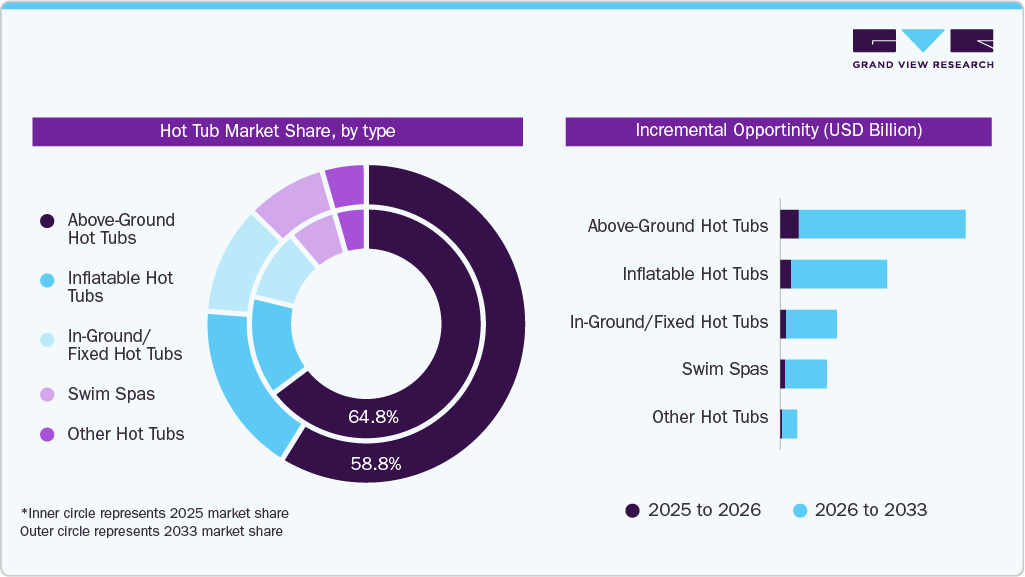
The above-ground hot tubs segment accounted for the largest revenue share of 64.8% in 2025. Their leadership is primarily linked to their relatively straightforward installation, lower site-preparation requirements, broad compatibility with existing residential outdoor spaces, and availability across multiple sizes and price points. Unlike in-ground or fixed installations, above-ground units generally do not require extensive excavation or permanent structural modification, reducing installation complexity for homeowners. The segment also benefits from the large residential customer base, which represented 75.00% of global hot tub revenue in 2025. Major manufacturers offer above-ground models with hydrotherapy jets, energy-efficient insulation, integrated lighting, water-care systems, digital controls, and entertainment features, allowing the category to serve both mainstream and premium consumers.
 To learn more about this report, Download Free Sample Report
The inflatable hot tubs segment is projected to register the fastest growth, at 7.2% CAGR during 2026-2033. Their growth is supported by lower purchase prices, portability, a relatively simple setup, and suitability for consumers testing hot tub ownership before committing to a permanent installation. Inflatable models are particularly relevant for smaller homes, rental properties, temporary outdoor spaces, and seasonal usage. The category also expands the addressable consumer base by providing an entry point below conventional rigid-shell hot tubs. However, permanent above-ground models are expected to remain dominant because of their greater durability, insulation performance, hydrotherapy capability, and suitability for long-term residential use.
Seating Capacity Insights
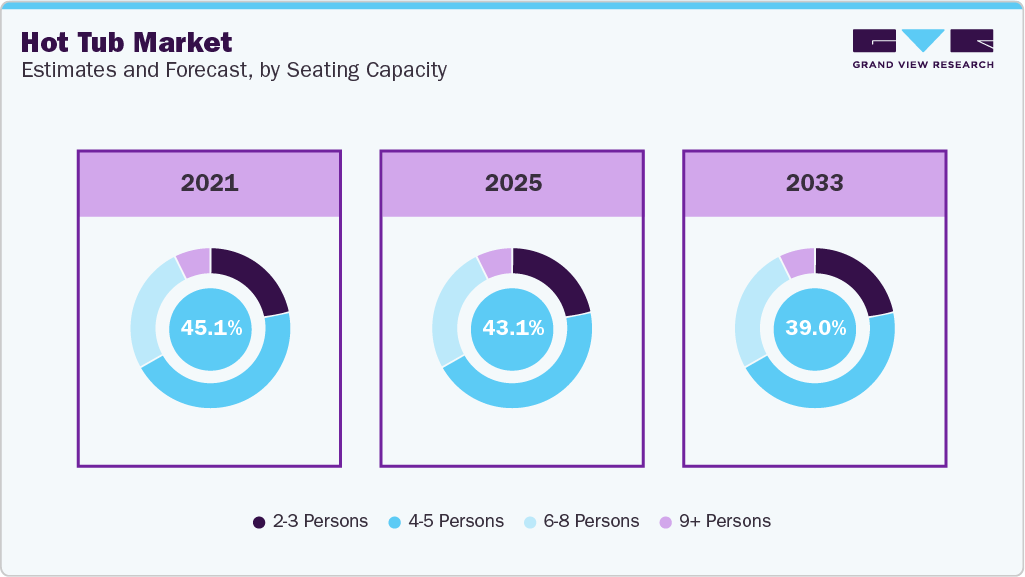
The 4-5 persons segment accounted for the largest revenue share of 43.1% in 2025. The segment occupies a practical middle ground between compact personal units and larger social or commercial models. Four- to five-person configurations are suitable for couples, families, and small groups while generally requiring less outdoor space and lower operating requirements than larger-capacity units. Manufacturers commonly offer this capacity across entry-level, mid-range, and premium models, allowing consumers to select between basic hydrotherapy functionality and more advanced features such as multiple jet zones, ergonomic seating, LED lighting, Bluetooth entertainment, and sophisticated water-management systems.
 To learn more about this report, Download Free Sample Report
The 2-3 person segment is projected to register the fastest growth, at 6.5% CAGR during 2026-2033. Their expansion is supported by increasing demand for compact wellness products, particularly where consumers have limited patios, balconies, gardens, or dedicated outdoor areas. Smaller units can also require less water and energy than larger models, making them attractive to buyers concerned about ongoing operating costs. The segment is further supported by consumers increasingly treating hot tubs as personal relaxation and wellness equipment rather than exclusively as social entertainment products. Compact units also provide an accessible option for couples and individual users seeking hydrotherapy without purchasing a larger-capacity model.
End Use Insights
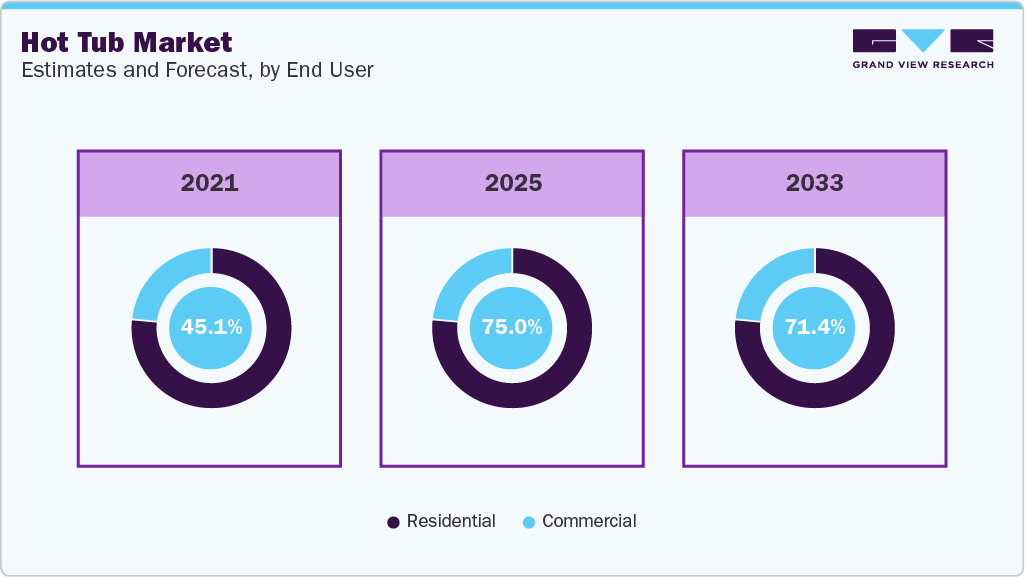
The residential segment accounted for the largest revenue share of 75.0% in 2025. Residential demand is closely connected with the broader shift toward outdoor living, home-based recreation, relaxation, and wellness. Homeowners increasingly use hot tubs as multipurpose amenities for hydrotherapy, stress reduction, family recreation, and socializing, rather than treating them solely as luxury leisure equipment.
 To learn more about this report, Download Free Sample Report
The commercial segment is projected to register the fastest growth, at 6.1% CAGR during 2026-2033. Hotels, resorts, spas, wellness centers, vacation rentals, fitness facilities, and other hospitality establishments increasingly use hot tubs as premium amenities. For commercial operators, hot tubs can enhance guest experience and complement broader wellness offerings such as pools, saunas, massages, and fitness facilities. Vacation-rental properties can also use hot tubs as differentiating amenities when competing for leisure travelers. The commercial segment, therefore, has greater exposure to hospitality investment and wellness tourism, while replacement cycles and multi-unit installations can generate recurring demand for equipment.
Price Tier Insights
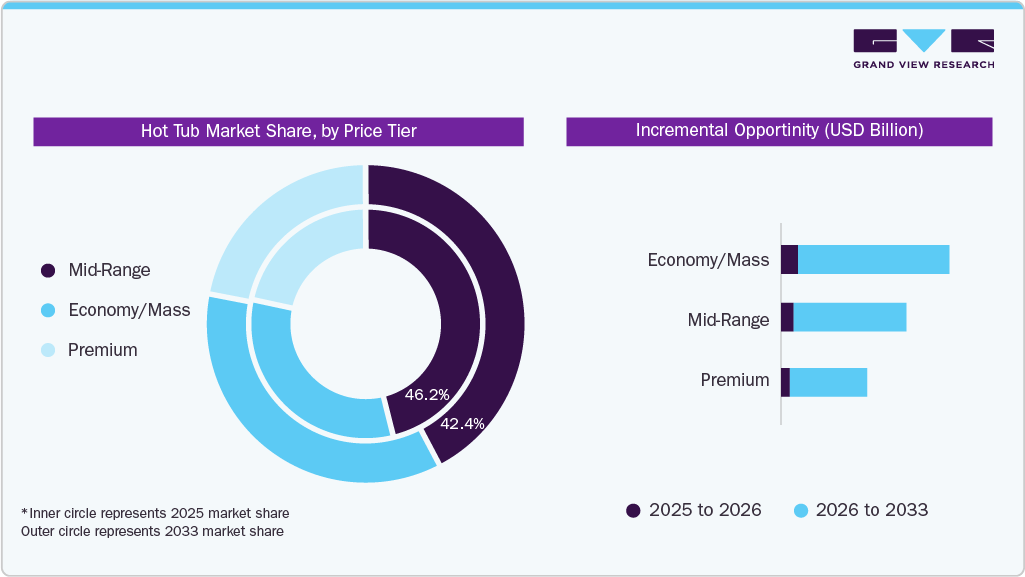
The mid-range hot tubs segment accounted for the largest revenue share of 46.2% in 2025. Their leadership reflects the ability to balance purchase affordability with the features consumers increasingly expect from modern hot tubs. Mid-range models commonly provide multiple hydrotherapy jets, improved insulation, digital controls, filtration systems, LED lighting, ergonomic seating, and water-management features without reaching the substantially higher prices associated with highly customized premium installations. This positioning makes the segment particularly relevant to mainstream residential buyers who want a durable wellness product but remain sensitive to the total ownership cost. The segment's scale is also supported by the broad availability of mid-range models through specialty dealers and manufacturer-led sales channels.
 To learn more about this report, Download Free Sample Report
The economy/mass hot tubs segment is projected to grow at the fastest CAGR of 5.7% during 2026-2033. Growth is supported by greater consumer accessibility to entry-level rigid-shell and inflatable models, lower upfront investment, and increasing interest among first-time buyers. Inflatable hot tubs are particularly important in this price tier because they reduce barriers to transportation, installation, and site preparation. Economy products can therefore attract consumers who previously considered hot tubs too expensive or difficult to install. Continued product improvements, including better insulation, stronger materials, digital controls, and improved filtration, can further encourage consumers to enter the category at lower price points before potentially upgrading to larger or more sophisticated models.
Distribution Channel Insights
The specialty retail stores segment accounted for the largest revenue share, of 52.1%, in 2025, underscoring the enduring importance of physical dealers in hot tub purchasing. Unlike many consumer products, hot tubs require consumers to evaluate physical dimensions, seating ergonomics, jet configuration, shell construction, insulation, controls, filtration, and installation requirements before purchase. Specialty dealers can provide demonstrations, showroom or wet-testing experiences, financing options, delivery coordination, installation support, maintenance services, and replacement parts.
 To learn more about this report, Download Free Sample Report
The online channels segment is projected to be the fastest-growing distribution channel, at 6.5% CAGR from 2026 to 2033. Consumers increasingly use digital channels to compare models, specifications, prices, dimensions, features, energy requirements, warranties, and customer reviews before visiting a dealer or completing a purchase. Online discovery is particularly valuable for inflatable and entry-level products that involve less complex installation.
Regional Insights
The North America hot tub market accounted for the largest revenue share of 41.7% in 2025, supported by high household purchasing power, widespread backyard and outdoor-living culture, established spa-dealer networks, and strong replacement demand for installed hot tubs. The U.S. dominates regional demand, while Canada benefits from strong suitability for hot tubs in colder climates and growing consumer interest in year-round home wellness. Energy efficiency, insulation, smart controls, hydrotherapy, and premium seating configurations are increasingly important purchase criteria.
 To learn more about this report, Download Free Sample Report
U.S. Hot Tub Market Trends
The hot tub market in the U.S. accounted for approximately 86.5% of North America, driven by a large installed base, strong adoption of backyard leisure products, high discretionary spending, and an extensive network of manufacturers, dealers, retailers, installers, and service providers. Replacement and upgrade purchases represent an important demand pool, particularly as consumers move toward larger models, improved hydrotherapy, energy-efficient insulation, smart controls, and premium wellness features. The U.S. is also the primary competitive hub for brands such as Jacuzzi Brands, Watkins Wellness, Master Spas, Bullfrog International, Cal Spas, and Sundance Spas.
The Canada hot tub market is supported by the country’s cold climate, detached-home ownership, outdoor-living culture, and consumer preference for year-round wellness amenities. Insulation quality, energy efficiency, durable cabinets, effective heating systems, and winter performance are particularly important differentiators. Canadian manufacturers and brands such as Arctic Spas, Coast Spas, and Canadian Spa Company benefit from their ability to design products suited to colder conditions. Canada is also expected to be the fastest-growing market in North America, with an estimated CAGR of approximately 6.1% through 2026-2033.
Europe Hot Tub Market Trends
The hot tub market in Europe accounted for approximately 27.0% of global revenue in 2025, supported by established outdoor-living markets, strong wellness culture, developed tourism infrastructure, and demand for premium home leisure products. The region has a relatively mature installed base, making replacement, refurbishment, and upgrading important sources of demand. Energy efficiency is particularly influential because of European electricity costs and environmental considerations. The UK, Germany, France, Italy, and the Nordic countries represent important demand centers, while premium manufacturers compete through design, energy performance, hydrotherapy, and smart-home integration.
The Germany hot tub market represents one of Europe's largest markets, with an estimated share of 28.4% in 2025, supported by high household purchasing power, an established wellness culture, and strong consumer emphasis on product quality and energy efficiency. Demand is particularly relevant to detached homes, gardens, wellness facilities, hotels, and premium leisure properties. German consumers tend to place considerable emphasis on durability, operating costs, insulation, engineering quality, and environmental performance. Premium and mid-range hard-shell hot tubs, therefore, represent the core of the market, while smart controls and energy-efficient heating systems are becoming increasingly relevant in purchasing decisions.
The hot tub market in the UK is supported by strong consumer interest in garden leisure, home wellness, staycations, and outdoor entertainment. The UK's developed specialist-retailer and dealer network provides consumers with access to installation, financing, maintenance, and after-sales services, supporting higher-value purchases. Demand is also influenced by the hospitality sector, holiday parks, vacation rentals, and boutique accommodation. The market is relatively mature, making replacement and upgrading of existing installations an important growth mechanism alongside new household penetration.
Asia Pacific Hot Tub Market Trends
The hot tub market in Asia Pacific represents the fastest-growing regional market, with an estimated CAGR of 6.2% from 2026 to 2033. Growth is supported by rising disposable incomes, expanding premium residential construction, luxury hospitality development, wellness tourism, and increasing consumer interest in home-based relaxation. Japan, China, Australia, South Korea, and affluent Southeast Asian markets are important demand centers. Unlike mature Western markets, a significant portion of regional growth is coming from new installations in premium residential developments, hotels, resorts, spas, and wellness facilities.
The China hot tub market held the largest share of 25.7% in Asia Pacific in 2025. Demand is increasingly associated with luxury residential developments, villas, hotels, resorts, spas, and high-income households. China's rapidly expanding wellness and hospitality infrastructure provides a significant commercial demand base, while premium residential construction creates opportunities for integrated outdoor and indoor spa installations. The market remains more concentrated toward premium consumers than mass-market household adoption, with product differentiation increasingly centered on smart controls, hydrotherapy, design, and integration with broader home wellness systems.
The hot tub market in Australia & New Zealand is expected to be one of the fastest-growing markets in Asia Pacific, supported by a strong outdoor-living culture, high detached-home penetration, favorable demand for backyard leisure products, and expanding wellness and hospitality applications. Consumers increasingly seek premium outdoor entertainment and wellness solutions, while resorts, holiday accommodation, and luxury residential developments provide additional demand. Energy efficiency, water management, UV-resistant materials, and products designed for outdoor climatic conditions are important competitive factors.
Central & South America Hot Tub Market Trends
The hot tub market in Central & South America accounted for approximately 6.5% of global revenue in 2025, supported by increasing investment in hospitality, resorts, luxury residential projects, wellness centers, and vacation properties. Brazil represents the largest market, while Mexico's inclusion in North America means that Brazil, Argentina, Chile, Colombia, and other South American markets form the principal regional demand base. Compared with North America and Europe, penetration of residential hot tubs remains lower, leaving considerable scope for expansion as premium housing, tourism, and wellness facilities develop.
The Brazil hot tub market represents the largest market in Central & South America, with a share of 58.2% in 2025. Demand is concentrated in higher-income residential consumers, luxury condominiums, hotels, resorts, clubs, and vacation properties. The country's warm climate means that hot tubs compete partly with swimming pools and other outdoor leisure products, but they are increasingly positioned as compact wellness and hydrotherapy solutions. Local manufacturing and regional distribution capabilities support product availability, while premium residential construction and hospitality development provide opportunities for higher-value models.
Middle East & Africa Hot Tub Market Trends
The hot tub market in the Middle East & Africa accounted for approximately 3.9% of global revenue in 2025. Growth is concentrated in the Gulf, where high-income consumers, luxury hospitality, tourism, premium residential developments, and wellness facilities support demand. Unlike colder markets, hot tubs in the Middle East are frequently positioned as premium wellness, leisure, and hospitality amenities rather than essential outdoor products. Hotels, resorts, villas, private clubs, and luxury developments, therefore, represent important demand channels.
The UAE hot tub market is the largest market in the Middle East & Africa region, with an estimated share of 42.2% in 2025. Dubai and Abu Dhabi are the principal demand centers because of their concentration of luxury hotels, resorts, high-end residential developments, villas, wellness facilities, and affluent consumers. The country's position as an international tourism and luxury-property hub supports both residential and commercial demand. Buyers in this segment generally prioritize premium design, advanced hydrotherapy, smart controls, aesthetic integration, and reliable after-sales service. The UAE also provides a gateway for international hot tub brands entering wider Gulf markets.
The hot tub market in South Africa represents one of the more established African markets, with demand concentrated in affluent residential areas, luxury lodges, hotels, resorts, spas, and vacation accommodations. The market benefits from an established outdoor leisure culture and a developed hospitality sector. Johannesburg, Cape Town, Durban, and major tourism destinations provide important demand centers. Compared with the Gulf, residential demand is more relevant, while tourism properties provide an important commercial customer base. Premium consumers increasingly consider energy efficiency, durability, installation support, and maintenance availability when purchasing hot tubs.
Key Hot Tub Companies Insights
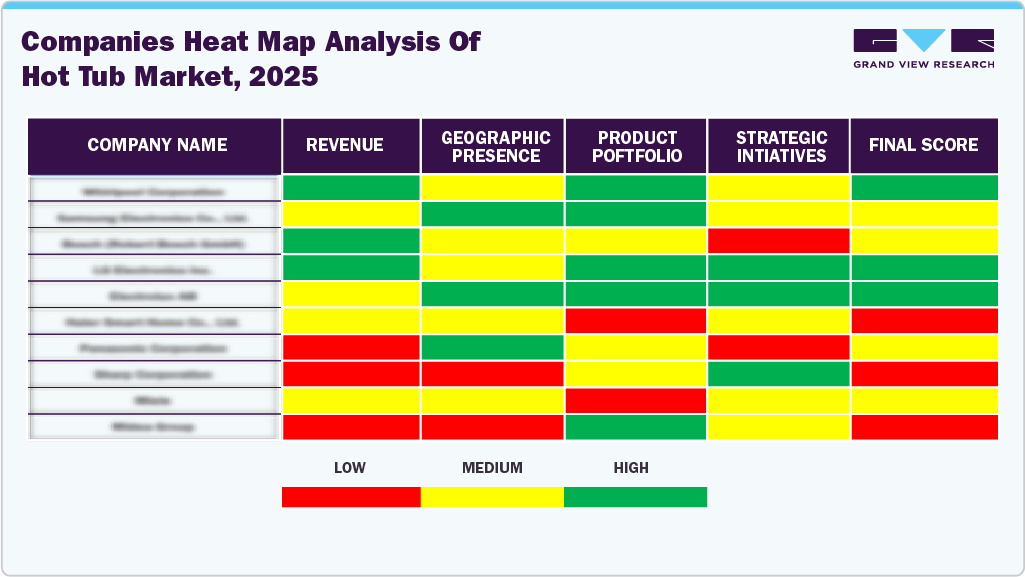
The global hot tub market is moderately fragmented, with competition concentrated among established North American and European spa manufacturers, premium wellness brands, and a broad base of regional and independent manufacturers. Unlike highly consolidated durable-goods categories, the hot tub market does not have a single company controlling a dominant global share. Competitive positioning is shaped by product reliability, hydrotherapy features, energy efficiency, insulation technology, brand reputation, dealer networks, after-sales service, customization, and pricing. North America remains the core competitive hub, while European manufacturers differentiate through design, energy efficiency, and premium wellness positioning.
-
Leading Global Hot Tub Manufacturers: Companies such as Jacuzzi Brands, Watkins Wellness, Master Spas, Bullfrog International, Cal Spas, Sundance Spas, and Artesian Spas form the leading competitive group, particularly across the premium and mid-to-premium segments. These companies benefit from established dealer networks, long operating histories, broad product portfolios, strong brand recognition, and recurring demand for replacement and upgrade purchases. Their competitive strength extends beyond the physical hot tub to installation, servicing, water-care solutions, warranties, and dealer-supported customer relationships.
-
Premium & Technology-Focused Players: Bullfrog International, Sundance Spas, Jacuzzi Brands, Watkins Wellness, and Master Spas compete strongly in higher-value hot tubs by emphasizing hydrotherapy, seating configurations, jet systems, energy efficiency, insulation, smart controls, and modular or customizable features. Bullfrog differentiates through its JetPak therapy system, while premium brands increasingly integrate app-based controls, automated water-care features, improved insulation, and energy-management technologies to justify higher selling prices.
-
Regional & Specialist Manufacturers: Companies such as Arctic Spas, Coast Spas, Artesian Spas, Canadian Spa Company, and Cal Spas strengthen competition through regional manufacturing expertise and specialization in specific climatic or consumer requirements. Arctic Spas, for example, has a strong positioning around cold-climate performance and insulation, while Canadian manufacturers benefit from product engineering suited to colder environments. These companies compete effectively where dealer relationships, local service availability, and climate-specific product performance influence purchasing decisions.
-
Inflatable & Value-Oriented Competition: The competitive structure becomes significantly more fragmented in the entry-level segment because inflatable hot tubs are supplied by a wider group of manufacturers and consumer goods brands. Companies such as Bestway and Intex have expanded access to hot tubs through relatively low purchase prices, portability, simplified installation, and mass-market distribution. This segment competes primarily on affordability and convenience rather than advanced hydrotherapy, premium materials, or long-term durability, creating a distinct competitive tier below traditional acrylic and hard-shell spas.
-
Market Share is Highly Fragmented: Company-level market share should be interpreted carefully because most manufacturers do not separately disclose global hot tub revenue, and reported corporate revenues frequently include swim spas, accessories, chemicals, replacement parts, services, or other wellness products. The leading established manufacturers, therefore, account for a meaningful proportion of premium hard-shell hot tub sales, but no individual company is likely to command a dominant share of the total global market. Regional manufacturers, independent dealers, private-label suppliers, and inflatable hot tub brands collectively represent a substantial portion of industry volume.
-
Dealer Networks as a Competitive Moat: Distribution and after-sales service remain major determinants of competitive positioning. Traditional hot tubs are relatively bulky products requiring delivery, site preparation, installation, warranty support, maintenance, and replacement components; consequently, manufacturers with dense authorized-dealer networks possess an advantage over purely online competitors. Dealer relationships are particularly important in North America, where consumers commonly evaluate multiple spa models through physical showroom experiences before purchase.
-
Premiumization & Product Differentiation: Competition is increasingly shifting from basic soaking functionality toward differentiated wellness experiences. Manufacturers are adding targeted hydrotherapy zones, ergonomic seating, enhanced massage systems, lighting, waterfalls, Bluetooth/audio systems, smartphone controls, improved filtration, and energy-efficient insulation. Premium manufacturers can therefore expand average selling prices by combining physical product upgrades with personalization and wellness-oriented features rather than competing solely on tub size.
-
Energy Efficiency and Operating Cost: Energy consumption is becoming an increasingly important purchasing criterion, particularly in colder climates and markets with elevated electricity costs. Manufacturers are competing through improved cabinet insulation, thermal covers, efficient pumps, circulation systems, heat-retention technologies, and smarter heating controls. This favors established manufacturers with greater engineering capabilities and creates differentiation beyond the initial purchase price.
-
The competitive environment is expected to remain fragmented, but consolidation and brand portfolio expansion could gradually strengthen the position of large manufacturers with broad dealer networks and strong manufacturing capabilities. The most defensible competitive advantages are likely to come from brand trust, hydrotherapy innovation, energy efficiency, service infrastructure, customization, and lifecycle support, rather than manufacturing scale alone.
 To learn more about this report, Download Free Sample Report
Key Hot Tub Companies
The following key companies have been profiled for this study on the hot tub market.
-
Jacuzzi Brands LLC
-
Watkins Wellness (Hot Spring Spas)
-
Master Spas
-
Bullfrog International
-
Cal Spas
-
Sundance Spas
-
Blue Falls Mfg. (Arctic Spas)
-
Artesian Spas
-
Coast Spas
-
Canadian Spa Company
Competitive Benchmarking
Category
Operating Strategies
Competitive Edge
Weakness
Established Players (Jacuzzi Brands LLC; Watkins Wellness (Hot Spring Spas); Master Spas; Cal Spas; Sundance Spas)
Maintain broad portfolios spanning above-ground hot tubs, swim spas, premium fixed installations, and multiple seating capacities. Strengthen dealer networks, showroom presence, after-sales service, and product innovation around energy efficiency, hydrotherapy, smart controls, and water-management systems. Continue targeting residential consumers while expanding commercial applications such as hotels, resorts, and wellness facilities.
Strong brand recognition, extensive dealer and service networks, established manufacturing capabilities, and long-standing relationships with homeowners, dealers, hospitality operators, and contractors. Broad product portfolios allow these companies to serve multiple price tiers and use cases while supporting premium positioning.
High manufacturing and distribution costs, dependence on discretionary consumer spending and residential construction/remodeling cycles, and relatively high exposure to energy-efficiency regulations and fluctuations in component, acrylic, equipment, and transportation costs. Large established organizations may also face slower product-cycle adaptation than smaller specialized competitors.
Emerging & Specialty Players (Bullfrog International; Blue Falls Mfg. (Arctic Spas); Artesian Spas; Coast Spas; Canadian Spa Company)
Focus on differentiated hydrotherapy systems, energy-efficient designs, premium customization, cold-climate performance, swim spas, and specialized residential wellness applications. Leverage dealer partnerships, regional distribution, digital marketing, and product-specific technologies to compete against larger brands. Emphasize modular jet systems, insulation, durability, smart controls, and customization to strengthen consumer appeal.
Greater specialization in hydrotherapy, energy efficiency, customization, and niche applications enables these companies to differentiate beyond basic hot-tub functionality. Strong dealer relationships and focused product portfolios also allow faster responses to consumer preferences and regional requirements, particularly in premium and specialty segments.
Smaller manufacturing scale and geographic reach compared with the largest global brands. Greater dependence on dealer networks, premium residential demand, and discretionary spending can increase vulnerability during housing slowdowns or weaker consumer confidence. International expansion may also require higher logistics, service, and distribution investments.
Recent Developments
-
In May 2026, Olympic Hot Tub acquired Spa Warehouse, a regional hot tub and wellness retailer in the Pacific Northwest and exclusive dealer for Caldera Spas. The acquisition expanded Olympic Hot Tub’s presence across the Puget Sound region and strengthened its product offering by combining Caldera Spas with its existing Hot Spring Spas business, both manufactured by Watkins Wellness. This reflects continued consolidation among specialty hot tub retailers and expansion of dealer networks.
-
In October 2025, King Technology acquired Unique Solutions of North Dakota, the manufacturer of Ahh-some and Hot Tub Serum water-care products. The transaction added jet-cleaning and hot tub water-treatment products to King Technology’s portfolio and strengthened its position in the hot tub, pool and swim-spa chemical market. The deal highlights increasing strategic interest in recurring-revenue categories such as water treatment and maintenance products, alongside the sale of hot tubs themselves.
-
In June 2025, Platinum Spas launched its Luxury Collection comprising six new hot tub models incorporating advanced hydrotherapy, intelligent water-care technology and enhanced insulation. The collection was designed around premium wellness experiences while placing greater emphasis on energy efficiency and simplified ownership. This indicates that premium manufacturers are increasingly differentiating products through technology, wellness functionality and operating efficiency rather than relying only on conventional jet configurations.
-
In May 2025, Bullfrog Spas highlighted continued expansion of its U.S. operations and worldwide retail network, with products being sold through hundreds of retail locations and 25 factory-owned stores. The company continued to emphasize U.S.-based manufacturing, product customization and its JetPak Therapy System, reinforcing the industry's movement toward customizable hydrotherapy and differentiated premium spa configurations.
-
In February 2025, Masco reported that Watkins Wellness had achieved double-digit sales growth from the integration of Sauna360 into its dealer network and had expanded into cold-plunge products. The development demonstrates how major hot tub manufacturers are increasingly building broader home-wellness ecosystems around hot tubs, combining spas with adjacent categories such as saunas and cold therapy rather than operating solely as hot tub manufacturers.
-
In 2025, Jacuzzi expanded the availability of its infrared and red-light therapy technology across additional hot tub models and continued development of its True Water™ nanobubble water-care technology. The company positions the technology around reducing reliance on conventional chemicals and simplifying water maintenance, demonstrating the industry's broader shift toward wellness-oriented hydrotherapy and automated/lower-maintenance water treatment.
Hot Tub Market Report Scope
Report Attribute
Details
Market size in 2025
USD 5.6 billion
Estimated market size in 2026
USD 5.9 billion
Revenue forecast in 2033
USD 7.9 billion
Growth rate
CAGR of 4.4% from 2026 to 2033
Base year
2025
Actuals
2021 - 2025
Forecast period
2026 - 2033
Quantitative units
Revenue in USD billion and CAGR from 2026 to 2033
Report coverage
Revenue forecast, company ranking, competitive landscape, growth factors, and trends
Segments covered
Type, seating capacity, end use, price tier, distribution channel, region
Regional scope
North America; Europe; Asia Pacific; Central & South America; Middle East & Africa
Country scope
U.S.; Canada; Mexico; UK; Germany; France; Italy; Spain; China; India; Japan; Australia & New Zealand; South Korea; Brazil; UAE; South Africa
Key companies profiled
Jacuzzi Brands LLC; Watkins Wellness (Hot Spring Spas); Master Spas; Bullfrog International; Cal Spas; Sundance Spas; Blue Falls Mfg. (Arctic Spas); Artesian Spas; Coast Spas; Canadian Spa Company
Customization scope
Free report customization (equivalent up to 8 analysts’ working days) with purchase. Addition or alteration to country, regional & segment scope.
Pricing and purchase options
Avail customized purchase options to meet your exact research needs. Explore purchase options
Global Hot Tub Market Report Segmentation
This report forecasts revenue growth at global, regional & country levels and provides an analysis of the latest trends and opportunities in each of the sub-segments from 2026 to 2033. For this study, Grand View Research has segmented the global hot tub market report on the basis of type, seating capacity, end use, price tier, distribution channel, and region:
-
Type Outlook (Revenue, USD Billion, 2021 - 2033)
-
Above-Ground Hot Tubs
-
Inflatable Hot Tubs
-
In-Ground / Fixed Hot Tubs
-
Swim Spas
-
Other Hot Tubs
-
-
Seating Capacity Outlook (Revenue, USD Billion, 2021 - 2033)
-
2-3 Persons
-
4-5 Persons
-
6-8 Persons
-
9+ Persons
-
-
End Use Outlook (Revenue, USD Billion, 2021 - 2033)
-
Residential
-
Commercial
-
-
Price Tier Outlook (Revenue, USD Billion, 2021 - 2033)
-
Economy/Mass
-
Mid-Range
-
Premium
-
-
Distribution Channel Outlook (Revenue, USD Billion, 2021 - 2033)
-
Specialty Retail Stores
-
Direct-to-Consumer (D2C)
-
Online Channels
-
Others
-
-
Regional Outlook (Revenue, USD Billion, 2021 - 2033)
-
North America
-
U.S.
-
Canada
-
Mexico
-
-
Europe
-
Germany
-
UK
-
France
-
Italy
-
Spain
-
-
Asia Pacific
-
China
-
India
-
Japan
-
Australia & New Zealand
-
South Korea
-
-
Central & South America
-
Brazil
-
-
Middle East & Africa
-
UAE
-
South Africa
-
-
Research Methodology
The hot tub market figures in this report are based on a proven research process that combines executive interviews with secondary research from proprietary databases, company filings, and recognized regulatory and institutional sources. Market size is built through value-chain sizing-reconciling supply-side and demand-side estimates-and triangulated with bottom-up and top-down approaches. Every estimate passes multiple levels of expert validation before publication, with each hot tub segment quantified using the revenue-capture definitions in the table below.
Segment Definition
Type
Revenue capture definition
Above-Ground Hot Tubs
Covers portable or permanently positioned hot tubs installed above ground level, including acrylic, fiberglass, molded, and other rigid-shell units. Includes indoor and outdoor configurations, integrated seating, water jets, heating systems, filtration, controls, covers, and standard accessories. Excludes swimming pools and standalone bathtubs without hydrotherapy functionality.
Inflatable Hot Tubs
Covers portable hot tubs manufactured primarily with inflatable or air-supported structures, including PVC and reinforced multilayer materials. Includes compact and family-sized models, integrated heating, bubbling or hydrotherapy systems, filtration, control units, inflatable covers, liners, pumps, and associated accessories supplied as part of the product.
In-Ground / Fixed Hot Tubs
Covers hot tubs permanently installed into ground-level structures, decks, terraces, floors, or purpose-built outdoor and indoor installations. Includes fixed acrylic, concrete, fiberglass, tile, and other constructions incorporating hydrotherapy jets, heating, filtration, circulation, controls, seating, lighting, covers, and installation-related components.
Swim Spas
Covers elongated spa systems combining hydrotherapy seating with swimming or resistance-training functionality. Includes single-zone and dual-zone configurations, integrated current-generation systems, hydrotherapy jets, heating and filtration equipment, exercise features, seating areas, covers, controls, and related accessories sold with residential or commercial swim-spa installations.
Other Hot Tubs
Covers hot-tub products not classified as above-ground, inflatable, in-ground/fixed hot tubs, or swim spas. Includes specialized compact units, unconventional constructions, wood-fired or wood-bodied spa systems, and other hydrotherapy-oriented soaking products incorporating heating, water circulation, jets, filtration, seating, or related control systems.
Seating Capacity
Revenue capture definition
2-3 Persons
Covers hot tubs designed and marketed for simultaneous occupancy of two to three users. Includes compact portable, rigid-shell, inflatable, and fixed configurations with corresponding seating layouts, hydrotherapy jets, heating and filtration systems, controls, covers, and standard accessories. Capacity is based on the manufacturer-specified intended number of users.
4-5 Persons
Covers hot tubs designed for simultaneous use by four to five people, including portable, rigid-shell, inflatable, and permanently installed configurations. Includes product models with multiple seating positions, lounge seating where applicable, hydrotherapy jets, heating, filtration, circulation, controls, covers, steps, and standard manufacturer-supplied accessories.
6-8 Persons
Covers hot tubs specified for simultaneous occupancy of six to eight users across residential and commercial configurations. Includes above-ground, inflatable, fixed, and applicable spa models with multiple seats or loungers, hydrotherapy jets, heating, filtration, circulation, control systems, covers, steps, and other standard product accessories.
9+ Persons
Covers large-capacity hot tubs designed for simultaneous occupancy of nine or more users. Includes residential, hospitality, wellness, recreational, and other commercial configurations with multiple seating positions, hydrotherapy systems, heating and filtration equipment, circulation systems, controls, covers, access components, and standard accessories supplied with the installation.
End Use
Revenue capture definition
Residential
Covers hot tubs purchased or installed for use in private residences, including detached homes, apartments, condominiums, vacation properties, and private recreational spaces. Includes indoor and outdoor installations, portable and fixed units, and associated heating, filtration, hydrotherapy, controls, covers, maintenance equipment, and accessories intended for household use.
Commercial
Covers hot tubs used within commercial, institutional, hospitality, wellness, recreational, and shared-use facilities. Includes installations in hotels, resorts, spas, gyms, clubs, rental properties, healthcare and wellness facilities, and other establishments, together with commercial-grade heating, filtration, hydrotherapy, controls, maintenance systems, covers, and supporting equipment.
Price Tier
Revenue capture definition
Economy / Mass
Covers hot tubs positioned within entry-level and mass-market pricing, including basic rigid-shell, inflatable, and selected portable configurations. Products may include fundamental heating, filtration, circulation, jet, seating, control, and covering systems, with pricing reflecting standardized specifications, mainstream materials, limited customization, and broad retail or online availability.
Mid-Range
Covers hot tubs positioned above entry-level products and below premium offerings, incorporating enhanced materials, construction, seating configurations, hydrotherapy features, heating, filtration, insulation, controls, and accessories. Includes products sold through specialty retailers, D2C channels, dealers, and online platforms with broader feature combinations and moderate customization.
Premium
Covers higher-priced hot tubs featuring advanced construction, premium materials, enhanced insulation, sophisticated hydrotherapy systems, greater seating configurations, advanced controls, lighting, water-management features, energy-efficiency components, and extensive accessories. Includes high-specification residential and commercial models with greater customization, upgraded finishes, and specialized installation requirements.
Distribution Channel
Revenue capture definition
Specialty Retail Stores
Covers sales of hot tubs through dedicated spa, pool, wellness, and specialty home-improvement retailers operating physical stores or dealer showrooms. Includes manufacturer-authorized dealers and independent specialty retailers where customers can evaluate products, receive specifications, obtain installation services, and purchase hot tubs, accessories, maintenance products, and related equipment.
Direct-to-Consumer (D2C)
Covers hot-tub sales conducted directly by manufacturers or brands through their own branded websites, company-owned stores, showrooms, sales teams, or direct sales programs. Includes transactions where the brand controls customer acquisition and sales, with products covering hot tubs, swim spas, configurations, accessories, installation services, and related direct offerings.
Online Channels
Covers hot-tub transactions conducted through third-party digital marketplaces, multi-brand e-commerce platforms, online retailers, and other independent internet-based sales channels. Includes inflatable and portable units as well as selected rigid-shell products available for online purchase, together with associated accessories, equipment, delivery arrangements, and digitally facilitated transactions.
Others
Covers hot-tub sales through distribution routes not classified under specialty retail stores, D2C, or online channels. Includes independent dealers without dedicated specialty-store classification, pool and landscape contractors, builders, project-based suppliers, hospitality procurement, distributors, wholesalers, and other intermediary or institutional procurement channels.
Estimation Model
Layer
Guiding Question
Description
01 Property & Facility Base Layer
Where can hot tubs potentially be installed?
Residential housing stock forms the primary demand pool, complemented by hotels, resorts, spas, gyms, vacation rentals, and other wellness-oriented establishments. Relevant indicators include owner-occupied housing, detached/semi-detached homes, outdoor living space, climate suitability, household income, hospitality capacity, and wellness infrastructure.
02 Installation Suitability & Affordability Layer
Which properties/facilities are realistically suitable for hot tub installation?
Household disposable income, homeownership, property characteristics, outdoor-space availability, electricity access, climate, and discretionary spending establish the economically and practically suitable customer base. Commercial suitability is assessed through hotel/resort room inventory, spa facilities, gyms, and vacation-rental properties.
03 New Installation & Replacement Demand Layer
How many hot tubs are purchased each year?
Hot-tub penetration, new installations, replacement cycles, refurbishment, upgrades, and incremental purchases determine annual unit demand. Demand is differentiated across permanent/above-ground units, portable and inflatable models, seating capacities, and residential versus commercial applications. Total units, ownership, and sales data provide important calibration points.
04 Monetisation Layer
How much revenue is generated?
Annual unit demand is valued using segment-specific ASPs across portable, above-ground, inground, inflatable, and premium smart hot tubs. Revenue differences in seating capacity, material features, energy efficiency, control units, installation complexity, and brand positioning. Equipment, accessories, installation, and aftermarket services can be treated separately depending on the defined market scope.
Delivered Customizations
This report has been delivered with the following In-depth customizations
Client Request
Customization Delivered
Value Adds
Cross-Segmentation Analysis of Hot Tubs Types, seating capacities, End Use & Regional Demand
Detailed cross-segmentation of above-ground, inflatable, in-ground/fixed hot tubs, swim spas, and other formats by 2-3, 4-5, 6-8, and 9+ person capacity, further mapped across residential and commercial users. The analysis evaluates the suitability of each configuration for detached homes, apartments, vacation homes, hotels, resorts, spas, fitness facilities, and other commercial locations.
Identifies the product configurations with the strongest fit for different use environments rather than treating all hot tubs as a single category. The analysis can highlight the shift toward larger-capacity units for family/social use and the increasing relevance of swim spas for wellness and aquatic fitness. PHTA industry commentary specifically notes growing consumer interest in larger hot tubs and high demand for swim spas.
Residential vs. Commercial Hot Tub Opportunity Mapping
Separate assessment of residential and commercial demand, including household purchases, second homes, vacation properties, hotels, resorts, spas, health clubs, and hospitality properties. The analysis compares purchase drivers, installation requirements, utilization rates, replacement cycles, maintenance requirements, and purchasing decision-makers for each end-user group.
Helps identify that residential buyers are more influenced by wellness, relaxation, family use, backyard experience, aesthetics, and affordability, whereas commercial buyers place greater emphasis on durability, serviceability, operating cost, installation, safety, and lifecycle economics. This creates a more actionable view of where premium and high-capacity products can be positioned.
Hot Tub Wellness & Lifestyle Application Mapping
Analysis of demand according to the principal consumer use case: relaxation/stress relief, sleep and recovery, hydrotherapy, fitness/recovery, family/social use, outdoor leisure, and hospitality/wellness experiences. The study maps these applications to product type, seating capacity, premium features, and target consumer groups.
Moves the market analysis beyond “hot tub ownership” and identifies the actual reason for purchase. This is particularly relevant for premium products, where manufacturers can sell therapeutic jets, ergonomic seating, hydrotherapy, water features, lighting, and wellness-oriented experiences rather than competing purely on size and price. PHTA industry commentary identifies wellness, stress relief, sleep, family connection, and athletic recovery among the benefits increasingly associated with hot-tub use.
Frequently Asked Questions About This Report
The global hot tub market was valued at USD 5.6 billion in 2025 and is projected to reach USD 5.9 billion in 2026.
North America dominated the market, accounting for 41.7% of revenue in 2025.
Asia Pacific is the fastest-growing regional market.
The Above-ground hot tubs segment led the market with a 64.8% revenue share in 2025, while inflatable hot tubs are projected to be the fastest-growing type segment at a 7.2% CAGR.
The hot tub for 4–5 Persons segment dominated the market with a 43.1% revenue share in 2025.
The mid-range segment held the largest revenue share of 46.2% in 2025.
The global hot tub market is expected to grow at a 4.4% CAGR from 2026 to 2033, reaching USD 7.9 billion by 2033.
Key factors include rising consumer interest in home wellness and relaxation, growing adoption of residential hot tubs, increasing demand for inflatable and space-efficient models, expanding commercial wellness and hospitality applications, and greater availability of hot tubs through direct-to-consumer and online channels.
Key players include Jacuzzi Brands LLC; Watkins Wellness (Hot Spring Spas); Master Spas; Bullfrog International; Cal Spas; Sundance Spas; Blue Falls Mfg. (Arctic Spas); Artesian Spas; Coast Spas; Canadian Spa Company
About the Author(s)
Homecare & Decor Research Team
Consumer Goods · Homecare & DecorThis report was authored by the homecare & decor research team at Grand View Research - comprising two research analysts, one senior research analyst, and one industry expert - with specialized expertise in the homecare & decor segment of the consumer goods industry. All findings are based on proprietary consumer goods databases, executive interviews, and regulatory analysis, subject to internal peer review prior to publication.
Last Updated:
Speak to Analyst

Customize this report to your needs - add regions, segments, or data points, with 20% free customization.
Or view our licence options:


ISO 9001:2015 & 27001:2022 Certified
We are GDPR and CCPA compliant! Your transaction & personal information is safe and secure. For more details, please read our privacy policy.


