
- Home
- »
- Power Generation & Storage
- »
-
HVDC Converter Transformer Market Size Report 2026-2033GVR Report cover

HVDC Converter Transformer Market (2026 - 2033)
Size, Share & Trends Analysis Report By Phase (Single-Phase, Three-Phase), By Application (Hydropower Converter Station, Wind Power Converter Station), By Power Rating, By Region, And Segment Forecasts
Market Size, 2025
$3.0BMarket Estimate, 2026
$3.2BMarket Forecast, 2033
$5.5BCAGR, 2026–2033
8.0%HVDC Converter Transformer Market Summary
The global HVDC converter transformer market size was valued at USD 3.0 billion in 2025 and is projected to grow from USD 3.2 billion in 2026 to USD 5.5 billion by 2033, at a CAGR of 8.0% from 2026 to 2033. Asia Pacific dominated the market, accounting for the largest revenue share of 45.3% in 2025. The market is driven by rising electricity demand, increasing renewable energy integration, grid modernization, and the expansion of long-distance, high-capacity power transmission networks.
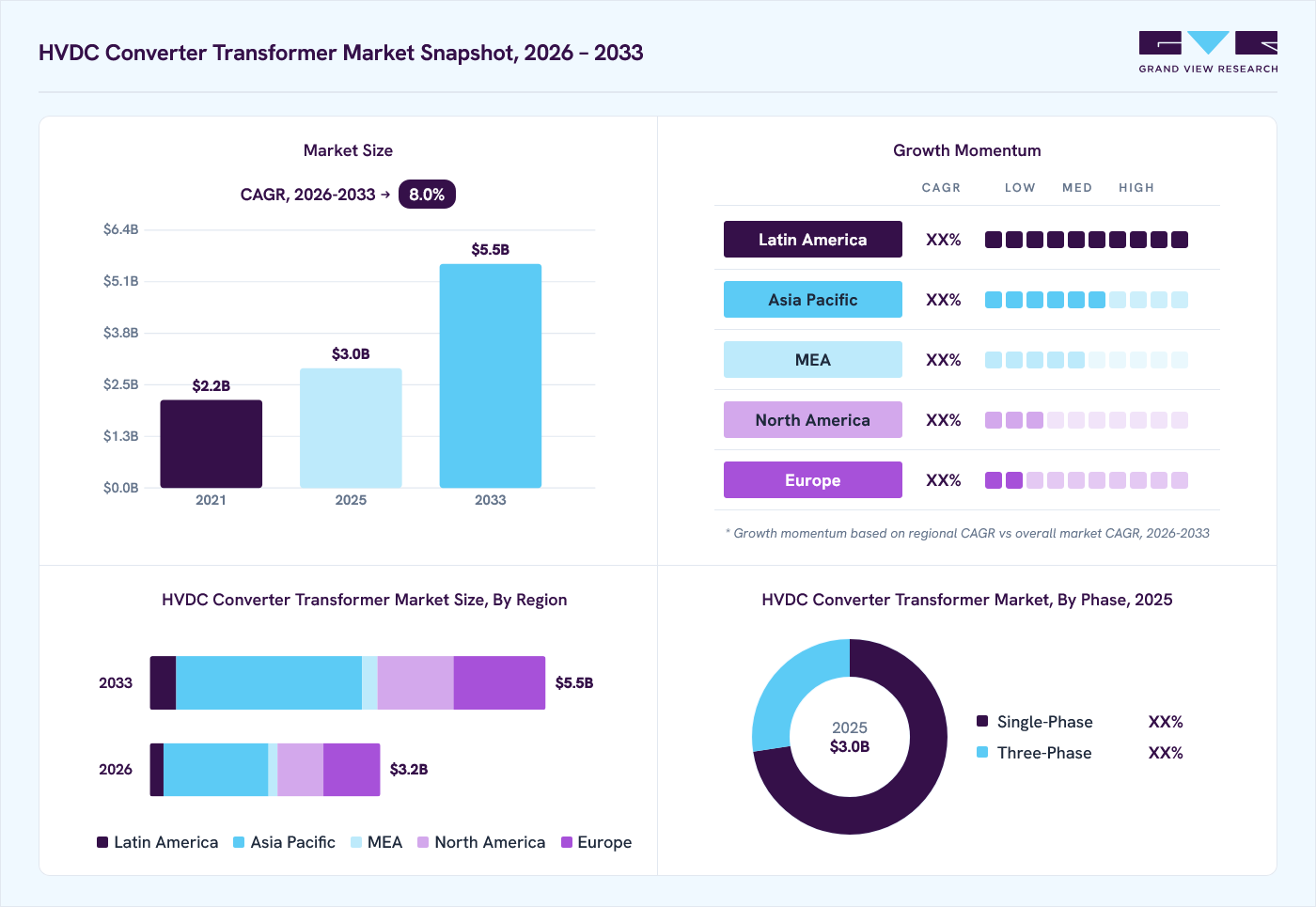 Source: Grand View Research, IR Documents, Primary Interviews, Paid DatabasesTo learn more about this report,
 Download Free Sample Report
Key Market Trends & Insights
- By application: Wind power converter station held the largest revenue share of 23.5% in 2025.
- By power rating: 1,001-3,000 MW held the largest revenue share of 42.9% in 2025.
- By phase: Single-phase segment held the largest revenue share of 72.5% in 2025.
Regional Highlights
- Largest regional market: Asia Pacific (45.3% revenue share, 2025)
- Fastest-growing regional market: Latin America (highest CAGR, 2026-2033)
- By country: China held the largest market share in 2025
Market Size & Forecast
- Market size in 2025: USD 3.0 Billion
- Estimated market size in 2026: USD 3.2 Billion
- Projected market size by 2033: USD 5.5 Billion
- CAGR (2026-2033): 8.0%
GVR research-powered AIAsk Prism AI about the HVDC converter transformer marketGet cited answers from GVR research on market growth, segments, regulations and forecasts.Start with✓ Source-linked answers ✓ Market-specific context ✓ Traceable figuresExplore Prism AI ↗
Growing offshore wind development, cross-border grid interconnections, and UHVDC projects are further supporting demand for HVDC converter transformers, which enable efficient power conversion and transmission over long distances with lower energy losses.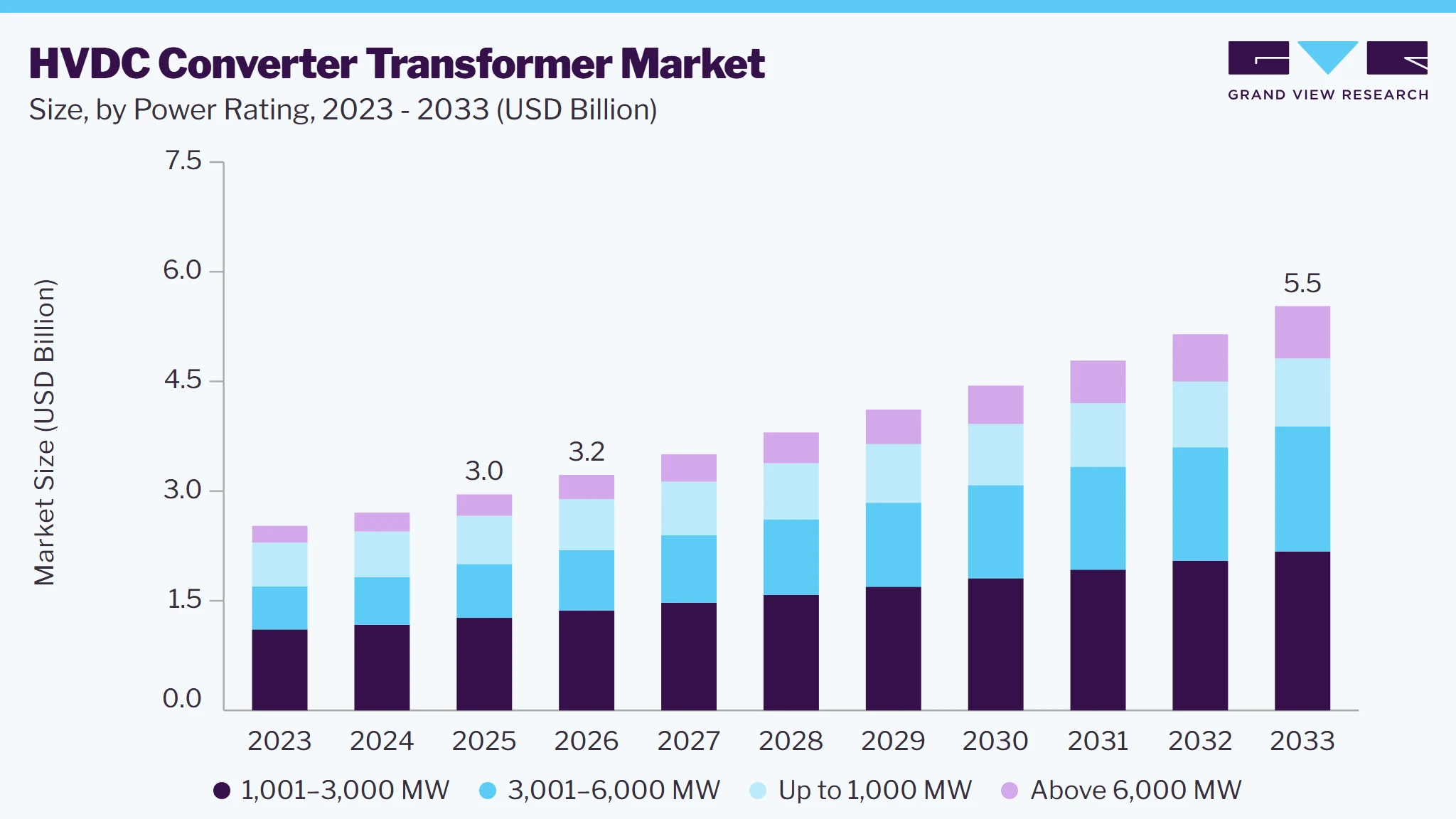 To learn more about this report, Download Free Sample Report
Market Dynamics
The market is shaped by rising electricity demand, increasing integration of renewable energy, grid modernization, and the expansion of long-distance, high-capacity power transmission networks. Demand is further supported by offshore wind projects, cross-border interconnections, and UHVDC transmission corridors, all of which require reliable converter transformer systems. However, high manufacturing costs, complex design requirements, long project lead times, and the need for specialized engineering and testing can limit market growth. Overall, growing investments in renewable power evacuation and grid expansion are expected to outweigh these challenges and support market growth.
The increasing integration of large-scale renewable energy sources, particularly solar and wind, is a key market driver. Renewable power is often generated in remote locations, requiring efficient transmission over long distances to major consumption centers. HVDC systems enable high-capacity power transfer with lower losses and improved grid stability, thereby increasing demand for converter transformers as countries expand renewable energy evacuation and interstate transmission infrastructure.
In June 2025, Hitachi Energy announced its participation in China’s Gansu-Zhejiang ±800 kV UHVDC project, described as the world's first ultra-high voltage flexible DC transmission line. The project is designed to transmit large volumes of clean power from renewable-rich western China to Zhejiang in eastern China, supporting renewable energy integration while strengthening the national grid. The project demonstrates the growing use of HVDC infrastructure to connect remote renewable generation with major electricity demand centers.
High manufacturing costs, complex engineering requirements, and limited specialized production capacity constrain the market. These transformers require customized insulation systems, specialized winding configurations, extensive testing, and careful transportation due to their large size and weight, resulting in long procurement and delivery timelines. Limited global manufacturing capacity can further create supply bottlenecks, increasing project costs and potentially delaying HVDC transmission projects.
Emerging opportunities exist for manufacturers to develop compact, high-power converter transformers optimized for VSC and MMC-based HVDC systems, particularly for offshore wind, cross-border interconnections, and multi-terminal HVDC networks. The growing adoption of VSC technology, driven by its compact footprint, controllability, and suitability for offshore and weak-grid applications, is creating demand for lighter, more efficient, and modular transformer designs. In May 2025, IEC published IEC TR 63411:2025 on VSC-HVDC grid connections for offshore wind, supporting demand for compact converter transformer solutions.
Analyst Perspective
The market is positioned for strong structural growth as utilities shift toward high-capacity transmission to connect remote renewable generation with major demand centers. Demand is increasingly moving toward higher-voltage and higher-capacity transformers, particularly for UHVDC corridors and offshore wind connections. The adoption of VSC and MMC is creating opportunities for technologically advanced transformer designs, especially in offshore and multi-terminal applications. However, high capital requirements, specialized manufacturing capabilities, and extended transformer lead times are likely to favor established OEMs and create barriers to entry. Overall, Asia-Pacific is expected to remain the volume center, while Europe and North America offer strong growth potential through offshore wind, interconnection, and grid-modernization projects.
Application Insights
Wind power converter station held the largest revenue share of 23.5% in 2025, driven by the rapid expansion of offshore wind capacity and increasing investments in long-distance renewable power transmission. The growing distance between offshore wind farms and onshore demand centers is increasing the need for HVDC-based transmission solutions. HVDC enables efficient bulk power transmission over long distances while reducing losses compared with conventional HVAC systems. Rising investments in offshore converter platforms and grid interconnections are further supporting demand for HVDC converter transformers. This trend is expected to remain a key growth contributor as countries accelerate renewable energy and grid modernization programs.
The PV converter station segment is expected to register the fastest CAGR of 13.0% during the forecast period, driven by the rapid expansion of utility-scale solar power generation and increasing investments in renewable energy transmission infrastructure. Growing solar capacity in resource-rich regions is creating a need to transmit electricity over long distances to major demand centers. HVDC systems enable efficient, low-loss transmission of bulk solar power and support grid stability. Rising government investments in renewable energy evacuation and grid modernization are further supporting segment growth.
Power Rating Insights
The 1,001-3,000 MW segment accounted for the largest revenue share, at 42.9% in 2025, driven by the growing deployment of medium- to large-capacity HVDC projects for bulk power transmission. This capacity range is well-suited for integrating large renewable energy projects and transmitting electricity over long distances with lower losses. Increasing investment in interregional and cross-border transmission networks is further strengthening demand. The segment also benefits from its suitability for offshore wind and large-scale solar power evacuation. Growing grid modernization initiatives and rising electricity demand are expected to sustain demand for HVDC systems within this capacity range.
The above 6,000 MW is anticipated to register the fastest CAGR of 11.6% during the forecast period. This growth is supported by the increasing development of ultra-high capacity HVDC transmission corridors for bulk power transfer over long distances. Growth is further supported by large-scale renewable energy evacuation, cross-regional grid interconnections, and rising investments in UHVDC infrastructure. The ability to transmit several gigawatts of electricity efficiently makes these systems suitable for connecting remote renewable generation with major demand centers. The increasing deployment of ±800 kV and higher-voltage transmission networks is expected to further strengthen demand for high-capacity converter transformers.
Phase Insights
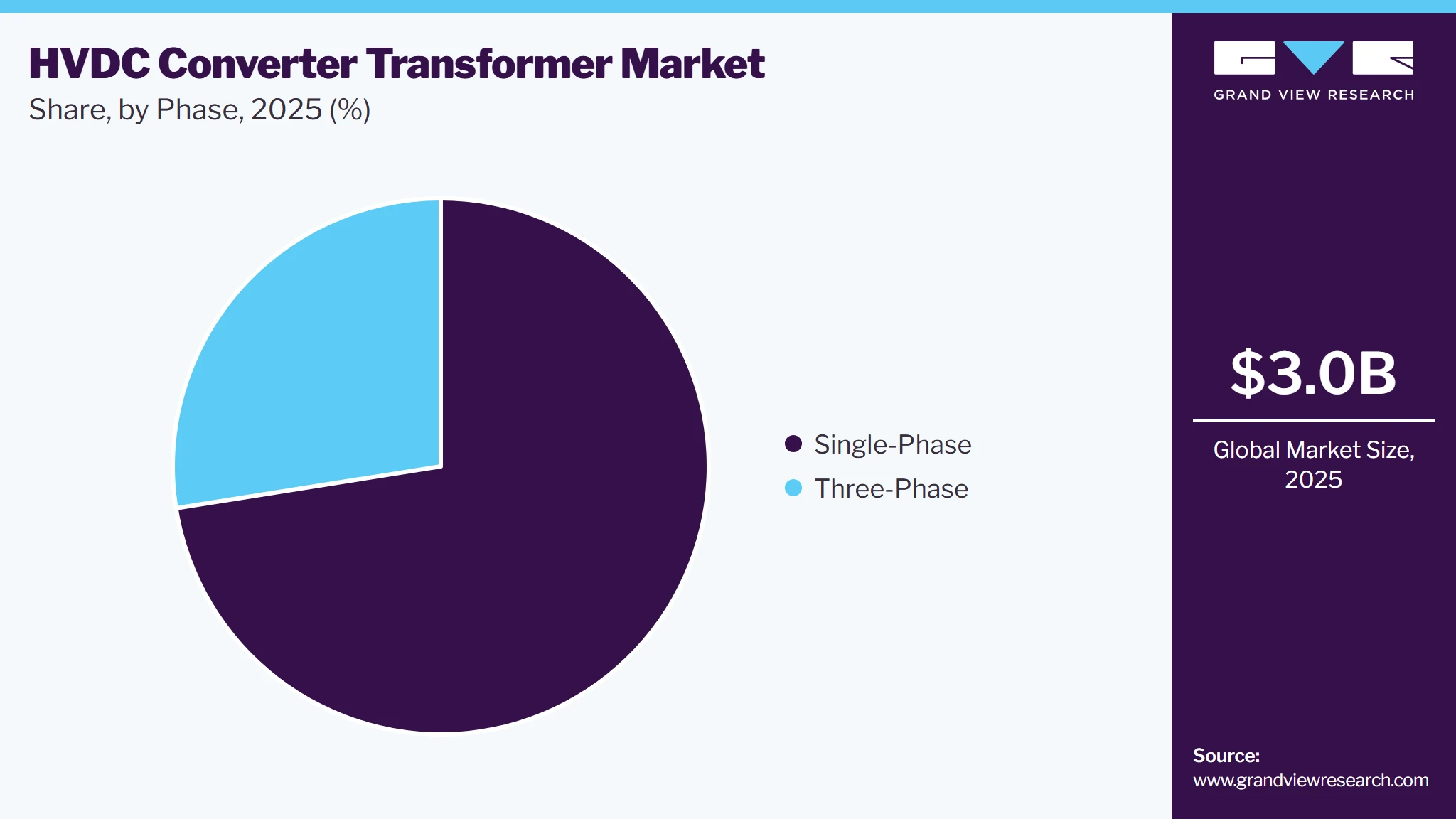
The single-phase segment dominated the market with a revenue share of 72.5% in 2025, driven by its suitability for high-capacity HVDC transmission systems and large-scale converter stations. Single-phase units offer greater flexibility in transporting and installing large transformers compared with equivalent three-phase designs. They can also be combined into transformer banks to achieve higher overall power ratings, making them suitable for UHVDC projects. The growing deployment of long-distance and high-capacity HVDC transmission networks is therefore supporting continued demand for single-phase converter transformers.
 To learn more about this report, Download Free Sample Report
The three-phase segment is anticipated to register the fastest CAGR of 5.9% from 2026 to 2033, supported by increasing adoption in medium- and high-capacity HVDC transmission applications. Three-phase converter transformers offer compact system configurations and efficient integration with AC grids. Growing investment in grid interconnections and renewable power transmission is further supporting demand. Their suitability for projects with manageable transportation and installation constraints is also contributing to adoption. Overall, the expansion of HVDC infrastructure is expected to sustain growth in this segment.
Regional Insights
Europe is a major market for HVDC converter transformers, supported by growing offshore wind capacity, cross-border power connections, and grid upgrades. Countries are investing in HVDC links to move renewable electricity from offshore and remote areas to major demand centers. The development of North Sea offshore grids is creating additional demand for high-capacity converter transformers. Growing focus on renewable energy integration and energy security is further supporting market growth. Investments in modern transmission networks are expected to keep demand strong across the region.
North America HVDC Converter Transformer Market Trends
The HVDC converter transformer market in North America is experiencing growing demand as utilities expand transmission capacity and connect new renewable power projects. Rising electricity demand from data centers, industries, and electrification is putting pressure on existing grids. HVDC is gaining attention for moving large amounts of electricity over long distances with lower losses. Offshore wind development is also creating opportunities for HVDC transmission systems. Continued investment in grid expansion and modernization is expected to support market growth.
The U.S. HVDC converter transformer market is driven by the need to strengthen the aging transmission grid and connect large renewable energy projects to major demand centers. Growing electricity use from data centers, manufacturing, and electrification is increasing the need for new high-capacity transmission lines. HVDC systems offer an efficient solution for long-distance power transfer and grid interconnection. Offshore wind projects are also creating new opportunities for HVDC infrastructure. Rising federal and utility investment in transmission modernization is expected to support demand for converter transformers.
Asia Pacific HVDC Converter Transformer Market Trends
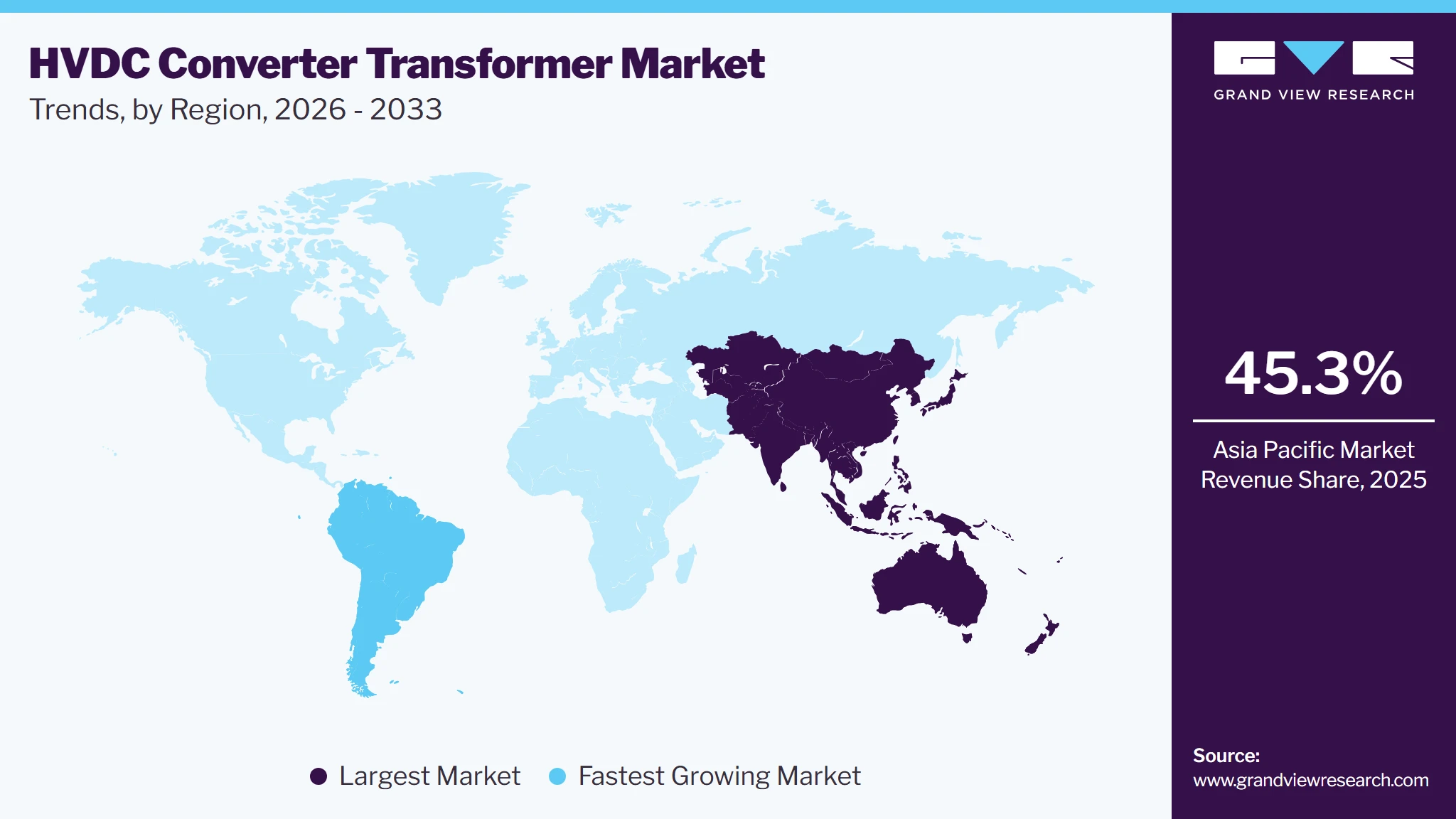
The HVDC converter transformer market in the Asia Pacific dominated the global market with a revenue share of 45.3% in 2025, supported by rapid investments in power transmission and grid infrastructure. China is leading regional demand due to large-scale renewable energy projects and long-distance transmission requirements. The region is also expanding UHVDC networks to transfer electricity from remote generation areas to major consumption centers. Rising electricity demand and industrial growth are further increasing the need for high-capacity transmission systems. Continued investment in grid modernization and renewable power integration is expected to maintain Asia-Pacific’s leading market position.
 To learn more about this report, Download Free Sample Report
China HVDC converter transformer marketis a leading market for HVDC converter transformers due to its extensive UHVDC network and large-scale renewable energy development. The country uses HVDC systems to transmit electricity from resource-rich western and northern regions to major demand centers in the east. Continued investment in UHVDC projects is creating demand for high-capacity converter transformers. China is also expanding renewable energy transmission to reduce grid congestion and improve power utilization. Ongoing investment in long-distance transmission is expected to maintain strong market growth.
Latin America HVDC Converter Transformer Market Trends
The HVDC converter transformer market in Latin America is anticipated to register the fastest CAGR of 9.7% over the forecast period. The region offers growing opportunities for HVDC converter transformers as countries expand renewable energy and transmission infrastructure. Brazil and Argentina are increasing investments in wind, solar, and hydropower projects, creating a need to move electricity over long distances. HVDC technology can help connect remote generation areas with major cities and industrial centers. Cross-border power connections are also creating opportunities for HVDC projects. However, project financing, permitting, and regulatory differences may affect the pace of market development.
Middle East & Africa HVDC Converter Transformer Market Trends
The HVDC converter transformer market in MEA is supported by rising electricity demand, renewable energy development, and investment in regional power connections. Countries such as Saudi Arabia, the UAE, and South Africa are expanding large-scale solar and other renewable projects. HVDC systems can help transmit power efficiently over long distances and support cross-border electricity trade. Growing industrial activity and urbanization are also increasing the need for reliable transmission networks. Continued investment in renewable energy and grid infrastructure is expected to create new opportunities for converter transformer manufacturers.
Key HVDC Converter Transformer Company Insights
Some of the key players operating in the global market include GE Vernova and Siemens Energy, among others.
-
GE Vernova is a major player in the market, offering HVDC converter transformers and related grid technologies for high-voltage power transmission applications. Its portfolio supports the transmission of large amounts of electricity over long distances while helping improve grid reliability and stability. The company provides converter transformer solutions for HVDC transmission projects, including systems that support renewable energy integration and the interconnection of power networks. Its expertise in high-voltage equipment, grid technologies, and global project execution positions GE Vernova as a key participant in the market.
-
Siemens Energy is a prominent market player, providing HVDC converter transformers and associated transmission technologies for high-voltage power networks. Its solutions are used in HVDC transmission systems to enable efficient long-distance electricity transmission, grid interconnection, and integration of renewable power generation. The company combines its expertise in transformers, HVDC technology, power transmission, and grid infrastructure to support large-scale transmission projects worldwide. Its broad technology portfolio and global presence position Siemens Energy as a leading market participant.
Key HVDC Converter Transformer Companies
The following key companies have been profiled for this study on the HVDC converter transformer market.
-
Bharat Heavy Electricals Limited
-
Changzhou XD Transformer Co., Ltd.
-
GE Vernova
-
Hitachi Energy Ltd.
-
HYOSUNG HEAVY INDUSTRIES
-
Hyundai Electric Co., Ltd.
-
Mitsubishi Electric Corporation
-
Siemens Energy
-
TBEA Co., Ltd.
-
TOSHIBA CORPORATION
Competitive Benchmarking
Category
Operating Strategies
Competitive Edge
Weakness
Established Players (Bharat Heavy Electricals Limited, GE Vernova, Hitachi Energy Ltd, HYOSUNG HEAVY INDUSTRIES, Hyundai Electric Co., Ltd., Mitsubishi Electric Corporation, Siemens Energy, TOSHIBA CORPORATION)
- Leverage established global operations, strong utility relationships, and extensive high-voltage equipment portfolios to secure large-scale HVDC converter transformer projects.
- Invest in advanced transformer designs, insulation systems, cooling technologies, and HVDC technologies to improve reliability, efficiency, and power transmission capacity.
- Expand integrated offerings by combining converter transformers with HVDC systems, grid equipment, digital monitoring, and power transmission solutions.
- Strong global brand recognition and long-standing relationships with utilities, transmission operators, and infrastructure developers.
- Extensive experience in high-voltage and HVDC projects, supported by proven transformer technologies and large manufacturing capabilities.
- Ability to provide integrated HVDC solutions, including converter transformers, transmission systems, grid equipment, and related services.
- Higher manufacturing and project costs compared with smaller regional manufacturers, particularly for customized HVDC projects.
- Large organizational structures can result in longer decision-making and project execution processes.
- Strong dependence on major utility and infrastructure projects can expose companies to project delays, tender cycles, and fluctuations in transmission investments.
Emerging Players (TBEA Co., Ltd., Changzhou XD transformer Co., Ltd)
- Leverage cost-competitive manufacturing capabilities and regional supply chains to compete for HVDC converter transformer projects, particularly in Asia and other price-sensitive markets.
- Invest in UHVDC, high-capacity converter transformers, advanced insulation, and transformer testing capabilities to strengthen technical competitiveness.
- Expand international presence through partnerships with utilities, EPC contractors, and transmission equipment providers.
- Competitive manufacturing costs and access to well-established Asian power equipment supply chains.
- Strong capabilities in high-voltage and UHV transformer manufacturing, particularly for large-scale transmission applications.
- Greater flexibility in pricing, customization, and project execution compared with some large global suppliers.
- Comparatively smaller global project references and international utility relationships than leading established players.
- Lower brand recognition in some developed markets can create challenges when competing for large international HVDC projects.
- International service networks, local manufacturing facilities, and after-sales support may be less extensive than those of established global players.
Recent Developments
-
In November 2025, GE Vernova introduced its latest developments toward 800 kV DC converter transformer technology, focusing on transformer designs that can accommodate the high electrical stresses associated with UHVDC transmission while remaining within practical transportation and installation limits. The design keeps key connections inside the transformer tank, helping address shipping and dimensional constraints for large converter transformers. This development supports the company’s efforts to serve higher-capacity HVDC links for long-distance power transmission and renewable energy integration.
HVDC Converter Transformer Market Report Scope
Report Attribute
Details
Market size value in 2025
USD 3.0 billion
Market size value in 2026
USD 3.2 billion
Revenue forecast in 2033
USD 5.5 billion
Growth rate
CAGR of 8.0% from 2026 to 2033
Historical data
2021 - 2025
Forecast period
2026 - 2033
Quantitative Units
Revenue in USD billion and CAGR from 2026 to 2033
Report coverage
Revenue forecast, competitive landscape, growth factors, and trends
Segments covered
Application, power rating, phase, region
Regional scope
North America; Europe; Asia Pacific; Latin America; MEA
Country scope
U.S.; Canada; Mexico; Germany; UK; France; Italy; Spain; China; India; Japan; South Korea; Australia; Brazil; Argentina; UAE; Saudi Arabia; South Africa
Key companies profiled
Bharat Heavy Electricals Limited; Changzhou XD Transformer Co., Ltd.; GE Vernova; Hitachi Energy Ltd.; HYOSUNG HEAVY INDUSTRIES; Hyundai Electric Co., Ltd.; Mitsubishi Electric Corporation; Siemens Energy; TBEA Co., Ltd.; TOSHIBA CORPORATION
Customization scope
Free report customization (equivalent up to 8 analysts working days) with purchase. Addition or alteration to country, regional & segment scope.
Pricing and purchase options
Avail customized purchase options to meet your exact research needs. Explore purchase options
Global HVDC Converter Transformer Market Report Segmentation
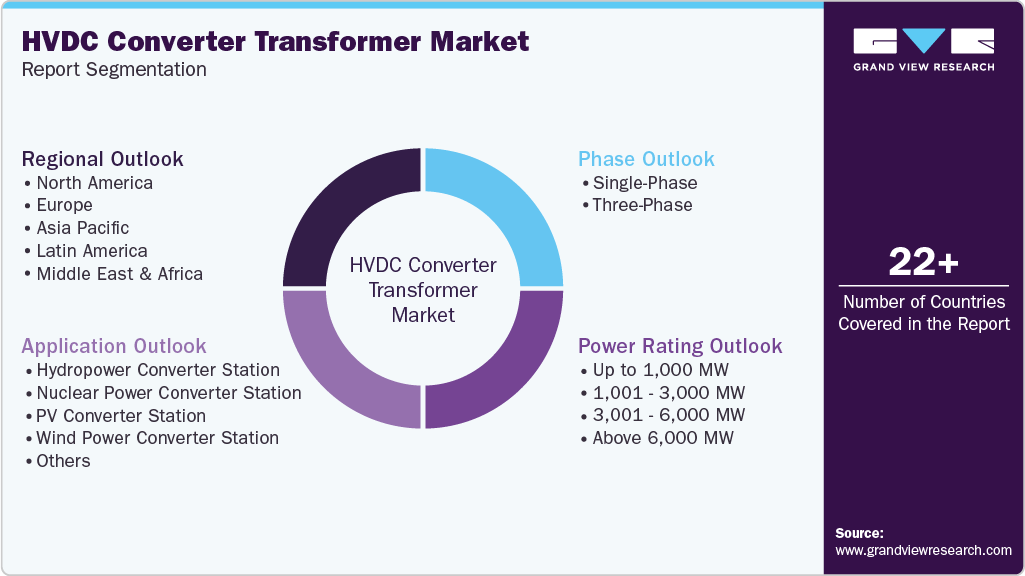
This report forecasts revenue growth at global, regional, and country levels and provides an analysis of the latest industry trends in each of the sub-segments from 2021 to 2033. For this study, Grand View Research has segmented the global HVDC converter transformer market report based on application, power rating, phase, and region:
 To learn more about this report, Download Free Sample Report
-
Application Outlook (Revenue, USD Billion, 2021 - 2033)
-
Hydropower Converter Station
-
Nuclear Power Converter Station
-
PV Converter Station
-
Wind Power Converter Station
-
Others
-
-
Power Rating Outlook (Revenue, USD Billion, 2021 - 2033)
-
Up to 1,000 MW
-
1,001-3,000 MW
-
3,001-6,000 MW
-
Above 6,000 MW
-
-
Phase Outlook (Revenue, USD Billion, 2021 - 2033)
-
Single-Phase
-
Three-Phase
-
-
Regional Outlook (Revenue, USD Billion, 2021 - 2033)
-
North America
-
U.S.
-
Canada
-
Mexico
-
-
Europe
-
Germany
-
UK
-
France
-
Italy
-
Spain
-
-
Asia Pacific
-
China
-
India
-
Japan
-
South Korea
-
Australia
-
-
Latin America
-
Brazil
-
Argentina
-
-
Middle East & Africa
-
Saudi Arabia
-
UAE
-
South Africa
-
-
Research Methodology
The HVDC converter transformer market figures in this report are based on a proven research process that combines executive interviews with secondary research from proprietary databases, company filings, and recognized regulatory and institutional sources. Market size is built through value-chain sizing-reconciling supply-side and demand-side estimates-and triangulated with bottom-up and top-down approaches. Every estimate passes multiple levels of expert validation before publication, with each HVDC converter transformer segment quantified using the revenue-capture definitions in the table below.
Segment Definition
Segment - Application
Revenue capture definition
Hydropower Converter Station
Revenue from sales of HVDC converter transformers used in converter stations for transmitting electricity generated from hydropower plants.
Nuclear Power Converter Station
Revenue from sales of HVDC converter transformers used in converter stations for transmitting electricity generated from nuclear power plants.
PV Converter Station
Revenue from sales of HVDC converter transformers used in converter stations for transmitting electricity generated from photovoltaic power plants.
Wind Power Converter Station
Revenue from sales of HVDC converter transformers used in converter stations for transmitting electricity generated from wind power plants.
Others
Revenue from sales of HVDC converter transformers used in converter stations for other power generation and transmission applications not covered under hydropower, nuclear, PV, or wind power.
Segment - Power Rating
Revenue capture definition
Up to 1,000 MW
Revenue from sales of HVDC converter transformers designed for converter stations with a power rating of up to 1,000 MW.
1,001-3,000 MW
Revenue from sales of HVDC converter transformers designed for converter stations with a power rating between 1,001 MW and 3,000 MW.
3,001-6,000 MW
Revenue from sales of HVDC converter transformers designed for converter stations with a power rating between 3,001 MW and 6,000 MW.
Above 6,000 MW
Revenue from sales of HVDC converter transformers designed for converter stations with a power rating above 6,000 MW.
Segment - Phase
Revenue capture definition
Single-Phase
Revenue from sales of single-phase HVDC converter transformers used in HVDC converter stations for high-voltage power transmission.
Three-Phase
Revenue from sales of three-phase HVDC converter transformers used in HVDC converter stations for high-voltage power transmission.
Estimation Model
Layer Name
Key Question
Description
Demand Layer
Which factors generate demand for HVDC converter transformers?
Assess demand arising from increasing electricity consumption, renewable energy integration, long-distance power transmission, grid interconnection, offshore wind development, and grid modernization. Evaluate how the expansion of hydropower, nuclear, PV, and wind generation capacity drives the need for HVDC converter stations and associated converter transformers.
Application & Power Rating Layer
Which applications and power ratings generate market revenue?
Evaluate revenue across hydropower, nuclear power, PV, wind power, and other converter stations, further segmented by up to 1,000 MW, 1,001-3,000 MW, 3,001-6,000 MW, and above 6,000 MW. Assess the number and scale of HVDC projects, converter transformer requirements, transmission capacity, and project-specific transformer configurations.
Phase Layer
Which phase configurations generate market revenue?
Assess revenue across single-phase and three-phase HVDC converter transformers based on their use in HVDC converter stations, project configuration, transmission capacity, technical requirements, and number of transformers deployed per project.
Revenue Layer
How is market revenue generated?
Market revenue is quantified through the sales of HVDC converter transformers supplied for HVDC converter stations. Revenue is estimated based on the number of transformers deployed, average selling price, transformer capacity, application, power rating, phase configuration, and project size.
Delivered Customizations
This report has been delivered with the following In-depth customizations
Client Request
Customization Delivered
Value Adds
Application Opportunity Assessment
Market analysis was conducted across Hydropower Converter Station, Nuclear Power Converter Station, PV Converter Station, Wind Power Converter Station, and Others by evaluating HVDC project pipelines, power generation capacity, renewable energy deployment, transmission requirements, and converter transformer demand.
Identified high-potential applications based on project activity, capacity additions, grid integration requirements, and future HVDC converter transformer revenue opportunities.
Phase Opportunity Assessment
Market analysis was conducted across Single-Phase and Three-Phase HVDC converter transformers by evaluating transformer configurations, project requirements, power capacity, technical specifications, and deployment across different converter station applications.
Identified high-potential phase configurations based on technology suitability, project deployment patterns, transmission capacity requirements, and future adoption.
Regional Opportunity Assessment
Country-level analysis was conducted to assess HVDC converter transformer demand based on electricity consumption, grid modernization, renewable energy development, long-distance transmission requirements, HVDC project pipelines, and investments in transmission infrastructure across key regions.
Identified high-growth countries and regions with strong HVDC project pipelines, increasing transmission capacity requirements, renewable energy integration, and favorable opportunities for converter transformer suppliers.
Frequently Asked Questions About This Report
The HVDC converter transformer market size was estimated at USD 3.0 billion in 2025 and is expected to reach USD 3.2 billion in 2026.
The HVDC converter transformer market is expected to grow at a CAGR of 8.0% from 2026 to 2033 to reach USD 5.5 billion by 2033.
The HVDC converter transformer market is driven by growing renewable energy integration, increasing long-distance power transmission, grid modernization, rising electricity demand, and expansion of offshore wind projects.
The Asia Pacific region dominated the HVDC converter transformer market with a revenue share of 45.3% in 2025.
China dominated the Asia Pacific region market with a revenue share of 54.8% in 2025.
Latin America is anticipated to register the fastest CAGR of 9.7% over the forecast period.
Based on phase, the single-phase segment accounted for largest revenue share of 72.5% in 2025.
Based on application, the wind power converter station segment accounted for largest revenue share of 23.5% in 2025.
The key players operating in the HVDC converter transformer market are Bharat Heavy Electricals Limited, Changzhou XD transformer Co.,Ltd, GE Vernova, Hitachi Energy Ltd, HYOSUNG HEAVY INDUSTRIES, Hyundai Electric Co., Ltd., Mitsubishi Electric Corporation, Siemens Energy Energy, TBEA Co., Ltd., TOSHIBA CORPORATION, and others.
About the Author(s)
Power Generation & Storage Research Team
Energy & Power · Power Generation & StorageThis report was authored by the power generation & storage research team at Grand View Research - comprising two research analysts, one senior research analyst, and one industry expert - with specialized expertise in the power generation & storage segment of the energy & power industry. All findings are based on proprietary energy & power databases, executive interviews, and regulatory analysis, subject to internal peer review prior to publication.
Last Updated:
Speak to Analyst

Customize this report to your needs - add regions, segments, or data points, with 20% free customization.
Or view our licence options:


ISO 9001:2015 & 27001:2022 Certified
We are GDPR and CCPA compliant! Your transaction & personal information is safe and secure. For more details, please read our privacy policy.


