
- Home
- »
- Medical Devices
- »
-
Hydrogel-based Drug Delivery System Market Report, 2033GVR Report cover

Hydrogel-based Drug Delivery System Market (2026 - 2033)
Size, Share & Trends Analysis Report By Polymer Origin (Natural, Synthetic, Hybrid), By Delivery Route (Subcutaneous, Ocular, Oral Cavity), By Region, And Segment Forecast
Market Size, 2025
$8.4BMarket Estimate, 2026
$9.0BMarket Forecast, 2033
$14.1BCAGR, 2026–2033
6.7%Hydrogel-based Drug Delivery System Market Summary
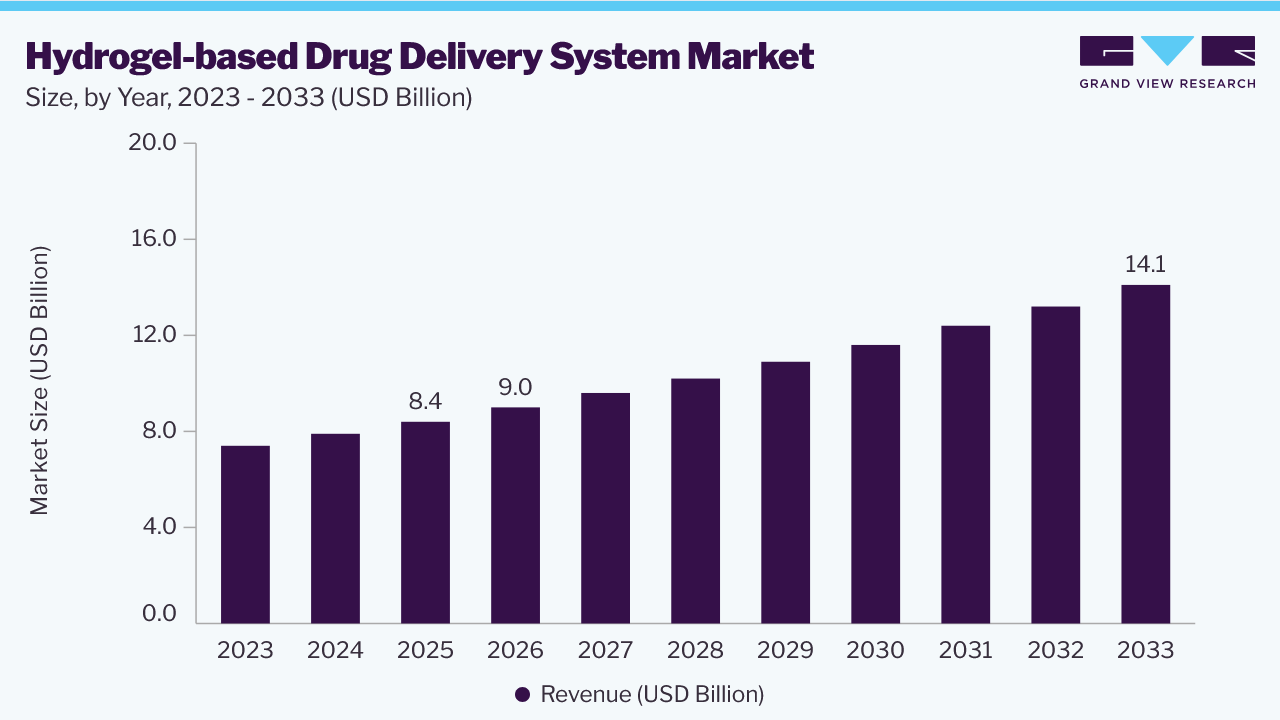
The global hydrogel-based drug delivery system market size was valued at USD 8.4 billion in 2025 and is projected to grow from USD 9.0 billion in 2026 to USD 14.1 billion by 2033, at a CAGR of 6.7% from 2026 to 2033. North America dominated the market, accounting for a revenue share of 40.0% in 2025. Key factors driving the growth of the global market for hydrogel-based drug delivery system include the biocompatibility and biodegradable properties coupled with a controlled release profile, which makes hydrogel a potential drug delivery system.
 Source: Grand View Research, IR Documents, Primary Interviews, Paid DatabasesTo learn more about this report,
 Download Free Sample Report
Key Market Trends & Insights
- By polymer origin: The synthetic hydrogels segment held the largest market share of over 45.0% in 2025.
- By delivery route: The hydrogel-based ocular drug delivery segment held the largest market share in 2025.
Regional Highlights
- Largest regional market: North America (40.0% revenue share, 2025)
- Fastest-growing regional market: Asia Pacific (highest CAGR, 2026-2033)
Market Size & Forecast
- Market size in 2025: USD 8.4 Billion
- Estimated market size in 2026: USD 9.0 Billion
- Projected market size by 2033: USD 14.1 Billion
- CAGR (2026-2033): 6.7%
Prism AI by Grand View Research Free to tryAsk a question about the hydrogel-based drug delivery system marketTry asking✓Every figure cited from GVR research Prefer the report? Download free sample →Due to the growing inclination towards controlled release drug delivery over conventional systems, hydrogels are widely used for achieving controlled drug release of incorporated drugs.
Due to their immense biocompatibility, physiochemical tolerability, and drug protection, hydrogels are used for controlled and targeted drug delivery. Furthermore, these properties of hydrogels are useful in encapsulating proteins and nucleic acids, contributing to increasing innovations in hydrogel-based drug delivery systems. Hydrogels are preferred drug carriers due to features such as easy production and self-application.
In recent years, the hydrogel-based drug delivery systems industry has experienced increasing investment in R&D in search of innovative drug delivery methods and diagnostics. Development in polymer science has led to the formation of biopolymers that provide a biocompatible and biodegradable framework for hydrogels, promoting their usage in efficient and targeted drug delivery. Therefore, there has been a noteworthy rise in enhancements in R&D activities.
Analyst Perspective
The market is poised for robust growth, supported by the increasing demand for targeted and controlled drug delivery, rising prevalence of chronic diseases, and ongoing advancements in biomaterials and pharmaceutical formulations. Hydrogel-based delivery systems are gaining widespread adoption due to their excellent biocompatibility, high water content, and ability to provide sustained and site-specific drug release, improving therapeutic efficacy while minimizing adverse effects. Expanding research in tissue engineering, regenerative medicine, and injectable hydrogel technologies is further broadening the market's application scope. As healthcare providers seek safer, more effective, and minimally invasive treatment solutions, companies that focus on advanced hydrogel formulations, multifunctional delivery platforms, and strategic collaborations are expected to strengthen their competitive position.
Polymer Origin Insights
Synthetic hydrogels dominated the market and accounted for a share of over 45.0% in 2025. Hydrogel polymer origins are classified into natural, synthetic, and hybrid. A hydrogel-based drug delivery system is made from synthetic polymers as they have higher drug absorbing capacity, improved mechanical capacity, and enhanced lifetime. Some of the widely used synthetic polymers in drug delivery applications are polyethylene glycol (PEG) and poly (lactic-co-glycolic acid) (PLGA).
The natural polymers segment is expected to grow significantly from 2026 to 2033. Natural polymers such as xanthan gum, alginate, pectin, dextran, and chitosan are increasingly being explored due to their nontoxicity, easy availability, and biodegradability characteristics. Extensive research is being undertaken to investigate the definite applications of natural polysaccharides in drug delivery, which is expected to drive demand for this segment during the forecast period.
Delivery Route Insights
The hydrogel-based ocular drug delivery systems accounted for the largest revenue share in 2025. A growing number of people impacted by ophthalmic disorders and problems have developed a need for more effective drug delivery systems, as limitations such as low ocular bioavailability are identified in conventional systems. This has encouraged a lot of research and development in this domain, which has resulted in new product developments and innovation. For instance, in October 2025, researchers in Germany developed a hybrid gelatin–alginate hydrogel system capable of co-delivering dual antiglaucoma drugs with extended release profiles lasting several weeks. The system integrates microparticle–hydrogel architecture to improve stability and controlled diffusion in ocular environments.
The topical hydrogel segment is expected to register the fastest CAGR from 2026 to 2033. Administering drugs topically is an efficient and affordable way to provide therapeutic substances to specific areas. Novel hydrogels have broad applications in treating pediatric, geriatric, and pregnant patients. These consist of nanoparticles, nanoemulsions, micro emulsions, liposomes, self-nano emulsifying drug delivery systems, cubosomes, and similar structures. Therefore, R&D in this drug delivery system is a key factor for market growth. For instance, in July 2025, Chinese research institutions developed a pH-responsive hydrogel drug delivery system that releases antimicrobial agents selectively in infected tissue environments, improving targeted therapy efficiency and reducing systemic toxicity.
Regional Insights
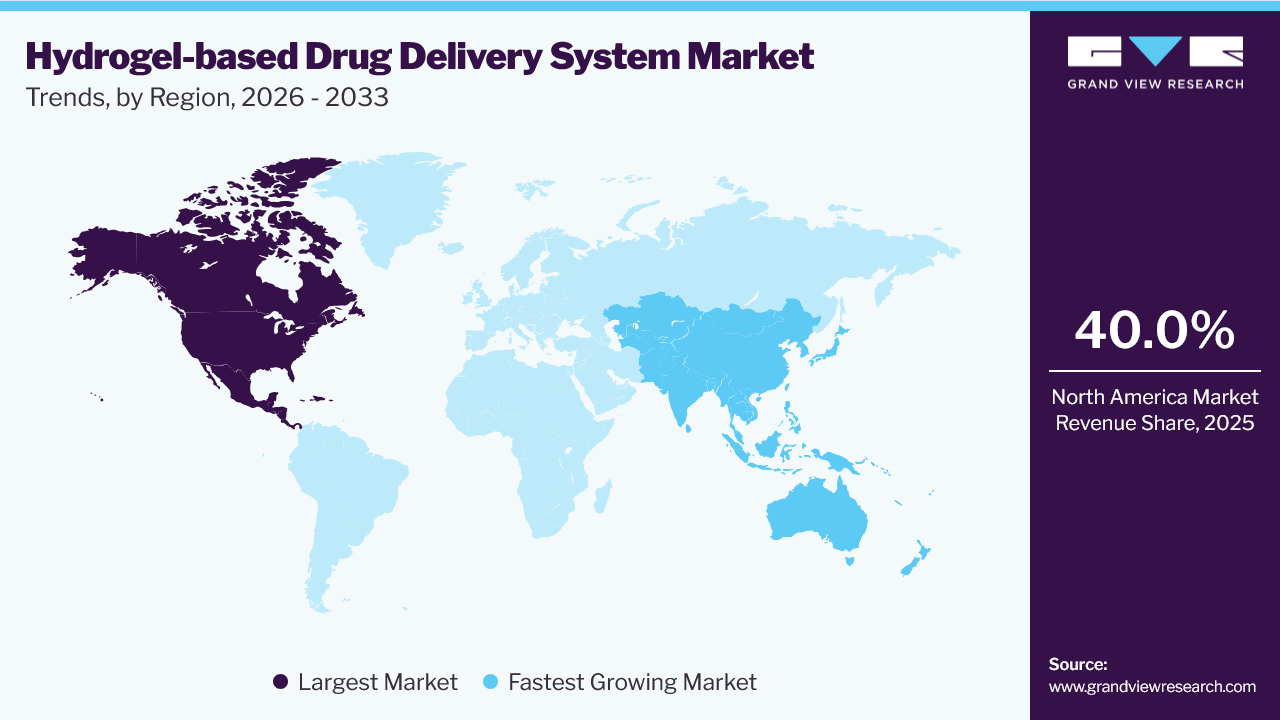
The hydrogel-based drug delivery system industry in North America dominated the global market, with a revenue share of 40.0% in 2025.
 To learn more about this report, Download Free Sample Report
U.S. Hydrogel-based Drug Delivery System Market Trends
The hydrogel-based drug delivery system industry in the U.S. held the largest revenue share in the North American region of around 80.0% in 2025. This is primarily due to several key companies and major pharmaceutical industry participants in the country. In addition, growing investment in R&D in the U.S. has resulted in innovation and new product development, which is expected to propel growth in the coming years.
Europe Hydrogel-based Drug Delivery System Market Trends
The hydrogel-based drug delivery system industry in Europe is identified as a lucrative region for this industry. Increased research on improving hydrogel-based protein delivery and a rise in investment in developing newer hydrogel-based drug delivery solutions are key factors driving this growth.
The Germany hydrogel-based drug delivery system industry is expected to experience significant growth from 2026 to 2033. This is primarily due to enhanced research and development activities needed to develop novel drug delivery systems. The research is primarily related to tumor therapy and the uninterrupted delivery of anti-infective while dealing with biological barriers.
Asia Pacific Hydrogel-based Drug Delivery System Market Trends
The hydrogel-based drug delivery system industry in Asia Pacific is anticipated to witness the fastest growth from 2026 to 2033 owing to a large target population, increased accessibility of the healthcare industry, rising demand for improved medical care in various therapeutic fields, and a growing emphasis on lowering healthcare expenses.
China hydrogel-based drug delivery industry is expected to grow rapidly from 2026 to 2033, owing to increasing investments by global companies in China’s pharmaceutical industries searching for novel diagnostics and drug delivery systems. In addition, the growing prevalence of health conditions such as inflammatory bowel disease (IBD) has been generating greater demand for advanced drug delivery technologies.
Key Hydrogel-based Drug Delivery System Company Insights
Some key companies in the market include GALDERMA; Johnson & Johnson; Bausch + Lomb; Medtronic; and Ocular Therapeutix, Inc. Vendors in the market are focusing on increasing their customer base to gain a competitive edge in the industry. Therefore, key players are taking several strategic initiatives, such as mergers and acquisitions, and partnerships with other emerging and prominent industry participants.
- Ocular Therapeutix, Inc., is a biopharmaceutical company that specializes in creating, advancing, and marketing new treatments for eye disorders. It employs its own bioresorbable hydrogel-based formulation technology, ELUTYX. The company has manufacturing facilities in Massachusetts.
Key Hydrogel- based Drug Delivery System Companies:
The following key companies have been profiled for this study on the hydrogel-based drug delivery system market:
-
GALDERMA
-
Johnson & Johnson
-
Bausch + Lomb
-
Ocular Therapeutix, Inc.
-
Merck KGaA
-
Evonik Industries AG
-
Ashland Inc.
-
Corbion N.V.
-
AbbVie Inc.
-
Biogelx Ltd.
Recent Developments
- In November 2025, a review published in the Journal of Clinical Medicine highlighted hydrogel-based delivery systems for non-opioid analgesics, showing growing clinical interest in hydrogel platforms for pain management applications. The study emphasizes hydrogels as carriers for controlled release of NSAIDs and neurological drugs.
- In September 2025, researchers published a new hydrogel drug delivery platform based on self-assembling peptide networks that significantly slows drug release and enables long-acting therapeutic effects. The system improves sustained release performance and reduces burst release, a long-standing limitation in injectable hydrogel carriers.
Hydrogel-based Drug Delivery System Market Report Scope
Report Attribute
Details
Market size in 2025
USD 8.4 billion
Estimated market size in 2026
USD 9.0 billion
Projected market size by 2033
USD 14.1 billion
Growth rate
CAGR of 6.7% from 2026 to 2033
Base year for estimation
2025
Historical data
2021 – 2024
Forecast period
2026 – 2033
Quantitative units
Revenue in USD billion and CAGR from 2026 to 2033
Report coverage
Revenue forecast, company ranking, competitive landscape, growth factors, and trends
Segments covered
Polymer origin, delivery route, region
Regional Scope
North America; Europe; Asia Pacific; Latin America;, MEA
Country Scope
U.S.; Canada; Mexico; UK; Germany; France; Italy; Spain; Denmark; Sweden; Norway; India; Japan; China; Thailand; South Korea; Brazil; Argentina; South Africa; Saudi Arabia; UAE; Kuwait
Key companies profiled
GALDERMA; Johnson & Johnson; Bausch + Lomb.; Ocular Therapeutix, Inc.; Merck KGaA; Evonik Industries AG; Ashland Inc.; Corbion N.V.; AbbVie Inc.; Biogelx Ltd.
Customization scope
Free report customization (equivalent up to 8 analysts working days) with purchase. Addition or alteration to country, regional & segment scope.
Pricing and purchase options
Avail customized purchase options to meet your exact research needs. Explore purchase options
Global Hydrogel-based Drug Delivery System Market Report Segmentation
This report forecasts revenue growth at global, regional, and country levels and provides an analysis of the latest industry trends in each of the sub-segments from 2021 to 2033. For this study, Grand View Research has segmented the global hydrogel-based drug delivery system market report based on polymer origin, delivery route, and region:
-
Polymer Origin Outlook (Revenue, USD Billion, 2021 - 2033)
-
Natural
-
Synthetic
-
Hybrid
-
-
Delivery Route Outlook (Revenue, USD Billion, 2021 - 2033)
-
Subcutaneous
-
Ocular
-
Oral Cavity
-
Topical
-
Other
-
-
Regional Outlook (Revenue, USD Billion, 2021 - 2033)
-
North America
-
U.S.
-
Canada
-
Mexico
-
-
Europe
-
Germany
-
UK
-
France
-
Italy
-
Spain
-
-
Asia Pacific
-
China
-
Japan
-
India
-
Thailand
-
South Korea
-
-
Latin America
-
Brazil
-
Argentina
-
-
Middle East & Africa
-
South Africa
-
Saudi Arabia
-
UAE
-
Kuwait
-
-
Frequently Asked Questions About This Report
North America dominated with an approximately 40.0% revenue share in 2025.
The synthetic hydrogels segment accounted for the largest revenue share of over 45.0% in 2025.
The global hydrogel-based drug delivery system market size was valued at USD 8.4 billion in 2025 and is estimated at USD 9.0 billion for 2026.
The global hydrogel-based drug delivery system market is expected to grow at a CAGR of 6.7% from 2026 to 2033, reaching USD 14.1 billion.
Key players in the market include GALDERMA; Johnson & Johnson; Bausch + Lomb.; Ocular Therapeutix, Inc.; Merck KGaA, Evonik Industries AG, Ashland Inc., Corbion N.V., AbbVie Inc., Biogelx Ltd., and others.
About the Author(s)
Medical Devices Research Team
Healthcare · Medical DevicesThis report was authored by the medical devices research team at Grand View Research - comprising two research analysts, one senior research analyst, and one industry expert - with specialized expertise in the medical devices segment of the healthcare industry. All findings are based on proprietary healthcare databases, executive interviews, and regulatory analysis, subject to internal peer review prior to publication.
Last Updated:
Speak to Analyst

Customize this report to your needs - add regions, segments, or data points, with 20% free customization.
Or view our licence options:


ISO 9001:2015 & 27001:2022 Certified
We are GDPR and CCPA compliant! Your transaction & personal information is safe and secure. For more details, please read our privacy policy.


