
- Home
- »
- Medical Devices
- »
-
Immunohematology Market Size & Share, Global Industry Report, 2024GVR Report cover

Immunohematology Market (2018 - 2024) Size, Share & Trends Analysis Report By Product (Immunohematology Analyzer, Immunohematology Reagent), By End Use (Hospitals, Blood banks, Diagnostic Laboratories), By Region, And Segment Forecasts
Market Size, 2015
$1.5BMarket Estimate, 2026
$1.9BMarket Forecast, 2024
$2.3BCAGR, 2016–2024
9.4%Report Overview
The global immunohematology market size was valued at USD 1.5 billion in 2015. The market is expected to witness significant growth owing to the development of innovative technologies for blood screening and new product launches. Hospitals and diagnostic laboratories are shifting their preference to automated instrumentation and integration of different functions in a single platform, which is also augmenting the growth.
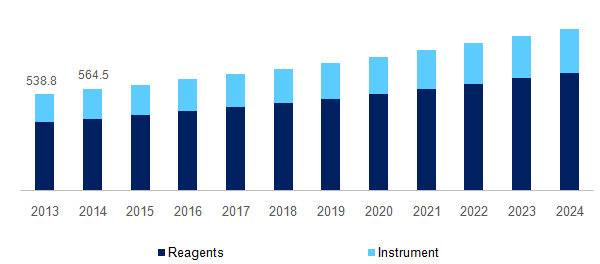
U.S. immunohematology market by product, 2013 - 2024 (USD Million)
 Source: Grand View Research, IR Documents, Primary Interviews, Paid DatabasesTo learn more about this report,
 Download Free Sample Report
 Industry players are increasingly investing in research and development, thus boosting the market growth. Grifols invested USD 256.97 million and USD 211.95 million in R&D in the year 2015 and 2014, respectively.
Furthermore, rising emphasis on business diversification is also witnessed in the industry. Mergers and acquisitions are dynamic and is a major strategy deployed by key industry players as an expansion strategy.
In March 2016, Immucor acquired Sirona Genomics in USD 14.4 million. The deal was originally signed in 2014 and completed in 2016. The company aims at including HLA typing products in its product portfolio, which was acquired from Sirona Genomic.
Market Dynamics
The increasing demand for safe blood transfusions, supported by the rising prevalence of chronic diseases, trauma cases, cancer therapies, organ transplantation procedures, and complex surgical interventions, is driving the growth of the immunohematology market. Immunohematology testing is essential for blood grouping, antibody screening, cross-matching, and compatibility assessment, helping healthcare providers minimize transfusion-related complications such as hemolytic transfusion reactions and alloimmunization. The growing global requirement for blood and blood components has significantly increased the need for advanced immunohematology testing solutions across hospitals, blood banks, and diagnostic laboratories. According to the World Health Organization (WHO)report published in May 2025, approximately 118.5 million blood donations are collected globally each year, highlighting the expanding demand for reliable transfusion diagnostics and blood compatibility testing systems.
Increasing investments in healthcare infrastructure modernization and the expansion of blood bank networks across emerging economies are accelerating the adoption of automated immunohematology analyzers, reagents, and transfusion management systems. Technological advancements in automated blood bank diagnostics are further supporting market expansion by improving testing accuracy, reducing turnaround time, and minimizing manual errors in high-volume laboratory settings. Furthermore, manufacturers are increasingly focusing on AI-integrated and fully automated immunohematology analyzers to enhance laboratory workflow efficiency and support large-scale transfusion testing operations, particularly in hospitals and centralized blood banking facilities.
The high cost associated with advanced immunohematology analyzers, automated blood bank platforms, molecular blood typing systems, and transfusion diagnostic infrastructure remains a significant restraint on the growth of the immunohematology market, particularly across low- and middle-income countries. Healthcare facilities and diagnostic laboratories are required to make substantial capital investments in automated analyzers, laboratory information systems, software integration, maintenance services, quality assurance programs, and specialized reagents to establish efficient transfusion testing workflows. These financial requirements often limit the adoption of advanced immunohematology technologies among small and mid-sized hospitals and regional blood banks with constrained operational budgets. Moreover, the operation and maintenance of sophisticated immunohematology systems require highly trained laboratory personnel and transfusion medicine specialists, creating workforce-related challenges in several healthcare systems. The shortage of skilled professionals capable of managing automated blood compatibility testing, antibody identification, and molecular typing procedures continues to affect laboratory efficiency and testing capacity in developing regions. Limited reimbursement support for advanced transfusion diagnostics further restricts the implementation of next-generation immunohematology solutions, particularly in cost-sensitive healthcare markets.
Furthermore, disparities in blood screening standards and limited accessibility to automated diagnostic technologies across underdeveloped healthcare infrastructures continue to hinder broader market penetration. Many blood banks and diagnostic centers in resource-constrained settings still rely on conventional manual testing procedures due to budget limitations and inadequate laboratory modernization. These manual processes are time-consuming and labor-intensive and are more prone to operational inefficiencies and human error during blood grouping and compatibility testing, which may affect transfusion safety and overall laboratory productivity.
The increasing adoption of automated immunohematology platforms and molecular blood typing technologies is creating significant growth opportunities for the immunohematology market. Healthcare providers and blood banks are increasingly shifting toward automated transfusion diagnostic systems to improve testing accuracy, reduce turnaround time, and enhance laboratory efficiency. Advanced immunohematology analyzers support high-throughput blood grouping, antibody screening, and compatibility testing while minimizing manual intervention and operational errors. The growing demand for precision transfusion medicine, particularly for patients who require repeated blood transfusions, such as those with sickle cell disease, thalassemia, and cancer, is further accelerating the adoption of molecular typing and genotyping technologies.
Recent technological advancements and strategic industry initiatives are further supporting the growth of the immunohematology market. In February 2025, Grifols expanded its automated transfusion diagnostics portfolio with advanced immunohematology solutions designed to improve workflow automation and blood bank productivity. In addition, manufacturers operating in the immunohematology market are increasingly integrating AI-enabled data management, remote monitoring capabilities, and digital laboratory connectivity into immunohematology systems to enhance operational efficiency and testing accuracy. Growing government initiatives to modernize blood safety infrastructure, expand voluntary blood donation programs, and increase healthcare investments across emerging economies are also expected to accelerate the adoption of advanced technologies in the immunohematology market during the forecast period.
Product Insights
Immunohematology reagents accounted for largest share in 2015. This segment accounted for a significant share of demand due to growing number of blood banks and increased use of reagents in the immunohematology tests. The automated analyzers function on some specific reagents, thus making it a compulsory and recurring purchase for hospitals and diagnostic laboratories.
In immunohematology analyzers, automated analyzer is expected to be the faster-growing product over the forecast period. Automated analyzers are more precise, provide faster results, and consume fewer reagents. Some analyzers display instant digital results on the screen, helping faster screening and categorization of blood.
End-Use Insights
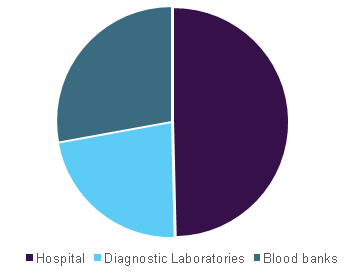
Hospitals accounted for the largest share in the end-use segment of the immunohematology market. It is mandatory for hospitals to check donated blood for infections, set parameters of hematology components, and perform pre-transfusion compatibility tests of donors and recipients.
Immunohematology market, by end-use, 2015
 To learn more about this report, Download Free Sample Report
 Analyzers, cell counters, and reagents help accelerate the process to make the transfusion procedure efficient and safe. Blood banks are also one of the majority shareholders owing to the increasing number of blood banks, rising awareness about donation, and increased number of voluntary donors across the globe. Grifols operates more than 43 plasma collection centers in the U.S. as a part of its vertical integration strategy, which they acquired in 2002.
Regional Insights
In 2015, North America emerged as one of the largest markets. The high number of trauma centers and blood bank facilities is the key reason for high demand for immunohematology products in this region.
Large cohort of target diseases, such as sickle cell diseases and cancer, is contributing to the high demand. Sickle cell disease and cancer patients require multiple and recurrent blood transfusions. It is estimated that 0.1 million people suffer from sickle cell disease, while 1,000 infants are born annually with the disorder, adding to the number.
Acceptance of new technology and preference of automated technology also contribute to its large share. The U.S. FDA is granting clearance to many advanced technologies based products, which is motivating companies to launch their products in this region.
Europe is also expected to be one of the key shareholders of the hematology market. The presence of industry giants such as Grifols, Roche Diagnostics Corporation, and Siemens Healthcare aids market growth in this region. Asia Pacific is expected to witness growth over the forecast period. Industry players expanding their presence in this region indicate the untapped opportunities in this region.
In July 2015, Siemens opened its new healthcare image center in Shenzhen, China. The center boasts a diagnostic imaging unit and views demonstrations as well as conducts workshops, presentations, and meetings of immunohematology technologists. Moreover, in 2014, Roche Diagnostics Corporation invested USD 455 million to expand its diagnostic business in China.
Immunohematology Market Share Insights
Some key industry participants include Bio-Rad Laboratories, Inc.; Immucor; Ortho Clinical Diagnostics; Grifols; BD (Becton Dickinson); Hologic, Inc.; Siemens Healthcare GmbH; ThermoFisher; Abbott; and Beckman Coulter, Inc.
The dynamic merger and acquisition activities in the industry are helping in the consolidation of the market. Acquisitions of smaller players to enhance product offerings have been a key strategy of growth followed by many companies.
For instance, in March 2013, Immucor acquired transplant and other immune-monitoring segments of Hologic, Inc., named as LIFECODES. It was expected to complement the product portfolio. The segment originally belonged to Gen-Probe Incorporated from which Hologic, Inc. acquired it in August 2012.
Major companies are introducing new products, which is also further augmenting market growth. In August 2015, Ortho Clinical Diagnostics launched Ortho Vision, an analyzer used in transfusion labs, which is currently available in the U.S.
Competitive Benchmarking
Operating Strategies
Competitive Edge
Weaknesses
Mature Players: Bio-Rad Laboratories
- Focus on expanding automated immunohematology analyzers, blood bank automation systems, and transfusion diagnostics portfolios.
- Strategic collaborations with hospitals, blood banks, and diagnostic laboratories to strengthen global distribution networks.
- Investments in molecular blood typing, AI-enabled transfusion management, and high-throughput compatibility testing technologies.
- Strong global presence with established regulatory approvals, extensive reagent portfolios, and integrated blood bank automation capabilities.
- Broad installed base across hospitals, blood banks, and centralized diagnostic laboratories.
- Advanced automation, high-throughput testing systems, and strong expertise in transfusion safety and compatibility testing.
- High instrument and reagent costs limit adoption in price-sensitive healthcare systems.
- Dependence on skilled laboratory professionals and sophisticated blood bank infrastructure.
- Regulatory complexity and long product validation timelines for transfusion diagnostic systems
.
Emerging Players: Novacyt
- Emphasis on niche molecular typing solutions, compact blood bank analyzers, and cost-effective transfusion diagnostics.
- Expansion through regional partnerships, distributor agreements, and localized manufacturing strategies.
- Focus on developing flexible and decentralized immunohematology testing platforms for emerging healthcare markets.
- Higher operational flexibility and faster adoption of innovative molecular typing and niche transfusion diagnostic technologies.
- Ability to offer cost-competitive and customized immunohematology solutions for regional laboratories and mid-sized healthcare facilities
- Increasing focus on specialized antibody screening and rare blood group identification applications.
- Limited global commercial presence and lower installed base compared to established multinational companies.
- Challenges associated with reimbursement coverage, regulatory approvals, and distribution expansion across multiple regions.
- Financial and operational constraints related to scaling advanced immunohematology technologies globally.
Immunohematology Market Report Scope
Report Attribute
Details
Market size value in 2020
USD 1.94 billion
Revenue forecast in 2024
USD 2.3 billion
Growth Rate
CAGR of 9.4% from 2016 to 2024
Base year for estimation
2015
Historical data
2013 - 2015
Forecast period
2016 - 2024
Quantitative units
Revenue in USD Million and CAGR from 2016 to 2024
Report coverage
Revenue forecast; company share; competitive landscape; growth factors and trends
Segments covered
Product, end-use, region
Regional scope
North America; Europe; Asia Pacific; Latin America; MEA
Country scope
U.S.; Canada; UK; Germany; Japan; China; India Brazil; Mexico; South Africa
Key companies profiled
Bio-Rad Laboratories; Inc.; Immucor; Ortho Clinical Diagnostics; Grifols; BD (Becton Dickinson); Hologic; Inc.; Siemens Healthineers; ThermoFisher; Abbott; Beckman Coulter; Inc.
Customization scope
Free report customization (equivalent up to 8 analysts working days) with purchase. Addition or alteration to country; regional & segment scope.
Pricing and purchase options
Avail customized purchase options to meet your exact research needs. Explore purchase options
Segments Covered in the ReportThis report forecasts revenue growth and provides an analysis of the latest trends in each of the sub-segments from 2013 to 2024. For the purpose of this study, Grand View Research has segmented the global immunohematology market on the basis of product, end-use, and region:
- Product Outlook (Revenue, USD Million; 2013 - 2024)
-
Immunohematology analyzer
-
Immunohematology reagent
-
- End-Use Outlook (Revenue, USD Million; 2013 - 2024)
-
Hospitals
-
Blood banks
-
Diagnostic laboratories
-
- Regional Outlook (Revenue, USD Million; 2013 - 2024)
-
North America
-
The U.S.
-
Canada
-
-
Europe
-
U.K.
-
Germany
-
-
Asia Pacific
-
Japan
-
China
-
India
-
-
Latin America
-
Brazil
-
Mexico
-
-
MEA
-
South Africa
-
-
Delivered Customizations
This report has been delivered with the following In-depth customizations
Client Request
Customization Delivered
Value Adds
Blood Bank & Transfusion Workflow Analysis
Detailed assessment of blood collection, typing, cross-matching, inventory flow, and transfusion management practices across hospitals and blood banks.
Helps improve workflow efficiency, reduce transfusion errors, and optimize blood utilization.
Hospital & Blood Center Adoption Trends
Analysis of immunohematology testing demand across hospitals, trauma centers, blood banks, and diagnostic laboratories.
Identifies high-demand customer segments and expansion opportunities.
Automation & Digital Lab Integration Analysis
Evaluation of automated blood grouping systems, digital transfusion platforms, laboratory automation, and data management solutions.
Tracks modernization trends and supports operational efficiency improvements.
Advanced Testing & Innovation Assessment
Assessment of molecular blood typing, genotyping technologies, AI-assisted compatibility testing, and next-generation immunohematology platforms.
Highlights emerging innovation areas and future technology growth opportunities.
Frequently Asked Questions About This Report
The global immunohematology market size was estimated at USD 1.85 billion in 2019 and is expected to reach USD 1.94 billion in 2020.
The global immunohematology market is expected to grow at a compound annual growth rate of 5.0% from 2016 to 2024 to reach USD 2.36 billion by 2024.
North America dominated the immunohematology market with a share of 42.0% in 2019. This is attributable to large number of trauma centers and blood bank facilities and Large cohort of target diseases, such as sickle cell diseases and cancer.
Some key players operating in the immunohematology market include Bio-Rad Laboratories, Inc.; Immucor; Ortho Clinical Diagnostics; Grifols; BD (Becton Dickinson); Hologic, Inc.; Siemens Healthineers; ThermoFisher; Abbott; and Beckman Coulter, Inc.
Key factors that are driving the market growth include the development of innovative technologies for blood screening and new product launches and key players are increasingly investing in research and development.
About the Author(s)
Medical Devices Research Team
Healthcare · Medical DevicesThis report was authored by the medical devices research team at Grand View Research - comprising two research analysts, one senior research analyst, and one industry expert - with specialized expertise in the medical devices segment of the healthcare industry. All findings are based on proprietary healthcare databases, executive interviews, and regulatory analysis, subject to internal peer review prior to publication.
Last Updated:
Speak to Analyst

Customize this report to your needs - add regions, segments, or data points, with 20% free customization.
Or view our licence options:


ISO 9001:2015 & 27001:2022 Certified
We are GDPR and CCPA compliant! Your transaction & personal information is safe and secure. For more details, please read our privacy policy.


