
- Home
- »
- Next Generation Technologies
- »
-
Impact Investing Market Size & Share Report, 2026-2033GVR Report cover

Impact Investing Market (2026 - 2033)
Size, Share & Trends Analysis Report By Asset Class (Equity, Fixed Income, Multi-asset, Alternatives), By Offerings, By Investment Style, By Investor Type, By Region, And Segment Forecasts
Market Size, 2025
$101.9BMarket Estimate, 2026
$119.8BMarket Forecast, 2033
$403.8BCAGR, 2026–2033
19.0%Impact Investing Market Summary
The global impact investing market size was valued at USD 101.9 billion in 2025 and is projected to grow from USD 119.8 billion in 2026 to USD 403.8 billion by 2033, at a CAGR of 19.0% from 2026 to 2033. The market in North America dominated with a revenue share of 37.4% in 2025. The industry is driven by increasing demand among investors to align their investment strategies with their personal values while generating measurable social and environmental impact alongside financial returns.
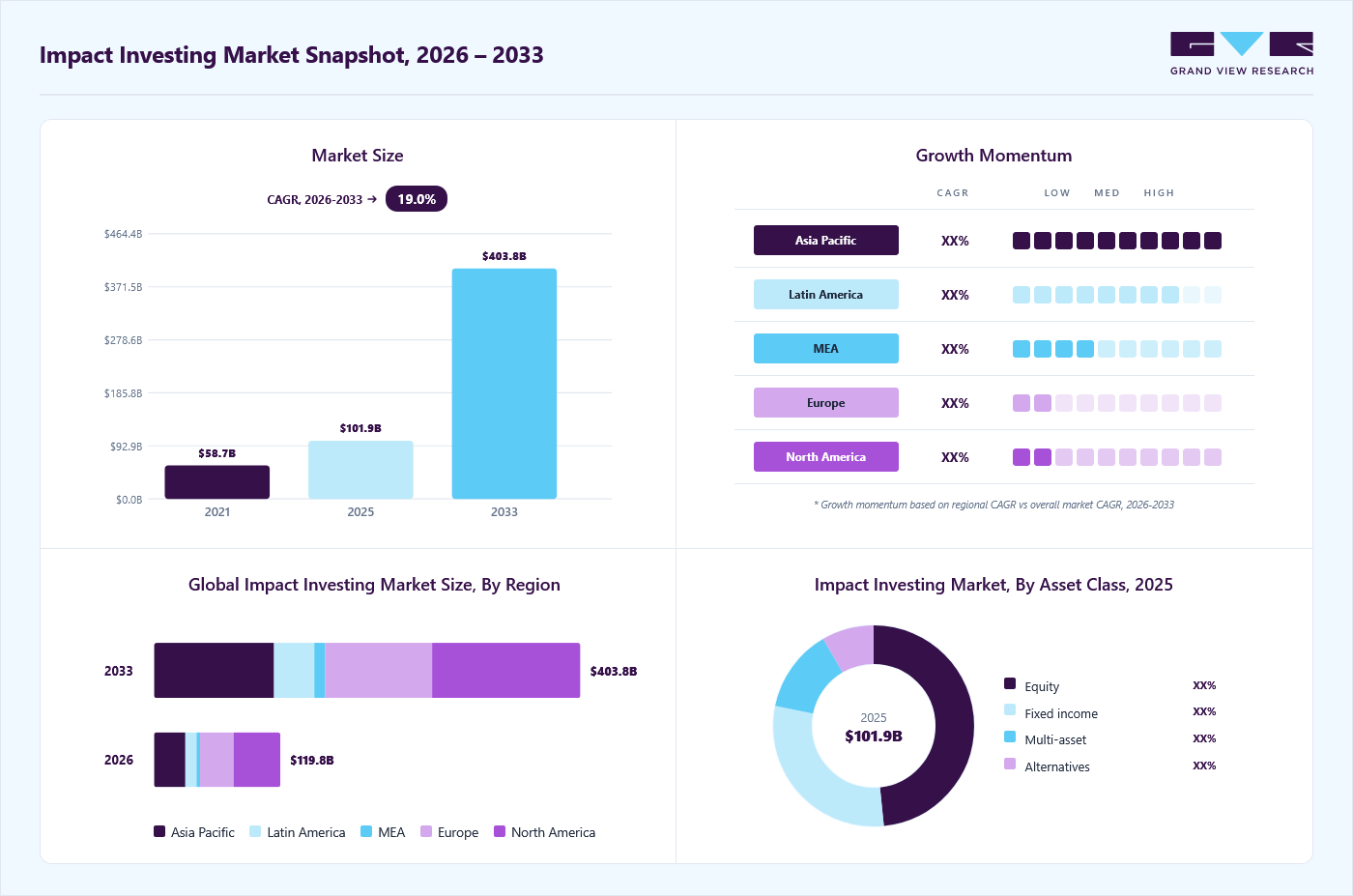 Source: Grand View Research, IR Documents, Primary Interviews, Paid DatabasesTo learn more about this report,
 Download Free Sample Report
Key Market Trends & Insights
- By asset class: Equity segment held the largest market share of 48.3% in 2025.
- By offerings: Equity segment held the largest market share in 2025.
- By investment style: Active segment held the largest market share in 2025.
- By investor type: Institutional investors segment held the largest market share in 2025.
Regional Highlights
- Largest regional market: North America (37.4% revenue share, 2025)
- Fastest-growing regional market: Asia Pacific (highest CAGR, 2026-2033)
- By country: The U.S. held the largest market share in 2025
Market Size & Forecast
- Market size in 2025: USD 101.9 Billion
- Estimated market size in 2026: USD 119.8 Billion
- Projected market size by 2033: USD 403.8 Billion
- CAGR (2026-2033): 19.0%
Three ways to get this report
Buy it, customize it, or ask a question.Ask an Analyst
Analyst response in 1 business day
- AccessReport author, directly
- Reply timeWithin 1 working day
- No sales callDirect answer only
- FormatEmail reply
- CostFree, no cost
Get the Full Report
What the study covers
- FormatsPDF · Excel · Dashboard
- Timeline2026–2033 annual, 2025 base
- Coverage20+ countries, 5 regions
- Companies10+ key players profiled
Customize the Report
20% free customization
- IncludeCountries, segments, points
- TailorTo your product definition
- ExtendDeeper competitor detail
- OrA fully bespoke study
- Turnaround5–10 working days
Heightened awareness of global challenges has influenced investor behavior, leading to a stronger preference for investments that contribute to positive societal outcomes. Consequently, capital is being increasingly directed toward impact-oriented opportunities, thereby supporting the expansion and maturity of the market. The growth is also attributed to the increasing support from governments and regulatory bodies for sustainable finance initiatives. Favorable policies and tax incentives are being introduced to promote investments in sectors such as renewable energy, healthcare, education, and social infrastructure. Additionally, improved disclosure requirements and ESG reporting standards are being implemented, ensuring greater transparency and accountability. Thus, investor confidence is strengthening, and a more structured, scalable environment for impact investing is being developed. To learn more about this report, Download Free Sample Report
The rise of impact measurement and reporting standards is also driving the impact investing industry’s growth. Investors are demanding more transparency and accountability in measuring and reporting the social and environmental impact of their investments. Standardized frameworks, such as the Global Reporting Initiative (GRI) and the Impact Reporting and Investment Standards (IRIS+), guide for measuring and communicating impact. These standards enable investors to make informed decisions and also contribute to building credibility and trust in impact investing.
A key technological trend in impact investing is the integration of financial technology (fintech), which is transforming how these investments are accessed, managed, and scaled. Fintech brings efficiency, transparency, and inclusivity to the market. Digital platforms, data analytics, and automated tools allow investors to identify opportunities that match their ethical values and social objectives, a process that was previously complex. Moreover, fintech improves access to information, enables time-based impact tracking, and encourages broader participation by retail investors. These advances are making the market more accessible, transparent, and technology-driven, supporting its ongoing growth.
Regulatory measures play a critical role in driving the growth of the industry. Governments around the world are implementing policies and regulations that encourage and support sustainable investments. This includes initiatives such as tax incentives, grants, and subsidies for impact investments, as well as the integration of Environmental, Social, and Governance (ESG) considerations into regulatory frameworks. These measures provide a favorable environment for impact investing to thrive and attract a broader range of investors.
The industry faces several challenges, one of the major challenges being the lack of standardized metrics and tools to assess the social and environmental impact of investments. Without universally accepted standards, investors cannot effectively compare or evaluate impact investment opportunities. To address this, industry stakeholders should develop and adopt standardized measurement frameworks, such as those from the Global Impact Investing Network (GIIN), including the IRIS framework. Moreover, collaboration among investors, organizations, and regulatory bodies is also essential to establish clear guidelines and best practices that improve transparency and strengthen confidence in the impact investing market.
Asset Class Insights
The equity segment accounted for the largest share of 48.33% in 2025. Equity investments provide investors with ownership stakes in companies that actively address social and environmental challenges, thus enabling them to directly support businesses aligned with their values and impact objectives. Additionally, equity investments offer the potential for substantial financial returns, making them particularly attractive to investors seeking a balanced combination of impact and profitability.
The fixed income segment is expected to grow at the fastest CAGR during the forecast period. Fixed-income investments provide a stable, predictable income stream, making them particularly attractive to risk-averse investors seeking both financial returns and measurable impact. This aligns closely with the objectives of impact investing, which aim to generate positive social and environmental outcomes alongside consistent financial performance. Furthermore, the rising demand for sustainable investment options has driven the expansion of instruments such as green and social bonds, which are specifically designed to finance projects with clear environmental and social benefits.
Offering Insights
The equity segment held the dominating share in the market in 2025. The segment’s growth is attributed to a wide range of investment opportunities, spanning from established impact-focused funds to early-stage venture capital investments in innovative and purpose-driven startups. This breadth enables investors to allocate capital to companies that closely align with their values and targeted impact objectives. Additionally, the equity segment provides relatively high liquidity, which allows investors to buy and sell shares with ease, thereby improving flexibility and supporting efficient portfolio management.
The bond funds segment is expected to grow at the fastest CAGR during the forecast period. The growth of the segment is driven by the increasing demand for stable and low-risk investment options, particularly among investors seeking predictable income streams alongside measurable impact. Rising interest in sustainable finance has led to the expansion of impact-focused instruments such as green, social, and sustainability bonds, which are being widely adopted to fund environmentally and socially beneficial projects. Additionally, supportive regulatory frameworks and government initiatives promoting sustainable investments are further accelerating the adoption of bond funds, thereby driving the overall growth of this segment.
Investment Style Insights
The active segment dominated the market in 2025. The segment’s growth is attributed to the increasing demand for control, transparency, and measurable impact in investment decisions. Impact investors are prioritizing a hands-on approach, allocating capital guided by specific social and environmental criteria, supported by rigorous due diligence and continuous monitoring. Additionally, the need to ensure accountability and alignment with impact objectives is encouraging active engagement with portfolio companies. Thus, active investment strategies are being widely adopted, contributing to the expansion of this segment within the industry.
The passive segment is projected to grow at the fastest CAGR over the forecast period. The segment’s growth is driven by the rising demand for cost-efficient and scalable investment solutions. Investors are favoring passive strategies that provide diversified exposure to impact-oriented assets through instruments such as exchange-traded funds (ETFs) and index funds. The growth of standardized ESG indices and improved data availability is further supporting this shift, enabling easier access to impact-aligned portfolios. Additionally, the lower management fees and reduced complexity associated with passive investing are contributing to its rising adoption, thereby driving the expansion of this segment.
Investor Type Insights
The institutional investors segment dominated the market in 2025. The segment's growth is driven by the increasing integration of environmental, social, and governance (ESG) considerations into investment strategies. Large investors such as pension funds, insurance companies, and endowments are allocating significant capital toward impact investments to achieve long-term, risk-adjusted returns while addressing sustainability objectives. Growing regulatory pressure, stakeholder expectations, and the need for responsible capital deployment are further encouraging this shift. Thus, institutional participation is expanding, contributing significantly to the growth and maturity of the impact investing market.
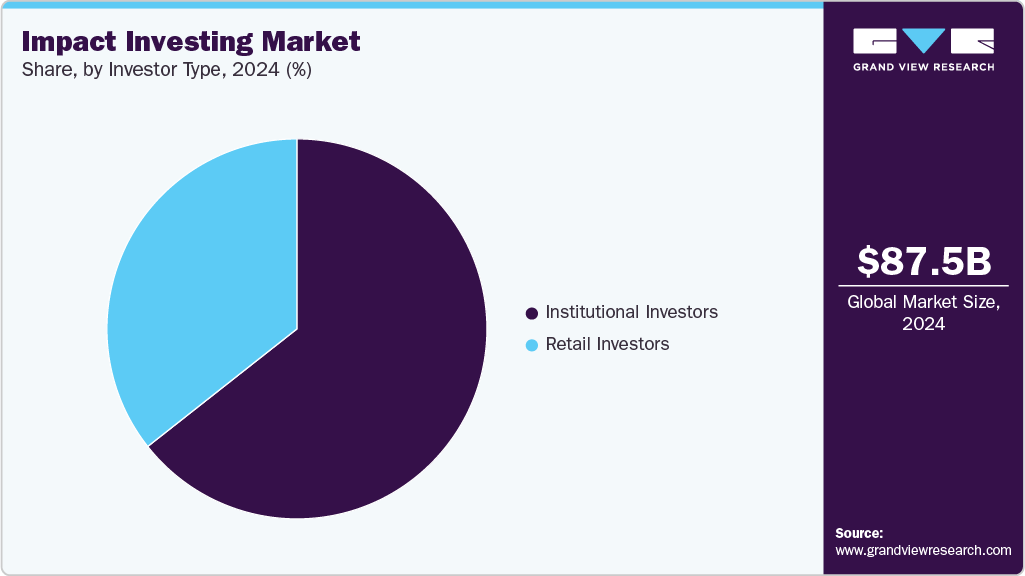 To learn more about this report, Download Free Sample Report
The retail investors segment is projected to grow at the fastest CAGR over the forecast period. The segment’s growth is attributed to increasing awareness of sustainable investing and the desire among individuals to align financial decisions with social and environmental values. Additionally, traditional financial institutions such as ABN AMRO and Aegon Asset Management are expanding their impact-focused product offerings for retail investors, including the Global Impact Equity Fund. Furthermore, the rise of digital investment platforms and mobile apps such as Robinhood and eToro is further supporting market growth by improving accessibility and ease of participation.
Regional Insights
The North America impact investing market held the largest share of 37.36% in 2025. The market growth in this region is attributed to the rising demand among investors to align financial returns with measurable social and environmental outcomes. Institutional investors (pension funds, insurance companies, and endowments) are increasingly integrating ESG considerations into their investment strategies, thereby accelerating capital allocation toward impact-oriented assets. Additionally, evolving regulatory frameworks in the U.S. and Canada are supporting the development of a more structured and transparent impact investing ecosystem, further contributing to the region’s market expansion.
 To learn more about this report, Download Free Sample Report
U.S. Impact Investing Market Trends
The impact investing market in the U.S. held a dominant position in 2025, owing to a significant concentration of dedicated funds, networks, and platforms promoting sustainable finance. Public and private sector collaboration has been instrumental in fostering innovation in areas such as green infrastructure, affordable housing, and inclusive finance. A favorable ecosystem comprising financial institutions, impact accelerators, and ESG data providers has catalyzed the deployment of capital into measurable impact-oriented outcomes.
Asia Pacific Impact Investing Market Trends
The impact investing market in Asia Pacific is expected to grow at the fastest CAGR of 21.1% over the forecast period. The growth in the region is attributable to growing interest from both domestic and international investors seeking to address regional socio-economic disparities. Diverse development challenges across the region, ranging from poverty alleviation to climate resilience, have created fertile ground for impact-driven capital. Moreover, governments in countries such as Australia, Singapore, and India are actively developing frameworks to promote blended finance and public-private partnerships.
The Japan impact investing industry held a substantial market share in 2025. The growth is supported by the government’s push toward sustainable development and corporate responsibility. Japanese institutional investors, such as pension funds and insurance firms, are beginning to integrate ESG and impact criteria into their investment mandates. The Japan Social Impact Investment Foundation (SIIF) has been instrumental in promoting social impact bonds and ecosystem development. As awareness and demand grow, the country is expected to play a larger role in advancing sustainable finance in the region, especially in aging society solutions and disaster resilience.
The impact investing industry in India is expected to grow rapidly in the forecast year. The country’s growth is attributed to the expansion of fintech, healthtech, agritech, and edtech startups. These technology-driven sectors are creating scalable solutions to address key social challenges, particularly in underserved areas. Additionally, increasing focus on early-stage and venture capital investments is further supporting the growth of high-impact, high-growth companies.
Europe Impact Investing Market Trends
The impact investing market in Europe was identified as a lucrative region in 2025. The European Union’s Sustainable Finance Disclosure Regulation (SFDR) and the EU Taxonomy have provided a strong regulatory push for transparency and accountability in impact-driven investments. Institutional investors and asset managers across the region are actively reallocating capital to address pressing social and environmental challenges, such as decarbonization and social inclusion. A collaborative environment among governments, financial institutions, and civil society continues to strengthen the region’s leadership in impact investing.
The UK impact investing industry holds a substantial market share in 2025 due to the presence of a strong policy framework and a vibrant community of social enterprises. The country was an early adopter of social impact bonds and continues to promote innovative financial mechanisms to address societal issues. With the Financial Conduct Authority (FCA) advancing ESG and sustainability regulations, asset managers are increasingly focusing on transparency in impact metrics.
The impact investing industry in Germany is expected to grow rapidly in the coming years. Rising investments in renewable energy and circular economy initiatives are creating significant opportunities for impact-oriented capital. Additionally, German corporations and the Mittelstand are increasingly integrating sustainability into their business strategies, encouraging greater participation from private investors. The growing presence of impact-focused funds and innovation hubs is further supporting the development of a robust and scalable impact investing ecosystem in the country.
Key Impact Investing Companies Insights
Some of the key companies in the impact investing market include BlackRock, Inc., Goldman Sachs, Bain Capital LP, Morgan Stanley, Prudential Financial, Inc., and others. Organizations are focusing on increasing the customer base to gain a competitive edge in the industry. Therefore, key players are taking several strategic initiatives, such as mergers and acquisitions, and partnerships with other major companies.
-
BlackRock, Inc. is an investment management corporation. It provides a broad range of investment and technology services to institutional and retail clients worldwide, including mutual funds, ETFs, and alternative investments. The company offers sustainable investing solutions, integrating environmental, social, and governance (ESG) factors into its investment processes and actively engaging with companies on climate-related and corporate governance issues.
-
Bain Capital LP is a private investment firm with a global presence across North America, Europe, and Asia. The firm manages over USD 185 billion in assets across a diverse range of investment strategies, including private equity, credit, public equity, venture capital, real estate, and impact investing. The firm has a presence across various sectors, including healthcare, consumer, technology, and financial services. Through its double bottom-line initiative, Bain Capital also emphasizes social impact, particularly via Bain Capital Double Impact, which focuses on investments that deliver both financial returns and measurable social outcomes.
Key Impact Investing Companies:
The following key companies have been profiled for this study on the impact investing market.
- BlackRock, Inc.
- Goldman Sachs
- Bain Capital LP
- Morgan Stanley
- Vital Capital
- Prudential Financial, Inc.
- BlueOrchard Finance Ltd.
- Manulife Investment Management Holdings (Canada) Inc.
- Leapfrog Investments
- Community Investment Management LLC
Recent Developments
-
In May 2025, TITAN Group announced a strategic partnership with Investing for Purpose (IFP), a Greek initiative dedicated to promoting impact investing by connecting long-term investors with startups and companies that deliver positive social and environmental outcomes. Through this collaboration, TITAN gained access to a diverse portfolio of Greek purpose-driven enterprises, enabling the company to align its investments with its core business objectives and sustainability strategy. The partnership focused on areas such as the environment, circular economy, education, and diversity and inclusion. As part of the agreement, TITAN also provided mentorship to selected companies, supporting their growth and amplifying their impact.
-
In March 2025, The NAB Foundation launched a USD 50 million Impact Investment Fund (IIF) aimed at amplifying its social and environmental contributions within Australia. As part of its USD 170 million corpus, the Foundation has already allocated USD 25 million to IIF, with USD 10 million invested to date. It plans to reach the full USD 50 million commitment by October 2026. The fund targets investments that deliver measurable positive outcomes in areas such as Indigenous Economic Advancement, Social and Affordable Housing, and Climate Transition, while also seeking appropriate risk-adjusted financial returns.
Impact Investing Market Report Scope
Report Attribute
Details
Market size in 2025
USD 101.9 billion
Estimated market size in 2026
USD 119.8 billion
Projected market size by 2033
USD 403.8 billion
Growth rate
CAGR of 19.0% from 2026 to 2033
Base year for estimation
2025
Historical data
2021 - 2025
Forecast period
2026 - 2033
Quantitative units
Revenue in USD million/billion and CAGR from 2026 to 2033
Report coverage
Revenue forecast, company ranking, competitive landscape, growth factors, and trends
Segments covered
Asset class, offerings, investment style, investor type, region
Regional scope
North America; Europe; Asia Pacific; Latin America; MEA
Country scope
U.S.; Canada; Mexico; Germany; UK; France; China; Japan; India; South Korea; Australia; Brazil; KSA; UAE; South Africa
Key companies profiled
BlackRock, Inc.; Goldman Sachs; Bain Capital LP; Morgan Stanley; Vital Capital; Prudential Financial, Inc.; BlueOrchard Finance Ltd.; Manulife Investment Management Holdings (Canada) Inc.; Leapfrog Investments; Community Investment Management LLC
Customization scope
Free report customization (equivalent up to 8 analysts working days) with purchase. Addition or alteration to country, regional & segment scope.
Pricing and purchase options
Avail customized purchase options to meet your exact research needs. Explore purchase options
Global Impact Investing Market Report Segmentation
This report forecasts revenue growth at global, regional, and country levels and provides an analysis of the latest industry trends in each of the sub-segments from 2021 to 2033. For this study, Grand View Research has segmented the global impact investing market report based on asset class, offerings, investment style, investor type, and region.
-
Asset Class Outlook (Revenue, USD Billion, 2021 - 2033)
-
Equity
-
Fixed income
-
Multi-asset
-
Alternatives
-
-
Offerings Outlook (Revenue, USD Billion, 2021 - 2033)
-
Equity
-
Bond Funds
-
ETFs/Index Fund
-
Alternatives/Hedge Funds
-
-
Investment Style Outlook (Revenue, USD Billion, 2021 - 2033)
-
Active
-
Passive
-
-
Investor Type Outlook (Revenue, USD Billion, 2021 - 2033)
-
Institutional Investors
-
Retail Investors
-
-
Regional Outlook (Revenue, USD Billion, 2021 - 2033)
-
North America
-
U.S.
-
Canada
-
Mexico
-
-
Europe
-
Germany
-
UK
-
France
-
-
Asia Pacific
-
China
-
Japan
-
India
-
South Korea
-
Australia
-
-
Latin America
-
Brazil
-
-
Middle East and Africa (MEA)
-
KSA
-
UAE
-
South Africa
-
-
Frequently Asked Questions About This Report
North America dominated with a 37.4% revenue share in 2025.
Asia Pacific is the fastest-growing region over the forecast period.
Equity segment held the largest revenue share in 2025, while bond funds is the fastest-growing offering.
The active segment held the largest revenue share in 2025, while passive is the fastest-growing style.
Institutional investors segment held the largest share in 2025, while retail investors is the fastest-growing type.
The global impact investing market size was valued at USD 101.9 billion in 2025 and is estimated at USD 119.8 billion for 2026.
The global impact investing market is expected to grow at a CAGR of 19.0% from 2026 to 2033, reaching USD 403.8 billion by 2033.
Key players include BlackRock, Inc.; Goldman Sachs; Bain Capital LP; Morgan Stanley; Vital Capital; Prudential Financial, Inc.; BlueOrchard Finance Ltd.; Manulife Investment Management Holdings (Canada) Inc.; Leapfrog Investments; Community Investment Management LLC.
The equity segment accounted for the largest share of 48.3% in 2025. Equity investments provide investors with ownership stakes in companies that actively address social and environmental challenges, thus enable them to directly support businesses aligned with their values and impact objectives.
The market growth is driven by increasing demand among investors to align their investment strategies with their personal values while generating measurable social and environmental impact alongside financial returns.
About the Author(s)
Next Generation Technologies Research Team
Technology · Next Generation TechnologiesThis report was authored by the next generation technologies research team at Grand View Research - comprising two research analysts, one senior research analyst, and one industry expert - with specialized expertise in the next generation technologies segment of the technology industry. All findings are based on proprietary technology databases, executive interviews, and regulatory analysis, subject to internal peer review prior to publication.
Last Updated:
Speak to Analyst

Customize this report to your needs - add regions, segments, or data points, with 20% free customization.
Or view our licence options:


ISO 9001:2015 & 27001:2022 Certified
We are GDPR and CCPA compliant! Your transaction & personal information is safe and secure. For more details, please read our privacy policy.


