
- Home
- »
- Advanced Interior Materials
- »
-
Impact-Resistant Glass Market Size And Share Report, 2033GVR Report cover

Impact-Resistant Glass Market (2026 - 2033)
Size, Share & Trend Analysis Report By End Use (Building & Construction, Automotive & Transportation, Security & Defense), By Interlayer, By Region, And Segment Forecasts
Market Size, 2025
$23.1BMarket Estimate, 2026
$24.8BMarket Forecast, 2033
$40.3BCAGR, 2026–2033
7.2%Impact-Resistant Glass Market Summary
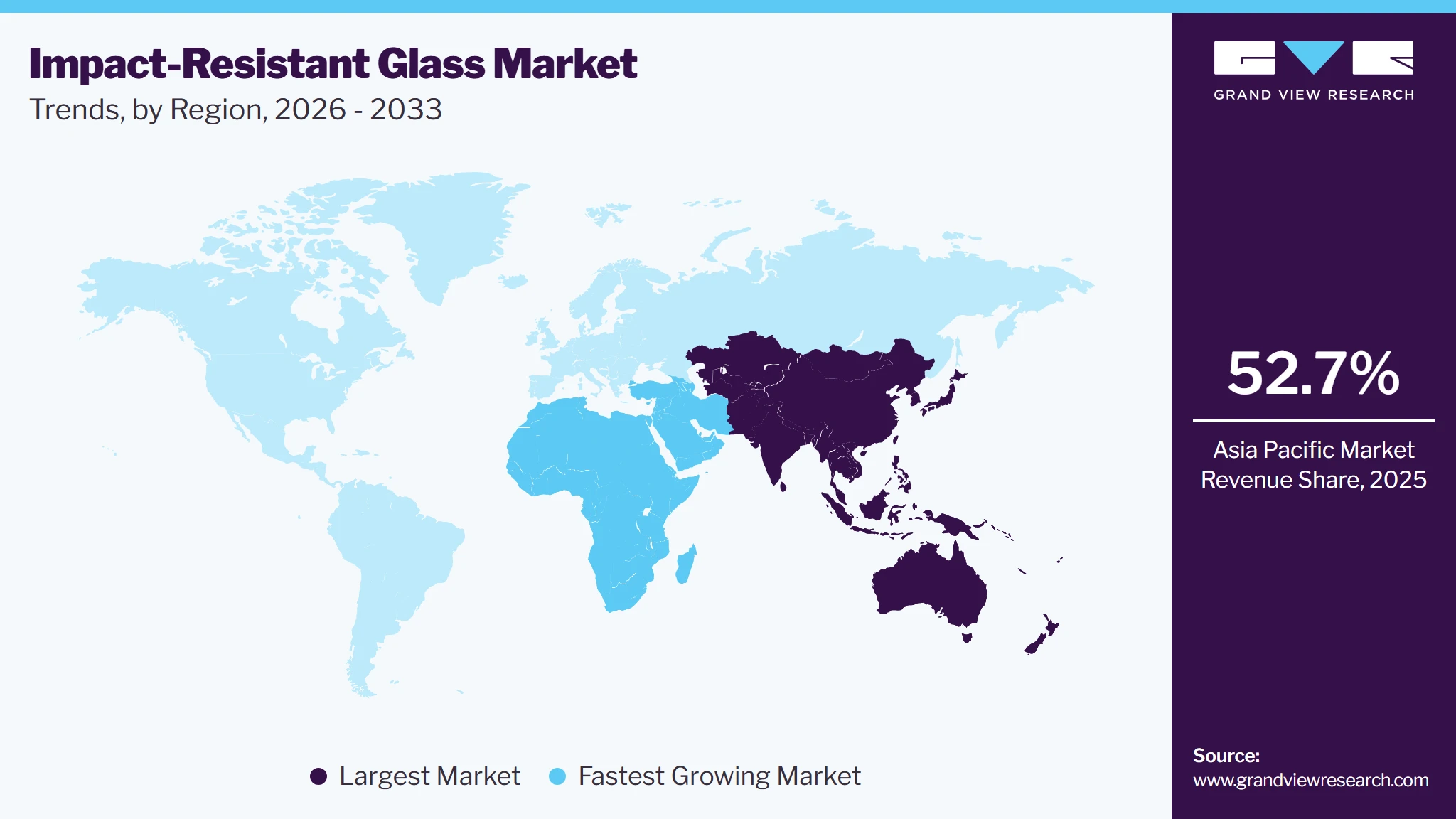
The global impact-resistant glass market size was valued at USD 23.1 billion in 2025 and is projected to grow from USD 24.8 billion in 2026 to USD 40.3 billion by 2033, at a CAGR of 7.2% from 2026 to 2033. Asia Pacific dominated the market, accounting for the largest revenue share of 52.7% in 2025. Market growth is driven by increasing demand for high-performance safety glazing in residential, commercial, automotive, and infrastructure applications, rising construction activity in regions exposed to hurricanes, cyclones, and other severe weather events, and growing requirements for forced-entry and security-resistant glazing.
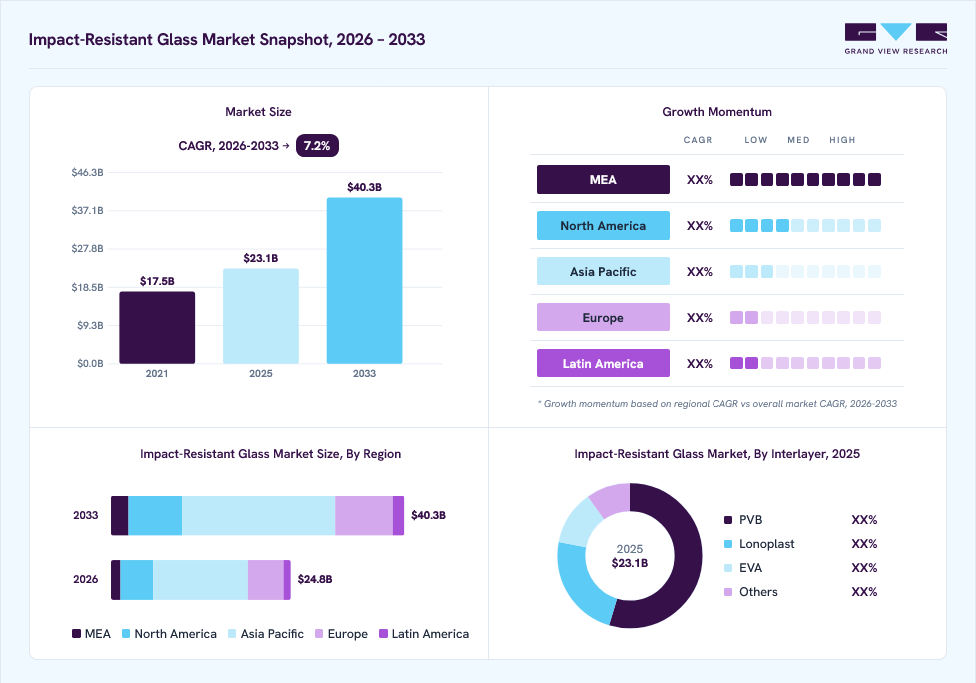 Source: Grand View Research, IR Documents, Primary Interviews, Paid DatabasesTo learn more about this report,
 Download Free Sample Report
Key Market Trends & Insights
- By end use, Building & construction segment accounted for the largest revenue share of 59.9% in 2025.
- By interlayer, PVB segment held the largest market share of 54.7% in 2025.
Regional Highlights
- Largest regional market: Asia Pacific (52.7% revenue share, 2025)
- Fastest-growing regional market: Middle East & Africa (highest CAGR, 2026-2033)
- By country: China held the largest market share in 2025.
Market Size & Forecast
- Market size in 2025: USD 23.1 Billion
- Estimated market size in 2026: USD 24.8 Billion
- Projected Market Size in 2033: USD 40.3 Billion
- CAGR (2026-2033): 7.2%
Prism AI by Grand View Research Free to tryAsk a question about the Impact-Resistant glass market✓Every figure cited from GVR research Prefer the report? Download free sample →
Growing emphasis on sustainable construction is supporting durable and resource-efficient glazing solutions. Manufacturers are developing thinner and lighter laminated products with durable interlayers and optimized material use. Longer service life can reduce replacement frequency, material waste, and lifecycle impacts. Thermal and solar-control features can further improve building energy performance.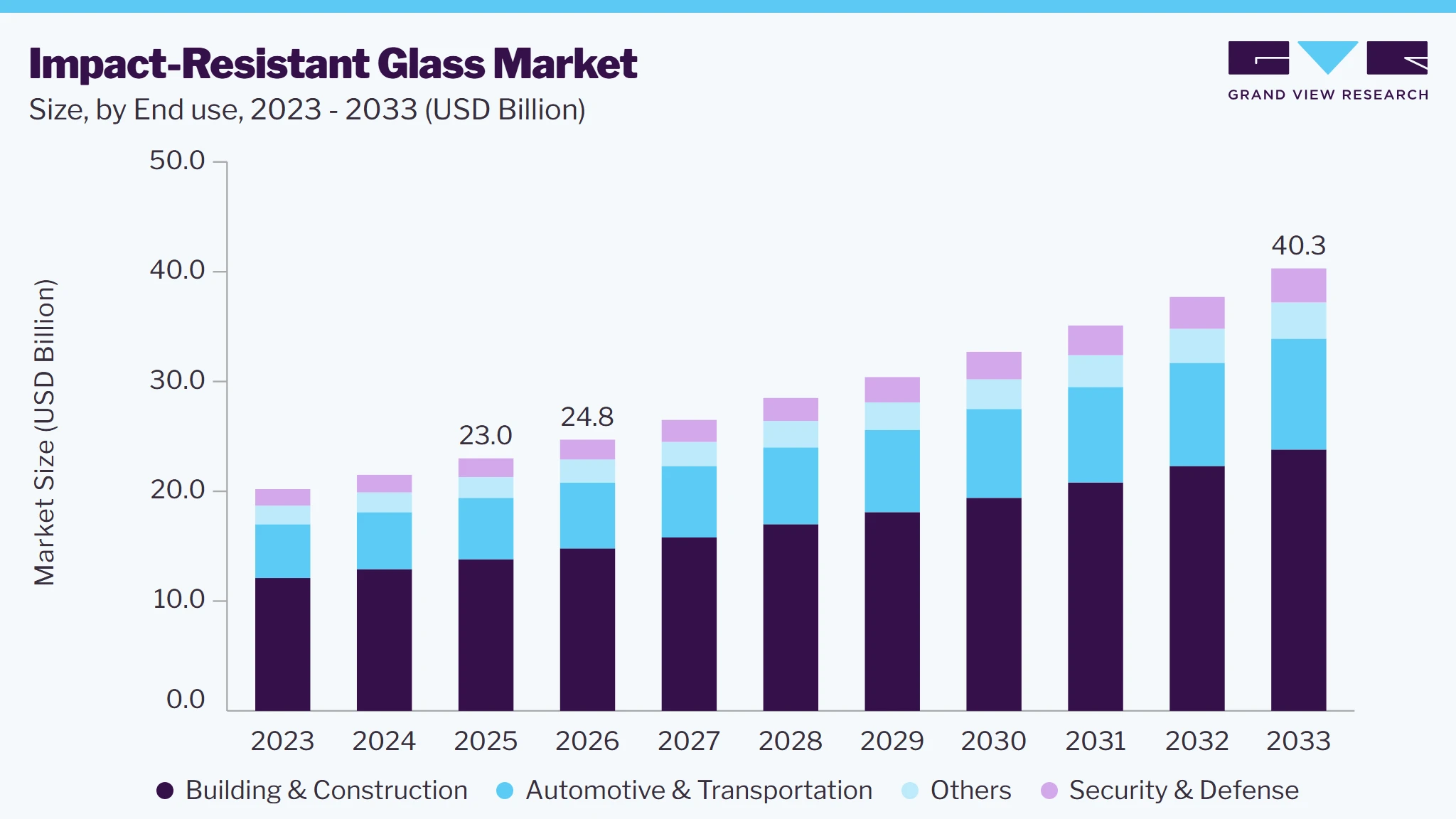 To learn more about this report, Download Free Sample Report
Technology advancements are improving strength, transparency, weight, and functionality. New PVB, lonoplast, and other interlayers enhance impact resistance and post-breakage integrity. They can also improve acoustic insulation, UV protection, and security. Advanced lamination, heat treatment, and edge-processing techniques are enabling thinner and lighter products with higher performance.
Market Dynamics
Growing concerns regarding property security and unauthorized access are increasing the demand for glazing systems capable of providing greater protection than conventional glass. Laminated and multilayer configurations can withstand repeated impacts while retaining fractured glass within the interlayer, helping reduce the risk of penetration and injury. This is supporting adoption across banks, retail stores, government facilities, airports, corporate offices, data centers, educational institutions, and high-value residential properties.
The integration of protective glazing into security-focused building designs is also encouraging the development of multifunctional products that combine impact resistance, forced-entry protection, acoustic insulation, UV control, and post-breakage integrity. As security considerations become increasingly incorporated into commercial and institutional building specifications, high-performance glazing is gaining importance as a component of broader building protection systems.
High product and installation costs remain a significant constraint. Compared with conventional annealed or standard tempered glass, these solutions can require multiple glass layers, polymer interlayers, specialized lamination, heat treatment, precision edge processing, and stringent quality control, resulting in higher manufacturing costs. Products designed for severe-weather, forced-entry, blast, or ballistic applications may require additional layers and specialized configurations, further increasing material and processing expenses.
Installation can also involve application-specific framing, anchoring, and glazing systems capable of transferring impact loads effectively to the surrounding structure. These requirements can increase total project costs, particularly in price-sensitive residential and commercial applications. In addition, testing and certification against applicable impact, wind, security, or other performance standards can increase product-development costs and lengthen qualification timelines.
Increasing emphasis on occupant safety, vehicle durability, and advanced vehicle design is creating opportunities across automotive and transportation applications. Laminated and specially engineered glazing can provide enhanced impact resistance while retaining fractured glass, supporting applications such as windshields, side glazing, panoramic roofs, buses, rail vehicles, and specialty transportation systems. The expansion of premium vehicles and electric vehicles is further supporting demand for glazing that combines safety with acoustic insulation, UV protection, thermal performance, and lightweight construction.
The growing use of larger windows and panoramic roof systems is encouraging manufacturers to develop thinner and lighter glazing configurations that meet demanding safety requirements without significantly increasing vehicle weight. This combination of enhanced protection, weight optimization, and multifunctionality is expected to broaden application opportunities across automotive and transportation segments.
Analyst Perspective
Rising emphasis on building safety, structural resilience, and high-performance glazing is supporting demand for impact-resistant glass across construction, automotive, transportation, and security applications. Increasing exposure to severe weather events, stricter safety requirements, and growing concerns around forced entry are encouraging the adoption of laminated and multilayer glazing systems. Technological progress in interlayers, lamination, lightweight constructions, and multifunctional glazing is improving impact performance while enabling acoustic, UV, thermal, and security benefits.
End Use Insights
The building & construction segment accounted for the largest share in 2025, representing 59.9% of global revenue. Its leading position is supported by extensive use in windows, doors, façades, curtain walls, skylights, and other building-envelope applications. Demand is further strengthened by stricter safety standards, resilient construction practices, renovation of aging buildings, and growing requirements for glazing that can withstand severe weather and accidental impacts.
The security & defense segment is projected to register the fastest CAGR of 6.8% during the forecast period. Rising requirements for forced-entry protection, blast mitigation, ballistic resistance, and secure building envelopes are driving adoption across government facilities, airports, financial institutions, defense installations, data centers, and other sensitive locations. Increasing investment in critical infrastructure protection is expected to support demand for specialized multilayer and high-performance glazing systems.
Interlayer Insights
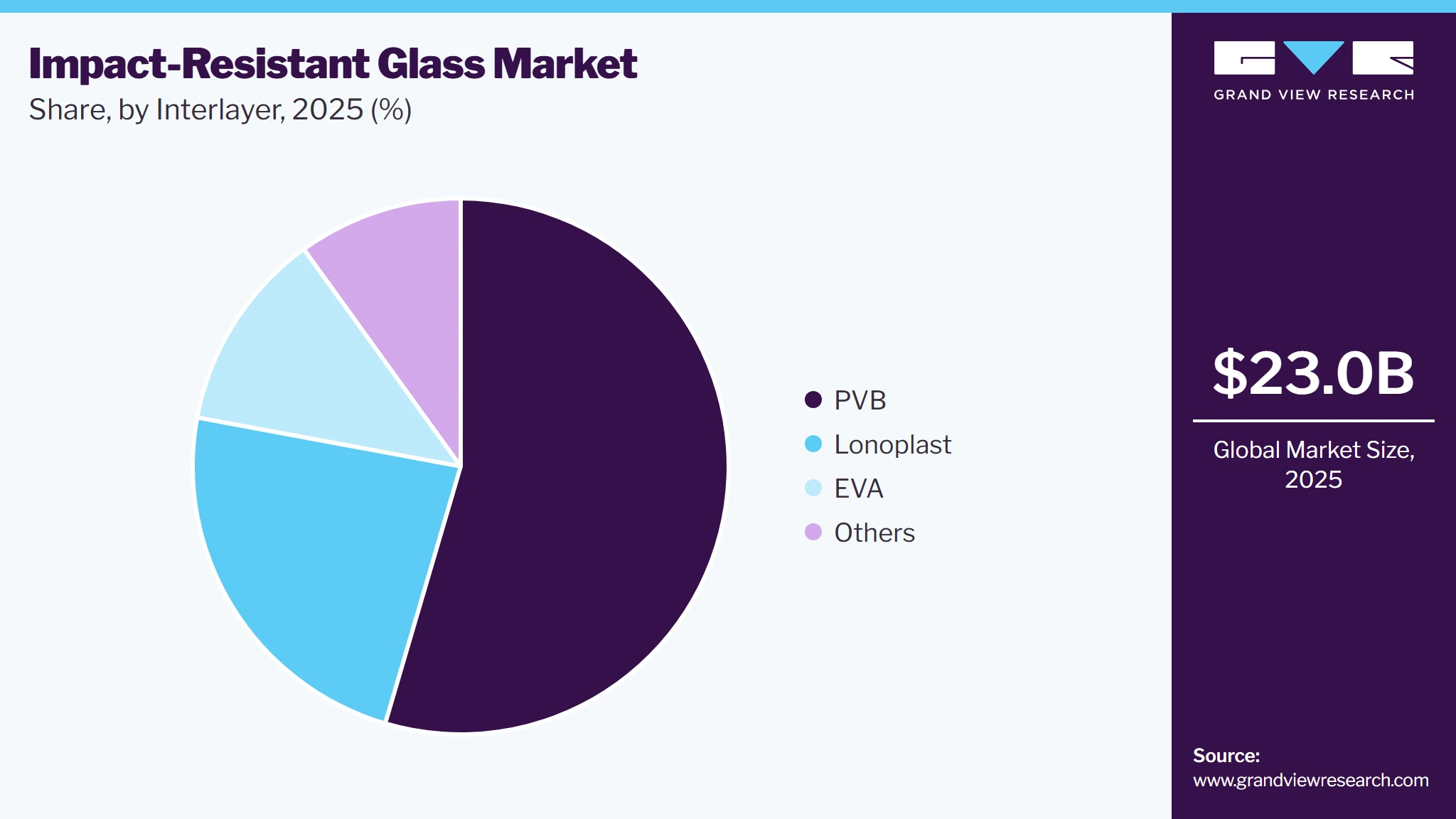
The PVB segment accounted for the largest share in 2025, representing 54.7% share of global revenue. Its widespread adoption is supported by established use in laminated glazing, good optical clarity, strong adhesion, UV protection, and effective retention of glass fragments following breakage. Broad availability, mature processing capabilities, and compatibility with architectural and automotive applications further reinforce its leading position.
 To learn more about this report, Download Free Sample Report
Lonoplast is projected to register the fastest CAGR of 7.6% during the forecast period. Its high stiffness and strength make it suitable for applications requiring enhanced structural integrity, including large-area façades, overhead glazing, hurricane-resistant systems, and security installations. Growing demand for thinner, stronger, and multifunctional glazing is expected to encourage greater adoption of lonoplast-based configurations.
Regional Insights
North America impact-resistant glass industry represents a mature market supported by stringent building standards, replacement of aging glazing systems, and strong demand for safety-oriented construction. The U.S. accounts for a significant share of regional consumption, particularly in hurricane-prone coastal areas where high-performance glazing is incorporated into residential and commercial structures. The renovation of offices, retail properties, public buildings, and transportation infrastructure also supports demand. Increasing preference for laminated glazing with acoustic, UV, and security characteristics is further broadening applications.
U.S. Impact-Resistant Glass Market Trends
The U.S. impact-resistant glass industry growth is strongly influenced by the hurricane-resistant construction, building-code requirements, and security considerations. Florida, Texas, the Gulf Coast, and other areas exposed to severe storms provide substantial demand for tested impact-resistant windows, doors, and façade systems. Commercial facilities, educational institutions, healthcare buildings, and government properties are also adopting higher-performance glazing to improve occupant protection.
Europe Impact-Resistant Glass Market Trends
Europe impact-resistant glass industry is characterized by demand for high-performance glazing driven by stringent construction standards, renovation activity, and emphasis on building durability. Countries such as Germany, France, the UK, Italy, and Spain are seeing applications across commercial buildings, transportation facilities, and premium residential projects. Product development is increasingly focused on combining protection with thermal insulation, acoustic performance, and architectural flexibility.
Asia Pacific Impact-Resistant Glass Market Trends
Asia Pacific impact-resistant glass industry is benefiting from rapid urban development, expanding construction activity, and increasing investment in modern commercial and transportation infrastructure. China, Japan, South Korea, India, and Southeast Asian economies are generating demand for advanced glazing in high-rise buildings, airports, hotels, offices, and residential developments. Growing automotive production also provides a substantial application base. Rising awareness of occupant safety and improvements in local manufacturing capabilities are gradually increasing the use of higher-performance glazing beyond premium construction projects.
 To learn more about this report, Download Free Sample Report
China impact-resistant glass industry is a significant market, supported by its large construction, automotive, infrastructure, and manufacturing sectors. Rapid development of commercial buildings, residential projects, transportation infrastructure, and high-rise structures is increasing demand for laminated, tempered, and other safety-oriented glazing solutions. Growing emphasis on building safety, severe-weather resilience, and higher-performance façades is further encouraging the use of protective glazing.
Latin America Impact-Resistant Glass Market Trends
Latin America impact-resistant glass industry is experiencing increasing adoption alongside urban redevelopment, commercial construction, and the modernization of residential properties. Brazil and Mexico represent important demand centers due to their sizeable construction and automotive industries. Applications are concentrated in façades, windows, doors, automotive glazing, and selected security installations. In coastal and storm-exposed areas, greater attention to building resilience is supporting the use of stronger glazing systems.
Middle East & Africa Impact-Resistant Glass Market Trends
Middle East and Africa impact-resistant glass industry is expected to register the fastest CAGR over the forecast period, driven by large-scale infrastructure development, premium real estate projects, hospitality construction, and transportation investments supporting demand across the MEA. The Gulf countries are particularly relevant, with extensive use of architectural glazing in airports, hotels, commercial towers, and luxury developments. High temperatures and intense solar exposure also encourage the integration of protective glazing with thermal and solar-control properties. In Africa, adoption is more concentrated in major urban centers and high-value commercial projects, where security, durability, and long-term performance are important purchasing considerations.
Key Impact-Resistant Glass Company Insights
Some of the key players operating in the market include AGC Inc., Guardian Industries, and others.
-
AGC Inc. is a Japan-based global glass manufacturer with a broad portfolio of architectural, automotive, and specialty glazing products. The company provides laminated and safety glass solutions designed to improve occupant protection, impact resistance, and post-breakage performance. Its offerings include laminated architectural glass, automotive glazing, and specialized glass systems that can combine safety with acoustic, solar-control, and thermal-performance characteristics. AGC serves commercial buildings, residential projects, transportation, automotive, and other applications requiring high-performance glazing.
-
Guardian Industries is a U.S.-based manufacturer of architectural and automotive glass with operations across multiple international markets. The company provides high-performance glazing solutions, including laminated, coated, and safety glass designed for applications requiring improved protection and durability. Its architectural portfolio includes glass products that can combine safety characteristics with solar control, thermal performance, and aesthetic flexibility. The company serves commercial and residential construction, automotive, and other specialized glazing applications.
-
Nippon Sheet Glass Co., Ltd. (NSG Group) is a Japan-based global manufacturer of architectural, automotive, and specialty glass products. The company offers laminated and safety glazing solutions designed to provide improved impact resistance, post-breakage integrity, security, and occupant protection. Its product portfolio includes advanced laminated glass for façades, windows, doors, automotive glazing, and other applications where safety and durability are important. NSG Group also develops multifunctional glazing that combines protective properties with thermal, acoustic, solar-control, and design performance.
Key Impact-Resistant Glass Companies:
The following key companies have been profiled for this study on the impact-resistant glass market.
-
AGC Inc.
-
Cardinal Glass Industries
-
Fuyao Glass Industry Group Co., Ltd.
-
Guardian Industries
-
Nippon Sheet Glass Co., Ltd. (NSG Group)
-
Saint-Gobain S.A.
-
SCHOTT AG
-
Şişecam Group
-
Vitro, S.A.B. de C.V.
-
Xinyi Glass Holdings Limited
Competitive Benchmarking
Category
Operating Strategies
Competitive Edge
Weakness
Established Players (AGC Inc.; Cardinal Glass Industries; Guardian Industries; Nippon Sheet Glass Co., Ltd. (NSG Group); Saint-Gobain S.A.; Şişecam Group; Vitro, S.A.B. de C.V.; Xinyi Glass Holdings Limited)
- Expand laminated, tempered, coated, and specialty glazing portfolios to address safety, security, architectural, automotive, and severe-weather applications.
- Strengthen regional production capacity and supply networks to serve large construction and automotive programs.
- Combine protective glazing with thermal, acoustic, solar-control, and aesthetic properties to increase product value.
- Extensive manufacturing footprints and established relationships with major glass processors, façade contractors, automakers, and construction companies.
- Ability to supply large-volume projects while maintaining broad product and specification coverage.
- Significant R&D capabilities support development of thinner, stronger, and multifunctional glazing configurations.
- Large, diversified portfolios can limit dedicated focus on specialized impact-resistant applications.
- High capital requirements for advanced processing, lamination, coating, and safety-testing infrastructure.
- Competition among major producers can place pressure on pricing, particularly for standardized laminated and safety-glass products.
Emerging & Regional Players (Fuyao Glass Industry Group Co., Ltd.; SCHOTT AG)
- Concentrate on technically demanding glazing for automotive, architectural, specialty, and security-oriented applications.
- Invest in advanced glass processing, multilayer constructions, coatings, and precision manufacturing to meet demanding specifications.
- Target applications where performance, optical quality, durability, and customization carry greater importance than commodity pricing.
- Strong expertise in specialized glass manufacturing and complex product configurations.
- Established capabilities in automotive and specialty glazing provide access to technically demanding customer segments.
- Ability to develop customized solutions for applications requiring stringent performance and quality specifications.
- Exposure to specialized end-use segments can create greater sensitivity to fluctuations in automotive and premium construction demand.
- Complex product configurations may result in higher manufacturing and qualification costs.
- Competing against vertically integrated global glass producers can make expansion into standardized architectural applications more challenging.
Recent Developments
-
In April 2025, MITER Brands introduced Diamond Glass, a next-generation laminated impact-resistant glazing solution designed for hurricane protection and intrusion resistance. The product is nearly half the weight of conventional impact glass and is up to 37% thinner, while reducing material use by as much as 40% per square foot. The development highlights the industry's shift toward lighter, thinner, and more resource-efficient protective glazing without compromising impact performance.
-
In July 2026, Saint-Gobain reaffirmed plans to expand its North American operations through additional capital expenditure and acquisitions. The company has invested approximately USD 8 billion in acquisitions, capital expenditure, and R&D across the U.S. and Canada since 2020. It plans to increase North America's contribution to group revenue toward 30% in the coming years. The company also announced further North American deals in 2026, including the acquisition of a glass-fiber manufacturing plant in North Carolina, strengthening its regional manufacturing footprint. The continued investment highlights Saint-Gobain's strategy of expanding production capacity and market presence in North America.
Impact-Resistant Glass Market Report Scope
Report Attribute
Details
Market Definition
The market size represents the revenue generated from the sale of impact-resistant glass across various regions in a given year.
Market size in 2025
USD 23.1 billion
Estimated market size in 2026
USD 24.8 billion
Projected market size by 2033
USD 40.3 billion
Growth rate
CAGR of 7.2%from 2026 to 2033
Base year for estimation
2025
Historical data
2021 - 2024
Forecast period
2026 - 2033
Quantitative Units
Revenue in USD billion and CAGR from 2026 to 2033
Report coverage
Revenue forecast, competitive landscape, growth factors, and trends
Segments covered
End use, interlayer, and region
Regional scope
North America; Europe; Asia Pacific; Latin America; Middle East & Africa
Country scope
U.S.; Canada; Mexico; Germany; France; Italy; UK; China; South Korea; India; Japan; Brazil
Key companies profiled
AGC Inc.; Cardinal Glass Industries; Fuyao Glass Industry Group Co., Ltd.; Guardian Industries; Nippon Sheet Glass Co., Ltd. (NSG Group); Saint-Gobain S.A.; SCHOTT AG; Şişecam Group; Vitro, S.A.B. de C.V.; Xinyi Glass Holdings Limited
Customization scope
Free report customization (equivalent up to 8 analysts working days) with purchase. Addition or alteration to country, regional & segment scope.
Pricing and purchase options
Avail customized purchase options to meet your exact research needs. Explore purchase options
Global Impact-Resistant Glass Market Report Segmentation
This report forecasts revenue growth at global, regional, and country levels and provides an analysis of the latest industry trends in each of the sub-segments from 2021 to 2033. For this study, Grand View Research has segmented the global impact-resistant glass market report based on end use, interlayer, and region.
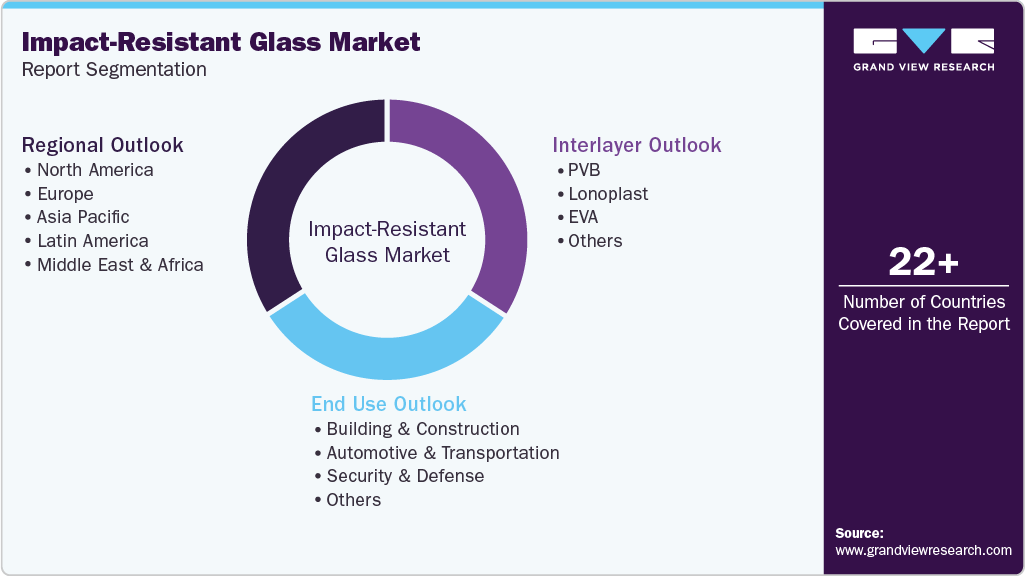 To learn more about this report, Download Free Sample Report
-
End Use Outlook (Revenue, USD Billion, 2021 - 2033)
-
Building & Construction
-
Automotive & Transportation
-
Security & Defense
-
Others
-
-
Interlayer Outlook (Revenue, USD Billion, 2021 - 2033)
-
PVB
-
Lonoplast
-
EVA
-
Others
-
-
Regional Outlook (Revenue, USD Billion, 2021 - 2033)
-
North America
-
U.S.
-
Canada
-
Mexico
-
-
Europe
-
Germany
-
France
-
Italy
-
UK
-
-
Asia Pacific
-
China
-
South Korea
-
India
-
Japan
-
-
Latin America
-
Brazil
-
-
Middle East & Africa
-
Research Methodology
The impact-resistant glass market figures in this report are based on a proven research process that combines executive interviews with secondary research from proprietary databases, company filings, and recognized regulatory and institutional sources. Market size is built through value-chain sizing-reconciling supply-side and demand-side estimates-and triangulated with bottom-up and top-down approaches. Every estimate passes multiple levels of expert validation before publication, with each impact-resistant glass segment quantified using the revenue-capture definitions in the table below.
Segment Definition
End Use
Revenue Capture Definition
Building & Construction
Revenue is captured from the sale of impact-resistant glazing used in windows, doors, façades, curtain walls, skylights, storefronts, and other architectural applications requiring enhanced protection against impact, severe weather, or forced entry.
Automotive & Transportation
Revenue is derived from the supply of laminated and specially engineered glazing used in windshields, side windows, panoramic roofs, buses, rail vehicles, and other transportation applications where occupant safety and impact performance are required.
Security & Defense
Revenue is generated from the sale of multilayer and specialized glazing designed for forced-entry, blast, ballistic, and high-impact protection in government facilities, banks, airports, defense installations, data centers, and other security-sensitive locations.
Others
Includes revenue from specialized protective glazing used in industrial facilities, marine applications, recreational vehicles, specialty equipment, and other applications requiring enhanced impact resistance.
Interlayer
Revenue Capture Definition
PVB
Revenue is captured from laminated glazing incorporating polyvinyl butyral interlayers, which provide adhesion between glass layers and help retain fractured glass after impact while offering safety, acoustic, and UV-related benefits.
Lonoplast
Revenue is derived from glazing incorporating high-performance lonoplast interlayers, which provide greater stiffness, strength, and structural integrity for demanding applications such as façades, overhead glazing, security systems, and hurricane-resistant assemblies.
EVA
Revenue is generated from laminated glass incorporating ethylene-vinyl acetate interlayers, primarily for applications requiring safety, decorative flexibility, UV resistance, and enhanced post-breakage performance.
Others
Includes revenue from glazing using alternative interlayer materials such as TPU and other specialty polymers developed for specific requirements related to impact resistance, security, acoustic performance, optical quality, or specialized architectural and transportation applications.
Estimation Model
Layer Name
Key Question
Description
Addressable Building Base Layer
What is the potential demand base for impact-resistant glass?
Quantify the building and façade base that can accommodate dynamic glazing across commercial, residential, hospitality, healthcare, education, transportation, and other applications. Evaluate factors such as total building floor area, glazing area, window-to-wall ratio, solar exposure, building age, energy-performance requirements, and new construction and renovation activity.
Technology Adoption Layer
How widely is electrochromic glazing being adopted?
Determine the penetration of electrochromic glazing across applicable building and architectural applications. Assess adoption by building type, glazing application, project size, technology type, and region. Incorporate existing installations, new projects, retrofit activity, and announced projects to establish the current and potential adoption base.
Glass Demand & Installation Layer
What quantity of impact-resistant glass is required?
Derive annual demand by applying electrochromic-glass penetration rates to the addressable glazing area. Incorporate new building construction, renovation, and replacement activity, average glazing requirements, and project-level installation volumes. The resulting demand is measured in square meters of impact-resistant glass installed or consumed annually.
Pricing & Revenue Layer
What is the monetary value of the installed glass demand?
Estimate market revenue by multiplying the calculated impact-resistant glass volume by the applicable average selling price per square meter. Pricing is assessed based on product specifications, glass configuration, size, tinting performance, control requirements, and application. Where relevant, separate the value of the glass from installation, controls, and other ancillary services to maintain consistency with the defined market scope.
Delivered Customizations
This report has been delivered with the following In-depth customizations
Client Request
Customization Delivered
Value Adds
Building Code & Certification Compliance Analysis
Assessment of applicable impact, wind-load, forced-entry, blast, and safety-glazing standards across major markets, including product testing and certification requirements.
Identifies regulatory barriers, certification requirements, and markets where compliance creates opportunities for qualified suppliers.
Impact-Resistant Glass Technology Cost & Economics Analysis
Assessment of product and installation costs across different impact-resistant glazing configurations, including laminated, tempered, heat-strengthened, multilayer, and specialized security glazing. The analysis considers glass thickness, interlayer type, processing requirements, framing systems, installation, testing, maintenance, and replacement costs.
Identifies the major cost drivers and compares the economics of impact-resistant glazing with conventional safety glass across residential, commercial, automotive, infrastructure, and security applications.
Product Performance & Specification Benchmarking
Comparative assessment of key product characteristics, including impact resistance, glass configuration, interlayer technology, thickness, weight, optical properties, post-breakage integrity, acoustic performance, UV protection, and security capabilities.
Enables comparison of competing product technologies and identifies performance gaps and differentiation opportunities for manufacturers, developers, architects, and façade contractors.
Frequently Asked Questions About This Report
The global impact-resistant glass market size was estimated at USD 23.1 billion in 2025 and is expected to reach USD 24.8 billion in 2026.
The global impact-resistant glass market is expected to grow at a compound annual growth rate of 7.2%from 2026 to 2033 to reach USD 40.3 billion by 2033.
By end use, building & construction accounted for the largest market revenue share of 59.9% in 2025.
Asia Pacific dominated the impact-resistant glass market with the largest revenue share of 52.7% in 2025.
The key factor driving the growth of the global impact-resistant glass market is the rising demand for safer and more resilient buildings amid increasing exposure to severe weather, security threats, and stringent building safety standards.
Some of the key players of the global impact-resistant glass market are AGC Inc.; Cardinal Glass Industries; Fuyao Glass Industry Group Co., Ltd.; Guardian Industries; Nippon Sheet Glass Co., Ltd. (NSG Group); Saint-Gobain S.A.; SCHOTT AG; Şişecam Group; Vitro, S.A.B. de C.V.; Xinyi Glass Holdings Limited, and others.
The impact-resistant glass market in China held the largest share in the Asia Pacific region in 2025.
By interlayer, the PVB accounted for the largest market revenue share of 54.7% in 2025.
By interlayer, the lonoplast segment is anticipated to register the fastest CAGR of 7.6% from 2026 to 2033.
About the Author(s)
Advanced Interior Materials Research Team
Advanced Materials · Advanced Interior MaterialsThis report was authored by the advanced interior materials research team at Grand View Research - comprising two research analysts, one senior research analyst, and one industry expert - with specialized expertise in the advanced interior materials segment of the advanced materials industry. All findings are based on proprietary advanced materials databases, executive interviews, and regulatory analysis, subject to internal peer review prior to publication.
Last Updated:
Speak to Analyst

Customize this report to your needs - add regions, segments, or data points, with 20% free customization.
Or view our licence options:


ISO 9001:2015 & 27001:2022 Certified
We are GDPR and CCPA compliant! Your transaction & personal information is safe and secure. For more details, please read our privacy policy.


