
- Home
- »
- Medical Devices
- »
-
India Condom Market Size, Share & Growth Report, 2033GVR Report cover

India Condom Market (2026 - 2033)
Size, Share & Trends Analysis Report By Material Type (Latex, Non-latex), By Product (Male Condom, Female Condom), By Distribution Channel (Mass Merchandizers), And Segment Forecasts
Market Size, 2025
$449.3MMarket Estimate, 2026
$498.0MMarket Forecast, 2033
$1,037.8MCAGR, 2026–2033
11.1%India Condom Market Summary
The India condom market size was valued at USD 449.3 million in 2025 and is projected to grow from USD 498.0 million in 2026 to USD 1,037.8 million by 2033, at a CAGR of 11.1% from 2026 to 2033. This growth is driven by premiumization, digital accessibility, and evolving consumer behavior. The market is witnessing a shift from economy products toward premium and specialty variants such as ultra-thin, dotted, flavored, and performance-enhancing condoms, supported by rising willingness among urban consumers to spend on branded intimacy and sexual wellness products. This transition is particularly visible among younger consumers (18-35 years), digitally engaged populations, and Tier 1 city consumers, leading to structurally improving revenue realization for organized brands.
Key Market Trends & Insights
- By material type: Latex segment held the largest market share in 2025.
- By product: Male condoms segment held the largest market share in 2025.
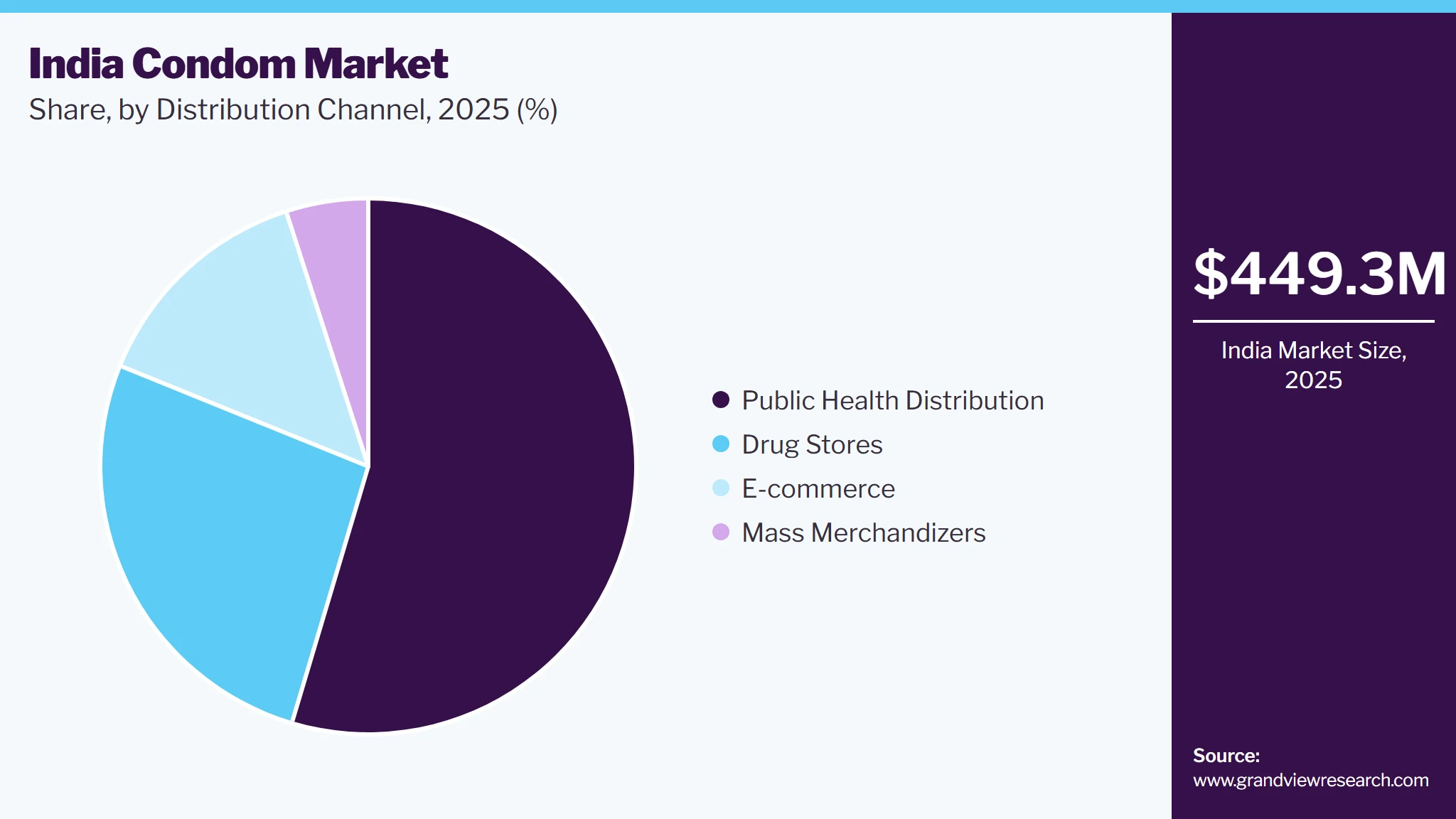
- By distribution channel: Public health distribution segment held the largest market share of 54.6% in 2025.
Market Size & Forecast
- Market size in 2025: USD 449.3 Million
- Estimated market size in 2026: USD 498.0 Million
- Projected market size by 2033: USD 1,037.8 Million
- CAGR (2026-2033): 11.1%
Prism AI by Grand View Research Free to tryAsk a question about the india condom marketTry asking✓Every figure cited from GVR research Prefer the report? Download free sample →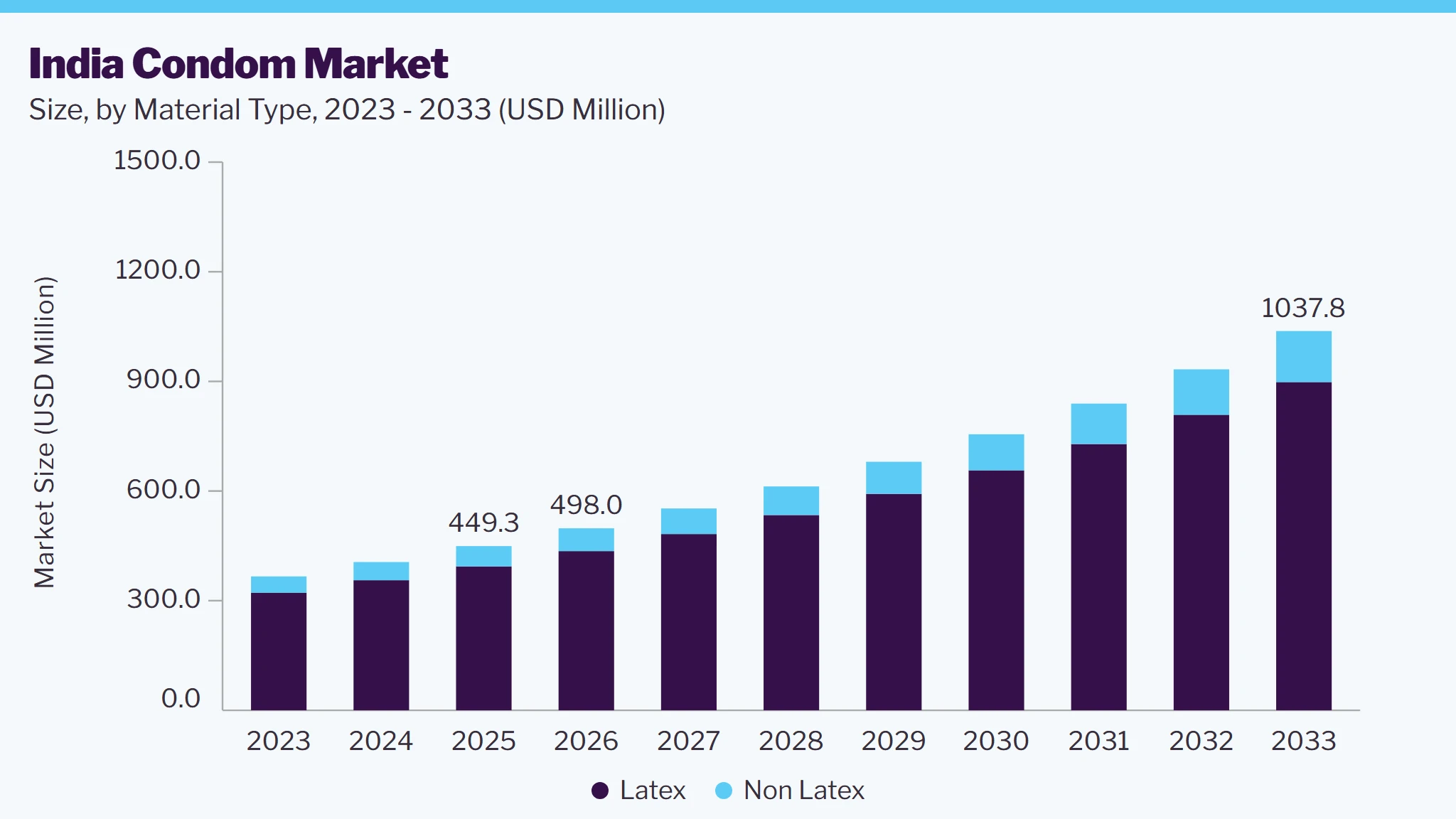 Source: Grand View Research, IR Documents, Primary Interviews, Paid DatabasesTo learn more about this report,
 Download Free Sample Report
Market Dynamics
The section below outlines the key factors driving the market, including rising awareness of safe sex and sexually transmitted infection (STI) prevention, increasing emphasis on family planning and contraception, and growing acceptance of condoms among younger and urban populations. It examines the influence of government initiatives such as the National Family Planning Programme, public-sector condom distribution, and awareness campaigns in improving contraceptive accessibility, alongside the growing role of private manufacturers, e-commerce platforms, and modern retail channels in expanding product availability. The section also evaluates market restraints associated with social stigma surrounding condom usage, inconsistent adoption across rural and semi-urban populations, price sensitivity, and misconceptions regarding contraceptive use, alongside opportunities arising from product innovation, premium and ultra-thin variants, flavored and textured condoms, non-latex alternatives, and targeted marketing to younger consumers and female users.
The prevalence of HIV and other sexually transmitted infections (STIs) in India is driving demand for condoms as an essential method of protection against sexually transmitted infections and unintended pregnancies. Continued transmission risks, particularly among key populations and individuals with inconsistent access to sexual health services, are reinforcing the importance of condom use as a preventive measure. Government-led HIV prevention initiatives under the National AIDS Control Programme (NACP), including targeted interventions, free condom distribution, and awareness campaigns, are supporting condom adoption across high-risk populations. According to a report published by The New Indian Express in December 2025, India has over 25 lakh people living with HIV, making it the country with the second-largest HIV-positive population globally. This highlights the importance of consistent condom uses in reducing HIV transmission risks and supports government-led prevention efforts, including condom distribution and awareness campaigns under the National AIDS and STD Control Programme. The WHO's HIV data and statistics further provide a global context for the ongoing need for preventive measures, including condom use, to reduce new HIV infections.Furthermore, growing awareness of sexual health and the importance of dual protection is encouraging demand for condoms through public healthcare channels as well as branded retail products.
Case Study Published by National Library of Medicine in June 2025: Potential for Female Condom Adoption in India's Family Planning Market
Background
A qualitative study conducted in Pune, India, examined the awareness, acceptance, and potential adoption of female condoms among women, their male partners, and family planning healthcare providers.
Key Findings
• The research involved 35 participants, including 25 women, five male partners of female sex workers, and five healthcare providers.
• Among the women interviewed, 12 expressed willingness to use female condoms in the future.
• The study also highlighted that improved awareness, wider product availability, and education could encourage greater acceptance.
• However, high product prices, limited familiarity, and social stigma remained key barriers to adoption.
Market Impact
The findings indicate an opportunity for condom manufacturers to strengthen their presence in India's female condom segment through affordable product offerings, targeted awareness campaigns, and partnerships with family planning organizations. Greater accessibility to female-controlled contraceptive options could also help expand the consumer base and diversify the product portfolio in the Indian condom market.
Social stigma and embarrassment associated with purchasing condoms remain a significant restraint for the India condom market, particularly among unmarried individuals, women, and consumers in rural and conservative communities. Cultural sensitivities surrounding premarital sex, limited openness in discussing sexual health, and concerns about being judged by pharmacists, shopkeepers, or acquaintances discourage consumers from purchasing condoms openly. The lack of privacy at traditional retail outlets further restricts access, with some consumers preferring to depend on partners or government distribution channels instead of directly approaching pharmacies. These social barriers can reduce purchase frequency, discourage experimentation with premium and specialized condom variants, and limit the adoption of female condoms.
A research article titled “Structural Barriers to Condom Adoption: Insights from India,” posted on Research Square in March 2026, provides direct evidence of social stigma as a barrier to condom adoption in India. The qualitative study involved 58 in-depth interviews with managers and leaders from government agencies, NGOs, research institutions, and social marketing organizations involved in condom promotion. The findings revealed that purchasing condoms is frequently perceived as socially inappropriate, with both customers and retailers experiencing embarrassment during transactions. One interviewee highlighted that consumers often avoid verbally requesting condoms at paan shops and instead rely on indirect signals, such as placing money on the counter, prompting retailers to discreetly hand over a wrapped condom pack. The study also identified concerns around shame, social judgment, and the association of condoms with illicit relationships and sexually transmitted infections. These findings demonstrate how entrenched cultural perceptions and discomfort at retail touchpoints can discourage open purchases and restrict broader condom market adoption
India's condom market offers an opportunity for manufacturers to collaborate with healthcare organizations, government agencies, NGOs, social marketing organizations, and digital platforms to address gaps in consumer awareness, accessibility, and adoption. Such partnerships can help manufacturers extend their reach into underserved rural and semi-urban markets, normalize conversations around sexual health, and encourage consistent condom usage among younger and previously underserved consumer groups.
In August 2025, Reckitt's Durex supported The Birds and Bees Talk initiative in partnership with Plan India and government stakeholders to improve adolescent sexual health and life-skills education, particularly across Northeast India. The initiative used school-based engagement, teacher participation, digital storytelling, and interactive formats such as Consent Cafés to promote discussions around consent, relationships, and sexual health. By 2025, the programme had reportedly reached more than 4 million young people and engaged over 2,000 schools. Such partnerships create opportunities to build early awareness of safe-sex practices and strengthen long-term acceptance of contraceptive products.
Social stigma and embarrassment associated with purchasing condoms remain a significant restraint for the India condom market, particularly among unmarried individuals, women, and consumers in rural and conservative communities. Cultural sensitivities surrounding premarital sex, limited openness in discussing sexual health, and concerns about being judged by pharmacists, shopkeepers, or acquaintances discourage consumers from purchasing condoms openly. The lack of privacy at traditional retail outlets further restricts access, with some consumers preferring to depend on partners or government distribution channels instead of directly approaching pharmacies. These social barriers can reduce purchase frequency, discourage experimentation with premium and specialized condom variants, and limit the adoption of female condoms. Consequently, despite increasing awareness of contraception and STI prevention, persistent social taboos continue to constrain retail penetration and broader consumer adoption.
Market Concentration & Characteristics
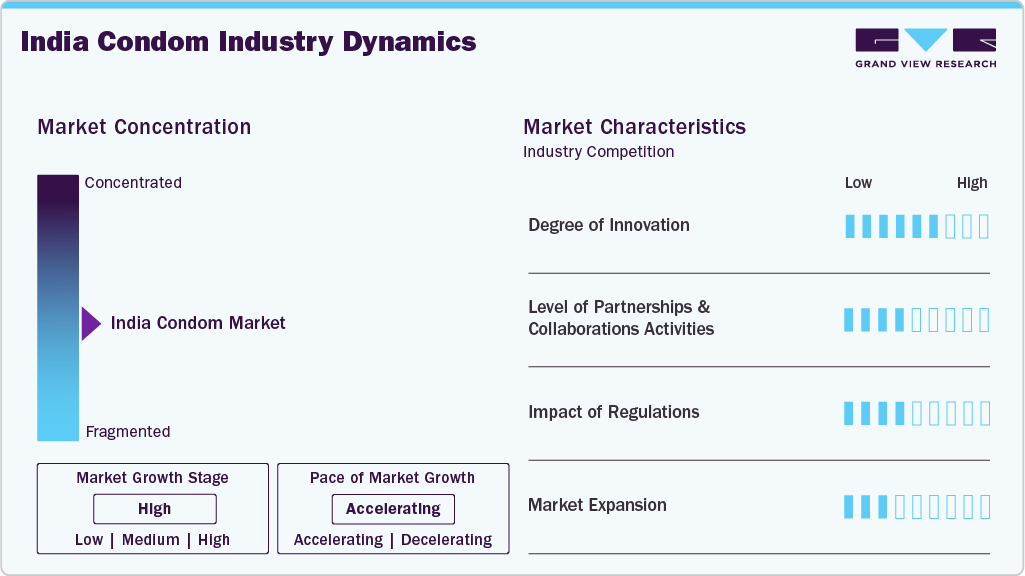
The chart below represents the relationship between industry concentration, industry characteristics, and industry participants. The industry is moderately concentrated, with few large and various emerging players entering the market. There is a moderate degree of innovation, moderate level of partnerships & collaborations activities, high impact of regulations, and moderate high expansion of industry.
Innovation in the India condom market is primarily focused on improving product differentiation, enhancing sexual experience, and developing specialized variants to attract younger consumers and premium buyers. Manufacturers are moving beyond conventional latex condoms through the introduction of ultra-thin, dotted, ribbed, textured, flavored, delay, and non-latex products. There is also increasing emphasis on material innovation, improved lubrication, and product designs that address consumer preferences for comfort and sensitivity. For instance, HLL Lifecare introduced an indigenous graphene condom in 2024, while in April 2026, it commissioned an upgraded 3-Dip condom manufacturing machine at its Irapuram facility to increase production of specialized variants, including ultra-thin and multi-textured condoms.
 To learn more about this report, Download Free Sample Report
The market is characterized more by collaborations between condom manufacturers, government health agencies, social marketing organizations (SMOs), and non-governmental organizations (NGOs) than by large-scale strategic mergers and acquisitions. These partnerships primarily focus on improving contraceptive accessibility, promoting safe-sex awareness, supporting HIV/AIDS prevention, and expanding distribution among underserved populations. For instance, Manforce Condoms partnered with SAATHII NGO in December 2023 to launch the #SafeTiesToSaveLives campaign, which involved community-level activities and family planning counselling, particularly for women living with HIV. Similarly, the Ministry of Health and Family Welfare works with six registered SMOs, including HLL Lifecare, DKT India, and Population Health Services India, to distribute affordable condoms through social marketing channels
The industry is significantly influenced by government regulations governing medical device manufacturing, product quality, safety, testing, packaging, and distribution. Condoms are classified as mechanical contraceptives under India's regulatory framework and are covered by the Medical Devices Rules, 2017, alongside relevant provisions of the Drugs and Cosmetics Act, 1940. The Central Drugs Standard Control Organization (CDSCO) oversees the regulatory framework, while applicable Bureau of Indian Standards (BIS) requirements and quality-testing procedures support product compliance. Manufacturers must maintain prescribed quality parameters, including physical integrity, packaging seal strength, appropriate labelling, batch identification, and expiry information.
Expansion in the market is being driven by manufacturers' efforts to strengthen rural distribution, improve affordability, increase digital sales, and target women and younger consumers through localized marketing campaigns. Companies are increasingly focusing on smaller, lower-priced packs and wider retail availability to address price sensitivity and purchase-related social stigma in Tier 2, Tier 3, and rural markets. For instance, Reckitt announced plans in September 2024 to expand Durex's reach among rural consumers and women in India, including introducing smaller, more affordable packs. The company highlighted that only around 10-15% of its Durex sales came from rural markets, indicating significant untapped distribution potential. In addition, HLL Lifecare reported annual condom production of approximately 221.7 crore units in July 2025, demonstrating the manufacturing capacity supporting institutional procurement, domestic distribution, and export opportunities.
Analyst Perspective
The market is shifting from a predominantly price-driven, mass-market category toward a more diversified consumer market supported by growing sexual health awareness, premium product adoption, and digital distribution. Market expansion will depend on increasing condom usage and on manufacturers' ability to address changing consumer preferences through product differentiation, discreet purchasing options, affordable pricing, and wider penetration across urban and rural markets. The growing availability of ultra-thin, textured, flavored, and specialty condoms, alongside the expansion of e-commerce and quick-commerce platforms such as Amazon, Flipkart, Blinkit, and Zepto, reflects this transition. However, social stigma, inconsistent awareness of contraceptive benefits, affordability constraints, and uneven rural distribution continue to limit broader adoption. Manufacturers that combine affordable product portfolios with premium innovations, targeted sexual health awareness initiatives, and stronger omnichannel distribution networks are likely to gain a competitive advantage.
Material Type Insights
Based on material type, the latex segment dominated the market with the largest revenue share in 2025. This is due to its affordability, high elasticity, durability, and widespread availability across pharmacies, supermarkets, government distribution channels, and online platforms. The established manufacturing ecosystem for natural rubber latex also enables large-scale production and competitive pricing, making latex condoms accessible to a broad consumer base, including price-sensitive and rural populations. In addition, manufacturers are increasingly focusing on premiumization through the introduction of ultra-thin, flavored, dotted, ribbed, and performance-oriented latex variants to attract younger consumers and increase average spending. The expansion of e-commerce and quick-commerce platforms is further improving access to premium products by offering discreet purchasing, wider product selection, and convenient repeat ordering. Furthermore, safe-sex awareness campaigns by brands such as Mankind Pharma's Manforce, alongside government-led HIV prevention and family planning initiatives, continue to reinforce latex condom adoption across India.
The non latex segment is expected to grow at the fastest CAGR during the forecast period. This is driven by increasing awareness of latex allergies, skin sensitivities, and consumer demand for alternative condom materials. Polyisoprene- and polyurethane-based condoms are gaining attention as alternatives for individuals who experience discomfort or allergic reactions associated with natural rubber latex. Growing consumer interest in premium sexual wellness products is also supporting segment expansion, particularly among urban and digitally engaged consumers seeking softer textures, improved comfort, reduced latex odor, and a more natural-feel experience. For instance, Reckitt's Durex Real Feel range offers non-latex condoms made using polyisoprene, positioning the product around enhanced softness and intimacy. Although higher prices and relatively limited availability compared with conventional latex products currently restrict mass-market adoption, increasing product awareness, premium retail expansion, and online distribution are expected to support non-latex condom penetration in India.
Product Insights
Based on product, the male condoms segment dominated the market with the largest revenue share in 2025. This is supported by its established role in government family planning programs, HIV prevention initiatives, and large-scale distribution through public healthcare institutions and NGO networks. Government-led procurement and social marketing programs help maintain product availability across different income groups, particularly in rural and underserved areas. In addition, brand-led awareness campaigns by Mankind Pharma (Manforce) and Reckitt (Durex) help normalize condom usage by positioning products around sexual wellness, pleasure, and relationship experiences instead of contraception alone. The expansion of e-commerce, quick-commerce, and direct-to-consumer wellness platforms is further improving accessibility by offering discreet purchasing, wider product choices, and convenient repeat ordering. These developments are supporting demand for conventional as well as premium male condoms, including ultra-thin, textured, flavored, and delay variants.
The female condoms segment is expected to grow at the fastest CAGR during the forecast period, due to expanding awareness of women-controlled contraception, reproductive autonomy, and protection against sexually transmitted infections increases. Unlike male condoms, female condoms provide women with greater control over barrier contraception, creating opportunities for adoption through reproductive health programs, NGO-led initiatives, and targeted sexual health education. However, limited consumer familiarity, relatively low product availability, higher prices, and social stigma continue to restrict widespread adoption. Product innovation is creating additional growth opportunities, particularly through the development of non-latex alternatives. For instance, Cupid Limited announced the development of a nitrile-based female condom, targeting the premium latex-free segment and addressing limitations associated with conventional latex products. The proposed product is positioned around improved comfort, reduced odor, a thinner feel, and suitability for consumers with latex sensitivities.
Distribution Channel Insights
Based on distribution channel, the public health distribution segment dominated the market with the largest revenue share of 54.6% in 2025 supported by government-led family planning and HIV prevention initiatives. Organizations such as the National AIDS Control Organization (NACO), state health departments, and NGOs facilitate large-scale procurement and distribution, particularly through public healthcare centers and rural outreach programs. Additionally, HLL Lifecare Limited plays an important role in institutional supply, with its large-scale manufacturing capacity and brands such as Nirodh supporting the availability of affordable condoms across government distribution networks.
 To learn more about this report, Download Free Sample Report
The e-commerce segment is expected to grow at the fastest CAGR during the forecast period. E-commerce platforms such as Amazon India and Flipkart are improving accessibility through discreet purchasing, wider product availability, and convenient home delivery, particularly among consumers who prefer privacy when purchasing condoms. The availability of specialized variants, including ultra-thin, flavored, delay, and premium condoms, is also improving product discovery and encouraging consumers to explore differentiated products. Furthermore, quick-commerce platforms such as Blinkit, Swiggy Instamart, and Zepto are supporting impulse and urgent purchases through rapid delivery, while D2C brands such as Sirona Hygiene are leveraging digital marketing, educational campaigns, and subscription-based models to expand consumer awareness and repeat purchases.
Key Companies in the India Condom Market
Some of the key companies operating in the India condom market include Mankind Pharma, Reckitt Benckiser Group PLC, Godrej Consumer Products Limited, TTK, HLL Lifecare Limited, Karex Berhad, Redcliffe Hygiene Pvt Ltd., Sirona Hygiene Private Limited, and Okamoto Industries, Inc. The companies are engaged in new product launches, mergers & acquisitions, and launch campaigns to create awareness regarding their products and increase their market share.
-
Mankind Pharma is a pharmaceutical company that offers a range of sexual wellness products to address the sexual health concerns of both men and women. Manforce is a key brand of the company that offers a variety of condoms in the Indian market.
-
Reckitt Benckiser Group PLC is a global company engaged in the consumer goods sector. The company's sexual wellness brand, Durex, offers a variety of products under this brand, such as condoms and lubricants.
Key India Condom Companies
-
Mankind Pharma
-
Reckitt Benckiser Group PLC
-
Godrej Consumer Products Limited
-
TTK
-
HLL Lifecare Limited
-
Krex Berhad
-
Redcliffe Hygiene Pvt Ltd.
-
Sirona Hygiene Private Limited
-
Okamoto Industries, Inc.
Competitive Benchmarking
Operating Strategies
Competitive Edge
Weaknesses
Mature players
- Reckitt Benckiser Group Plc.
- Mankind Pharma
- Godrej Consumer Products Limited
- TTK Healthcare Limited
- HLL Lifecare Limited
- Okamoto Industries, Inc.
- Cupid Limited
- Pente Lozer
- Focus on mass manufacturing and deep distribution networks across pharmacies, drugstores, and government supply programs.
- Strong reliance on multi-channel presence: offline retail, e-commerce, and institutional sales (HLL, PSU channels).
- Large-scale manufacturing capabilities (HLL, Cupid) enabling low-cost production and government supply contracts.
- Established regulatory and compliance experience in sexual wellness category.
- Strong brand trust and recall (Durex, Manforce, Skore, Moods).
- Heavy dependence on legacy pharmacy distribution and offline retail.
- Slower innovation cycles due to scale and compliance-heavy processes.
- High competition leads to price pressure in mass market segments.
Emerging players
- Karex Berhad
- Redcliffe Hygiene Pvt. Ltd.
- Sirona Hygiene Private Limited
- Convex Latex Pvt. Ltd.
- Aabha Contraceptives Pvt. Ltd.
- Indus Medicare
- Safeguard
- Contraceptives Pvt. Ltd.
- Target niche segments: women-centric sexual wellness, premium lifestyle condoms, and eco-friendly variants.
- Enter market via e-commerce and quick-commerce platforms instead of traditional retail.
- Strong positioning in privacy, discretion, and modern sexual wellness narratives.
- Foster product innovation cycles (women-centric products, hybrid wellness formats).
- Better alignment with Gen Z and urban consumers shifting to online purchasing behavior.
- Limited brand trust compared to established FMCG leaders.
- Weak distribution reach beyond metro and Tier 1 cities.
- Regulatory and compliance complexity slows down rapid expansion.
Recent Developments
-
In October 2025, Cipla Health launched Unfold, a new sexual wellness brand focused on promoting openness, trust, and choice in intimate wellbeing. The launch represents the company's expansion into the condom and sexual wellness category, with contemporary branding and packaging designed to reduce stigma and appeal to modern consumers. This development reflects increasing competition and diversification in India's condom market, particularly in the premium and consumer-oriented segments.
-
In July 2026, Durex launched Naturals Smooth Glide condoms to address comfort-related needs. Durex introduced Smooth Glide condoms featuring twice the water-based lubricant compared with its regular condom offering, designed to reduce dryness-related discomfort and improve comfort during intimacy. The launch highlights manufacturers' growing focus on product differentiation through enhanced lubrication and consumer-centric innovations, creating opportunities for premium, comfort-oriented condom variants in India.
India Condom Market Report Scope
Report Attribute
Details
Market size in 2025
USD 449.3 million
Estimated market size in 2026
USD 498.0 million
Projected market size by 2033
USD 1,037.8 million
Growth rate
CAGR of 11.1% from 2026 to 2033
Base year for estimation
2025
Historical data
2021 - 2024
Forecast data
2026 - 2033
Quantitative units
Revenue in USD Million/Billion and CAGR from 2026 to 2033, Volume (000’ Units) from 2021 - 2033
Report coverage
Revenue forecast, company ranking, competitive landscape, growth factors, and trends
Segments covered
Material type, product, distribution channels
Country scope
India
Key companies profiled
Mankind Pharma; Reckitt Benckiser Group PLC; Godrej Consumer Products Limited; TTK; HLL Lifecare Limited; Karex Berhad; Redcliffe Hygiene Pvt Ltd.; Sirona Hygiene Private Limited; Okamoto Industries, Inc.
Customization scope
Free report customization (equivalent up to 8 analysts working days) with purchase. Addition or alteration to country, regional & segment scope.
Pricing and purchase options
Avail customized purchase options to meet your exact research needs. Explore purchase options
India Condom Market Report Segmentation
This report forecasts revenue growth, country level and provides an analysis of the latest industry trends in each of the sub-segments from 2021 to 2033 For this study, Grand View Research has segmented India condom market report based on material type, product, distribution channels.
-
Material Type Outlook (Revenue, USD Million, 2021 - 2033)
-
Latex
-
Non Latex
-
Polyurethane
-
Polyisoprene
-
Lambskin
-
Nitrile Butadiene Rubber (NBR)
-
-
-
Product Outlook (Revenue, USD Million, 2021 - 2033)
-
Male Condoms
-
Female Condoms
-
-
Distribution Channel Outlook (Revenue, USD Million, 2021 - 2033)
-
Mass Merchandizers
-
Drug Stores
-
E-commerce
-
Public Health Distribution
-
Research Methodology
The India condom market figures in this report are based on a proven research process that combines executive interviews with secondary research from proprietary databases, company filings, and recognized regulatory and institutional sources. Market size is built through value-chain sizing - reconciling supply-side and demand-side estimates - and triangulated with bottom-up and top-down approaches. Every estimate passes multiple levels of expert validation before publication, with each India condom segment quantified using the revenue-capture definitions in the table below.
Segment Definition
Material Type
Revenue capture definition
Latex
Condoms manufactured using natural rubber latex to provide a barrier against unintended pregnancies and sexually transmitted infections (STIs).
Non-latex
Condoms manufactured using alternative materials such as polyurethane, polyisoprene, or nitrile, primarily catering to consumers with latex allergies or sensitivities.
Non-latex
Revenue capture definition
Polyurethane
A synthetic, latex-free material known for its thin structure, strength, and effective heat transfer. It is suitable for individuals with latex allergies and is used in both male and female condoms.
Polyisoprene
A synthetic rubber material that closely resembles natural latex in terms of elasticity, softness, and flexibility. It provides a latex-free alternative for individuals with natural rubber latex allergies.
Lambskin
A natural membrane material made from sheep intestinal membrane, offering a thin and natural-feeling barrier. It helps prevent pregnancy but does not reliably protect against sexually transmitted infections (STIs).
Nitrile Butadiene Rubber (NBR)
A synthetic rubber material offering flexibility, durability, and resistance to oils. It is used in certain barrier products and is a potential material category for latex-free condom applications.
Product
Revenue capture definition
Male Condoms
Barrier contraceptive products worn over the penis during sexual intercourse to prevent unintended pregnancies and reduce the risk of STI transmission.
Female Condoms
Internal barrier contraceptive products are inserted into the vagina before intercourse to prevent unintended pregnancies and reduce the risk of STI transmission.
Distribution Channel
Revenue capture definition
Mass Merchandisers
Large-format retail outlets, supermarkets, and hypermarkets that sell condoms through dedicated personal care and family planning sections.
Drug Stores
Pharmacies and chemist outlets that distribute condoms through healthcare and personal care product sections.
E-Commerce
Online marketplaces, brand-owned websites, and quick-commerce platforms that enable consumers to purchase condoms through digital ordering and home delivery.
Estimation Model
Section
Key Summary
1.1 Research Approach
A hybrid research approach combining secondary and primary research is used to assess the India condom market. The assessment considers revenues generated from latex and non-latex condoms across male and female condom products and offline and online distribution channels. Secondary sources include government publications, Ministry of Health and Family Welfare reports, National AIDS Control Organisation (NACO) publications, National Family Health Survey (NFHS) data, population statistics, public health reports, industry publications, company annual reports, product catalogs, and e-commerce platforms. Insights from condom manufacturers, distributors, wholesalers, retailers, pharmacies, e-commerce platforms, public procurement agencies, and sexual health organizations are used to validate market estimates, average selling prices, product volumes, distribution margins, and consumer purchasing trends.
1.2 Market Estimation Framework
Market size is estimated using three complementary approaches: (1) production, sales volume, and average selling price model, (2) revenue and consumption-based model, and (3) manufacturer and distribution channel revenue validation model. These approaches are triangulated to estimate the overall India condom market and develop forecasts based on domestic production, imports, exports, unit sales, average selling prices, consumer penetration, replacement and repeat purchases, and institutional procurement.
1.2.1 Demand Model
Estimates demand based on India's sexually active population, reproductive-age population, contraceptive adoption, condom usage prevalence, and awareness of sexually transmitted infections (STIs) and family planning. Additional indicators include population growth, urbanization, marriage and sexual activity trends, unmet contraceptive needs, male and female contraceptive preferences, government family planning initiatives, and demand for STI prevention. The model also considers increasing awareness of safe sex, changing attitudes toward contraception, demand for premium and specialty condoms, and the growing preference for discreet online purchases. Regional demand assessment considers state-level population distribution, contraceptive prevalence, urban and rural consumption patterns, healthcare access, retail availability, and penetration of e-commerce and quick-commerce platforms.
1.2.2 Revenue Model
Market value is calculated using condom sales volume, average selling price per unit or pack, product mix, and channel-specific realization. Revenue streams include sales of latex and non-latex condoms across male and female condom categories through pharmacies, drugstores, supermarkets, hypermarkets, convenience stores, online marketplaces, brand-owned websites, quick-commerce platforms, and government or institutional procurement channels. The model considers differences in pricing across standard, ultra-thin, textured, flavored, dotted, ribbed, delay, premium, and specialty condom variants, along with pack sizes, brand positioning, promotional discounts, and distribution margins. Domestic sales are evaluated separately from exports to avoid including export revenues in the India market estimate. Manufacturer-level revenue, distributor sales, and retailer sales are reconciled to prevent double counting across the distribution chain.
1.2.3 Vendor Model
Market estimates are validated using manufacturer-level production volumes, annual sales, product portfolios, average selling prices, distribution networks, retail presence, e-commerce sales, market expansion strategies, and reported revenues attributable to condom products. The assessment covers established domestic manufacturers, multinational condom brands, private-label suppliers, and emerging specialty condom brands. Key participants include Mankind Pharma (Manforce), HLL Lifecare (Moods), Reckitt (Durex), Cupid Limited, TTK Healthcare (Skore), and other relevant manufacturers and brand owners. Where condom-specific revenue data are unavailable, estimates use reported company sales, production capacity, product-wise sales volumes, channel checks, average selling prices, and comparable brand benchmarks. Government procurement and institutional supply contracts are evaluated separately from commercial retail sales to avoid duplication.
1.3 Forecast Development
Forecasts are developed by assessing changes in contraceptive awareness, condom adoption, population demographics, sexual health awareness, product innovation, retail penetration, and government family planning initiatives. Key variables include growth in sexually active consumer populations, increasing adoption of condoms for STI prevention, demand for premium and specialty variants, expansion of online and quick-commerce distribution, wider rural retail availability, and new product launches. Government procurement programs, public health campaigns, manufacturing capacity, raw material costs, competitive pricing, and the ability of manufacturers to expand distribution into underserved markets are also considered.
1.4 Segmentation Method
Segmentation is based on revenue contribution, unit sales, average selling prices, product mix, distribution channel sales, and manufacturer revenues. The market is classified by material type into Latex and Non-latex; by product into Male Condoms and Female Condoms; and by distribution channel into Pharmacies and Drugstores, Supermarkets and Hypermarkets, Convenience Stores, Online Channels, and Others. Segment estimates use manufacturer sales data, product-wise volumes, retail pricing, e-commerce listings, distribution checks, and channel-specific revenue contributions. Consistent classification rules are applied to distinguish products by material composition, intended use, and sales channel and to prevent double counting across overlapping product categories and distribution channels.
1.5 Scope & Assumptions
The market is measured in USD and includes revenues attributable to the sale of condoms in India across latex and non-latex materials, male and female condom products, and relevant distribution channels. The scope includes standard, premium, flavored, textured, ultra-thin, dotted, ribbed, delay, and other specialty condom variants. Estimates incorporate domestic manufacturer sales, imports intended for domestic consumption, unit sales, average selling prices, retail and online transactions, and institutional procurement. Export sales are excluded from the domestic market calculation. Lubricants, contraceptive pills, intrauterine devices, emergency contraceptives, and other sexual wellness products are excluded unless directly bundled with condoms and attributable to condom sales. Free condom distribution through government and public health programs is considered only where a measurable economic value can be attributed to the products supplied; general awareness campaigns and unrelated reproductive healthcare services are excluded. Manufacturer, distributor, and retailer revenues are reconciled to ensure that the same product sale is not counted multiple times.
Delivered Customizations
This report has been delivered with the following In-depth customizations
Client Request
Customization Delivered
Value Adds
Care Delivery Model × Patient Needs Opportunity Matrix
Mapping of medical respite care models against patient needs, including post-hospital recovery, wound care, chronic disease management, behavioral health support, and substance use treatment coordination.
Helps clients identify underserved patient groups, prioritize service capabilities, and develop care models aligned with local healthcare needs.
Facility Type & Bed Capacity Assessment
Assessment of shelter-based, standalone, apartment/hotel-based, and hospital-affiliated respite programs, including bed capacity, service coverage, staffing requirements, and expansion potential.
Supports facility planning, capacity optimization, and identification of underserved geographic markets.
Reimbursement & Funding Opportunity Analysis
Evaluation of Medicaid initiatives, managed-care contracts, hospital partnerships, government grants, philanthropic funding, and other applicable payment mechanisms across selected states.
Helps providers identify sustainable funding pathways, assess reimbursement feasibility, and reduce dependence on short-term grants and donations.
Hospital Partnership & Referral Network Analysis
Assessment of hospital discharge pathways, referral relationships, healthcare system partnerships, and opportunities to serve patients experiencing homelessness who lack a safe recovery environment.
Enables clients to identify potential referral partners, strengthen discharge coordination, and develop partnerships that address avoidable hospital utilization.
Regional Market Opportunity & Service Gap Analysis
Comparison of medical respite availability, existing providers, estimated bed capacity, homelessness-related healthcare needs, and service gaps across selected U.S. states or metropolitan areas.
Helps clients prioritize geographic expansion, identify underserved communities, and evaluate potential locations for new facilities.
Operating Cost & Financial Sustainability Assessment
Analysis of major cost components, including staffing, facility operations, clinical supplies, patient support, and care coordination, alongside potential funding and reimbursement sources.
Supports operating-budget development, financial feasibility assessment, and evaluation of the resources required to expand or sustain respite programs.
Frequently Asked Questions About This Report
The non latex segment is expected to grow at the fastest CAGR during the forecast period.
The female condoms segment is expected to grow at the fastest CAGR during the forecast period.
The high percentage of middle-aged population, prevalence of HIV, increasing awareness regarding sexual health, and increasing efforts by private and public players to promote the usage of contraceptives and birth control are major drivers for the growth of this market. For instance, the Mission Parivar Vikas (MPV) introduced by the government of India aims at increasing access of people to contraceptives and family planning services.
The India condom market size was valued at USD 449.3 million in 2025 and is estimated at USD 498.0 million for 2026.
The India condom market is expected to grow at a CAGR of 11.1% from 2026 to 2033, reaching USD 1,037.8 million by 2033.
Some of the key companies operating in the India condom market include Mankind Pharma; Reckitt Benckiser Group PLC; Godrej Consumer Products Limited; TTK; HLL Lifecare Limited; Karex Berhad; Redcliffe Hygiene Pvt Ltd.; Sirona Hygiene Private Limited; Okamoto Industries, Inc.
Based on product, the male condom segment dominated the market with the largest revenue share in 2025. This is supported by its established role in government family planning programs, HIV prevention initiatives, and large-scale distribution through public healthcare institutions and NGO networks.
Based on distribution channel, the public health distribution segment dominated the market with the largest revenue share of 54.6% in 2025 supported by government-led family planning and HIV prevention initiatives.
Latex dominated the market and accounted for the largest market share of in 2025. The material used in the latex condoms is derived from the sap of rubber trees which makes it more durable and elastic. Latex condoms are also considered useful in preventing pregnancy and protecting against HIV and other sexually transmitted infections (STIs).
About the Author(s)
Medical Devices Research Team
Healthcare · Medical DevicesThis report was authored by the medical devices research team at Grand View Research - comprising two research analysts, one senior research analyst, and one industry expert - with specialized expertise in the medical devices segment of the healthcare industry. All findings are based on proprietary healthcare databases, executive interviews, and regulatory analysis, subject to internal peer review prior to publication.
Last Updated:
Speak to Analyst

Customize this report to your needs - add regions, segments, or data points, with 20% free customization.
Or view our licence options:


ISO 9001:2015 & 27001:2022 Certified
We are GDPR and CCPA compliant! Your transaction & personal information is safe and secure. For more details, please read our privacy policy.


