
- Home
- »
- Homecare & Decor
- »
-
India Handmade Carpet & Rug Market, Industry Report, 2030GVR Report cover

India Handmade Carpet & Rug Market (2025 - 2030) Size, Share & Trends Analysis Report By Tufted, Needle Punched, Woven), By Material (Wool, Cotton, Polyester, Polypropylene), By End Use (Residential, Commercial), And Segment Forecasts
Market Size & Trends
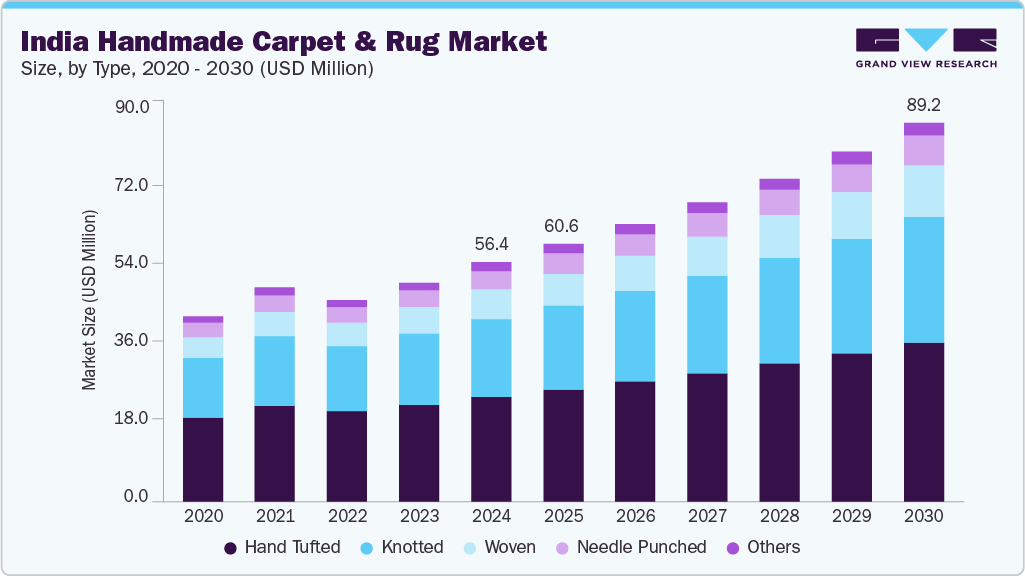
The India handmade carpet & rug market size was estimated at USD 56.4 million in 2024 and is expected to grow at a CAGR of 8.0% from 2025 to 2030. With the increasing emphasis on personalized and unique interiors, consumers are moving away from mass-produced items and opting for products that showcase skilled craftsmanship. Handmade carpets, known for their detailed designs and superior finishing, perfectly meet this demand, offering a blend of aesthetic beauty and cultural heritage that resonates well with Indian buyers. Economic changes in India also play a significant role. With the rise of urbanization and increasing disposable incomes, many Indian households are investing more in beautifying their living spaces.
 Source: Grand View Research, IR Documents, Primary Interviews, Paid DatabasesTo learn more about this report,
 Download Free Sample Report
 The expanding middle and upper-middle classes are seeking products that symbolize status and refined taste, and handmade carpets fit perfectly into this category. Due to their durability and timeless appeal, these rugs are perceived not only as decorative items but also as long-term investments. As lifestyles become more affluent, the demand for such premium home furnishings naturally rises. For instance, in FY25, average monthly spending on consumer durables in India surged by 72%, a significant increase from 6% in FY24. This rise is attributed to growing homeownership and the demand for home furnishings, indicating a shift towards investing in quality home décor.
In addition, the influence of global trends has encouraged Indian consumers to explore diverse and sophisticated interior design concepts. Social media platforms and international exposure have increased awareness about the value of artisanal and handmade products. This exposure has made Indian buyers more conscious of the environmental impact of their purchases, leading them to favor eco-friendly and sustainable products. Handmade carpets, which often use natural fibers and dyes, resonate with these values, attracting a clientele that is both style-conscious and environmentally aware.
Manufacturers are increasingly adopting natural fibers like wool, jute, and organic cotton, along with eco-friendly dyes, to meet the rising demand for sustainable home furnishings. Brands like Sheeltex India emphasize the use of these materials, contributing to a reduced environmental impact while supporting traditional crafts.
Furthermore, younger generations' revival of interest in traditional crafts has reinvigorated the handmade carpet industry in India. Many young consumers, while modern in outlook, are keen to connect with their cultural roots and support indigenous art forms. This cultural revival is creating a fresh market for handmade rugs that combine traditional techniques with contemporary designs. Artisans are innovating by blending classic patterns with modern aesthetics, thereby expanding the appeal of handmade carpets beyond conventional buyers to include younger demographics.
Designers like Arati Rao of Tantuvi are at the forefront of integrating traditional weaving techniques with contemporary design. By collaborating with artisans in Rajasthan and Telangana, Rao creates graphic dhurries and rugs that appeal to younger consumers seeking modern aesthetics rooted in heritage.
Consumer Insights
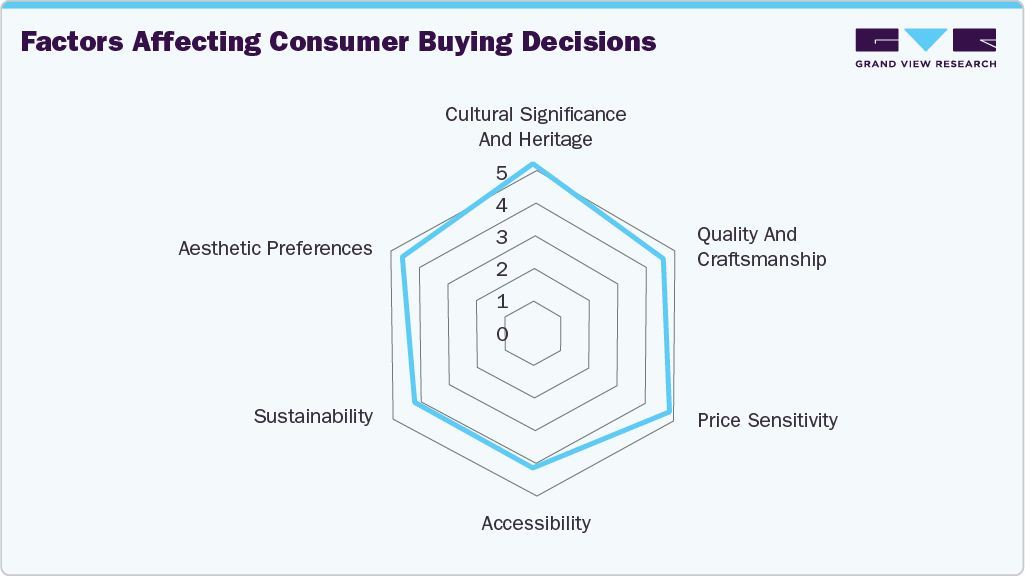
Consumers in India increasingly appreciate the craftsmanship and uniqueness that handmade carpets offer, distinguishing them from mass-produced alternatives. This appreciation stems not only from the aesthetic and tactile qualities of these rugs but also from a growing awareness of their cultural and artisanal value. Buyers tend to seek out products that tell a story, reflect tradition, and offer exclusivity, making handmade carpets a popular choice among discerning consumers.
In recent years, the Indian handmade carpet and rug market has seen a growing emphasis on customization and personalization, reflecting changing consumer attitudes toward home décor. Particularly among younger buyers, such as millennials and Gen Z, there is a clear preference for products that go beyond generic designs and allow for personal expression. These consumers seek rugs that not only enhance the aesthetics of their living spaces but also resonate with their tastes and lifestyle choices.
Research from 2024 reveals that approximately 33% of millennials and 23% of Gen Z consumers in India are actively considering purchasing rugs, with a significant number showing interest in customized options. This shift towards personalization is rooted in a desire for uniqueness and a rejection of mass-produced goods, as buyers increasingly value the story, craftsmanship, and exclusivity embedded in handmade rugs.
 To learn more about this report, Download Free Sample Report
 Handmade carpets, especially those originating from regions like Kashmir, Rajasthan, and Uttar Pradesh, carry centuries-old traditions and artisanal craftsmanship. Buyers often seek these carpets not just as floor coverings but as pieces of art that embody Indian culture and history. This emotional connection and appreciation for traditional artistry strongly influence purchasing behavior, with many consumers willing to invest in authentic handmade products that reflect their cultural pride.
Handmade carpets and rugs are valued for their intricate designs, natural dyes, and the skillful weaving process that can take months or even years to complete. Buyers tend to prioritize factors such as the fineness of the weave, the type of wool or silk used, and the durability of the materials. The reputation of artisans and the origin of the carpet often assure buyers of superior craftsmanship, which justifies the higher price point compared to machine-made alternatives. This emphasis on quality often drives buyers to seek out reputable sellers who guarantee authenticity and durability.
Handmade carpets tend to be premium products with considerable price tags due to the labor-intensive processes involved. Therefore, economic conditions, disposable income levels, and available budget strongly influence the decision-making process. Some buyers may opt for smaller rugs or less intricate designs as a compromise between quality and affordability. Seasonal discounts, export incentives, and local market competition also affect pricing dynamics and purchasing patterns.
Type Insights
The hand-tufted carpets & rugs accounted for a revenue share of 44.04% of market in 2024. Hand-tufting allows artisans to create intricate patterns and vibrant textures more quickly and cost-effectively compared to traditional hand-knotting, making these carpets accessible to a broader range of consumers. Their relatively lower production time and cost do not compromise the aesthetic appeal, which attracts buyers looking for stylish yet reasonably priced floor coverings. Additionally, hand-tufted rugs offer a wide variety of materials and styles, catering to diverse tastes and interior design trends, thereby securing a significant share of the handmade carpet market.
The demand for woven carpets & rugs in India is expected to grow at a CAGR of 10.0% from 2025 to 2030, driven by a rising appreciation for traditional craftsmanship combined with modern design preferences. Consumers are increasingly seeking unique, high-quality products that offer both aesthetic appeal and durability, making handmade woven carpets a popular choice. Additionally, growing disposable incomes and expanding urbanization are encouraging more people to invest in premium home décor items. The increasing presence of online marketplaces and international demand for authentic Indian textiles also support this growth, enabling artisans to reach a wider audience and boosting the overall market for handmade woven carpets and rugs.
Material Insights
The wool carpet & rug accounted for a revenue share of 52.86% of the overall Indian industry in 2024. Wool is highly regarded for its strength, natural insulation properties, and ability to showcase detailed craftsmanship, making it a preferred choice for premium handmade products. The rich texture and durability of wool carpets appeal to consumers who value both aesthetics and functionality. Furthermore, wool’s eco-friendly and biodegradable nature aligns with the increasing consumer demand for sustainable and authentic handcrafted items. This combination of qualities has helped wool maintain a dominant share in India’s handmade carpet industry.
The demand for cotton carpets & rugs in India is expected to grow at a CAGR of 9.9% from 2025 to 2030, driven by a rising awareness of sustainable and natural home décor products among consumers. Cotton, being a breathable and lightweight material, is especially suited for India’s climate, making it a popular choice for households seeking comfort along with aesthetic appeal. The increasing appreciation for handcrafted items that showcase traditional skills is also fueling demand, as buyers prefer unique and culturally rich designs. Furthermore, expanding distribution channels, including e-commerce platforms, are making handmade cotton carpets more accessible to a broader audience, helping to boost their market presence and appeal during this period.
End Use Insights
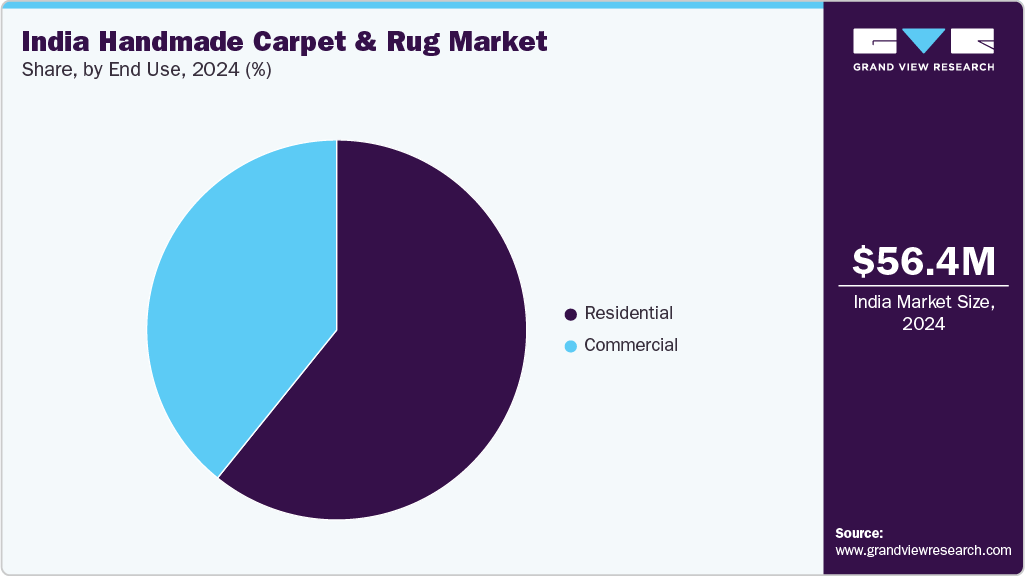
The residential application segment led the market and accounted for a revenue share of 60.79% of the overall market in 2024. As living standards improve and more people move into owned or rented homes, the need for decorative and functional floor coverings has increased. Handmade carpets and rugs not only add a layer of comfort but also serve as an affordable way to elevate interior design. This trend is further supported by the increasing availability of home décor products through both offline and online retail channels, making it easier for consumers to explore a variety of styles and price points. Additionally, rising awareness of home aesthetics through digital platforms and interior design content has encouraged more frequent upgrades and purchases, reinforcing the residential sector’s leading market share.
 To learn more about this report, Download Free Sample Report
 Commercial end use for handmade carpets & rugs is expected to grow at a CAGR of 8.3% from 2025 to 2030. Handmade carpets are valued for their exceptional quality, intricate patterns, and durability, making them ideal for upscale offices, hotels, and luxury retail spaces that aim to create a distinctive and elegant ambiance. As businesses increasingly invest in premium décor to enhance brand image and customer experience, the preference for artisanal products that offer exclusivity and cultural richness is strengthening. Additionally, the growing emphasis on sustainable and ethically produced goods supports the popularity of handmade rugs, further contributing to steady growth in this segment within the commercial market.
Key India Handmade & Rug Company Insights
The competitive landscape of the Indian handmade carpet and rug market showcases a vibrant mix of established traditional artisans, regional cooperatives, emerging boutique brands, and growing e-commerce platforms, all operating within a market influenced by rich cultural heritage and evolving consumer preferences. Over recent years, India’s handmade carpet industry has adapted to global trends, including increased demand for customized designs, sustainable production methods, and digital adoption for broader market reach.
Prominent players include well-known carpet manufacturing hubs like Bhadohi, Mirzapur, and Jaipur, where skilled artisans and family-run businesses produce a wide range of products from luxury hand-knotted carpets to affordable handwoven rugs. These traditional producers benefit from India’s reputation for craftsmanship and unique design patterns, often leveraging regional identities and certification marks like the Geographical Indication (GI) tag to differentiate their offerings. Alongside these, emerging boutique brands and designer labels are gaining traction by blending contemporary aesthetics with classic techniques, appealing to urban and international customers.
Key India Handmade Carpet & Rug Companies:
- Obeetee Pvt. Ltd.
- jaipurrugs.com
- Miras Crafts and Miras Carpet Industries
- Marwar.
- Vikram Carpets
- Rug India
- Bhadohi Rug Company
- Shahkar Rugs.
- JAVI Home
- Royal Carpet
GVR research-powered AIAsk Prism AI about the india handmade carpet & rug marketGet cited answers from GVR research on market growth, segments, regulations and forecasts.Start with✓ Source-linked answers ✓ Market-specific context ✓ Traceable figuresExplore Prism AI ↗Recent Developments
-
In January 2025, Jaipur Rugs inaugurated its first store in Raipur, Chhattisgarh, marking its 19th global retail outlet. This expansion aligns with the company's strategy to increase its domestic presence following a recent launch in Pune. The Raipur store underscores Jaipur Rugs' commitment to showcasing Indian craftsmanship and supporting artisans, particularly women, by offering luxury handmade rugs. Founded in 1978, the company now collaborates with over 40,000 rural artisans and operates more than 7,000 looms, distributing its products across over 90 countries.
-
In January 2025, Jaipur Rugs strategically acquired the renowned luxury rug and textile brand Shyam Ahuja to revive and elevate its presence in the global market. Established in 1963, Shyam Ahuja is famous for transforming the flatwoven dhurrie and earning recognition among top designers and celebrities worldwide. The acquisition includes Ahuja’s design archives, enabling Jaipur Rugs to develop the brand independently with its production network. With a strong footprint across 85 countries and a vast artisan network, Jaipur Rugs plans to honor Shyam Ahuja’s legacy while strengthening its position in the luxury segment internationally.
India Handmade Carpet & Rug Market Report Scope
Report Attribute
Details
Market size value in 2025
USD 60.6 million
Revenue forecast in 2030
USD 89.2 million
Growth rate
CAGR of 8.0% from 2025 to 2030
Actual data
2018 - 2024
Forecast period
2025 - 2030
Quantitative units
Revenue in USD million and CAGR from 2025 to 2030
Report coverage
Revenue forecast, company ranking, competitive landscape, growth factors, and trends
Segments covered
Type, material, and end use
Country scope
India
Key companies profiled
Obeetee Pvt. Ltd.; jaipurrugs.com; Miras Crafts and Miras Carpet Industries; Marwar.; Vikram Carpets; Rug India; Bhadohi Rug Company; Shahkar Rugs.; JAVI Home; Royal Carpet
Customization scope
Free report customization (equivalent up to 8 analysts working days) with purchase. Addition or alteration to country, regional & segment scope.
Pricing and purchase options
Avail customized purchase options to meet your exact research needs. Explore purchase options
India Handmade Carpet & Rug Market Report Segmentation
This report forecasts revenue growth at the country level and provides an analysis of the latest trends and opportunities in each of the sub-segments from 2018 to 2030. For this study, Grand View Research has segmented the India handmade carpet & rug market report based on type, material, and end use.
-
Type Outlook (Revenue, USD Million, 2018 - 2030)
-
Hand Tufted
-
Knotted
-
Woven
-
Needle Punched
-
Others
-
-
Material Outlook (Revenue, USD Million, 2018 - 2030)
-
Wool
-
Cotton
-
Polyester
-
Polypropylene
-
Others
-
-
End Use Outlook (Revenue, USD Million, 2018 - 2030)
-
Residential
-
Commercial
-
Frequently Asked Questions About This Report
The India handmade carpet and rug market was estimated at USD 56.4 million in 2024 and is expected to reach USD 60.6 million in 2025.
The India handmade carpet & rug market is expected to grow at a compound annual growth rate of 8.5% from 2025 to 2030 to reach USD 89.2 million by 2030.
The handmade hand-tufted carpets & rugs accounted for a share of about 44.0% of the India handmade carpet & rug industry in 2024, due to their artistic appeal and cost-effective production. Their intricate designs and quicker manufacturing process make them a popular choice in both domestic and export markets.
Some of the key players operating in the India handmade carpet & rug market include Obeetee Pvt. Ltd., jaipurrugs.com, Miras Crafts and Miras Carpet Industries, Marwar., Vikram Carpets, Rug India, Bhadohi Rug Company, Shahkar Rugs., JAVI Home, Royal Carpet
Major factors driving demand for the India handmade carpet and rug market include intricate craftsmanship, cultural significance, export potential, customization capabilities, and growing interest in traditional home décor styles among both domestic and international buyers.
About the Author(s)
Homecare & Decor Research Team
Consumer Goods · Homecare & DecorThis report was authored by the homecare & decor research team at Grand View Research - comprising two research analysts, one senior research analyst, and one industry expert - with specialized expertise in the homecare & decor segment of the consumer goods industry. All findings are based on proprietary consumer goods databases, executive interviews, and regulatory analysis, subject to internal peer review prior to publication.
Last Updated:
Speak to Analyst

Customize this report to your needs - add regions, segments, or data points, with 20% free customization.
Or view our licence options:


ISO 9001:2015 & 27001:2022 Certified
We are GDPR and CCPA compliant! Your transaction & personal information is safe and secure. For more details, please read our privacy policy.


