
- Home
- »
- Advanced Interior Materials
- »
-
Industrial Couplings Market Size & Share Report, 2026-2033GVR Report cover

Industrial Couplings Market (2026 - 2033)
Size, Share & Trends Analysis Report By Product Type (Flexible Couplings, Rigid Couplings), By End Use (Manufacturing, Oil & Gas), By Region, And Segment Forecasts
Market Size, 2025
$419.0MMarket Estimate, 2026
$438.2MMarket Forecast, 2033
$600.4MCAGR, 2026–2033
4.6%Industrial Couplings Market Summary
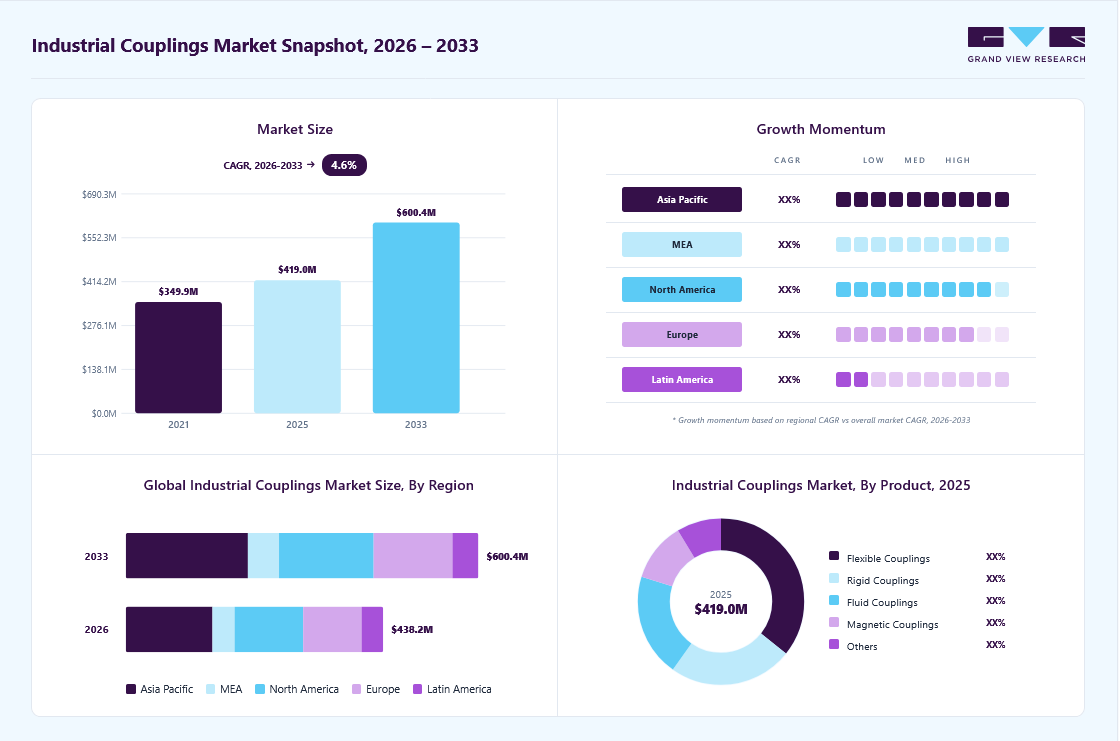
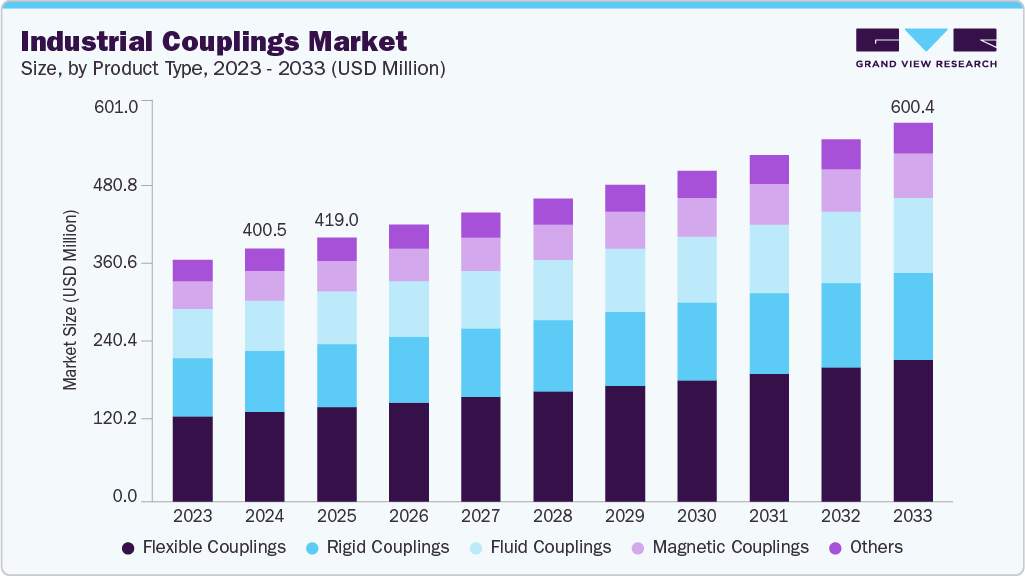
The global industrial couplings market size was valued at USD 419.0 million in 2025 and is projected to grow from USD 438.2 million in 2026 to USD 600.4 million by 2033, at a CAGR of 4.6% from 2026 to 2033. Asia Pacific dominated the market, accounting for a revenue share of 33.5% in 2025. The growth is driven by the rapid expansion of industrial automation and the rising need for efficient power transmission systems across manufacturing facilities.
 Source: Grand View Research, IR Documents, Primary Interviews, Paid DatabasesTo learn more about this report,
 Download Free Sample Report
Key Market Trends & Insights
- By product type: Flexible couplings segment led the market with the largest revenue share of 35.7% in 2025.
- By end use: Manufacturing segment led the market with the largest revenue share of 30.0% in 2025.
Regional Highlights
- Largest regional market: Asia Pacific (33.5% revenue share, 2025)
- By country: The China held the largest market share in 2025.
Market Size & Forecast
- Market size in 2025: USD 419.0 Million
- Estimated market size in 2026: USD 438.2 Million
- Projected market size by 2033: USD 600.4 Million
- CAGR (2026-2033): 4.6%
Three ways to get this report
Buy it, customize it, or ask a question.Ask an Analyst
Analyst response in 1 business day
- AccessReport author, directly
- Reply timeWithin 1 working day
- No sales callDirect answer only
- FormatEmail reply
- CostFree, no cost
Get the Full Report
What the study covers
- FormatsPDF · Excel · Dashboard
- Timeline2026–2033 annual, 2025 base
- Coverage20+ countries, 5 regions
- Companies10+ key players profiled
Customize the Report
20% free customization
- IncludeCountries, segments, points
- TailorTo your product definition
- ExtendDeeper competitor detail
- OrA fully bespoke study
- Turnaround5–10 working days
Couplings play a critical role in connecting rotating shafts, minimizing vibration, and enhancing equipment performance in automated systems. The growing adoption of smart factories and Industry 4.0 practices has increased demand for precision-engineered couplings capable of supporting high-speed and high-torque operations. Additionally, the integration of sensor-based monitoring in couplings to improve reliability and predictive maintenance is contributing to the market growth.
The growth of the renewable energy and power generation sectors is another key factor propelling the industrial couplings market. Couplings are extensively used in wind turbines, hydroelectric systems, and power transmission networks to ensure efficient torque transfer and operational stability. The global shift toward clean energy generation has encouraged investment in advanced coupling solutions that withstand high mechanical stress and harsh environments. Moreover, ongoing upgrades to existing power infrastructure and the expansion of grid-connected renewable projects are boosting demand for durable and maintenance-free coupling systems.
 To learn more about this report, Download Free Sample Report
Increasing infrastructure development and heavy industrial activity across emerging economies are significantly contributing to market expansion. The construction, mining, and oil & gas industries rely heavily on couplings for mechanical flexibility and torque control in pumps, compressors, and conveyors. The growing emphasis on industrial safety and operational efficiency has led to greater adoption of torsionally flexible and fail-safe coupling designs. Furthermore, the rising establishment of manufacturing plants in Asia and the Middle East is generating a consistent demand for customized, high-performance coupling systems tailored for diverse industrial applications.
Market Dynamics
The industrial couplings market is influenced by increasing industrial automation, expanding manufacturing activities, growing investments in power generation, mining, oil & gas, and process industries, along with the modernization of rotating machinery and power transmission systems. Advancements in material engineering, precision machining, and coupling design are enabling the development of high-performance solutions with enhanced torque capacity, vibration damping, misalignment compensation, and longer service life. The growing adoption of predictive maintenance, condition monitoring, and Industry 4.0 technologies continues to accelerate demand for reliable and maintenance-efficient coupling systems that improve equipment availability and operational performance. At the same time, fluctuations in steel and alloy prices, stringent industrial safety and energy efficiency standards, increasing demand for application-specific coupling designs, and global supply chain uncertainties influence manufacturing costs, product innovation, and competitive dynamics across the industrial couplings market.
The increasing deployment of rotating equipment across manufacturing, mining, oil & gas, power generation, and water treatment industries is driving demand for industrial couplings that ensure efficient power transmission and reliable machine performance. Couplings play a critical role in accommodating shaft misalignment, transmitting torque, and minimizing vibration, helping extend equipment life and reduce unplanned downtime. The expansion of automated production lines and heavy-duty industrial machinery is further accelerating the adoption of high-performance coupling solutions. Increasing investments in industrial modernization and capacity expansion across emerging economies continue to strengthen long-term market demand.
Volatility in the prices of steel, aluminum, and specialty alloys increases manufacturing costs and affects profit margins for coupling manufacturers. Many industrial applications require customized coupling designs based on torque ratings, operating speeds, environmental conditions, and equipment configurations, resulting in longer engineering cycles and higher production costs. The long service life of industrial couplings also limits replacement demand in established industries. In addition, compatibility requirements with legacy machinery can complicate retrofitting and increase installation costs for end users.
The growing installation of wind turbines, hydropower equipment, and other renewable energy systems is creating new opportunities for industrial coupling manufacturers to supply high-performance mechanical power transmission components. At the same time, innovations in composite materials, elastomer technology, and corrosion-resistant alloys are enabling the development of lighter, more durable, and maintenance-efficient coupling solutions. The increasing demand for compact, high-torque couplings in robotics, automated material handling systems, and precision manufacturing equipment is further expanding the market's application scope.
Market Concentration & Characteristics
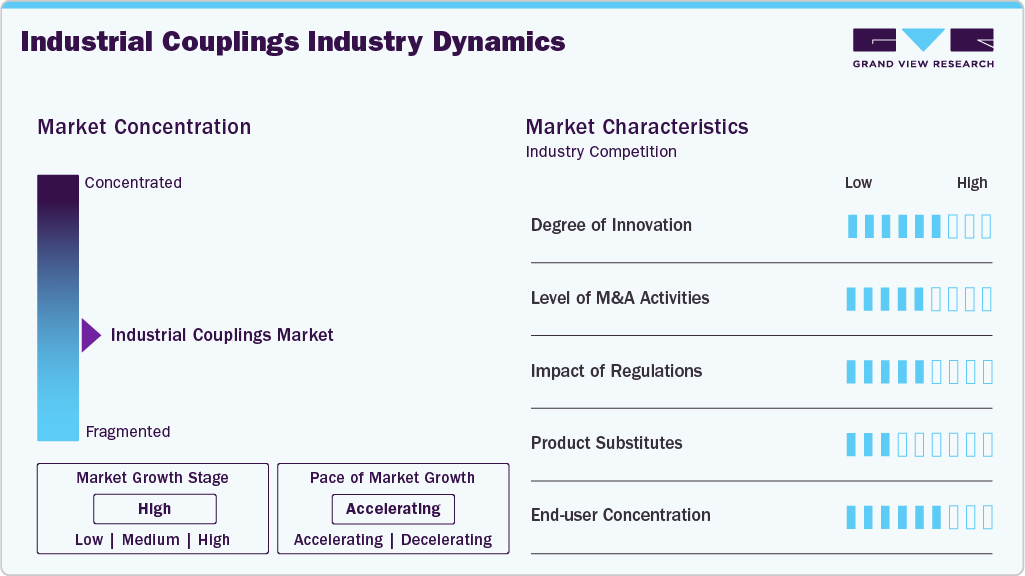
The global industrial couplings market exhibits a moderate to high degree of innovation, driven by the increasing need for precision, energy efficiency, and reliability in industrial applications. Manufacturers are integrating advanced materials, such as high-strength composites and corrosion-resistant alloys, to improve performance and durability. Technological advancements, including smart monitoring systems and predictive maintenance capabilities, are also redefining product functionality. The market has experienced moderate levels of mergers and acquisitions as leading players aim to strengthen their global presence, diversify product portfolios, and access emerging markets. Strategic alliances between manufacturers and automation technology providers further enhance innovation and competitiveness.
 To learn more about this report, Download Free Sample Report
Regulatory standards focusing on safety, environmental compliance, and energy efficiency significantly influence the industrial couplings market. Industry-specific regulations, such as ISO and ANSI certifications, mandate stringent testing and performance benchmarks, shaping design and production processes. The threat of service substitutes remains relatively low, as couplings serve a unique mechanical function that alternative components cannot easily replace. However, advances in direct-drive technologies and maintenance-free systems may pose minor substitution risks in specialized applications. End-user concentration is high in sectors such as manufacturing, oil & gas, power generation, and mining, where equipment reliability and operational continuity are critical. These industries’ demand for robust and adaptable couplings continues to define market dynamics and innovation trajectories.
Analyst Perspective
The industrial couplings market is experiencing steady growth as industries continue to invest in reliable power transmission systems that improve equipment performance and reduce unplanned downtime. Demand is being driven by expanding manufacturing activities, increasing investments in process industries, and the modernization of rotating equipment across sectors such as oil & gas, power generation, mining, water & wastewater, chemicals, and food & beverage. In addition, the growing adoption of automation and predictive maintenance is encouraging the use of high-performance couplings that offer improved vibration damping, torque transmission, and shaft alignment while minimizing maintenance requirements. Advancements in materials, precision engineering, and condition monitoring technologies are further enhancing product reliability and operational efficiency. As industrial facilities prioritize productivity, energy efficiency, and equipment longevity, manufacturers offering durable, application-specific, and maintenance-friendly industrial coupling solutions are expected to benefit from sustained long-term market growth.
Product Type Insights
Based on product type, the flexible couplings segment led the market with the largest revenue share of 35.7% in 2025, driven by the growing demand for high-performance power transmission solutions that accommodate misalignment and reduce vibration in rotating machinery. These couplings are increasingly used in pumps, compressors, and conveyor systems to ensure smooth torque transfer and extended equipment lifespan. The rapid expansion of industrial automation and robotics further amplifies their need, as flexible couplings enhance operational precision and reliability. Manufacturers are focusing on advanced materials and designs to improve load capacity and thermal resistance.
The magnetic couplings segment is expected to grow significantly at a CAGR of 4.9% over the forecast period, driven by the increasing emphasis on contactless torque transmission and leakage-free performance in critical industrial processes. These couplings are gaining traction in the chemical, pharmaceutical, and food industries where contamination prevention and process integrity are crucial. The rising preference for non-mechanical power transfer solutions reduces wear and maintenance costs, enhancing system longevity. Continuous advancements in magnetic materials and permanent magnet technology have significantly improved torque density and efficiency.
End Use Insights
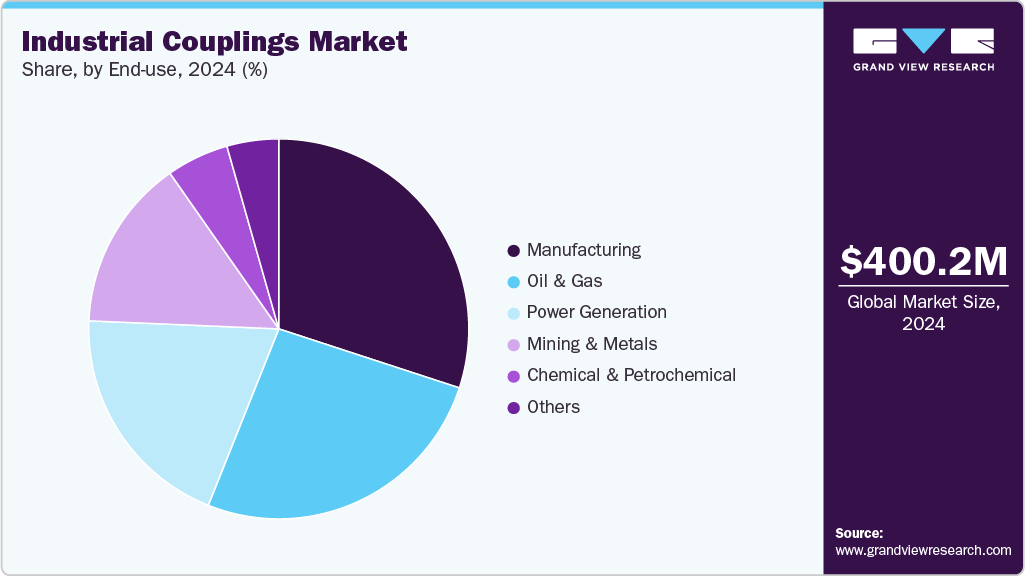
Based on end use, the manufacturing segment led the market with the largest revenue share of 30.0% in 2025, driven by the global push toward higher productivity and energy efficiency across production facilities. Couplings play a crucial role in connecting motors, pumps, and conveyors, ensuring reliable power transmission and minimizing mechanical stress. As factories adopt automated and digitally controlled systems, the need for precision-engineered couplings that can handle dynamic loads and misalignments is increasing. The rise of smart manufacturing and Industry 4.0 initiatives has also spurred demand for couplings with advanced monitoring capabilities.
 To learn more about this report, Download Free Sample Report
The oil & gas segment is expected to grow at the fastest CAGR of 5.2% over the forecast period, driven by the critical requirement for durable and corrosion-resistant couplings that can operate under extreme pressure and temperature conditions. Couplings are essential in drilling rigs, compressors, and pipeline systems, where operational safety and efficiency are paramount. The ongoing development of deepwater and unconventional energy projects has heightened demand for advanced coupling technologies capable of withstanding harsh environments. Manufacturers are increasingly investing in high-strength alloys and precision engineering to enhance performance and reduce downtime.
Regional Insights
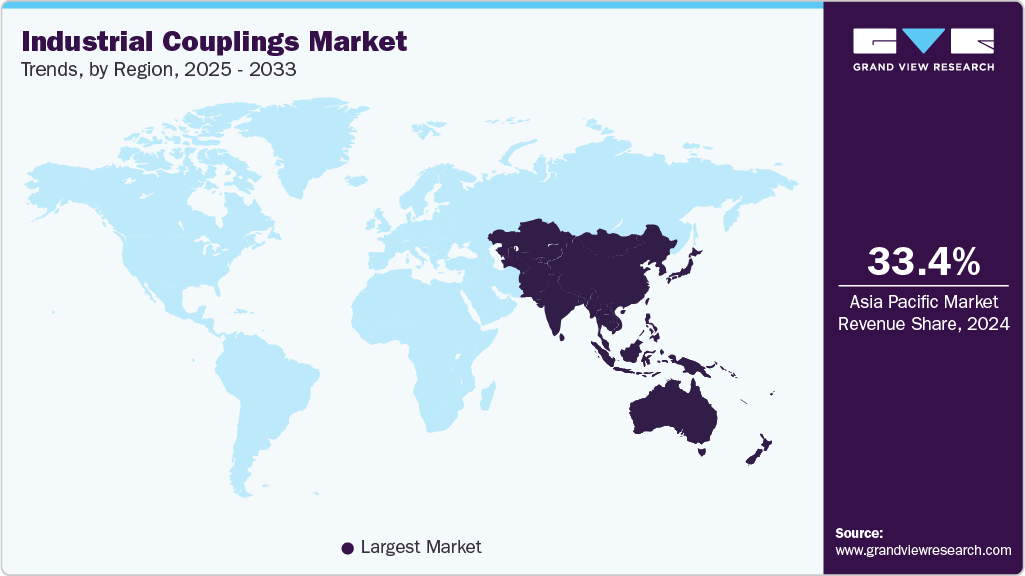
Asia Pacific dominated the industrial couplings market with the largest revenue share of 33.5% in 2025, experiencing robust growth due to rapid industrialization, urban development, and manufacturing expansion across emerging economies. Increasing investments in heavy industries, power generation, and transportation infrastructure are propelling demand for durable coupling systems. The region’s strong focus on automation and modernization of existing production facilities is also driving adoption. Moreover, government-led initiatives promoting industrial growth and foreign direct investments are strengthening regional production capacities. The availability of cost-effective labor and raw materials further supports the large-scale manufacturing of industrial couplings across countries like India, South Korea, and Japan.
 To learn more about this report, Download Free Sample Report
China Industrial Couplings Market Trends
The industrial couplings market in China held the largest share in the Asia Pacific region in 2025. China remains a dominant force in Asia Pacific, driven by its large-scale industrial manufacturing and continuous infrastructure expansion. The country’s strong focus on upgrading its mechanical and energy sectors fuels demand for high-efficiency coupling systems. Increasing automation in production lines and the rise of electric vehicle manufacturing further stimulate market growth. Domestic manufacturers are investing heavily in precision engineering and adopting international standards to enhance global competitiveness. Additionally, government initiatives promoting smart manufacturing and sustainable industrial practices are fostering innovation and expansion in the coupling sector.
North America Industrial Couplings Market Trends
The North America industrial couplings industry is driven by the widespread adoption of advanced manufacturing technologies and a strong focus on industrial automation. The region’s well-established oil & gas, aerospace, and automotive sectors rely heavily on high-performance coupling systems for precision and reliability. Ongoing investments in smart factories and digitalization initiatives further enhance the demand for technologically advanced couplings. Additionally, increasing emphasis on predictive maintenance and energy-efficient machinery supports the adoption of intelligent coupling solutions. The presence of major global manufacturers and continuous R&D efforts contribute to steady market growth across the region.
In the United States, the industrial couplings industry benefits from a mature industrial base and significant advancements in automation and robotics. The growing need for efficient torque transmission systems across sectors such as manufacturing, energy, and construction is fueling demand. Rising adoption of renewable energy systems, including wind and solar, has also boosted the use of couplings in power generation. Furthermore, a strong government focus on upgrading infrastructure and enhancing industrial productivity is encouraging equipment modernization. U.S. manufacturers are increasingly investing in high-precision, lightweight, and maintenance-free coupling designs to meet diverse application requirements.
Europe Industrial Couplings Market Trends
The Europe industrial couplings industry is characterized by strong technological innovation and a commitment to sustainability and energy efficiency. The region’s mature industrial landscape, particularly in automotive, aerospace, and machinery manufacturing, drives consistent demand for high-quality couplings. Stringent EU regulations on machinery safety and emissions are encouraging the adoption of eco-friendly and efficient mechanical components. Furthermore, increasing integration of automation technologies and IoT-based maintenance systems is enhancing operational reliability. The region’s focus on high-precision engineering and advanced material technologies continues to strengthen its position in the global market.
The Germany industrial couplings market plays a pivotal role in Europe, due to its advanced engineering capabilities and strong industrial heritage. The nation’s thriving automotive, mechanical, and renewable energy sectors drive demand for high-performance coupling systems. Continuous innovation in design, material use, and digital integration enables German manufacturers to produce durable and energy-efficient solutions. Additionally, the country’s focus on Industry 4.0 and smart manufacturing practices supports the growth of intelligent coupling technologies. The strong presence of globally recognized engineering firms further consolidates Germany’s leadership in the European coupling industry.
Latin America Industrial Couplings Market Trends
The Latin America industrial couplings industry is gaining traction with the expansion of manufacturing, mining, and energy production sectors. Countries such as Brazil and Mexico are witnessing increased investment in industrial infrastructure, creating demand for robust and efficient coupling systems. The growing adoption of automation technologies and the development of renewable energy projects are additional growth drivers. Despite economic fluctuations, the rising focus on operational safety and maintenance efficiency is encouraging the use of modern coupling solutions. Furthermore, collaborations with global manufacturers are improving product availability and technology transfer in the region.
Middle East & Africa Industrial Couplings Market Trends
The Middle East & Africa industrial couplings industry is driven by rapid industrialization and the expansion of oil & gas, energy, and construction industries. Large-scale infrastructure projects and investments in petrochemical facilities continue to create strong demand for reliable power transmission components. The adoption of heavy-duty coupling systems in the mining and water treatment sectors is also increasing. Moreover, governments are promoting industrial diversification to reduce dependence on oil, encouraging manufacturing growth. The region’s focus on modernizing production facilities and implementing predictive maintenance solutions further supports steady market advancement.
Key Companies & Market Share Insights
Some of the key players operating in market include SKF Group and Siemens AG.
-
SKF Group, headquartered in Sweden, is a global leader in bearings, seals, and power transmission components, including industrial couplings. The company offers a comprehensive range of flexible, rigid, and fluid couplings designed for heavy-duty applications. SKF’s coupling solutions focus on improving torque transmission efficiency, reducing vibration, and enhancing machinery reliability across manufacturing and energy sectors.
-
Siemens AG, based in Germany, is a leading global technology and industrial automation company. Its industrial coupling products include elastic, gear, and fluid couplings used in various drive systems. Siemens emphasizes precision engineering and digital integration, ensuring optimal performance and reduced mechanical stress in industrial processes.
Rexnord Corporation and Altra Industrial Motion Corp. are some of the emerging participants in the industrial couplings market.
-
Rexnord Corporation, headquartered in the United States, is a prominent provider of power transmission and motion control products. The company’s coupling portfolio includes gear, disc, and elastomeric types designed for demanding applications in mining, manufacturing, and processing industries. Rexnord’s products are engineered for high reliability, minimal maintenance, and superior operational efficiency under challenging conditions.
-
Altra Industrial Motion Corp., based in the U.S., specializes in power transmission and motion control technologies. The company offers a wide variety of couplings, including flexible shaft, grid, and jaw couplings, under its well-known brands such as TB Wood’s and Ameridrives. Altra’s products are designed to deliver superior torque control, misalignment compensation, and mechanical safety in high-performance industrial applications.
Key Industrial Couplings Companies
The following key companies have been profiled for this study on the industrial couplings market.
-
SKF Group
-
Siemens AG
-
Rexnord Corporation
-
Altra Industrial Motion Corp.
-
Voith GmbH & Co. KGaA
-
Tsubakimoto Chain Co.
-
John Crane (Smiths Group plc)
-
ABB Ltd.
-
KTR Systems GmbH
Competitive Benchmarking
Category
Operating Strategies
Competitive Edge
Weakness
Established Players (e.g., SKF Group, Flender GmbH, Regal Rexnord Corporation, Voith GmbH & Co. KGaA, Tsubakimoto Chain Co)
Focus on expanding industrial coupling portfolios and strengthening long-term partnerships with OEMs and industrial equipment manufacturers.
Invest in product innovation, manufacturing expansion, digital monitoring technologies, and strategic acquisitions to strengthen market position.
Broad product portfolios supported by global manufacturing and distribution networks.
Strong engineering expertise, established customer relationships, and comprehensive aftermarket service capabilities.
High exposure to fluctuations in raw material prices and industrial capital expenditure cycles.
Increasing demand for customized solutions and intense competition from regional manufacturers.
Emerging & Regional Players (e.g., KTR Systems GmbH, R+W Antriebselemente GmbH, Renold plc, John Crane (Smiths Group plc), regional manufacturers)
Focus on application-specific coupling solutions and customized engineering for niche industrial sectors.
Expand through regional partnerships, technical support, and customer-focused product development.
High flexibility in delivering customized products and shorter product development cycles.
Strong expertise in specialized coupling technologies and faster response to customer requirements.
Limited global manufacturing footprint and lower brand recognition than multinational competitors.
Greater exposure to pricing pressure and raw material cost volatility.
Recent Developments
- In October 2025, Dodge Industrial introduced its StratoLink Disc Couplings, marking a significant expansion of its advanced coupling portfolio. The new product line delivers next-generation performance, combining superior torque transmission with enhanced flexibility and durability. Designed for high-speed and high-torque industrial applications, StratoLink couplings ensure precise alignment and reduced maintenance requirements.
Industrial Couplings Market Report Scope
Report Attribute
Details
Market size in 2025
USD 419.0 million
Estimated market size in 2026
USD 438.2 million
Projected market size by 2033
USD 600.4 million
Growth rate
CAGR of 4.6% from 2026 to 2033
Base year for estimation
2025
Historical data
2021 - 2024
Forecast period
2026 - 2033
Quantitative units
Revenue in USD million and CAGR from 2026 to 2033
Report coverage
Revenue forecast, company ranking, competitive landscape, growth factors, and trends
Segments covered
Product type, end use, and region
Regional scope
North America; Europe; Asia Pacific; Latin America; Middle East & Africa
Country scope
U.S.; Canada; Mexico; Germany; UK; France; Italy; Spain; Japan; China; India
Key companies profiled
SKF Group; Flender GmbH; Regal Rexnord Corporation; Voith GmbH & Co. KGaA; Tsubakimoto Chain Co.; KTR Systems GmbH; John Crane (Smiths Group plc); Timken Company; R+W Antriebselemente GmbH; Renold plc
Customization scope
Free report customization (equivalent up to 8 analysts' working days) with purchase. Addition or alteration to country, regional & segment scope.
Pricing and purchase options
Avail customized purchase options to meet your exact research needs. Explore purchase options
Global Industrial Couplings Market Report Segmentation
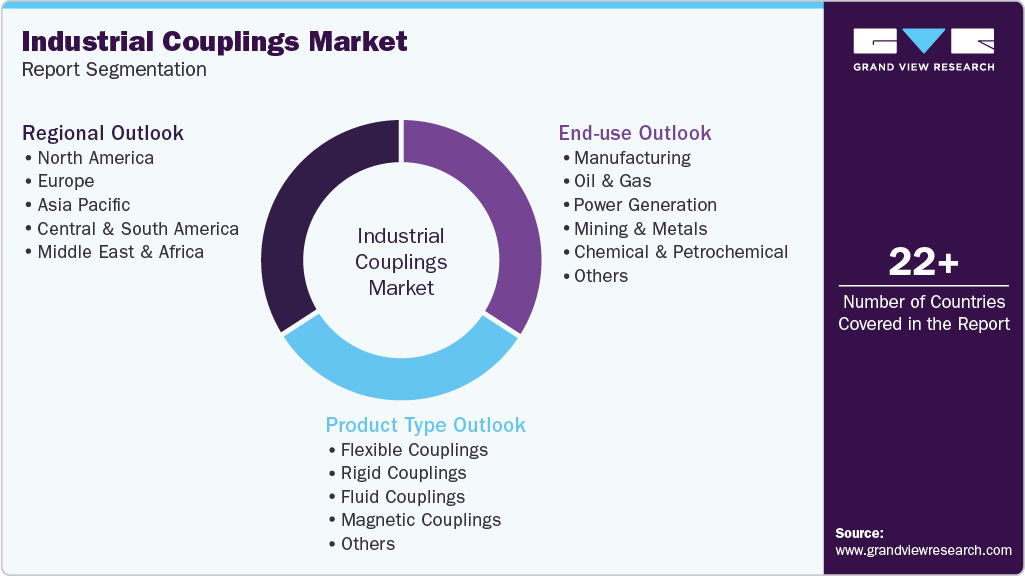
This report forecasts revenue growth at the global, regional, and country levels and provides an analysis of the latest industry trends in each of the sub-segments from 2021 to 2033. For this study, Grand View Research has segmented the global industrial couplings market report based on product type, end use, and region:
 To learn more about this report, Download Free Sample Report
-
Product Type Outlook (Revenue, USD Million, 2021 - 2033)
-
Flexible Couplings
-
Rigid Couplings
-
Fluid Couplings
-
Magnetic Couplings
-
Others
-
-
End Use Outlook (Revenue, USD Million, 2021 - 2033)
-
Manufacturing
-
Oil & Gas
-
Power Generation
-
Mining & Metals
-
Chemical & Petrochemical
-
Others
-
-
Regional Outlook (Revenue, USD Million, 2021 - 2033)
-
North America
-
U.S.
-
Canada
-
Mexico
-
-
Europe
-
Germany
-
UK
-
France
-
Italy
-
Spain
-
-
Asia Pacific
-
China
-
Japan
-
India
-
-
Central & South America
-
Middle East & Africa
-
Research Methodology
The industrial couplings market figures in this report are based on a proven research process that combines executive interviews with secondary research from proprietary databases, company filings, and recognized regulatory and institutional sources. Market size is built through value-chain sizing - reconciling supply-side and demand-side estimates - and triangulated with bottom-up and top-down approaches. Every estimate passes multiple levels of expert validation before publication, with each industrial couplings segment quantified using the revenue-capture definitions in the table below.
Segment Definition
Segment - Product Type
Revenue Capture Definition
Flexible Couplings
The segment refers to couplings designed to accommodate shaft misalignment while transmitting torque and reducing vibration. The segment captures revenue generated from the sale of flexible industrial couplings across all end-use industries.
Rigid Couplings
The segment refers to couplings that provide a rigid connection between aligned shafts for efficient torque transmission. The segment captures revenue generated from the sale of rigid industrial couplings across all end-use industries.
Fluid Couplings
The segment refers to hydrodynamic couplings that transmit power through hydraulic fluid to enable smooth torque transfer and overload protection. The segment captures revenue generated from the sale of fluid industrial couplings across all end-use industries.
Magnetic Couplings
The segment refers to couplings that transmit torque through magnetic fields without physical shaft contact for sealed applications. The segment captures revenue generated from the sale of magnetic industrial couplings across all end-use industries.
Others
The segment refers to other industrial coupling types, including gear, disc, grid, chain, jaw, and beam couplings. The segment captures revenue generated from the sale of all other industrial coupling types.
Segment - End Use
Revenue Capture Definition
Manufacturing
The segment captures revenue generated from industrial couplings supplied for manufacturing machinery, conveyors, compressors, and production equipment.
Oil & Gas
The segment captures revenue generated from industrial couplings supplied for drilling equipment, pumps, compressors, pipelines, and refinery operations.
Power Generation
The segment captures revenue generated from industrial couplings supplied for turbines, generators, pumps, and other rotating equipment in power plants.
Mining & Metals
The segment captures revenue generated from industrial couplings supplied for crushers, conveyors, mills, hoists, and mineral processing equipment.
Chemical & Petrochemical
The segment captures revenue generated from industrial couplings supplied for pumps, mixers, compressors, reactors, and other process equipment.
Others
The segment captures revenue generated from industrial couplings supplied for all other end-use industries, including marine, water & wastewater, food & beverage, cement, and construction.
Estimation Model
Layer Name
Key Question
Description
Industrial Power Transmission Demand Layer
Where are industrial couplings required?
Analyze demand across manufacturing, mining, oil & gas, power generation, water & wastewater, food & beverage, chemicals, marine, metals, pulp & paper, and other industrial sectors. Assess rotating equipment installations including pumps, compressors, motors, turbines, conveyors, mixers, and gearboxes to establish the addressable demand for industrial couplings.
Industrial Infrastructure & Manufacturing Investment Layer
Where is new equipment demand being created?
Evaluate investments in industrial plants, manufacturing facilities, process industries, utilities, mining operations, and infrastructure projects. Assess greenfield developments, production capacity expansions, equipment modernization, and replacement of aging rotating machinery that drive procurement of new industrial couplings.
Product Adoption Layer
Which industrial coupling technologies are being deployed?
Segment demand by product type, material, torque capacity, application, and end-use industry. Apply adoption rates based on torque transmission requirements, shaft alignment, vibration damping, operating speed, maintenance requirements, and environmental conditions.
Revenue Generation Layer
How much market revenue is generated?
Estimate annual shipments of industrial couplings by product type, application, end-use industry, and region. Quantify revenues generated exclusively from the sale of new industrial couplings supplied to OEMs, industrial equipment manufacturers, distributors, and end users.
Delivered Customizations
This report has been delivered with the following In-depth customizations
Client Request
Customization Delivered
Value Adds
Competitive Benchmarking
A competitive benchmarking analysis was conducted by evaluating established and emerging market participants based on product portfolio, coupling technologies, manufacturing footprint, distribution network, strategic initiatives, innovation capabilities, and competitive positioning within the industrial couplings market.
This benchmarking enabled stakeholders to assess competitive strengths, identify product differentiation opportunities, understand evolving industry strategies, and develop informed market positioning and growth plans.
Regional Segmentation
A comprehensive regional analysis was provided across key markets, highlighting industrial development, manufacturing activity, infrastructure investments, end-use industry demand, and regulatory standards influencing the industrial couplings market. The assessment also evaluated the contribution of major countries to regional market performance.
The regional insights helped stakeholders identify high-growth markets, optimize expansion strategies, allocate resources effectively, and align product offerings with regional industrial requirements and investment trends.
Opportunity Assessment
A detailed opportunity assessment was conducted by evaluating emerging industrial applications, advancements in coupling materials and designs, adoption of predictive maintenance technologies, and investments across manufacturing, renewable energy, mining, and process industries.
This assessment enabled stakeholders to prioritize high-potential investment areas, align product development with evolving industrial requirements, and capitalize on growth opportunities driven by industrial automation, renewable energy expansion, and smart maintenance technologies.
Frequently Asked Questions About This Report
The global industrial couplings market size was estimated at USD 419.0 million in 2025 and is expected to be USD 438.2 million in 2026.
The global industrial couplings market, in terms of revenue, is expected to grow at a compound annual growth rate of 4.6% from 2026 to 2033 to reach USD 600.4 million by 2033.
Some of key players in the industrial couplings market include SKF Group, Siemens AG, Rexnord Corporation, Altra Industrial Motion Corp., Voith GmbH & Co. KGaA, Tsubakimoto Chain Co., John Crane (Smiths Group plc), ABB Ltd., and KTR Systems GmbH
The key factors driving the industrial couplings market include increasing demand for energy-efficient, low-maintenance tools, technological advancements in motor design, and the rising adoption of cordless solutions across industrial and residential applications.
Asia Pacific is anticipated to be one of the fastest-growing regional markets over the forecast period, driven by rapid industrialization, expanding manufacturing activities, increasing infrastructure investments, and growing demand for industrial machinery.
The flexible couplings segment led the market with the largest revenue share of 35.7% in 2025.
The manufacturing segment accounted for the largest revenue share of 30.0% in 2025.
Key trends include increasing adoption of maintenance-free and high-performance coupling systems, integration of predictive maintenance technologies, growing demand for lightweight and corrosion-resistant materials, and rising investments in automated manufacturing and industrial machinery.
Asia Pacific dominated the industrial couplings market with the largest revenue share of 33.5% in 2025.
About the Author(s)
Advanced Interior Materials Research Team
Advanced Materials · Advanced Interior MaterialsThis report was authored by the advanced interior materials research team at Grand View Research - comprising two research analysts, one senior research analyst, and one industry expert - with specialized expertise in the advanced interior materials segment of the advanced materials industry. All findings are based on proprietary advanced materials databases, executive interviews, and regulatory analysis, subject to internal peer review prior to publication.
Last Updated:
Speak to Analyst

Customize this report to your needs - add regions, segments, or data points, with 20% free customization.
Or view our licence options:


ISO 9001:2015 & 27001:2022 Certified
We are GDPR and CCPA compliant! Your transaction & personal information is safe and secure. For more details, please read our privacy policy.


