
- Home
- »
- Biotechnology
- »
-
Industrial Microbiology Testing Services Market Report, 2033GVR Report cover

Industrial Microbiology Testing Services Market (2026 - 2033)
Size, Share & Trends Analysis Report By Test Type (Sterility Testing, Microbial Limits Testing, Water Testing), By End-use (Agricultural, Food & Beverages, Pharmaceutical & Biotechnology), By Region, And Segment Forecasts
Market Size, 2025
$3.9BMarket Estimate, 2026
$4.3BMarket Forecast, 2033
$8.2BCAGR, 2026–2033
9.6%Industrial Microbiology Testing Services Market Summary
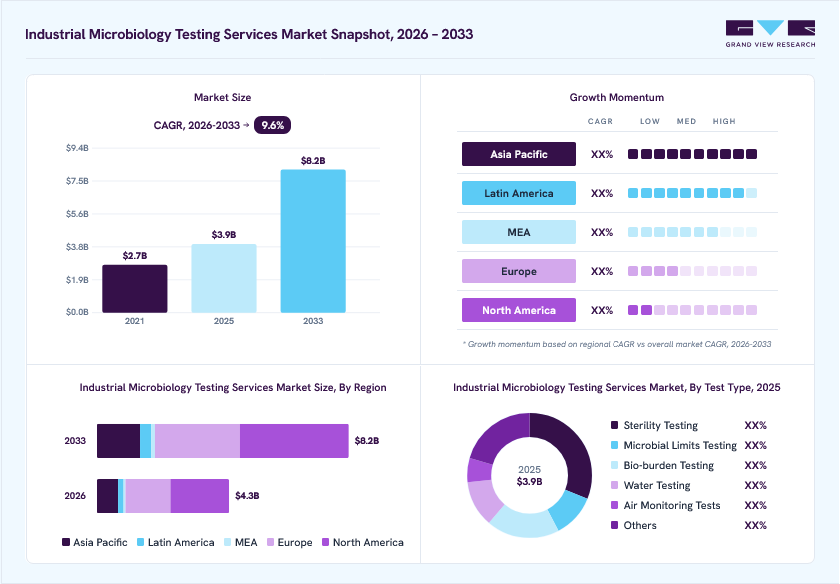
The global industrial microbiology testing services market size was valued at USD 3.9 billion in 2025 and is projected to grow from USD 4.3 billion in 2026 to USD 8.2 billion by 2033, at a CAGR of 9.6% from 2026 to 2033. North America dominated the market, accounting for the largest share of 44.5% in 2025. The market growth is driven by stringent quality regulations, rising demand for contamination testing across pharmaceutical, biotechnology, food, and healthcare industries, increased outsourcing to specialized laboratories, and adoption of rapid microbiological testing technologies.
 Source: Grand View Research, IR Documents, Primary Interviews, Paid DatabasesTo learn more about this report,
 Download Free Sample Report
Key Market Trends & Insights
- By test type: Sterility testing segment held the highest market share of 31.1% in 2025.
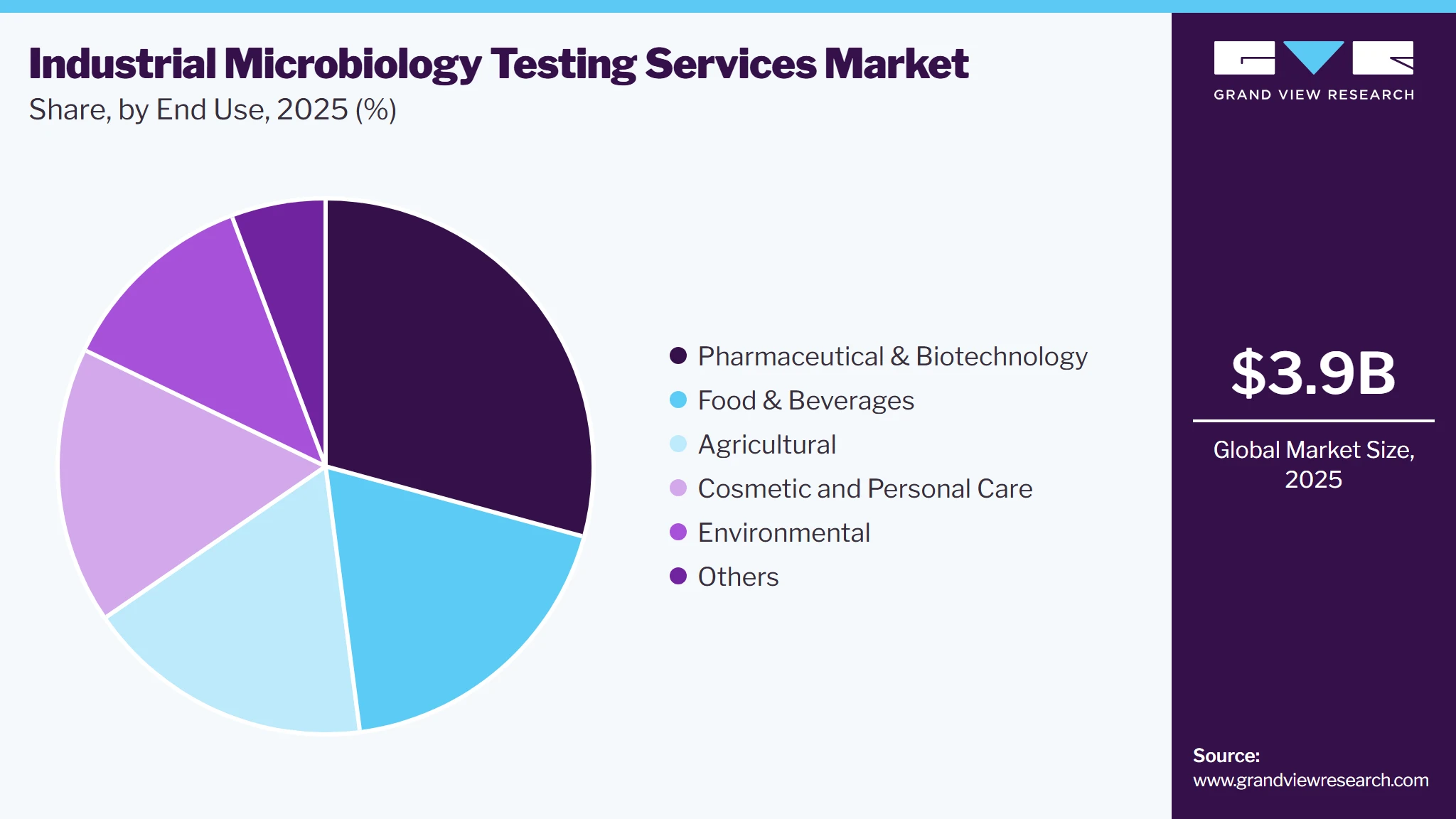
- By end-use: Pharmaceutical & biotechnology segment held the highest market share of 29.2% in 2025.
Regional Highlights
- Largest regional market: North America (44.5% revenue share, 2025)
- Fastest-growing regional market: Asia Pacific (highest CAGR, 2026-2033)
- By country: The U.S. held the largest market share in 2025
Market Size & Forecast
- Market Size in 2025: USD 3.9 Billion
- Estimated Market Size in 2026: USD 4.3 Billion
- Projected Market Size by 2033: USD 8.2 Billion
- CAGR (2026-2033): 9.6%
GVR research-powered AIAsk Prism AI about the industrial microbiology testing services marketGet cited answers from GVR research on market growth, segments, regulations and forecasts.Start with✓ Source-linked answers ✓ Market-specific context ✓ Traceable figuresExplore Prism AI ↗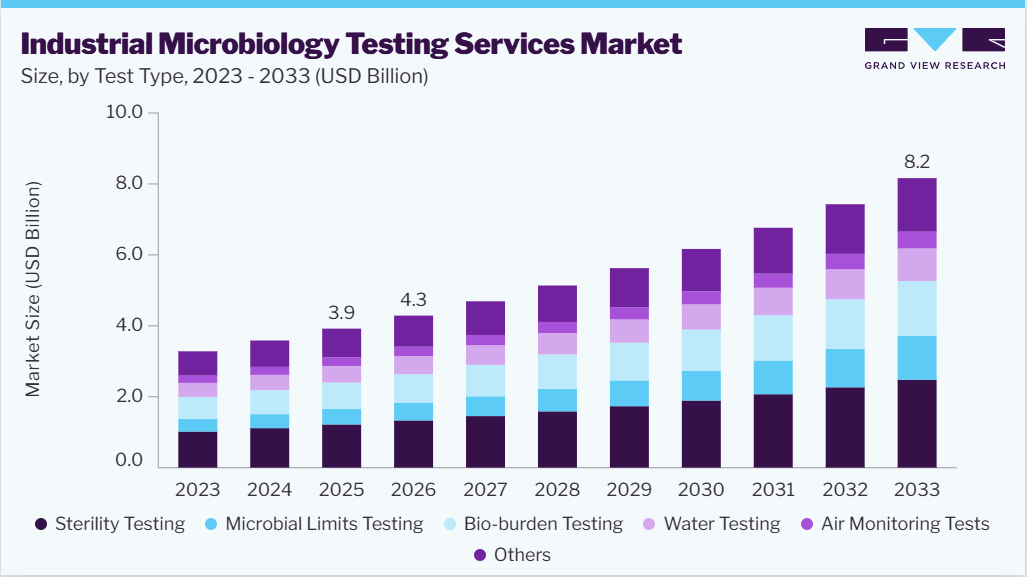 To learn more about this report, Download Free Sample Report
Market Dynamics
The industrial microbiology testing services market is evolving due to the increasing need for reliable microbial quality assessment across diverse industrial applications, including pharmaceuticals, biotechnology, food processing, and consumer healthcare products. Growing emphasis on manufacturing consistency, supply chain safety, and prevention of microbial contamination is encouraging companies to integrate comprehensive microbiological testing throughout production workflows. The shift toward advanced analytical techniques, automation, and rapid detection platforms is further transforming testing processes by improving accuracy, efficiency, and compliance with evolving industry standards.
Stringent regulatory requirements for microbial quality assessment across pharmaceutical, biotechnology, food & beverage, and medical device industries are driving demand for industrial microbiology testing services. The growing adoption of sterile manufacturing processes, biologics production, and environmental monitoring programs has increased the need for reliable microbial detection, identification, and validation services. In addition, outsourcing testing activities to specialized laboratories enables companies to ensure compliance while reducing operational complexity.
High operational costs, specialized infrastructure requirements, and the need for skilled professionals constrain the adoption of advanced microbiology testing services. Implementing rapid microbiological methods, molecular testing platforms, and automated systems often requires significant capital investment, which can limit adoption among small and medium-sized manufacturers. Moreover, variability in regulatory standards across regions can create challenges for service providers operating globally.
Market Concentration & Characteristics
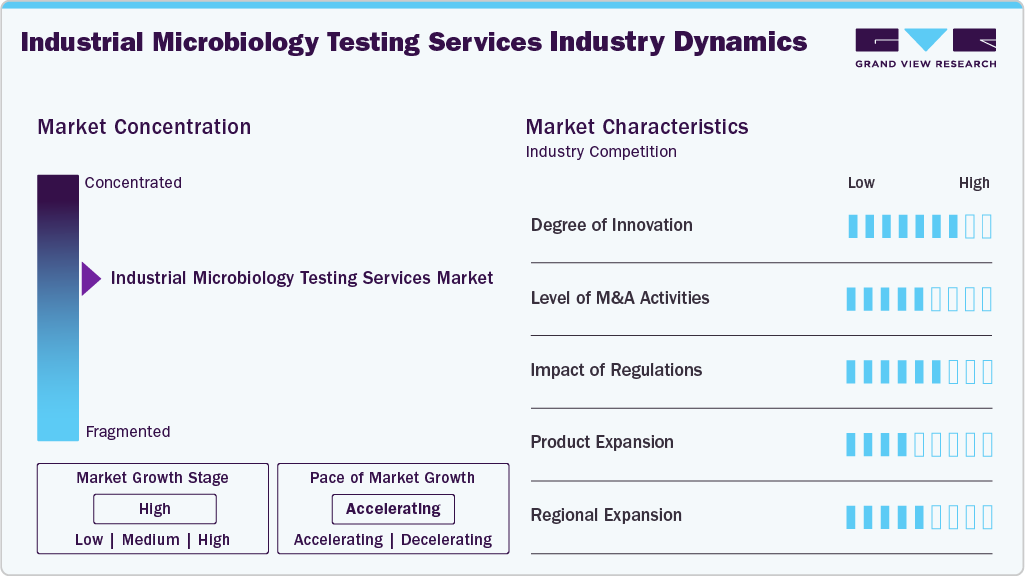
The industrial microbiology testing services industry is experiencing continuous innovation through the adoption of rapid microbiological methods (RMMs), automation, molecular diagnostics, and advanced analytical platforms. Service providers are increasingly integrating technologies such as PCR-based detection, next-generation sequencing, and AI-enabled data analysis to enhance microbial identification, reduce testing turnaround times, and improve accuracy. These advancements are enabling industries to move beyond conventional culture-based methods toward faster, more efficient quality-control solutions.
The industrial microbiology testing services industry is experiencing continuous innovation through the adoption of rapid microbiological methods (RMMs), automation, molecular diagnostics, and advanced analytical platforms. Service providers are increasingly integrating technologies such as PCR-based detection, next-generation sequencing, and AI-enabled data analysis to enhance microbial identification, reduce testing turnaround times, and improve accuracy. These advancements are enabling industries to move beyond conventional culture-based methods toward faster, more efficient quality-control solutions.
 To learn more about this report, Download Free Sample Report
Regulatory frameworks play a significant role in shaping demand for industrial microbiology testing services, as industries are required to comply with strict microbial safety, contamination control, and product quality standards. Guidelines from regulatory bodies emphasize robust testing protocols for sterile manufacturing, pharmaceuticals, biologics, and food products, driving the adoption of validated microbiological testing solutions. Increasing regulatory scrutiny is expected to further support market growth by encouraging routine testing and quality assurance practices.
Industrial microbiology testing services industry participants are expanding their service portfolios by introducing comprehensive microbiology testing solutions covering microbial identification, bioburden testing, sterility testing, endotoxin testing, environmental monitoring, and contamination analysis. Companies are also enhancing offerings through customized testing packages, rapid testing platforms, and integrated analytical services to meet the diverse requirements of end users. Expansion into specialized areas such as biologics manufacturing and advanced therapies is further creating new growth opportunities.
Industrial microbiology testing service providers are strengthening their presence across emerging and developed markets to capitalize on rising manufacturing activities and increasing regulatory requirements. North America and Europe continue to represent key markets due to established pharmaceutical and biotechnology industries, while Asia Pacific is witnessing rapid growth driven by expanding manufacturing capabilities, outsourcing trends, and investments in life sciences infrastructure. Companies are increasingly establishing regional laboratories and partnerships to improve accessibility and provide localized testing support. For instance, in June 2023, Eurofins expanded its microbiology testing capabilities in Colorado, U.S., after receiving CDPHE certification for hemp product microbial compliance testing, strengthening its regional testing portfolio and supporting localized food and consumer product testing needs.
Test Type Insights
The sterility testing segment in industrial microbiology testing services is the revenue-generating segment with the largest market share of 31.1% in 2025. Factors such as increased research & development in life sciences, and a surge in the number of medicine launches are driving market expansion. Moreover, rising global demand for sterilized products, as well as a few potential safety issues associated with the products, which usually arise from manufacturing processes that involve complicated biological and structural characteristics, are expected to drive the market throughout the forecast period.
The microbial limits testing segment is estimated to witness the fastest growth in the market throughout the forecast period, due to increasing regulatory requirements for microbial contamination control across the pharmaceutical, biotechnology, food, medical device, and cosmetics industries. Growing biologics production, stringent GMP compliance, and the adoption of rapid microbiological methods are further driving demand for outsourced microbial limits testing services.
End-use Insights
The pharmaceutical & biotechnology segment in industrial microbiology testing services is revenue-generating segment with the largest market share of 29.2% in 2025. The market growth is driven by the driven by stringent regulatory requirements, increasing biologics and sterile drug manufacturing, and growing outsourcing of microbiological quality control, sterility, bioburden, and environmental monitoring services.
 To learn more about this report, Download Free Sample Report
The food & beverages segment is estimated to witness the fastest growth in the market throughout the forecast period, driven by stringent food safety regulations, increasing demand for pathogen detection and shelf-life testing, and rising consumer preference for safe, high-quality food products. Growing processed food production and global food trade are further accelerating demand for industrial microbiology testing services.
Regional Insights
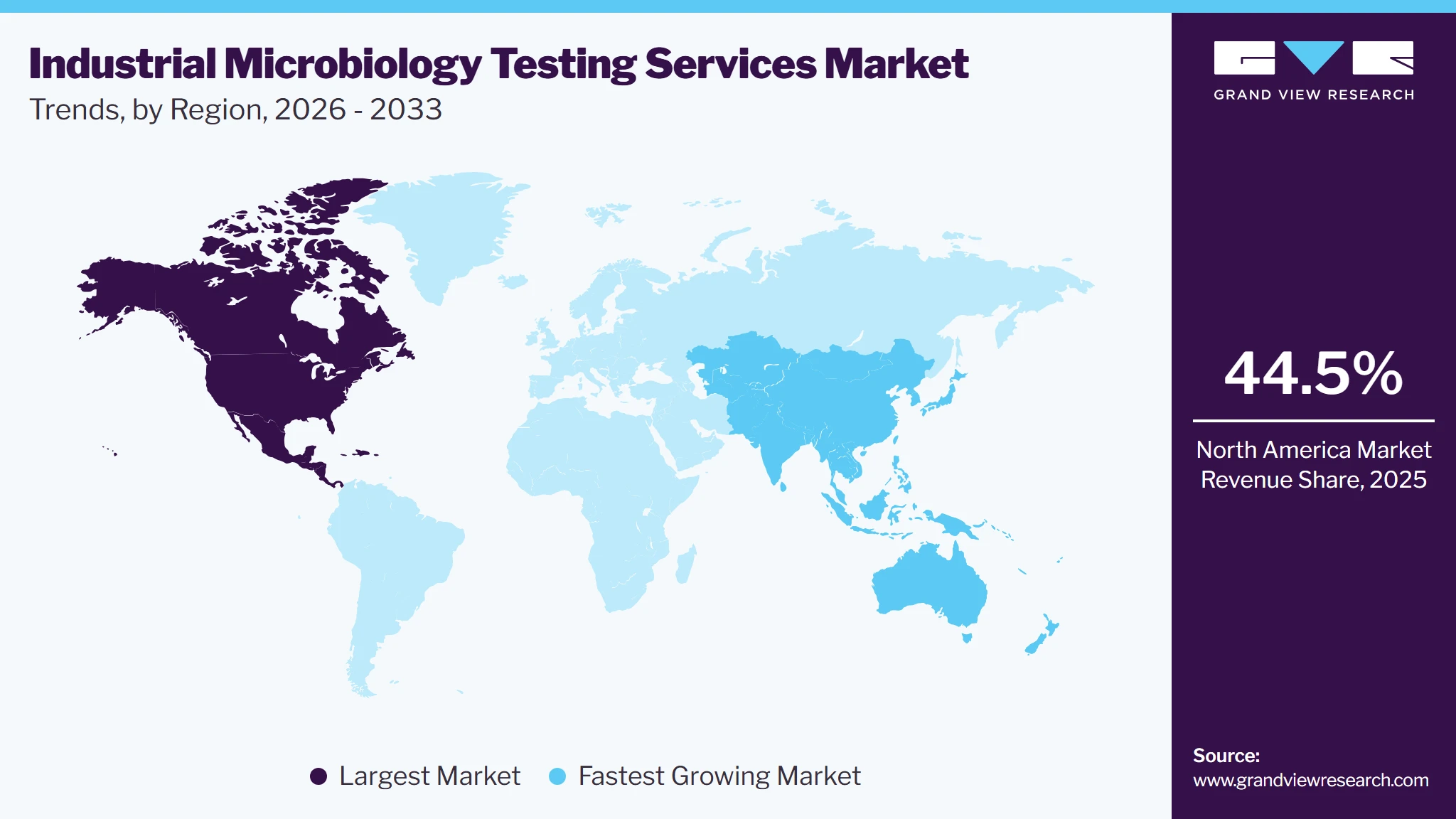
North America dominated the industrial microbiology testing services market and accounted for the largest revenue share of 44.5% in 2025, driven by its well-established pharmaceutical, biotechnology, medical device, and food manufacturing industries. Stringent regulatory oversight from agencies such as the FDA, USDA, and Health Canada has increased demand for sterility testing, microbial identification, environmental monitoring, and bioburden testing. The region also benefits from the strong presence of contract testing organizations, advanced laboratory infrastructure, and widespread adoption of rapid microbiological methods.
 To learn more about this report, Download Free Sample Report
U.S Industrial Microbiology Testing Services Market Trends
The U.S. dominated the North America market, fueled by its large pharmaceutical and biotechnology manufacturing base, expanding biologics production, and stringent GMP requirements. Rising outsourcing of microbiology quality testing and investments in advanced laboratory capabilities further drive market growth.
Europe Industrial Microbiology Testing Services Market Trends
Europe held a significant share of the industrial microbiology testing services market, due to the presence of major biopharmaceutical manufacturing hubs, stringent EU GMP guidelines, and growing production of biologics, vaccines, and advanced therapies are driving demand for sterility testing, microbial identification, and environmental monitoring services.
The UK industrial microbiology testing services market is driven by its mature life sciences sector, expanding contract manufacturing activities, and growing advanced therapeutics production. Increasing pharmaceutical R&D, regulatory requirements, and adoption of outsourced microbiology testing services further support market growth.
Germany represents one of the leading industrial microbiology testing services markets in Europe, due to its strong pharmaceutical manufacturing sector, advanced chemical and medical device industries, and stringent European Union quality standards. The country's emphasis on GMP-compliant manufacturing, coupled with increasing production of biologics and biosimilars, has fueled demand for microbial limits testing, sterility testing, and environmental monitoring services across industrial manufacturing facilities.
Asia Pacific Industrial Microbiology Testing Services Market Trends
The Asia Pacific region is projected to expand at the fastest CAGR of 10.7% over the forecast period, owing to expanding pharmaceutical manufacturing, increasing biologics production, and growing investments in biotechnology across China, India, South Korea, and Southeast Asia. Rising contract manufacturing activities, improving regulatory standards, and increasing exports of pharmaceutical and food products are accelerating demand for microbiology testing services. Governments across the region are also investing in laboratory infrastructure to strengthen product quality and global regulatory compliance.
China accounted for the largest share of the Asia Pacific market, driven by rapid expansion of pharmaceutical manufacturing, contract development and manufacturing organizations (CDMOs), and biotechnology companies. Increasing implementation of GMP standards, rising biologics production, and growing exports of pharmaceutical ingredients have significantly increased demand for sterility testing, microbial identification, and environmental monitoring services.
Japan’s industrial microbiology testing services market is supported by its regulated pharmaceutical industry, growing biologics and regenerative medicine sectors, and emphasis on product quality. Rising demand for advanced microbiological testing and rapid testing technologies is further driving market growth.
Latin America Industrial Microbiology Testing Services Market Trends
The Latin American industrial microbiology testing services market is emerging gradually as biotechnology research and genomics capabilities continue to expand across the region. Increasing investments in life science infrastructure, growing research activities in molecular diagnostics, and rising interest in precision medicine are supporting adoption.
MEA Industrial Microbiology Testing Services Market Trends
The Middle East & Africa market is witnessing steady growth due to rising pharmaceutical manufacturing investments, expanding food processing industries, and strengthening regulatory frameworks. Increasing laboratory infrastructure development and food safety requirements are driving demand for industrial microbiology testing services.
Key Industrial Microbiology Testing Services Company Insights
The continuous demand for industrial microbiology testing services by multiple applications has created numerous market opportunities for major players to capitalize on. For instance, in June 2023, The Colorado Department of Public Health & Environment (CDPHE) approved Eurofins Microbiology Laboratories, Inc. of Lafayette, Colorado to execute microbial hemp testing to ensure compliance for industrial hemp & hemp-derived products.
Key Industrial Microbiology Testing Services Companies:
The following key companies have been profiled for this study on the industrial microbiology testing services market.
-
Charles River Laboratories
-
Eurofins Scientific
-
Intertek Group Plc
-
STERIS
-
TÜV SÜD
-
Pace Analytical Services
-
SGS
-
Bureau Veritas
-
Mérieux NutriSciences
-
Nelson Laboratories, LLC
-
WuXi AppTec
-
Microbac
-
Anacon Laboratories
Competitive Benchmarking
Category
Operating Strategies
Competitive Edge
Weakness
Established Players ((Eurofins Scientific; Charles River Laboratories; SGS.)
- Expanding global laboratory networks, enhancing GMP-compliant microbiology testing capabilities, adopting rapid microbiological methods, and broadening service portfolios across pharmaceutical, biotechnology, food, and healthcare industries through acquisitions, partnerships, and facility expansions.
- Strong global presence, extensive regulatory expertise, diversified testing portfolios covering sterility testing, microbial limits testing, bioburden testing, environmental monitoring, and long-standing relationships with multinational manufacturers
- High operational costs, complex global infrastructure management, and slower customization compared with smaller specialized laboratories.
Emerging Players (DNA Script; K&A Labs GmbH; CSBio)
- Improving turnaround times, and targeting niche applications across pharmaceutical, food, environmental, and industrial sectors.
- Greater flexibility, localized customer support, faster response times, and ability to provide customized testing solutions for specific regulatory and industry requirements.
- Limited geographic reach, smaller laboratory networks, and lower investment capacity for advanced automation.
Recent Developments
-
In April 2026, Thermo Fisher Scientific agreed to sell its microbiology business to Astorg for approximately USD 1.08 billion in the U.S., involving antimicrobial susceptibility testing and culture media products used in pharmaceutical and food safety applications, highlighting continued investment and consolidation in microbiology testing solutions supporting the industrial microbiology testing services market.
-
In May 2023, Charles River Laboratories launched Accugenix Next Generation Sequencing (NGS) services enabling advanced bacterial and fungal identification while expanding regional access through laboratory partnerships in Austria and the Netherlands for industrial microbiology testing.
-
In June 2022, SGS expanded its microbiology testing capabilities in Phoenix, Arizona, U.S., by launching a Biosafety Level-2 laboratory focused on antimicrobial efficacy testing for hand sanitizers and antibacterial products.
Industrial Microbiology Testing Services Market Report Scope Table
Report Attribute
Details
Market size in 2025
USD 3.9 billion
Estimated market size in 2026
USD 4.3 billion
Projected market size by 2033
USD 8.2 billion
Growth rate
CAGR of 9.6% from 2026 to 2033
Historical data
2021 - 2025
Forecast period
2026 - 2033
Quantitative units
Revenue in USD million/billion and CAGR from 2026 to 2033
Report coverage
Revenue forecast, company ranking, competitive landscape, growth factors, and trends
Segments covered
Test type, end-use, region
Regional scope
North America; Europe; Asia Pacific; Latin America; MEA
Country scope
U.S.; Canada; UK; Germany; Italy; France; Spain; Denmark; Sweden; Norway; Japan; China; India; South Korea; Australia; Thailand; Brazil; Mexico; Argentina; South Africa; Saudi Arabia; UAE; Kuwait
Key companies profiled
Charles River Laboratories; Eurofins Scientific; Intertek Group Plc; STERIS; TÜV SÜD; Pace Analytical Services; SGS; Bureau Veritas; Mérieux NutriSciences; Nelson Laboratories, LLC; WuXi AppTec; Microbac; Anacon Laboratories
Customization scope
Free report customization (equivalent up to 8 analysts' working days) with purchase. Addition or alteration to country, regional & segment scope.
Pricing and purchase options
Avail customized purchase options to meet your exact research needs. Explore purchase options
Global Industrial Microbiology Testing Services Market Report Segmentation
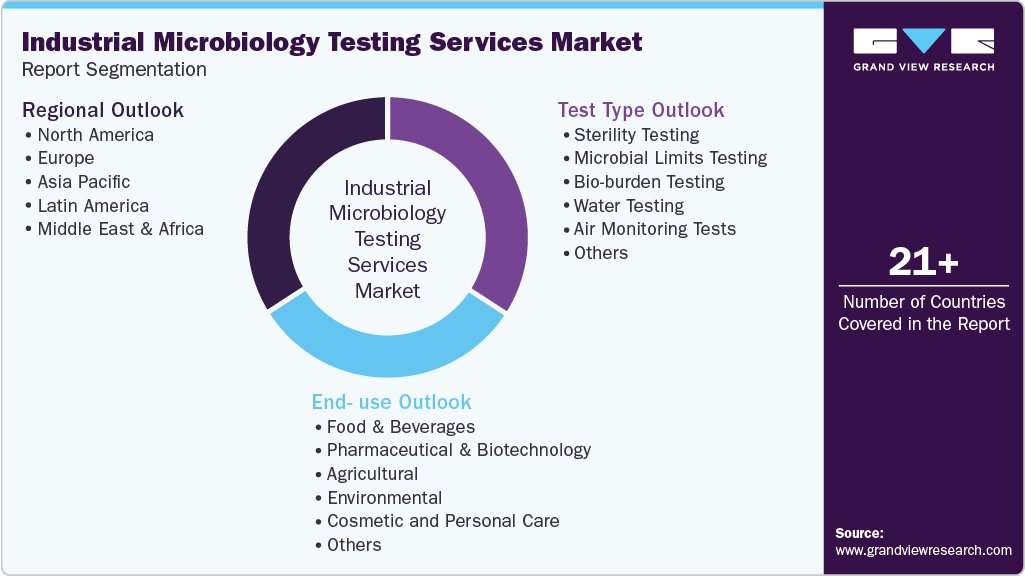
This report forecasts revenue growth and provides an analysis on the latest trends in each of the sub-segments from 2021 to 2033. For this report, Grand View Research has segmented the global industrial microbiology testing services market report on the basis of test type, end-use, and region:
 To learn more about this report, Download Free Sample Report
-
Test Type Outlook (Revenue, USD Million, 2021 - 2033)
-
Sterility Testing
-
Microbial Limits Testing
-
Bio-burden Testing
-
Water Testing
-
Air Monitoring Tests
-
Others
-
-
End-use Outlook (Revenue, USD Million, 2021 - 2033)
-
Food & Beverages
-
Pharmaceutical & Biotechnology
-
Agricultural
-
Environmental
-
Cosmetic and Personal Care
-
Others
-
-
Regional Outlook (Revenue, USD Million, 2021 - 2033)
-
North America
-
U.S.
-
Canada
-
Mexico
-
-
Europe
-
Germany
-
UK
-
France
-
Italy
-
Spain
-
Denmark
-
Sweden
-
Norway
-
-
Asia Pacific
-
China
-
Japan
-
India
-
South Korea
-
Australia
-
Thailand
-
-
Latin America
-
Brazil
-
Argentina
-
-
Middle East & Africa
-
South Africa
-
Saudi Arabia
-
UAE
-
Kuwait
-
-
Research Methodology
The industrial microbiology testing services market figures in this report are based on a proven research process that combines executive interviews with secondary research from proprietary databases, company filings, and recognized regulatory and institutional sources. Market size is built through value-chain sizing-reconciling supply-side and demand-side estimates-and triangulated with bottom-up and top-down approaches. Every estimate passes multiple levels of expert validation before publication, with each industrial microbiology testing services segment quantified using the revenue-capture definitions in the table below.
Segment Definition
Segment -Test Type
Revenue capture definition
Sterility Testing
The segment includes revenue generated from microbiological testing services performed to detect the presence or absence of viable microorganisms in pharmaceutical products, medical devices, biologics, and other sterile manufacturing environments to ensure compliance with regulatory standards.
Microbial Limits Testing
The segment includes revenue generated from microbiological testing services used to quantify microbial load and detect specified microorganisms in non-sterile products, including pharmaceuticals, cosmetics, food products, and raw materials.
Bio-burden Testing
The segment includes revenue generated from testing services that measure the total number of viable microorganisms present in raw materials, in-process samples, and finished products before sterilization or aseptic processing.
Water Testing
The segment includes revenue generated from microbiological analysis of water systems used in pharmaceutical, food processing, industrial, and environmental applications to detect microbial contamination and ensure water quality compliance.
Air Monitoring Tests
The segment includes revenue generated from microbiological testing services used to monitor airborne microorganisms in controlled environments, including cleanrooms, manufacturing facilities, laboratories, and healthcare settings.
Others
The segment includes revenue generated from additional industrial microbiology testing services such as microbial identification, pathogen detection, environmental monitoring, endotoxin testing, antimicrobial efficacy testing, and rapid microbiological testing methods.
Segment - End Use
Revenue capture definition
Food & Beverages
The segment includes revenue generated from microbiology testing services used for food safety, pathogen detection, microbial contamination analysis, shelf-life assessment, and regulatory compliance testing across food and beverage products.
Pharmaceutical & Biotechnology
The segment includes revenue generated from microbiology testing services supporting pharmaceutical and biotechnology manufacturing, including sterility testing, bioburden testing, microbial identification, environmental monitoring, and GMP quality control testing for drugs, biologics, vaccines, and advanced therapies.
Agricultural
The segment includes revenue generated from microbiological testing services used for agricultural products, soil analysis, plant health assessment, biological inputs, and microbial contamination testing of agricultural materials.
Environmental
The segment includes revenue generated from microbiological testing services for environmental monitoring applications, including water quality testing, wastewater analysis, air monitoring, and microbial assessment of environmental samples.
Cosmetic & Personal Care
The segment includes revenue generated from microbiology testing services for cosmetic and personal care products, including microbial limits testing, preservative efficacy testing, contamination assessment, and product safety evaluation.
Others
The segment includes revenue generated from microbiology testing services across additional industries such as medical devices, chemicals, industrial manufacturing, research institutions, and consumer products.
Estimation Model
Category
Methodology
Description
Top-Down
Company Revenue Analysis
Aggregated revenues of key industrial microbiology testing service providers across sterility testing, microbial limits testing, bioburden testing, water testing, air monitoring, and other services. Estimates were validated through company reports, industry publications, regulatory databases, and secondary research.
Bottom-Up
Industry Demand Analysis and Application-Based Assessment
Estimated the global market size based on microbiology testing demand across pharmaceutical & biotechnology, food & beverages, environmental, agricultural, and cosmetic sectors, considering regulatory requirements, manufacturing activity, outsourcing trends, and adoption patterns.
Primary Research
Interviews with Testing Service Providers, Industry Experts, Quality Control Professionals, and Key Opinion Leaders
Conducted interviews with microbiology testing laboratories, pharmaceutical and biotechnology manufacturers, food testing organizations, quality assurance professionals, regulatory experts, and industry consultants to validate market estimates, service pricing, testing demand, technology adoption, and competitive landscape.
Validation
Data Triangulation & Validation Model
Market estimates were validated through triangulation of secondary research, primary interviews, company-level revenue analysis, laboratory capacity assessment, and end-use industry demand evaluation to ensure accuracy and consistency across segments and regions.
Forecasting
Forecasting & CAGR Modeling
Forecasts were developed using historical market trends, growth in pharmaceutical and biotechnology manufacturing, increasing regulatory compliance requirements, expansion of food safety testing, adoption of rapid microbiological methods, and rising outsourcing of quality control testing services.
Delivered Customizations
This report has been delivered with the following In-depth customizations
Client Request
Customization Delivered
Value Adds
Technology advancement analysis
Assessment of emerging developments in industrial microbiology testing, including rapid microbiological methods, automated microbial detection, molecular identification, and next-generation sequencing-based testing approaches.
Helps identify innovation trends, technology adoption patterns, and future growth opportunities in microbiology testing services.
Testing service capability assessment
Benchmarking of microbiology testing service providers based on test portfolio, laboratory capabilities, regulatory certifications, geographic coverage, turnaround time, and advanced testing technologies.
Supports competitive benchmarking and evaluation of service provider capabilities across key market segments.
Outsourcing vs. in-house testing analysis
Evaluation of factors influencing organizations’ decisions to outsource microbiology testing services versus maintaining internal quality control laboratories, including cost, regulatory compliance, expertise, and infrastructure requirements.
Provides insights into customer preferences, outsourcing trends, and opportunities for service providers across pharmaceutical, food, and industrial applications.
Frequently Asked Questions About This Report
Asia Pacific is the fastest-growing region over the forecast period.
The sterility testing segment led with a 31.1% revenue share in 2025, while microbial limits testing segment is the fastest-growing test type.
The global industrial microbiology testing services market size was valued at USD 3.9 billion in 2025 and is estimated at USD 4.3 billion for 2026.
The global industrial microbiology testing services market is expected to grow at a CAGR of 9.6% from 2026 to 2033, reaching USD 8.2 billion by 2033.
The pharmaceutical & biotechnology segment led with a 29.2% revenue share in 2025, while food & beverages segment is astest-growing end-use.
Key factors include the rapid spread of infectious diseases across the globe, including the novel coronavirus disease and its emerging variants, increasing utilization of advanced industrial microbiology techniques for pharmaceutical and food & beverage manufacturing, and rising public concerns about the efficacy and safety of pharmaceutical and food & beverage products are the main drivers of the global industrial microbiology testing services market.
Key players include Charles River Laboratories, Intertek Group plc, Spectro Analytical Labs Pvt. Limited, Pacelabs, Biotech Testing Services, Merck KGaA, TÜV SÜD, Precise Analytics Lab, Eurofins Scientific, Biocare Research (India) Pvt. Ltd., STERIS.
North America dominated the market, accounting for the largest share of 44.5% in 2025.
About the Author(s)
Biotechnology Research Team
Healthcare · BiotechnologyThis report was authored by the biotechnology research team at Grand View Research - comprising two research analysts, one senior research analyst, and one industry expert - with specialized expertise in the biotechnology segment of the healthcare industry. All findings are based on proprietary healthcare databases, executive interviews, and regulatory analysis, subject to internal peer review prior to publication.
Last Updated:
Speak to Analyst

Customize this report to your needs - add regions, segments, or data points, with 20% free customization.
Or view our licence options:


ISO 9001:2015 & 27001:2022 Certified
We are GDPR and CCPA compliant! Your transaction & personal information is safe and secure. For more details, please read our privacy policy.


