
- Home
- »
- Advanced Interior Materials
- »
-
Industrial Ovens Market Size & Share Report, 2026-2033GVR Report cover

Industrial Ovens Market (2026 - 2033)
Size, Share & Trends Analysis Report By Product (Curing Oven, Baking Oven), By Process (Batch, Continuous), By Energy Source (Electric, Natural Gas), By End Use (Chemical, Food & Beverage), By Region, And Segment Forecasts
Market Size, 2025
$8.4BMarket Estimate, 2026
$8.7BMarket Forecast, 2033
$11.7BCAGR, 2026–2033
4.4%Industrial Ovens Market Summary
The global industrial ovens market size was valued at USD 8.4 billion in 2025 and is projected to grow from USD 8.7 billion in 2026 to USD 11.7 billion by 2033, at a CAGR of 4.4% from 2026 to 2033. Asia Pacific dominated the market, accounting for a revenue share of 42.4% in 2025. The industrial ovens industry is primarily driven by the expanding manufacturing and production sectors that require precise temperature control and efficient thermal processing.
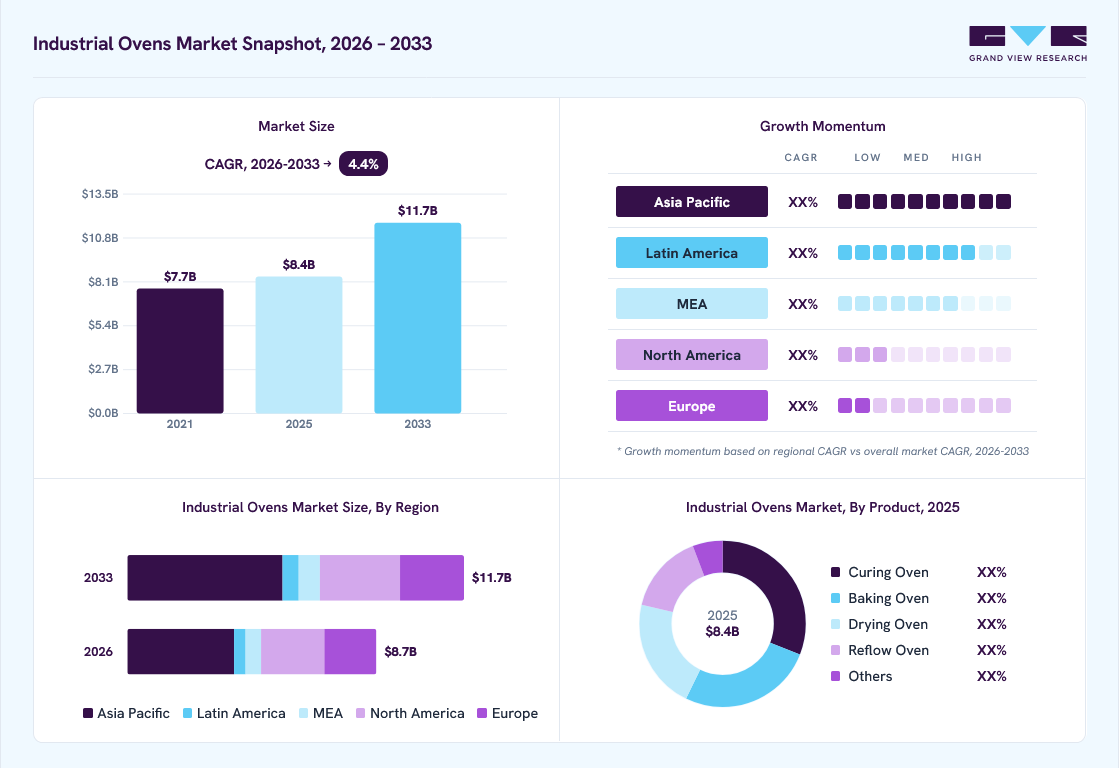 Source: Grand View Research, IR Documents, Primary Interviews, Paid DatabasesTo learn more about this report,
 Download Free Sample Report
Continuous process ovens dominate the market due to their ability to facilitate high-volume production with consistent operation, reducing workforce dependence and manufacturing costs. Rapid industrialization and urbanization, especially in emerging economies like India and China, further boost demand by increasing the need for advanced, reliable industrial ovens in various industries such as automotive, aerospace, food processing, and chemical manufacturing.
Key Market Trends & Insights
- By product: Curing oven segment led the market with the largest revenue share of 31.1% in 2025.
- By process: Batch segment led the market with the largest revenue share of 54.9% in 2025.
- By energy source: Electric segment led the market with the largest revenue share of 54.9% in 2025.
- By end use: Food & beverage segment led the market with the largest revenue share of 27.7% in 2025
Regional Highlights
- Largest regional market: Asia Pacific (42.4% revenue share, 2025)
- By country: The China held the largest market share in 2025.
Market Size & Forecast
- Market size in 2025: USD 8.4 Billion
- Estimated market size in 2026: USD 8.7 Billion
- Projected market size by 2033: USD 11.7 Billion
- CAGR (2026-2033): 4.4%
Prism AI by Grand View Research Free to tryAsk a question about the industrial ovens marketTry asking✓Every figure cited from GVR research Prefer the report? Download free sample →
Another significant driver is the rising emphasis on energy efficiency and sustainability, fueled by stringent environmental regulations and the need to reduce carbon footprints. Technological advancements, including the integration of AI, IoT, and smart sensors, enhance operational efficiency, real-time monitoring, and predictive maintenance, enabling manufacturers to optimize energy consumption and reduce downtime. In addition, government policies promoting cleaner technologies and the shift towards alternative energy sources in industrial ovens support market growth globally, with regions like Europe and North America leading in adoption due to regulatory pressures. To learn more about this report, Download Free Sample Report
Market Dynamics
The industrial ovens market is driven by the increasing demand for energy-efficient and precision-controlled thermal processing solutions across industries such as automotive, aerospace, electronics, food & beverage, chemicals, and metal processing. Growing manufacturing output, rising emphasis on product quality and process consistency, and the need to improve operational efficiency are accelerating the adoption of advanced industrial oven systems. Additionally, stringent environmental regulations and sustainability initiatives are encouraging manufacturers to invest in low-emission and energy-efficient heating technologies. However, high initial capital investment, substantial operating and maintenance costs, and volatility in energy prices continue to restrain market growth.
The expansion of industrial manufacturing activities across sectors such as automotive, aerospace, electronics, food & beverage, chemicals, pharmaceuticals, and metal processing continues to drive demand for industrial ovens. Increasing production volumes, coupled with stringent quality standards and the need for precise, uniform, and repeatable thermal processing, are encouraging manufacturers to invest in advanced industrial oven systems.
Furthermore, the growing emphasis on improving production efficiency, minimizing energy consumption, and complying with increasingly stringent environmental regulations is accelerating the adoption of energy-efficient industrial ovens across both greenfield manufacturing facilities and plant modernization projects.
High capital investment and operating costs remain key restraints for the industrial ovens market. The deployment of industrial ovens requires substantial upfront expenditure for equipment procurement, installation, facility integration, and commissioning, particularly for customized or large-capacity systems. Additionally, high energy consumption, routine maintenance requirements, periodic replacement of heating components, and rising electricity and fuel prices increase the overall cost of ownership. These financial challenges are particularly significant for small and medium-sized manufacturers, limiting investments in advanced thermal processing technologies and delaying equipment replacement cycles.
The increasing focus on sustainable manufacturing and operational efficiency presents significant growth opportunities for the industrial ovens market. Manufacturers are increasingly replacing conventional thermal processing equipment with energy-efficient industrial ovens featuring advanced insulation materials, high-efficiency heating systems, precision temperature controls, and automated process management capabilities.
In addition, rising investments in manufacturing capacity expansion, industrial modernization, and high-growth industries such as electric vehicles, batteries, semiconductors, and advanced materials are expected to accelerate demand for technologically advanced industrial ovens. The growing need to reduce operating costs, improve process reliability, and achieve higher production efficiency is expected to further support market growth over the forecast period.
Market Concentration & Characteristics
The industrial ovens industry exhibits a moderate level of market concentration, with a few well-established players holding a significant share of the global market. These companies typically operate across multiple regions and serve a diverse range of end-use industries, including automotive, aerospace, electronics, food processing, and chemicals. The market is characterized by strong technological expertise, with manufacturers offering a wide range of oven types such as conveyor, batch, curing, drying, and reflow ovens, each tailored to specific industrial applications.
Customization, energy efficiency, and automation are key differentiators in this market. End users increasingly demand solutions that can integrate with advanced manufacturing systems, including Industry 4.0 and IoT-enabled technologies. This has led to a growing emphasis on smart ovens with features like real-time monitoring, precise temperature control, and predictive maintenance capabilities. As a result, innovation and technical capability are critical for maintaining competitiveness.
 To learn more about this report, Download Free Sample Report
M&A activity in the industrial ovens sector is moderate, focusing on consolidating technological capabilities and expanding geographic reach. Companies pursue strategic acquisitions to enhance product portfolios, especially in energy-efficient and smart oven solutions, to meet growing demand in the automotive, aerospace, and food processing industries. This trend supports market growth by fostering innovation and competitive positioning.
Stringent environmental and safety regulations globally significantly impact the industrial ovens industry, compelling manufacturers to develop energy-efficient, low-emission products. Government policies favoring clean energy adoption and sustainability drive investments in electric and hybrid ovens. Compliance with these regulations ensures market access and encourages modernization of existing equipment to reduce carbon footprints and improve worker safety.
Analyst Perspective
The industrial ovens market is experiencing steady growth as manufacturers increasingly invest in advanced thermal processing equipment to improve production efficiency, product quality, and energy performance. Demand is being driven by expanding applications across automotive, aerospace, electronics, food processing, pharmaceuticals, and metal fabrication, where precise temperature control is critical for curing, drying, baking, annealing, tempering, and heat treatment processes. In addition, the growing adoption of Industry 4.0 technologies, automated production lines, and energy-efficient heating systems is encouraging manufacturers to upgrade conventional ovens with digitally controlled, high-performance solutions. As industries continue to focus on operational efficiency, sustainability, and process consistency, suppliers offering reliable, energy-efficient, and application-specific industrial ovens are expected to benefit from sustained long-term market growth.
Drivers, Opportunities & Restraints
The industrial ovens industry is driven by rising demand from key sectors such as automotive, aerospace, and metal processing that require precise and reliable thermal processing. Increasing industrialization and automation, especially in emerging economies, are boosting the need for energy-efficient and high-performance ovens. In addition, stringent environmental regulations and the push for sustainability are accelerating the adoption of advanced, low-emission oven technologies.
Opportunities lie in the integration of Industry 4.0 technologies like AI, IoT, and smart sensors, which enhance process control, predictive maintenance, and energy optimization. The growing trend toward hybrid and electric heating systems offers potential for reducing carbon footprints and operational costs. Expanding industrial activities in Asia-Pacific and government incentives for clean energy adoption also present significant growth prospects.
High initial capital investment and maintenance costs for advanced industrial ovens can restrain market growth, particularly for small and medium enterprises. In addition, fluctuating energy prices and the complexity of retrofitting existing systems with new technology may slow adoption. Regulatory compliance costs and the need for skilled operators to manage sophisticated equipment also pose challenges.
Product Insights
Based on product, the curing oven segment led the market with the largest revenue share of 31.1% in 2025, due to its extensive application across industries such as automotive, aerospace, electronics, and healthcare. These ovens are essential for processes like adhesive curing, coating, and composite material hardening, which require precise temperature control and consistency. The segment's steady growth is supported by increasing demand for high-quality, durable products and stringent quality standards in manufacturing.
The drying oven segment is anticipated to grow at the fastest CAGR during the forecast period, driven by its versatile use in applications such as sterilization, evaporation, temperature testing, and incubation across chemical, pharmaceutical, and food industries. Rising industrial activities and the need for efficient moisture removal and product stabilization fuel this growth. In addition, innovations aimed at improving energy efficiency and process control in drying ovens are accelerating their adoption.
End Use Insights
Based on end use, the food & beverage segment led the market with the largest revenue share of 27.7% in 2025, owing to the growing demand for baking, drying, and curing processes essential in food production. The expansion of packaged and processed food industries globally, especially in North America and Europe, fuels the need for reliable, energy-efficient ovens. Continuous ovens are widely used here to support high-volume production with consistent quality and reduced labor costs.
 To learn more about this report, Download Free Sample Report
The automotive and aerospace segment is anticipated to grow at the fastest CAGR during the forecast period, due to increasing production volumes and the critical need for precise heat treatment, curing, and drying of components. Advanced manufacturing techniques and stringent quality standards in these sectors drive demand for technologically sophisticated ovens, including batch and continuous types with enhanced process control. Rapid industrialization in Asia-Pacific also contributes to the accelerated growth of this segment.
Process Insights
Based on process, the batch segment led the market with the largest revenue share of 54.9% in 2025, due to its flexibility and suitability for smaller production runs and customized processes. Batch ovens are widely used in industries like automotive and electronics, where precision and the ability to handle varied product types are essential. Their adaptability to different thermal processes and ease of use in specialized applications contribute to their rising demand, especially in emerging markets.
The continuous oven segment is expected to grow at the fastest CAGR during the forecast period, driven by its ability to support high-volume production with consistent and uninterrupted operation. These ovens are favored in industries such as food processing, pharmaceuticals, and automotive, where steady throughput and energy efficiency are critical. Continuous ovens also benefit from automation and advanced process controls, making them the preferred choice for large-scale manufacturing environments.
Energy Source Insights
Based on energy source, the electric segment led the market with the largest revenue share of 54.9% in 2025, due to advances in energy efficiency and its suitability for smaller batch processes and low-temperature applications. Electric ovens provide precise temperature control and consistent heat distribution without combustion emissions, making them favorable for industries with strict contamination and environmental standards. In addition, simpler installation and enhanced safety features contribute to their rising adoption, especially in regions with limited gas infrastructure.
The natural gas segment is expected to grow at the fastest CAGR during the forecast period, driven by its lower operational costs and ability to quickly reach high temperatures, making it ideal for large-scale, continuous production processes. Gas ovens offer a higher turndown ratio, allowing flexible temperature control across a wide range, which is advantageous for industries requiring variable heating cycles. Despite higher initial installation costs, the long-term savings in fuel expenses make natural gas ovens preferred for heavy industrial use.
Regional Insights
The industrial ovens market in North America held a significant share in 2024, driven by strong manufacturing hubs in the U.S., Canada, and Mexico, particularly in the automotive, aerospace, and metal fabrication sectors. Government incentives promoting energy efficiency and domestic production stimulate capital investments in advanced thermal systems. The region’s focus on innovation and sustainability supports steady market growth.
U.S. Industrial Ovens Market Trends
The industrial ovens market in the U.S. is expected to grow at a substantial CAGR of 3.6% from 2025 to 2033. The U.S. holds the largest share of the global industrial ovens industry, driven by its large manufacturing base in the automotive, aerospace, and metal processing industries. The market benefits from continuous technological innovation, automation, and stringent environmental regulations that encourage energy-efficient oven adoption.
The Canada industrial ovens market is growing steadily, supported by expanding manufacturing sectors and increasing investments in clean and energy-efficient technologies. Although smaller than the U.S. market, Canada focuses on niche applications in aerospace, food processing, and pharmaceuticals, with government incentives promoting sustainable industrial practices. Growth is moderate but consistent, driven by modernization efforts and rising demand for advanced thermal processing equipment.
Asia Pacific Industrial Ovens Market Trends
Asia Pacific dominated the industrial ovens market with the largest revenue share of 42.4% in 2025. This growth is primarily driven by rapid industrialization, urbanization, and the expanding automotive and electronics manufacturing sectors in countries such as China, India, and those across Southeast Asia. Strategic collaborations between multinational corporations and local manufacturers are fostering technology transfer and enabling more cost-efficient production. In addition, rising disposable incomes, increasing infrastructure investments, and supportive government initiatives are further propelling market growth across the region.
 To learn more about this report, Download Free Sample Report
The industrial ovens market in China held the largest share in the Asia Pacific region in 2025., driven by its massive manufacturing base, especially in automotive, electronics, and steel production sectors. Rapid industrialization, government support for infrastructure development, and a growing focus on energy-efficient and continuous process ovens drive market expansion. In addition, China’s increasing demand for high-quality thermal processing equipment to improve production efficiency fuels growth in this region.
The India industrial ovens market is expected to grow at the fastest CAGR of 6.1% from 2025 to 2033, owing to rapid industrialization and expanding automotive, metal processing, and solar cell manufacturing industries. Government initiatives promoting Make in India and infrastructure investments accelerate the adoption of advanced industrial ovens. The rising need for energy-efficient and cost-effective thermal processing solutions in small and medium enterprises further supports market growth.
Europe Industrial Ovens Market Trends
The industrial ovens market in Europe holds a significant market share, driven by stringent environmental regulations and decarbonization targets that encourage adoption of electric and sustainable industrial ovens. Western European countries lead with advanced furnace designs and renewable energy integration. The region’s focus on reducing carbon emissions and improving energy efficiency underpins market growth.
The Germany industrial ovens marketaccounted for the largest market revenue share of 28.0% in Europe in 2024. Germany dominates the European industrial ovens industry due to its strong metal processing and automotive manufacturing sectors, which demand high-precision thermal treatment solutions. The country benefits from a well-established industrial base and continuous innovation in electric and gas ovens, supported by major players like Vaillant GmbH. Rising metal prices and increased demand for electric furnaces in downstream metal processing also drive growth in the German market.
The industrial ovens market in UK is driven by expanding aerospace, automotive, and food processing industries requiring specialized thermal processing equipment. Increased investments in automation and Industry 4.0 technologies enhance operational efficiency and product quality. Furthermore, the UK’s regulatory push for sustainability and energy-efficient manufacturing fosters demand for advanced electric and hybrid ovens, supporting market growth.
Middle East & Africa Industrial Ovens Market Trends
The industrial ovens market in the Middle East & Africa is shaped by investments in petrochemical processing and high-temperature industrial applications, particularly in oil-rich countries. North African and sub-Saharan regions are gradually modernizing their industrial base, focusing on ceramics and food processing sectors. However, growth remains measured due to infrastructural and economic constraints.
The UAE industrial ovens market is growing due to rapid industrialization and diversification efforts beyond oil, with strong demand from metal processing, aerospace, and automotive sectors. Local manufacturers focus on advanced, energy-efficient furnace technologies that comply with international standards, supporting sustainability goals. In addition, the UAE’s strategic position as a trade hub facilitates exports and adoption of innovative industrial ovens, boosting market expansion.
Latin America Industrial Ovens Market Trends
The industrial ovens market in Latin America’s growth is moderate, supported by increasing industrial activities in the automotive and metal processing sectors. Investments in modernization and energy-efficient ovens are gradually rising, although economic fluctuations and infrastructural challenges temper rapid expansion. Government initiatives aimed at boosting industrial productivity also contribute to steady demand.
The Brazil industrial ovens market growth is driven by expanding manufacturing sectors such as automotive, metal processing, and food production, which demand efficient thermal processing solutions. Increasing urbanization and rising consumer spending fuel investments in advanced ovens, while local manufacturers focus on improving energy efficiency and compliance with environmental standards. The growing emphasis on modernization and automation also supports market expansion in Brazil.
Key Industrial Ovens Company Insights
Some of the key players operating in the market include ASC Process Systems, Cincinnati Sub-Zero (CSZ), and Midwest Finishing Systems, Inc.
-
ASC Process Systems is a leading global manufacturer specializing in autoclaves, composite curing ovens, and thermal process systems primarily for aerospace, nuclear, glass laminating, and ballistics industries. Their products are known for advanced control systems, high precision, and reliability, serving mission-critical manufacturing needs worldwide. ASC’s ovens feature optimized airflow and energy efficiency, supporting complex composite curing processes with low maintenance and high uptime.
-
Midwest Finishing Systems, Inc. is a leading provider specializing in the design, fabrication, and installation of complete turnkey powder coating and finishing systems. Their offerings include custom pretreatment washers, dry-off and cure ovens, environmental rooms, conveyance systems, and controls, all tailored to specific customer requirements. The company focuses on delivering energy-efficient and automated finishing solutions primarily for industries such as automotive, manufacturing, and metal finishing.
Key Industrial Ovens Companies
The following key companies have been profiled for this study on the industrial ovens market.
-
ASC Process Systems
-
Harper International.
-
Midwest Finishing Systems, Inc.
-
Industrial Combustion Engineers, Inc.
-
David Weisman, LLC.
-
Carbolite Gero Ltd.
-
Wisconsin Oven Corporation.
-
Despatch
-
Therma-Tron-X, Inc.
-
JLS Ovens.
-
Surface Combustion, Inc.
-
Grieve Corporation
-
Thermcraft (Aeco Company)
-
Infrared Heating Technologies, LLC.
-
Weiss-Technik
Competitive Benchmarking
Category
Operating Strategies
Competitive Edge
Weakness
Established Players (e.g., Wisconsin Oven Corporation, Despatch, Grieve Corporation, Weiss-Technik, Surface Combustion, Inc.)
- Focus on expanding comprehensive product portfolios with high-performance, energy-efficient, and application-specific industrial oven solutions for diverse manufacturing industries.
- Strengthen global market presence through strategic distribution networks, engineering expertise, and comprehensive aftermarket service capabilities.
- Invest in product innovation, customized thermal processing solutions, and manufacturing capacity expansion to address evolving customer requirements and regulatory standards.
- Strong global brand recognition supported by extensive industry experience and a diversified customer base.
- Broad product portfolios with advanced engineering capabilities serving multiple thermal processing applications and end-use industries.
- Well-established manufacturing infrastructure, technical support, and aftermarket service networks that enhance customer retention and long-term market competitiveness.
- Higher equipment acquisition and lifecycle costs compared to regional and niche manufacturers.
- Longer sales cycles and project lead times due to engineered-to-order product offerings and customized system integration.
- Greater exposure to fluctuations in industrial capital expenditure and cyclical manufacturing investments.
Emerging & Regional Players (e.gTherma-Tron-X, Inc., Carbolite Gero Ltd., Harper International, Thermcraft, ASC Process Systems., regional players)
- Focus on niche thermal processing applications and highly customized industrial oven solutions tailored to specific industry requirements.
- Strengthen regional market presence through customer-centric engineering, flexible manufacturing capabilities, and strategic partnerships.
- Differentiate through specialized application expertise, rapid product customization, and competitive pricing strategies.
- High flexibility in delivering customized thermal processing solutions for specialized industrial applications.
- Faster response times, shorter project execution cycles, and competitive pricing for regional and application-specific markets.
- Strong technical expertise in selected thermal processing technologies, enabling differentiation in niche market segments.
- Limited global footprint and comparatively lower brand recognition than established multinational competitors.
- Narrower product portfolios and lower investment capacity for large-scale research and product development initiatives.
- Smaller manufacturing scale and less extensive aftermarket service networks, which may limit competitiveness in large international projects.
Recent Developments
-
In April 2025,Midwest Finishing Systems continues to strengthen its position by offering fully automated and highly flexible turnkey powder coating systems, including pretreatment washers, dry-off and cure ovens, environmental rooms, and material handling solutions. Their focus on modular design, quick installation, and custom Allen-Bradley control systems enhances energy efficiency and operational precision.
-
June 4, 2024, Despatch introduced a new 27 cubic foot model to its LAC lab oven series, designed to save valuable lab space while offering capacity for up to 25 shelves. The LFC2-27 Class A variant meets NFPA safety standards for handling flammable solvents and moisture removal, featuring a pressure relief panel, purge timer, and exhaust fan for enhanced safety.
Industrial Ovens Market Report Scope
Report Attribute
Details
Market size in 2025
USD 8.4 billion
Estimated market size in 2026
USD 8.7 billion
Projected market size by 2033
USD 11.7 billion
Growth rate
CAGR of 4.4% from 2026 to 2033
Base year for estimation
2025
Historical data
2021 – 2024
Forecast period
2026 - 2033
Quantitative units
Revenue in USD billion and CAGR from 2026 to 2033
Report coverage
Revenue forecast, company ranking, competitive landscape, growth factors, and trends
Segments covered
Product, process, energy sources, end use, region
Regional scope
North America; Europe; Asia Pacific; Latin America; Middle East & Africa
Country scope
U.S.; Canada; Mexico; UK; Germany; France; Spain; Italy; China; Japan; India; Australia; South Korea; Brazil; Argentina; Saudi Arabia; South Africa; UAE
Key companies profiled
Wisconsin Oven Corporation, Despatch, Grieve Corporation, Therma-Tron-X, Inc., Surface Combustion, Inc., Carbolite Gero Ltd., Harper International, Thermcraft, ASC Process Systems, and Weiss-Technik.
Customization scope
Free report customization (equivalent up to 8 analysts' working days) with purchase. Addition or alteration to country, regional & segment scope.
Pricing and purchase options
Avail customized purchase options to meet your exact research needs. Explore purchase options
Global Industrial Ovens Market Report Segmentation
This report forecasts revenue growth at global, regional, and country levels and provides an analysis of the latest industry trends in each of the sub-segments from 2021 to 2033. For this study, Grand View Research has segmented the global industrial ovens market report based on product, process, energy sources, end use, and region.
-
Product Outlook (Revenue, USD Million, 2021 - 2033)
-
Curing Oven
-
Baking Oven
-
Drying Oven
-
Reflow Oven
-
Others
-
-
Process Outlook (Revenue, USD Million, 2021 - 2033)
-
Batch
-
Continuous
-
-
Energy Source Outlook (Revenue, USD Million, 2021 - 2033)
-
Electric
-
Natural Gas
-
Others
-
-
End Use Outlook (Revenue, USD Million, 2021 - 2033)
-
Food & Beverage
-
Chemical
-
Electrical & Electronics
-
Automotive & Aerospace
-
Pharmaceutical
-
Others
-
-
Regional Outlook (Revenue, USD Million, 2021 - 2033)
-
North America
-
U.S.
-
Canada
-
Mexico
-
-
Europe
-
Germany
-
France
-
Italy
-
Spain
-
UK
-
-
Asia Pacific
-
China
-
India
-
Japan
-
South Korea
-
Australia
-
-
Latin America
-
Brazil
-
Argentina
-
-
Middle East and Africa
-
Saudi Arabia
-
UAE
-
South Africa
-
-
Research Methodology
The industrial ovens market figures in this report are based on a proven research process that combines executive interviews with secondary research from proprietary databases, company filings, and recognized regulatory and institutional sources. Market size is built through value-chain sizing - reconciling supply-side and demand-side estimates - and triangulated with bottom-up and top-down approaches. Every estimate passes multiple levels of expert validation before publication, with each industrial ovens segment quantified using the revenue-capture definitions in the table below.
Segment Definition
Segment - Product
Revenue Capture Definition
Curing Oven
Revenue is generated from the sale of industrial curing ovens used to cure coatings, adhesives, composites, paints, resins, and other materials through controlled heat treatment across various manufacturing industries.
Baking Oven
Revenue is generated from the sale of industrial baking ovens designed for thermal processing applications such as food production, powder coating, ceramics, and other industrial baking processes requiring uniform heat distribution.
Drying Oven
Revenue is generated from the sale of industrial drying ovens used to remove moisture, solvents, or volatile compounds from materials, components, and finished products in industrial manufacturing processes.
Reflow Oven
Revenue is generated from the sale of industrial reflow ovens, primarily used for soldering electronic components onto printed circuit boards (PCBs) through controlled temperature profiles in electronics manufacturing.
Others
Revenue is generated from the sale of other industrial oven types, including annealing, tempering, preheating, sterilization, burn-in, and custom-designed thermal processing ovens not classified under the above categories.
Segment - Process
Revenue Capture Definition
Batch
Revenue is generated from the sale of batch industrial ovens designed to process materials or products in discrete loads, offering operational flexibility for low- to medium-volume manufacturing applications.
Continuous
Revenue is generated from the sale of continuous industrial ovens that enable uninterrupted thermal processing of products on conveyorized or automated production lines for high-volume manufacturing operations.
Segment – Energy Source
Revenue Capture Definition
Electric
Revenue is generated from the sale of electrically powered industrial ovens that utilize electric heating elements to provide precise temperature control and energy-efficient thermal processing.
Natural Gas
Revenue is generated from the sale of natural gas-fired industrial ovens designed to deliver high-temperature thermal processing with lower operating costs for large-scale industrial applications.
Others
Revenue is generated from the sale of industrial ovens powered by alternative energy sources, including LPG, diesel, fuel oil, steam, infrared, and hybrid heating systems.
Segment – End Use
Revenue Capture Definition
Food & Beverage
Revenue is generated from the sale of industrial ovens used for baking, drying, roasting, curing, and other thermal processing applications in food and beverage manufacturing facilities.
Chemical
Revenue is generated from the sale of industrial ovens used for drying, curing, heating, and processing chemicals, specialty materials, resins, coatings, and related industrial products.
Electrical & Electronics
Revenue is generated from the sale of industrial ovens used in electronics manufacturing for PCB reflow soldering, component curing, drying, burn-in testing, and semiconductor processing applications.
Automotive & Aerospace
Revenue is generated from the sale of industrial ovens used for paint curing, composite material processing, adhesive bonding, heat treatment, and component manufacturing in the automotive and aerospace industries.
Pharmaceutical
Revenue is generated from the sale of industrial ovens used for sterilization, drying, depyrogenation, and controlled thermal processing during pharmaceutical manufacturing and laboratory operations.
Others
Revenue is generated from the sale of industrial ovens used across additional industries, including metal fabrication, textiles, plastics, rubber, glass, ceramics, research laboratories, and general industrial manufacturing applications.
Estimation Model
Layer No.
Layer Name
Key Question
Description
01
Industrial Thermal Processing Demand Layer
Where are industrial ovens required?
Analyze demand across automotive, aerospace, food processing, electronics, chemicals, pharmaceuticals, metal fabrication, and other manufacturing industries. Assess requirements for curing, drying, baking, annealing, tempering, preheating, and heat treatment processes to establish the addressable demand for industrial ovens.
02
Manufacturing Capacity Expansion Layer
Where is new equipment demand being created?
Evaluate investments in manufacturing facilities, industrial automation, production line expansions, and plant modernization across key end-use industries. Assess greenfield projects, replacement of aging thermal processing equipment, and capacity expansion initiatives that drive procurement of new industrial ovens.
03
Product Adoption Layer
What technologies are deployed across thermal processing applications?
Estimate industrial oven adoption by product type, process configuration, energy source, end-use industry, and region. Evaluate deployment based on process requirements, production efficiency, energy consumption, and application-specific performance.
04
Revenue Generation Layer
How is market revenue generated?
Estimate annual shipments of industrial ovens by product type, heating technology, process type, end-use industry, and region. Quantify revenues generated exclusively from the sale of new industrial ovens supplied to manufacturing facilities, OEMs, and industrial processors.
Delivered Customizations
This report has been delivered with the following In-depth customizations
Client Request
Customization Delivered
Value Adds
Competitive Benchmarking
Benchmarked leading industrial oven manufacturers based on product portfolio strength, technology capabilities, manufacturing expertise, end-use industry focus, geographic presence, and strategic positioning, while differentiating established global leaders from emerging and regional market participants.
Provided a comprehensive assessment of the competitive landscape, enabling the client to evaluate competitive positioning, identify key differentiators, and benchmark strategic capabilities across leading manufacturers.
Regional Segmentation
Refined regional analysis by evaluating manufacturing activity, thermal processing demand, industrialization trends, and end-use industry concentration across North America, Europe, Asia Pacific, Latin America, and the Middle East & Africa.
Identified high-growth regional markets and investment opportunities, supporting market entry and expansion strategies.
Opportunity assessment
Assessed growth opportunities across automotive & aerospace, food & beverage, chemicals, pharmaceuticals, and electrical & electronics industries, with emphasis on energy-efficient industrial ovens, manufacturing modernization, and equipment replacement.
Identified high-potential revenue segments and strategic investment areas expected to drive future market growth. Supported strategic decision-making by highlighting emerging demand areas, technology adoption trends, and long-term growth opportunities.
Frequently Asked Questions About This Report
The global industrial oven’s market size was estimated at USD 8,200.7 million in 2024 and is expected to be USD 8,435.2 million in 2025.
The global industrial ovens market, in terms of revenue, is expected to grow at a compound annual growth rate of 4.3% from 2025 to 2030 to reach USD 10,421.8 million by 2030.
Asia Pacific dominated the industrial ovens market in 2024, accounting for 41.9% of the revenue share. This growth is primarily driven by rapid industrialization, urbanization, and the expanding automotive and electronics manufacturing sectors in countries such as China, India, and those across Southeast Asia.
Some of the key players operating in the global industrial ovens market include ASC Process Systems; Harper International.; Midwest Finishing Systems, Inc.; Industrial Combustion Engineers, Inc.; David Weisman, LLC.; Carbolite Gero Ltd.; Wisconsin Oven Corporation.; Despatch; Therma-Tron-X, Inc.; JLS Ovens.; Surface Combustion, Inc.; Grieve Corporation; Thermcraft (Aeco Company); Infrared Heating Technologies, LLC.
Key factors propelling the global industrial ovens market include the rising demand for energy-efficient and high-performance thermal processing solutions across industries such as automotive, aerospace, and food processing.
About the Author(s)
Advanced Interior Materials Research Team
Advanced Materials · Advanced Interior MaterialsThis report was authored by the advanced interior materials research team at Grand View Research - comprising two research analysts, one senior research analyst, and one industry expert - with specialized expertise in the advanced interior materials segment of the advanced materials industry. All findings are based on proprietary advanced materials databases, executive interviews, and regulatory analysis, subject to internal peer review prior to publication.
Last Updated:
Speak to Analyst

Customize this report to your needs - add regions, segments, or data points, with 20% free customization.
Or view our licence options:


ISO 9001:2015 & 27001:2022 Certified
We are GDPR and CCPA compliant! Your transaction & personal information is safe and secure. For more details, please read our privacy policy.


