
- Home
- »
- Advanced Interior Materials
- »
-
Industrial Separators Market Size & Share Report 2026-2033GVR Report cover

Industrial Separators Market (2026 - 2033)
Size, Share & Trends Analysis Report By Product (Magnetic Separators, Centrifugal Separators, Gravity & Density Separators, Membrane Separators, Decanter Separators), By End Use, By Region, And Segment Forecasts
Market Size, 2025
$12.5BMarket Estimate, 2026
$13.6BMarket Forecast, 2033
$25.3BCAGR, 2026–2033
9.3%Industrial Separators Market Summary
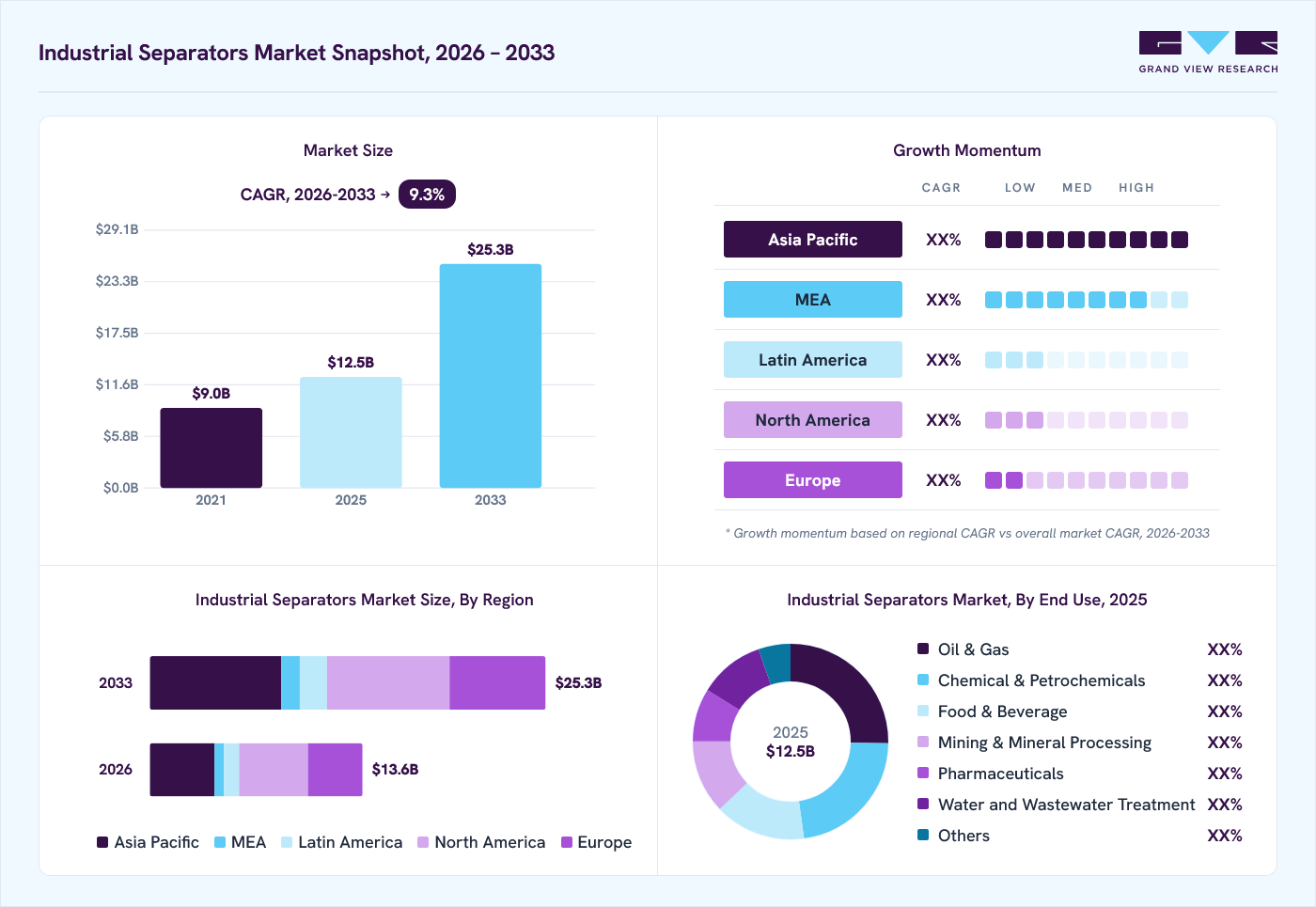
The global industrial separators market size was valued at USD 12.5 billion in 2025 and is projected to grow from USD 13.6 billion in 2026 to USD 25.3 billion by 2033, at a CAGR of 9.3% from 2026 to 2033. North America dominated the market, accounting for a revenue share of 32.5% in 2025. The market is driven by the increasing complexity of industrial processing requirements and the need for precise phase separation, contaminant removal, and material recovery across oil and gas, chemicals, pharmaceuticals, food and beverage, mining, and wastewater treatment.
 Source: Grand View Research, IR Documents, Primary Interviews, Paid DatabasesTo learn more about this report,
 Download Free Sample Report
Key Market Trends & Insights
- By product: Centrifugal separators segment dominated the market in 2025, holding 29.6% market share.
- Based on end use: Water and wastewater treatment segment is the fastest-growing segment, projected to register a 10.5% CAGR during the forecast period.
Regional Highlights
- Largest regional market: North America (32.5% revenue share, 2025)
- Fastest-growing regional market: Asia Pacific (highest CAGR, 2026-2033)
- By country: The U.S. held the largest market share in 2025
Market Size & Forecast
- Market Size in 2025: USD 12.5 Billion
- Estimated market size in 2026: USD 13.6 Billion
- Projected Market Size by 2033: USD 25.3 Billion
- CAGR (2026-2033): 9.3%
Three ways to get this report
Buy it, customize it, or ask a question.Ask an Analyst
Analyst response in 1 business day
- AccessReport author, directly
- Reply timeWithin 1 working day
- No sales callDirect answer only
- FormatEmail reply
- CostFree, no cost
Get the Full Report
What the study covers
- FormatsPDF · Excel · Dashboard
- Timeline2026–2033 annual, 2025 base
- Coverage20+ countries, 5 regions
- Companies10+ key players profiled
Customize the Report
20% free customization
- IncludeCountries, segments, points
- TailorTo your product definition
- ExtendDeeper competitor detail
- OrA fully bespoke study
- Turnaround5–10 working days
Stringent product quality specifications, environmental compliance obligations, and the expansion of process-intensive manufacturing activities are reinforcing the deployment of industrial separation systems. Additionally, technological advancements in separation mechanisms, equipment configuration, and automated process control are driving market growth by improving separation accuracy, throughput, and operational consistency. Capital expenditure on industrial wastewater treatment, chemical processing infrastructure, and material recovery facilities is creating additional demand for application-specific separator systems. Equipment procurement is increasingly driven by feedstock characteristics, separation efficiency requirements, throughput specifications, and lifecycle operating costs, prompting manufacturers to refine system performance in line with industry-specific process parameters.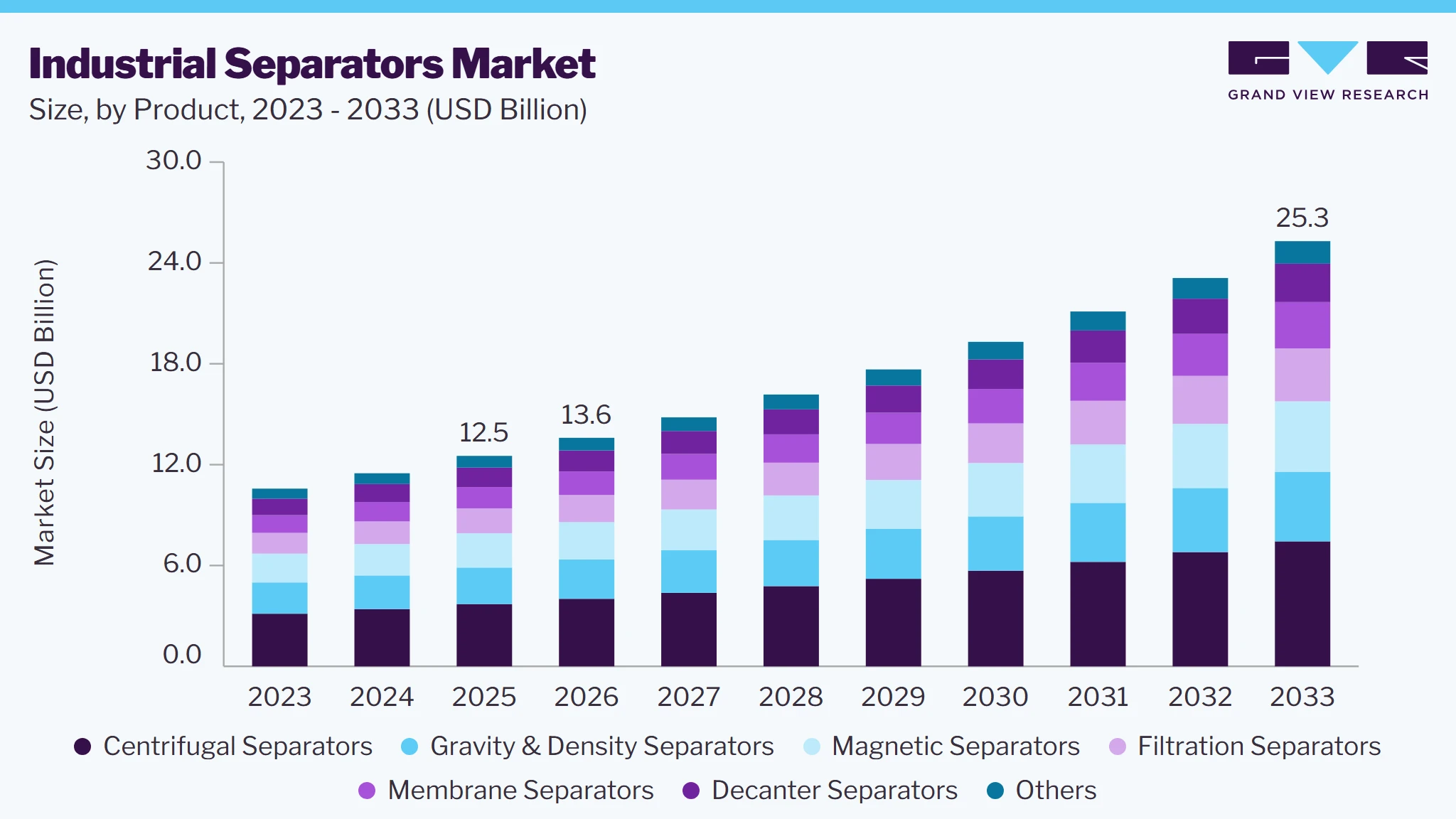 To learn more about this report, Download Free Sample Report
Market Dynamics
The global industrial separators market is underpinned by investment across process manufacturing, hydrocarbon processing, mineral processing, and water and wastewater treatment infrastructure. Increasing feedstock variability, stringent product specifications, and tighter environmental compliance requirements are driving the need for separation technologies that maintain process integrity across diverse operating conditions. Equipment selection is increasingly governed by separation precision, processing capacity, material compatibility, system integration requirements, and total cost of ownership, shaping procurement strategies across capital-intensive and continuous-process industries.
Capacity expansion across chemicals, oil and gas, pharmaceuticals, food and beverage, mining, and wastewater treatment is reinforcing demand for industrial separation equipment. These applications require the controlled removal of suspended solids, the separation of immiscible phases, the purification of process streams, and the recovery of commercially valuable constituents. The need to maintain product conformity, protect downstream equipment, and comply with industrial discharge standards is strengthening the deployment of centrifugal separators, filtration systems, and other mechanical separation technologies across production and treatment operations.
High acquisition costs and complex integration requirements remain constraints on industrial separator adoption, particularly among smaller enterprises and capital-constrained facilities. Project expenditure extends beyond equipment procurement to include installation, auxiliary infrastructure, instrumentation, commissioning, and ongoing maintenance. Furthermore, variations in feed composition, particle-size distribution, viscosity, corrosiveness, and operating parameters can necessitate application-specific configurations and specialized materials, increasing engineering complexity and potentially extending implementation schedules.
Investment in industrial process optimization and resource recovery creates opportunities for industrial separator manufacturers across established and expanding end-use industries. The replacement of aging equipment and integration of advanced separation systems can address evolving requirements for process consistency, operational reliability, and product purity. Concurrently, growing emphasis on wastewater reuse, material reclamation, and by-product valorization is expanding the scope for separation technologies that enable the recovery of reusable constituents, reduce waste generation, and improve resource efficiency across industrial operations.
Market Concentration & Characteristics
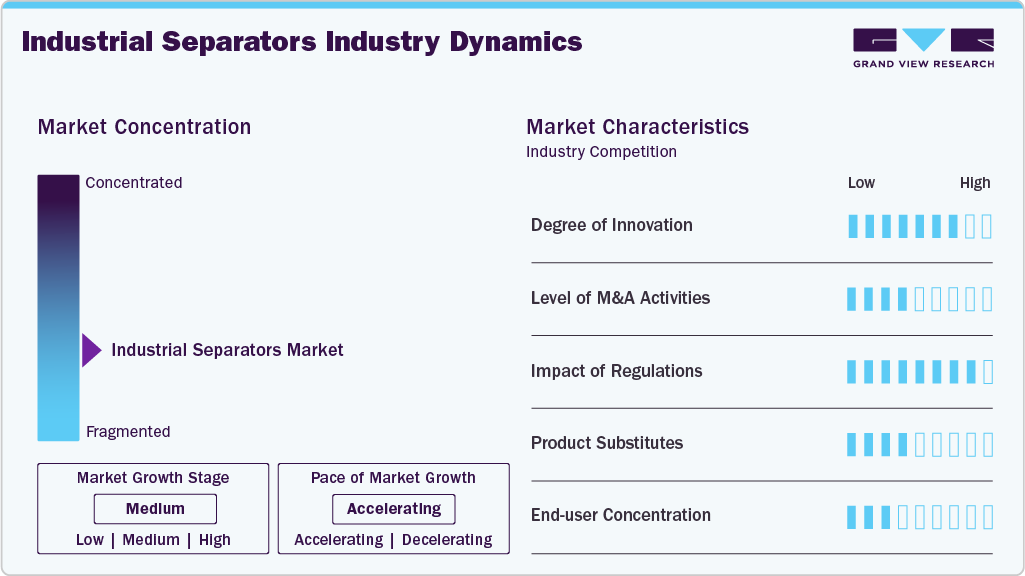
The global industrial separators market is moderately fragmented, with competition distributed among multinational equipment manufacturers, specialized separation technology providers, and regional engineering companies. Although established manufacturers maintain competitive advantages through extensive product portfolios, engineering expertise, global distribution networks, and integrated system capabilities, specialized suppliers retain opportunities in application-specific and customized solutions.
Product differentiation is shaped by separation methodology, feed composition, throughput capacity, and the physical and chemical properties of processed materials. Centrifugal, filtration-based, and other mechanical separation systems address distinct industrial requirements, with equipment specifications varying according to separation precision, operating pressure, temperature tolerance, and material compatibility. The integration of automated controls, instrumentation, and process-monitoring capabilities is also influencing equipment development, particularly in continuous-processing applications requiring consistent output quality and operational stability.
 To learn more about this report, Download Free Sample Report
Market demand is distributed across oil and gas, chemicals, pharmaceuticals, food and beverage, mining, and water and wastewater treatment, creating varied purchasing requirements and competitive opportunities. Procurement decisions are governed by separation performance, lifecycle expenditure, maintenance requirements, regulatory compliance, and compatibility with existing process infrastructure. Large-scale industrial facilities often require customized systems aligned with complex process specifications, whereas smaller installations may favor standardized or modular equipment.
Analyst Perspective
The global industrial separators market is shaped by industrial requirements for phase separation, contaminant removal, and material recovery across oil and gas, chemicals, food processing, mining, pharmaceuticals, and water treatment. Product demand is influenced by feed characteristics, processing capacity, separation precision, and operating conditions. Centrifugal separators retain broad industrial applicability, while membrane technologies are well-suited to applications requiring selective separation and stringent purity specifications. Oil and gas remains a principal demand center, reflecting the separation requirements of hydrocarbon processing, whereas water and wastewater treatment presents opportunities linked to treatment infrastructure development and water reuse. Competitive differentiation rests on separation performance, equipment reliability, operating costs, and application-specific engineering capabilities.
Product Insights
The centrifugal separators segment dominated the global industrial separators market with a revenue share of 29.6% in 2025, reflecting its extensive deployment across hydrocarbon processing, chemical manufacturing, food processing, and industrial treatment operations. Its market leadership is attributable to the ability to achieve continuous, high-throughput separation of solid-liquid and liquid-liquid mixtures across diverse process conditions.
The membrane separators segment is projected to register the fastest CAGR of 10.2% during the forecast period. Growth is underpinned by increasing requirements for selective separation, high-purity process streams, and advanced filtration across pharmaceutical manufacturing, food and beverage processing, and water treatment. Improvements in membrane selectivity, material durability, and fouling management are expanding the application potential across processes that require precise contaminant removal and constituent recovery.
End Use Insights
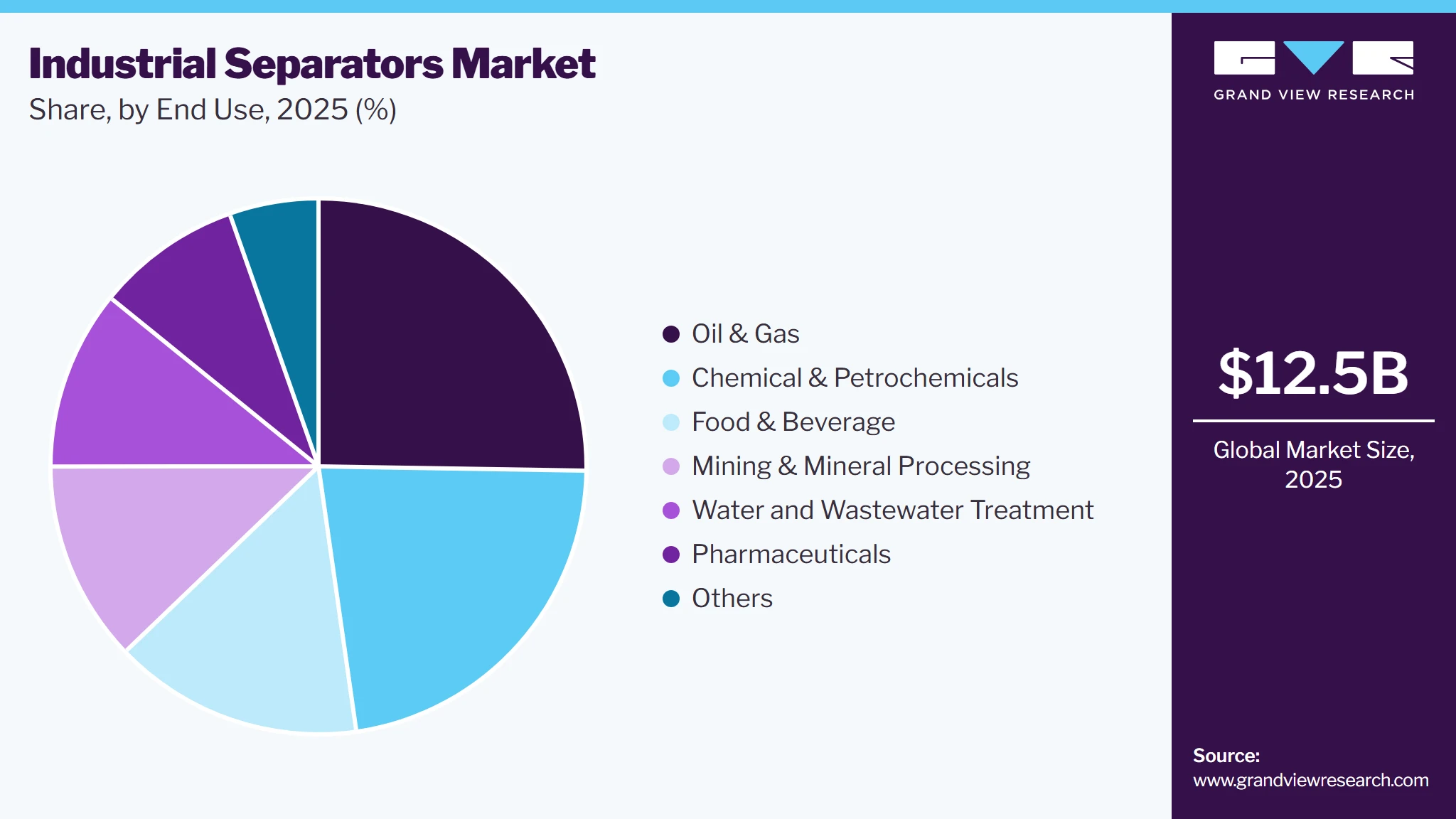
The oil and gas segment accounted for the largest revenue share of 25.3% in 2025. Industrial separators are integral to upstream production, gas processing, refining, and hydrocarbon conditioning, where the removal of water, suspended solids, and unwanted fluid constituents is essential to maintaining process specifications and protecting downstream equipment. Continued requirements for production-fluid treatment and process-stream conditioning across hydrocarbon operations sustain the segment's leading market position.
 To learn more about this report, Download Free Sample Report
The water and wastewater treatment segment is projected to register the fastest CAGR during the forecast period, supported by rising investment in treatment infrastructure, increasingly stringent discharge standards, and growing emphasis on water reclamation. Industrial separators facilitate suspended-solids removal, sludge processing, contaminant reduction, and the recovery of reusable water from municipal and industrial effluent streams. Increasing pressure to improve treatment performance and reduce freshwater consumption is broadening the deployment of separation technologies across industrial facilities and municipal treatment networks.
Regional Insights
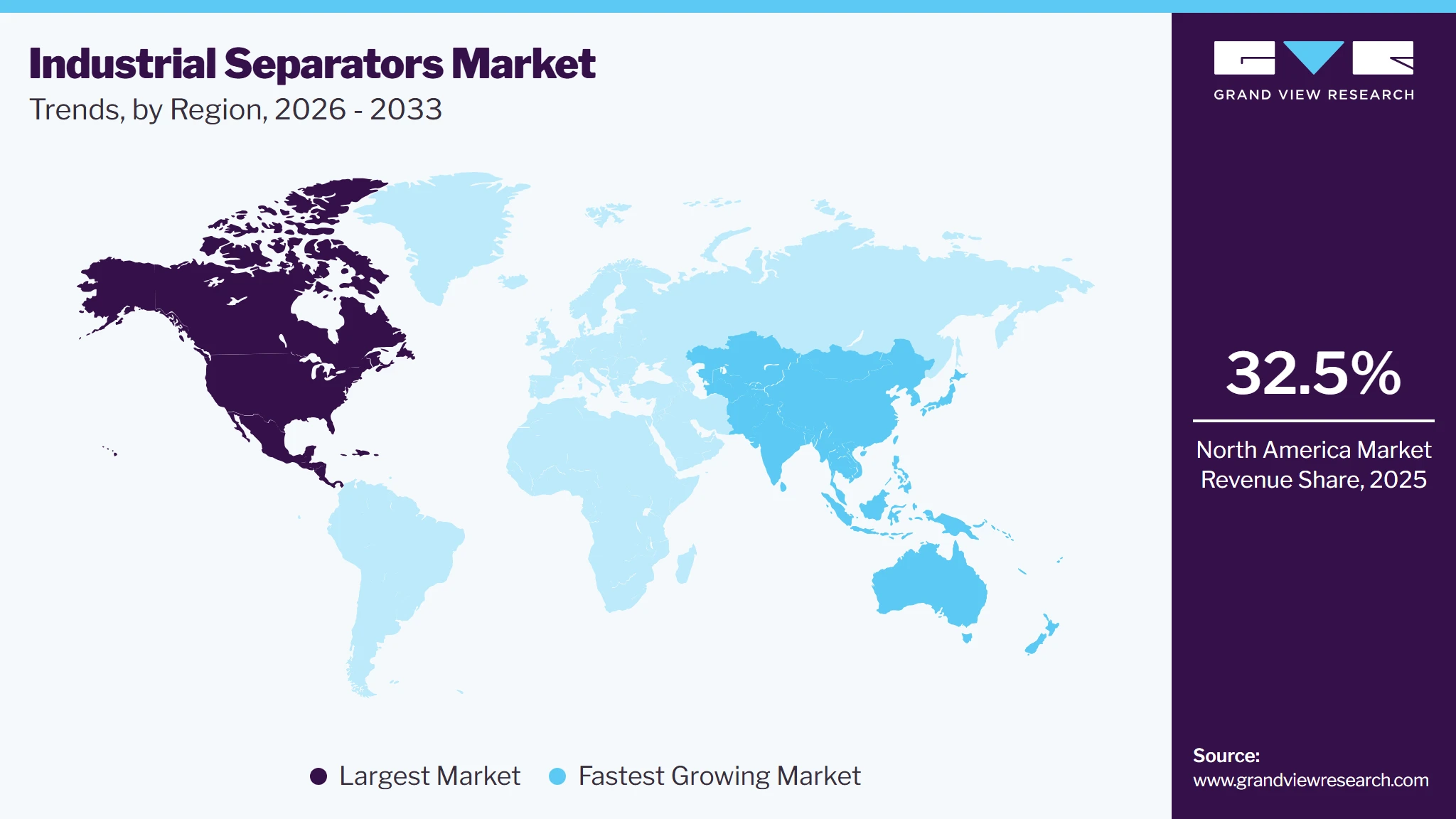
North America represents an established industrial separators market, accounting for a revenue share of 32.5% in 2025. The growth is supported by a substantial installed equipment base across hydrocarbon processing, chemicals, pharmaceuticals, food manufacturing, mining, and water treatment. Regional expenditure encompasses new installations, capacity expansion, equipment replacement, and process-system upgrades. Procurement priorities increasingly reflect separation precision, throughput requirements, material compatibility, and lifecycle costs, particularly in continuous-processing environments where equipment performance directly affects production economics and regulatory compliance.
 To learn more about this report, Download Free Sample Report
U.S. Industrial Separators Market Trends
The industrial separators market in the U.S. dominated the North American industry in 2025, supported by its extensive industrial infrastructure, diversified manufacturing base, and substantial hydrocarbon processing activity. Demand spans refinery operations, chemical production, pharmaceutical manufacturing, food processing, and industrial wastewater treatment. Modernization of production systems, investment in advanced manufacturing, and upgrades to treatment infrastructure sustain equipment procurement, while the replacement of aging installations creates opportunities for suppliers offering advanced separation capabilities.
The Mexico industrial separators market is projected to register the fastest CAGR of 10.1% during the forecast period. Manufacturing expansion, food processing, chemical production, and industrial infrastructure investment are broadening the domestic application base. Requirements for process-fluid purification, solids removal, and wastewater treatment are creating additional procurement opportunities. Production-facility modernization and stricter environmental management practices are expected to reinforce demand across manufacturing and treatment applications.
Europe Industrial Separators Market Trends
The industrial separators market in Europe is shaped by advanced process manufacturing, established treatment infrastructure, and stringent environmental and product-quality requirements. Demand originates from chemical synthesis, pharmaceutical production, food processing, mineral operations, and industrial effluent treatment. Equipment purchasing increasingly considers lifecycle performance, energy consumption, maintenance requirements, and compliance with application-specific standards. Replacement of aging machinery and integration of advanced separation technologies remain important sources of investment across the region's mature industrial economies.
The Germany industrial separators market represents a prominent sector within Europe, underpinned by its chemical manufacturing base, pharmaceutical industry, and precision-oriented industrial ecosystem. Separation systems support chemical intermediate processing, production-liquid clarification, and the removal of unwanted constituents from manufacturing streams. Equipment specifications reflect stringent process tolerances, compatibility with established production lines, and reliable operation across complex industrial environments. Modernization expenditures and automated process control integration continue to influence procurement requirements.
The industrial separators market in France reflects demand from pharmaceutical manufacturing, food production, chemicals, and public water infrastructure. Separation equipment supports purification processes, treatment of production residues, and recovery of reusable constituents from industrial streams. Purchasing decisions are influenced by treatment performance, hygiene requirements in sensitive manufacturing environments, and conformity with applicable discharge standards.
Asia Pacific Industrial Separators Market Trends
The industrial separators industry in the Asia Pacific is anticipated to grow at the fastest CAGR from 2026 to 2033. The industrial separators market in the Asia Pacific presents diverse demand conditions, reflecting differences in industrial development, manufacturing specialization, and treatment infrastructure across national markets. Expanding capacity in chemicals, electronics, pharmaceuticals, food processing, and mining is increasing the range of applications requiring separation equipment. Infrastructure development and industrial wastewater management drive additional demand, while established manufacturing centers create demand for higher-capacity systems and technology upgrades. The regional market encompasses both new installations and modernization across a broad range of industrial settings.
The China industrial separators market is substantial within Asia Pacific, supported by large-scale chemical production, mining, electronics manufacturing, and extensive industrial infrastructure. Separation equipment is incorporated into mineral-processing circuits, chemical production lines, industrial filtration operations, and wastewater treatment facilities. Demand reflects the scale of manufacturing activity, the need for consistent process output, and requirements for industrial residue management. Investment in treatment systems and process optimization is encouraging the adoption of equipment capable of handling high operating volumes and demanding separation specifications.
The industrial separators market in India is being shaped by expanding activity across chemicals, pharmaceuticals, food processing, mining, and municipal treatment infrastructure. Investment in effluent treatment, water reclamation, and industrial pollution control is broadening the application base for centrifugal, membrane-based, and other separation technologies. Manufacturing capacity expansion and the development of treatment facilities are generating demand for equipment that addresses process-fluid purification, solids removal, and industrial discharge management.
Middle East & Africa Industrial Separators Market Trends
The industrial separators market in the Middle East and Africa reflects the combined influence of hydrocarbon production, mineral extraction, industrial diversification, and water infrastructure development. Petroleum operations require separation of produced fluids and conditioning of process streams, while mining activities generate requirements for slurry processing and mineral recovery. Desalination and wastewater treatment investments provide additional applications, particularly in water-constrained locations.
The Saudi Arabia industrial separators market is supported by petroleum processing, petrochemical production, and investment in water management infrastructure. Separation systems are incorporated into hydrocarbon treatment, chemical manufacturing, and industrial wastewater operations. Expansion of downstream production facilities is broadening equipment requirements across multiple processing stages, while investment in water reuse and treatment is extending demand beyond conventional energy applications.
Latin America Industrial Separators Market Trends
The industrial separators market in Latin America is influenced by resource-processing industries, agricultural commodity processing, chemical manufacturing, and treatment infrastructure. Demand varies according to the scale of industrial operations, the composition of processed materials, and investment in environmental management. Mining and energy activities require specialized separation equipment, while food manufacturing and municipal treatment generate demand for systems addressing clarification, purification, and waste-stream management.
The Brazil industrial separators market has gained ground from offshore petroleum production, mineral extraction, food processing, and a diversified manufacturing sector. Offshore operations require separation systems capable of treating complex production fluids in space-constrained installations, whereas mining activities generate demand for equipment to handle mineral slurries and recover process materials. Food-processing facilities and industrial treatment plants offer additional applications for liquid clarification and residue management. Investment in production infrastructure and environmental treatment continues to shape equipment requirements across these industrial segments.
Key Industrial Separators Company Insights
Some of the key players operating in the market include Alfa Laval AB, GEA Group AG, ANDRITZ AG, among others.
-
Alfa Laval AB is a Sweden-based manufacturer of industrial equipment specializing in separation, heat transfer, and fluid handling technologies. Its portfolio includes centrifugal separators and decanter centrifuges for processing liquid-liquid and solid-liquid mixtures. These products serve oil and gas, chemical processing, food and beverage, pharmaceutical, marine, and wastewater treatment applications. The company's specialization in separation technology and its broad industrial application base underpin its position in the global industrial separators market.
-
GEA Group AG is a Germany-based engineering company supplying process equipment and technologies to the food, beverage, pharmaceutical, chemical, and related industries. Its separation solutions include centrifugal systems for clarifying liquids, removing suspended solids, and separating immiscible phases. The equipment portfolio addresses applications such as dairy processing, edible-oil refining, pharmaceutical production, and chemical manufacturing. GEA's integration of separation equipment within broader process-engineering solutions distinguishes its offering in the market.
Key Industrial Separators Companies
The following key companies have been profiled for this study on the industrial separators market.
-
Alfa Laval AB
-
GEA Group AG
-
ANDRITZ AG
-
Flottweg SE
-
Pieralisi Group
-
Mitsubishi Kakoki Kaisha, Ltd.
-
Ferrum Process Systems Ltd.
-
HEINKEL Process Technology GmbH
-
Hiller GmbH
-
Centrisys-CNP
-
Parkson Corporation
-
Tetra Pak
-
SPX FLOW, Inc.
-
Veolia Water Technologies
-
WesTech Engineering, Inc.
Competitive Benchmarking
Category
Operating Strategies
Competitive Edge
Weakness
Established Players (e.g., Alfa Laval AB; GEA Group AG; ANDRITZ AG; Flottweg SE; Pieralisi Group; Mitsubishi Kakoki Kaisha, Ltd.; Ferrum Process Systems Ltd.; HEINKEL Process Technology GmbH; Hiller GmbH; Centrisys-CNP)
- Broaden centrifugal, decanter, and solid-liquid separation portfolios to address diverse process requirements. Prioritize application-specific engineering, equipment optimization, process integration, and aftermarket services while adapting system specifications to feed characteristics, throughput, and operating conditions.
- Established manufacturing capabilities, specialized separation technologies, and extensive application expertise support participation across multiple process industries. Broad product portfolios and established customer relationships facilitate access to industrial projects and recurring equipment replacement and servicing requirements.
- High development and manufacturing costs can constrain pricing flexibility. Technical qualification requirements and customized configurations may lengthen procurement cycles, while competition from alternative separation technologies places pressure on equipment performance and lifecycle economics.
Emerging & Regional Players (e.g., Parkson Corporation; Veolia Water Technologies; WesTech Engineering, Inc.
- Concentrate on selected separation applications, including wastewater clarification, sludge dewatering, solids removal, and industrial treatment processes. Strengthen market participation through specialized equipment configurations, application engineering, and integration with treatment infrastructure.
- Focused technical capabilities and application-specific expertise support targeted industrial and municipal requirements. Specialized solutions and project-level customization enable participation in applications where treatment performance and process compatibility determine equipment selection.
- Comparatively narrower exposure across industrial separation technologies may limit participation in markets requiring diverse centrifugal, membrane, and other process-separation systems. Dependence on specific end-use industries and infrastructure investment cycles can also influence demand.
Recent Developments
-
In March 2026, GEA introduced the GSE 150 CPR for citrus juice clarification. The centrifugal separator is designed for medium-capacity processors handling juice with high and variable pulp concentrations. Its Constant Pulp Removal (CPR) technology enables continuous, pressurized pulp discharge, helping maintain clarification consistency and limit juice losses. The launch addresses food manufacturers' requirements for product-quality control and stable processing across variable raw-material conditions.
-
In September 2025, ANDRITZ launched the MiningMaster ME4 filter press for mining tailings dewatering. The equipment is intended to separate solids from process suspensions and reduce moisture in mineral residues, supporting tailings handling and water recovery at mining sites. Its introduction addresses the operational requirements of mineral-processing facilities managing large volumes of residual material, where dewatering performance influences tailings management and water reuse.
Industrial Separators Market Report Scope
Report Attribute
Details
Market size in 2025
USD 12.5 billion
Estimated market size in 2026
USD 13.6 billion
Revenue forecast in 2033
USD 25.3 billion
Growth Rate
CAGR of 9.3% from 2026 to 2033
Historical data
2021 - 2024
Forecast period
2026 - 2033
Quantitative units
Revenue in USD billion and CAGR from 2026 to 2033
Report coverage
Revenue forecast, company ranking, competitive landscape, growth factors, and trends
Segments covered
Product, end use, region
Regional scope
North America; Europe; Asia Pacific; Latin America; Middle East & Africa
Country scope
U.S.; Canada; Mexico; UK; Germany; France; Italy; Spain; China; Japan; India; Australia; South Korea; Brazil; Argentina; UAE; Saudi Arabia; South Africa
Key companies profiled
Alfa Laval AB; GEA Group AG; ANDRITZ AG; Flottweg SE; Pieralisi Group; Mitsubishi Kakoki Kaisha, Ltd.; Ferrum Process Systems Ltd.; HEINKEL Process Technology GmbH; Hiller GmbH; Centrisys-CNP; Parkson Corporation; Tetra Pak; SPX FLOW, Inc.; Veolia Water Technologies; WesTech Engineering, Inc.
Customization scope
Free report customization (equivalent up to 8 analysts working days) with purchase. Addition or alteration to country, regional & segment scope.
Pricing and purchase options
Avail customized purchase options to meet your exact research needs. Explore purchase options
Global Industrial Separators Market Report Segmentation
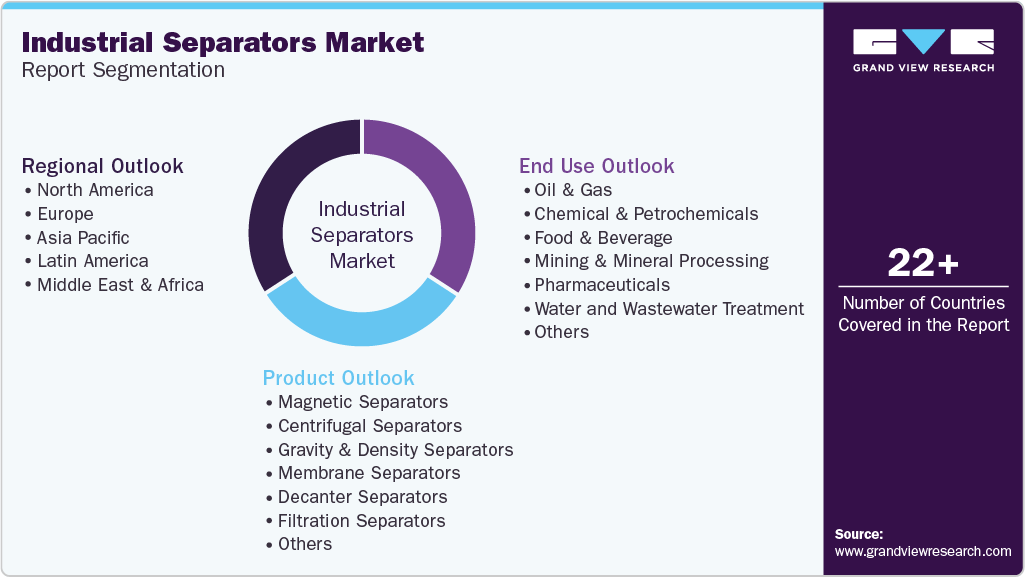
This report forecasts revenue growth at global, regional, and country levels and provides an analysis of the latest industry trends in each of the sub-segments from 2021 to 2033. For this study, Grand View Research has segmented the global industrial separators market report based on product, end use, and region.
 To learn more about this report, Download Free Sample Report
-
Product Outlook (Revenue, USD Billion, 2021 - 2033)
-
Magnetic Separators
-
Centrifugal Separators
-
Gravity & Density Separators
-
Membrane Separators
-
Decanter Separators
-
Filtration Separators
-
Others
-
-
End Use Outlook (Revenue, USD Billion, 2021 - 2033)
-
Oil & Gas
-
Chemical & Petrochemicals
-
Food & Beverage
-
Mining & Mineral Processing
-
Pharmaceuticals
-
Water and Wastewater Treatment
-
Others
-
-
Regional Outlook (Revenue, USD Billion, 2021 - 2033)
-
North America
-
U.S.
-
Canada
-
Mexico
-
-
Europe
-
Germany
-
Spain
-
France
-
Italy
-
UK
-
-
Asia Pacific
-
China
-
India
-
Japan
-
Australia
-
South Korea
-
-
Latin America
-
Brazil
-
Argentina
-
Middle East and Africa
-
Saudi Arabia
-
UAE
-
South Africa
-
-
Research Methodology
The industrial separators market figures in this report are based on a proven research process that combines executive interviews with secondary research from proprietary databases, company filings, and recognized regulatory and institutional sources. Market size is built through value-chain sizing-reconciling supply-side and demand-side estimates-and triangulated with bottom-up and top-down approaches. Every estimate passes multiple levels of expert validation before publication, with eachindustrial separatorssegment quantified using the revenue-capture definitions in the table below.
Segment Definition
Product
Revenue Capture Definition
Magnetic Separators
Revenue generated from the sale of magnetic separators that remove ferrous and other magnetically susceptible contaminants from liquids, slurries, powders, and bulk materials across industrial processing operations.
Centrifugal Separators
Revenue generated from the sale of centrifugal separators that separate suspended solids, immiscible liquids, or combinations of liquid and solid phases through centrifugal force.
Gravity & Density Separators
Revenue generated from the sale of gravity and density separators that classify or separate materials according to differences in specific gravity, density, or settling behavior.
Membrane Separators
Revenue generated from the sale of membrane separation systems that selectively separate components of liquid or gas streams based on membrane permeability, pore size, or molecular characteristics.
Decanter Separators
Revenue generated from the sale of decanter separators, including decanter centrifuges, that continuously separate solids from liquids or separate liquid phases in slurries and process mixtures.
Filtration Separators
Revenue generated from the sale of filtration separators that remove suspended particles and contaminants from liquids or gases through filter media, screens, or other filtration mechanisms.
Others
Revenue generated from the sale of industrial separators not classified within the specified product categories, including specialized separation equipment based on alternative separation mechanisms.
End Use
Revenue Capture Definition
Oil & Gas
Revenue generated from the sale of industrial separators for oil, gas, and produced-water separation, hydrocarbon processing, contaminant removal, and treatment of process streams across upstream, midstream, and downstream operations.
Chemical & Petrochemicals
Revenue generated from the sale of industrial separators for phase separation, solids removal, product purification, and process-stream treatment in chemical and petrochemical manufacturing.
Food & Beverage
Revenue generated from the sale of industrial separators for clarification, ingredient separation, solids removal, and liquid purification in food and beverage processing.
Mining & Mineral Processing
Revenue generated from the sale of industrial separators for mineral classification, slurry separation, solids recovery, tailings treatment, and process-water management in mining and mineral-processing operations.
Pharmaceuticals
Revenue generated from the sale of industrial separators for separating solids and liquids, purifying process streams, and removing particulates during pharmaceutical manufacturing and related production processes.
Water and Wastewater Treatment
Revenue generated from the sale of industrial separators for suspended-solids removal, sludge dewatering, contaminant separation, and treatment of industrial and municipal water and wastewater streams.
Others
Revenue generated from the sale of industrial separators to end-use industries not covered by the specified categories, including power generation, pulp and paper, marine, and other industrial processing applications.
Estimation Model
Layer Name
Key Question
Description
Demand Assessment Layer
What establishes the underlying demand for industrial separators?
Assess separation requirements across oil and gas, chemical and petrochemical processing, food and beverage, mining and mineral processing, pharmaceutical manufacturing, and water and wastewater treatment. Evaluate industrial processing activity, material characteristics, process-stream volumes, and separation requirements to determine demand across the specified product categories and end-use industries.
Capital Investment & Procurement Layer
Which investment patterns translate into equipment procurement?
Examine capital expenditure on new industrial facilities, production capacity additions, treatment infrastructure, and upgrades to existing process lines. Assess replacement cycles, plant modernization, process modifications, and changes in separation requirements to identify demand arising from new equipment installations and existing-facility investments.
Product & Application Assessment Layer
How are separator technologies allocated across end-use applications?
Examine the adoption of magnetic, centrifugal, gravity and density, membrane, decanter, and filtration separators across the defined end-use industries. Assess technology selection in relation to feed composition, phase separation requirements, particle characteristics, processing capacity, operating conditions, and application-specific performance specifications.
Market Revenue Estimation Layer
How is annual market revenue quantified?
Estimate annual revenue generated from industrial separator sales by product category, end-use industry, and geographic market. Incorporate equipment sales associated with new installations, capacity expansions, replacement purchases, and plant upgrades, accounting for differences in equipment specifications, system configuration, processing capacity, and realized selling prices.
Delivered Customizations
This report has been delivered with the following In-depth customizations
Client Request
Customization Delivered
Value Adds
Competitive Benchmarking
Evaluated leading industrial separator manufacturers across product portfolio breadth, separation technology capabilities, engineering expertise, manufacturing infrastructure, geographic reach, application-specific configurations, and technology development initiatives. The assessment covered magnetic, centrifugal, gravity and density, membrane, decanter, and filtration separators.
Establishes comparative competitive positioning and delineates differences in technological capabilities, portfolio coverage, and application expertise. The findings identify potential capability gaps, areas of product differentiation, and opportunities for portfolio development and strategic market expansion.
Regional Segmentation
Assessed North America, Europe, Asia Pacific, Latin America, and the Middle East & Africa using indicators such as industrial output, oil and gas processing activity, chemical and petrochemical capacity, mining and mineral processing operations, food and beverage manufacturing, pharmaceutical production, water and wastewater treatment infrastructure, and industrial capital expenditure.
Clarifies regional variations in demand fundamentals, investment intensity, and equipment procurement prospects. The assessment supports geographic prioritization, country-level market evaluation, market-entry planning, and strategic allocation of commercial resources.
Opportunity Assessment
Evaluated commercial potential across product categories and end-use industries, including oil and gas, chemicals and petrochemicals, food and beverage, mining and mineral processing, pharmaceuticals, and water and wastewater treatment. The analysis considered new facility installations, capacity expansions, equipment replacement, process upgrades, and modernization of existing industrial infrastructure.
Differentiates demand arising from new installations, capacity additions, and replacement cycles. The findings support the prioritization of attractive product-application segments, identification of prospective revenue opportunities, and alignment of commercial and investment strategies with industry-specific procurement requirements.
About the Author(s)
Advanced Interior Materials Research Team
Advanced Materials · Advanced Interior MaterialsThis report was authored by the advanced interior materials research team at Grand View Research - comprising two research analysts, one senior research analyst, and one industry expert - with specialized expertise in the advanced interior materials segment of the advanced materials industry. All findings are based on proprietary advanced materials databases, executive interviews, and regulatory analysis, subject to internal peer review prior to publication.
Last Updated:
Speak to Analyst

Customize this report to your needs - add regions, segments, or data points, with 20% free customization.
Or view our licence options:


ISO 9001:2015 & 27001:2022 Certified
We are GDPR and CCPA compliant! Your transaction & personal information is safe and secure. For more details, please read our privacy policy.


