
- Home
- »
- Next Generation Technologies
- »
-
Intelligent Power Module Market Size Report, 2026-2033GVR Report cover
![Intelligent Power Module Market (2026 - 2033)Report]()
Intelligent Power Module Market (2026 - 2033)
Size, Share & Trends Analysis Report By Power Device (IGBT, MOSFET), By Voltage Rating (0 V to 599 V, 600 V to 1,199 V, 1,200 V and above), By Application (Automotive, Industrial, Energy & Utility), By Region, And Segment Forecasts
Market Size, 2025
$3.4BMarket Estimate, 2026
$3.8BMarket Forecast, 2033
$9.9BCAGR, 2026–2033
14.7%Intelligent Power Module Market Summary
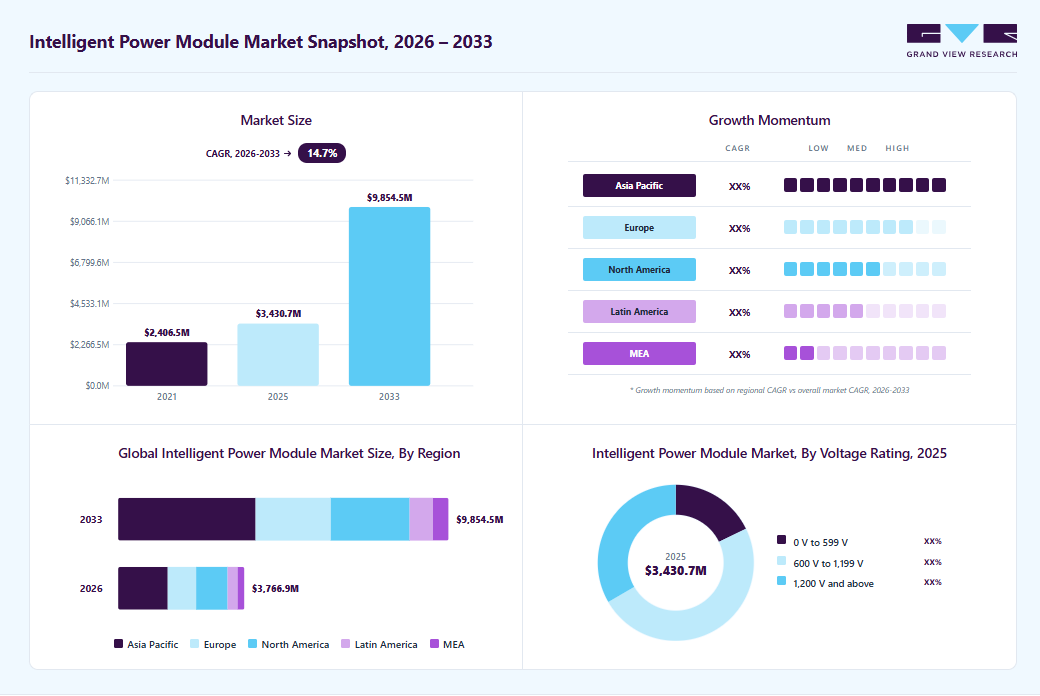
The global intelligent power module market size was valued at USD 3.4 billion in 2025 and is projected to grow from USD 3.8 billion in 2026 to USD 9.9 billion by 2033, at a CAGR of 14.7% from 2026 to 2033. The market in Asia Pacific dominated with a revenue share of 39.0% in 2025. The Intelligent Power Module (IPM) market is growing due to increasing adoption of industrial automation and smart manufacturing technologies.
Key Market Trends & Insights
- By power device: IGBT segment held the largest market share of 77.8% in 2025.
- By voltage rating: 600 v to 1,199 v segment held the largest market share of 48.8% in 2025.
- By application: Automotive segment held the largest market share in 2025.
Regional Highlights
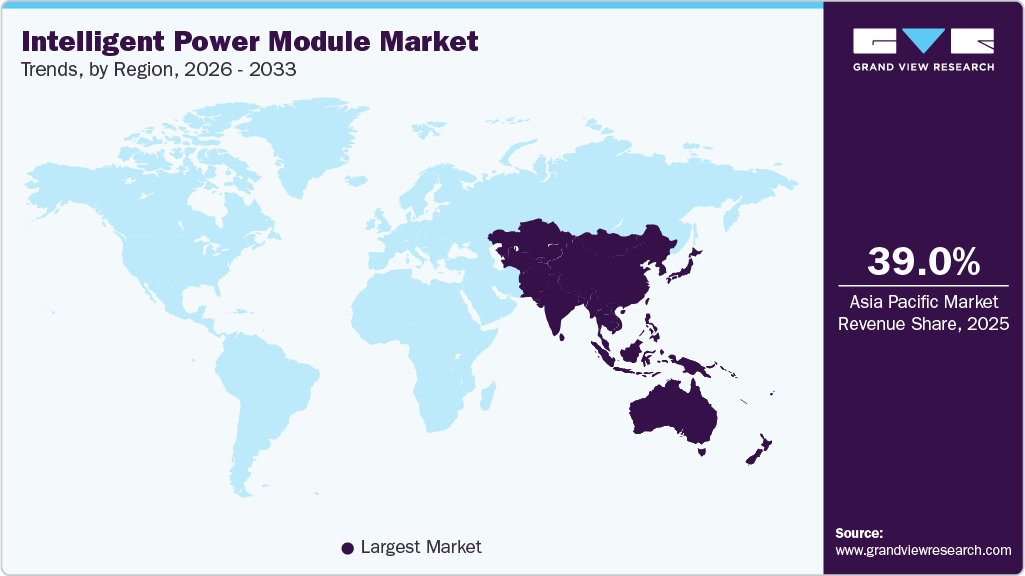
- Largest regional market: Asia Pacific (39.0% revenue share, 2025)
Market Size & Forecast
- Market size in 2025: USD 3.4 Billion
- Estimated market size in 2026: USD 3.8 Billion
- Projected market size by 2033: USD 9.9 Billion
- CAGR (2026-2033): 14.7%
Industries are deploying automated equipment, motor drive systems, and power electronics to improve efficiency and process control. This is driving demand for intelligent power modules that offer precise power management and high energy efficiency. Rising use of robotics, CNC machines, and industrial IoT (IIoT) systems is further supporting market expansion.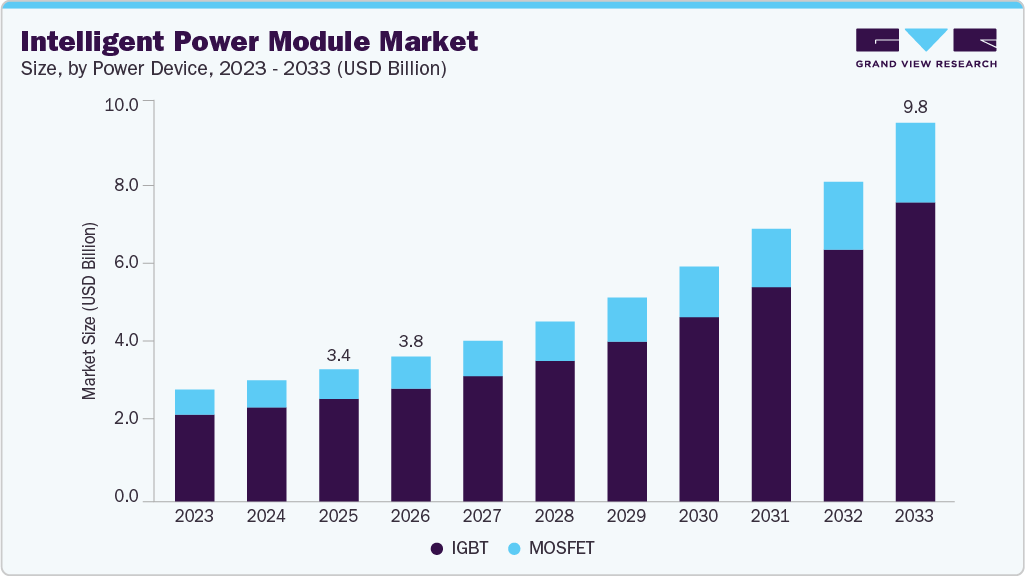
The adoption of silicon carbide-based Intelligent Power Modules is driving strong growth in the IPM market. These advanced power modules enable higher energy efficiency and reduce power losses in industrial systems. Improved power density supports compact and lightweight designs for motor drive and power electronics applications. Increasing use of advanced industrial equipment across sectors is further boosting demand. As energy efficiency standards become stricter, silicon carbide IPMs are witnessing wider adoption. Companies are actively developing and launching silicon carbide-based IPMs to meet evolving efficiency and performance requirements. For instance, in March 2025, onsemi, a U.S.-based semiconductor company, launched a 1200 V silicon carbide (SiC) MOSFET-based IPM series called EliteSiC SPM 31, designed to deliver high energy efficiency, high power density, and a compact form factor for inverter motor drives in industrial applications such as HVAC, robotics, pumps, and data-center cooling systems.
The Intelligent Power Module (IPM) market is growing due to rising demand for compact, energy-efficient power electronics solutions. IPMs improve motor drive efficiency, reduce power losses, and enhance system performance. Their small form factor enables integration into space-limited inverter designs. Advanced thermal management and built-in protection features increase reliability and extend operational life. Increasing adoption across industrial automation, HVAC, electric vehicles, and consumer electronics is driving steady growth in the global IPM market. The adoption of Intelligent Power Modules is steadily increasing across multiple sectors. For instance, in April 2025, Alpha and Omega Semiconductor Limited, a U.S.-based semiconductor company, launched the Mega IPM-7 series Intelligent Power Modules. The series features a compact, high-efficiency design optimized for BLDC motor drives in home appliances and power tools, delivering higher power density and reliable performance.
The integration of AI and IoT in Intelligent Power Modules (IPMs) is gaining importance in advanced industrial applications. These smart IPMs enable real-time monitoring of voltage, current, and temperature for improved system control. Embedded intelligence supports fault detection and predictive maintenance, reducing unplanned downtime. IoT connectivity enables remote diagnostics and continuous performance tracking across industrial systems. AI-based algorithms optimize power usage and operational efficiency. This enhances overall system reliability and energy performance. It also extends the operational lifespan of industrial equipment. Adoption is increasing across Industry 4.0 and smart factory environments. Demand is rising for connected and intelligent IPMs in automation systems. These advancements support more efficient and data-driven industrial operations.
Power Device Insights
The IGBT segment dominated the global Intelligent Power Module market with a revenue share of 77.8% in 2025, due to its high reliability, cost-effectiveness, and mature technology base. IGBT-based IPMs are widely used in industrial motor drives, HVAC systems, home appliances, and power tools because they deliver stable performance under high-voltage and high-current conditions. Their robust protection features and easy integration simplify system design for manufacturers. Strong thermal performance and long operational life further support their widespread adoption. Compared to newer technologies, IGBTs offer a balanced combination of efficiency and cost advantage.
The MOSFET segment is witnessing strong growth in the Intelligent Power Module market due to its high switching speed and superior efficiency. MOSFET-based IPMs are suitable for low- to medium-voltage applications, reducing switching losses and improving overall energy efficiency. Their compact design supports integration into space-constrained systems. These IPMs are widely used in consumer electronics and home appliances for efficient power control. Enhanced performance enables quieter and smoother motor operation. Increasing demand for energy-efficient and compact power solutions is driving the adoption of MOSFET-based IPMs across multiple applications.
Voltage Rating Insights
The 600 V to 1,199 V segment dominated the global Intelligent Power Module (IPM) market in 2025, due to its wide use across industrial and commercial applications. This voltage range is commonly deployed in motor drives, HVAC systems, and industrial automation equipment. Strong demand from manufacturing and processing industries supported its leading position. The segment offers a strong balance of efficiency, performance, and reliability, along with support for compact and energy-efficient inverter designs. Manufacturers prefer this range due to its broad application compatibility and ability to handle moderate to high power requirements, making it highly versatile.
The 1,200 V and above segment is witnessing steady growth over the forecast period, due to increasing demand for high-power applications. It is widely used in electric vehicles, fast-charging infrastructure, heavy industrial motor drives, and railway systems. Higher voltage capability enables improved power efficiency and lower current losses. Advancements in wide-bandgap technologies such as silicon carbide (SiC) are supporting adoption. These modules also enable compact designs even at higher power levels. Rising investments in electrification and renewable energy systems are further increasing demand for the 1,200 V and above segment.
Application Insights
The automotive segment dominated the Intelligent Power Module market in 2025, due to rapid vehicle electrification worldwide. Rising adoption of electric and hybrid vehicles has increased demand for high-efficiency power electronics. IPMs are widely used in traction inverters, onboard chargers, and DC-DC converters, improving energy efficiency and driving range. They also support reliable vehicle operation and thermal stability under demanding conditions. Growing use of advanced driver assistance systems and in-vehicle comfort features further increases IPM integration. Strict emission and fuel efficiency regulations are accelerating adoption across the automotive industry. Manufacturers focus on compact and high-performance IPMs for seamless system integration. These factors collectively reinforce the automotive segment’s leading position in the IPM market.
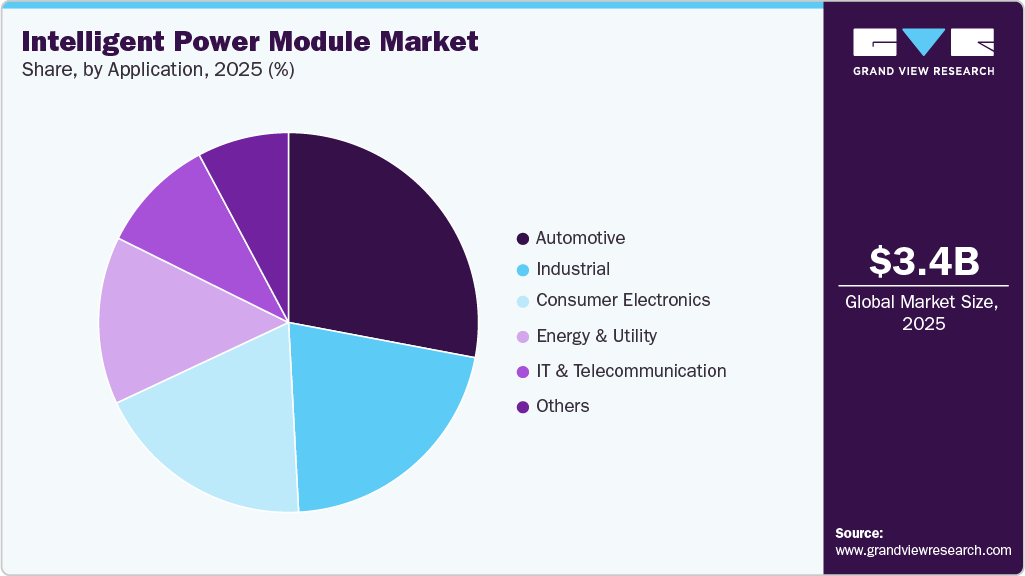
The consumer electronics segment is witnessing steady growth in the Intelligent Power Module (IPM) market. Rising demand for energy-efficient and compact electronic devices is driving adoption across the sector. IPMs are widely used in air conditioners, refrigerators, washing machines, and other home appliances. They improve energy efficiency, reduce power losses, and support quieter operation. Their compact design enables integration into space-constrained electronic products. Built-in protection features enhance reliability and extend product lifespan. Growing preference for smart and connected appliances is further supporting demand. These factors are contributing to the continued expansion of IPMs in the consumer electronics sector.
Regional Insights
The Asia Pacific Intelligent Power Module (IPM) market led the global industry, with the largest revenue share of 39.0% in 2025. Rapid industrialization across China, Japan, South Korea, and India significantly contributed to this growth. The region’s strong adoption of energy-efficient solutions and advanced motor drives increased demand for IPMs. Silicon carbide-based modules, known for high efficiency and compact design, are increasingly preferred in industrial applications. Government initiatives supporting sustainable manufacturing and industrial automation further strengthened market expansion.
Europe Intelligent Power Module Market Trends
The Europe Intelligent Power Module (IPM) market is expanding steadily due to increasing adoption of energy-efficient industrial systems. Key countries such as Germany, France, and Italy are driving demand through strong industrial automation and advanced manufacturing applications. Growing preference for silicon carbide-based IPMs supports higher efficiency and compact motor drive solutions. Rising investments in renewable energy, including wind and solar power, are further increasing the need for reliable power modules.
North America Intelligent Power Module Trends
The North America Intelligent Power Module (IPM) market is driven by increasing demand for industrial automation and energy-efficient systems. The U.S. and Canada contribute significantly to adoption across manufacturing and renewable energy applications. Rising use of silicon carbide-based modules enhances efficiency through compact designs and reduced power losses. Expanding deployment in electric vehicles and data-center cooling systems further supports market demand. Continuous advancements in power electronics and system integration are strengthening the regional market landscape.
U.S. Intelligent Power Module Market Trends
The U.S. Intelligent Power Module (IPM) market is experiencing steady growth driven by rising demand for energy-efficient industrial systems. Increasing adoption of silicon carbide-based IPMs is supported by their high-power density and compact design advantages. Expanding use in industrial automation, renewable energy integration, and electric vehicle applications is further strengthening market demand. Strong focus on technological innovation and advanced power electronics development supports continued adoption.
Key Intelligent Power Module Company Insights
Some of the key companies in the Intelligent Power Module industry include ABB, Fuji Electric Co., Ltd., Hitachi, Ltd., Infineon Technologies AG, Mitsubishi Electric Corporation, onsemi, ROHM Co., Ltd., and others. Organizations are focusing on increasing customer base to gain a competitive edge in the industry. Therefore, key players are taking several strategic initiatives, such as mergers and acquisitions, and partnerships with other major companies.
-
Infineon Technologies AG offers a broad portfolio of Intelligent Power Modules (IPMs) based on IGBT and silicon carbide (SiC) technologies. Its IPMs are applied in industrial motor drives, HVAC systems, renewable energy inverters, and electric vehicle systems. The company focuses on enhancing power density while reducing switching and conduction losses. Integrated protection and gate driver functions improve system reliability and simplify design integration. Continuous research and collaboration with industrial customers support advancements in IPM performance and efficiency.
-
Mitsubishi Electric has extensive expertise in the development of Intelligent Power Modules for industrial and appliance applications. Its IPMs are widely used in motor drives, elevators, air conditioners, and factory automation systems. The company emphasizes stable operation, thermal efficiency, and built-in protection features. Product development is focused on improving efficiency and durability under high-load conditions.
Key Intelligent Power Module Companies:
The following key companies have been profiled for this study on the intelligent power module market.
- ABB
- Fuji Electric Co., Ltd.
- Hitachi, Ltd.
- Infineon Technologies AG
- Mitsubishi Electric Corporation
- onsemi
- ROHM Co., Ltd.
- Schneider Electric
- STMicroelectronics
- Toshiba Electronic Devices & Storage Corporation.
Recent Developments
-
In December 2025, Mitsubishi Electric India launched its latest power semiconductor technologies, including advanced Intelligent Power Module (IPM) solutions. The launch highlighted new DIPIPM IGBTs with integrated inverter circuits, gate drivers, and protection features designed for HVAC, industrial motor drives, and renewable energy applications.
-
In September 2025, Infineon Technologies AG and ROHM signed an agreement to collaborate on silicon carbide (SiC) power device packaging, enabling each other as second-source suppliers of selected SiC power packages to improve design flexibility and availability for customers. This collaboration supports broader adoption of SiC solutions, which are key for high-efficiency IPMs in automotive and industrial applications.
-
In August 2024, Infineon Technologies AG expanded its IPM portfolio by adding the CIPOS Maxi Intelligent Power Module series to its IGBT product family, enhancing options for low-power motor drive applications. The aim of this expansion was to provide higher energy efficiency, compact system design, and improved reliability for industrial and appliance motor drive solutions.
Intelligent Power Module Market Report Scope
Report Attribute
Details
Market size in 2025
USD 3.4 billion
Estimated Market size in 2026
USD 3.8 billion
Projected Market size by 2033
USD 9.9 billion
Growth rate
CAGR of 14.7% from 2026 to 2033
Base year for estimation
2025
Historical data
2021 - 2024
Forecast period
2026 - 2033
Quantitative units
Revenue in USD million/billion and CAGR from 2026 to 2033
Report coverage
Revenue forecast, company ranking, competitive landscape, growth factors, and trends
Segments covered
Power device, voltage rating, application, region
Regional scope
North America; Europe; Asia Pacific; Latin America; MEA
Country scope
U.S.; Canada; Mexico; UK; Germany; France; China; Japan; India; South Korea; Australia; Brazil; KSA; UAE; South Africa
Key companies profiled
ABB; Fuji Electric Co., Ltd.; Hitachi, Ltd.; Infineon Technologies AG; Mitsubishi Electric Corporation; onsemi; ROHM Co., Ltd.; Schneider Electric; STMicroelectronics; Toshiba Electronic Devices & Storage Corporation
Customization scope
Free report customization (equivalent up to 8 analysts working days) with purchase. Addition or alteration to country, regional & segment scope.
Pricing and purchase options
Avail customized purchase options to meet your exact research needs. Explore purchase options
Global Intelligent Power Module Market Report Segmentation
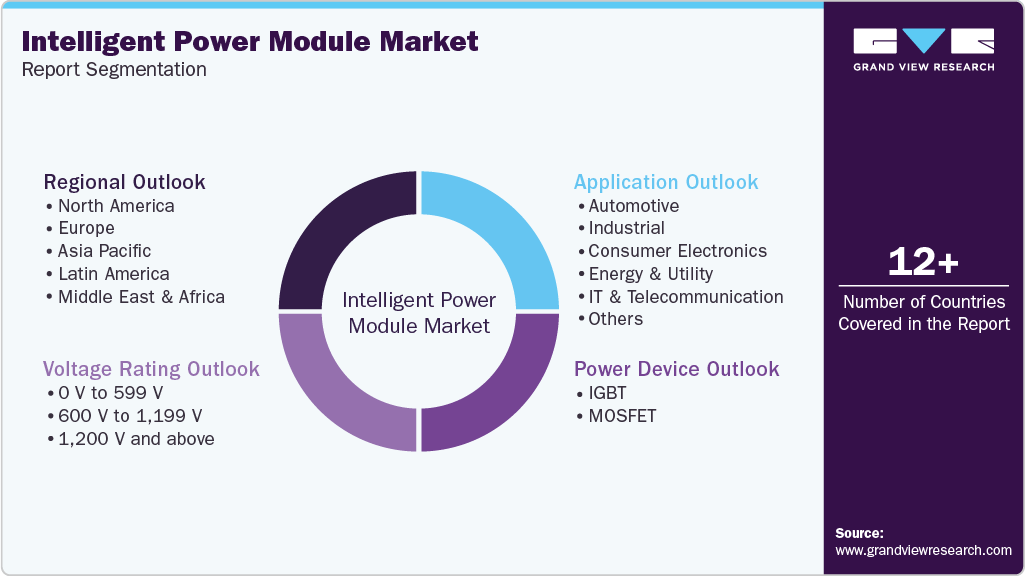
This report forecasts revenue growth at global, regional, and country levels and provides an analysis of the latest industry trends in each of the sub-segments from 2021 to 2033. For this study, Grand View Research has segmented the global Intelligent Power Module market report based on power device, voltage rating, application and region.
-
Power Device Outlook (Revenue, USD Million, 2021 - 2033)
-
IGBT
-
MOSFET
-
-
Voltage Rating Outlook (Revenue, USD Million, 2021 - 2033)
-
0 V to 599 V
-
600 V to 1,199 V
-
1,200 V and above
-
-
Application Outlook (Revenue, USD Million, 2021 - 2033)
-
Automotive
-
Industrial
-
Consumer Electronics
-
Energy & Utility
-
IT & Telecommunication
-
Others
-
-
Regional Outlook (Revenue, USD Million, 2021 - 2033)
-
North America
-
U.S.
-
Canada
-
Mexico
-
-
Europe
-
UK
-
Germany
-
France
-
-
Asia Pacific
-
China
-
Japan
-
India
-
South Korea
-
Australia
-
-
Latin America
-
Brazil
-
-
Middle East and Africa (MEA)
-
KSA
-
UAE
-
South Africa
-
-
Frequently Asked Questions About This Report
The IGBT segment accounted for the largest revenue share of 77.8% in 2025.
The 600v to 1,199v segment led with a 48.8% revenue share in 2025.
The automotive segment dominated the market and accounted for the largest revenue share in 2025.
The global intelligent power module market size was valued at USD 3.4 billion in 2025 and is estimated at USD 3.8 billion for 2026.
The global intelligent power module (IPM) market is expected to grow at a CAGR of 14.7% from 2026 to 2033, reaching USD 9.9 billion by 2033.
Key players include ABB; Fuji Electric Co., Ltd.; Hitachi, Ltd.; Infineon Technologies AG; Mitsubishi Electric Corporation; onsemi; ROHM Co., Ltd.; Schneider Electric; STMicroelectronics; Toshiba Electronic Devices & Storage Corporation.
Key factors driving the market growth include growing demand for energy-efficient systems, increasing adoption of electric vehicles, expansion of renewable energy infrastructure, and advancements in power semiconductor technologies.
Asia Pacific dominated the intelligent power module (IPM) market with a share of 39.0% in 2025, driven by a strong electronics manufacturing presence, rapid electric vehicle adoption, expanding industrial automation, and significant investments in renewable energy infrastructure.
About the Author(s)
Next Generation Technologies Research Team
Technology · Next Generation TechnologiesThis report was authored by the next generation technologies research team at Grand View Research - comprising two research analysts, one senior research analyst, and one industry expert - with specialized expertise in the next generation technologies segment of the technology industry. All findings are based on proprietary technology databases, executive interviews, and regulatory analysis, subject to internal peer review prior to publication.
Last Updated:
Speak to Analyst


Customize this report to your needs — add regions, segments, or data points, with 20% free customization.
Or view our licence options:


ISO 9001:2015 & 27001:2022 Certified
We are GDPR and CCPA compliant! Your transaction & personal information is safe and secure. For more details, please read our privacy policy.


