
- Home
- »
- Automotive & Transportation
- »
-
Intelligent Traffic Management System Market Report, 2033GVR Report cover

Intelligent Traffic Management System Market (2026 - 2033)
Size, Share & Trends Analysis Report By Solution (Traffic Monitoring System, Traffic Signal Control System, Traffic Enforcement Camera, Integrated Corridor Management), By Region, And Segment Forecasts
Market Size, 2025
$13.8BMarket Estimate, 2026
$15.5BMarket Forecast, 2033
$48.7BCAGR, 2026–2033
17.8%Intelligent Traffic Management System Market Summary
The global intelligent traffic management system market size was estimated at USD 13.8 billion in 2025 and is projected to grow from USD 15.5 billion in 2026 to USD 48.7 billion by 2033, growing at a CAGR of 17.8% from 2026 to 2033. North America dominated the global market with the largest revenue share of 38.2% in 2025. The growth of the market can be attributed to the rising demand for real-time traffic information for passengers and drivers, along with an increased number of vehicles on the road.
 Source: Grand View Research, IR Documents, Primary Interviews, Paid DatabasesTo learn more about this report,
 Download Free Sample Report
 Key Market Trends & Insights
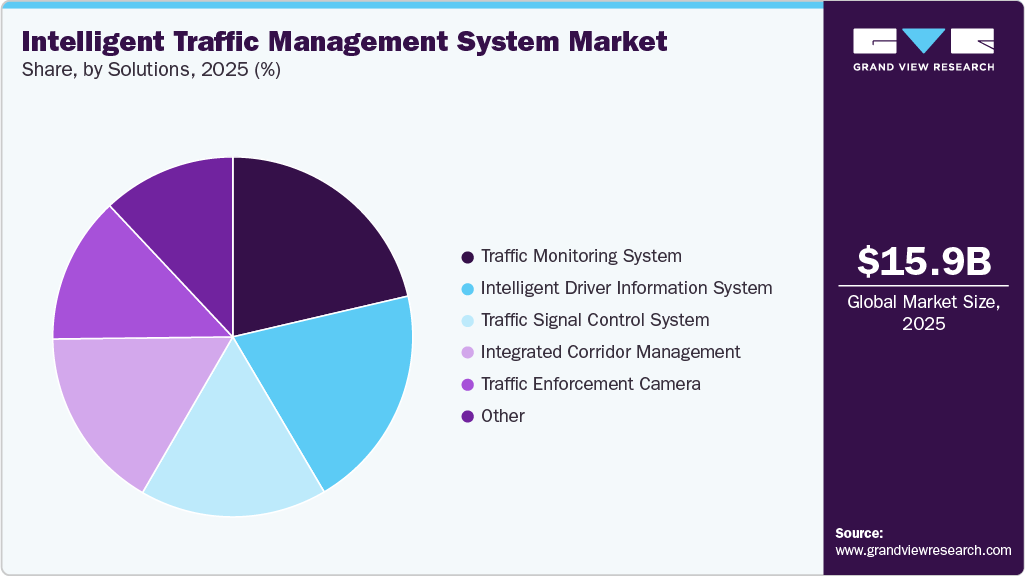
- By Solution: Traffic monitoring system segment dominated the market, with a revenue share of 21.4% in 2025.
Regional Highlights
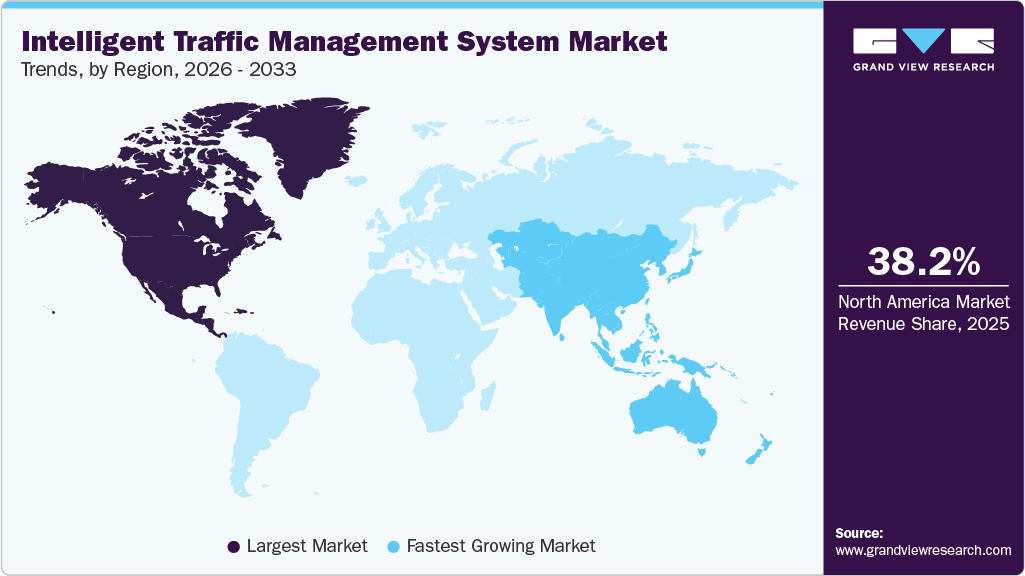
- Largest regional market: North America (38.2% revenue share, 2025)
- Fastest-growing regional market: Asia Pacific (highest CAGR, 2026-2033)
- By country: The U.S. held the largest market share in 2025.
Market Size & Forecast
- Market size in 2025: USD 13.8 Billion
- Estimated market size in 2026: USD 15.5 Billion
- Projected market size by 2033: USD 48.7 Billion
- CAGR (2026-2033): 17.8%
Three ways to get this report
Buy it, customize it, or ask a question.Ask an Analyst
Analyst response in 1 business day
- AccessReport author, directly
- Reply timeWithin 1 working day
- No sales callDirect answer only
- FormatEmail reply
- CostFree, no cost
Get the Full Report
What the study covers
- FormatsPDF · Excel · Dashboard
- Timeline2026–2033 annual, 2025 base
- Coverage20+ countries, 5 regions
- Companies10+ key players profiled
Customize the Report
20% free customization
- IncludeCountries, segments, points
- TailorTo your product definition
- ExtendDeeper competitor detail
- OrA fully bespoke study
- Turnaround5–10 working days
An intelligent traffic management system ensures traffic flow, road safety, and mobility. One of the key factors driving demand for intelligent traffic management systems is the growing development of smart cities. Improved traffic efficiency allows transportation authorities to respond to emergencies faster. Furthermore, the increased use of public transportation can aid in the reduction of carbon dioxide emissions and airborne pollutants for developing smart cities. Moreover, these traffic management solutions also provide real-time data for the analysis and response to emergencies on an immediate basis. These benefits offered by ITMS would further supplement the market growth.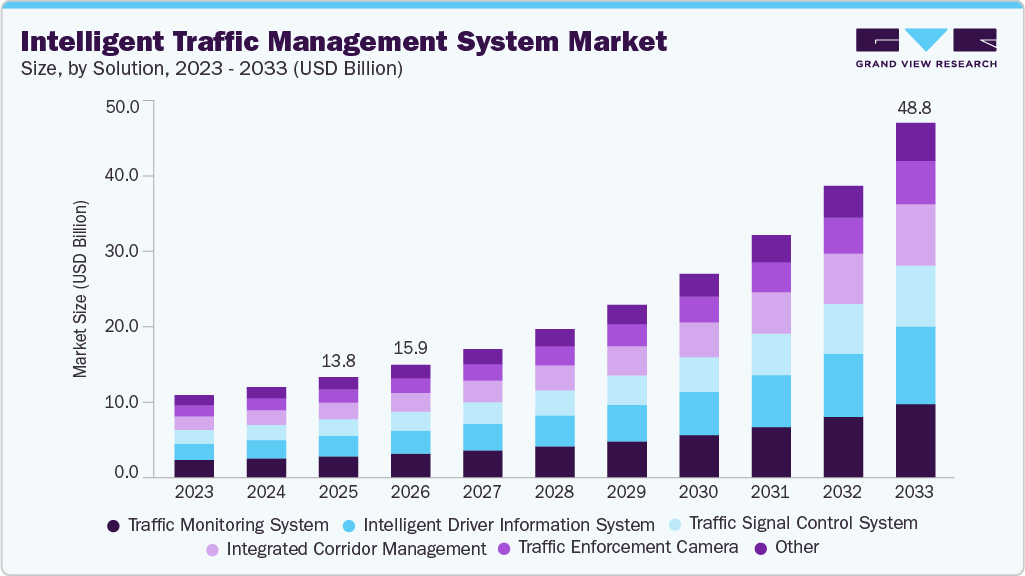 To learn more about this report, Download Free Sample Report
 Countries across the globe are putting effort into modifying their traffic management infrastructure to reduce traffic congestion. Moreover, the adoption of telematics services in vehicles has a significant impact on security and safety. These services enhance driver safety, reduce fuel consumption, improve driver behavior, and enable cost reduction. Telematics tracking systems are widely deployed in cars, which include accessing and activating vehicles remotely using Radio Frequency Identification (RFID). These factors are estimated to fuel growth opportunities in the market.
The growing urban population and rapid industrialization have increased the number of vehicles on the road, causing heavy traffic congestion. As a result, safety concerns for urban planners and high levels of CO2 emissions are expected to have a significant impact on the growth of the intelligent traffic management system market. According to the European Joint Research Centre (JRC), road congestion in Europe costs around 1% of the region's Gross Domestic Product (GDP). Most urban infrastructure development and management bodies in the region have made mitigation their top priority. Further, the intelligent traffic management system also facilitates smart mobility solutions, which can play an important role in addressing all of these issues and solutions while also promoting the growth of the ITMS market.
The high costs involved in developing, installing, and maintaining intelligent traffic management systems continue to limit market growth. Implementing effective ITMS requires a centralized and advanced traffic management center capable of processing real-time traffic data. It must also be seamlessly connected to system operators, transportation authorities, and emergency response agencies. In addition, the overall ITMS network relies on multiple components, such as CCTV cameras, mobile data terminals, advanced traveler information systems, and highway advisory radio, which must be deployed across numerous locations to function effectively. These extensive infrastructure needs demand substantial investment, posing financial challenges for governments in developing nations.
Market Dynamics
The Intelligent Traffic Management System (ITMS) market is experiencing significant growth driven by increasing urbanization, rising traffic congestion, and growing investments in smart city infrastructure. Governments and transportation authorities are increasingly deploying advanced traffic monitoring, control, and analytics solutions to improve road safety and mobility efficiency. However, high implementation costs and integration challenges associated with legacy infrastructure could hamper the growth of the market. In addition, advancements in artificial intelligence (AI), IoT, and connected vehicle technologies are expected to create growth opportunities for the market during the forecast period. The increasing focus on sustainable transportation and real-time traffic optimization is further expected to support market growth.
The growing emphasis on road safety is driving the global adoption of intelligent traffic management systems. Road accidents, traffic violations, and congestion-related incidents continue to create significant social and economic challenges for governments and transportation authorities. Intelligent traffic management systems enable real-time monitoring of road conditions, rapid incident detection, and automated traffic control measures that enhance roadway safety. Technologies such as video analytics, automatic incident detection, traffic enforcement cameras, and predictive analytics support proactive traffic management. These solutions help reduce accident risks, improve emergency response times, and enhance overall transportation safety. Governments are increasingly implementing traffic safety initiatives that rely on intelligent traffic technologies. This focus on safer transportation networks is driving significant market growth.
Advancements in traffic monitoring capabilities are enabling transportation agencies to respond more effectively to road incidents. Real-time data collection and analysis provide greater visibility into traffic conditions and potential safety risks. Intelligent systems also support compliance with traffic regulations through automated enforcement mechanisms. Growing public awareness regarding road safety is encouraging investments in modern traffic management infrastructure, thereby driving the growth of the market.
The integration of intelligent traffic management systems with existing transportation infrastructure presents a significant challenge for market participants. Many cities operate legacy traffic control systems that were not designed to support modern digital technologies. Integrating advanced sensors, analytics platforms, communication networks, and control systems often requires substantial infrastructure upgrades and technical modifications. Compatibility issues can increase implementation complexity and project costs. Data interoperability challenges may also affect the effectiveness of integrated traffic management solutions. These challenges can delay deployment timelines and create operational complexities during system transitions, thereby limiting adoption rates and potentially restraining market growth.
The rapid development of smart cities is significantly driving the growth of the intelligent traffic management system market. Governments worldwide are investing in digital infrastructure to improve urban mobility, public safety, and transportation efficiency. Intelligent traffic management systems are a critical component of smart city ecosystems, enabling real-time traffic monitoring and coordinated transportation management. Integration of sensors, cameras, communication networks, and analytics platforms allows authorities to optimize traffic operations and improve incident response capabilities. Smart city initiatives are also encouraging the adoption of connected transportation infrastructure that supports seamless mobility services. The growing focus on data-driven urban management is creating strong demand for advanced traffic technologies. These investments are expected to contribute to the growth of the market during the forecast period.
Analyst Perspective
The intelligent traffic management system market is benefiting from the increasing need for efficient urban mobility and data-driven transportation management. Market participants are focusing on integrating AI, IoT, and real-time analytics capabilities to improve traffic flow, road safety, and operational efficiency. Growing investments in smart city projects and connected transportation infrastructure continue to support market growth. The increasing emphasis on reducing congestion and enhancing commuter experience is expected to drive sustained growth in the ITMS market.
Solution Insights
Based on solution, the traffic monitoring system segment led the market with the largest revenue share of 21.4% in 2025. Inadequate signal controls can lead to road congestion and increase the overall travel time to a large extent. The favorable government initiatives to develop traffic infrastructures, the emergence of smart city projects, and the growth of adaptive intelligent traffic controls & analytics are key factors in deploying traffic monitoring systems. Furthermore, rising traffic congestion and vehicle pollution have accelerated the need for Mobility as a Service (MaaS), which is anticipated to drive market growth over the forecast period.
 To learn more about this report, Download Free Sample Report
 The intelligent driver information system segment is expected to grow at the fastest CAGR over the forecast period. The segment’s growth is driven by the rising need to enhance road safety and reduce accident rates. Increasing traffic congestion in urban areas has created strong demand for real-time navigation support, hazard warnings, and adaptive route guidance that help drivers make informed decisions. The growth of connected vehicles and the integration of in-car infotainment systems further support the adoption of IDIS, as automakers increasingly incorporate advanced driver assistance features into both premium and mid-range models.
Regional Insights
North America dominated the global intelligent traffic management system market with the largest revenue share of 38.2% in 2025. The market growth can be attributed to the growing focus of the U.S. and Canadian governments on improving the overall transportation infrastructure to help reduce accidents and congestion on highways and cities.Advances in communication technologies and addressing vehicular congestion for improved transport capacity effectiveness through real-time exchange are predicting a revolution in the region's transportation network. Further, the growing adoption of mobile and radio devices featuring short-range dedicated technology enables drivers across the region, driving the demand for ITMS solutions during the forecast period.
 To learn more about this report, Download Free Sample Report
 U.S. Intelligent Traffic Management System Market Trends
The intelligent traffic management system market in the U.S. held the largest share in the North America region in 2025. The United States Department of Transportation (DOT) is aggressively investing in research and development, implementation, and adoption of intelligent traffic management systems across the country. The U.S. ITMS market is experiencing significant growth, driven by increasing investments in smart city initiatives and advanced transportation infrastructure. Rising urbanization and traffic congestion have led to the adoption of adaptive traffic control systems and IoT-based solutions that optimize traffic flow and enhance safety.
Europe Intelligent Traffic Management System Market Trends
Europe intelligent traffic management system market is expected to register a moderate CAGR from 2026 to 2033.The Europe ITMS market is growing rapidly, fueled by stringent government regulations aimed at reducing carbon emissions and improving road safety. The region’s focus on smart city development and sustainable transportation has driven the adoption of advanced traffic management solutions, such as adaptive signal control and real-time monitoring. Additionally, significant investments in IoT and AI-based traffic technologies are enhancing the efficiency of urban mobility across Europe.
The UK intelligent traffic management system market is expected to grow at a notable CAGR from 2026 to 2033. The market is expanding due to the government’s emphasis on reducing traffic congestion and achieving net-zero carbon emissions by 2050. Initiatives such as the rollout of smart motorways and investments in AI-powered traffic control systems are driving the adoption of advanced solutions.
Intelligent traffic management system market in Germany held a substantial market share in 2025. Germany’s ITMS market is driven by the country’s focus on sustainable transportation and its leadership in automotive innovation. With increasing urbanization and traffic congestion, there is growing adoption of adaptive traffic signal control systems, smart sensors, and AI-powered analytics to optimize traffic flow. Government initiatives, such as investments in smart city projects and emission reduction targets, are further accelerating the deployment of advanced traffic technologies.
Asia Pacific Intelligent Traffic Management System Market Trends
The Asia Pacific intelligent traffic management system market is expected to grow at the fastest CAGR of 21.3% during the forecast period. The demand for intelligent traffic management system is expected to increase significantly in key countries including China, Japan, South Korea, and India, which are anticipated to lead the ITMS market. Furthermore, the initiatives undertaken by government bodies in the region are expected to fuel the growth of the market.
Intelligent traffic management system market in China held a substantial market share in 2025. China’s ITMS market is expanding rapidly due to large-scale urbanization and government-backed smart city initiatives. The country is investing heavily in adaptive traffic control systems and IoT-enabled technologies to manage traffic in its sprawling metropolitan areas.
The Japan intelligent traffic management system market is expected to grow rapidly in the coming years due to the increasing adoption of intelligent traffic management system in the corporate. Japan's ITMS market is driven by the country’s commitment to innovation and efficient urban mobility. Advanced technologies, such as AI-powered traffic signal control and real-time monitoring systems, are being widely adopted to address rising congestion in densely populated cities.
Key Intelligent Traffic Management System Company Insights
Some of the key companies in the intelligent traffic management system industry include Siemens AG, Cubic Corporation, Inc., and Kapsch TrafficCom Market players are investing aggressively in research & development activities, improving their internal processes, actively engaging in new product development, and improving their existing products and services as part of their efforts to acquire new customers and increase their respective market shares.
-
Siemens AG holds a significant market share in the ITMS market, with its broad portfolio of traffic management solutions, including adaptive traffic control systems, real-time monitoring, and integrated mobility platforms. As a global leader, Siemens benefits from strong market penetration in Europe, North America, and Asia Pacific, driven by government-backed smart city initiatives and the rising demand for sustainable transportation. The company's focus on innovation, such as its mobility-as-a-service (MaaS) platform, positions it well for continued growth in the ITMS sector, especially as cities adopt more advanced, data-driven traffic solutions.
-
Cubic Corporation has established itself as a key player in the ITMS market, particularly in traffic management solutions related to tolling, transit management, and real-time data analytics. With a strong presence in North America and expanding operations globally, Cubic focuses on integrating its systems with connected vehicle technologies and IoT-based platforms. Their solutions are widely adopted in urban centers aiming to optimize traffic flow, reduce congestion, and improve public transit efficiency.
Key Intelligent Traffic Management System Companies:
The following key companies have been profiled for this study on the intelligent traffic management system market.
-
Cubic Corporation
-
SNC-Lavalin Group (Atkins)
-
Thales Group
-
International Business Machines Corporation
-
General Electric Company
-
Siemens AG
-
Kapsch TrafficCom
-
TomTom International BV
-
Q-Free ASA
-
TransCore
Competitive Benchmarking
Category
Operating Strategies
Competitive Edge
Weakness
Established Players (Thales Group, Cubic Corporation, Kapsch TrafficCom, Siemens AG)
Established players focus on delivering end-to-end intelligent transportation solutions through large-scale infrastructure projects, advanced analytics, AI integration, and smart city collaborations. These companies emphasize long-term government contracts, technology innovation, and integrated traffic management platforms to strengthen their market position.
Strong global presence, extensive transportation expertise, large project execution capabilities, established customer relationships, and significant R&D investments provide these companies with a competitive advantage. Their ability to offer comprehensive transportation and mobility solutions further enhances market leadership.
High dependence on public infrastructure spending, lengthy project implementation cycles, and complex regulatory requirements may affect growth. Large organizational structures can also limit flexibility in responding to rapidly evolving technology trends.
Emerging Players (Q-Free ASA, TransCore, Quarterhill Inc., Sensys Networks, Inc.)
Emerging players in the market focus on niche markets, differentiating themselves from established players. This can help them establish a foothold in the market and attract a dedicated user base.
Strong specialization in traffic technologies, agility in product development, expertise in mobility analytics, and innovative transportation solutions allow these companies to compete effectively in specific market segments. Their focused approach enables rapid adoption of emerging technologies.
Emerging players often have limited resources, which can make it difficult for them to invest in research and development, marketing, and customer support. This can limit their ability to compete with established players who have more resources at their disposal.
Recent Developments
-
In August 2025, Sensys Networks, Inc. unveiled its MultiSens Intersection solution at the ITS World Congress, marking the debut of the industry’s first unified traffic detection platform that seamlessly integrates video AI and wireless sensor technologies into one system. This innovative solution eliminates the traditional compromise between achieving comprehensive intersection analysis and ensuring dependable advance detection.
-
In June 2025, Kapsch TrafficCom AG announced that it has secured contracts from the New York State Department of Transportation to operate two Traffic Management Centers (TMCs) in New York State. The two centers, located in Rochester and Hornell, will enhance regional traffic operations and support efficient transportation management.
Intelligent Traffic Management System Market Report Scope
Report Attribute
Details
Market size in 2025
USD 13.8 billion
Estimated Market size in 2026
USD 15.5 billion
Projected Market size by 2033
USD 48.7 billion
Growth rate
CAGR of 17.8% from 2026 to 2033
Base year for estimation
2025
Historical data
2021 - 2024
Forecast period
2026 - 2033
Quantitative units
Revenue in USD billion and CAGR from 2026 to 2033
Report coverage
Revenue forecast, company market share, competitive landscape, growth factors, and trends
Segments covered
Solution and Region
Regional scope
North America; Europe; Asia Pacific; Latin America; MEA
Country scope
U.S.; Canada; Mexico; Germany; UK; France; Italy; Spain; Denmark; Sweden; Norway; China; Japan; India; South Korea; Australia; Thailand; Brazil; Argentina; KSA; UAE; Kuwait; South Africa
Key companies profiled
Cubic Corporation; SNC-Lavalin Group (Atkins); Thales Group; International Business Machines Corporation; General Electric Company; Siemens AG; Kapsch TrafficCom; TomTom International BV; Q-Free ASA; TransCore
Customization scope
Free report customization (equivalent up to 8 analysts' working days) with purchase. Addition or alteration to country, regional & segment scope.
Pricing and purchase options
Avail customized purchase options to meet your exact research needs. Explore purchase options
Global Intelligent Traffic Management System Market Report Segmentation
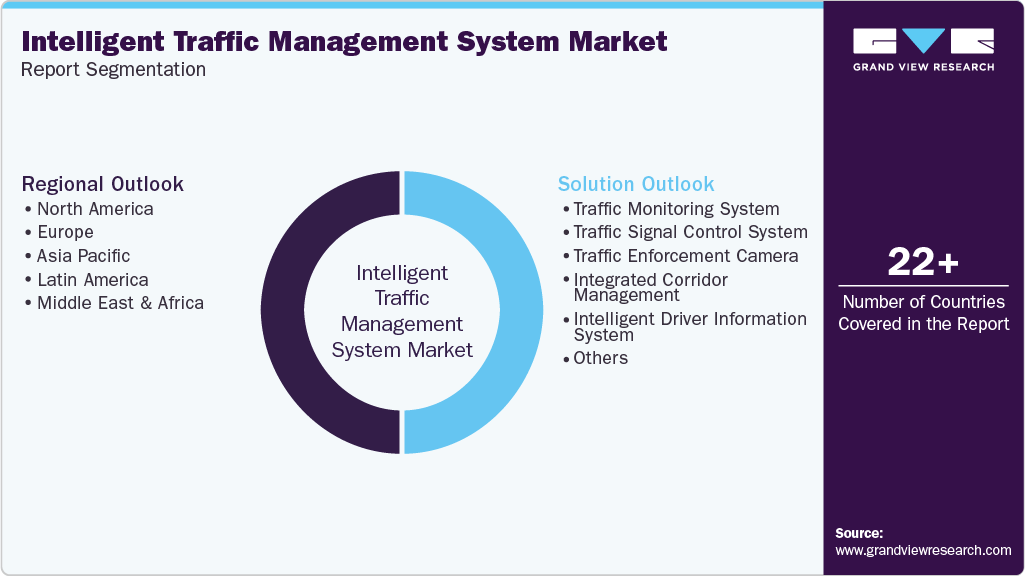
This report forecasts revenue growth at global, regional, and country levels and provides an analysis of the latest industry trends in each of the sub-segments from 2021 to 2033. For this study, Grand View Research has segmented the global intelligent traffic management system market report based on solution and region:
 To learn more about this report, Download Free Sample Report
 -
Solution Outlook (Revenue, USD Million, 2021 - 2033)
-
Traffic Monitoring System
-
Traffic Signal Control System
-
Traffic Enforcement Camera
-
Integrated Corridor Management
-
Intelligent Driver Information System
-
Others
-
-
Regional Outlook (Revenue, USD Million, 2021 - 2033)
-
North America
-
U.S.
-
Canada
-
Mexico
-
-
Europe
-
Germany
-
UK
-
France
-
Italy
-
Spain
-
Denmark
-
Sweden
-
Norway
-
-
Asia Pacific
-
China
-
India
-
Japan
-
Australia
-
Thailand
-
South Korea
-
-
Latin America
-
Brazil
-
Argentina
-
-
Middle East & Africa (MEA)
-
South Africa
-
Saudi Arabia
-
UAE
-
Kuwait
-
-
Research Methodology
The intelligent traffic management system market figures in this report are based on a proven research process that combines executive interviews with secondary research from proprietary databases, company filings, and recognized regulatory and institutional sources. Market size is built through value-chain sizing - reconciling supply-side and demand-side estimates - and triangulated with bottom-up and top-down approaches. Every estimate passes multiple levels of expert validation before publication, with each intelligent traffic management system segment quantified using the revenue-capture definitions in the table below.
Segment Definition
Segment - Solution
Revenue capture definition
Traffic Monitoring System
This segment captures revenue generated from traffic monitoring systems used for collecting, processing, analyzing, summarizing, and disseminating traffic data. This system includes both software and hardware devices, such as a video surveillance system, closed-circuit television, loop detector system, radar sensor, video detection software system, and communication system.
Traffic Signal Control System
This segment captures revenue generated from the traffic signal control system that coordinates individual traffic signals to achieve network-wide traffic operation goals. These systems consist of intersection traffic signals/variable message signs/traffic lights, inductive loop detectors, a communication network, and a Traffic Control Center (TCC) to manage the system used for tracing and detecting traffic data to activate the required action for managing road traffic.
Traffic Enforcement Camera
This segment captures revenue generated from traffic enforcement cameras installed or mounted either beside or over the road to detect violations of traffic signals, such as speeding vehicles crossing the red-light signal or driving on a prohibited lane. This system can be integrated with an automated ticketing system to fine a driver for violating the law. There are different types of enforcement camera systems depending on applications, such as bus lane enforcement, red light enforcement, speed limit enforcement, and stop sign enforcement.
Integrated Corridor Management (ICM)
This segment captures revenue generated from ICM system that integrates and optimally utilizes existing devices and systems to manage traffic congestion in corridors. It has several features of the transportation management system, such as freeway management, arterial management, transit management, traveler information, traffic surveillance & monitoring, incident management, and adaptive ramp metering. The systems required for effective implementation of ICM include Decision Support System (DSS), smart fusion subsystem, SmartNET subsystem, and agency-operated operation system used for traffic management.
Intelligent Driver Information System
This segment captures revenue generated from system that helps in reducing traffic congestion by providing drivers with traffic information, thereby facilitating quick travel decisions. It includes in-vehicle systems such as driver communication system & navigation system, Highway Advisory Radio (HAR) system, dynamic message signs, webpage, and telephone system.
Others
This segment captures revenue generated from systems such as meteorological systems, traffic control system based on weather conditions, queue detection system, and proximity detection system.
Estimation Model
Layer Name
Key Question
Description
Transportation Infrastructure / Demand Layer
Who requires traffic monitoring and traffic management solutions?
Establish the total potential demand base by identifying road networks, highways, urban transportation corridors, intersections, municipalities, transportation agencies, smart city projects, and public infrastructure authorities.
Addressable Market Layer
Who can realistically be reached and served by ITMS providers?
Refine the total transportation ecosystem into the realistically serviceable market by considering factors such as government transportation budgets, smart city investments, digital infrastructure readiness, regulatory support, communication network availability, and modernization initiatives. It helps determine the share of transportation infrastructure that can potentially adopt intelligent traffic management solutions.
ITMS Adoption & Deployment Layer
Who is actively deploying intelligent traffic management systems?
Estimate annual demand generation by analyzing adoption rates of traffic monitoring systems, traffic signal control systems, traffic enforcement cameras, integrated corridor management solutions, and intelligent driver information systems. It converts the addressable market into measurable deployments across urban roads, highways, intersections, public transportation corridors, and smart city projects.
Revenue Layer
How does ITMS deployment translate into market revenue?
Convert intelligent traffic management system deployments into market revenue through the sale of hardware. Revenue is generated by applying pricing for traffic monitoring systems, traffic signal control systems, enforcement cameras, and other solutions deployed across transportation networks.
Delivered Customizations
This report has been delivered with the following In-depth customizations
Client Request
Customization Delivered
Value Adds
Regional & Country Opportunity Analysis
Delivered region-wise and country-wise market size, forecasts, and growth analysis across North America, Europe, Asia Pacific, Latin America, and Middle East & Africa
Assessment of smart city investments, transportation infrastructure spending, and urban mobility initiatives
Identification of high-growth countries and emerging smart transportation markets
Supported regional expansion and investment strategies
Enabled market prioritization and opportunity assessment
Assisted in identifying emerging growth regions
Traffic Volume & Infrastructure Demand Analysis
Delivered analysis of vehicle traffic volumes, congestion levels, road network expansion, and transportation infrastructure demand by region and country
Assessment of urbanization impact on traffic management requirements
Evaluation of future transportation capacity needs
Supported investment prioritization
Improved understanding of long-term market drivers
Competitive Benchmarking & Strategic Landscape Analysis
Delivered benchmarking of major ITMS providers based on product portfolio, technology capabilities, project experience, regional presence, partnerships, and innovation initiatives
Analysis of mergers & acquisitions, smart city collaborations, and product launches
Supported competitive intelligence and strategic decision-making
Enabled identification of market gaps and growth opportunities
Assisted in strengthening market positioning
Frequently Asked Questions About This Report
The global intelligent traffic management system market size was estimated at USD 13.8 billion in 2025 and is expected to reach USD 15.5 billion in 2026.
Based on solution, the traffic monitoring system segment led the market with the largest revenue share of 21.4% in 2025.
The intelligent driver information system segment is the fastest-growing solution and is expected to grow at the CAGR of 17.8% over the forecast period.
North America dominated the intelligent traffic management system industry and accounted for a share of 38.2% in 2025. This is attributed to the growing need for real-time data among drivers and passengers, as well as the rapid adoption of IoT and Industry 4.0 in the region.
Some key players operating in the ITMS market include Cubic Corporation; SNC-Lavalin Group (Atkins); Thales Group; International Business Machines Corporation; General Electric Company; Siemens AG; Kapsch TrafficCom; TomTom International BV; Q-Free ASA; TransCore
The rising demand for presenting real-time traffic information to drivers and passengers is one of the key factors driving the demand for an intelligent traffic management system.
The global intelligent traffic management system market is expected to grow at a compound annual growth rate of 17.8% from 2026 to 2033 to reach USD 48.7 billion by 2033.
The Asia Pacific intelligent traffic management system market is expected to grow at the fastest CAGR of 21.3% during the forecast period.
About the Author(s)
Automotive & Transportation Research Team
Technology · Automotive & TransportationThis report was authored by the automotive & transportation research team at Grand View Research - comprising two research analysts, one senior research analyst, and one industry expert - with specialized expertise in the automotive & transportation segment of the technology industry. All findings are based on proprietary technology databases, executive interviews, and regulatory analysis, subject to internal peer review prior to publication.
Last Updated:
Speak to Analyst

Customize this report to your needs - add regions, segments, or data points, with 20% free customization.
Or view our licence options:


ISO 9001:2015 & 27001:2022 Certified
We are GDPR and CCPA compliant! Your transaction & personal information is safe and secure. For more details, please read our privacy policy.


