
- Home
- »
- Next Generation Technologies
- »
-
Interaction Sensor Market Size, Share & Trends Report, 2033GVR Report cover

Interaction Sensor Market (2026 - 2033)
Size, Share & Trends Analysis Report By Technology (Camera-Based Sensors, Voice Recognition Sensors), By Industry Vertical (Consumer Electronics, Automotive, Healthcare), By Region, And Segment Forecasts
Market Size, 2025
$58.3BMarket Estimate, 2026
$67.4BMarket Forecast, 2035
$321.9BCAGR, 2026–2035
25.0%Interaction Sensor Market Summary
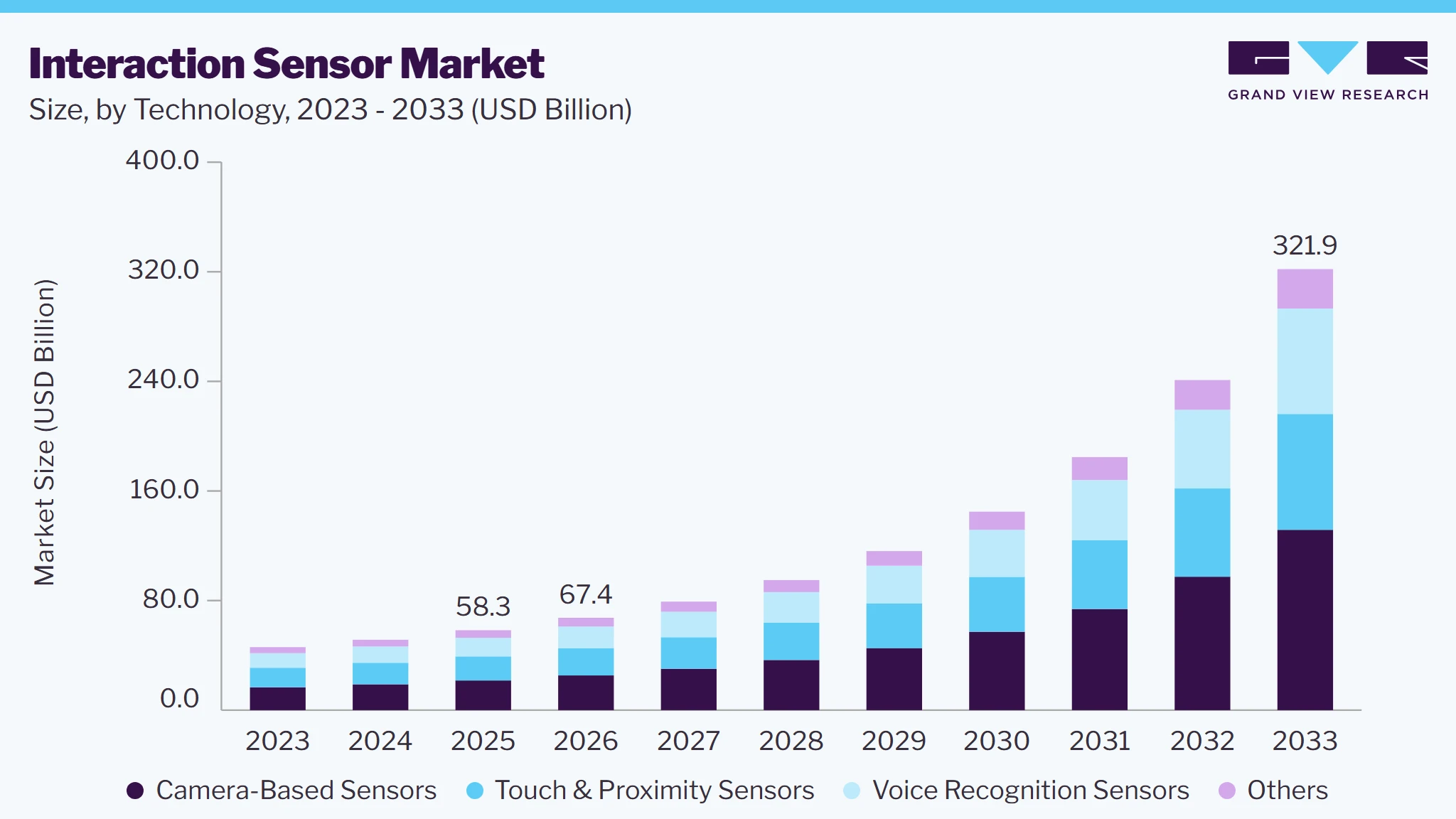
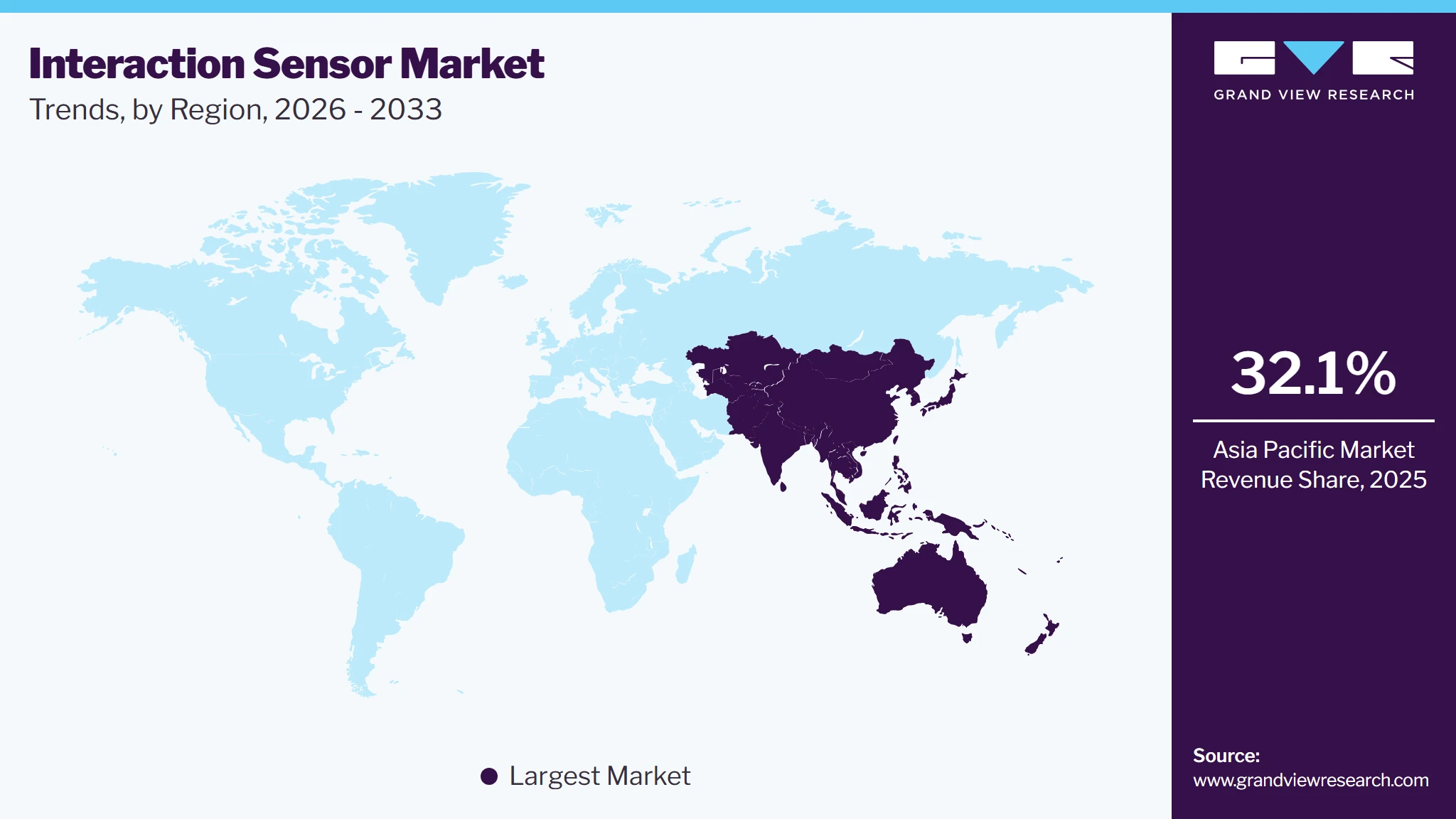
The global interaction sensor market size was valued at USD 58.3 billion in 2025 and is projected to grow USD 67.4 billion in 2026 to USD 321.9 billion by 2033, at a CAGR of 25.0% from 2026 to 2033. Asia Pacific dominated the market, accounting for a revenue share of 32.1% in 2025 and is projected to grow at the fastest CAGR over the forecast period. Increasing aircraft production and air traffic are driving demand for interaction sensors by expanding the need for aircraft, liability, and operational risk coverage.
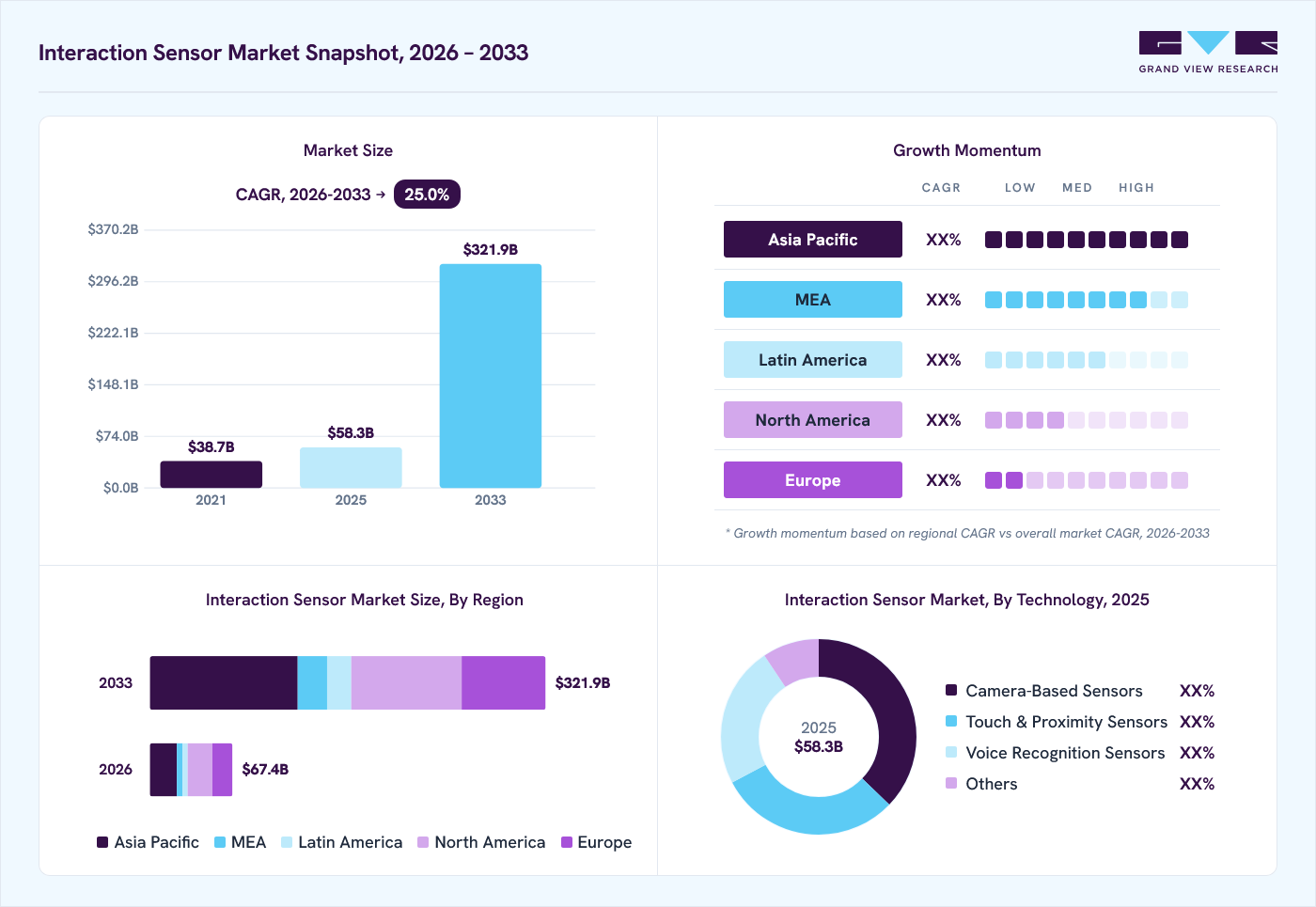 Source: Grand View Research, IR Documents, Primary Interviews, Paid DatabasesTo learn more about this report,
 Download Free Sample Report
Key Market Trends & Insights
- By technology: Camera-based sensors segment led the market and accounted for 37.1% of the global revenue in 2025 and is projected to grow at the fastest CAGR over the forecast period.
- By industry vertical: Consumer electronics segment led the market and accounted for the global revenue in 2025.
Regional Highlights
- Largest regional market: Asia Pacific (32.1% revenue share, 2025)
- By country: China held the largest market share in 2025.
Market Size & Forecast
- Market size in 2025: USD 58.3 Billion
- Estimated market size in 2026: USD 67.4 billion
- Projected market size by 2033: USD 321.9 Billion
- CAGR (2026-2033): 25.0%
Prism AI by Grand View Research Free to tryAsk a question about the interaction sensor marketTry asking✓Every figure cited from GVR research Prefer the report? Download free sample →Increasing demand for intuitive and convenient user interfaces is driving the adoption of interaction sensors across consumer electronics, automotive systems, smart devices, and connected equipment. Interaction sensors enable devices to recognize voice commands, visual inputs, gestures, and other forms of user interaction, reducing dependence on traditional physical controls. As manufacturers compete on user experience and product differentiation, sensor-enabled interfaces are increasingly being integrated into premium and mainstream products. This trend is supporting greater deployment of camera-based and voice recognition technologies across multiple industries.
 To learn more about this report, Download Free Sample Report
The growing adoption of multimodal interfaces is trending in the market. as manufacturers increasingly combine voice, vision, touch, and gesture recognition to provide more intuitive and flexible user interaction. Rather than relying on a single interaction method, manufacturers are developing systems that respond to different inputs based on the user's environment and requirements. This approach improves convenience and can make interaction with smart devices and vehicles more natural. As artificial intelligence capabilities improve, multimodal sensing is expected to become increasingly important for premium and next-generation products.
Strengthening privacy and data protection requirements are influencing the development and deployment of interaction sensors, particularly camera-based and voice recognition systems. Regulations governing the collection, processing, storage, and sharing of personal data can affect products that capture images, voice recordings, or behavioral information. Manufacturers and technology providers need to incorporate privacy safeguards, data minimization, consent mechanisms, and appropriate data-management practices into interaction-enabled products. Compliance requirements can increase development costs but also encourage greater consumer confidence in sensor-based technologies.
High development and integration costs pose a restraint for the interaction sensor market, particularly for sophisticated camera-based and AI-enabled systems. Manufacturers need to invest in sensors, processing hardware, software, algorithms, testing, and system integration to deliver reliable interaction capabilities. These costs can be difficult to justify for lower-priced products where consumers remain highly price sensitive. Consequently, adoption may initially remain concentrated in premium products and applications where enhanced user experience provides sufficient commercial value.
Market Dynamics
The interaction sensor market is expanding as electronic devices, vehicles, healthcare equipment, and other connected systems increasingly require more intuitive ways for users to communicate with technology. Growth is being driven by the shift from conventional buttons and switches to touch, proximity, voice, gesture, and camera-based interactions. At the same time, improvements in artificial intelligence, sensing accuracy, miniaturization, and low-power operation are allowing interaction capabilities to be integrated into a wider range of products. This is encouraging manufacturers to invest in sensors that can make products more responsive, personalized, and easier to operate.
Increasing Demand for Natural and Touchless User Interaction is fueling the market growth. Consumers and businesses are increasingly expecting electronic products to respond to more natural forms of interaction rather than relying entirely on conventional physical controls. Smartphones, smart home products, vehicles, industrial equipment, and healthcare devices are incorporating touch, voice, gesture, proximity, and visual interaction to simplify operation. This shift is particularly important where users need to operate a product while moving, wearing gloves, maintaining hygiene, or performing another task simultaneously. As product interfaces become an important part of differentiation, manufacturers are increasingly viewing interaction sensing as a value-enhancing feature rather than simply an additional component.
Interaction sensors address this demand by allowing products to recognize user actions and respond with limited physical effort. Touch and proximity solutions can replace or supplement traditional buttons, while voice and camera-based sensing can support hands-free operation and more personalized interaction. The number of interaction-sensing applications and the revenue opportunity for sensor suppliers are expected to increase.
The integration of interaction sensors can become difficult when manufacturers need to maintain reliable performance across different environmental and operating conditions. Sensors may need to operate accurately despite changes in temperature, moisture, lighting, surrounding objects, electromagnetic interference, background noise, or variations in user interaction. Manufacturers need additional design, testing, calibration, and validation before incorporating a new interaction technology into mass-produced products. This increases development requirements and can slow adoption, particularly for cost-sensitive products.
The restraint is particularly relevant for smaller manufacturers and for applications where the additional interaction functionality does not immediately justify higher product development costs. The impact can be stronger in emerging markets, where manufacturers often prioritize affordability and proven technologies over newer interaction methods. Consequently, suppliers need to provide solutions that are easy to integrate and require limited supporting hardware or development effort. The availability of compact, ready-to-integrate touch, proximity, and interaction solutions can partially reduce this barrier, but complex applications continue to require significant engineering investment.
Automotive interiors represent a significant opportunity as vehicles are increasingly designed as connected, interactive environments rather than purely as transportation systems. Drivers and passengers are being offered more functions through displays, voice commands, touch controls, gesture recognition, proximity sensing, and camera-based systems. This creates opportunities for interaction sensors to support safer, more convenient operation while reducing reliance on traditional physical controls. The opportunity is further strengthened by the increasing number of electronic functions being integrated into modern vehicles.
Sensor suppliers with capabilities spanning touch, proximity, gesture, vision, and related interface technologies are well positioned to benefit from this transition. Emerging radar and optical sensing solutions can add new forms of interaction, while established semiconductor suppliers can leverage their broader customer relationships and product portfolios to secure large-scale design wins. These capabilities are increasingly being applied across automotive in-cabin sensing, gesture recognition, driver monitoring, and other interaction applications. This makes automotive one of the most attractive areas for future investment, particularly as manufacturers seek more personalized and intelligent cabin experiences.
Market Concentration & Characteristics
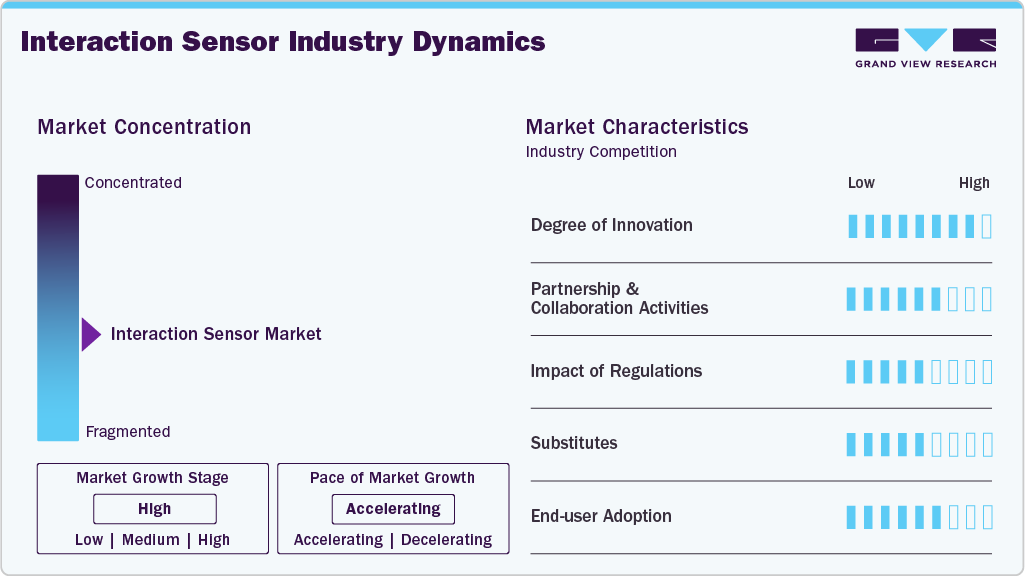
The interaction sensor market is moderately fragmented, reflecting the presence of a broad range of participants offering sensing technologies across touch, proximity, gesture, optical, capacitive, and other interaction modalities. The market does not appear to be dominated by a small number of suppliers because interaction sensing is used across diverse applications, including consumer electronics, automotive, healthcare, aerospace & defense, and entertainment. Differences in sensing requirements, form factors, integration capabilities, and application-specific performance requirements create opportunities for both established suppliers and specialized technology providers. This fragmentation is further supported by the relatively high degree of innovation, as market participants continuously develop more responsive, compact, accurate, and multimodal sensing solutions. The market's partnership and collaboration activity is at a medium-to-high level, indicating that technology integration and application-specific development are important competitive factors.
 To learn more about this report, Download Free Sample Report
The market characteristics also indicate moderate regulatory influence and moderate availability of substitutes, suggesting that both compliance requirements and the availability of alternative sensing technologies shape competition. Regulatory requirements are particularly relevant in safety-sensitive applications, where reliability, electromagnetic compatibility, data protection, and functional performance can influence technology selection. At the same time, end users can evaluate different sensing approaches based on cost, accuracy, integration complexity, and intended use, preventing any single technology from achieving universal dominance. End-user adoption is moderately high and continues to expand, supported by the growing integration of interactive interfaces and intelligent sensing capabilities into connected products. Moreover, the combination of high innovation, active collaboration, moderate regulatory impact, available substitutes, and increasing adoption supports a moderately fragmented competitive structure, with opportunities for differentiation through technology performance, application specialization, integration capabilities, and product innovation.
Analyst Perspective
The interaction sensor market is entering a broader adoption phase as manufacturers increasingly prioritize intuitive, responsive, and low-effort user interfaces across connected products. Touch, proximity, camera-based, voice, gesture, and radar-based sensing are expanding the ways users interact with electronic systems, while artificial intelligence is improving the ability of products to understand user actions. Investment is expected to increase toward compact, low-power, highly integrated sensing solutions that can support multiple interaction methods within a single product. Automotive in-cabin systems, smart consumer devices, healthcare equipment, and industrial interfaces are expected to remain important areas of investment. Competition is also shifting from individual sensor components toward broader interaction platforms and application-specific solutions, increasing the importance of integration capabilities and customer design relationships.
Technology Insights
Based on technology, the camera-based sensors segment accounted for 37.1%, the largest share of global revenue in 2025 and is projected to grow at the fastest CAGR over the forecast period. The segment dominance is supported by increasing adoption of visual interaction capabilities across electronic devices and intelligent systems. Demand is being supported by applications such as gesture recognition, facial interaction, user presence detection, and touchless control, particularly as manufacturers focus on improving convenience and user experience. Advancements in image processing and AI-based vision technologies are improving the accuracy and responsiveness of camera-enabled interaction systems, thereby supporting their integration into next-generation products.
The Voice recognition sensors segment is projected to grow at the significant CAGR over the forecast period. Voice recognition sensors are gaining importance as manufacturers increasingly incorporate voice-enabled interfaces into connected devices and digital platforms. The segment growth is being supported by improvements in speech recognition, noise handling, and AI-based language processing, which allow systems to respond more accurately to user commands. The technology is particularly relevant to smart consumer devices and vehicle infotainment systems, where users increasingly expect hands-free control of navigation, entertainment, communication, and other functions.
Industry Vertical Insights
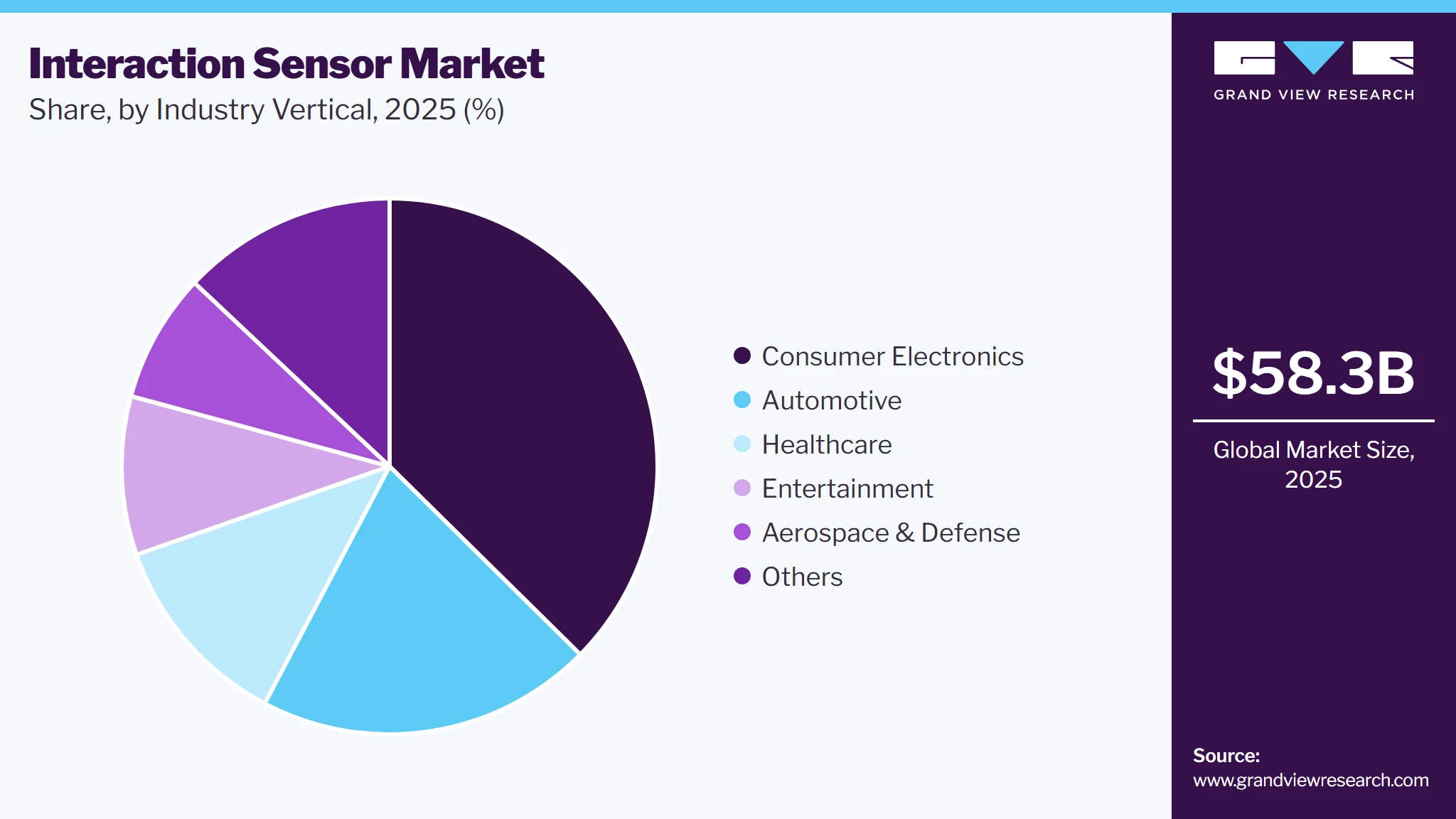
Based on industry vertical, the consumer electronics segment accounted for the largest share of global revenue in 2025. The segment’s growth is driven by the widespread integration of interactive features across smartphones, smart home devices, wearables, gaming systems, and other connected products. Manufacturers are increasingly incorporating sensing capabilities to provide more intuitive, personalized, and touchless user experiences while differentiating their products in competitive markets. The growing adoption of AI-enabled devices, proximity and presence sensing, gesture-based controls, and voice interfaces is expected to support continued demand for interaction sensors in this segment.
 To learn more about this report, Download Free Sample Report
The automotive segment is projected to grow at the fastest CAGR over the forecast period. The growth can be attributed to the increasing adoption of interaction sensors in medical devices, diagnostic equipment, and patient monitoring systems. Rising demand for touchless interfaces, contactless controls, and automated medical equipment is supporting the integration of interaction sensors across hospitals, clinics, and other healthcare facilities. The use of proximity, gesture, and touch sensors in patient monitoring equipment, surgical systems, and smart medical devices is further strengthening adoption. Increasing investments in healthcare infrastructure and the deployment of advanced medical technologies are also contributing to segment growth.
Regional Insights
Asia Pacific Interaction Sensor Market Trends
The Asia Pacific Interaction Sensor led the global market and accounted for 32.1% of the global revenue in 2025 and is projected to grow at the fastest CAGR over the forecast period, supported by expanding consumer electronics production, automotive manufacturing, smartphone penetration, and smart-device adoption. Countries across the region are investing heavily in AI, semiconductor technologies, connected devices, and intelligent mobility solutions. Large consumer markets and increasing disposable incomes are encouraging manufacturers to introduce advanced interaction features across a broader range of products. The region's strong electronics manufacturing ecosystem also supports cost-effective large-scale deployment of interaction sensor technologies.
 To learn more about this report, Download Free Sample Report
China held a dominant share in the Asia Pacific interaction sensor, due to its large consumer electronics industry, expanding smart-home ecosystem, and rapidly developing automotive technology sector. Domestic technology and automotive companies are increasingly incorporating voice interfaces, camera-based sensing, AI, and intelligent cockpit technologies into their products. The country's large manufacturing base also enables interaction sensor technologies to be deployed across products on a significant scale. Continued investment in AI and intelligent vehicles is expected to provide substantial opportunities for market expansion.
Japan interaction sensor is expected to grow at a significant CAGR over the forecast period. driven by its advanced consumer electronics, automotive, robotics, and technology industries. Japan companies have historically invested in technologies designed to improve human-machine interaction, creating a strong foundation for sensor-based interfaces. Automotive manufacturers are increasingly incorporating voice recognition, camera-based sensing, and intelligent cockpit functions into vehicles. The country's aging population and emphasis on automation also create opportunities for intuitive interaction technologies that can simplify the operation of connected products and systems.
North America Interaction Sensor Market Trends
North America Interaction Sensor held the significant share in the market, due to strong adoption of advanced consumer electronics, connected devices, AI-enabled technologies, and digital automotive systems. The region benefits from the presence of major technology companies, automotive manufacturers, and semiconductor and sensor suppliers developing advanced interaction solutions. High consumer acceptance of voice assistants and smart-home technologies is also supporting market expansion. Continued investment in AI and connected-device ecosystems is expected to drive the region's growth.
The U.S. Interaction Sensor held the largest market share in 2025. supported by high adoption of smart consumer electronics, connected-home products, voice-enabled devices, and advanced automotive technologies. The country has a strong ecosystem of technology companies developing AI, voice recognition, computer vision, and human-machine-interface technologies. Automotive manufacturers are also increasingly incorporating advanced interaction capabilities into vehicle interiors. Strong technology investment and consumer willingness to adopt new digital interfaces are expected to support continued market growth.
Europe Interaction Sensor Market Trends
The Europe Interaction Sensor market is expected to grow at a significant CAGR over the forecast period, driven by advanced automotive manufacturing, high adoption of connected technologies, and increasing emphasis on vehicle safety and intelligent mobility. The region has a strong presence of automotive OEMs and Tier-1 suppliers that are investing in advanced cockpit and human-machine-interface technologies. Regulatory requirements related to privacy, data protection, vehicle safety, and cybersecurity also influence product development. Demand is expected to remain strong as European manufacturers increasingly integrate intelligent interaction capabilities into vehicles and consumer products.
The U.K. is gaining momentum in the interaction sensor market, owing to the increasing adoption of smart-home devices, connected consumer electronics, AI-enabled technologies, and advanced automotive systems. Growing demand for convenient voice-controlled interfaces is creating opportunities for voice recognition technologies across consumer and commercial applications. The country's technology ecosystem also supports innovation in AI and human-machine interaction. Adoption is expected to increase as businesses and consumers place greater emphasis on automation and personalized digital experiences.
The Germany held a substantial share in the Europe Interaction Sensor, due to its strong automotive manufacturing base and extensive supplier ecosystem. Automakers and technology suppliers are increasingly investing in advanced cockpit systems, voice interfaces, camera-based sensing, and other technologies designed to improve vehicle-user interaction. Germany's strong industrial and engineering capabilities also support the development and integration of sophisticated sensing technologies. Increasing digitalization of vehicles is expected to remain a major growth opportunity for the market.
Key Interaction Sensor Company Insights
Key players operating in the Interaction Sensor include Acconeer, Google Inc, Infineon Technologies AG, YAGEO Group, Microchip Technology Inc., Neonode Inc., NXP Semiconductors., TDK Corporation., Texas Instruments Incorporated., STMicroelectronics Key players in the Interaction Sensor are focusing on expanding sensor technology portfolios, developing advanced touch, gesture, proximity, vision, and voice-based solutions, and strengthening their presence across consumer electronics and automotive applications. Companies also emphasizing strategic partnerships, product innovation, and AI-enabled sensing technologies to improve competitiveness and secure new design wins.
-
Acconeer is a semiconductor company specializing in low-power radar sensing technology. The company offers radar sensors based on its patented Pulsed Coherent Radar (PCR) technology for applications. Acconeer develops compact radar sensors and modules designed for applications requiring accurate detection of distance, presence, motion, and micro-motion across consumer, automotive, industrial, and IoT applications.
-
Infineon Technologies AG is a semiconductor company. The company offers radar sensors, 3D ToF image sensors, MEMS microphones, capacitive sensors, and other sensing technologies. Infineon Technologies AG is relevant to the interaction sensor market through its capacitive sensing, radar, 3D ToF, and microphone technologies, which support touchless gesture interaction, voice-enabled interfaces, presence detection, and automotive in-cabin interaction applications.
Key Interaction Sensor Companies
The following key companies have been profiled for this study on the interaction sensor market.
-
Acconeer
-
Google Inc
-
Infineon Technologies AG
-
YAGEO Group
-
Microchip Technology Inc.
-
Neonode Inc.
-
NXP Semiconductors.
-
TDK Corporation.
-
Texas Instruments Incorporated.
-
STMicroelectronics
Company Categorization
Operating Strategies
Competitive Edge
Weaknesses
Mature Players: Infineon Technologies AG, NXP Semiconductors, Texas Instruments Incorporated, STMicroelectronics, Microchip Technology Inc.
Mature players in the interaction sensor are focus on broad portfolio strategy, supplying interaction-related components across several product categories and industry verticals. Their approach is to build long-term relationships with manufacturers and provide multiple supporting products around the sensing function, which makes adoption easier for customers.
Mature players gain a competitive advantage through portfolio breadth combined with established customer relationships and manufacturing scale. This allows these suppliers to offer interaction components alongside other products required by the same device, helping customers simplify procurement and product development.
These companies face challenges related to their broad business structures can make them less focused on a single emerging interaction technology than specialized companies. Because they serve many semiconductor and electronic applications, investment and product development must be balanced across multiple markets.
Emerging Players: Acconeer, Neonode Inc.
Emerging players in the interaction sensor are focus on strategies built around specialized interaction and sensing technologies. Their approach is to target specific applications where conventional sensing methods face limitations and then expand through design wins and partnerships with product manufacturers.
Emerging players gain market traction through their primary advantage is specialization, which enables them to address interaction use cases that may not be adequately served by conventional interfaces. Compact sensing solutions, touchless interaction, low-power operation, and specialized in-cabin or gesture applications provide opportunities to differentiate from larger suppliers.
Emerging players face limitations due to narrower scale and customer base compared with diversified semiconductor suppliers. Specialized technologies also need to move from evaluation and individual design wins into repeated high-volume production before they can materially improve market position.
Recent Developments
- In March 2026, Infineon Technologies AG collaborated with SUBARU CORPORATION, a major Japanese automobile manufacturer, to integrate its AURIX TC4x automotive microcontroller into the next-generation ADAS ECU. The technology enables real-time processing and fusion of camera, radar, and other sensor data, supporting faster vehicle decision-making and advanced sensing capabilities.
- In August 2026, TDK Corporation. launched the TDK SensEI edgeRX Pro sensor module, integrating vibration, acoustic, magnetic, temperature, and rotational motion sensing with edge AI processing. The module supports advanced anomaly detection and predictive maintenance across manufacturing, energy, utilities, and industrial facilities.
Interaction Sensor Market Report Scope
Report Attribute
Details
Market size in 2025
USD 58.3 billion
Estimated market size in 2026
USD 67.4 billion
Projected market size by 2033
USD 321.9 billion
Growth Rate
CAGR of 25.0% from 2026 to 2033
Base year for estimation
2025
Historical data
2021 - 2024
Forecast period
2026 - 2033
Quantitative units
Revenue in USD billion and CAGR from 2026 to 2033
Report coverage
Revenue forecast, company ranking, competitive landscape, growth factors, and trends
Segments covered
Technology, industry vertical, region
Regional scope
North America, Europe, Asia Pacific, Latin America, MEA
Country scope
U.S., Canada, Mexico, Germany, U.K., France, China, Japan, India, South Korea, Australia, Brazil, Kingdom of Saudi Arabia, UAE, South Africa
Key companies profiled
Acconeer, Google Inc, Infineon Technologies AG, YAGEO Group, Microchip Technology Inc., Neonode Inc., NXP Semiconductors., TDK Corporation., Texas Instruments Incorporated., STMicroelectronics
Customization scope
Free report customization (equivalent up to 8 analysts working days) with purchase. Addition or alteration to country, regional & segment scope.
Pricing and purchase options
Avail customized purchase options to meet your exact research needs. Explore purchase options
Global Interaction Sensor Market Report Segmentation
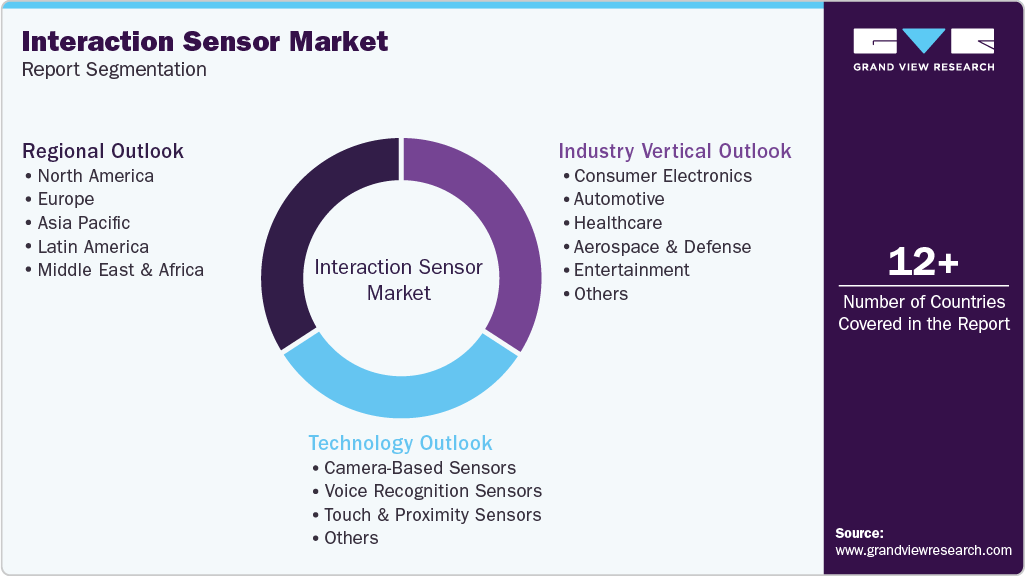
The report forecasts revenue growth at global, regional, and country levels and provides an analysis of the latest industry trends in each of the sub-segments from 2021 to 2033. For the purpose of this study, Grand View Research has segmented the interaction sensor market based on technology, industry vertical, and region.
 To learn more about this report, Download Free Sample Report
-
Technology Outlook (Revenue, USD Billion, 2021 - 2033)
-
Camera-Based Sensors
-
Voice Recognition Sensors
-
Touch and Proximity Sensors
-
Others
-
-
Industry Vertical Outlook (Revenue, USD Billion, 2021 - 2033)
-
Consumer Electronics
-
Automotive
-
Healthcare
-
Aerospace & Defense
-
Entertainment
-
Others
-
-
Regional Outlook (Revenue, USD Billion, 2021 - 2033)
- North America
-
U.S.
-
Canada
-
Mexico
-
- Europe
-
Germany
-
U.K.
-
France
-
- Asia Pacific
-
China
-
India
-
Japan
-
South Korea
-
Australia
-
-
Latin America
-
Brazil
-
- Middle East & Africa (MEA)
-
UAE
-
Kingdom of Saudi Arabia (KSA)
-
South Africa
-
- North America
Research Methodology
The interaction sensor market figures in this report are based on a proven research process that combines executive interviews with secondary research from proprietary databases, company filings, and recognized regulatory and institutional sources. Market size is built through value-chain sizing-reconciling supply-side and demand-side estimates-and triangulated with bottom-up and top-down approaches. Every estimate passes multiple levels of expert validation before publication, with each interaction sensor segment quantified using the revenue-capture definitions in the table below.
Segment Definition
Technology
Revenue capture definition
Camera-Based Sensors
The segment revenue is generated from the sale of camera-based sensing components, modules, and related hardware used to detect users, faces, movements, gestures, body position, and visual interaction. Revenue includes camera sensor units supplied directly to device manufacturers as well as integrated sensing modules used in consumer electronics, automotive, healthcare, entertainment, and other applications.
Voice Recognition Sensors
The segment revenue is generated from microphones, microphone arrays, voice-sensing components, and related sensor hardware used to capture and recognize human speech or voice commands. Revenue includes components supplied for smart speakers, smartphones, vehicles, home appliances, wearable devices, and other voice-enabled products in which voice serves as the interaction method.
Touch and Proximity Sensors
The segment revenue is generated from touch sensors, capacitive sensing components, proximity sensors, touch controllers, and related hardware used to identify physical or near-surface user interaction. Revenue includes sensor components and integrated solutions supplied for displays, buttons, touchpads, control panels, appliances, vehicles, industrial equipment, and other interactive products. Current supplier portfolios demonstrate applications ranging from automotive and industrial interfaces to consumer devices.
Others
The segment revenue is generated from interaction-sensing technologies that do not fall under camera-based, voice recognition, touch, or proximity sensing. This includes gesture, pressure, force, motion, radar-based interaction, and other specialized sensing components and modules used to recognize user actions. Revenue includes standalone sensors, modules, and integrated sensing products supplied for specialized interaction applications.
Industry Vertical
Revenue capture definition
Consumer Electronics
The segment revenue is generated from interaction sensors incorporated into smartphones, tablets, laptops, smart speakers, wearables, smart home devices, gaming devices, televisions, appliances, and other consumer electronic products. Revenue includes sensors, modules, and related interaction components supplied to manufacturers for user-interface functionality.
Automotive
The segment revenue is generated from interaction sensors incorporated into passenger vehicles and commercial vehicles for driver and passenger interaction. Revenue includes sensors used for touch controls, voice interaction, gesture recognition, proximity detection, camera-based interaction, and in-cabin user monitoring.
Healthcare
The segment revenue is generated from interaction sensors used in medical equipment, patient-monitoring systems, healthcare interfaces, rehabilitation equipment, diagnostic devices, and connected healthcare products. Revenue includes sensor components and modules that allow users, patients, or healthcare professionals to interact with equipment.
Aerospace & Defense
The segment revenue is generated from interaction sensors used in aircraft, defense equipment, training systems, control interfaces, cockpit systems, and other specialized aerospace and defense applications. Revenue includes sensors and modules designed to support human interaction with equipment in demanding operating environments.
Entertainment
The segment revenue is generated from interaction sensors incorporated into gaming systems, virtual and augmented reality equipment, interactive displays, entertainment installations, and related devices. Revenue includes sensing components that detect gestures, movement, touch, proximity, and other user actions.
Others
The segment revenue is generated from interaction sensors used in industrial automation, smart buildings, retail equipment, robotics, education technology, public infrastructure, and other applications outside the major industry verticals. Revenue includes standalone sensors, modules, and integrated interaction solutions supplied for these applications.
Estimation Model
Layer Name
Key Question
Description
Addressable Product Base
How many products can incorporate interaction sensors?
This layer establishes the total product base across consumer electronics, automotive, healthcare, aerospace & defense, entertainment, and other industries that can potentially use interaction sensors. It considers products where users need to communicate with electronic systems through touch, voice, proximity, gesture, camera, or other methods. The layer provides the foundation for determining the overall addressable opportunity for the Interaction Sensor Market.
Sensor Penetration
How extensively are interaction sensors being adopted?
This layer estimates the proportion of addressable products that actually incorporate interaction-sensing technologies. Penetration differs according to application because smartphones and modern vehicles generally require more interactive functions than conventional industrial or basic electronic products. The assessment considers the increasing movement from physical controls toward touch, voice, gesture, proximity, and visual interaction.
Sensor Revenue per Product
How much interaction-sensor revenue is generated from each product?
This layer estimates the average interaction-sensor revenue associated with each equipped product. Revenue can vary significantly depending on whether a product uses a single touch sensor, multiple sensing components, or a combination of camera, voice, proximity, gesture, and other technologies. Higher-value applications such as automotive and specialized healthcare equipment can therefore generate greater revenue per product than simpler consumer applications.
Market Revenue Validation
Does the calculated opportunity reflect actual market conditions?
The final layer validates the estimated Interaction Sensor Market revenue against supplier portfolios, product launches, design activity, application adoption, and industry-level demand. It also considers differences between component revenue, sensor-module revenue, and integrated interaction solutions to prevent double counting. The final estimate is then adjusted for regional adoption, technology mix, replacement cycles, and the competitive structure of the market.
Delivered Customizations
This report has been delivered with the following In-depth customizations
Client Request
Customization Delivered
Value Adds
Regional Interaction Sensor Market Opportunity Assessment
- Country/region-wise market sizing and forecasts
- Analysis of demand, adoption trends, and regulatory landscape
- Identification of high-growth regions and investment hotspots
- Identified region-specific growth opportunities
- Supported expansion and go-to-market strategy
- Enabled informed regional investment decisions
Cross-Segmentation Analysis for the Interaction Sensor Market
- Criss-cross market analysis by technology, industry vertical
- Demand and adoption assessment across key segments
- Segment attractiveness and growth potential benchmarking
- Identified high-potential market segments
- Supported targeted industry vertical positioning and marketing strategy
- Improved customer and segment prioritization
Competitive Benchmarking and Strategic Positioning in the Interaction Sensor Market
- Benchmarking of key competitors across industry verticals, pricing, partnerships, and innovation
- Comparative assessment of market share, capabilities, and strategies
- Analysis of competitive strengths, gaps, and differentiation areas
- Identified competitive white spaces and growth gaps
- Supported strategic positioning and differentiation
- Enabled data-driven competitive strategy development
About the Author(s)
Next Generation Technologies Research Team
Technology · Next Generation TechnologiesThis report was authored by the next generation technologies research team at Grand View Research - comprising two research analysts, one senior research analyst, and one industry expert - with specialized expertise in the next generation technologies segment of the technology industry. All findings are based on proprietary technology databases, executive interviews, and regulatory analysis, subject to internal peer review prior to publication.
Last Updated:
Speak to Analyst

Customize this report to your needs - add regions, segments, or data points, with 20% free customization.
Or view our licence options:


ISO 9001:2015 & 27001:2022 Certified
We are GDPR and CCPA compliant! Your transaction & personal information is safe and secure. For more details, please read our privacy policy.


