
- Home
- »
- Biotechnology
- »
-
iPSC-Derived Cardiomyocytes Market Size Report, 2033GVR Report cover

iPSC-Derived Cardiomyocytes Market (2026 - 2033)
Size, Share & Trends Analysis Report By Cardiomyocyte Type (Ventricular-like Cardiomyocytes, Atrial-like Cardiomyocytes), By Application (Drug Discovery & Screening), By End User, By Region, And Segment Forecasts
Market Size, 2025
$55.2MMarket Estimate, 2026
$59.3MMarket Forecast, 2033
$107.7MCAGR, 2026–2033
8.9%iPSC-Derived Cardiomyocytes Market Summary
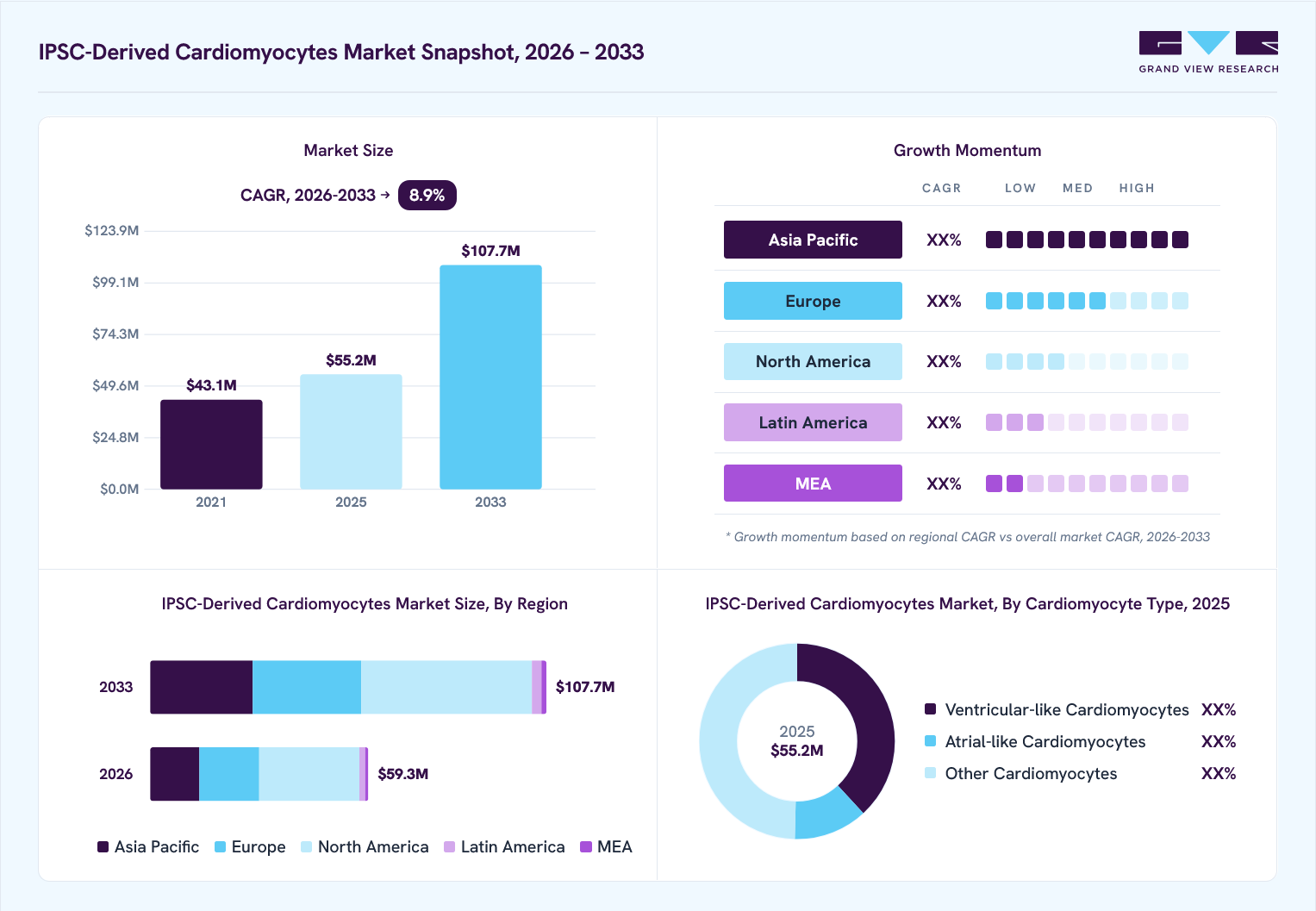
The global iPSC-derived cardiomyocytes market size was valued at USD 55.2 million in 2025 and is projected to grow from USD 59.3 million in 2026 to USD 107.7 million by 2033, at a CAGR of 8.9% from 2026 to 2033. North America dominated the market, accounting for a revenue share of 46.3% in 2025. The market growth is driven by increasing adoption of stem cell technologies, growing demand for cardiac disease modeling, expanding applications in drug discovery and toxicity screening, and rising investments in regenerative medicine and cardiovascular research.
 Source: Grand View Research, IR Documents, Primary Interviews, Paid DatabasesTo learn more about this report,
 Download Free Sample Report
Key Market Trends & Insights
- By cardiomyocyte type: Ventricular-like cardiomyocytes segment held a significant market share of 38.1% in 2025.
- By application: Cardiotoxicity & safety pharmacology segment held the highest market share in 2025.
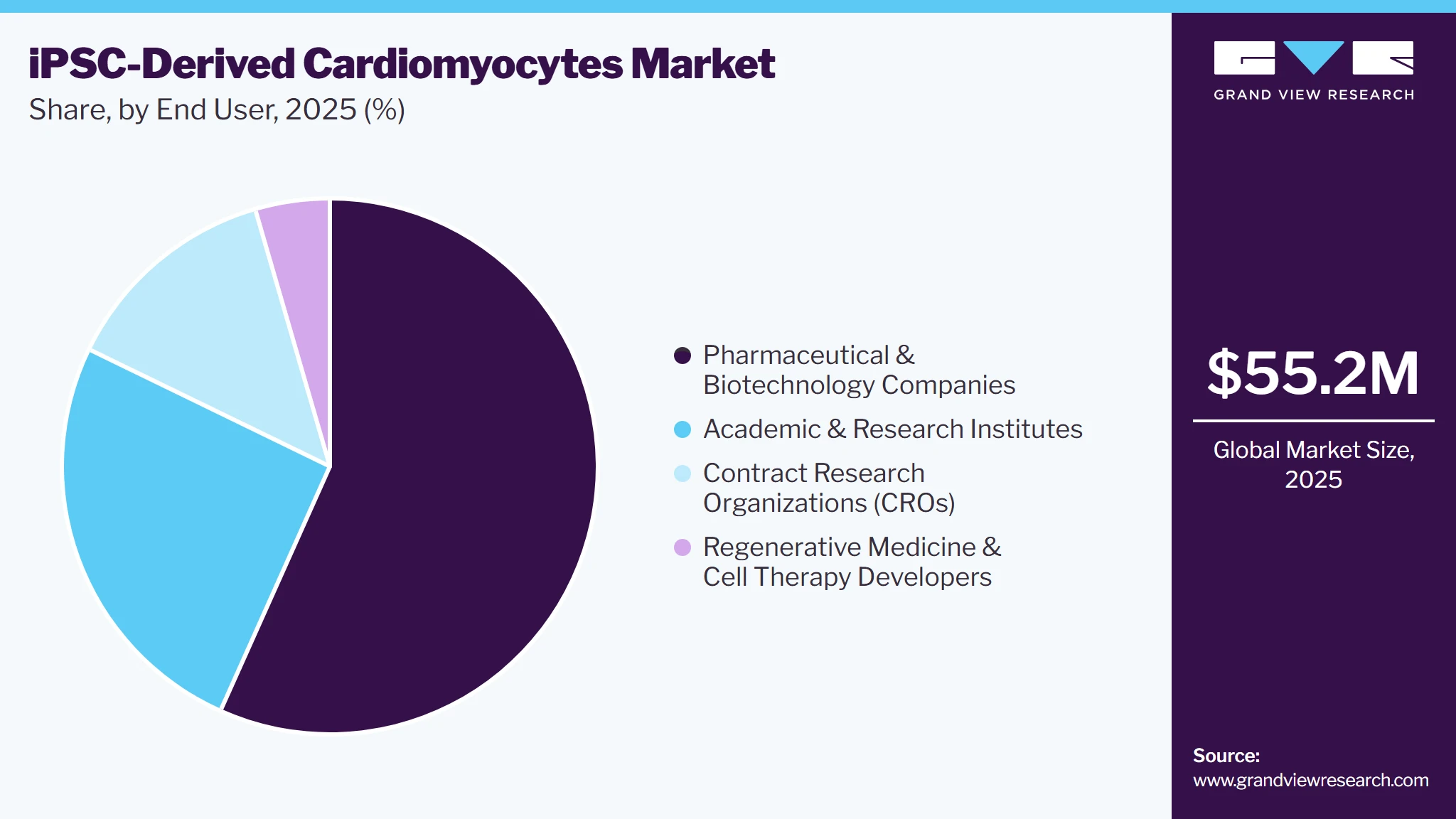
- By end user: Pharmaceutical & biotechnology companies segment held the highest market revenue share of 56.7% in 2025.
Regional Highlights
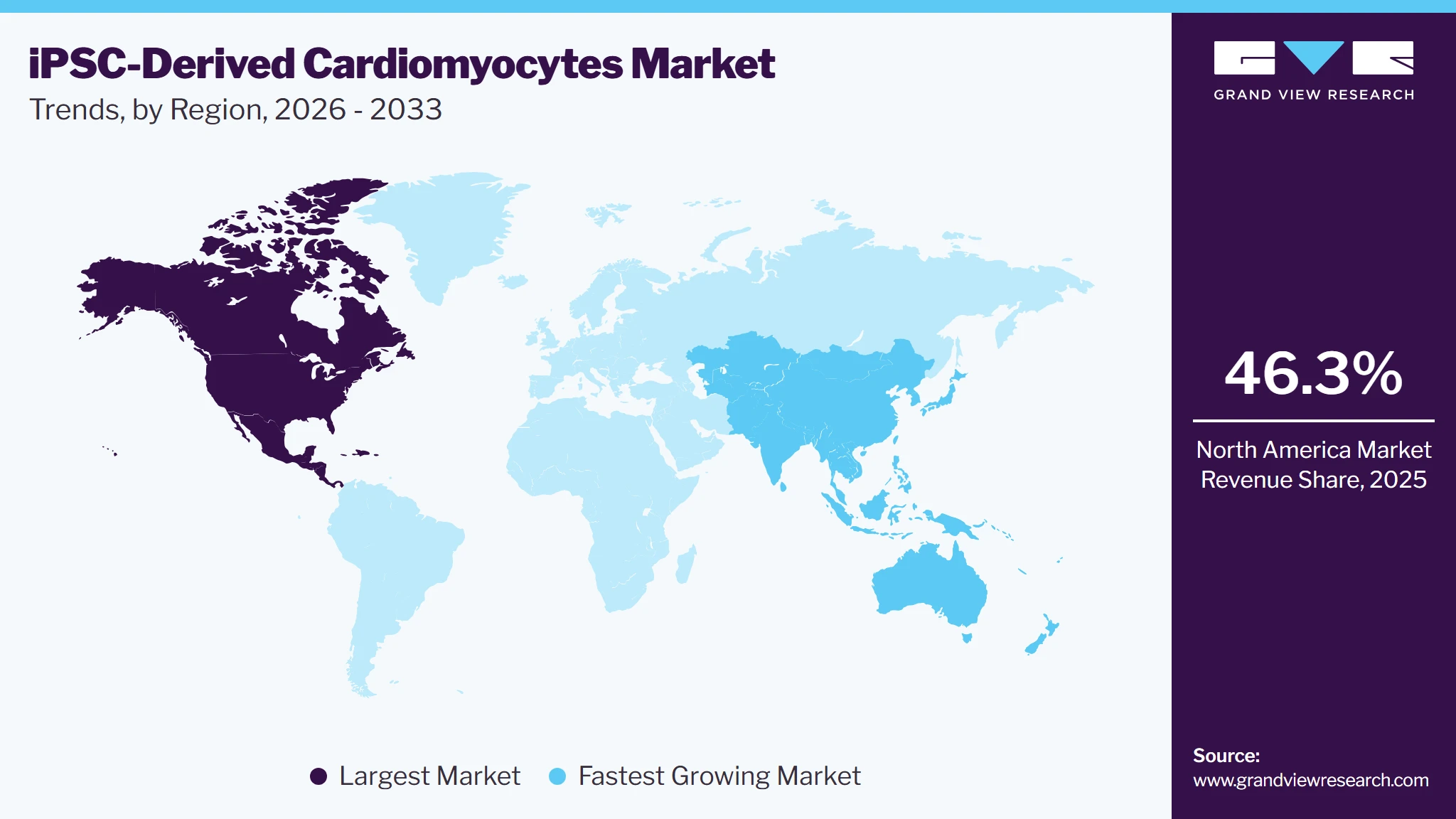
- Largest regional market: North America (46.3% revenue share, 2025)
- Fastest-growing regional market: Asia Pacific (highest CAGR, 2026-2033)
- By country: The U.S. held the largest market share in 2025.
Market Size & Forecast
- Market size in 2025: USD 55.2 Million
- Estimated market size in 2026: USD 59.3 million
- Projected market size by 2033: USD 107.7 Million
- CAGR (2026-2033): 8.9%
Prism AI by Grand View Research Free to tryAsk a question about the iPSC-Derived cardiomyocytes marketTry asking✓Every figure cited from GVR research Prefer the report? Download free sample →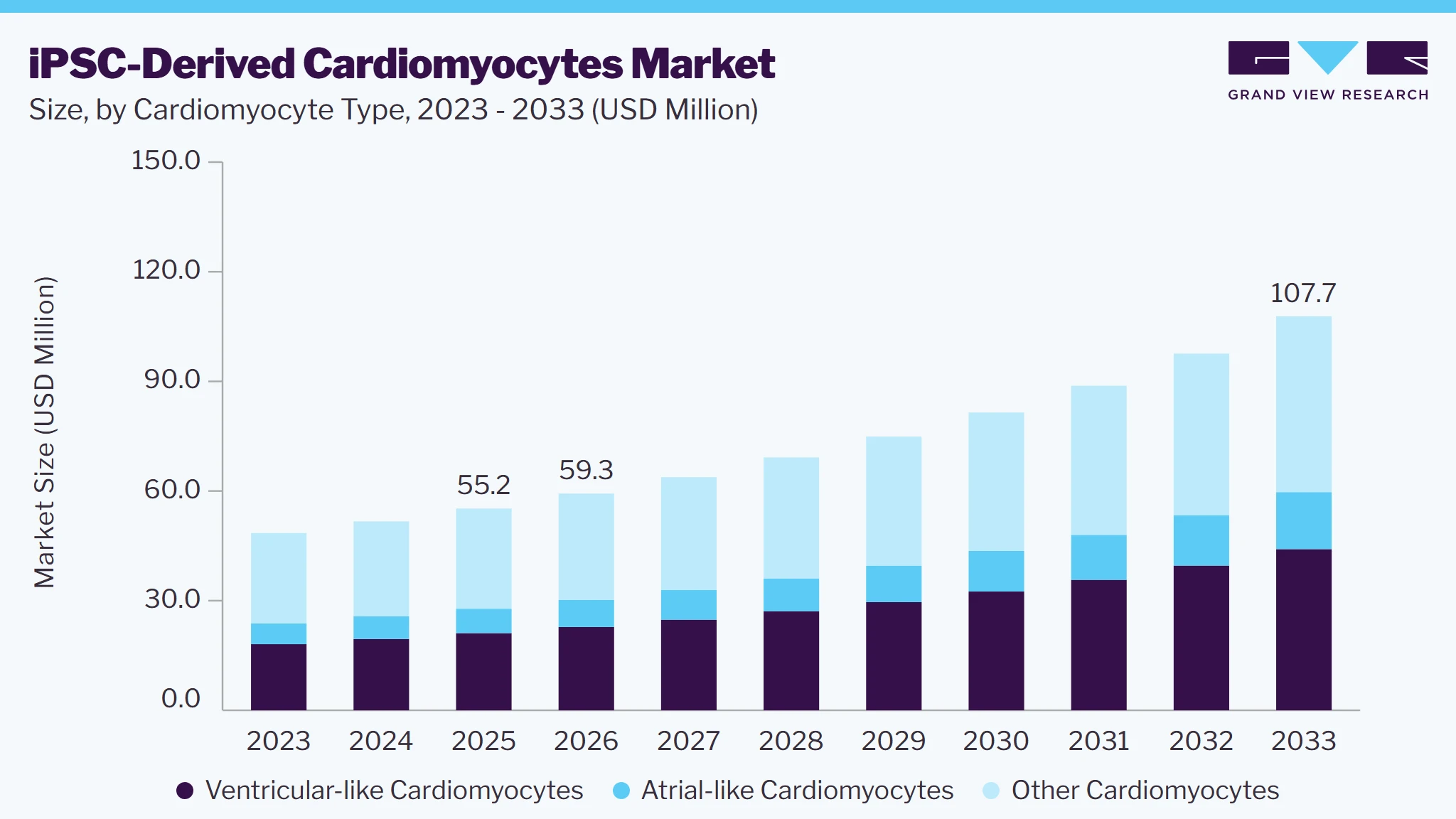 To learn more about this report, Download Free Sample Report
Market Dynamics
The iPSC-derived cardiomyocytes market is witnessing significant growth, driven by increasing demand for advanced cardiac disease modeling across cardiovascular research, precision medicine, drug discovery, and toxicity testing. Growing adoption of induced pluripotent stem cell technologies and other cellular models is enabling the study of cardiac function, disease mechanisms, drug responses, and cardiotoxicity with greater accuracy and efficiency. In addition, expanding use of iPSC-derived cardiomyocytes for therapeutic screening, personalized treatment development, disease modeling, and regenerative medicine research is supporting market growth.
Growing demand for human-relevant models in drug discovery and cardiac safety testing is driving the iPSC-derived cardiomyocytes market. These cells enable researchers to evaluate drug-induced cardiotoxicity and assess cardiac electrophysiological responses using human-derived cellular models, supporting more relevant preclinical safety assessments. For instance, in February 2026, Axion BioSystems announced that the U.S. FDA had accepted its letter of intent for a human iPSC-cardiomyocyte multielectrode array (MEA) assay into the ISTAND program. The assay is designed to detect cardiac electrical abnormalities, including delayed repolarization and arrhythmia-like events. This development highlights the growing role of iPSC-derived cardiomyocytes in advancing functional cardiac safety assessment and drug development.
“Acceptance into the FDA’s ISTAND Program is an important milestone, not just for Axion BioSystems, but for the broader movement toward human-relevant cardiac safety assessment. This assay reflects more than a decade of scientific validation, collaborative studies, and real-world use across industry and regulatory settings. We look forward to working with FDA to advance its qualification as a drug development tool that can increase confidence in early cardiac safety decisions.”
-Julien Bradley, CEO of Axion BioSystems.
In addition to their use in drug discovery and cardiac safety testing, iPSC-derived cardiomyocytes are being investigated for therapeutic applications in patients with heart failure and ischemic heart disease. Clinical studies are evaluating different cell delivery approaches, including direct injection into the heart, cardiomyocyte spheroids, engineered cardiac tissue, and cell sheets. This clinical research demonstrates the expanding application of pluripotent stem cell-derived cardiomyocytes in regenerative medicine. The following table summarizes selected clinical trials and their treatment approaches.
Clinical Trials Involving iPSC-Derived or Other Pluripotent Stem Cell-Derived
Trial title
Trial ID
Treatment type
Cell type
Delivery method
Allogeneic iPSC-derived cardiomyocyte therapy in patients with worsening ischemic heart failure
NCT05566600
Cell
hiPSC-CM
Epicardial injection
Epicardial injection of hiPSC-CMs to treat severe chronic ischemic heart failure
NCT06340048
Cell
HiCM-188
Intramyocardial injection
HECTOR: Human embryonic stem cell-derived cardiomyocyte therapy for chronic ischemic left ventricular dysfunction
NCT05068674
Cell
ESC-CMs
Cardiac catheter
BioVAT-HF: Engineered human myocardium as biological ventricular assist tissue in terminal heart failure
NCT04396899
Patch
hiPSC-CM
Mini-thoracotomy or open-chest surgery
LAPiS: iPSC-derived cardiomyocyte spheroids in patients with heart failure
NCT04945018
Spheroids
HS-001 CS
Epicardial injection
Clinical trial of allogeneic iPSC-derived cardiomyocyte sheets for ischemic cardiomyopathy
jRCT2053190081
Cell sheet patch
hiPSC-CM
Thoracotomy
Source: Nature, Secondary Research, Primary Interviews, Grand View Research Analysis
Challenges in cell engraftment and the risk of arrhythmias can restrain the iPSC-derived cardiomyocytes market by limiting the safety and effectiveness of cardiac cell therapies. After transplantation, these cells must survive, integrate with heart tissue, and function properly. However, low cell retention and abnormal electrical activity can affect treatment outcomes. According to a review published in npj Biomedical Innovations in January 2026, the retention of transplanted human pluripotent stem cell-derived cardiomyocytes following intramyocardial injection is generally around 1-10%. The review also identified arrhythmias associated with cell engraftment as a major challenge in the clinical development of these therapies. These limitations can complicate treatment development and delay the broader clinical application of iPSC-derived cardiomyocytes.
The integration of iPSC-derived cardiomyocytes into advanced cardiac models, including heart-on-a-chip systems and three-dimensional engineered heart tissues, presents an opportunity for market growth. These models can reproduce aspects of human cardiac function and support the evaluation of drug efficacy, cardiotoxicity, and disease mechanisms. According to an article published in Advanced Healthcare Materials in February 2026, researchers developed a tri-culture heart-on-a-chip platform integrating iPSC-derived cardiomyocytes, cardiac fibroblasts, and endothelial cells from a single iPSC line. The platform maintained more than 90% cell viability under perfusion for seven days and demonstrated functional responses to isoproterenol. The inclusion of endothelial cells also reduced doxorubicin-induced cardiotoxic effects, highlighting the potential of these models to improve preclinical cardiac safety assessment.
The study also highlights the importance of incorporating interactions between cardiomyocytes, fibroblasts, and endothelial cells to improve cardiac model performance. By providing a vascular interface and enabling controlled drug exposure, the platform may address limitations of simplified cardiac models, which can misrepresent drug-induced toxicity. Its scalable design could support parallel experiments and improve the assessment of drug responses. These advances have potential to expand the use of iPSC-derived cardiomyocytes in predictive drug screening, help identify cardiac safety concerns earlier, and create new market opportunities in advanced preclinical testing platforms.
Market Concentration & Characteristics
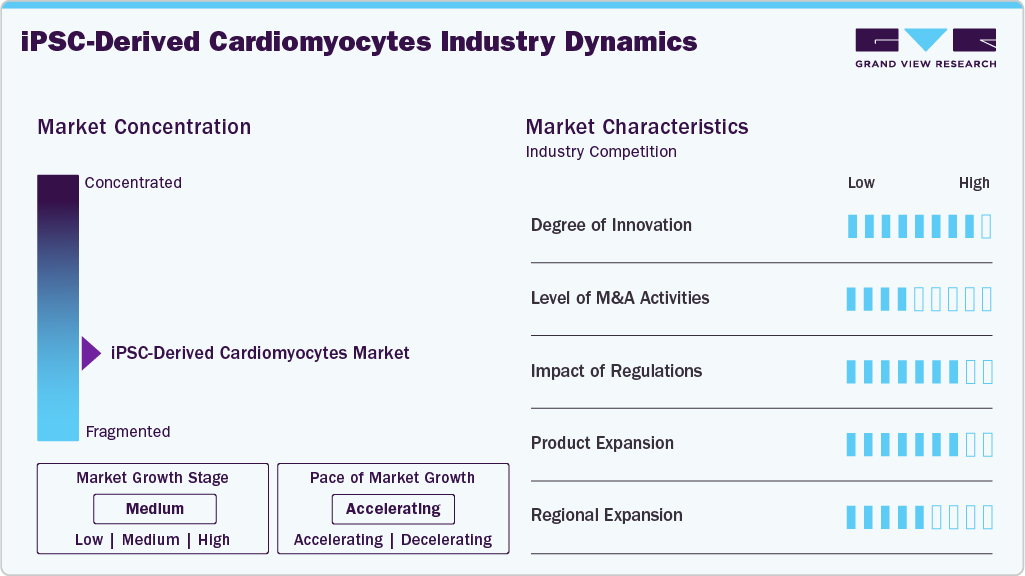
The degree of innovation in the iPSC-derived cardiomyocytes market is high, driven by advances in cardiac cell differentiation, cellular purification, and physiologically relevant cardiac models. For instance, in January 2025, Ncardia launched Ncyte Heart in a Box, a three-dimensional cardiac microtissue model derived from human induced pluripotent stem cells. The model combines ventricular cardiomyocytes, endothelial cells, and cardiac fibroblasts to better represent the cellular complexity of human heart tissue. This innovation supports cardiac disease modeling, drug screening, cardiotoxicity assessment, and cardiovascular drug discovery.
“This launch marks a significant milestone in cardiac research innovation. With Ncyte Heart in a Box, we are empowering researchers to study complex cardiac biology with unprecedented precision, enabling breakthroughs in cardiovascular therapeutics and personalized medicine.”
-Jeroen de Groot, Divisional CEO of Ncardia.
 To learn more about this report, Download Free Sample Report
The level of merger and acquisition activity in the iPSC-derived cardiomyocytes market is low, as the market remains specialized and focused on developing and supplying human stem cell-derived cardiac models for research and drug discovery. Companies primarily emphasize internal product development, improvements in cardiomyocyte differentiation protocols, and expansion of cell model portfolios rather than pursuing acquisitions. The specialized nature of iPSC technology and the need for expertise in cardiac cell differentiation and characterization may also limit acquisition opportunities. Consequently, market development is driven more by technological innovation and product development than by merger and acquisition activity.
The impact of regulations on the iPSC-derived cardiomyocytes market is moderate to high, as regulatory expectations for cell quality, consistency, and assay reliability influence the use of these cells in drug discovery and cardiovascular safety assessment. Manufacturers and research organizations must ensure that iPSC-derived cardiomyocytes demonstrate appropriate functional characteristics and reproducible performance for their intended applications. These requirements encourage standardized differentiation protocols, cell characterization, quality control, and validated assay methods, supporting reliable cardiotoxicity testing, cardiac disease modeling, and preclinical drug evaluation.
The iPSC-derived cardiomyocytes market is expanding through the launch of specialized manufacturing platforms designed to support scalable production of cardiac cells for therapeutic applications. For instance, in January 2026, Cellistic launched its Echo-Cardio platform, a GMP manufacturing platform for producing iPSC-derived cardiomyocytes with a defined, homogeneous phenotype and demonstrated functional relevance. The platform is designed to support reproducible cardiac regenerative medicine programs and provides cell therapy developers with manufacturing capabilities intended to facilitate progression from development toward clinical and commercial production. This launch broadens the availability of specialized manufacturing solutions for iPSC-derived cardiomyocyte-based therapies.
“Building on this foundation and more than 15 years of experience in iPSC-derived cell therapy process development and GMP manufacturing, our team has developed three platforms designed to overcome the limitations of current cell therapy approaches. These off-the-shelf allogeneic cell therapies are a cost-effective way of ensuring more patients have access to these life-changing treatment options.”
- Gustavo Mahler, CEO of Cellistic
The iPSC-derived cardiomyocytes market is expanding geographically as companies establish international commercialization networks to increase the availability of stem cell-derived cardiac products. For instance, in October 2026, Dai Nippon Printing (DNP), NEXEL, and CMIC Pharma Science established TriNebula Cell Tech Co., Ltd. in Japan to support the global marketing and commercialization of iPSC-derived products, including cardiomyocytes. Under a licensing agreement with NEXEL, DNP also plans to manufacture cardiomyocytes and develop a global manufacturing and sales structure. This initiative is expected to broaden international access to iPSC-derived cardiomyocytes for drug discovery and safety assessment.
Analyst Perspective
The iPSC-derived cardiomyocytes market is expected to witness moderate growth, supported by increasing demand for human-relevant cardiac models in drug discovery, cardiotoxicity testing, and cardiovascular disease research. As pharmaceutical and biotechnology companies seek to improve the predictive accuracy of preclinical studies, demand is expected to rise for specialized cardiomyocytes that enable reliable assessment of drug responses, cardiac function, and disease mechanisms. Growing investment in regenerative medicine and stem cell-based cardiac therapies is further expanding opportunities for therapeutic development. However, challenges related to cell maturation, batch consistency, and transplantation safety may constrain adoption. Market participants are focusing on improving cell differentiation, enhancing manufacturing scalability, and developing advanced cardiac models.
Cardiomyocyte Type Insights
The ventricular-like cardiomyocytes segment accounted for the significant revenue share, over 38.1% in 2025, supported by increasing applications in regenerative medicine, cardiovascular disease treatment, and drug development. These cells are being investigated for their potential to restore cardiac muscle function in patients with severe heart failure. In June 2026, Heartseed initiated patient dosing in its Phase I/II EMERALD clinical trial of HS-005, an investigational therapy comprising purified iPSC-derived ventricular cardiomyocytes formulated into spheroids. In Addition, in October 2026, Heartseed reported that the first patient with ischemic heart disease-related heart failure had been dosed in the trial’s ischemic heart disease cohort. Following review of four-week post-administration data, the independent safety monitoring committee approved continuation of this cohort. HS-005 spheroids are manufactured by Nikon CeLL innovation under contract to Heartseed, highlighting continued clinical development of iPSC-derived ventricular cardiomyocytes for regenerative cardiac therapy.
The atrial-like cardiomyocytes segment is expected to register the fastest CAGR during 2026-2033, driven by increasing demand for chamber-specific human cardiac models for atrial fibrillation research, drug discovery, and cardiotoxicity screening. For instance, in September 2026, myriamed GmbH entered into an exclusive partnership with bit.bio to expand global commercial access to its human iPSC-derived cardiac cell portfolio, including cryopreserved atrial and ventricular cardiomyocytes. The agreement will make these cells available through bit.bio’s commercial channel and integrate them into broader drug discovery workflows, supporting the adoption of atrial-like cardiomyocytes for preclinical cardiac research.
"myriamed has built its position at the forefront of human cardiac modelling through decades of dedicated research and technology development. Partnering with bit.bio gives us a great reach alongside a cell programming platform that complements our own work. Together, we have an opportunity not only to accelerate the adoption of human-relevant models, but also to help redefine drug development, placing human biology at the centre of faster, more predictive decision-making."
- Arne Östlind, CEO of myriamed GmbH
Application Insights
The cardiotoxicity & safety pharmacology segment dominated the market with a share of 36.1% in 2025 and is expected to grow at the fastest CAGR over the forecast period. The growth is supported by increasing demand for human-relevant models to evaluate drug-induced cardiac risks during preclinical development. iPSC-derived cardiomyocytes enable researchers to assess drug effects on cardiac electrical activity, contractility, cell viability, and potential arrhythmias. Their use in preclinical drug screening helps pharmaceutical companies identify potential cardiac safety concerns earlier in development and supports more reliable safety assessments. These applications are expected to drive demand for iPSC-derived cardiomyocytes in drug discovery and cardiovascular safety testing.
The cardiovascular disease modeling segment is expected to register the significant CAGR during 2026-2033, driven by increasing research into regenerative medicine and the development of human-relevant models for cardiovascular disorders. iPSC-derived cardiomyocytes can support the investigation of disease mechanisms, evaluation of potential therapeutic interventions, and development of cell-based approaches for conditions such as myocardial infarction, ischemic heart disease, and heart failure. Their ability to model human cardiac function and potentially replace damaged heart muscle cells is expected to support continued research and clinical development in cardiovascular medicine.
End User Insights
Pharmaceutical & biotechnology companies segment accounted for 56.7% share in 2025, making it a leading end user segment. Growth is driven by increasing adoption of human-relevant cardiac models for drug discovery and development. For instance, in September 2025, HeartBeat.bio announced a research collaboration with Boehringer Ingelheim to develop gene therapy treatments for inherited cardiomyopathies. The collaboration combines Boehringer Ingelheim’s gene therapy development expertise with HeartBeat.bio’s Cardioid Drug Discovery Platform, which incorporates iPSC-derived cardiac organoids and automated screening technologies. This partnership highlights the use of iPSC-based cardiac models by pharmaceutical and biotechnology companies to advance therapeutic development for cardiovascular diseases.
“Inherited heart diseases often strike early and progress silently. By modeling genetic cardiomyopathies in human cardiac organoids, we can screen and profile potential therapies with unprecedented precision and speed. This collaboration with Boehringer Ingelheim marks an important step towards bringing new, transformative treatments to patients with inherited heart conditions.”
- Michael Krebs, CEO of HeartBeat.bio.
 To learn more about this report, Download Free Sample Report
Regenerative medicine & cell therapy developers segment is projected to witness the fastest CAGR during 2026–2033, supported by increasing research and development of stem cell-based therapies for cardiovascular disorders. iPSC-derived cardiomyocytes offer potential for repairing damaged heart tissue, improving cardiac function, and developing regenerative treatments for conditions such as myocardial infarction and heart failure. Continued advances in cell differentiation, transplantation techniques, and manufacturing processes are expected to support the development of iPSC-based cardiac therapies and expand their potential applications in regenerative medicine.
Regional Insights
North America dominated the iPSC-derived cardiomyocytes market, accounting for the largest revenue share of 46.3% in 2025, driven by increasing demand for human-relevant cardiac models in drug discovery and cardiotoxicity testing. For instance, in June 2023, StemBioSys launched CELLvo Atrial Cardiomyocyte, developed in collaboration with REPROCELL. The product consists of chamber-specific human induced pluripotent stem cell-derived atrial cardiomyocytes designed to improve in-vitro drug screening by more closely replicating the electrophysiological properties of human atrial cells. The launch supports pharmaceutical and academic research by providing a specialized cellular model for evaluating drug-induced cardiotoxicity and arrhythmia risk.
 To learn more about this report, Download Free Sample Report
“Having access to mature, human atrial cells derived from human induced pluripotent stem cells (hiPSCs) is a breakthrough in many ways. The chamber-specificity of CELLvo Atrial Cardiomyocyte is a significant advance because the electrophysiology of each heart chamber is distinct, and there are drug compounds that are known to cause arrhythmia in only the atria or ventricles. Thus, these mature human atrial cells mirror those found in a natural, beating heart and should be better predictors of drug effects and toxicity. This thesis was affirmed by data published in a peer-reviewed journal, which demonstrated that hiPSC-CMs cultured on Matrix Plus are a more accurate predictor for cardiac toxicity than the ion-channel in vitro testing method commonly in use.”
-Bob Hutchens, CEO of StemBioSys
U.S. iPSC-Derived Cardiomyocytes Market Trends
The U.S. iPSC-derived cardiomyocytes market is expected to grow over the forecast period, supported by increasing federal funding for advanced cardiotoxicity testing and human-relevant preclinical drug screening technologies. For instance, on August 2023, U.S.-based VALA Sciences, Inc. received a Phase II Small Business Technology Transfer (STTR) award of approximately USD 2.46 million from the National Institutes of Health (NIH) to develop a high-throughput testing platform using human iPSC-derived cardiomyocytes. The project incorporates automated imaging and analysis of electrical activity, calcium signaling, and cardiac contraction to evaluate drug-induced cardiotoxicity.
Europe iPSC-Derived Cardiomyocytes Market Trends
Europe iPSC-derived cardiomyocytes market is anticipated to grow significantly over the forecast period, supported by increasing demand for advanced human-relevant models in drug discovery, growing emphasis on cardiovascular safety assessment, and advancements in stem cell reprogramming and differentiation technologies. iPSC-derived cardiomyocytes provide a valuable platform for evaluating drug-induced cardiotoxicity, studying cardiac disease mechanisms, and screening potential therapeutic compounds. The region’s established pharmaceutical and biotechnology industries, strong research infrastructure, and increasing adoption of physiologically relevant in-vitro models are expected to support market growth.
UK iPSC-Derived Cardiomyocytes Market Trends
The UK iPSC-derived cardiomyocytes industry is expected to grow over the forecast period, driven by increasing commercial availability of human iPSC-derived cardiomyocytes for pharmaceutical research and cardiac safety testing. For instance, in February 2025, UK-based AMSBIO announced a new range of ready-to-use human iPSC-derived cardiomyocytes, supplied in high-purity formats and functionally validated for research applications. This product expansion supports the use of iPSC-derived cardiomyocytes in drug discovery, disease modeling, and preclinical cardiac research.
Germany iPSC-Derived Cardiomyocytes Market Trends
The iPSC-derived cardiomyocytes market in Germany is anticipated to grow significantly over the forecast period, supported by increasing demand for human-relevant cardiac safety testing and advanced preclinical drug screening technologies. For instance, in March 2026, Germany-based Iventim Solutions GmbH and the University of Cologne announced a €1.8 million (USD 2.02 million) research collaboration to develop KI2CARDIO, an AI-powered imaging and analysis platform for evaluating human stem-cell-derived cardiomyocytes and cardiac organoids. This collaboration highlights ongoing advancements in cardiomyocyte-based analysis technologies for pharmaceutical research and cardiotoxicity assessment.
Asia Pacific iPSC-Derived Cardiomyocytes Market Trends
Asia Pacific is expected to grow at the fastest CAGR of 11.1% during the forecast period, supported by increasing clinical development and commercial partnerships focused on iPSC-based cardiac therapies. For instance, in June 2025, China-based HELP Therapeutics and China Resources Sanjiu Pharmaceutical announced a strategic partnership to co-develop and commercialize HiCM-188, an investigational therapy for advanced heart failure in mainland China. The collaboration highlights regional efforts to advance iPSC-based treatments for cardiovascular diseases.
"This co-development agreement with China Resources Sanjiu marks a significant milestone for HELP Therapeutics. Their exceptional clinical network, innovation mindset, and commercial capabilities will accelerate the availability of our therapies to patients and contribute to the growth of China's cell therapy industry."
- Dr. Eugene Wang, Founder and CEO of HELP Therapeutics.
China iPSC-Derived Cardiomyocytes Market Trends
China’s iPSC-derived cardiomyocytes industry is expected to grow over the forecast period, supported by advances in regenerative medicine and cell-based cardiovascular therapies. For instance, in October 2024, HELP Therapeutics announced that the U.S. FDA had cleared its IND application for HiCM-188, an allogeneic human iPSC-derived cardiomyocyte therapy for end-stage heart failure. The planned Phase I clinical study across U.S. sites aims to evaluate the therapy’s safety and tolerability, highlighting China’s progress in developing iPSC-derived cell therapies for cardiac regeneration.
“Our off-the-shelf product - the Regenerative Cardiac Cell Injection (iPS-CMs: HiCM188) - has successfully obtained IND clinical trial approval in the U.S. This product innovatively shifts from whole heart transplantation to precise myocardial repair by transplanting fresh myocardial cells into damaged areas, promising a revolutionary treatment option for heart failure patients. Additionally, the company is committed to developing affordable innovative drugs, aiming to create cell therapy products that are accessible and beneficial a broad patient population.”
-Jiaxian Wang, MD, PhD, Founder and CEO of Help Therapeutics.
Japan iPSC-Derived Cardiomyocytes Market Trends
Japan’s iPSC-derived cardiomyocytes market is witnessing rapid growth driven by regulatory progress and the commercialization of iPSC-based cardiac therapies. For instance, in March 2026, Cuorips Inc. received conditional and time-limited manufacturing and marketing approval from Japan’s Ministry of Health, Labour and Welfare for RiHEART, an allogeneic iPSC-derived cardiomyocyte sheet designed to treat severe heart failure caused by ischemic cardiomyopathy. This milestone highlights Japan’s progress in translating iPSC-derived cardiomyocyte technology into clinical treatment.
Latin America iPSC-Derived Cardiomyocytes Market Trends
The Latin America iPSC-derived cardiomyocytes industry is expected to grow steadily over the forecast period, supported by increasing demand for advanced cell-based models in cardiovascular drug discovery, cardiotoxicity testing, and disease modeling. The growing adoption of human iPSC-derived cardiomyocytes in pharmaceutical research is expected to support the evaluation of drug safety and cardiac disease mechanisms. In addition, expanding biotechnology research capabilities and increasing interest in human-relevant preclinical testing models are anticipated to create opportunities for market development across the region.
MEA iPSC-Derived Cardiomyocytes Market Trends
The Middle East & Africa iPSC-derived cardiomyocytes industry is growing steadily, supported by investment in stem cell manufacturing infrastructure and the development of clinical-grade iPSC technologies. For instance, in January 2025, the Abu Dhabi Stem Cells Center (ADSCC) in the United Arab Emirates announced that it had developed clinical-grade induced pluripotent stem cells using an in-house, virus-free protocol that complies with good manufacturing practice standards. This development supports the region’s regenerative medicine capabilities and may facilitate future applications of iPSC-derived cells.
Key iPSC-Derived Cardiomyocytes Companies Insights
The iPSC-derived cardiomyocytes market is highly competitive, with key players focusing on cell differentiation technologies, disease modeling, cardiotoxicity screening, high-throughput assays, and scalable cell production solutions. Companies are strengthening their market position through product launches, technological advancements, strategic collaborations, and expansion of stem cell research capabilities. Moreover, competitive positioning depends on product offerings, technological capabilities, cell purity, functional performance, geographic presence, customer base, and applications across cardiovascular disease research, drug discovery, toxicity testing, regenerative medicine, and personalized medicine.
Key iPSC-Derived Cardiomyocytes Companies:
The following key companies have been profiled for this study on the iPSC-derived cardiomyocytes market:
-
FUJIFILM Holdings Corporation
-
Ncardia (acquired by Kiniciti Bio, Inc.)
-
Axol Bioscience Ltd.
-
NEXEL Co., Ltd.
-
Takara Bio Inc.
-
BPS Bioscience, Inc.
-
Creative Bioarray
-
Applied StemCell (acquired by QHP Capital)
-
Cell Applications
-
myriamed GmbH
-
AcceGen
-
Curi Bio, Inc.
-
StemBioSys, Inc.
Competitive Benchmarking
Category
Operating Strategies
Competitive Edge
Weakness
Established Players (FUJIFILM Holdings Corporation; Ncardia; Axol Bioscience Ltd.; NEXEL Co., Ltd.; Takara Bio Inc.)
- Expanding iPSC-derived cardiomyocyte portfolios for drug discovery, cardiotoxicity testing, and disease modelling; improving cell quality, maturity, and production scalability; and strengthening research collaborations.
- Established product portfolios, advanced stem cell technologies, specialized cardiac models, and strong research expertise.
- High production costs, cell variability, challenges in cardiomyocyte maturation, and competition from alternative cardiac models.
Emerging and Specialized Players (BPS Bioscience, Inc.; Creative Bioarray; Applied StemCell (acquired by QHP Capital); Cell Applications; myriamed GmbH; AcceGen; Curi Bio, Inc.; StemBioSys, Inc.)
- Developing specialized cardiomyocytes, cardiac disease models, and research solutions; expanding drug screening applications and commercial partnerships.
- Specialized products, flexible research solutions, niche expertise, and differentiated cardiac modelling capabilities.
- Limited scale for some providers, production challenges, variable product availability, and competition from established suppliers.
Recent Developments
- In May 2026, FUJIFILM Cellular Dynamics, Inc., a subsidiary of FUJIFILM Holdings Corporation, opened a new iPSC development and manufacturing facility in Madison, Wisconsin, as part of a USD 200 million strategic investment. The facility is expected to quadruple manufacturing capacity for iPSC-based research products and expand production of iPSC-derived iCell products, strengthening applications in drug discovery, cardiotoxicity testing, and preclinical safety assessment.
“Completion of this facility comes at a critical time in the iPSC field, where FUJIFILM Cellular Dynamics has been setting industry standards for more than 20 years. This new facility enables us to respond to growing demand from pharmaceutical companies, research institutions, and academia engaged in new drug research and development, further delivering on our commitment to the development of life-changing medical treatments and to the people who will benefit from the.”
- Toshihisa Iida, director, corporate vice president, general manager of Life Sciences Strategy Headquarters and Bio CDMO Division, FUJIFILM Corporation, Japan.
- In September 2025, Ncardia launched Ncyte NHP-C vCardiomyocytes, the first commercially available ventricular-like cardiomyocytes derived from cynomolgus monkey induced pluripotent stem cells (iPSCs). The product supports cross-species cardiac research, cardiotoxicity screening, and preclinical drug safety assessment, strengthening Ncardia’s portfolio of iPSC-derived cardiac models for pharmaceutical and biotechnology research.
“As the only iPSC-derived NHP ventricular cardiomyocytes on the market, Ncyte NHP-C vCardiomyocytes set a new standard for translational cardiovascular research. They give researchers the ability to perform direct cross-species comparisons in vitro, improve cardiotoxicity risk assessment, and meet the FDA’s evolving expectations around reducing the use of live non-human primates in safety testing.”
- Jeroen de Groot, Divisional Chief Executive of Ncardia.
- In March 2025, Axol Bioscience Ltd. launched MyoMax Maturation Media, a specialized medium designed to enhance the structural and functional maturity of human iPSC-derived ventricular cardiomyocytes. The product promotes improved sarcomere alignment, maturity-associated marker expression, metabolic maturation, and electrophysiological characteristics, supporting more physiologically relevant in vitro cardiac models for cardiotoxicity screening, disease modeling, and drug development.
iPSC-Derived Cardiomyocytes Market Report Scope
Report Attribute
Details
Market size in 2025
USD 55.2 million
Estimated market size in 2026
USD 59.3 million
Projected market size by 2033
USD 107.7 million
Growth rate
CAGR of 8.9% from 2026 to 2033
Historical data
2021 - 2025
Forecast period
2026 - 2033
Quantitative units
Revenue in USD million, and CAGR from 2026 to 2033
Report coverage
Revenue forecast, company ranking, competitive landscape, growth factors, and trends
Segments covered
Cardiomyocyte type, application, end user, region
Regional scope
North America; Europe; Asia Pacific; Latin America; MEA
Country scope
U.S., Canada, Mexico, UK, Germany, France, Italy, Spain, Norway, Denmark, Sweden, China, Japan, India, South Korea, Australia, Thailand, Brazil, Argentina, Saudi Arabia, South Africa, UAE, Kuwait
Key companies profiled
FUJIFILM Holdings Corporation, Ncardia (acquired by Kiniciti Bio, Inc.), Axol Bioscience Ltd., NEXEL Co., Ltd., Takara Bio Inc., BPS Bioscience, Inc., Creative Bioarray, Applied StemCell (acquired by QHP Capital), Cell Applications, myriamed GmbH, AcceGen, Curi Bio, Inc., and StemBioSys, Inc.
Customization scope
Free report customization (equivalent up to 8 analysts' working days) with purchase. Addition or alteration to country, regional & segment scope.
Pricing and purchase options
Avail customized purchase options to meet your exact research needs. Explore purchase options
Global iPSC-Derived Cardiomyocytes Market Report Segmentation
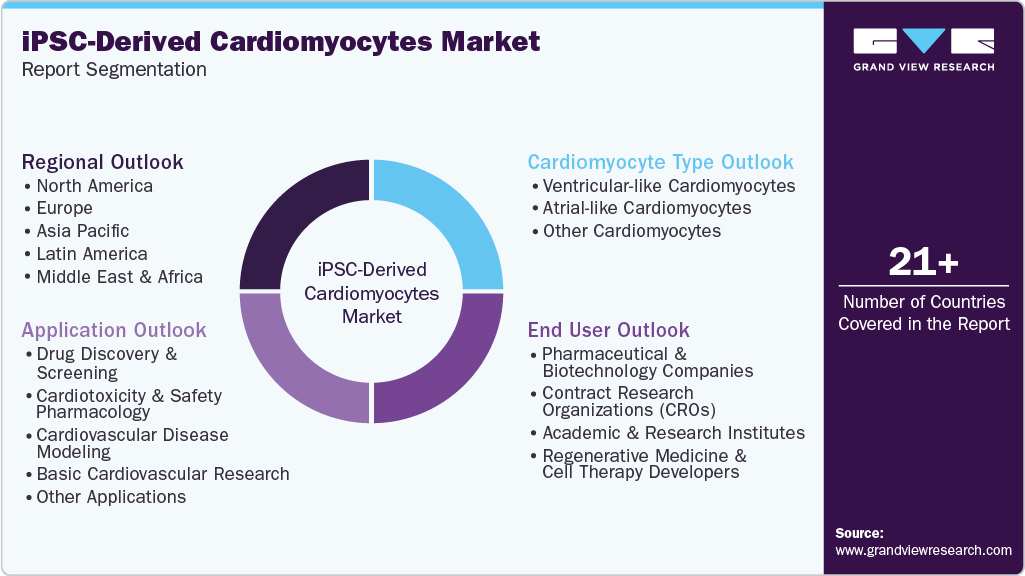
This report forecasts revenue growth and provides an analysis on the latest trends in each of the sub-segments from 2021 to 2033. For the purpose of this report, Grand View Research has segmented the global iPSC-derived cardiomyocytes market on the basis of cardiomyocyte type, application, end user and region
 To learn more about this report, Download Free Sample Report
-
iPSC-Derived Cardiomyocytes Cardiomyocyte Type Outlook (Revenue, USD Million, 2021 - 2033)
-
Ventricular-like Cardiomyocytes
-
Atrial-like Cardiomyocytes
-
Other Cardiomyocytes
-
-
iPSC-Derived Cardiomyocytes Application Outlook (Revenue, USD Million, 2021 - 2033)
-
Drug Discovery & Screening
-
Cardiotoxicity & Safety Pharmacology
-
Cardiovascular Disease Modeling
-
Basic Cardiovascular Research
-
Other Applications
-
-
iPSC-Derived Cardiomyocytes End User Outlook (Revenue, USD Million, 2021 - 2033)
-
Pharmaceutical & Biotechnology Companies
-
Contract Research Organizations (CROs)
-
Academic & Research Institutes
-
Regenerative Medicine & Cell Therapy Developers
-
-
iPSC-Derived Cardiomyocytes Regional Outlook (Revenue, USD Million, 2021 - 2033)
-
North America
-
U.S.
-
Canada
-
Mexico
-
-
Europe
-
UK
-
Germany
-
France
-
Italy
-
Spain
-
Denmark
-
Sweden
-
Norway
-
-
Asia Pacific
-
Japan
-
China
-
India
-
Australia
-
Thailand
-
South Korea
-
-
Latin America
-
Brazil
-
Argentina
-
-
Middle East and Africa (MEA)
-
South Africa
-
Saudi Arabia
-
UAE
-
Kuwait
-
-
Research Methodology
The iPSC-derived cardiomyocytes market figures in this report are based on a proven research process that combines executive interviews with secondary research from proprietary databases, company filings, and recognized regulatory and institutional sources. Market size is built through value-chain sizing-reconciling supply-side and demand-side estimates-and triangulated with bottom-up and top-down approaches. Every estimate passes multiple levels of expert validation before publication, with each iPSC-derived cardiomyocytes segment quantified using the revenue-capture definitions in the table below.
Segment Definition
Segment - Cardiomyocyte Type
Revenue Capture Definition
Ventricular-like Cardiomyocytes
Revenue generated from induced pluripotent stem cell-derived cardiomyocytes differentiated to exhibit ventricular-like characteristics, used in drug discovery, cardiac safety assessment, cardiovascular disease modeling, and research on ventricular function.
Atrial-like Cardiomyocytes
This segment captures income from iPSC-derived cardiomyocytes differentiated to exhibit atrial-like characteristics, used to investigate atrial electrophysiology, arrhythmias, drug responses, and atrial-specific cardiovascular disorders.
Other Cardiomyocytes
Market value in this category stems from iPSC-derived cardiomyocyte types other than ventricular-like and atrial-like cardiomyocytes, including sinoatrial node-like, pacemaker-like, and other specialized cardiac cell populations.
Segment - Application
Revenue Capture Definition
Drug Discovery & Screening
Revenue generated from iPSC-derived cardiomyocytes used to identify and evaluate drug candidates, screen compounds for pharmacological activity, investigate mechanisms of action, and assess potential therapeutic effects, excluding applications primarily focused on cardiac toxicity and safety evaluation.
Cardiotoxicity & Safety Pharmacology
This segment captures income from iPSC-derived cardiomyocytes used primarily to evaluate drug-induced cardiac toxicity, electrophysiological abnormalities, arrhythmia risk, and other cardiovascular safety liabilities during drug discovery and development.
Cardiovascular Disease Modeling
Market value in this category stems from iPSC-derived cardiomyocytes used to establish or investigate cellular models of specific cardiovascular disorders, including cardiomyopathies and arrhythmias, to study disease mechanisms and evaluate potential therapeutic interventions.
Basic Cardiovascular Research
Revenue generated from iPSC-derived cardiomyocytes used primarily for fundamental studies of cardiac development, cellular physiology, electrophysiology, contractility, signaling pathways, and normal cardiomyocyte function, excluding studies primarily focused on disease-specific modeling or drug evaluation.
Other Applications
Revenue from iPSC-derived cardiomyocytes used for applications outside drug discovery and screening, cardiotoxicity and safety pharmacology, cardiovascular disease modeling, and basic cardiovascular research, including regenerative medicine research and cardiac tissue engineering when these are the primary purposes of use.
Segment - End User
Revenue Capture Definition
Pharmaceutical & Biotechnology Companies
Revenue generated from iPSC-derived cardiomyocytes purchased or used directly by pharmaceutical and biotechnology companies for drug discovery, compound screening, cardiac safety assessment, disease modeling, and preclinical research conducted within their own operations.
Contract Research Organizations (CROs)
This segment captures income from iPSC-derived cardiomyocytes purchased or used by contract research organizations to provide outsourced drug screening, cardiotoxicity testing, cardiovascular disease modeling, and other preclinical cardiac research services to clients.
Academic & Research Institutes
Market value in this category stems from iPSC-derived cardiomyocytes purchased or used by universities, academic laboratories, and research institutes for fundamental cardiovascular research, disease modeling, cellular physiology studies, and translational research, including regenerative medicine research conducted within these institutions.
Regenerative Medicine & Cell Therapy Developers
Revenue generated from iPSC-derived cardiomyocytes purchased or used by organizations primarily focused on developing regenerative medicine products or cell-based therapies, including cardiac cell replacement approaches, therapeutic candidate development, and cardiac tissue engineering for therapeutic applications.
Estimation Model
Category
Subcategory
Description
Top-Down
Commodity Flow Analysis
Market value was estimated by assessing revenues from IPSC-derived cardiomyocytes, cell culture products, differentiation kits, assay kits, cryopreserved cells, instruments, and laboratory services. Company financials, product portfolios, pricing, production volumes, and commercial offerings were analyzed to quantify revenue across major applications and technologies. Revenue from specialized cardiomyocyte products and services was evaluated to determine overall market value.
Parent Market
Parent Market & Penetration-Based Analysis
The IPSC-derived cardiomyocytes market was assessed within the broader induced pluripotent stem cells market based on applications in drug discovery, cardiotoxicity testing, disease modeling, and regenerative medicine research. Adoption of these cells across pharmaceutical, biotechnology, and academic research workflows was evaluated to establish the addressable opportunity. Research applications include preclinical safety assessment, cardiovascular disease modeling, and therapeutic development.
Segmentation
Country-Level Segment Share Modeling
Country-level shares were estimated using stem cell research activity, cardiomyocyte production capacity, drug discovery programs, disease modeling, and clinical research infrastructure. Differences in cardiovascular disease burden, demand for cardiotoxicity testing, technology availability, laboratory infrastructure, and pharmaceutical R&D were incorporated to determine country and regional distributions across cardiomyocyte type, application, and end-user segments.
Validation
Data Triangulation & Validation Model
Market estimates were reconciled using company revenues, cardiomyocyte production volumes, product pricing, manufacturing capacity, laboratory activity, research applications, and scientific evidence. The resulting estimates were cross-checked across cardiomyocyte type, application, product type, end user, country, and region to ensure consistency between volume-based and revenue-based calculations.
Forecasting
Forecasting & CAGR Modeling
Future demand was projected using observed expansion of drug discovery, cardiotoxicity testing, cardiovascular disease incidence, regenerative medicine, and pharmaceutical research. Increasing demand for predictive drug screening, advanced cell models, technological improvements, and growing adoption of IPSC-derived cardiomyocytes across research applications were incorporated into segment-level growth assumptions.
Delivered Customizations
This report has been delivered with the following In-depth customizations
Client Request
Customization Delivered
Value Adds
iPSC-Derived Cardiomyocyte Pricing & Purchasing Pattern Assessment
Assessment of product pricing, order quantities, repeat purchasing patterns, and procurement preferences across selected pharmaceutical companies, CROs, and research laboratories.
Help clients to understand customer purchasing behavior, evaluate pricing strategies, and align product offerings with end-user requirements.
iPSC-Derived Cardiomyocyte Batch Consistency Assessment
Comparative analysis of batch-to-batch variation in cell viability, purity, functional characteristics, and assay performance using available product specifications and published data.
Help clients to identify important product consistency parameters and understand factors influencing customer selection and experimental reproducibility.
iPSC-Derived Cardiomyocyte Application-Specific Demand Assessment
Detailed assessment of cell requirements across selected use cases, such as cardiotoxicity screening, disease modeling, drug discovery, and cardiac electrophysiology studies.
Help clients to identify application-specific customer needs and prioritize product development, marketing, and sales efforts.
Frequently Asked Questions About This Report
The global iPSC-derived cardiomyocytes market size was valued at USD 55.2 million in 2025 and is estimated at USD 59.3 million in 2026.
The global iPSC-derived cardiomyocytes market is expected to grow at a CAGR of 8.9% from 2026 to 2033, reaching USD 107.7 million by 2033
The market growth is driven by increasing adoption of stem cell technologies, growing demand for cardiac disease modeling, expanding applications in drug discovery and toxicity screening, and rising investments in regenerative medicine and cardiovascular research.
North America dominated with a 46.3% revenue share in 2025.
Asia Pacific is the fastest-growing region over the forecast period.
The ventricular-like cardiomyocytes segment held a significant market share of 38.1% revenue share in 2025, while atrial-like cardiomyocytes segment is the fastest-growing segment.
The cardiotoxicity & safety pharmacology segment held the largest revenue share in 2025, while cardiovascular disease modeling segment is anticipated to grow with the significant CAGR.
Pharmaceutical & biotechnology companies segment held the largest share (over 56.7%) in 2025 and regenerative medicine & cell therapy developers segment is the fastest growing segment.
Key players includes FUJIFILM Holdings Corporation, Ncardia (acquired by Kiniciti Bio, Inc.), Axol Bioscience Ltd., NEXEL Co., Ltd., Takara Bio Inc., BPS Bioscience, Inc., Creative Bioarray, Applied StemCell (acquired by QHP Capital), Cell Applications, myriamed GmbH, AcceGen, Curi Bio, Inc., and StemBioSys, Inc.
About the Author(s)
Biotechnology Research Team
Healthcare · BiotechnologyThis report was authored by the biotechnology research team at Grand View Research - comprising two research analysts, one senior research analyst, and one industry expert - with specialized expertise in the biotechnology segment of the healthcare industry. All findings are based on proprietary healthcare databases, executive interviews, and regulatory analysis, subject to internal peer review prior to publication.
Last Updated:
Speak to Analyst

Customize this report to your needs - add regions, segments, or data points, with 20% free customization.
Or view our licence options:


ISO 9001:2015 & 27001:2022 Certified
We are GDPR and CCPA compliant! Your transaction & personal information is safe and secure. For more details, please read our privacy policy.


