
- Home
- »
- Advanced Interior Materials
- »
-
Iron Casting Market Size, Share & Trends Report, 2026-2033GVR Report cover

Iron Casting Market (2026 - 2033)
Size, Share & Trends Analysis Report By Product (Gray, Ductile, Malleable), By Application (Automotive, Machinery & Tools, Railways), By Region (North America, Europe, APAC, Central & South America, Middle East & Africa), And Segment Forecasts
Market Size, 2025
$124.2BMarket Estimate, 2026
$131.9BMarket Forecast, 2033
$216.8BCAGR, 2026–2033
7.4%Iron Casting Market Summary
The iron casting market size was estimated at USD 124.2 billion in 2025 and is projected to grow from USD 131.9 billion in 2026 to USD 216.8 billion by 2033, growing at a CAGR of 7.4% from 2026 to 2033. Asia Pacific dominated the global market, with a revenue share of 67.3% in 2025. The market growth is anticipated to be driven by the rising investments in the railway industry worldwide and the demand for iron cast pipes from water-related infrastructure projects and oil & gas.
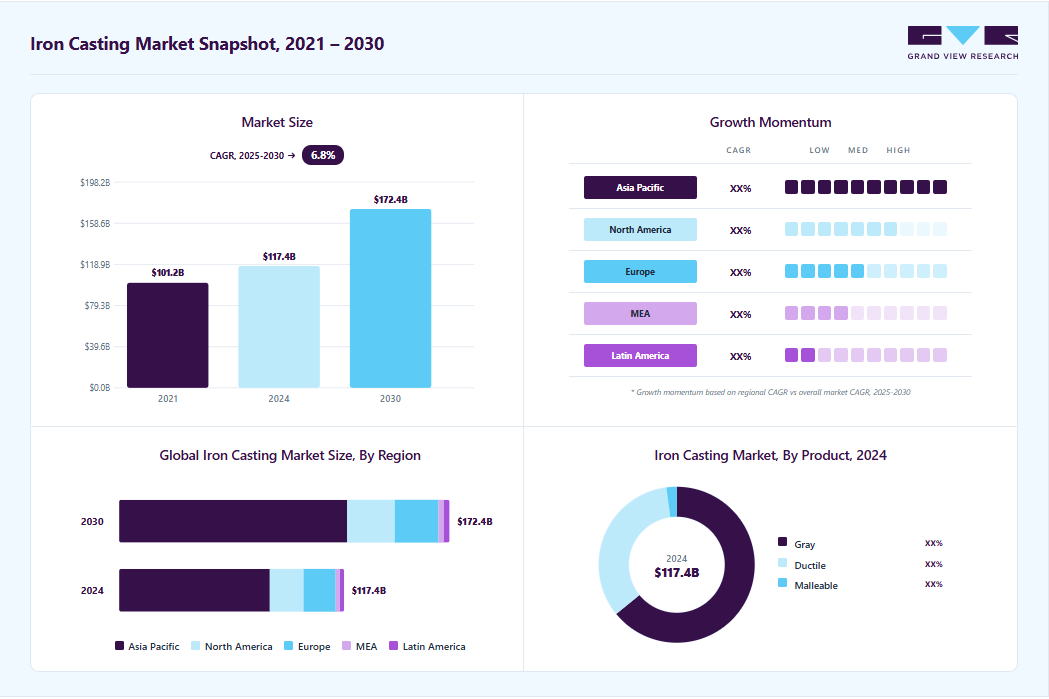 Source: Grand View Research, IR Documents, Primary Interviews, Paid DatabasesTo learn more about this report,
 Download Free Sample Report
 Key Market Trends & Insights
- By product: Gray iron casting segment led the market with the largest revenue share of 64.1% in 2025.
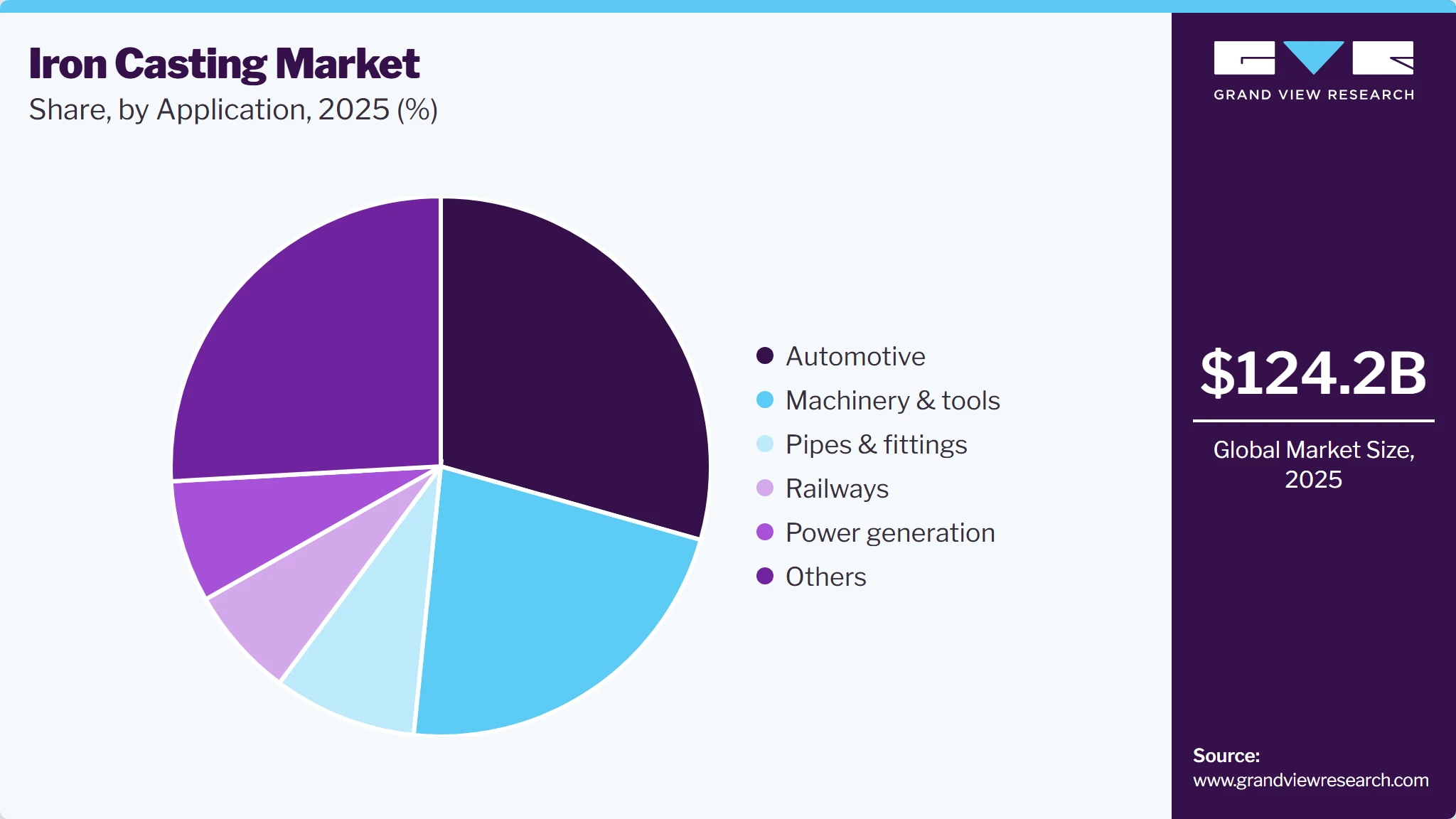
- By application: Automotive segment led the market with the largest revenue share of 29.4% in 2025.
Regional Highlights
- Largest regional market: Asia Pacific (67.3% revenue share, 2025)
- By country: The China held the largest market share in 2025.
Market Size & Forecast
- Market size in 2025: USD 124.2 Billion
- Estimated market size in 2026: USD 131.9 Billion
- Projected market size by 2033: USD 216.8 Billion
- CAGR (2026-2033): 7.4%
Three ways to get this report
Buy it, customize it, or ask a question.Ask an Analyst
Analyst response in 1 business day
- AccessReport author, directly
- Reply timeWithin 1 working day
- No sales callDirect answer only
- FormatEmail reply
- CostFree, no cost
Get the Full Report
What the study covers
- FormatsPDF · Excel · Dashboard
- Timeline2026–2033 annual, 2025 base
- Coverage20+ countries, 5 regions
- Companies10+ key players profiled
Customize the Report
20% free customization
- IncludeCountries, segments, points
- TailorTo your product definition
- ExtendDeeper competitor detail
- OrA fully bespoke study
- Turnaround5–10 working days
In terms of application, the railway is anticipated to register a CAGR of 8.1% in terms of revenue during the forecast period. Rising investments in railway infrastructure are anticipated to positively impact the iron casting market growth over the forecast period. For instance, in April 2025, the 135-year-old rail bridge over the Mithi River in Bandra, Mumbai, one of the last remaining cast-iron screw-pile bridges on Indian Railways, began to be dismantled and replaced, marking the end of the cast-iron era in Indian railway infrastructure. Built in 1888, the bridge featured eight massive cast-iron pillars weighing 8-10 tons each and extending 15-20 meters into the riverbed to anchor the structure. This transition is significant in the context of iron casting, as the bridge’s original screw-pile design exemplified the 19th-century engineering marvels made possible by cast iron technology.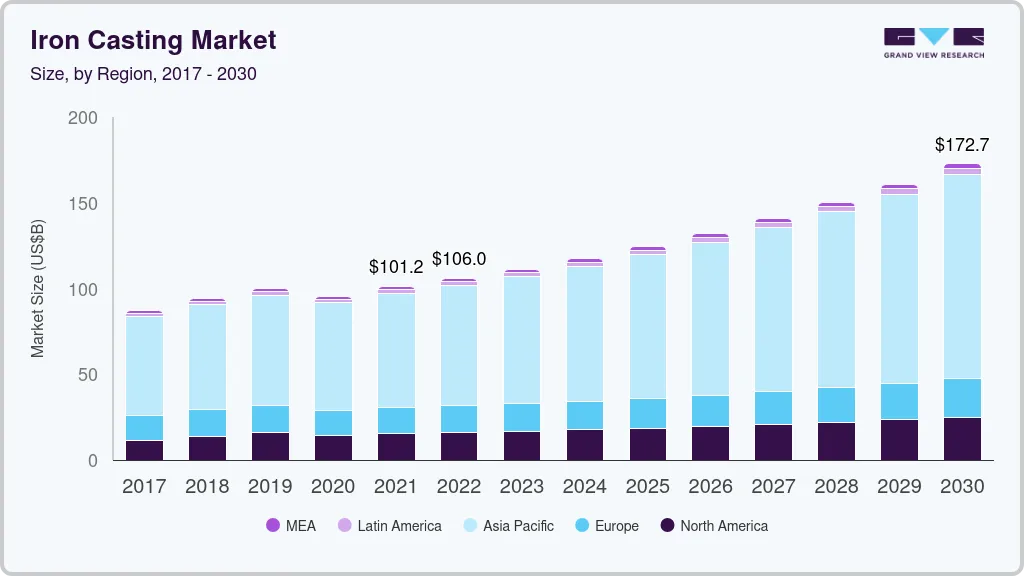 To learn more about this report, Download Free Sample Report
 Cast iron, known for its compressive strength and moldability, was widely used in bridge construction during the industrial era. However, the material’s brittleness and susceptibility to corrosion over time have led to structural vulnerabilities, especially in critical infrastructure like railways. The replacement of the Mithi River Bridge with RCC reflects the broader shift in civil engineering from cast iron toward more durable and resilient materials, ensuring greater safety and longevity for modern rail networks.
Growing concerns among individuals about the potential health risks of non-stick cookware and increasing global demand for toxin-free kitchen cookware have led cast iron cookware manufacturers to expand production capacity. This is expected to positively influence the growth of the gray cast iron segment of the market over the forecast period. For instance, in September 2024, Caraway announced the launch of its new Enameled Cast Iron Cookware Collection, marking a significant expansion of its non-toxic, design-driven kitchenware offerings. This collection combines traditional cast iron durability and heat retention with a unique three-layer enamel coating that eliminates the need for seasoning and ensures easy cleaning.
Market Dynamics
The iron casting market is primarily driven by strong demand from the automotive, construction, infrastructure, and industrial machinery sectors. Iron castings remain essential for manufacturing engine blocks, brake components, pipes, fittings, pumps, compressors, and heavy equipment due to their high strength, durability, wear resistance, and cost-effectiveness. Rapid urbanization and increasing investments in transportation networks, water distribution systems, railways, and energy infrastructure are further boosting the consumption of cast iron components in both developed and emerging economies.
The growth of the global automotive industry remains one of the most significant drivers for the iron casting market. Iron castings are widely used in the manufacture of engine blocks, cylinder heads, brake drums, flywheels, transmission housings, differential cases, and suspension components due to their strength, durability, wear resistance, and cost-effectiveness. Despite the increasing adoption of lightweight materials in certain vehicle applications, iron continues to play a critical role in heavy-duty vehicles, commercial trucks, off-highway equipment, and performance-oriented automotive components where high mechanical strength and thermal stability are required. As vehicle production expands across developing economies and replacement demand remains strong in mature markets, the consumption of iron cast components continues to increase.
The transition toward advanced mobility solutions is also creating new opportunities for iron casting manufacturers. Growing production of hybrid vehicles, commercial electric vehicles, and heavy transport fleets requires robust cast components for drivetrain systems, motor housings, braking assemblies, and chassis applications. In addition, rising investments in automotive manufacturing facilities across Asia Pacific, North America, and Europe are strengthening demand for high-quality cast iron products. Continuous improvements in casting technologies, including automated molding and precision casting processes, are enabling manufacturers to produce lighter, more complex, and dimensionally accurate components, further supporting the adoption of iron castings across the automotive sector.
Volatility in raw material prices remains a key challenge for the iron casting market, as manufacturers rely heavily on inputs such as pig iron, steel scrap, ferroalloys, coke, and foundry sand. Prices of these materials are influenced by fluctuations in mining output, global trade policies, supply chain disruptions, transportation costs, and changes in industrial demand. Sudden increases in raw material costs can significantly raise production expenses and compress profit margins, particularly for small and medium sized foundries that have limited pricing power. In addition, frequent price fluctuations make long-term procurement planning and contract negotiations more difficult, creating uncertainty across the supply chain and potentially affecting investment decisions and production schedules within the iron casting industry.
Infrastructure development across emerging economies presents a significant growth opportunity for the iron casting market. Governments in countries across the Asia Pacific, Latin America, the Middle East, and Africa are increasing investments in transportation networks, urban housing, water supply systems, wastewater treatment facilities, industrial parks, and energy infrastructure to support economic growth and urbanization. Iron castings are widely used in applications such as pipes, valves, fittings, manhole covers, drainage systems, railway components, and construction machinery due to their durability, strength, and cost-effectiveness. As large-scale infrastructure projects continue to expand and industrialization accelerates in developing regions, demand for iron casting products is expected to rise steadily, creating new opportunities for foundries and casting manufacturers worldwide.
Analyst Perspective
The iron casting market continues to benefit from strong demand across automotive, railways, machinery, power generation, and water infrastructure sectors. Growth is increasingly supported by investments in railway modernization, renewable energy projects, and industrial manufacturing expansion, particularly in Asia Pacific. Ductile iron castings are gaining traction due to their superior strength and durability, while gray iron remains the dominant product category because of its cost effectiveness and broad application base. Although lightweight materials such as aluminum are creating competitive pressure in automotive applications, iron castings remain essential for heavy duty and high performance components.
Product Insights & Trends
Based on product, gray iron casting segment led the market with the largest revenue share of 64.1% in 2025. Its growing applications in various industries, including railways, pipes & fittings, propel the segment growth in the iron casting industry. It has graphite particles that precipitate in a spherical form, resulting in high strength and toughness of ductile iron. Ductile cast iron is anticipated to register a CAGR of 7.0% in terms of revenue across the forecast period, ranging from 2026 to 2033.
Ductile cast iron is widely used in the manufacture of tractors and implement parts, crankshafts, cylinder heads, switch boxes, electrical fittings, motor frames, flywheels, drive pulleys, work rolls, and circuit breakers. Its microstructure results in more ductile cast iron than gray or white cast iron, making it suitable for producing water and sewage pipes.
Malleable cast iron is widely used in numerous industries, including agriculture, tools and equipment, automotive, and metal and mining. It manufactures electrical fittings and equipment, washers, brackets, hand tools, mining hardware, pipe fittings, farm equipment, bearing caps, steering gear housing, and machine parts.
Application Insights & Trends
Based on application, the automotive segment led the market with the largest revenue share of 29.4% in 2025. Engine blocks are usually cast from aluminum alloy or cast iron. Although aluminum offers weight reduction, cast iron is preferred owing to factors such as durability, the ability to resist high internal pressure, more strength, more horsepower, and cost-efficiency. In 2024, the automotive industry accounted for over 29% of the global iron casting market.
 To learn more about this report, Download Free Sample Report
 In January 2025, Tata Motors is set to launch Avinya as an all-electric luxury brand positioned above its existing Tata lineup and below Land Rover. The connection to iron casting lies in the manufacturing and structural requirements of premium electric vehicles like Avinya. While the EMA platform emphasizes lightweight materials and advanced battery integration, iron casting remains crucial for specific components that require high strength and durability, such as subframes, suspension mounts, and specific drivetrain elements.
Iron castings are widely used in machinery and tools owing to their good wear resistance, high strength, and good machinability. Although steel is an alternative to cast iron, ductile iron is preferred over steel for manufacturing machine tools as it has good vibration-damping capacity.
Regional Insights
The North America iron casting market is set to experience steady growth, driven by robust economic indicators and substantial investments in infrastructure. For instance, according to the International Monetary Fund (IMF), in 2023, the real GDP growth in North America was estimated at 2.3%, with a slight decline to 2.0% in 2024 and 2025. The U.S. economy is a key contributor to this growth, highlighting the region's commitment to enhancing its economic landscape through significant construction and infrastructure initiatives.
U.S. Iron Casting Market Trends
In the U.S., infrastructure revitalization projects-spurred by the Bipartisan Infrastructure Law-boosted the need for ductile and gray iron castings used in piping, bridges, and heavy machinery. U.S. dominated the North America iron casting market with revenue share of over 84% in 2024. U.S.-based foundries like Waupaca Foundry and Neenah Enterprises ramped production capacity to meet increased domestic demand and reduce dependency on imported components. Simultaneously, the rise of electric vehicle (EV) manufacturing in Michigan and other automotive hubs has led to increased investment in precision castings, particularly for lightweight, heat-resistant iron components.
Asia Pacific Iron Casting Market Trends
Asia Pacific dominated the iron casting market with the largest revenue share of 67.3% in 2025. Asia Pacific is one of the world's largest consumers of iron castings. The increasing demand for iron castings in various industries, such as infrastructure and construction, automotive, renewables, machine tooling, and pipes, is anticipated to augment the demand over the forecast period. The countries in the region are investing in improving railway connectivity, which is anticipated to augment the demand for iron castings. For instance, in October 2021, the Vietnamese government announced to invest USD 10.5 billion to build and upgrade rail infrastructure across the country by 2030.
 To learn more about this report, Download Free Sample Report
 China Iron Casting Market Trends
China held the largest share of the Asia Pacific iron casting market in 2025, supported by its large manufacturing base and strong demand from the automotive, machinery, construction, and industrial equipment sectors. Continued investments in infrastructure, industrial production, and advanced manufacturing technologies are expected to support demand for iron cast components across key end-use industries.
Europe Iron Casting Market Trends
The iron casting industry in Europe is characterized by a strong industrial base, advanced manufacturing technologies, and a significant presence in end-user industries such as automotive, construction, and machinery. Countries like Germany, Italy, France, and the UK are leading contributors, with Germany holding a dominant position due to its well-established automotive and engineering sectors. European foundries benefit from stringent quality standards and environmental regulations that have led to the adoption of cleaner and more efficient casting techniques. The emphasis on lightweight and high-strength components, particularly in automotive and transportation, drives innovation in material formulations and process automation.
Key Iron Casting Company Insights
Some of the key players operating in the market include Proterial Ltd., LIAONING BORUI MACHINERY CO., LTD (DANDONG FOUNDRY), and Brakes India.
-
Proterial Ltd., originally founded as Tobata Foundry in 1910, has evolved into a global leader in high-performance materials manufacturing. The company has a rich history marked by key mergers and acquisitions, including collaborations with Hitachi Metals and other specialized firms.
-
Dandong Foundry has nearly 70 years of experience in producing grey iron and ductile iron castings. The company’s annual output is 8,000 tons, and 50% of its products are exported to markets including the U.S., Germany, Australia, the UK, Italy, and Japan, reflecting our strong global presence.
Key Iron Casting Companies
The following key companies have been profiled for this study on the iron casting market.
-
Proterial Ltd.
-
Liaoning Borui Machinery Co., Ltd. (Dandong Foundry)
-
Brakes India
-
OSCO Industries Inc.
-
Chamberlin
-
Crescent Foundry
-
Georg Fischer Ltd
-
Grupo Industrial Saltillo (GIS)
-
Newby Holdings Limited
-
Castings P.L.C.
-
CALMET
Competitive Benchmarking
Category
Operating Strategies
Competitive Edge
Weakness
Established Players (e.g., Proterial Ltd., Brakes India, OSCO Industries Inc., Chamberlin)
- Mature participants in the iron casting market primarily focus on high-volume production, process standardization, and long-term supply relationships with the automotive, industrial machinery, construction equipment, railway, and infrastructure sectors.
- These companies operate large foundries equipped with advanced molding, melting, machining, and finishing capabilities to produce a broad range of gray iron, ductile iron, and malleable iron castings.
- Established players possess strong competitive advantages through their extensive manufacturing infrastructure, technical expertise, and long-standing relationships with major industrial customers.
- Their large production capacities enable them to achieve economies of scale, optimize raw material procurement, and maintain competitive pricing while delivering consistent product quality.
- Despite their strong market positions, mature players face challenges associated with high energy consumption, labor costs, and environmental compliance requirements.
- Iron casting operations require substantial investments in melting furnaces, emission control systems, and waste management infrastructure.
Emerging & Regional Players (e.g., LIAONING BORUI MACHINERY CO., LTD. (DANDONG FOUNDRY), Crescent Foundry, CALMET)
- Emerging participants in the iron casting market generally focus on specialized casting applications, regional customer bases, and flexible manufacturing capabilities.
- Rather than competing directly with established foundries on production volume, these companies often target niche opportunities involving customized castings, short production runs, and specialized industrial components.
- Emerging companies benefit from operational flexibility and the ability to quickly adapt to changing customer requirements.
- Their smaller organizational structures allow faster decision-making, shorter product development cycles, and greater responsiveness to custom casting specifications.
- Emerging participants face significant challenges related to limited production scale, lower financial resources, and reduced purchasing power for raw materials.
- Competing against large, established foundries with integrated operations and extensive customer networks can be difficult, particularly in price-sensitive market segments.
Recent Developments
-
In September 2025, Proterial Ltd. announced plans to transfer its Automotive Casting business to a U.S.-based investment company. The business includes casting and machining operations across Japan, South Korea, the U.S., and India, and the transaction is intended to enable faster decision-making and increased investment in automotive casting capabilities and product development.
-
In late 2025, Castings P.L.C. commissioned a new foundry production line at its William Lee facility, adding up to 12,000 tonnes of gross foundry capacity and increasing the group's overall capacity by approximately 15%. The new line also enables the production of larger iron castings, strengthening the company's manufacturing capabilities and supporting capacity expansion across its foundry operations.
Iron Casting Market Report Scope
Report Attribute
Details
Market definition
The market size refers to the total consumption of iron cast components produced from molten iron and utilized across various end-use industries in a single year, including automotive, machinery, pipes and fittings, railways, power generation, and others.
Market size in 2025
USD 124.2 billion
Estimated market size in 2026
USD 131.9 billion
Projected market size by 2033
USD 216.8 billion
Growth rate
CAGR of 7.4% from 2026 to 2033
Base year for estimation
2025
Historical data
2021 - 2024
Forecast period
2026 - 2033
Quantitative units
Revenue in USD million, volume in kilotons, and CAGR from 2026 to 2033
Report coverage
Revenue forecast, volume forecast, company ranking, competitive landscape, growth factors, and trends
Segments covered
Product, application, and region.
Regional scope
North America; Europe; Asia Pacific; Latin America; Middle East & Africa
Country scope
U.S., Canada, Mexico, Germany, UK, France, Italy, Russia, Türkiye, India, China, Japan, South Korea, Brazil, Saudi Arabia, UAE
Key companies profiled
Proterial Ltd., Liaoning Borui Machinery Co., Ltd. (Dandong Foundry), Brakes India, OSCO Industries Inc., Chamberlin, Crescent Foundry, Georg Fischer Ltd., Grupo Industrial Saltillo (GIS), Newby Holdings Limited, Castings P.L.C., CALMET
Customization scope
Free report customization (equivalent up to 8 analysts' working days) with purchase. Addition or alteration to country, regional & segment scope.
Pricing and purchase options
Avail customized purchase options to meet your exact research needs. Explore purchase options
Global Iron Casting Market Report Segmentation
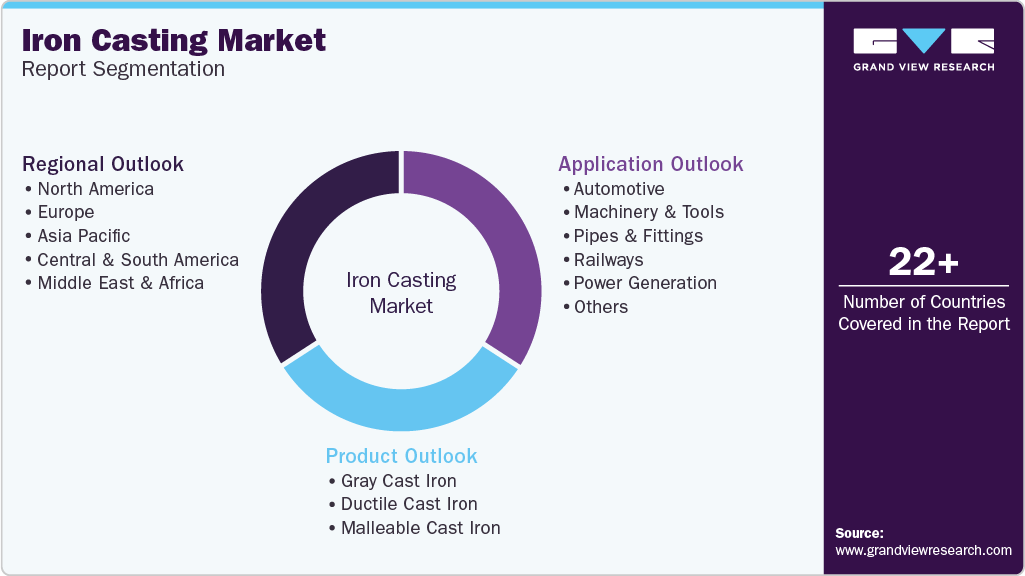
This report forecasts volume & revenue growth at the global, country, and regional levels and provides an analysis of the latest trends in each of the sub-segments from 2021 to 2033. For this study, Grand View Research has segmented the global iron casting market report based on product, application, and region:
 To learn more about this report, Download Free Sample Report
 -
Product Outlook (Volume, Kilotons; Revenue, USD Million, 2021 - 2033)
-
Gray Cast Iron
-
Ductile Cast Iron
-
Malleable Cast Iron
-
-
Application Outlook (Volume, Kilotons; Revenue, USD Million, 2021 - 2033)
-
Automotive
-
Machinery & tools
-
Pipes & fittings
-
Railways
-
Power generation
-
Others
-
-
Regional Outlook (Volume, Kilotons; Revenue, USD Million, 2021 - 2033)
-
North America
-
U.S.
-
Canada
-
Mexico
-
-
Europe
-
Germany
-
France
-
Italy
-
UK
-
Russia
-
Türkiye
-
-
Asia Pacific
-
China
-
India
-
Japan
-
South Korea
-
Indonesia
-
-
Central & South America
-
Brazil
-
Argentina
-
-
Middle East & Africa
-
South Africa
-
-
Research Methodology
The iron casting market figures in this report are based on a proven research process that combines executive interviews with secondary research from proprietary databases, company filings, and recognized regulatory and institutional sources. Market size is built through value-chain sizing - reconciling supply-side and demand-side estimates - and triangulated with bottom-up and top-down approaches. Every estimate passes multiple levels of expert validation before publication, with each iron casting segment quantified using the revenue-capture definitions in the table below.
Segment Definition
Product
Revenue Capture Definition
Gray
Gray iron casting refers to cast iron products manufactured with a graphite microstructure in the form of flakes, giving the fractured surface a gray appearance.
Ductile
Ductile iron casting, also known as nodular or spheroidal graphite iron casting, consists of cast iron in which graphite is present as spherical nodules rather than flakes.
Malleable
Malleable iron casting refers to cast iron products produced by heat treating white iron castings to transform brittle carbides into temper carbon nodules. This process enhances ductility, toughness, and shock resistance.
Application
Revenue Capture Definition
Automotive
This segment includes iron castings used in passenger vehicles, commercial vehicles, and off highway equipment.
Machinery & tools
Machinery and tools applications comprise iron castings used in industrial equipment, machine tools, pumps, compressors, agricultural machinery, and construction equipment.
Pipes & fittings
This segment covers iron castings utilized in water distribution systems, sewage networks, oil and gas pipelines, and industrial fluid handling systems.
Railways
Railway applications include iron castings used in locomotives, freight wagons, passenger coaches, braking systems, track components, and infrastructure equipment.
Power generation
This segment encompasses iron castings employed in thermal, hydroelectric, wind, and other power generation facilities.
Others
The others segment includes iron castings used across diverse industries such as marine, mining, construction, aerospace support equipment, consumer goods, and municipal infrastructure.
Estimation Model
Layer Name
Key Question
Description
Metal Component Demand Base Layer
What forms the demand base?
Identify global demand for cast metal components across major end use industries including automotive, construction, industrial machinery, agriculture, railways, mining, energy, and heavy equipment. Assess production volumes of equipment and machinery that utilize iron castings. This layer establishes the total addressable demand for iron casting products.
Iron Casting Application Penetration Layer
Where are iron castings utilized?
Estimate the penetration of iron castings across key applications such as engine blocks, brake components, pipes and fittings, pumps, valves, machine tools, transmission systems, construction equipment, and infrastructure products. Analyze adoption trends across developed and emerging manufacturing economies.
Casting Consumption Intensity Layer
How much iron casting is consumed?
Analyze average iron casting consumption across end use sectors based on production output, equipment size, component complexity, and replacement rates. Evaluate the utilization of gray iron, ductile iron, malleable iron, and other cast iron grades. Consumption intensity varies according to industrial activity, infrastructure investments, and engineering requirements.
Revenue Layer
How is market revenue generated?
Market revenue is quantified through the production and sale of iron castings supplied to automotive, industrial, construction, energy, and infrastructure sectors. Revenue is generated from the sale of finished cast components and customized casting solutions. Market value is influenced by casting volumes, raw material prices, manufacturing costs, product specifications, and demand from downstream industries.
Delivered Customizations
This report has been delivered with the following In-depth customizations
CLIENT REQUEST
CUSTOMIZATION DELIVERED
VALUE ADDS
Europe Iron Casting Market Assessment
A customized study focused specifically on the European gray and ductile iron casting market, covering country-level demand analysis, production trends, end-use industries, trade dynamics, and competitive landscape across major European economies.
Helped the North America-based client evaluate market opportunities within Europe, understand regional demand-supply dynamics, and support strategic expansion and sourcing decisions in the European iron casting industry.
Global Iron Casting Market Segmentation & End-Use Analysis
A market study covering industry value chain analysis, regulatory framework, market dynamics, and detailed product outlook for gray, ductile, and malleable cast iron. The study also included historical and forecast analysis across key application segments such as automotive, machinery & tools, pipes & fittings, railways, and power generation.
A market study covering industry value chain analysis, regulatory framework, market dynamics, and detailed product outlook for gray, ductile, and malleable cast iron. The study also included historical and forecast analysis across key application segments such as automotive, machinery & tools, pipes & fittings, railways, and power generation.
Opportunity Assessment
Identification of high growth opportunities across automotive production, industrial machinery expansion, railway modernization projects, water infrastructure development, renewable energy equipment manufacturing, and power generation investments.
Enabled prioritization of high return growth segments and emerging regional opportunities. Supported long term investment planning, foundry modernization initiatives, and strategic business development decisions aligned with evolving industrial requirements.
Frequently Asked Questions About This Report
The iron casting market is expected to grow at a compound annual growth rate of 7.4% from 2026 to 2033 to reach USD 216.8 billion by 2033.
North America is anticipated to register the fastest CAGR over the forecast period.
Based on product, gray iron cast accounted for the largest revenue share of 64.1% in 2025.
The key factor that is driving the growth of the global iron casting market is resurgent demand from end-use sectors such as machinery and tools, railway, and energy infrastructure. Also, growing investments in the railway industry worldwide, coupled with rising demand for iron cast pipes from water-related infrastructure projects and the oil and gas sector, are driving demand for cast iron.
Asia Pacific dominated the market with revenue share of 67.3% in 2025.
Based on application, automotive accounted for the largest revenue share of 29.4% in 2025.
The iron casting market size was valued at USD 124.2 billion in 2025 and is expected to reach USD 131.9 billion in 2026.
China dominated the Asia Pacific iron casting market with a revenue share of 57.3% in 2025.
Some of the key players operating in the iron casting market are Proterial Ltd., Liaoning Borui Machinery Co., Ltd. (Dandong Foundry), Brakes India, OSCO Industries Inc., Chamberlin, Crescent Foundry, Georg Fischer Ltd., Grupo Industrial Saltillo (GIS), Newby Holdings Limited, Castings P.L.C., and CALMET.
About the Author(s)
Advanced Interior Materials Research Team
Advanced Materials · Advanced Interior MaterialsThis report was authored by the advanced interior materials research team at Grand View Research - comprising two research analysts, one senior research analyst, and one industry expert - with specialized expertise in the advanced interior materials segment of the advanced materials industry. All findings are based on proprietary advanced materials databases, executive interviews, and regulatory analysis, subject to internal peer review prior to publication.
Last Updated:
Speak to Analyst

Customize this report to your needs - add regions, segments, or data points, with 20% free customization.
Or view our licence options:


ISO 9001:2015 & 27001:2022 Certified
We are GDPR and CCPA compliant! Your transaction & personal information is safe and secure. For more details, please read our privacy policy.


