
- Home
- »
- Beauty & Personal Care
- »
-
J-Beauty Products Market Size & Share Report, 2026-2033GVR Report cover

J-Beauty Products Market (2026 - 2033)
Size, Share & Trends Analysis Report By Product (Skin Care, Hair Care), By Type (Conventional, Organic), By Price Tier, By Gender, By Distribution Channel, By Region, And Segment Forecasts
Market Size, 2025
$37.2BMarket Estimate, 2026
$39.0BMarket Forecast, 2033
$59.8BCAGR, 2026–2033
6.3%J-Beauty Products Market Summary
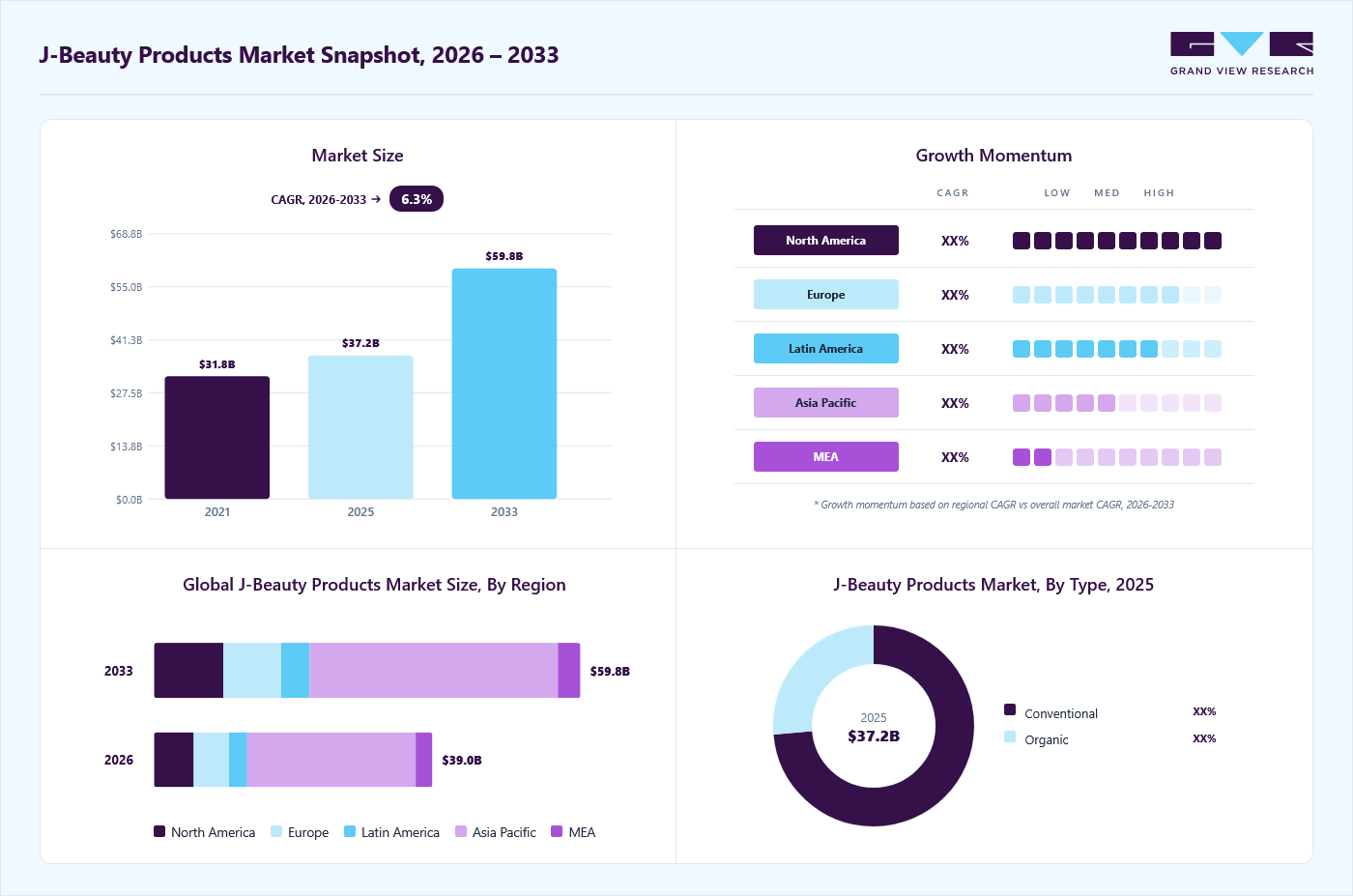
The global J-Beauty products market size was valued at USD 37.2 billion in 2025 and is projected to grow from USD 39.0 billion in 2026 to USD 59.8 billion by 2033, at a CAGR of 6.3% from 2026 to 2033. The Asia Pacific held the largest share of 60.8% of the global market in 2025. The global market is gaining traction as consumers increasingly shift toward minimalist and preventive skincare routines that prioritize long-term skin health over complex, multi-step regimens.
 Source: Grand View Research, IR Documents, Primary Interviews, Paid DatabasesTo learn more about this report,
 Download Free Sample Report
 Key Market Trends & Insights
- By product: Skin care products segment held the largest market share of 48.9% in 2025.
- By type: Conventional j-beauty products segment held the largest market share of 73.5% in 2025.
- By gender: Women’s j-beauty products segment held the largest market share of 78.0% in 2025.
- By price tier: Mass j-beauty products segment held the largest market share of 62.8% in 2025.
- By distribution channel: Pharmacies & drugstores segment held the largest market share of 40.5% in 2025.
Regional Highlights
- Largest regional market: Asia Pacific (60.8% revenue share, 2025)
- By country: held the largest share in 2025
Market Size & Forecast
- Market size in 2025: USD 37.2 Billion
- Estimated market size in 2026: USD 39.0 Billion
- Projected market size by 2033: USD 59.8 Billion
- CAGR (2026-2033): 6.3%
Three ways to get this report
Buy it, customize it, or ask a question.Ask an Analyst
Analyst response in 1 business day
- AccessReport author, directly
- Reply timeWithin 1 working day
- No sales callDirect answer only
- FormatEmail reply
- CostFree, no cost
Get the Full Report
What the study covers
- FormatsPDF · Excel · Dashboard
- Timeline2026–2033 annual, 2025 base
- Coverage20+ countries, 5 regions
- Companies10+ key players profiled
Customize the Report
20% free customization
- IncludeCountries, segments, points
- TailorTo your product definition
- ExtendDeeper competitor detail
- OrA fully bespoke study
- Turnaround5–10 working days
Daily-use products such as hydrating lotions, lightweight emulsions, and gentle cleansers are witnessing strong demand as consumers focus on maintaining skin balance, strengthening the barrier, and preventing early damage rather than relying on corrective treatments. This shift is particularly visible among younger consumers and urban professionals who prefer time-efficient routines with fewer but highly effective products, aligning closely with the core philosophy of Japanese skincare.Strong consumer preference for natural and traditional ingredients continues to shape purchasing behavior, supporting the global positioning of J-Beauty formulations. Ingredients such as rice bran, green tea, camellia oil, and fermented extracts are increasingly favored for their proven soothing, antioxidant, and brightening properties. Consumers associate these ingredients with safety, long-term compatibility, and cultural authenticity, especially as clean beauty awareness rises globally. Brands are reinforcing this positioning by combining traditional ingredients with modern dermatological validation, strengthening consumer trust and supporting premium product differentiation across international markets.
 To learn more about this report, Download Free Sample Report
 Rising focus on skin health, anti-aging, and overall wellness is further driving demand across the market. Consumers are prioritizing hydration, UV protection, and early-stage anti-aging solutions as part of their daily routines, leading to higher adoption of products such as sunscreen, essence-based treatments, and collagen-supporting serums. Anti-aging is increasingly viewed as a preventive practice rather than a corrective one, with younger demographics investing in long-term skin maintenance. This has encouraged brands to develop formulations that deliver gradual, visible improvements while maintaining skin sensitivity and balance.
Global expansion through e-commerce and cross-border retail is significantly contributing to the international market growth, supported by increasing overseas demand and improved digital commerce infrastructure. Online marketplaces, brand-owned platforms, and international beauty retailers are enabling Japanese skincare brands to reach consumers across North America, Europe, and Southeast Asia with greater ease, reducing reliance on traditional brick-and-mortar expansion. The market is also benefiting from advancements in logistics, localized fulfillment strategies, and seamless digital payment systems, which are improving delivery timelines and overall customer experience.
At the same time, companies are actively strengthening their international presence through targeted expansion strategies. For instance, in April 2024, Yoshitsu Co., Ltd. expanded its footprint in the U.S. market by establishing a dedicated subsidiary to enhance distribution efficiency and support rising demand for Japanese beauty products. Such initiatives reflect how J-Beauty brands are investing in localized operations and integrated supply chains to improve market penetration. This combination of digital accessibility, operational expansion, and growing global consumer interest is enabling Japanese beauty brands to scale internationally while reinforcing their positioning as high-quality, accessible skincare solutions across global markets.
The growing influence of social media, beauty influencers, and digital content is playing a critical role in shaping consumer awareness and demand. Platforms such as Instagram, YouTube, and TikTok are driving product discovery through skincare routines, ingredient-focused education, and visual transformations. The global popularity of concepts such as “glass skin” and hydration-focused routines has strengthened the cultural appeal of J-Beauty, positioning it as a disciplined and results-driven approach to skincare that resonates strongly with international consumers.
Continuous advancements in skincare technology and product innovation are reinforcing the competitiveness of J-Beauty brands in the global market. Companies are investing in advanced formulation techniques such as fermentation, micro-encapsulation, and enhanced delivery systems to improve ingredient efficacy and absorption. At the same time, faster product development cycles and data-driven insights are enabling brands to introduce new formulations quickly in response to evolving consumer preferences. This combination of scientific innovation and consumer-centric development is supporting sustained growth and differentiation in an increasingly competitive beauty landscape.
Brand Market Share Insights
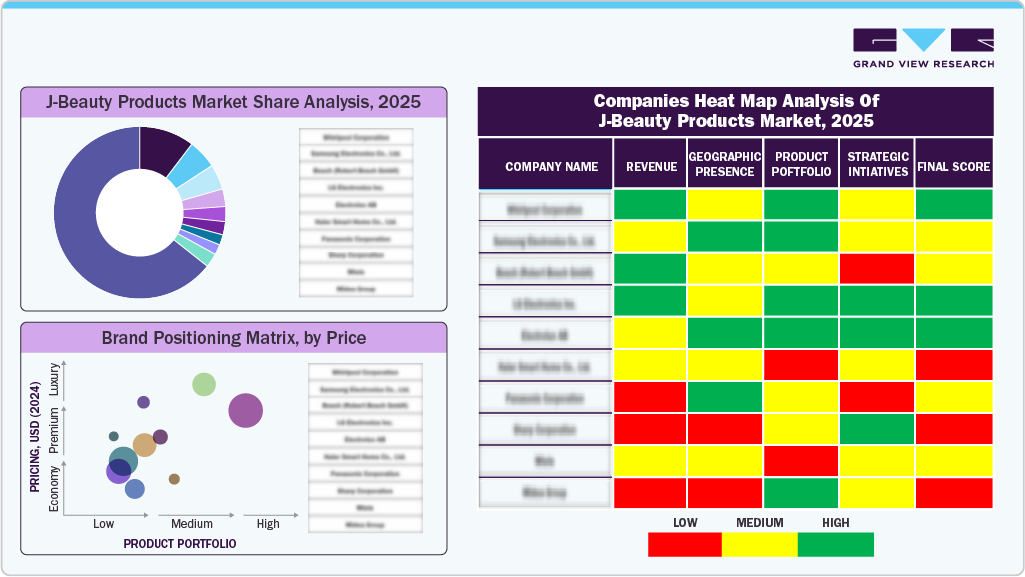
The global market is highly competitive, driven by strong domestic players and expanding global reach. Leading companies such as Shiseido Company, Kao Corporation, Kosé Corporation, POLA Orbis Holdings, and DHC Corporation are strengthening their positions through continuous product innovation, premium formulations, and strong distribution networks. Brands are combining traditional ingredients such as rice bran and camellia oil with advanced skincare science, while emerging players attract younger consumers through minimalist and clean beauty positioning. Increasing use of e-commerce, influencer-led marketing, and cross-border retail is further intensifying competition, enabling brands to expand globally and engage directly with consumers, positioning J-Beauty as a fast-growing and innovation-driven segment in the global beauty market.
 To learn more about this report, Download Free Sample Report
 Consumer Insights
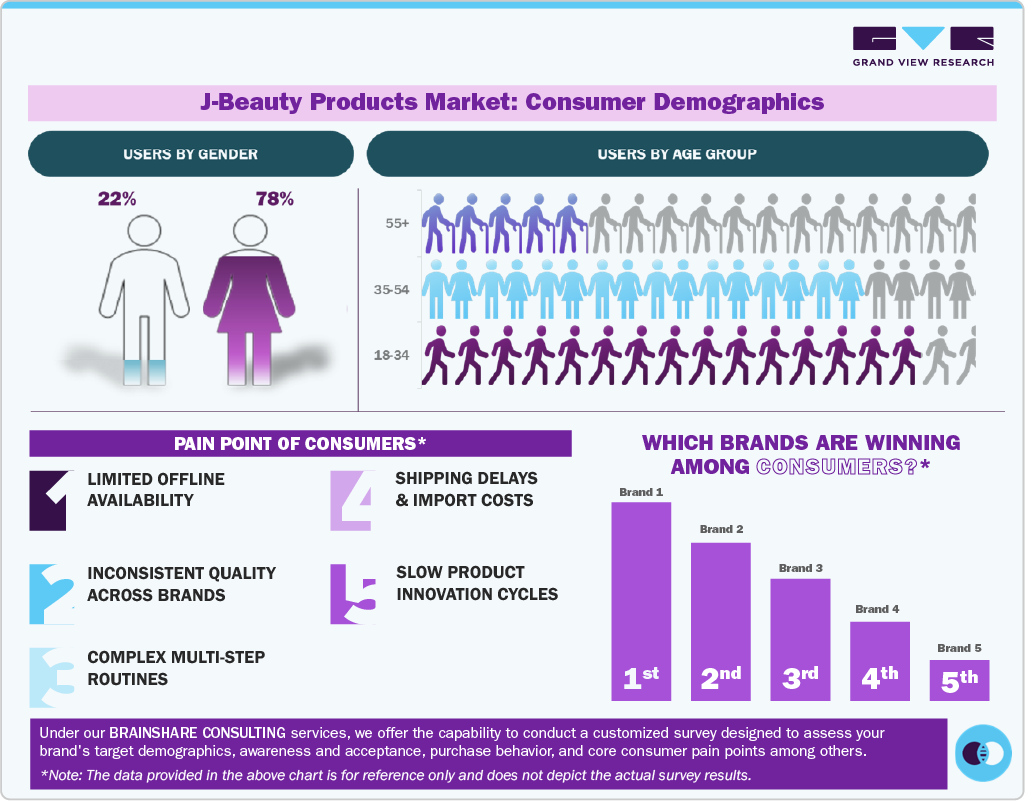
Consumers in the global market are increasingly focused on efficacy-driven and minimalist skincare, with a strong preference for formulations that deliver visible outcomes such as hydration, brightening, and skin barrier repair. Buyers actively assess ingredient functionality and product performance before purchase, driving demand for formulations that combine traditional Japanese ingredients such as rice bran, green tea, and camellia oil with clinically supported actives. This has led to growing adoption of multifunctional products such as essences, emulsions, and hybrid treatments, as consumers prefer solutions that address multiple concerns within simplified routines. At the same time, rising preference for clean beauty and ingredient transparency is influencing purchasing behavior, with consumers prioritizing clearly labeled, gentle formulations suitable for sensitive skin, reinforcing the shift toward “skinimalism” and high-performance skincare.
 To learn more about this report, Download Free Sample Report
 Digital ecosystems are playing a central role in shaping consumer preferences and accelerating product adoption in the market. Social and content-driven platforms enable continuous product discovery, ingredient education, and peer validation, where consumers rely heavily on reviews, expert opinions, and routine-based content before making purchase decisions. This trend mirrors broader Asian beauty market dynamics, where strong digital engagement and rapid product feedback cycles are intensifying competition and innovation. Brands are therefore investing in advanced R&D, clinical validation, and faster product development cycles to align with evolving consumer expectations, while leveraging cross-border digital channels to scale internationally and strengthen their positioning in the global skincare market.
Product Insights
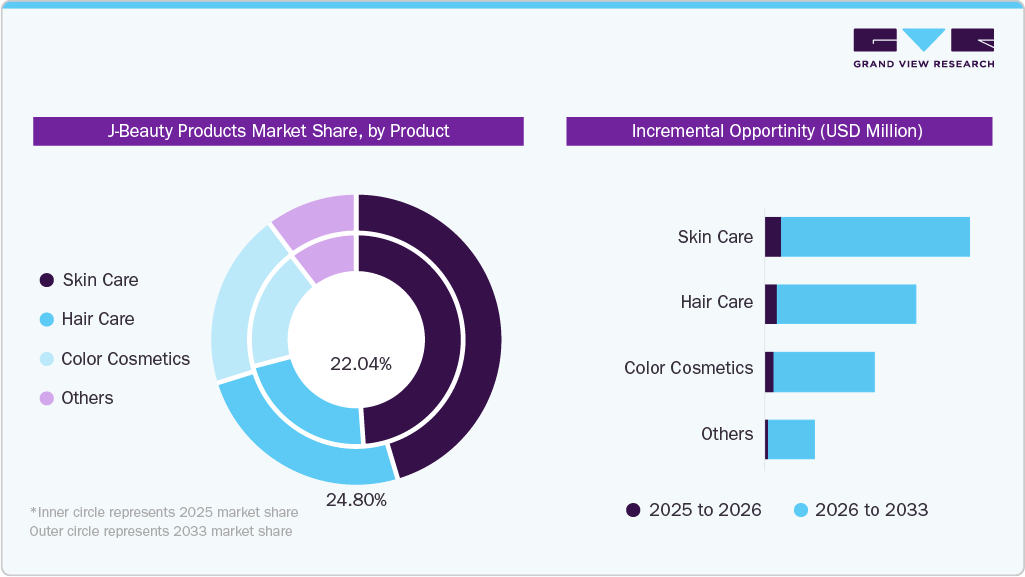
Skin care products accounted for the largest market share of 48.9% in 2025, supported by rising consumer demand for daily-use skincare solutions that deliver consistent and visible results. Increasing awareness around UV exposure, pollution, and lifestyle-related skin concerns is driving higher adoption of products such as sunscreens, cleansing oils, and treatment lotions that form the foundation of preventive skincare routines. Japanese brands are also benefiting from strong product credibility built on dermatological testing, product safety, and long-standing consumer trust, encouraging repeat purchases and routine-based usage. In addition, the growing popularity of at-home skincare rituals and self-care practices is reinforcing demand for high-quality, easy-to-use formulations that replicate salon-like results.
 To learn more about this report, Download Free Sample Report
 Hair care products are anticipated to grow at a CAGR of 7.8% from 2026 to 2033, driven by increasing consumer focus on scalp health, hair strengthening, and damage repair solutions. Products such as shampoos, conditioners, hair masks, and scalp treatments are gaining traction as consumers adopt routine-based hair care practices similar to skincare regimens. Japanese hair care formulations emphasize gentle cleansing, moisture retention, and scalp nourishment, often incorporating ingredients such as camellia oil, rice extract, and seaweed known for their strengthening and smoothing properties. These products are designed for daily use and cater to concerns such as hair fall, dryness, and damage caused by pollution and heat styling.
Type Insights
Conventional J-beauty products accounted for 73.5% of the market in 2025, supported by strong consumer reliance on well-established, daily-use formulations that deliver consistent and predictable results. These products are widely preferred for addressing routine skincare needs such as cleansing, hydration, and basic skin maintenance, making them suitable for long-term use across diverse consumer groups. Japanese brands have built strong credibility around product safety, mild formulations, and dermatological reliability, encouraging repeat usage and brand loyalty. In addition, conventional products are competitively priced and easily accessible across mass retail, pharmacies, and online platforms, enabling broader consumer reach.
Organic J-beauty products are expected to grow at a CAGR of 7.7% from 2026 to 2033, driven by increasing consumer inclination toward clean, sustainable, and skin-friendly formulations. These products typically incorporate naturally derived ingredients such as rice extract, green tea, yuzu, and camellia oil, which are perceived as gentle and suitable for sensitive skin, strengthening consumer trust and adoption. Organic formulations are often positioned as safer alternatives to synthetic-heavy products, offering nourishment, hydration, and long-term skin benefits while avoiding harsh additives. In addition, rising awareness around ingredient sourcing, eco-conscious packaging, and product transparency is encouraging consumers to shift toward organic skincare options.
Gender Insights
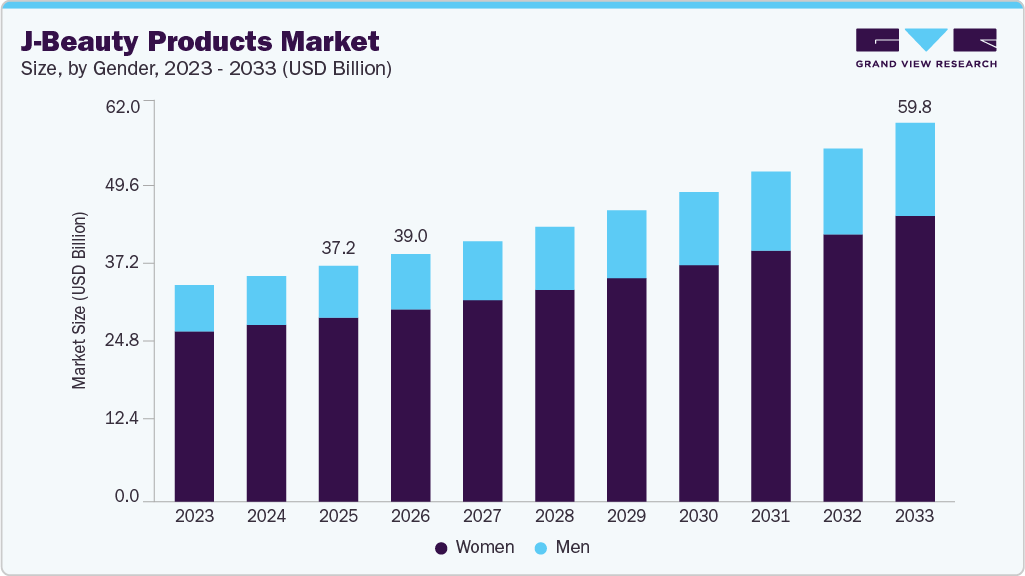
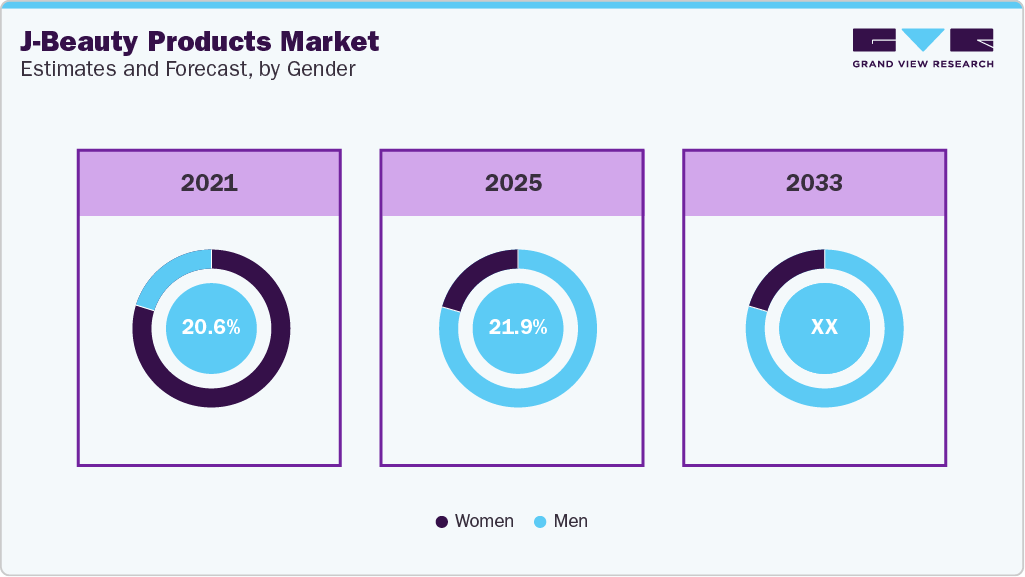
The demand for women’s J-beauty products accounted for a market share of 78.0% in 2025, driven by high engagement in skincare routines and a strong preference for preventive and maintenance-focused products. Women are actively adopting multi-step yet simplified routines centered on hydration, layering, and long-term skin health, leading to consistent product usage and repeat purchases. Increasing interest in targeted solutions such as anti-aging, brightening, and skin barrier repair is further encouraging product exploration across categories, including serums, essences, and treatment lotions. In addition, the availability of innovative formats such as lightweight emulsions, sheet masks, and hybrid skincare products is supporting routine expansion and convenience.
 To learn more about this report, Download Free Sample Report
 The demand for J-beauty products among men is expected to grow at a CAGR of 7.8% from 2026 to 2033, supported by increasing focus on grooming, skin maintenance, and appearance-conscious lifestyles among male consumers. Men are progressively adopting simplified and functional skincare routines to address concerns such as excess oil, dryness, acne, and post-shave irritation, driving demand for easy-to-use products such as all-in-one lotions, cleansers, and lightweight moisturizers. In addition, rising awareness of ingredient benefits and the growing influence of digital content and grooming trends are encouraging trial and adoption.
Price Tier Insights
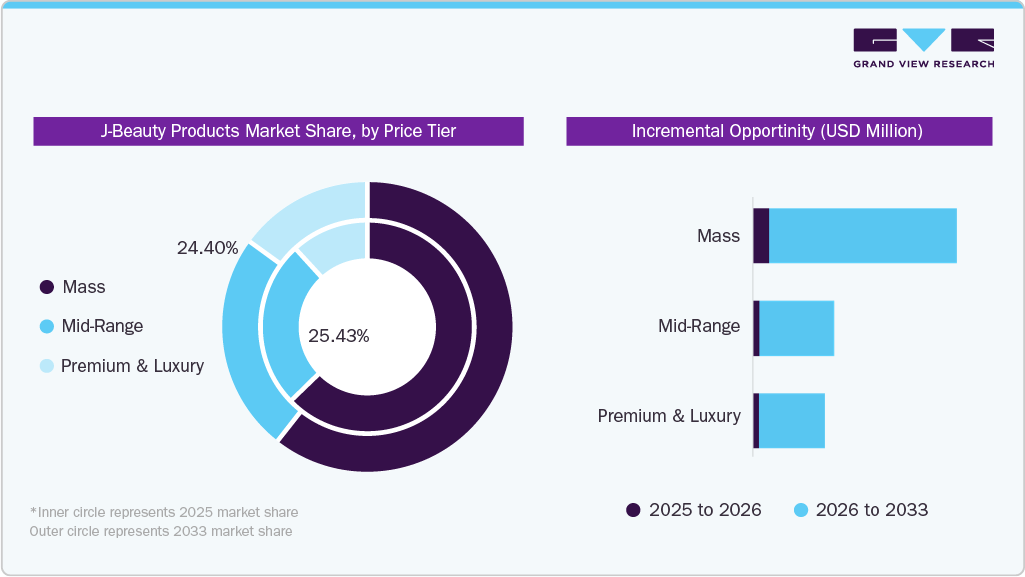
Mass J-beauty products accounted for a market share of 62.8% in 2025, driven by strong demand for affordable, daily-use skincare solutions that deliver reliable performance. Consumers prefer mass-market products for routine needs such as cleansing, hydration, and basic skin maintenance, as they offer a balance between quality and accessibility. Japanese brands in this segment focus on simple, effective formulations with proven ingredients, enabling consistent usage without high spending. In addition, wide availability across drugstores, supermarkets, and online platforms is supporting easy access and frequent purchases.
 To learn more about this report, Download Free Sample Report
 The demand for luxury & premium J-beauty products is expected to grow at a CAGR of 9.5% from 2026 to 2033, driven by increasing consumer willingness to invest in high-performance, scientifically advanced skincare solutions. Consumers in this segment prioritize product efficacy, ingredient quality, and brand credibility, leading to higher adoption of premium formulations enriched with advanced actives, fermentation technologies, and anti-aging benefits. These products are often positioned around skin rejuvenation, brightening, and long-term skin health, appealing to consumers seeking visible and lasting results. overall.
Distribution Channel Insights
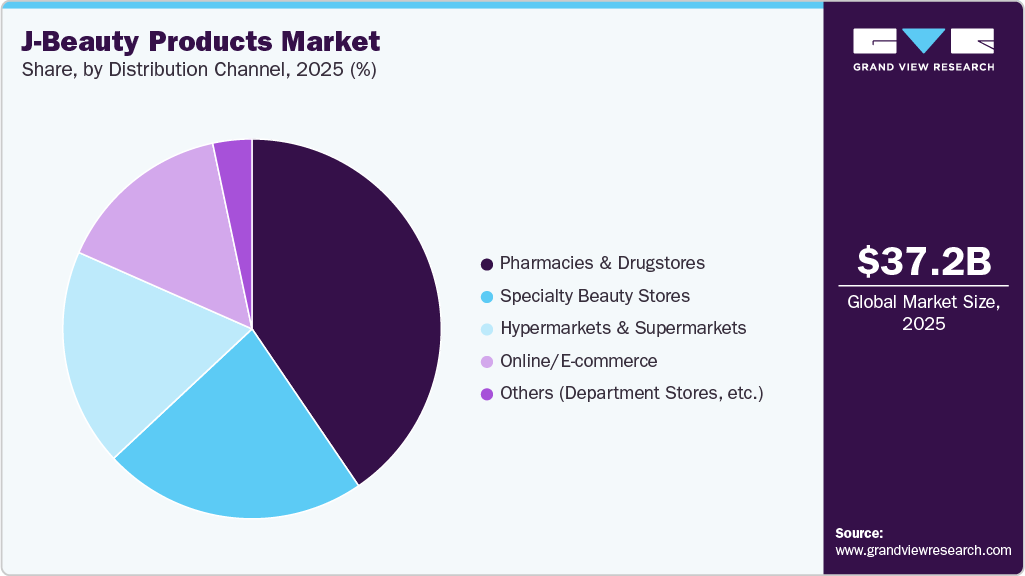
The sale of J-beauty products through pharmacies & drugstores accounted for 40.5% in 2025, driven by strong consumer trust in pharmacy-led retail and the availability of dermatologist-recommended, safe, and effective skincare products. Consumers widely prefer pharmacies and drugstores for purchasing daily-use essentials such as cleansers, lotions, sunscreens, and treatment products, as these outlets are associated with product authenticity and quality assurance. Japanese brands benefit from established distribution networks across drugstore chains, enabling consistent product visibility and accessibility. In addition, in-store guidance, product sampling, and clear labeling further support informed purchasing decisions.
 To learn more about this report, Download Free Sample Report
 The sale of J-beauty products through online/e-commerce are expected to grow at a CAGR of 8.8% from 2026 to 2033, driven by the rapid expansion of digital retail platforms and increasing consumer preference for convenient, direct purchasing channels. Consumers are actively turning to e-commerce to access a wider range of products, including new launches, niche brands, and premium formulations that may have limited offline availability. Brand-owned websites, global marketplaces, and cross-border platforms are enabling seamless product access across regions, supported by improved logistics, faster delivery timelines, and secure payment systems. In addition, digital engagement tools such as virtual consultations, personalized recommendations, and influencer-led content are enhancing the online shopping experience and building consumer trust.
Regional Insights
North America J-beauty products market is expected to grow at a CAGR of 8.3% from 2026 to 2033. The market is driven by increasing consumer interest in global skincare trends and rising adoption of Japanese beauty philosophies centered on hydration, simplicity, and skin barrier health. Consumers in the region are actively exploring J-beauty products that incorporate traditional Japanese ingredients such as rice bran, green tea, and camellia oil, supported by growing awareness through social media, dermatology-led content, and influencer-driven education. The expansion of cross-border e-commerce platforms and partnerships with major beauty retailers is improving product accessibility across the United States and Canada. In addition, rising demand for clean-label formulations, lightweight textures, and multifunctional skincare products is encouraging J-beauty brands to strengthen their presence and expand their consumer base in the region.
U.S. J-Beauty Products Market Trends
The J-beauty products industry in the U.S. accounted for a revenue share of around 87.4% on the North America market in 2025. The market is driven by strong consumer adoption of advanced skincare routines and increasing interest in globally influenced beauty solutions. U.S. consumers are actively engaging with J-beauty brands that emphasize hydration-focused regimens, lightweight formulations, and long-term skin health, supported by growing awareness through social media, dermatology-led content, and online beauty communities. The market is also benefiting from the availability of Japanese skincare products across e-commerce platforms, specialty beauty retailers, and premium stores, improving accessibility and product visibility.
Canada J-beauty products market is expected to grow at a CAGR of 10.2% from 2026 to 2033. The market is driven by increasing consumer interest in holistic skincare approaches that emphasize hydration, skin balance, and long-term skin health. Canadian consumers are gradually adopting J-beauty products that incorporate traditional Japanese ingredients such as rice bran, green tea, and camellia oil, supported by rising awareness through digital platforms and global beauty trends. Many consumers prefer gentle, minimalist formulations that align with clean beauty preferences and are suitable for sensitive skin, particularly in regions with harsh weather conditions.
Europe J-Beauty Products Market Trends
The J-beauty products industry in Europe accounted for a revenue share of 12.5% in 2025. The market is driven by increasing consumer interest in international skincare trends and growing adoption of Japanese beauty philosophies focused on hydration, layering, and skin barrier care. Consumers across key markets such as France, Germany, Italy, Spain, and the UK are actively exploring J-beauty products that incorporate traditional Japanese ingredients such as rice bran, green tea, and camellia oil, supported by rising awareness through digital platforms and beauty influencers. The region is also witnessing strong demand for clean-label, minimalist, and sustainability-focused formulations, aligning closely with J-beauty positioning.
The UK J-beauty products market accounted for a revenue share of around 21.6% in 2025. The market is supported by rising demand for high-quality, reliable skincare products that emphasize product safety and long-term usability. Consumers in the UK are increasingly valuing formulations backed by strong brand heritage, precise manufacturing standards, and consistent performance. Growing concerns around environmental stressors such as pollution and climate variability are also encouraging the adoption of protective skincare products, including sunscreens, anti-pollution creams, and repairing treatments.
The J-beauty products market in Germany is expected to grow at a CAGR of 9.7% from 2026 to 2033. The market is driven by increasing consumer focus on product efficacy, ingredient transparency, and scientifically backed skincare solutions. German consumers are highly attentive to formulation details and actively seek products that offer clinically supported benefits such as hydration retention, barrier repair, and anti-aging performance. In addition, rising demand for fragrance-free, dermatologically tested, and hypoallergenic products is supporting the growth of gentle Japanese skincare offerings.
Asia Pacific J-Beauty Products Market Trends
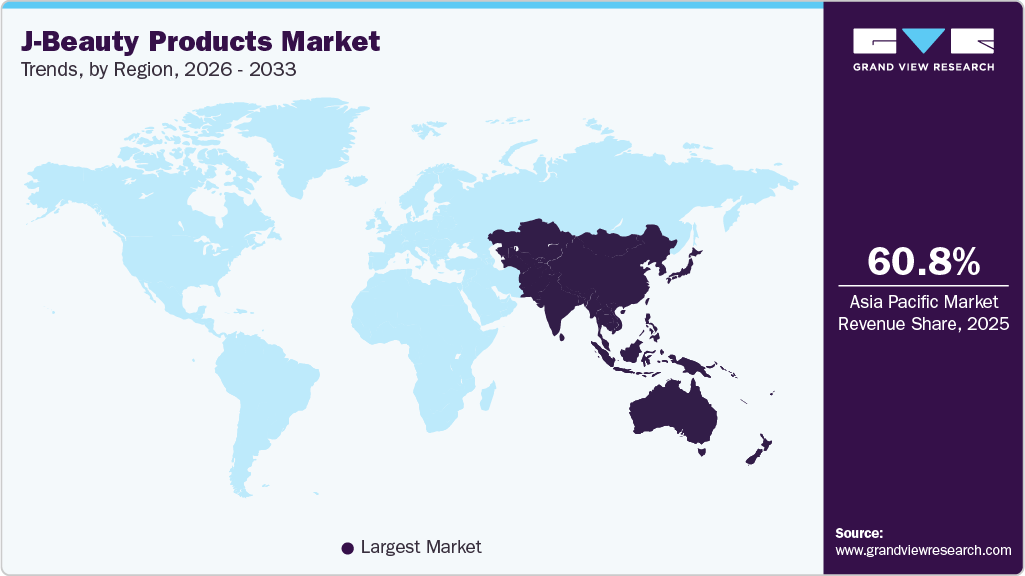
The J-beauty products industry in the Asia Pacific accounted for a revenue share of around 60.8% of the global market in 2025. The market is driven by strong regional familiarity with Japanese skincare practices and high consumer engagement in routine-based beauty regimens. Consumers across the region adopt multi-step skincare approaches centered on hydration, layering, and skin maintenance, supporting consistent product usage and category depth. The presence of well-established retail networks, including drugstores, specialty beauty chains, and convenience stores, is enabling widespread product accessibility across both urban and semi-urban areas. In addition, proximity to Japan allows for faster product availability, frequent new launches, and stronger brand visibility. Growing demand for high-quality yet accessible skincare solutions, combined with continuous product innovation and strong cultural alignment, is reinforcing the region’s leading position in the global market.
 To learn more about this report, Download Free Sample Report
 Japan J-beauty products market accounted for a revenue share of around 26.8% on the Asia Pacific market in 2025. The market is driven by strong domestic brand loyalty and continuous innovation in skincare formulations. Japanese consumers demonstrate high engagement with routine-based skincare, emphasizing product quality, consistency, and long-term skin maintenance. The market benefits from advanced research and development capabilities, enabling frequent product upgrades and the introduction of high-performance formulations. In addition, widespread availability across drugstores, department stores, and convenience retail channels ensures easy product access and high purchase frequency.
The J-beauty products market in India is expected to grow at a CAGR of 10.4% from 2026 to 2033. The market is driven by increasing demand for effective yet affordable skincare solutions among a rapidly expanding urban consumer base. Consumers are showing strong interest in lightweight, climate-suitable formulations that address concerns such as oil control, pigmentation, and sun protection, making Japanese skincare products well-suited for daily use in diverse weather conditions. The market is also benefiting from rising preference for high-quality products that offer visible results without complex routines, encouraging adoption of simplified skincare formats. In addition, the expansion of online beauty platforms, improved access to international brands, and the growing influence of peer reviews and digital content are supporting product discovery.
Central & South America J-Beauty Products Market Trends
The J-beauty products industry in CSA is expected to grow at a CAGR of 6.7% from 2026 to 2033. The market is driven by increasing demand for practical and climate-suitable skincare solutions across the region. Consumers are showing a strong preference for lightweight, fast-absorbing formulations that address concerns such as excess oil, sun exposure, and dehydration. The market is also benefiting from rising awareness of daily skincare routines focused on cleansing, hydration, and protection, encouraging consistent product usage. In addition, improving access through regional distributors, online marketplaces, and international shipping options is enabling wider availability of Japanese brands.
Middle East & Africa J-Beauty Products Market Trends
The J-beauty products industry in MEA is expected to grow at a CAGR of 4.4% from 2026 to 2033. The market is supported by increasing demand for high-performance skincare that delivers visible results with minimal product layering. Consumers in the region are showing a preference for efficient, results-driven formulations that fit into streamlined routines, particularly among working professionals and younger demographics. The market is also benefiting from rising interest in premium beauty experiences, where product texture, sensorial appeal, and brand storytelling play an important role in purchase decisions. In addition, growth in luxury retail environments and curated beauty assortments is enhancing exposure to niche international brands, including J-beauty.
Key J-Beauty Products Companies:
The following key companies have been profiled for this study on the j-beauty products market.
- Shiseido Company, Limited
- SK-II
- KOSÉ Corporation
- Kao Corporation
- Clé de Peau Beauté
- Shu Uemura
- DHC Corporation
- Rohto Pharmaceutical Co., Ltd.
- Kao Corporation
- POLA ORBIS Holdings Inc.
Recent Developments
-
In April 2026, SK-II officially entered the Indian beauty market, marking a strategic expansion into one of the fastest-growing premium skincare segments globally. The brand introduced its core product portfolio, including its signature PITERA-based formulations, while leveraging personalized retail experiences and AI-driven skin analysis to engage consumers. This move reflects SK-II’s focus on tapping into rising demand for high-performance, science-backed skincare in India, while strengthening its presence across key urban and luxury retail channels.
-
In February 2026, Kanebo Cosmetics Inc., under its mass brand Kate Tokyo, introduced the Bouncy Cheek Shadow, a hybrid blush product offering both color and contouring effects. The launch reflected increasing consumer preference for multi-functional and natural-looking makeup solutions.
-
In January 2026, Kosé Corporation, through its premium brand Decorté, launched the Zen Wear Stay Foundation. The product is designed to deliver a long-wear, skin-like finish while incorporating hydration-focused technology, catering to growing demand for breathable, humidity-resistant base makeup.
-
In June 2025, Japan-based makeup brand KATE strengthened its business across Asia through a series of strategic initiatives focused on expanding brand visibility and cultural relevance. The company is increasing investments in regional marketing, promoting its signature “shadow-enhancing makeup” concept, and leveraging collaborations with popular Japanese cultural content to connect with younger consumers. Alongside immersive retail experiences and digital campaigns, this approach is aimed at building stronger brand recognition and accelerating growth across key Asian markets.
J-Beauty Products Market Report Scope
Report Attribute
Details
Market size in 2025
USD 37.2 billion
Estimated market size in 2026
USD 39.0 billion
Projected market size by 2033
USD 59.8 billion
Growth rate
CAGR of 6.3% from 2026 to 2033
Historical data
2021 - 2025
Forecast period
2026 - 2033
Quantitative units
Revenue in USD million/billion and CAGR from 2026 to 2033
Report coverage
Revenue forecast, company ranking, competitive landscape, growth factors, and trends
Segments covered
Product; type; gender, price tier, distribution channel, region
Regional scope
North America; Europe; Asia Pacific; CSA; MEA
Country scope
U.S.; Canada; Mexico; Germany; UK; France; Italy; Spain; China; India; Japan; Australia & New Zealand; South Korea; Brazil; South Africa
Key companies profiled
Shiseido Company, Limited; SK-II; KOSÉ Corporation; Kao Corporation; Clé de Peau Beauté; Shu Uemura; DHC Corporation; Rohto Pharmaceutical Co., Ltd.; Kao Corporation; POLA ORBIS Holdings Inc.
Customization scope
Free report customization (equivalent up to 8 analysts working days) with purchase. Addition or alteration to country, regional & segment scope.
Pricing and purchase options
Avail customized purchase options to meet your exact research needs. Explore purchase options
Global J-Beauty Products Market Report Segmentation
This report forecasts revenue growth at global, regional & country levels and provides an analysis of the latest trends and opportunities in each of the sub-segments from 2021 to 2033. For this study, Grand View Research has segmented the global J-beauty products market based on product, type, gender, price tier, distribution channel, and region:
-
Product Outlook (Revenue, USD Million, 2021 - 2033)
-
Skin Care
-
Face Skin Care
-
Lotions, Face Creams, & Moisturizers
-
Cleansers & Face Wash
-
Facial Serums
-
Sunscreen/Sun Care
-
Sheet Face Masks
-
Others (Scrub, etc.)
-
-
Body Skin Care
-
Hair Removal Products
-
Lotions, Creams, & Moisturizers
-
Body Sunscreen/Sun Care
-
Body Scrub
-
Others (Serum, Oils, etc.)
-
-
-
Hair Care
-
Shampoo
-
Conditioner
-
Oils
-
Serums
-
Others (Hair Masks, Peels, Etc.)
-
-
Color Cosmetics
-
Face Color Cosmetics
-
Foundation
-
Concealer
-
Blush and Bronzer
-
Powder
-
Others (Highlighter, etc.)
-
-
Lip Color Cosmetics
-
Lipstick
-
Lip Liner
-
Lip Gloss
-
Lip Tint
-
Others (Lip Powder, Plummer, etc.)
-
-
Eye Color Cosmetics
-
Eye Shadow
-
Eyeliner
-
Mascara
-
Eye Pencil
-
False Eyelashes
-
Others (Eye Primer, etc.)
-
-
Nail Color Cosmetics
-
-
-
Type Outlook (Revenue, USD Million, 2021 - 2033)
-
Conventional
-
Organic
-
-
Gender Outlook (Revenue, USD Million, 2021 - 2033)
-
Men
-
Women
-
-
Price Tier Outlook (Revenue, USD Million, 2021 - 2033)
-
Mass
-
Mid-Range
-
Premium & Luxury
-
-
Distribution Channel Outlook (Revenue, USD Million, 2021 - 2033)
-
Supermarkets & Hypermarkets
-
Pharmacies & Drugstores
-
Specialty Beauty Stores
-
Online / E-Commerce
-
Others (Dept. Stores, etc.)
-
-
Regional Outlook (Revenue, USD Million, 2021 - 2033)
-
North America
-
U.S.
-
Canada
-
Mexico
-
-
Europe
-
Germany
-
UK
-
France
-
Italy
-
Spain
-
-
Asia Pacific
-
China
-
India
-
Japan
-
Australia & New Zealand
-
South Korea
-
-
Central & South America
-
Brazil
-
-
Middle East & Africa
-
South Africa
-
-
Frequently Asked Questions About This Report
The key factors that are driving the global J-beauty products market are the increasing trend of a minimalist and simplified approach to skincare, growing skincare concerns, and growing interest in natural and traditional ingredients.
The pharmacies & drugstores segment led with a 40.5% revenue share in 2025, while the online/e-commerce segment is expected to grow at a CAGR of 8.8% from 2026 to 2033.
The women’s j-beauty products segment led with a 78.0% revenue share in 2025, while the j-beauty products among men segment is expected to grow at a CAGR of 7.8% from 2026 to 2033.
The conventional j-beauty products segment led with a 73.5% revenue share in 2025, while the organic j-beauty products segment is expected to grow at a CAGR of 7.7% from 2026 to 2033.
The skin care products segment led with a 48.9% revenue share in 2025, while the hair care products segment is anticipated to grow at a CAGR of 7.8% from 2026 to 2033.
Some of the key players operating in the J-beauty products market include Shiseido Company, Limited; SK-II; KOSÉ Corporation; Kao Corporation; Clé de Peau Beauté; Shu Uemura; DHC Corporation; Rohto Pharmaceutical Co., Ltd.; Kao Corporation; POLA ORBIS Holdings Inc. among others.
The global J-beauty products market size accounted for USD 37.2 billion in 2025 and is expected to reach USD 39.0 billion in 2026.
The global J-beauty products market, in terms of revenue, is expected to grow at a compound annual growth rate of 6.3% from 2026 to 2033 to reach USD 59.8 billion by 2033.
Asia Pacific dominated the J-beauty products market with a revenue share of 60.8% in 2025. This can be attributed to the presence of numerous J-beauty brands, growing skincare rituals and self-care culture among the women population, and the increasing influence of social media and influencer marketing.
About the Author(s)
Beauty & Personal Care Research Team
Consumer Goods · Beauty & Personal CareThis report was authored by the beauty & personal care research team at Grand View Research - comprising two research analysts, one senior research analyst, and one industry expert - with specialized expertise in the beauty & personal care segment of the consumer goods industry. All findings are based on proprietary consumer goods databases, executive interviews, and regulatory analysis, subject to internal peer review prior to publication.
Last Updated:
Speak to Analyst

Customize this report to your needs - add regions, segments, or data points, with 20% free customization.
Or view our licence options:


ISO 9001:2015 & 27001:2022 Certified
We are GDPR and CCPA compliant! Your transaction & personal information is safe and secure. For more details, please read our privacy policy.


