
- Home
- »
- Petrochemicals
- »
-
Keratin Market Size, Share & Growth Report, 2026-2033GVR Report cover
![Keratin Market (2026 - 2033)Report]()
Keratin Market (2026 - 2033)
Size, Share & Trend Analysis Report By Product (Hydrolyzed), By Application by Source (Personal Care & Cosmetics, Healthcare & Pharmaceuticals, Food& Beverages), By Region (North America, Europe), And Segment Forecasts
Market Size, 2025
$1.8BMarket Estimate, 2026
$1.9BMarket Forecast, 2033
$3.0BCAGR, 2026–2033
6.8%Keratin Market Summary
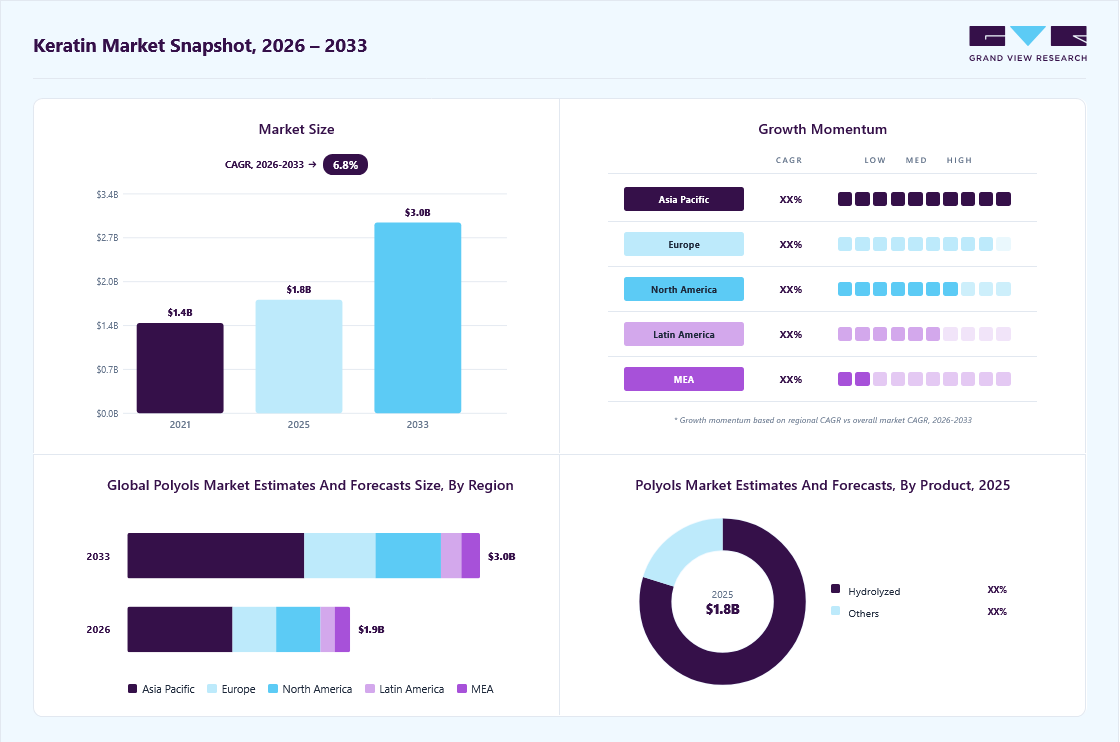
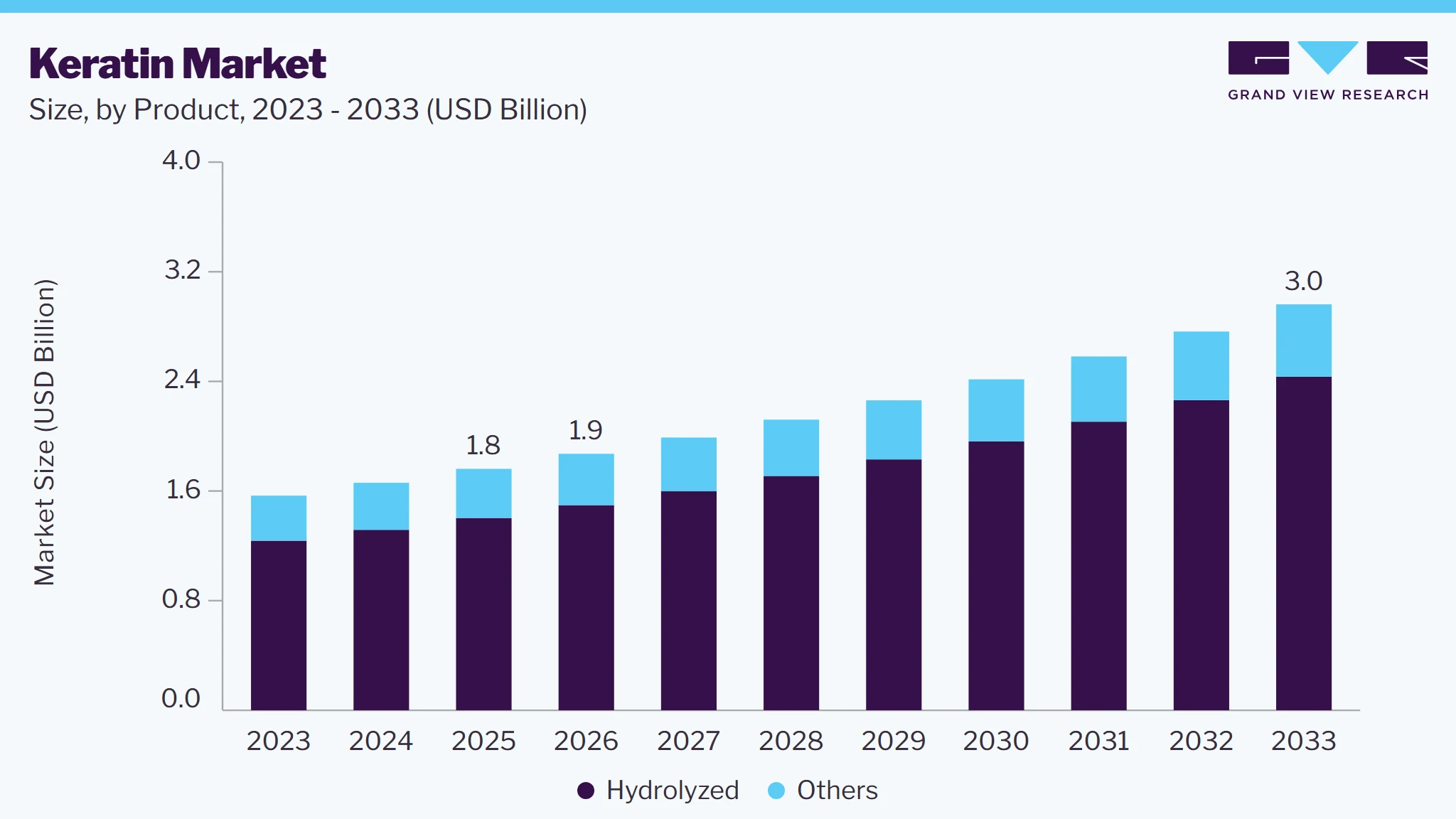
The global keratin market size was valued at USD 1.8 billion in 2025 and is projected to grow from USD 1.9 billion in 2026 to USD 3.0 billion by 2033, at a CAGR of 6.8% from 2026 to 2033. The market in Asia Pacific dominated with a revenue share of 46.8% in 2025. The increasing consumption of keratin in the personal care and cosmetics industry is a key factor driving market growth.
Key Market Trends & Insights
- By product: Hydrolyzed segment held the largest market share of 79.6% in 2025.
- By application by source: Personal care & cosmetics segment held the largest market share of 45.5% in 2025.
Regional Highlights
- Largest regional market: Asia Pacific (46.8% revenue share, 2025)
- By country: China held the largest market share in 2025.
Market Size & Forecast
- Market size in 2025: USD 1.8 Billion
- Estimated market size in 2026: USD 1.9 Billion
- Projected market size by 2033: USD 3.0 Billion
- CAGR (2026-2033): 6.8%
Three ways to get this report
Buy it, customize it, or ask a question.Get the Full Report
What the study covers
- FormatsPDF · Excel · Dashboard
- Timeline2026–2033 annual, 2025 base
- Coverage20+ countries, 5 regions
- Companies10+ key players profiled
Customize the Report
20% free customization
- IncludeCountries, segments, points
- TailorTo your product definition
- ExtendDeeper competitor detail
- OrA fully bespoke study
- Turnaround5–10 working days
Ask an Analyst
A direct answer, usually in 1 working day
- AccessReport author, directly
- Reply timeWithin 1 working day
- No sales callDirect answer only
- FormatEmail reply
- CostFree, no cost
Keratin is commonly used in skincare and hair care products, including conditioners and shampoo, to reduce oiliness, eliminate dead skin cells, repair damage, and minimize blemishes caused by chemicals and heat. Being insoluble in water, keratin can be sourced from horns, feathers, the outer skin layer, hair, wool, nails, and claws.The demand for keratin is rising in personal care and cosmetics because it is a sustainable, safe, and multifunctional alternative to other acids used in cosmetic products. Its revitalizing effects on hair and skin will further boost demand for keratin in this industry. A significant factor driving the growth of the keratin industry is the increasing preference for bio-based products among consumers, mainly due to rising disposable incomes. Manufacturers are consistently upgrading their product offerings to meet the growing needs of end users, resulting in higher keratin consumption. The expanding global population and ongoing urbanization and industrialization in emerging economies like India have prompted various governments to increase their manufacturing investments to meet the rising demand for keratin.
The global cosmetics industry is gradually shifting toward innovative ingredients that are effective and have fewer adverse effects. As a result, using keratin in cosmetics has led to a higher demand for hair care products. This industry benefits from an increased interest in hair care regimens as more individuals seek effective hair solutions.
Market Dynamics
The keratin market is experiencing steady growth driven by increasing consumer demand for premium hair care, skincare, and personal care products, along with the rising popularity of keratin-based treatments for hair strengthening, repair, and smoothing. Keratin, a structural protein naturally found in hair, skin, and nails, is widely used in cosmetic formulations due to its ability to improve hair texture, reduce damage, and enhance overall appearance. Growing awareness of personal grooming, increasing disposable incomes, and the expansion of the global beauty and wellness industry are further supporting market growth. Rising demand for protein-based ingredients in nutraceuticals, biomedical applications, and sustainable cosmetic formulations is creating new growth opportunities for the keratin market.
The growing consumer focus on hair health, beauty enhancement, and personal grooming is a key driver of the keratin market. Keratin is extensively used in shampoos, conditioners, hair masks, serums, and professional salon treatments due to its ability to repair damaged hair, improve elasticity, and restore shine.
The increasing prevalence of hair damage caused by chemical treatments, pollution, heat styling, and environmental stressors has encouraged consumers to seek keratin-enriched products. Furthermore, the expansion of the salon and professional beauty services industry, coupled with growing demand for premium and specialized hair care solutions, continues to boost keratin consumption worldwide. Rising urbanization, evolving beauty trends, and increasing spending on personal care products are expected to sustain market growth throughout the forecast period.
The availability and sourcing of raw materials used in keratin production remain significant challenges for the market. Commercial keratin is primarily derived from animal-based sources such as wool, feathers, horns, and hooves, making supply dependent on livestock and poultry industry dynamics.
Concerns regarding animal-derived ingredients, ethical sourcing, and stringent regulations governing cosmetic and personal care ingredients may limit market expansion in certain regions. Variability in raw material quality, processing costs, and compliance with safety and environmental standards can increase production expenses. Consumer preference for vegan and plant-based alternatives may also pose challenges for traditional keratin manufacturers, particularly in mature cosmetic markets.
The increasing demand for sustainable, clean-label, and environmentally friendly ingredients presents significant opportunities for the keratin market. Advances in biotechnology, protein extraction techniques, and waste valorization processes are enabling manufacturers to produce high-quality keratin from renewable and recycled sources, including poultry feathers and wool waste.
Growing interest in natural cosmetics, functional personal care products, and protein-based biomaterials is expanding keratin applications beyond traditional hair care products. Emerging opportunities in wound healing, tissue engineering, drug delivery systems, and nutraceutical formulations are further strengthening market potential. In addition, the development of plant-based and recombinant keratin alternatives is attracting environmentally conscious consumers and supporting product innovation. Companies investing in sustainable sourcing, advanced extraction technologies, and high-performance keratin formulations are expected to gain a competitive advantage in the evolving global market.
Analyst Perspective
The global keratin market is positioned for steady growth, driven by increasing demand for high-performance personal care products, rising consumer awareness regarding hair and skin health, and expanding applications in nutraceutical and biomedical sectors. Hydrolyzed keratin remains the most widely utilized product type due to its superior solubility, bioavailability, and compatibility with cosmetic formulations. The growing popularity of premium hair repair treatments, protein-enriched beauty products, and beauty-from-within supplements continues to strengthen demand across developed and emerging markets.
Product Insights
The hydrolyzed dominated the product segment at a revenue share of 79.6% in 2025 and is expected to continue to dominate the industry over the forecast period. Hydrolyzed keratin is a blend of amino acids and peptides commonly found in nails, hair, skin, and other personal care products. It serves multiple purposes, including acting as a humectant, a nail conditioning agent, and an antistatic agent. Additionally, hydrolyzed keratin contributes to the health of biological tissues. Cosmetic and personal care companies incorporate it into their products to enhance well-being, health, and beauty.
Alpha-keratin is the leading type in this segment. As a fibrous structural protein, alpha-keratin is crucial in personal care and cosmetics. Several factors support their market dominance. Consumers seek high-quality hair cosmetics and smooth and straightening solutions, which drives the demand for alpha-keratin products. These products' safety and environmental friendliness have also contributed to their popularity.
Application by Source Insights
The personal care & cosmetics segment accounted for the largest revenue share of 45.5% in 2025. The demand for personal care products has grown significantly globally in the past few years, particularly for hair care products. The product market finds applications in numerous personal care categories, such as conditioners, shampoos, and facial moisturizers. The rising demand for keratin reflects consumers' lifestyle changes, simplifying beauty routines amid busy schedules.
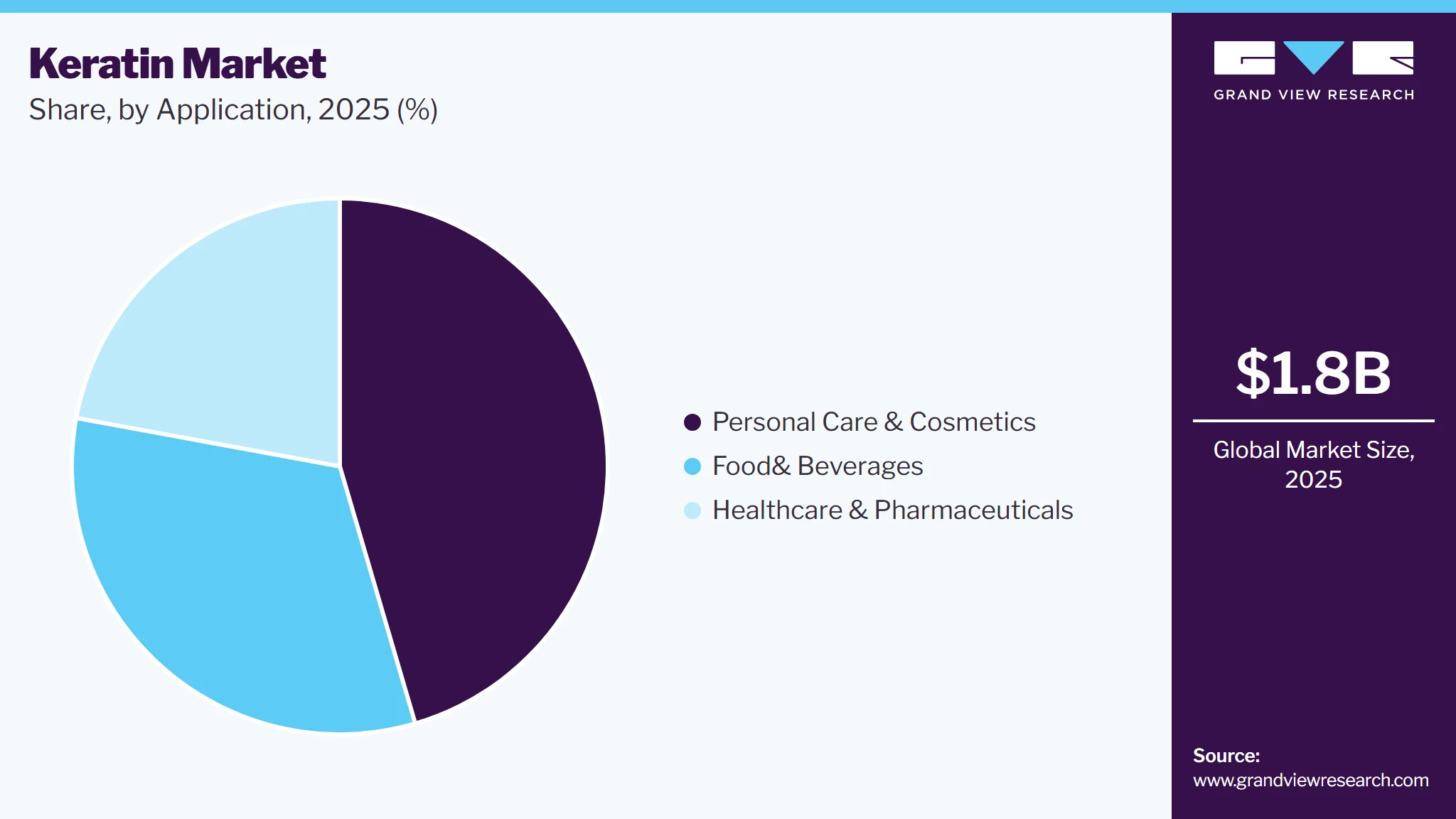
Due to its unique properties, keratin is increasingly being explored in the food and beverage industry. It can be utilized as a functional ingredient, enhancing the texture and stability of protein bars and beverages. Its high protein content makes it a valuable addition to fortifying snacks while offering potential health benefits, such as supporting hair, skin, and nail health. Additionally, Keratin’s natural resources can contribute to the trend of cleaner labels in food products.
Regional Insights
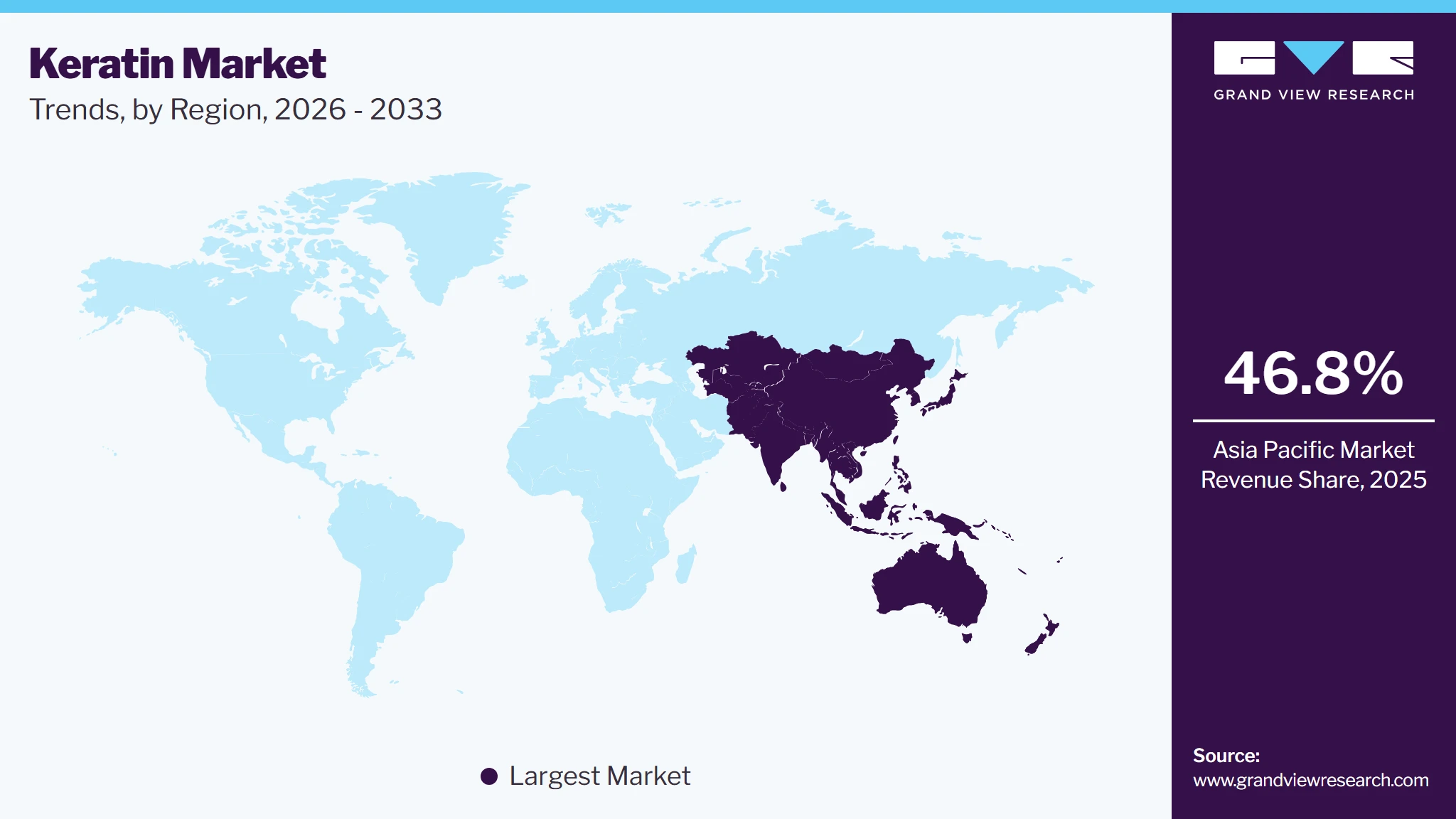
Asia Pacific accounted for 46.8% of the keratin market revenue in 2025, making it the largest regional market. The Asia Pacific region is dominant in the keratin market, owing to the presence of global multinational companies in the region with high demand from end-use markets, personal care & cosmetics, healthcare & pharmaceuticals, and food & beverages markets. The Asia-Pacific region includes South Korea, Japan, China, India, and other countries. The growth of the female workforce, the development of the middle class, and urbanization have all contributed to the adoption of convenience-oriented lifestyles. This shift has led to an increased demand for keratin products in both developing and developed economies.
China Keratin Market Trends
China held the highest market revenue share in Asia Pacific in 2025. The market in China is expected to grow during the forecast period. This growth is attributed to increasing consumer awareness about the product market, which must lead to increased demand for products in the region.
North America Keratin Market Trends
The North American market is experiencing growth, primarily due to consumers' increasing use of hair and skin care products. The presence of various small and large producers is enhancing awareness and driving demand for personal care products. Manufacturers in North America are adopting an integrated approach to health and cosmetic products, treating them as interconnected categories rather than handling each separately in the personal care sector.
Europe Keratin Market Trends
The European market is witnessing significant growth, fueled by a strong demand for high-quality hair care products and treatments. The region's focus on sustainability and eco-friendly formulations also increases the attractiveness of keratin products to consumers. Key markets in Europe include the United Kingdom, France, and Germany, which play crucial roles in shaping market trends and consumer preferences.
Latin America Keratin Market Trends
The Latin American keratin market is expected to experience significant growth, fueled by rising consumer demand for hair care and cosmetic products. Key contributors to this growth include Brazil and Argentina, where increasing disposable incomes and a heightened interest in personal grooming are noticeable. Additionally, the market is influenced by trends favoring sustainable and ethically sourced keratin, which aligns with global consumer preferences for eco-friendly products.
Middle East & Africa (MEA) Keratin Market Trends
The keratin market in the MEA region is set for growth. This expansion is fueled by an increasing demand for personal care products and the rising popularity of keratin in hair treatments and cosmetics. Key markets in the region include Saudi Arabia and South Africa, where consumer awareness of hair health and beauty trends is growing. Additionally, a significant shift toward sustainable and ethically sourced keratin products aligns with global consumer preferences for eco-friendly options.
Key Keratin Company Insights
Some of the key players operating in the market include BASF SE and Keraplast.
-
BASF SE operates through six business segments: Industrial Solutions, Materials, Surface Technologies, Chemicals, Nutrition and care, and Agricultural Solutions. The company's products are used in agriculture, construction, pharmaceuticals, energy and power, home care and nutrition, automotive and transportation, rubber and plastics, leather and textiles, and personal care and hygiene industries. The company has over 355 manufacturing facilities in over 90 countries and regions, including Europe, Asia Pacific, North America, Central America, South America, the Middle East, and Africa. BASF has a presence in 93 countries and operates 234 production sites worldwide.
-
Keraplast is a leading biotechnology company dedicated to developing keratin protein technology. The company has created a process that preserves the natural properties of keratin, allowing clients to harness the benefits of authentic keratin protein across various fields, including hair care, wound care, skincare, and nutrition.
Key Keratin Companies
The following key companies have been profiled for this study on the keratin market.
-
Proteina
-
Hefei TNJ Chemical Industry Co., Ltd.
-
Rejuvenol
-
Scherdiva
-
Keratin Express
-
Keraplast
-
NutriScience Innovations LLC
-
Guangzhou FONCIU Cosmetics Limited
-
Shaanxi Qinland Bio-Tech Co., Ltd.
-
Wellgreen Technology Co., Ltd.
-
Greentech Biochemicals Co., Limited.
-
MakingCosmetics Inc.
-
Kerline Srl
-
Active Concepts LLC
-
BASF SE
Competitive Benchmarking
Category
Operating Strategies
Competitive Edge
Weakness
Established Players (BASF SE, Keraplast, Active Concepts LLC, Kerline Srl, Proteina, Rejuvenol)
- Expand production of hydrolyzed keratin and specialty protein ingredients for personal care, nutraceutical, and biomedical applications.
- Invest in advanced extraction, purification, and formulation technologies to improve product performance and functionality.
- Develop innovative keratin-based solutions aligned with clean-label, natural, and sustainable product trends.
- Strengthen market presence through strategic partnerships with cosmetic brands, pharmaceutical companies, and ingredient distributors.
- Strong technical expertise and established manufacturing capabilities.
- Broad product portfolios serving multiple end-use industries.
- Long-standing relationships with global personal care and healthcare companies.
- Ability to meet stringent quality, safety, and regulatory requirements across international markets.
- Dependence on animal-derived raw materials can create sourcing challenges.
- Higher production costs are associated with purification and specialty processing.
- Regulatory scrutiny regarding ingredient safety and sustainability claims.
- Competition from alternative protein-based and plant-derived ingredients.
Emerging & Specialized Players (NutriScience Innovations LLC, Hefei TNJ Chemical Industry Co., Ltd., Guangzhou FONCIU Cosmetics Limited, Shaanxi Qinland Bio-Tech Co., Ltd., Wellgreen Technology Co., Ltd., Greentech Biochemicals Co., Limited, MakingCosmetics Inc., Keratin Express, Scherdiva)
- Focus on niche applications in beauty supplements, cosmetic formulations, and specialty personal care products.
- Leverage e-commerce and direct-to-brand ingredient supply models to expand customer reach.
- Develop customized keratin formulations tailored to specific customer requirements.
- Emphasize sustainable sourcing, innovative ingredient blends, and cost-effective production approaches.
- Greater flexibility in responding to emerging beauty and wellness trends.
- Ability to serve specialized market segments with customized offerings.
- Faster product development and commercialization cycles.
- Strong positioning in regional markets and growing demand for natural ingredients.
- Limited production capacity and global distribution networks compared with established manufacturers.
- Lower brand recognition in international markets.
- Dependence on third-party raw material suppliers and contract manufacturing in some cases.
- Greater vulnerability to raw material price fluctuations and competitive pricing pressure.
Recent Developments
-
In March 2024, Keraplast Technologies, a prominent keratin market player, announced plans to expand its operations into new regions, explicitly targeting Europe and the Asia-Pacific. This strategic initiative aims to enhance the company’s market presence and capitalize on the increasing global demand for keratin-based products. By entering these dynamic markets, Keraplast seeks to take advantage of growth opportunities and meet evolving consumer preferences.
-
In April 2024, Unilever, a significant player in the keratin industry, recently launched a new line of hair care products featuring keratin as a key ingredient. This launch is part of Unilever's strategy to diversify its product offerings and meet consumer demand for effective, natural hair care solutions. By introducing keratin-infused products, the company aims to improve hair health and attract a broader range of customers.
Keratin Market Report Scope
Report Attribute
Details
Market size in 2025
USD 1.8 billion
Estimated market size in 2026
USD 1.9 billion
Projected market size by 2033
USD 3.0 billion
Growth rate
CAGR of 6.8% from 2026 to 2033
Base year for estimation
2025
Historical data
2021 - 2024
Forecast period
2026 - 2033
Quantitative units
Revenue in USD million/billion, volume in kilotons and CAGR from 2026 to 2033
Report coverage
Volume, Revenue forecast, company ranking, competitive landscape, growth factors, and trends
Segments covered
Product, application by source & region
Regional scope
North America; Europe; Asia Pacific; Latin America; MEA
Country scope
U.S.; Canada; Mexico; Germany; UK; Italy; France; Spain; China; India; Japan; South Korea; Thailand; Brazil; Argentina; Saudi Arabia; South Africa
Key companies profiled
Proteina; Hefei TNJ Chemical Industry Co., Ltd.; Rejuvenol; Scherdiva; Keratin Express; Keraplast; NutriScience Innovations LLC; Guangzhou FONCIU Cosmetics Limited; Shaanxi Qinland Bio-Tech Co., Ltd.; Wellgreen Technology Co., Ltd.; Greentech Biochemicals Co., Limited.; MakingCosmetics Inc.; Kerline Srl; Active Concepts LLC; BASF SE.
Customization scope
Free report customization (equivalent up to 8 analysts' working days) with purchase. Addition or alteration to country, regional & segment scope.
Pricing and purchase options
Avail customized purchase options to meet your exact research needs. Explore purchase options
Global Keratin Market Report Segmentation
This report forecasts revenue and volume growth at global, regional, and country levels and analyzes the latest industry trends in each of the sub-segments from 2021 to 2033. For this study, Grand View Research has segmented the global keratin market report by product, application by source, and region.
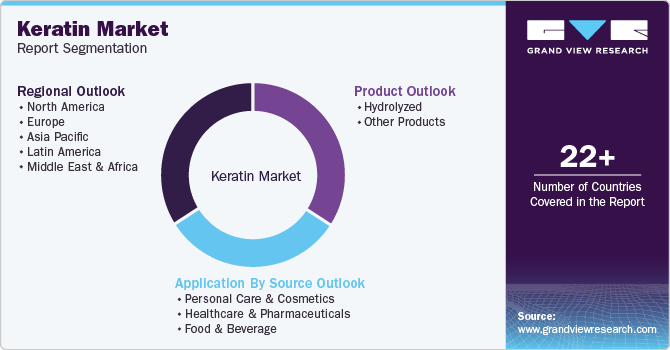
-
Product Outlook (Volume, Tons; Revenue, USD Million; 2021 - 2033)
-
Hydrolyzed
-
Other Products
-
-
Application by source Outlook (Volume, Tons; Revenue, USD Million; 2021 - 2033)
-
Personal Care & Cosmetics
-
Animal
-
Plant
-
-
Healthcare & Pharmaceuticals
-
Animal
-
Plant
-
-
Food & Beverage
-
Animal
-
Plant
-
-
-
Regional Outlook (Volume, Tons; Revenue, USD Million; 2021 - 2033)
-
North America
-
U.S.
-
Canada
-
Mexico
-
-
Europe
-
Germany
-
UK
-
France
-
Italy
-
Spain
-
-
Asia Pacific
-
China
-
India
-
Japan
-
South Korea
-
Thailand
-
-
Latin America
-
Brazil
-
Argentina
-
-
Middle East & Africa
-
Saudi Arabia
-
South Africa
-
-
Research Methodology
The keratin market figures in this report are based on a proven research process that combines executive interviews with secondary research from proprietary databases, company filings, and recognized regulatory and institutional sources. Market size is built through value-chain sizing - reconciling supply-side and demand-side estimates - and triangulated with bottom-up and top-down approaches. Every estimate passes multiple levels of expert validation before publication, with each keratin segment quantified using the revenue-capture definitions in the table below.
Segment Definition
Segment - Product
Revenue capture definition
Hydrolyzed
Revenue is derived from the commercialization of water-soluble keratin proteins supplied to manufacturers of hair care, skincare, nail care, and nutritional products, where the ingredient is incorporated to enhance repair, conditioning, and strengthening properties.
Other Products
Revenue comes from the sale of specialized keratin forms such as keratin peptides, powders, concentrates, and biomaterial-grade keratin used in cosmetic formulations, dietary supplements, medical products, and research applications.
Segment - Application by source
Revenue capture definition
Personal Care & Cosmetics
Revenue is generated through the incorporation of keratin ingredients into finished beauty and personal care products, including shampoos, conditioners, hair treatments, skin care products, and nail care solutions sold through retail, salon, and professional channels.
Food & Beverages
Revenue originates from the use of keratin-based proteins and derivatives in dietary supplements, functional foods, and wellness beverages formulated to support hair, skin, and nail health.
Healthcare & Pharmaceuticals
Revenue is obtained from supplying keratin for medical and pharmaceutical applications such as wound dressings, tissue scaffolds, regenerative therapies, drug delivery systems, and other biocompatible healthcare products.
Estimation Model
Layer Name
Key Question
Description
Keratin Production Layer
What forms is the supply base?
Identify global keratin production capacity based on the availability of raw materials such as wool, feathers, horns, hooves, and other protein-rich by-products, along with extraction technologies, hydrolysis processes, purification capabilities, quality standards, and manufacturing facilities. This layer establishes the foundational supply base serving personal care, healthcare, nutraceutical, and industrial applications worldwide.
Application Adoption Layer
Where is keratin utilized?
Estimate the proportion of keratin consumed across personal care & cosmetics, food & beverage supplements, healthcare & pharmaceutical products, biomedical materials, and other specialty applications based on product formulations, consumer demand, technological advancements, and regional usage patterns.
Consumption Intensity Layer
How much is keratin used?
Analyze application-specific usage rates, cosmetic production volumes, dietary supplement formulations, medical product manufacturing, protein ingredient requirements, and industry adoption trends to determine annual keratin demand across key end-use sectors and geographic markets.
Revenue Layer
How is market revenue generated?
Market revenue is generated through the sale of hydrolyzed keratin, keratin peptides, keratin powders, and other keratin-derived ingredients supplied to personal care product manufacturers, nutraceutical companies, pharmaceutical firms, biomedical material developers, and specialty ingredient formulators worldwide.
Delivered Customizations
This report has been delivered with the following In-depth customizations
Client Request
Customization Delivered
Value Adds
Cross-Segmentation Analysis
Detailed cross-segmentation assessment evaluating the relationship between product types, applications, and keratin consumption patterns. Analysis identifies usage intensity, formulation requirements, protein concentration needs, performance characteristics, and revenue contribution across intersecting segments such as hydrolyzed keratin in personal care products, keratin supplements in food & beverages, and specialty keratin materials in healthcare and pharmaceutical applications.
Supports product portfolio optimization and market prioritization by identifying the most attractive product-application combinations, enabling improved resource allocation, sales targeting, product innovation strategies, and long-term growth planning across the keratin value chain.
Competitive Benchmarking
Comparative evaluation of leading keratin manufacturers based on product portfolio breadth, extraction and processing capabilities, manufacturing capacity, raw material sourcing strategies, geographic presence, sustainability initiatives, end-use specialization, customer relationships, distribution networks, and strategic developments across key regional markets.
Assists competitive intelligence, partnership evaluation, and supplier assessment by providing deeper visibility into market positioning, technological strengths, differentiation strategies, innovation capabilities, operational efficiency, and areas of competitive advantage.
Opportunity Assessment
Comprehensive assessment of emerging opportunities associated with sustainable keratin production, biotechnology-based extraction methods, beauty-from-within supplements, premium hair care formulations, regenerative medicine, wound healing products, tissue engineering applications, and increasing demand for natural and protein-based ingredients across global markets.
Helps identify high-growth investment areas, emerging application opportunities, technology development priorities, and market expansion strategies, supporting long-term revenue growth and competitive positioning across the keratin value chain.
Frequently Asked Questions About This Report
Some prominent players in the keratin market include Proteina; Hefei TNJ Chemical Industry Co., Ltd.; Rejuvenol; Scherdiva; Keratin Express; Keraplast; NutriScience Innovations LLC; Guangzhou FONCIU Cosmetics Limited; Shaanxi Qinland Bio-Tech Co., Ltd.; Wellgreen Technology Co., Ltd.; Greentech Biochemicals Co., Limited.; MakingCosmetics Inc.; Kerline Srl; Active Concepts LLC; BASF SE..
The global keratin market anticipated to witness a significant growth over the forecast years. Increasing consumption of keratin in personal care & cosmetic industry is a major factor driving the market growth
Asia Pacific emerged as the leading regional market in 2025, capturing 46.8% of global revenue.
The global keratin market size was valued at USD 1.8 billion in 2025 and is estimated at USD 1.9 billion for 2026.
The global keratin market is expected to grow at a CAGR of 6.8% from 2026 to 2033, reaching USD 3.0 billion by 2033.
The personal care & cosmetic segment accounted for the major share of 45.5% in the market by revenue in 2025, owing to the increasing demand for Keratin from the personal care & cosmetic market.
The hydrolyzed keratin segment dominated the keratin market in 2025, accounting for 79.6% of total market revenue. Its leadership is attributed to superior solubility, enhanced bioavailability, and widespread use in hair care, skincare, nail care, nutraceuticals, and specialty cosmetic formulations.
Sustainability is becoming a key focus area for the keratin industry as manufacturers increasingly utilize renewable and upcycled raw materials such as poultry feathers, wool waste, and other animal by-products. Advances in eco-friendly extraction technologies and circular economy practices are helping reduce waste while improving resource efficiency.
Significant opportunities are emerging from the expansion of premium personal care products, beauty-from-within supplements, and biomedical applications. Growing research into keratin-based biomaterials for wound healing, tissue engineering, regenerative medicine, and advanced healthcare products is expected to create new revenue streams.
About the Author(s)
Petrochemicals Research Team
Bulk Chemicals · PetrochemicalsThis report was authored by the petrochemicals research team at Grand View Research - comprising two research analysts, one senior research analyst, and one industry expert - with specialized expertise in the petrochemicals segment of the bulk chemicals industry. All findings are based on proprietary bulk chemicals databases, executive interviews, and regulatory analysis, subject to internal peer review prior to publication.
Last Updated:
Speak to Analyst


Customize this report to your needs - add regions, segments, or data points, with 20% free customization.
Or view our licence options:


ISO 9001:2015 & 27001:2022 Certified
We are GDPR and CCPA compliant! Your transaction & personal information is safe and secure. For more details, please read our privacy policy.


