
- Home
- »
- Advanced Interior Materials
- »
-
Laminated Steel Market Size & Share Report, 2026-2033GVR Report cover

Laminated Steel Market (2026 - 2033)
Size, Share & Trends Analysis Report By Product (Carbon Steel, Low-Alloy Steel), By End Use (Automotive & Transportation, Construction & Buildings), By Region, And Segment Forecasts
Market Size, 2025
$1.7BMarket Estimate, 2026
$1.8BMarket Forecast, 2033
$2.4BCAGR, 2026–2033
4.2%Laminated Steel Market Summary
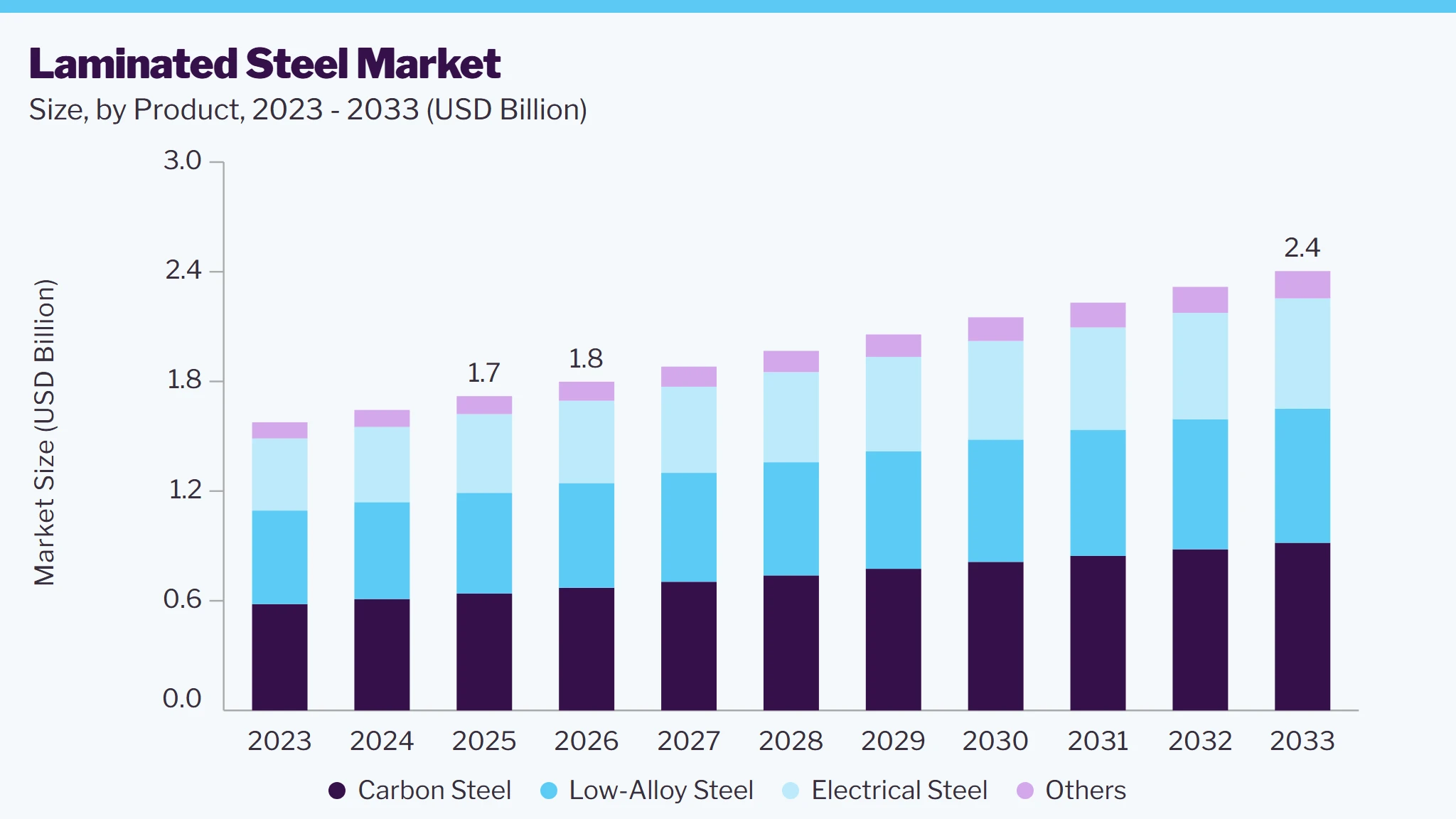
The global laminated steel market size was valued at USD 1.7 billion in 2025 and is projected to grow from USD 1.8 billion in 2026 to USD 2.4 billion by 2033, at a CAGR of 4.2% from 2026 to 2033. Asia Pacific dominated the market, accounting for a revenue share of 75.3% in 2025. Laminated steel, known for its excellent strength, corrosion resistance, and noise-dampening properties, has become a preferred choice for manufacturers seeking to enhance product quality and longevity.
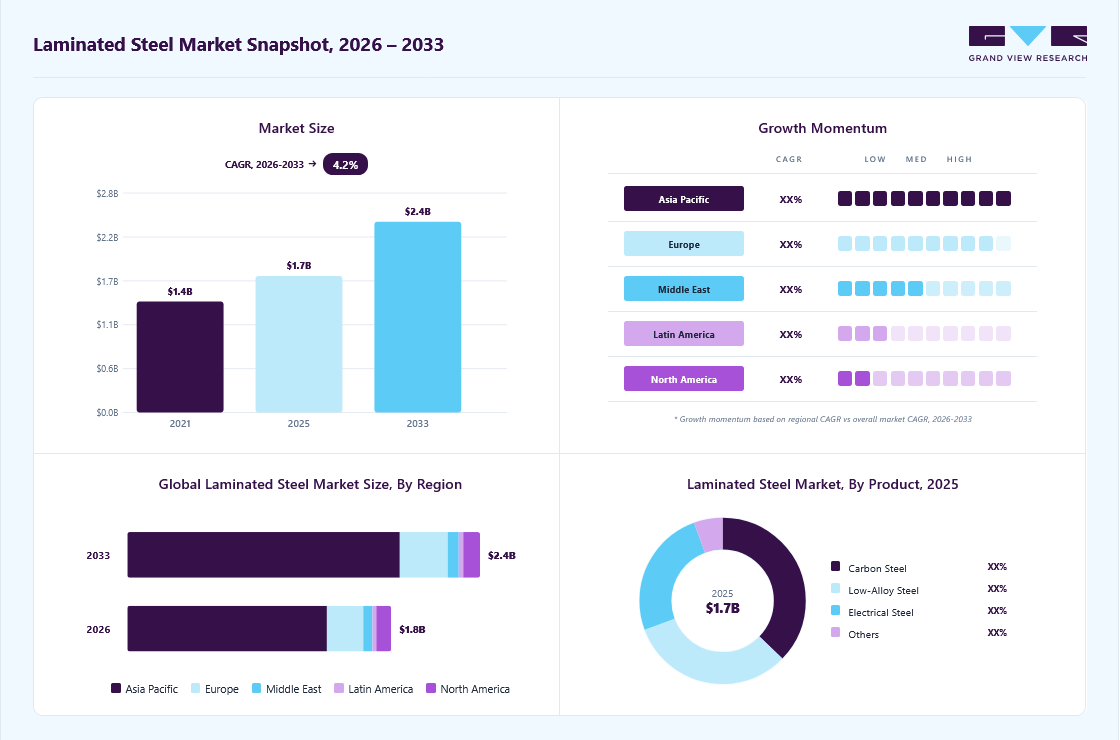 Source: Grand View Research, IR Documents, Primary Interviews, Paid DatabasesTo learn more about this report,
 Download Free Sample Report
Key Market Trends & Insights
- By : product: Carbon steel segment led the market with the largest revenue share of 37.2% in 2025.
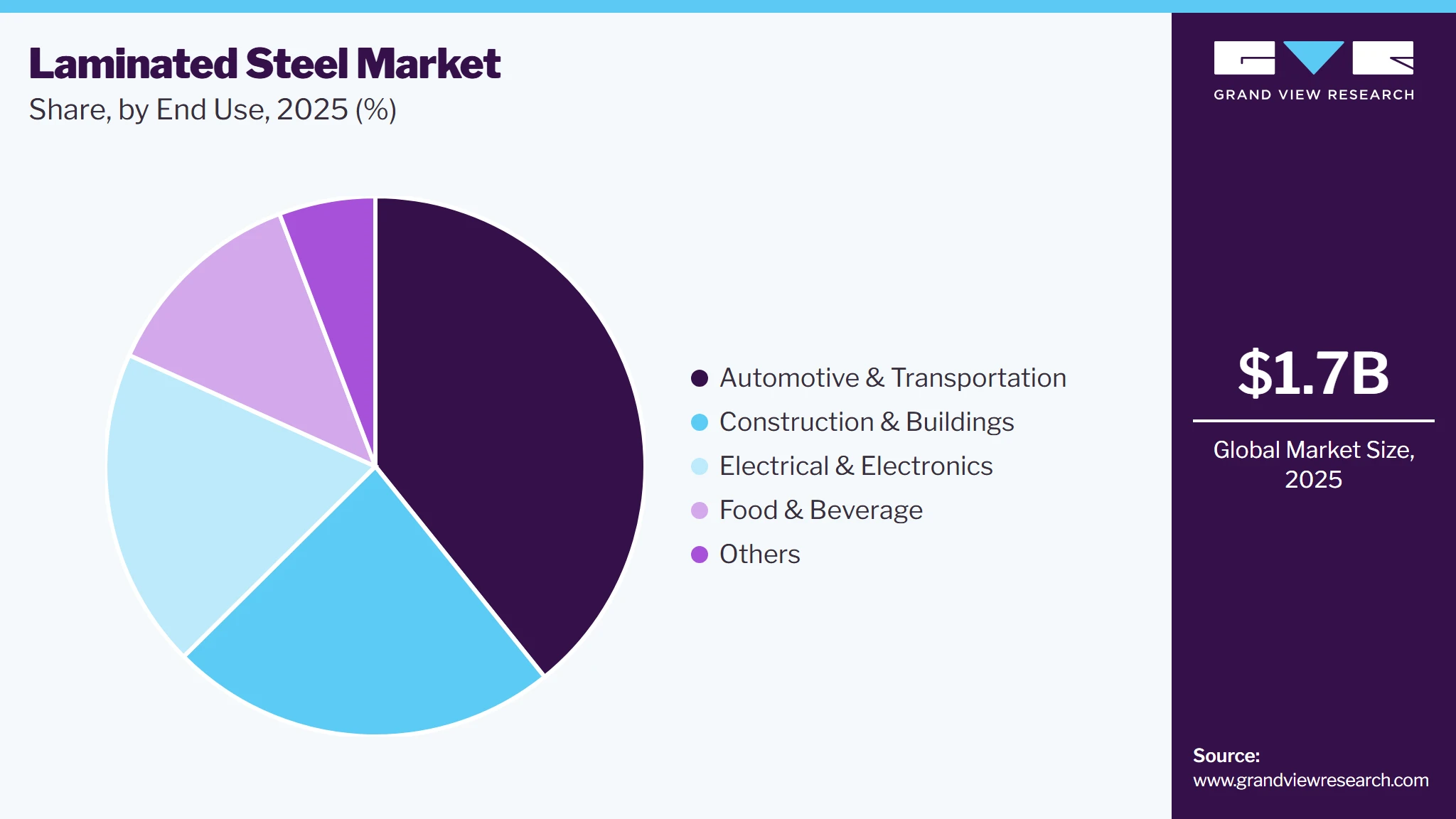
- By end use: Automotive & transportation segment led the market with the largest revenue share of 39.2% in 2025.
Regional Highlights
- Largest regional market: Asia Pacific (75.3% revenue share, 2025)
- By country: The China held the largest market share in 2025.
Market Size & Forecast
- Market size in 2025: USD 1.7 Billion
- Estimated market size in 2026: USD 1.8 Billion
- Projected market size by 2033: USD 2.4 Billion
- CAGR (2026-2033): 4.2%
Prism AI by Grand View Research Free to tryAsk a question about the laminated steel marketTry asking✓Every figure cited from GVR research Prefer the report? Download free sample →As industries prioritize sustainability and efficiency, laminated steel's ability to reduce energy consumption and improve performance has further fueled its adoption. With the rise of electric vehicles (EVs) and the need for lightweight yet strong materials, laminated steel has become a critical component in vehicle manufacturing. Its use in electric motor cores, chassis, and body panels helps reduce vehicle weight, improve fuel efficiency, and enhance overall performance. In addition, stringent government regulations regarding vehicle emissions and safety standards have pushed automakers to adopt advanced materials, further boosting market growth.
 To learn more about this report, Download Free Sample Report
The construction industry has also played a significant role in driving the demand for laminated steel. As urbanization accelerates globally, there is a growing need for robust and sustainable building materials. Laminated steel is widely used in structural applications, roofing, and cladding due to its durability, fire resistance, and aesthetic appeal. The material's ability to withstand harsh environmental conditions and reduce maintenance costs has made it a popular choice for residential and commercial construction projects. Furthermore, the increasing focus on green building practices has led to greater market adoption, as it aligns with sustainability goals by being recyclable and energy efficient.
Innovations in lamination techniques, such as improved bonding methods and the development of advanced coatings, have enhanced the material's properties and expanded its applications. These advancements have made laminated steel more cost-effective and accessible, enabling its use in various industries. In addition, integrating automation and digital technologies in production processes has improved efficiency and reduced waste, further driving market growth.
Market Dynamics
The growing demand from the automotive industry is a major driver of the laminated steel market. Automakers are increasingly adopting laminated steel for body panels, structural components, battery enclosures, and noise-reduction applications due to its high strength, corrosion resistance, vibration-damping properties, and lightweight characteristics. As vehicle manufacturers focus on improving fuel efficiency, passenger comfort, and electric vehicle performance, laminated steel is gaining preference over conventional steel in several applications. The expansion of global automobile production, particularly electric and hybrid vehicles, is expected to sustain demand for advanced laminated steel products throughout the forecast period.
The expansion of residential, commercial, and industrial construction activities is a significant driver of growth for the laminated steel market. Rapid urbanization, population growth, and increasing government investments in infrastructure projects such as airports, railway stations, metro networks, commercial complexes, warehouses, and public buildings are creating strong demand for durable and high performance construction materials. Laminated steel is widely used for roofing systems, wall cladding, doors, partitions, ceiling panels, and structural components due to its excellent corrosion resistance, mechanical strength, and attractive surface finish. These properties help extend the service life of buildings while reducing maintenance requirements, making laminated steel a preferred material for modern construction projects.
The growing emphasis on sustainable and energy-efficient buildings is further supporting the adoption of laminated steel across the construction sector. Architects and developers are increasingly selecting materials that offer durability, recyclability, and enhanced weather resistance while meeting stringent environmental regulations. Laminated steel provides superior protection against moisture, chemicals, and harsh climatic conditions, making it suitable for both interior and exterior applications. In addition, the increasing adoption of prefabricated and modular construction methods is driving demand for laminated steel, as it enables faster installation, consistent quality, and improved structural performance in large scale infrastructure developments.
High production and processing costs remain a key restraint on the laminated steel market, as manufacturing requires advanced lamination technologies, specialized coating systems, high-precision equipment, and stringent quality control measures. In addition to the cost of steel substrates, manufacturers incur expenses for polymer films, adhesives, protective coatings, and energy-intensive production processes, resulting in higher overall production costs than those of conventional steel products. These increased costs often translate into higher product prices, making laminated steel less attractive for price-sensitive industries and projects with limited budgets. Small- and medium-sized manufacturers may also face challenges in investing in advanced production facilities, which can limit market expansion and slow the adoption of laminated steel in developing regions.
The growing demand for sustainable and recyclable materials presents a significant opportunity for the laminated steel market as industries increasingly prioritize environmentally responsible manufacturing practices and circular economy initiatives. Laminated steel offers excellent durability, long service life, and the inherent recyclability of its steel substrate, helping manufacturers reduce material waste and improve resource efficiency. Sectors such as construction, automotive, packaging, and consumer appliances are adopting materials that support lower lifecycle environmental impacts while complying with increasingly stringent environmental regulations. In addition, advancements in eco-friendly lamination technologies, low-emission coatings, and recyclable polymer films are enhancing the sustainability profile of laminated steel, encouraging broader adoption among manufacturers seeking to meet environmental goals and customer demand for greener products.
Analyst Perspective
The laminated steel market is expected to experience steady growth as industries increasingly seek materials that combine durability, corrosion resistance, and enhanced performance across automotive, construction, electrical equipment, and industrial applications. The growing adoption of electric vehicles, the expansion of modern infrastructure, and rising investments in energy-efficient electrical systems are driving demand for laminated steel products with superior strength, vibration damping, and long service life.
Product Insights
“Based on product, carbon steel segment led the market with the largest revenue share of 37.2% in 2025”
Carbon steel's strength, versatility, and relatively low cost make it ideal for construction, automotive, and heavy machinery applications. The rapid industrialization and urbanization in emerging economies are boosting the demand for structural steel products, where carbon steel is widely used due to its high tensile strength and ability to withstand heavy loads.
Electrical steel is anticipated to grow significantly over the forecast period. Electrical steel, which is specifically designed to enhance the performance of electrical machines, is crucial for manufacturing transformers, motors, and generators. The global push for cleaner energy and the expansion of renewable energy sources has significantly increased the need for high-performance electrical machines.
End Use Insights
“Based on end use, automotive & transportation segment led the market with the largest revenue share of 39.2% in 2025.”
As the automotive industry continues to focus on fuel efficiency and reducing carbon emissions, the need for lighter materials is becoming more pronounced. In addition, the rise of EVs and advancements in automotive manufacturing techniques further accelerate the demand for high-performance laminated steel to enhance the strength and safety of electric and hybrid vehicles.
 To learn more about this report, Download Free Sample Report
Electrical & electronics is anticipated to register the fastest CAGR over the forecast period. Laminated steel is integral to the efficient operation of inverters, transformers, and other equipment that convert and store renewable energy, such as solar and wind power. As governments and industries push for greener energy solutions and sustainability, the demand for materials that can enhance the performance of energy systems will continue to grow.
Regional Insights
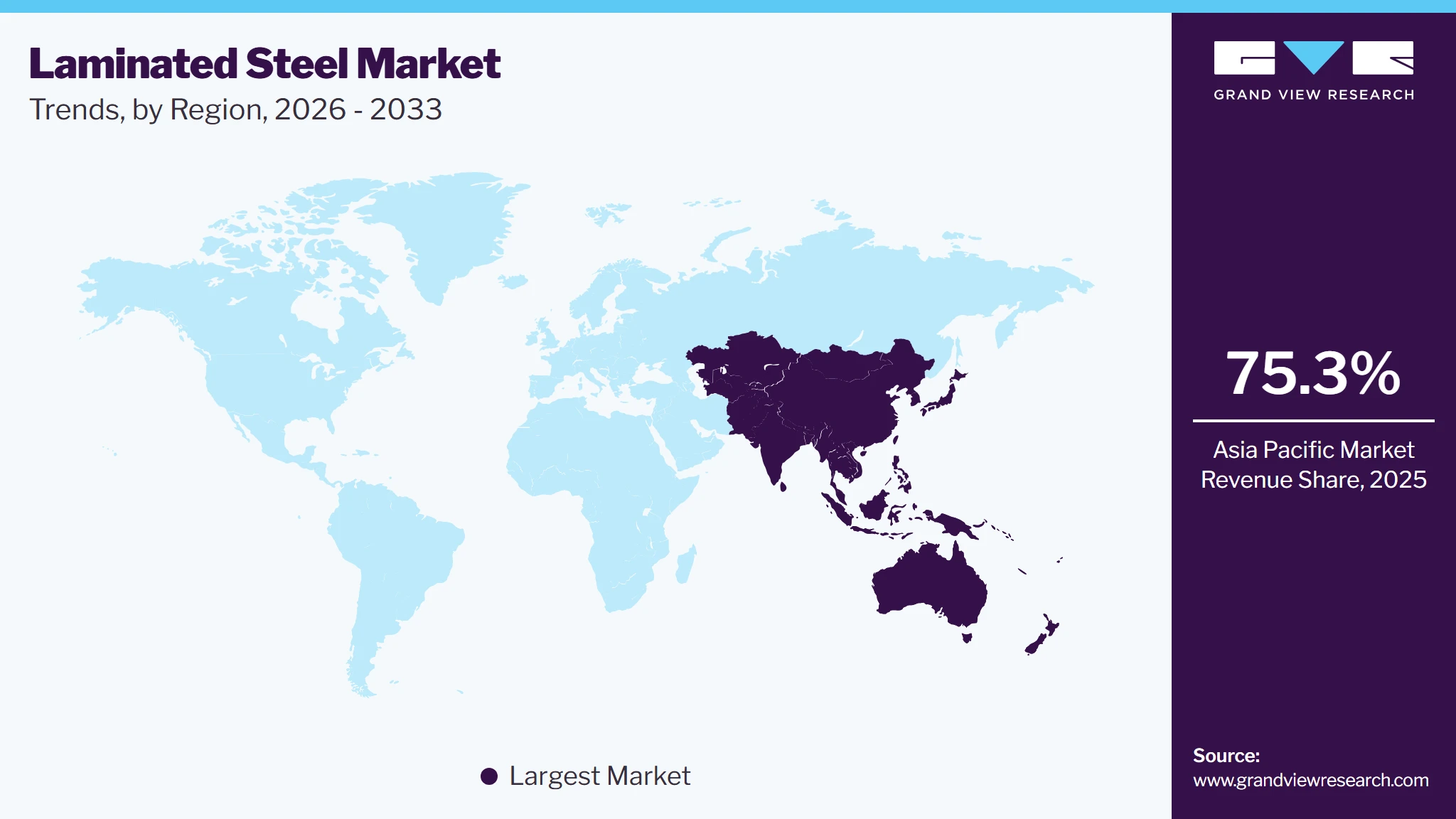
“Asia Pacific dominated the laminated steel market with the largest revenue share of 75.3% in 2025.”
The North America laminated steel industry is home to a well-established automotive manufacturing sector, with major U.S., Canadian, and Mexican companies producing millions of vehicles yearly. As the demand for lightweight vehicles increases, especially with the rise of EVs, laminated steel plays a critical role in ensuring that vehicles meet performance, safety, and fuel efficiency standards.
U.S. Laminated Steel Market Trends
The U.S. laminated steel industry is driven by the construction and infrastructure sectors that are also key contributors to the growth and with continued investments in infrastructure modernization, the demand for high-performance materials has increased. The U.S. government’s commitment to infrastructure renewal, including projects funded by initiatives like the Infrastructure Investment and Jobs Act, further drives demand for laminated steel, especially in large-scale public works and urban development.
Asia Pacific Laminated Steel Market Trends
The Asia Pacific laminated steel industry is anticipated to grow at a healthy CAGR over the forecast period. The laminated steel market in the China held the largest share in the Asia Pacific region in 2025. Countries such as India, China, and others have invested heavily in large-scale infrastructure projects, including transportation networks, bridges, and high-rise buildings. With continued government initiatives to improve infrastructure in APAC, the demand for laminated steel for construction, bridges, and urban infrastructure is expected to remain strong.
 To learn more about this report, Download Free Sample Report
Europe Laminated Steel Market Trends
Europe laminated steel industry held a significant market share in 2024. Europe’s focus on modernizing and improving infrastructure, including transportation systems, bridges, and buildings, has created a steady demand for materials with high strength, durability, and resistance to harsh environmental conditions.
Central & South America Laminated Steel Market Trends
The laminated steel industry in Central & South America is anticipated to grow significantly over the forecast period owing to increasingly adopting advanced manufacturing processes, such as continuous casting, precision lamination, and automated rolling mills, which enhance the quality and cost-effectiveness of laminated steel products. These innovations help produce laminated steel that meets the specific demands of diverse industries such as automotive, construction, and energy. As steel production techniques continue to improve, manufacturers in Central & South America are better positioned to offer high-performance laminated steel products that cater to the region’s growing industrial needs.
Middle East & Africa Laminated Steel Market
The laminated steel industry in the Middle East & Africa is anticipated to grow significantly over the forecast period. Countries in the MEA region, particularly in the GCC countries such as the UAE, Saudi Arabia, and Qatar, invest heavily in large-scale infrastructure projects, including high-rise buildings, bridges, and airports. Furthermore, the region has long been a key player in the oil & gas industry, and the demand for durable, high-strength materials for pipelines, refineries, and power plants has been a major driver of laminated steel consumption.
Key Laminated Steel Company Insights
Some of the key players operating in the market include Nippon Steel Corporation, ArcelorMittal, and others.
-
Nippon Steel Corporation is one of the world’s leading steel producers and is known for its innovative technologies and high-quality products. It offers advanced laminated steel solutions designed to meet the evolving needs of industries such as automotive, construction, aerospace, and electronics. These products are characterized by superior strength, lightweight properties, and corrosion resistance, making them ideal for durability and efficiency applications.
-
ArcelorMittal is one of the world’s leading steel and mining companies. It focuses on high-quality steel production while implementing advanced technologies to enhance efficiency and reduce environmental impact. The company offers a diverse range of laminated steel products that cater to various industrial applications, particularly in the electrical and automotive sectors. Their non-oriented electrical steel (NOES) is designed for power generation and automotive electrification, providing high magnetic performance and sustainability.
Key Laminated Steel Companies
The following key companies have been profiled for this study on the laminated steel market.
-
Alliance Steel
-
ArcelorMittal
-
China Ansteel Group Corporation Limited
-
JFE Steel Corporation
-
LIENCHY LAMINATED METAL CO., LTD.
-
Nippon Steel Corporation
-
POSCO
-
Tata Steel
-
thyssenkrupp AG
-
United States Steel Corporation
Competitive Benchmarking
Category
Operating Strategies
Competitive Edge
Weakness
Established Players (e.g. Alliance Steel, ArcelorMittal)
- Mature participants in the laminated steel market primarily focus on vertically integrated manufacturing, advanced lamination technologies, and long term supply agreements with automotive, electrical equipment, construction, and industrial machinery manufacturers.
- These companies operate integrated facilities covering steel production, rolling, coating, lamination, and finishing processes to ensure consistent product quality and operational efficiency.
- Established players possess significant competitive advantages through their integrated manufacturing infrastructure, advanced processing technologies, and extensive production capacities.
- Their ability to control the entire value chain from steelmaking to lamination enables better cost management, product consistency, and reliable supply.
- Despite their strong market positions, mature players face challenges related to high capital intensity, rising raw material costs, and increasing energy prices.
- Laminated steel manufacturing requires significant investments in rolling mills, lamination lines, coating systems, and quality control technologies.
Emerging & Regional Players (e.g., LIENCHY LAMINATED METAL CO., LTD.)
- Emerging participants in the laminated steel market generally focus on specialized laminated products, regional market expansion, and flexible manufacturing capabilities.
- Rather than competing directly with established producers on production scale, these companies target niche applications such as lightweight laminated steel, electrical laminations, decorative laminated steel, and customized industrial products.
- Emerging companies benefit from operational flexibility and the ability to adopt modern manufacturing technologies without extensive legacy infrastructure.
- Their production facilities often incorporate advanced automation, digital monitoring systems, and energy efficient equipment that improve operational efficiency and product consistency.
- Emerging participants face significant challenges related to limited production capacity, lower economies of scale, and restricted financial resources.
- Competing with established manufacturers that possess integrated steelmaking operations, extensive distribution networks, and long standing customer relationships can be difficult, particularly in price sensitive market segments.
Recent Developments
- In February 2025, ArcelorMittal announced its plans to construct a new, world-class electrical steel manufacturing facility in Calvert, Alabama. This wholly owned facility will produce up to 150,000 metric tons of non-oriented electrical steel (NOES) annually, catering to the automotive and mobility industries, renewable energy production, and other commercial and industrial applications.
Laminated Steel Market Report Scope
Report Attribute
Details
Market size in 2025
The market size represents the apparent consumption of laminated steel-in various applications.
Estimated market size in 2026
USD 1.7 billion
Projected market size by 2033
USD 1.8 billion
Growth rate
USD 2.4 billion
Market size in 2025
CAGR of 4.2% from 2026 to 2033
Base year for estimation
2025
Historical data
2021 - 2024
Forecast period
2026 - 2033
Quantitative units
Revenue in USD million, volume in kilotons, and CAGR from 2026 to 2033
Report coverage
Revenue forecast, volume forecast, company ranking, competitive landscape, growth factors, and trends
Segments covered
Product, end use, and region.
Regional scope
North America; Europe; Asia Pacific; Latin America; Middle East & Africa
Country scope
U.S., Canada, Mexico, Germany, Italy, Russia, France, China, India, Japan, Indonesia, Brazil, Saudi Arabia
Key companies profiled
Alliance Steel; ArcelorMittal; China Ansteel Group Corporation Limited; JFE Steel Corporation; LIENCHY LAMINATED METAL CO., LTD.; Nippon Steel Corporation; POSCO; Tata Steel; thyssenkrupp AG; United States Steel Corporation
Customization scope
Free report customization (equivalent up to 8 analysts' working days) with purchase. Addition or alteration to country, regional & segment scope.
Pricing and purchase options
Avail customized purchase options to meet your exact research needs. Explore purchase options
Global Laminated Steel Market Report Segmentation
This report forecasts revenue and volume growth at global, regional, and country levels and provides an analysis of the latest industry trends in each of the sub-segments from 2021 to 2033. For this study, Grand View Research has segmented the global laminated steel market report based on product, end use, and region.
 To learn more about this report, Download Free Sample Report
-
Product Outlook (Volume, Kilotons; Revenue, USD Million, 2021 - 2033)
-
Carbon Steel
-
Low-Alloy Steel
-
Electrical Steel
-
Others
-
-
End Use Outlook (Volume, Kilotons; Revenue, USD Million, 2021 - 2033)
-
Automotive & Transportation
-
Construction & Buildings
-
Electrical & Electronics
-
Food & Beverage
-
Others
-
-
Regional Outlook (Volume, Kilotons; Revenue, USD Million, 2021 - 2033)
-
North America
-
U.S.
-
Canada
-
Mexico
-
-
Europe
-
Germany
-
Russia
-
France
-
Italy
-
-
Asia Pacific
-
China
-
India
-
Japan
-
Indonesia
-
-
Central & South America
-
Brazil
-
-
Middle East & Africa
-
Saudi Arabia
-
-
Research Methodology
Laminated Steel Market, Laminated Steel Market Size, Laminated Steel Market Share, Laminated Steel Market Analysis, Laminated Steel Market Trends, Laminated Steel Industry Insights, Laminated Steel Market Report, Laminated Steel Industry Report, Laminated Steel Market Research, Laminated Steel Market Growth, Laminated Steel Industry Growth, Laminated Steel Market Forecast, Laminated Steel Industry Forecast, Laminated Steel Industry Analysis
Segment Definition
Product
Revenue Capture Definition
Carbon Steel
Carbon steel in the laminated steel market comprises laminated sheets and coils manufactured from steel with varying carbon content, widely used in construction, automotive, machinery, and industrial applications. This segment captures revenue generated from the production and sale of laminated carbon steel products due to their strength, durability, and cost effectiveness.
Low-Alloy Steel
Low alloy steel includes laminated steel products containing small quantities of alloying elements such as chromium, nickel, molybdenum, or vanadium to enhance mechanical properties and corrosion resistance. Revenue for this segment is derived from the supply of laminated low alloy steel for automotive, energy, heavy equipment, and structural engineering applications.
Electrical Steel
Electrical steel consists of laminated steel specifically engineered with magnetic properties for use in transformers, electric motors, generators, and other electrical equipment. The segment represents revenue generated from grain oriented and non grain oriented laminated electrical steel products supplied to the power generation and electrical manufacturing industries.
Others
The others segment includes laminated steel products manufactured from specialty steel grades such as stainless steel, tool steel, and advanced high strength steel that serve niche industrial applications. Revenue is generated from laminated steel used in aerospace, defense, precision engineering, consumer appliances, and specialized manufacturing sectors.
End Use
Revenue Capture Definition
Automotive & Transportation
The automotive and transportation segment includes revenue generated from laminated steel used in the manufacturing of passenger vehicles, commercial vehicles, rail components, shipbuilding, and transportation equipment. Laminated steel is valued for its strength, formability, durability, and lightweight design capabilities, supporting improved vehicle performance, safety, and fuel efficiency.
Construction & Buildings
The construction and buildings segment represents revenue from laminated steel used in residential, commercial, and industrial infrastructure, including structural components, roofing, wall panels, beams, and flooring systems. Laminated steel offers high load bearing capacity, corrosion resistance, and long service life, making it a preferred material for modern construction projects.
Electrical & Electronics
The electrical and electronics segment captures revenue generated from laminated steel used in transformers, motors, generators, electrical enclosures, appliances, and electronic equipment. The material provides essential magnetic, mechanical, and protective properties required for efficient electrical performance and product reliability.
Food & Beverage
The food and beverage segment includes revenue from laminated steel used in food processing equipment, storage systems, packaging materials, beverage containers, and commercial kitchen applications. Laminated steel is selected for its durability, hygiene, corrosion resistance, and ability to meet stringent food safety standards.
Others
The others segment comprises revenue generated from laminated steel used across industries such as aerospace, marine, industrial machinery, agriculture, oil and gas, healthcare, and consumer goods. These applications require specialized laminated steel products that provide enhanced mechanical performance, wear resistance, or environmental protection.
Estimation Model
Layer Name
Key Question
Description
Industrial & Manufacturing Demand Base Layer
What forms the demand base?
Identify global demand from major steel consuming industries including automotive, electrical & electronics, construction, industrial machinery, food & beverage packaging, and consumer appliances. Assess manufacturing output, infrastructure development, and industrial production to establish the total addressable demand for laminated steel products.
Laminated Steel Application Penetration Layer
Where is laminated steel utilized?
Estimate the penetration of laminated steel across key applications including automotive components, electrical equipment, transformers, motors, construction panels, industrial machinery, food processing equipment, and consumer appliances. Analyze the adoption of carbon steel laminates, low alloy steel laminates, electrical steel laminates, and other laminated steel products across end use industries and regions.
Laminated Steel Consumption Intensity Layer
How much laminated steel is consumed?
Analyze laminated steel consumption intensity based on vehicle production, electrical equipment manufacturing, industrial machinery output, construction activity, and appliance production. Evaluate material usage according to product design, performance requirements, and engineering specifications. Consumption intensity varies according to manufacturing technology, product complexity, energy efficiency standards, and regional industrial growth.
Revenue Layer
How is market revenue generated?
Market revenue is quantified through the sale of laminated steel products including carbon steel, low alloy steel, electrical steel, and other specialty laminated steel materials. Revenue generation is driven by demand from automotive, electrical & electronics, construction, industrial manufacturing, food & beverage, and consumer appliance sectors. Market value is influenced by steel prices, lamination technology, processing costs, product specifications, and regional supply demand dynamics.
Delivered Customizations
This report has been delivered with the following In-depth customizations
Client Request
Customization Delivered
Value Adds
Regional Segmentation
Detailed regional analysis of the laminated steel market across North America, Europe, Asia Pacific, Latin America, and Middle East & Africa. Included evaluation of laminated steel production capacities, automotive manufacturing, electrical equipment production, construction activities, appliance manufacturing, industrial machinery demand, infrastructure investments, and government regulations supporting advanced steel materials.
Identified high growth manufacturing hubs and emerging demand centers for laminated steel. Enabled strategic expansion planning based on industrialization, automotive production, and electrical equipment manufacturing trends. Supported regional demand forecasting and supply chain optimization.
Cross Segmentation
Comprehensive cross segmentation analysis by product type, end use industry, and region, including carbon steel laminates in construction, low alloy steel laminates in automotive, electrical steel laminates in transformers and motors, and specialty laminated steel products across industrial machinery, appliances, and energy applications. Evaluated regional consumption patterns, product preferences, technology adoption, and end use demand trends.
Enabled identification of the most attractive product end use combinations and high growth market segments. Supported product portfolio optimization, customer targeting, and investment prioritization strategies.
Opportunity Assessment
Identification of high growth opportunities across electric vehicles, energy efficient electrical equipment, renewable energy systems, smart grid infrastructure, industrial automation, advanced construction materials, and sustainable manufacturing applications.
Enabled prioritization of high return growth segments and emerging regional opportunities. Supported long term investment planning, capacity expansion decisions, product innovation, and strategic business development initiatives aligned with evolving automotive, electrical, and industrial manufacturing trends.
Frequently Asked Questions About This Report
The global laminated steel market size was estimated at USD 1.7 billion in 2025 and is expected to reach USD 1.8 billion in 2026.
The global laminated steel market is expected to grow at a compound annual growth rate of 4.2% from 2026 to 2033 to reach USD 2.4 billion by 2033.
Asia Pacific dominated the market with revenue share of 75.3% in 2025.
Asia Pacific is anticipated to register the fastest CAGR over the forecast period.
Automotive & transportation accounted for largest revenue share of 39.2% in 2025.
Based on product, carbon steel segment accounted for a market revenue share of 37.2% in 2025.
The key players operating in the laminated steel market are Alliance Steel; ArcelorMittal; China Ansteel Group Corporation Limited; JFE Steel Corporation; LIENCHY LAMINATED METAL CO., LTD.; Nippon Steel Corporation; POSCO; Tata Steel; thyssenkrupp AG; United States Steel Corporation.
The key factor that is driving the growth of the global laminated steel market is the growing demand for durable and lightweight materials in various industries, including automotive, construction, and electronics.
China dominated the Asia Pacific market with revenue share of 64.5% in 2025.
About the Author(s)
Advanced Interior Materials Research Team
Advanced Materials · Advanced Interior MaterialsThis report was authored by the advanced interior materials research team at Grand View Research - comprising two research analysts, one senior research analyst, and one industry expert - with specialized expertise in the advanced interior materials segment of the advanced materials industry. All findings are based on proprietary advanced materials databases, executive interviews, and regulatory analysis, subject to internal peer review prior to publication.
Last Updated:
Speak to Analyst

Customize this report to your needs - add regions, segments, or data points, with 20% free customization.
Or view our licence options:


ISO 9001:2015 & 27001:2022 Certified
We are GDPR and CCPA compliant! Your transaction & personal information is safe and secure. For more details, please read our privacy policy.


