
- Home
- »
- Advanced Interior Materials
- »
-
Landfill Mining Market Size & Share Report, 2026-2033GVR Report cover

Landfill Mining Market (2026 - 2033)
Size, Share & Trends Analysis Report By Material Recovery (Metals, Plastic, Organics), By Landfill Type (Municipal Solid Waste, Industrial Waste, Hazardous Waste), By Region, And Segment Forecasts
Market Size, 2025
$8.4BMarket Estimate, 2026
$9.4BMarket Forecast, 2033
$20.2BCAGR, 2026–2033
11.6%Landfill Mining Market Summary
The global landfill mining market size was valued at USD 8.4 billion in 2025 and is projected to grow from USD 9.4 billion in 2026 to USD 20.2 billion by 2033, at a CAGR of 11.6% from 2026 to 2033. Asia Pacific dominated the market, accounting for a revenue share of 40.0% in 2025. Market growth is primarily driven by rising urbanization, rapid industrialization, and increasing emphasis on sustainable waste management practices.
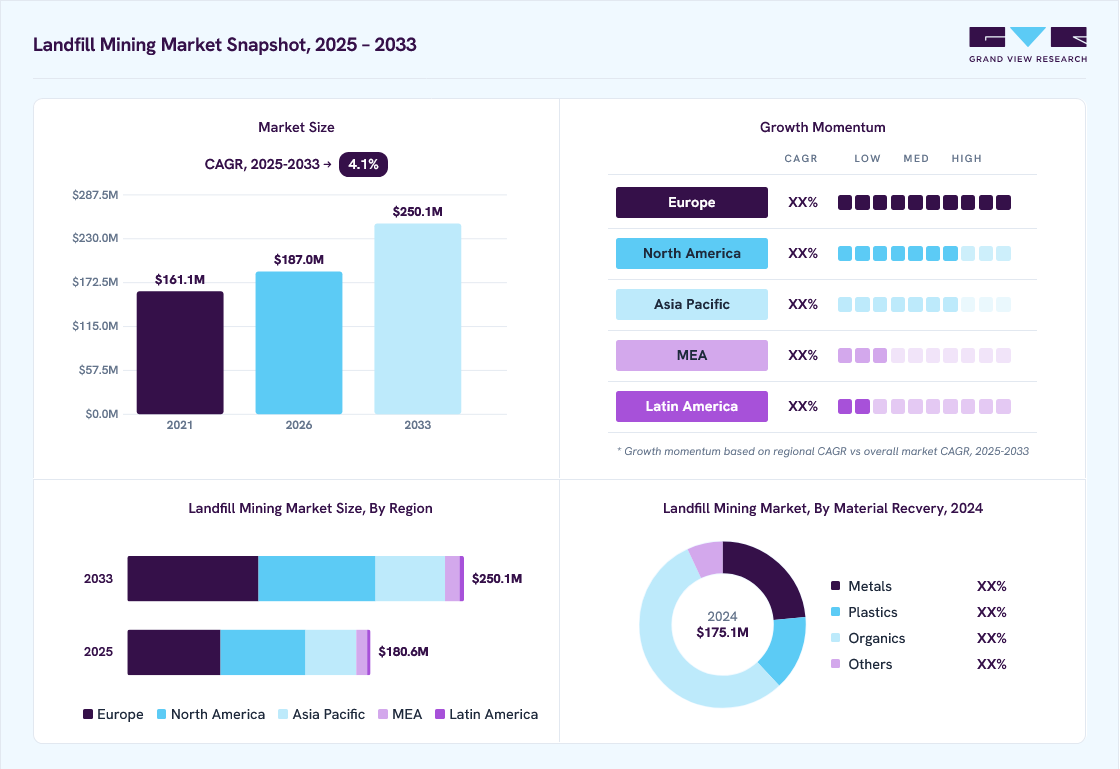 Source: Grand View Research, IR Documents, Primary Interviews, Paid DatabasesTo learn more about this report,
 Download Free Sample Report
 Key Market Trends & Insights
- By material recovery: Organics segment led the market with the largest revenue share of 53.6% in 2025.
- By landfill type: Municipal solid waste (MSW) landfills segment led the market with the largest revenue share of 53.3% in 2025.
Regional Highlights
- Largest regional market: Asia Pacific (40.0% revenue share, 2025)
- By country: The China held the largest market share in 2025.
Market Size & Forecast
- Market size in 2025: USD 8.4 Billion
- Estimated market size in 2026: USD 9.4 Billion
- Projected market size by 2033: USD 20.2 Billion
- CAGR (2026-2033): 11.6%
Three ways to get this report
Buy it, customize it, or ask a question.Ask an Analyst
Analyst response in 1 business day
- AccessReport author, directly
- Reply timeWithin 1 working day
- No sales callDirect answer only
- FormatEmail reply
- CostFree, no cost
Get the Full Report
What the study covers
- FormatsPDF · Excel · Dashboard
- Timeline2026–2033 annual, 2025 base
- Coverage20+ countries, 5 regions
- Companies10+ key players profiled
Customize the Report
20% free customization
- IncludeCountries, segments, points
- TailorTo your product definition
- ExtendDeeper competitor detail
- OrA fully bespoke study
- Turnaround5–10 working days
The growing need to recover valuable materials such as metals, plastics, and aggregates from legacy landfills further supports industry expansion. In addition, landfill mining is crucial in mitigating environmental pollution, reclaiming land for redevelopment, and reducing greenhouse gas emissions. Its applications are expanding across the Hazardous Waste and recycling sectors, as recovered resources are increasingly used as raw materials in industrial processes, contributing to circular economic initiatives and resource efficiency goals.Sustainability is a key priority in the global landfill mining industry, reshaping approaches to excavation, material recovery, and post-remediation land use. Companies involved in landfill reclamation are increasingly adopting advanced sorting technologies, eco-friendly excavation equipment, and Hazardous Waste-efficient processing methods to minimize environmental impact. There is also a growing emphasis on responsible waste handling and traceability, with stakeholders prioritizing projects that align with Environmental, Social, and Governance (ESG) standards.
 To learn more about this report, Download Free Sample Report
 Furthermore, the transition toward a circular economy drives efforts to recover and repurpose materials such as metals, plastics, and Construction Waste aggregates from legacy landfills, reducing reliance on virgin raw materials and lowering carbon footprints. As industries and municipalities push for greener infrastructure and low-emission development, sustainable landfill mining practices are becoming a regulatory requirement and a strategic advantage, enabling resource efficiency, land restoration, and long-term environmental stewardship.
Market Dynamics
Growing emphasis on the circular economy and sustainable resource management is a major driver of the landfill mining market. Governments and municipalities are increasingly investing in excavating legacy landfills to recover valuable materials such as ferrous and non-ferrous metals, plastics, aggregates, and organic fractions that can be reintroduced into industrial supply chains. This approach reduces dependence on virgin raw materials, lowers landfill volumes, and supports environmental remediation while creating additional revenue opportunities from recovered resources.
The growing focus on the circular economy is a significant driver of the landfill mining market as governments and industries seek to maximize resource efficiency and reduce dependence on virgin raw materials. Landfills contain substantial quantities of valuable materials, including ferrous and non-ferrous metals, plastics, glass, construction aggregates, and organic matter that can be recovered and reintroduced into manufacturing processes. Recovering these resources helps conserve natural reserves, lowers extraction costs, and reduces the environmental impact associated with conventional mining activities.
Many countries are implementing circular economy policies that encourage waste recovery, recycling, and landfill remediation to achieve sustainability and climate goals. Public authorities are increasingly supporting landfill mining projects through funding programs, regulatory incentives, and public-private partnerships to transform legacy waste sites into valuable resource hubs. Advancements in material sorting, metal separation, and recycling technologies are further improving recovery efficiency, making landfill mining an economically attractive solution while reducing landfill volumes and increasing resource circularity across industries.
High capital and operational costs remain a key restraint for the landfill mining market, as projects require substantial investment in excavation equipment, material recovery systems, waste sorting technologies, transportation, and environmental monitoring. In addition, expenses related to site assessment, regulatory compliance, hazardous waste handling, and post excavation land remediation significantly increase the overall project cost. These financial challenges can extend payback periods and discourage municipalities and private operators from undertaking large scale landfill mining projects, particularly in regions with limited funding or low commodity prices.
The expansion of urban land reclamation projects presents a significant opportunity for the landfill mining market as cities face increasing pressure from rapid urbanization and limited availability of developable land. Excavating and remediating old landfill sites enables municipalities to recover valuable materials while transforming previously unusable land into residential, commercial, industrial, recreational, or infrastructure developments. This dual benefit of resource recovery and land redevelopment is encouraging greater investment in landfill mining projects, particularly in densely populated regions where land values are high and sustainable urban planning has become a priority.
Analyst Perspective
The landfill mining market is gradually evolving into a strategic component of the circular economy as governments and private organizations seek to recover valuable resources while addressing the environmental challenges associated with legacy landfill sites. Growing volumes of municipal and industrial waste, increasing scarcity of developable urban land, and stricter environmental regulations are driving investments in landfill excavation, material recovery, land reclamation, and waste remediation projects. Advancements in automated sorting, metal recovery, and waste processing technologies are improving the economic viability of recovering metals, plastics, organics, and other reusable materials from old landfills.
Drivers, Opportunities & Restraints
The landfill mining industry is primarily driven by rapid urbanization, industrial expansion, and growing pressure to adopt sustainable waste management solutions. Governments and municipal bodies increasingly focus on remediating legacy landfills to reclaim land for infrastructure development, reducing pollution, and meeting stricter environmental regulations. The rising demand for secondary raw materials, such as metals, plastics, and Construction Waste aggregates recovered from excavated waste, further fuels market growth. For example, the Okhla landfill project in Delhi has successfully processed over 5.6 million tons of legacy waste, significantly reduced landfill height, and supplied refuse-derived fuel (RDF) to cement plants, demonstrating landfill mining initiatives' economic and environmental value.
Landfill mining presents significant opportunities for advancing circular economy models, creating new revenue streams, and transforming reclaimed land into valuable assets. Integrating waste-to-Hazardous Waste solutions allows Hazardous Waste recovery from excavated waste, while public-private partnerships enable large-scale remediation projects with shared costs and benefits. In addition, reclaimed land can be repurposed for real estate, renewable Hazardous Waste parks, or green urban spaces, enhancing long-term value. A notable example is Chennai’s Perungudi and Kodungaiyur landfill reclamation project, where over 43 lakh tons of legacy waste have been cleared, reclaiming nearly 97 acres of land, part of which is being converted into urban forests and renewable infrastructure.
Despite strong growth potential, the landfill mining industry faces several challenges that could hinder its expansion. High upfront costs associated with excavation, segregation, and recycling technologies often discourage investment, particularly in developing regions. In addition, unpredictable waste composition, hazardous material handling, and methane emission risks pose significant operational and environmental challenges. Regulatory hurdles and lengthy approval processes can also delay project execution. For instance, several U.S. landfill reclamation projects have faced setbacks due to stringent environmental compliance requirements and high remediation costs, illustrating the financial and regulatory barriers that must be addressed for broader adoption.
Material Recovery Insights
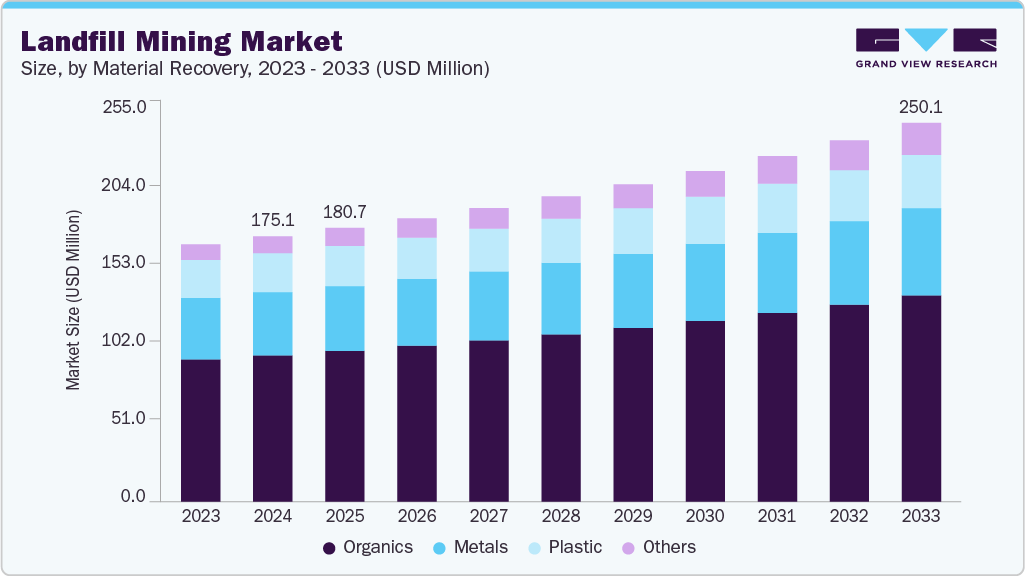
Based on material recovery, organics segment led the market with the largest revenue share of 53.6% in 2025. The organics segment led the market with the largest revenue share of 55.2% in 2024, due to their abundance in legacy landfills. Rising demand for bioenergy, compost, and soil enhancers, combined with supportive government policies promoting circular bioeconomy models, is significantly boosting the recovery and utilization of organic waste. Improved processing technologies also enhance conversion efficiency, making organics a key driver of market growth.
Meanwhile, the metals and plastics segment is anticipated to grow at the fastest CAGR during the forecast period, with metals benefiting from strong demand in construction and manufacturing, and plastics gaining traction through expanding recycling infrastructure and regulatory mandates. The “others” category, including glass, e-waste, and construction debris, contributes a smaller but growing portion, supported by advancements in sorting technologies and increased focus on resource efficiency. Together, these segments transform landfill mining into a vital source of secondary raw materials and a cornerstone of sustainable resource management.
Landfill Type Insights
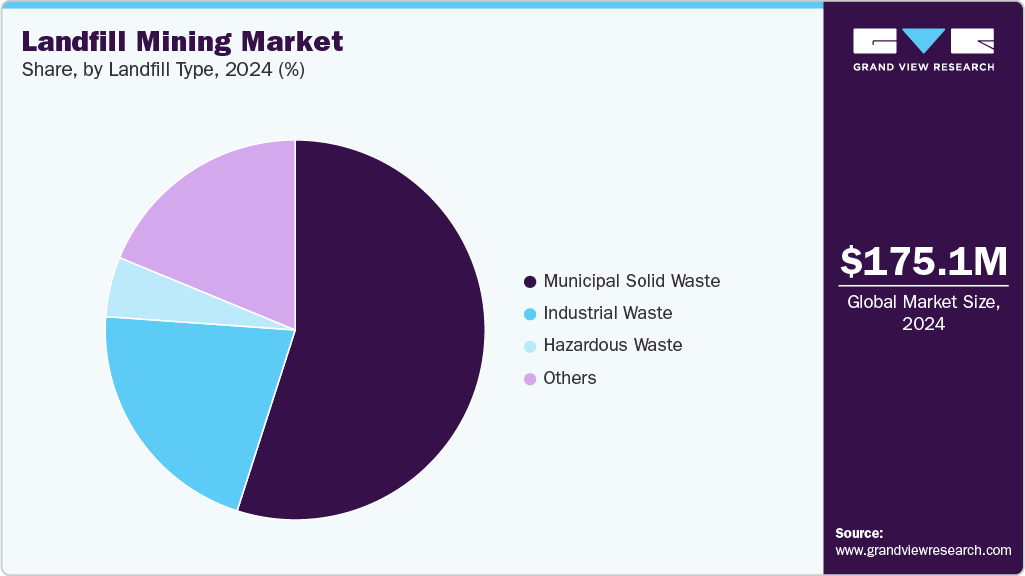
Based on landfill type, municipal solid waste (MSW) landfills segment led the market with the largest revenue share of 53.3% in 2025. driven by its high concentration of recyclable metals, plastics, and organics. Rapid urbanization and population growth have increased landfill volumes, creating opportunities for large-scale material recovery and land reclamation initiatives. Government incentives and public-private partnerships accelerate remediation projects, while recovered materials are increasingly integrated into local supply chains.
 To learn more about this report, Download Free Sample Report
 The industrial waste segment is anticipated to grow at the fastest CAGR during the forecast period, as it provides valuable ferrous and non-ferrous metals, aggregates, and hazardous waste-rich organics. Hazardous waste and other specialized streams are increasingly processed using advanced segregation and treatment technologies, ensuring environmental compliance. Industrial applications leverage recovered metals to reduce production costs and minimize environmental footprints. Growing applications in recycled hazardous waste generation and sustainable industrial inputs further reinforce the market’s global expansion.
Emerging waste streams such as electronic, medical, and specialized industrial residues are gaining attention in landfill mining, driven by their high content of recoverable metals and hazardous components. Advanced processing technologies, including robotic sorting, chemical treatment, and thermal recovery, enable efficient extraction of valuable materials while ensuring safe disposal of contaminants. This expansion into niche waste streams increases overall recovery volumes. It helps municipalities and industries meet stringent environmental and regulatory standards, further strengthening the role of landfill mining in sustainable waste management.
Regional Insights
The landfill mining market in the North America is experiencing steady growth, driven by rising emphasis on sustainable waste management, land reclamation, and resource recovery. Increasing efforts to reclaim valuable urban land for infrastructure development and renewable Hazardous Waste installations further accelerate adoption. For example, large-scale projects such as the Okhla and Bhalswa landfill remediation initiatives in major U.S. cities are setting benchmarks in material recovery, where excavated waste is processed into refuse-derived fuel (RDF) and Construction Waste materials, highlighting the economic and environmental potential of landfill mining. The landfill mining market in China. held the largest share in the Asia Pacific region in 2025.
U.S. Landfill Mining Market Trends
The landfill mining market in the U.S. remains at the forefront of landfill mining in North America, driven by stringent environmental regulations, municipal sustainability goals, and advancements in waste-to-resource technologies. Federal and state-level initiatives promoting landfill remediation and resource recovery encourage large-scale investments in landfill mining and waste-to-Hazardous Waste infrastructure. Public-private partnerships are increasingly common, helping cities tackle legacy landfill challenges while unlocking land for commercial, residential, and renewable Hazardous Waste projects.
Europe Landfill Mining Market Trends
Europe dominated the global landfill mining market with the largest revenue share of 38.2% in 2024, supported by stringent EU waste directives, decarbonization targets, and policies focused on circular economic adoption. The region invests heavily in landfill remediation projects to recover valuable materials, reduce greenhouse gas emissions, and repurpose reclaimed land for renewable Hazardous Waste generation and urban development. The European Union’s Circular Economy Action Plan and funding under the Horizon Europe program encourage innovative landfill mining technologies and cross-border collaboration.
 To learn more about this report, Download Free Sample Report
 Asia Pacific Landfill Mining Market Trends
Asia Pacific dominated the landfill mining market with the largest revenue share of 40.0% in 2025, due to rapid urbanization, increasing waste generation, and government-led initiatives to address legacy landfill challenges. Countries such as China, India, and South Korea are leading the way with large-scale biomining and landfill reclamation projects to recover recyclables, produce refuse-derived fuel, and reclaim valuable land for urban development. India, for instance, has accelerated nationwide biomining programs under its Swachh Bharat Mission, with projects in Chennai, Delhi, and Mumbai successfully processing millions of tons of legacy waste.
Key Landfill Mining Company Insights
Some of the key players operating in the market include Biogas Technology, Clarke Hazardous Waste, Condorchem Envitech, and Others.
-
Biogas Technology, established in 2002 and headquartered in London, United Kingdom, specializes in landfill gas-to-Hazardous Waste projects. The company captures methane from municipal and industrial landfills and converts it into renewable electricity and heat, supplying power to local grids and industrial facilities across Europe. Biogas Technology also provides engineering and consulting services for landfill gas management projects, supporting sustainable waste-to-Hazardous Waste solutions.
-
Clarke Hazardous Waste, founded in 1989 and headquartered in Altrincham, United Kingdom, is a global leader in gas engine power plants, including those fueled by landfill gas. The company designs, installs, and maintains Hazardous Waste systems that convert methane from landfills into electricity, serving industrial, municipal, and utility clients worldwide. Clarke Hazardous Waste operates in multiple regions, including North America, Europe, and Asia.
-
Condorchem Envitech, established in 1995 and headquartered in Barcelona, Spain, provides environmental solutions for landfill management. The company specializes in leachate treatment, landfill gas capture, and industrial waste recovery. Condorchem Envitech serves municipal and industrial clients across Europe, Asia, and Latin America, helping reduce environmental impact while recovering valuable materials from legacy landfills.
Key Landfill Mining Companies
The following key companies have been profiled for this study on the landfill mining market.
-
Biogas Technology
-
Clarke Hazardous Waste
-
Condorchem Envitech
-
Dressta
-
Edaphic Scientific
-
Envitech Solutions
-
ETW Energietechnik
-
Gresham Gas Sampling & Groundwater Solutions
-
ISCO Industries
-
Landsaver Environmental
Competitive Benchmarking
Category
Operating Strategies
Competitive Edge
Weakness
Established Players (e.g. Biogas Technology, Clarke Hazardous Waste)
- Mature participants in the landfill mining market primarily focus on integrated waste recovery operations that combine excavation, material separation, metal recovery, refuse derived fuel production, and land reclamation services.
- These companies leverage advanced sorting technologies, screening systems, magnetic separation, sensor based sorting, and biological treatment processes to maximize the recovery of valuable materials from legacy landfill sites.
- Established players possess significant competitive advantages through their extensive waste management infrastructure, advanced processing technologies, and broad project execution experience.
- Their ability to provide complete landfill mining solutions, from site assessment and excavation to material recovery and land restoration, enables efficient project delivery and stronger customer confidence.
- Despite their strong market positions, mature players face challenges related to high capital investment requirements and uncertain material recovery economics.
- Landfill mining projects require substantial expenditure on excavation equipment, sorting technologies, environmental protection systems, and site remediation activities.
Emerging & Regional Players (e.g., Edaphic Scientific, Envitech Solutions)
- Emerging participants in the landfill mining market generally focus on innovative resource recovery technologies, modular processing systems, and specialized environmental remediation services.
- Rather than competing directly with established waste management companies on project scale, these firms target niche opportunities involving critical metal recovery, construction material recycling, contaminated land remediation, and circular economy solutions.
- Emerging companies benefit from operational flexibility and the ability to implement modern resource recovery technologies without legacy operational constraints.
- Their modular processing systems, digital waste analysis tools, and automated sorting technologies enable faster deployment and improved material recovery efficiency.
- Emerging participants face significant challenges related to limited financial resources, technology commercialization risks, and restricted operational experience.
- Scaling innovative landfill mining technologies from pilot projects to commercial operations requires considerable capital investment, extensive field validation, and long project development timelines.
Recent Developments
-
On January 15, 2025, Biogas Technology commissioned a new landfill gas-to-Hazardous Waste project in Rotterdam, Netherlands, with a capacity of 5 MW. The facility captures methane from municipal landfills and converts it into renewable electricity for the local grid. Advanced gas monitoring and purification systems were implemented to optimize Hazardous Waste recovery and ensure compliance with EU environmental standards, strengthening Biogas Technology’s position in sustainable landfill Hazardous Waste solutions.
-
On April 10, 2025, Clarke Hazardous Waste completed the installation of a landfill gas-powered power plant at the Okhla landfill site in Delhi, India, generating 3 MW of renewable electricity. The project involved retrofitting existing landfill gas collection systems, implementing high-efficiency gas engines, and integrating Hazardous Waste into nearby industrial and municipal networks. This initiative highlights Clarke Hazardous Waste’s global expertise in converting landfill emissions into clean Hazardous Waste.
-
On June 5, 2025, Condorchem Envitech launched an advanced leachate treatment and landfill gas capture system at a closed landfill in Barcelona, Spain. The project includes chemical and biological treatment units that process hazardous leachate, recover metals and other recyclables, and prevent harmful emissions. This development reinforces Condorchem Envitech’s commitment to environmental remediation and sustainable landfill management practices.
Landfill Mining Market Report Scope
Report Attribute
Details
Market size in 2025
Market size represents the total annual economic value of recoverable materials (such as metals, plastics, organics, and other reusable resources) extracted from landfill mining activities
Estimated market size in 2026
USD 8.4 billion
Projected market size by 2033
USD 9.4 billion
Growth rate
USD 20.2 billion
Market size in 2025
CAGR of 11.6% from 2026 to 2033
Base year for estimation
2025
Historical data
2021 - 2024
Forecast period
2026 - 2033
Quantitative units
Revenue in USD million and CAGR from 2026 to 2033
Report coverage
Revenue forecast, company ranking, competitive landscape, growth factors, and trends
Segments covered
Material recovery, landfill type, and region.
Regional scope
North America; Europe; Asia Pacific; Latin America; Middle East & Africa
Country scope
U.S., Canada, Mexico, Finland, Sweden, Russia, Poland, India, China, Indonesia, Australia, Chile, Peru, Brazil, Saudi Arabia, South Africa
Key companies profiled
Biogas Technology; Clarke Hazardous Waste; Condorchem Envitech; Dressta; Edaphic Scientific; Envitech Solutions; ETW Energietechnik; Gresham Gas Sampling & Groundwater Solutions; ISCO Industries; Landsaver Environmental
Customization scope
Free report customization (equivalent up to 8 analysts' working days) with purchase. Addition or alteration to country, regional & segment scope.
Pricing and purchase options
Avail customized purchase options to meet your exact research needs. Explore purchase options
Global Landfill Mining Market Report Segmentation
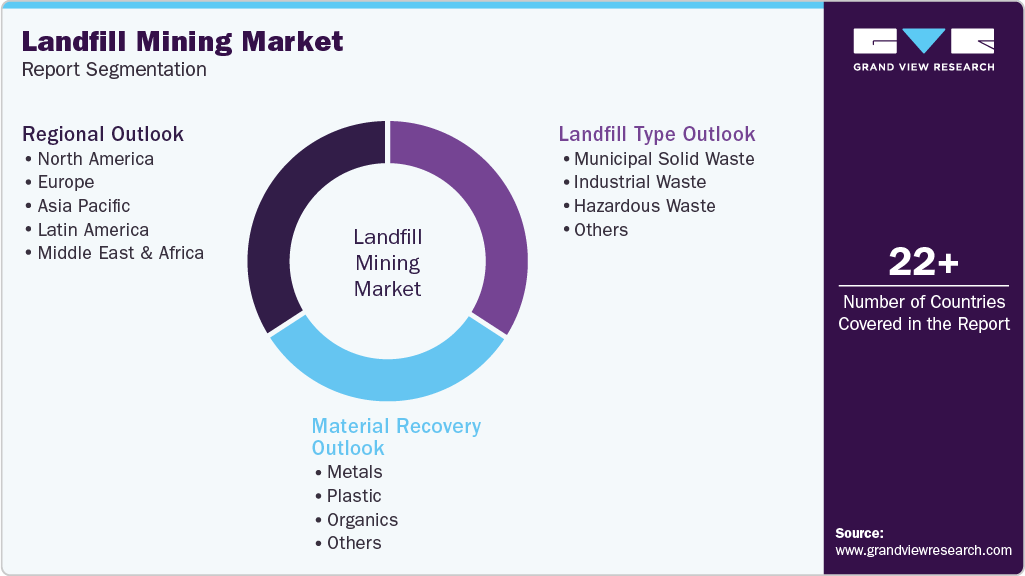
This report forecasts global, country, and regional revenue growth and analyzes the latest trends in each sub-segment from 2021 to 2033. For this study, Grand View Research has segmented the global landfill mining market report by material recovery, landfill type, and region:
 To learn more about this report, Download Free Sample Report
 -
Material Recovery Outlook (Revenue, USD Million, 2021 - 2033)
-
Metals
-
Plastic
-
Organics
-
Others
-
-
Landfill Type Outlook (Revenue, USD Million, 2021 - 2033)
-
Municipal Solid Waste
-
Industrial Waste
-
Hazardous Waste
-
Others
-
-
Regional Outlook (Revenue, USD Million, 2021 - 2033)
-
North America
-
U.S.
-
Canada
-
Mexico
-
-
Europe
-
Germany
-
France
-
UK
-
Italy
-
-
Asia Pacific
-
China
-
India
-
Japan
-
South Korea
-
-
Latin America
-
Brazil
-
-
Middle East & Africa
-
South Africa
-
Saudi Arabia
-
-
Research Methodology
The landfill mining market figures in this report are based on a proven research process that combines executive interviews with secondary research from proprietary databases, company filings, and recognized regulatory and institutional sources. Market size is built through value-chain sizing - reconciling supply-side and demand-side estimates - and triangulated with bottom-up and top-down approaches. Every estimate passes multiple levels of expert validation before publication, with each landfill mining segment quantified using the revenue-capture definitions in the table below.
Segment Definition
Material Recovery
Revenue Capture Definition
Metals
The metals segment captures revenue generated from the recovery of ferrous and non ferrous metals such as steel, iron, aluminum, copper, and other valuable metals extracted from legacy landfill waste. Recovered metals are processed and supplied to recycling and manufacturing industries, reducing the need for primary metal extraction.
Plastics
The plastics segment represents revenue from the recovery and recycling of plastic materials extracted during landfill mining operations. Recovered plastics are sorted, cleaned, and processed for use in packaging, construction materials, automotive components, and consumer products.
Organics
The organics segment includes revenue generated from the recovery of biodegradable waste such as food waste, wood, paper, and other organic materials found in landfills. These materials are converted into compost, refuse derived fuel, biogas, or other value added products through biological and thermal treatment processes.
Others
The others segment comprises revenue generated from the recovery of materials such as glass, construction debris, textiles, rubber, minerals, and inert waste from landfill mining activities. These recovered materials are utilized in construction, infrastructure development, industrial manufacturing, and alternative recycling applications.
Landfill Type
Revenue Capture Definition
Municipal Solid Waste (MSW) Landfills
The municipal solid waste landfills segment captures revenue generated from landfill mining activities involving household, commercial, and institutional waste disposal sites. These projects focus on recovering recyclable materials, reclaiming land, and reducing environmental liabilities through advanced sorting and processing technologies.
Industrial Waste Landfills
The industrial waste landfills segment represents revenue from landfill mining operations conducted at sites containing waste generated by manufacturing, mining, power generation, and other industrial activities. Material recovery includes metals, minerals, construction materials, and industrial byproducts that can be recycled or reused.
Hazardous Waste /Landfills
The hazardous waste landfills segment includes revenue generated from the excavation, treatment, and recovery of materials from landfills containing hazardous industrial, chemical, or toxic waste. Specialized landfill mining technologies are employed to safely recover valuable resources while minimizing environmental and public health risks.
Others
The others segment comprises revenue generated from landfill mining activities at construction and demolition waste landfills, mining waste dumps, ash disposal sites, and mixed waste disposal facilities. These projects focus on recovering reusable materials, reclaiming land for future development, and reducing long term environmental impacts.
Estimation Model
Layer No.
Layer Name
Key Question
Description
01
Landfill Waste Stock Demand Base Layer
What forms the demand base?
Identify global volumes of municipal solid waste, industrial waste, construction & demolition waste, and legacy landfill sites suitable for resource recovery. Assess landfill capacities, waste accumulation, environmental regulations, and urban land scarcity to establish the total addressable opportunity for landfill mining activities.
02
Landfill Mining Application Penetration Layer
Where is landfill mining utilized?
Estimate the penetration of landfill mining across key applications including metal recovery, recyclable material extraction, refuse derived fuel (RDF) production, soil reclamation, landfill remediation, and urban land redevelopment. Analyze adoption across municipal landfills, industrial landfills, and hazardous waste disposal sites in different regions.
03
Resource Recovery Intensity Layer
How much material is recovered?
Analyze resource recovery intensity based on landfill composition, excavation volumes, sorting efficiency, and material recovery technologies. Evaluate the recovery of ferrous and non ferrous metals, plastics, glass, soil, aggregates, and combustible materials from excavated waste. Recovery intensity varies according to landfill age, waste characteristics, processing technology, and regulatory standards.
04
Revenue Layer
How is market revenue generated?
Market revenue is quantified through landfill excavation services, resource recovery operations, recyclable material sales, energy recovery, land reclamation projects, and environmental remediation services. Revenue generation is driven by the sale of recovered metals, plastics, aggregates, refuse derived fuel, reclaimed land, and waste management services. Market value is influenced by commodity prices, recovery rates, landfill remediation investments, government regulations, and urban redevelopment initiatives.
Delivered Customizations
This report has been delivered with the following In-depth customizations
Client Request
Customization Delivered
Value Adds
Regional Segmentation
Detailed regional analysis of the landfill mining market across North America, Europe, Asia Pacific, Latin America, and Middle East & Africa. Included evaluation of municipal and industrial landfill volumes, waste generation trends, landfill rehabilitation programs, recycling infrastructure, government waste management regulations, circular economy initiatives, and investments in resource recovery technologies.
Identified high growth regions for landfill reclamation and resource recovery projects. Enabled strategic expansion planning based on landfill inventories, waste management policies, and sustainability initiatives. Supported regional demand forecasting and investment prioritization.
Competitive Benchmarking
Benchmarking analysis of leading landfill mining companies, waste management firms, environmental engineering companies, and recycling technology providers based on project portfolio, processing capacity, technology capabilities, geographic footprint, material recovery efficiency, sustainability initiatives, operational expertise, and strategic partnerships.
Assisted in evaluating competitive positioning, technological strengths, and market leadership opportunities. Supported competitive intelligence, partnership assessments, acquisition evaluations, and strategic differentiation initiatives.
Opportunity Assessment
Identification of high growth opportunities across urban landfill reclamation, critical material recovery, waste to energy projects, land redevelopment, environmental remediation, carbon reduction initiatives, and circular economy programs.
Enabled prioritization of high return investment opportunities and emerging regional markets. Supported long term strategic planning, technology investments, project development, and business expansion initiatives aligned with circular economy and sustainable waste management objectives.
Frequently Asked Questions About This Report
The global landfill mining market size was estimated at USD 8.4 billion in 2025 and is expected to reach USD 9.4 billion in 2026.
The global landfill mining market is expected to grow at a compound annual growth rate of 11.6% from 2026 to 2033 to reach USD 20.2 billion by 2033.
Asia Pacific dominated the market with revenue share of 40.0% in 2025.
China dominated the Asia Pacific market with revenue share of 47.4% in 2025.
Middle East & Africa is anticipated to register the fastest CAGR over the forecast period.
Organics accounted for largest revenue share of 53.6% in 2025.
Based on landfill type, municipal solid waste (MSW) landfills accounted for largest revenue share of 53.3% in 2025.
The key players operating in the landfill mining market are Biogas Technology; Clarke Hazardous Waste; Condorchem Envitech; Dressta; Edaphic Scientific; Envitech Solutions; ETW Energietechnik; Gresham Gas Sampling & Groundwater Solutions; ISCO Industries; Landsaver Environmental
The global landfill mining market is primarily driven by rapid urbanization, industrial growth, and rising waste volumes, which create demand for land reclamation and resource recovery. Environmental regulations and circular economy initiatives further boost investments in landfill remediation, recycling, and waste-to-hazardous Waste projects worldwide.
About the Author(s)
Advanced Interior Materials Research Team
Advanced Materials · Advanced Interior MaterialsThis report was authored by the advanced interior materials research team at Grand View Research - comprising two research analysts, one senior research analyst, and one industry expert - with specialized expertise in the advanced interior materials segment of the advanced materials industry. All findings are based on proprietary advanced materials databases, executive interviews, and regulatory analysis, subject to internal peer review prior to publication.
Last Updated:
Speak to Analyst

Customize this report to your needs - add regions, segments, or data points, with 20% free customization.
Or view our licence options:


ISO 9001:2015 & 27001:2022 Certified
We are GDPR and CCPA compliant! Your transaction & personal information is safe and secure. For more details, please read our privacy policy.


