
- Home
- »
- Advanced Interior Materials
- »
-
Laser Cladding Market Size, Share & Trends Report, 2033GVR Report cover

Laser Cladding Market (2026 - 2033)
Size, Share & Trends Analysis Report By End User (Original Equipment Manufacturer, Small And Medium-sized Enterprises), By Region (North America, Europe, APAC, Latin America, MEA), And Segment Forecasts
Market Size, 2025
$621.4MMarket Estimate, 2026
$679.4MMarket Forecast, 2033
$1,403.9MCAGR, 2026–2033
10.9%Laser Cladding Market Summary
The global laser cladding market size was valued at USD 621.4 million in 2025 and is projected to grow from USD 679.4 million in 2026 to USD 1,403.9 million by 2033, at a CAGR of 10.9% from 2026 to 2033. Asia Pacific dominated the market, accounting for a revenue share of 34.5% in 2025. The growing demand from aerospace, automotive, and other high-performance industries is expected to propel the market significantly.
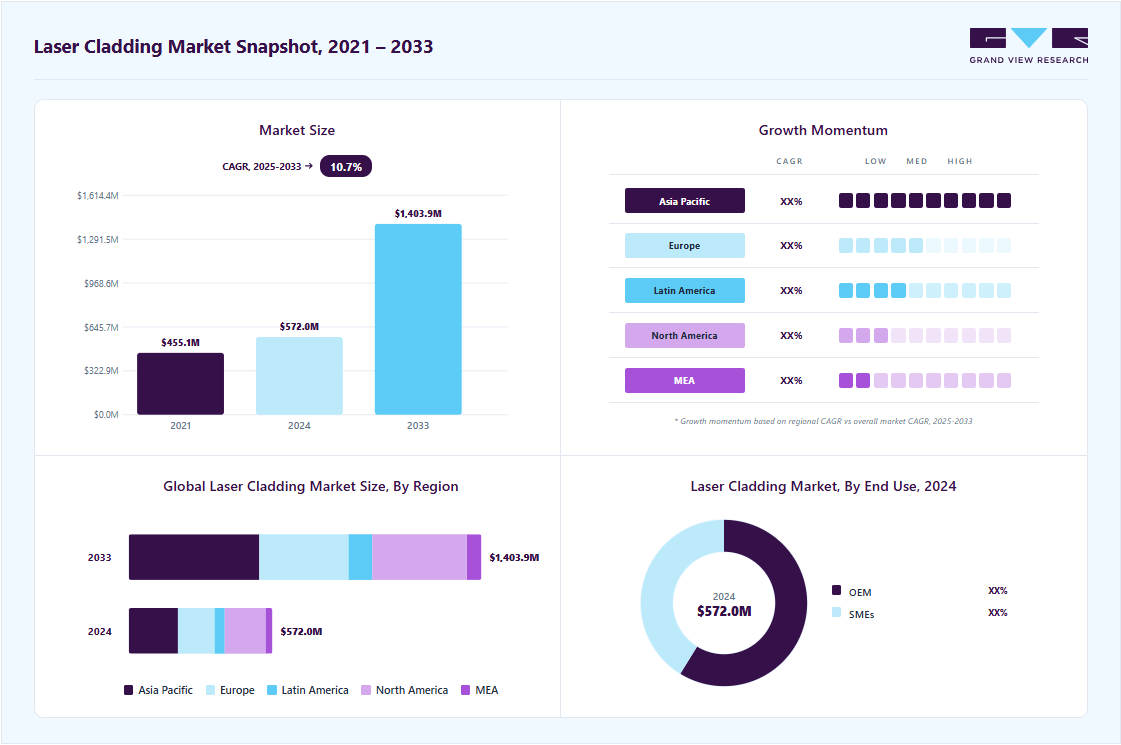 Source: Grand View Research, IR Documents, Primary Interviews, Paid DatabasesTo learn more about this report,
 Download Free Sample Report
 Key Market Trends & Insights
- By end use: OEM segment led the market with the largest revenue share of 58.9% in 2025
Regional Highlights
- Largest regional market: Asia Pacific (34.5% revenue share, 2025)
- By country: China held the largest market share in 2025.
Market Size & Forecast
- Market size in 2025: USD 621.4 Million
- Estimated market size in 2026: USD 679.4 Million
- Projected market size by 2033: USD 1,403.9 Million
- CAGR (2026-2033): 10.9%
Three ways to get this report
Buy it, customize it, or ask a question.Ask an Analyst
Analyst response in 1 business day
- AccessReport author, directly
- Reply timeWithin 1 working day
- No sales callDirect answer only
- FormatEmail reply
- CostFree, no cost
Get the Full Report
What the study covers
- FormatsPDF · Excel · Dashboard
- Timeline2026–2033 annual, 2025 base
- Coverage20+ countries, 5 regions
- Companies10+ key players profiled
Customize the Report
20% free customization
- IncludeCountries, segments, points
- TailorTo your product definition
- ExtendDeeper competitor detail
- OrA fully bespoke study
- Turnaround5–10 working days
This growth spans laser cladding systems, specialized services, and consumable materials such as metallic powders, alloys, and composite coatings designed for high-wear and high-temperature applications. As indicated in the chart below, the steady increase in global motor vehicle production further reinforces this trend, as manufacturers seek durable components and surface refurbishment solutions. The market is experiencing robust growth as recent innovations in laser sources and automated process integration dramatically enhance performance and cost efficiency. Key technological breakthroughs in laser sources have been central to this surge. The transition from conventional CO₂ lasers to fiber and diode lasers offers higher beam quality, superior energy efficiency, and finer control over heat input, enabling thinner, denser clad layers with minimal substrate dilution. To learn more about this report, Download Free Sample Report
 Market Dynamics
The global laser cladding market is driven by increasing demand for advanced surface engineering technologies that enhance component durability, improve operational efficiency, and reduce lifecycle costs across aerospace, automotive, oil & gas, mining, power generation, marine, and heavy equipment industries. Growing investments in industrial automation, remanufacturing, and predictive maintenance are accelerating the adoption of laser cladding for component repair, refurbishment, and performance restoration. Technological advancements in high-power fiber lasers, multi-axis robotic integration, real-time process monitoring, and digital manufacturing are improving process precision, productivity, and application versatility.
The growing demand from the aerospace, automotive, and other high-performance industries is expected to propel the laser cladding market significantly. This growth spans laser cladding systems, specialized services, and consumable materials, including metallic powders, alloys, and composite coatings designed for high-wear and high-temperature applications.
Beyond aerospace and automotive, heavy industries such as mining, oil & gas, and construction are increasingly driving demand for laser cladding. Machinery in these sectors faces severe wear, corrosion, and high-pressure conditions, creating a strong need for surface enhancement, refurbishment, and MRO services. Laser cladding allows companies to extend the life of critical components, reduce downtime, and improve operational efficiency, making it a preferred technology for industrial applications.
High initial investment and operational costs are a significant factor restraining the growth of the laser cladding market. Advanced laser cladding systems, which include high-power lasers, precision motion controls, automation modules, and protective enclosures, require substantial capital expenditure.
For many small- and medium-sized manufacturers, these upfront costs can be prohibitive, limiting the adoption of laser cladding technologies despite their clear benefits in surface enhancement, component refurbishment, and MRO applications.
The growing emphasis on remanufacturing, circular economy initiatives, and sustainable manufacturing presents a significant opportunity for the laser cladding market. Industries are increasingly prioritizing the repair and restoration of high-value components over complete replacement to reduce material consumption, lower production costs, and minimize environmental impact.
Laser cladding enables precise material deposition with minimal heat input and waste generation, making it well suited for extending component life while maintaining performance. Rising investments in industrial refurbishment programs, coupled with stricter sustainability goals across aerospace, energy, mining, automotive, and heavy machinery sectors, are expected to accelerate technology adoption.
Market Concentration & Characteristics
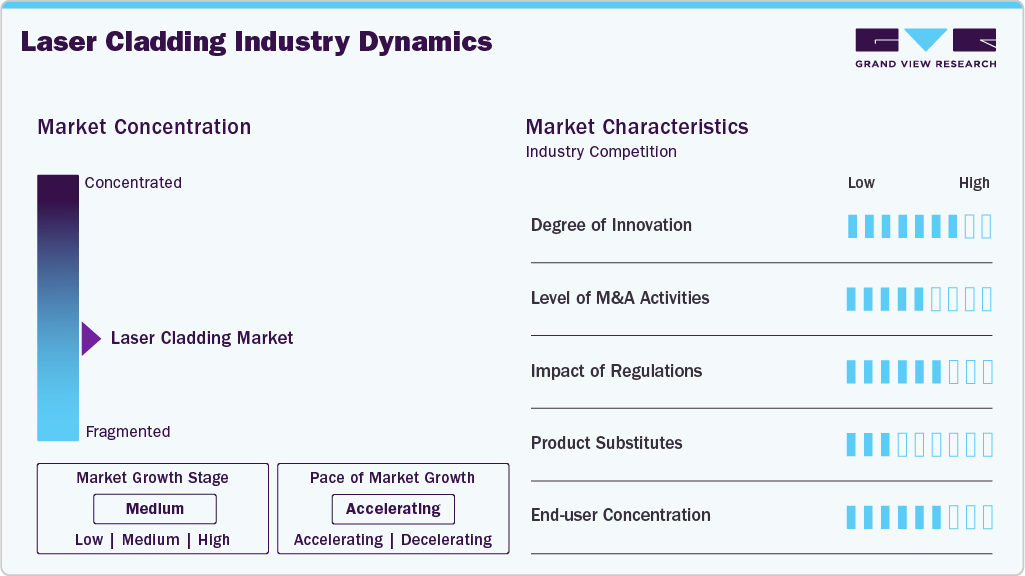
The laser cladding industry is moderately fragmented due to several global and regional players offering diverse technologies and services. While a few large companies hold notable market shares, many mid-sized and specialized firms compete in specific sectors such as aerospace, automotive, and oil & gas. This competitive environment drives innovation and customization. However, barriers like high equipment costs and technical expertise requirements limit market entry.
The laser cladding industry shows a high degree of innovation, driven by demand for wear-resistant and corrosion-resistant coatings across industries. Advancements include real-time process monitoring, automation, and hybrid cladding techniques. R&D is focused on improving material compatibility, deposition rates, and surface properties, enabling broader adoption in aerospace, energy, and tooling applications.
 To learn more about this report, Download Free Sample Report
 Mergers and acquisitions in the laser cladding industry are shaping competitive dynamics by enabling companies to expand technological capabilities, enter new markets, and strengthen supply chains. Strategic acquisitions often focus on enhancing material science, digital integration, and specialized equipment offerings. These activities help larger firms consolidate their presence in high-growth regions and streamline R&D and service portfolios. For instance, in September 2024, Laserline acquired a 70% stake in WBC Photonics, a Boston-based laser company, to expand its blue industrial diode lasers offerings. The deal enables Laserline to provide lasers with high beam quality above 4 mm·mrad and output powers up to 4 kW.
Regulations in the laser cladding industry primarily address worker safety, emission controls, and material standards. Compliance with industrial safety norms and environmental guidelines influences equipment design and operational practices. In addition, certification requirements for aerospace and automotive components are pushing manufacturers to adopt high-precision, reliable laser cladding processes, indirectly driving quality improvements and technological advancements in the market.
Analyst Perspective
The laser cladding market is witnessing robust growth as industries increasingly adopt advanced surface engineering technologies to improve component durability, reduce maintenance costs, and extend equipment life. Sectors such as aerospace, oil & gas, mining, power generation, and automotive are investing in laser cladding to enhance wear resistance, corrosion protection, and dimensional restoration of high-value components. The growing shift toward repair and remanufacturing, coupled with the adoption of fiber laser technology, automation, and additive manufacturing, is further accelerating market expansion. As manufacturers focus on improving operational efficiency and sustainability through component refurbishment rather than replacement, providers of high-precision, automated, and application-specific laser cladding solutions are expected to benefit from sustained long-term growth.
End User Insights
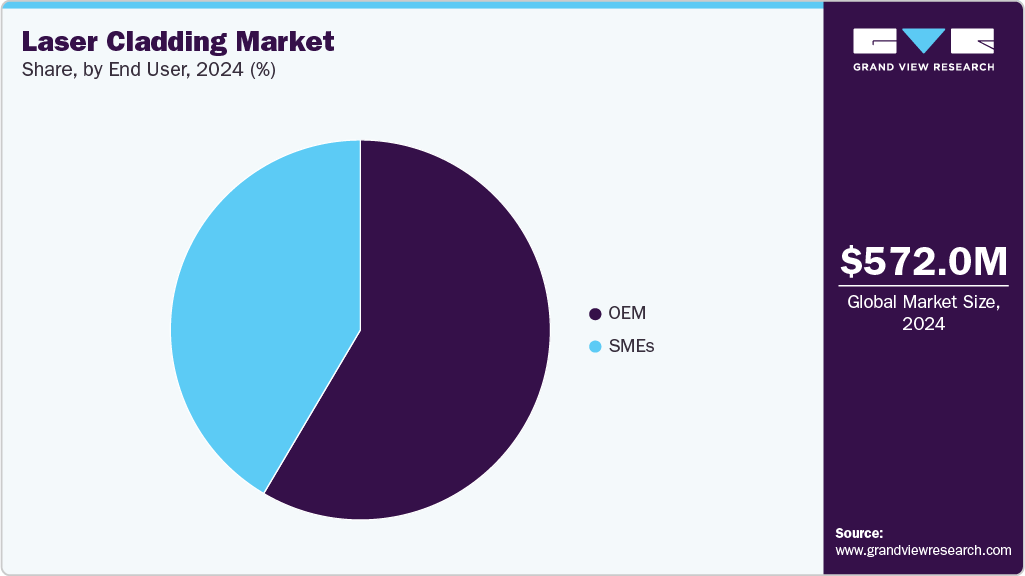
Based on end use, the OEM segment led the market with the largest revenue share of 58.9% in 2025. OEMs are increasingly adopting laser cladding technology to enhance their products' performance, durability, and lifespan. Laser cladding involves depositing a thin material layer onto a substrate using a high-powered laser, which melts the coating material and fuses it precisely to the base metal. This process creates a strong metallurgical bond, resulting in coatings that provide superior wear resistance, corrosion protection, and heat resistance.
 To learn more about this report, Download Free Sample Report
 The SME segment is expected to witness significant growth during the forecast period. SMEs increasingly embrace laser cladding technology, driven primarily by its cost-efficiency, adaptability, and evolving accessibility in compact and automated systems. Traditional barriers like steep initial investment and the need for specialized skills continue to challenge uptake. Nonetheless, advances in laser technology and the rise of service-based models are helping to lower these hurdles.
Regional Insights
North America is expected to grow at a 9.9% CAGR during the forecast period, driven by increasing adoption across aerospace, automotive, oil & gas, energy, and heavy machinery industries. The region benefits from its advanced manufacturing ecosystem, which supports deploying cutting-edge surface engineering solutions designed to extend the lifecycle of critical components and reduce overall maintenance costs.
U.S. Laser Cladding Market Trends
The laser cladding market in the U.S. is expected to grow at a CAGR of 9.8% from 2025 to 2033, driven by its expansive aerospace and defense sector, strong automotive production base, and significant oil & gas operations. As an early adopter of advanced manufacturing technologies, the country benefits from a well-established innovation ecosystem supported by research collaborations between industry leaders, government programs, and academic institutions.
Canada laser cladding market is anticipated to experience significant growth, primarily driven by the oil & gas and mining industries. The demand for surface repair and wear-resistant coatings in heavy machinery, pipelines, and drilling equipment is substantial, and the technology is gaining traction as industries seek more cost-effective and durable solutions to extend the lifespan of critical assets.
Europe Laser Cladding Market Trends
The laser cladding market in Europe is expected to grow at a 10.5% CAGR during the forecast period, driven by advancements across automotive, aerospace, defense, energy, and space sectors. The shift toward electric vehicles (EVs) and lightweight design has heightened the need for advanced surface engineering solutions in the automotive industry, particularly in Germany and Italy. Laser cladding plays a critical role by enhancing EV components' wear resistance and durability, such as battery casings, transmission systems, and tooling equipment.
Germany laser cladding market is growing rapidly. Home to globally renowned manufacturers such as Volkswagen, BMW, Audi, and Daimler, Germany has positioned itself as a leader in advanced automotive production. The industry’s ongoing shift toward electric vehicles (EVs) and lightweight materials is accelerating the need for precision surface engineering technologies like laser cladding.
The laser cladding market in the UK is expected to grow rapidly during the forecast period. In 2023, the United Kingdom strengthened its position as a global aerospace hub, ranking as the world's third-largest exporter of aircraft parts with exports valued at USD 10.5 million, according to OEC World data. Major destinations included Germany, the United States, France, Canada, and Spain. Although new U.S. tariffs may affect trade flows, the long-term outlook for the UK aerospace sector remains positive.
Asia Pacific Laser Cladding Market Trends
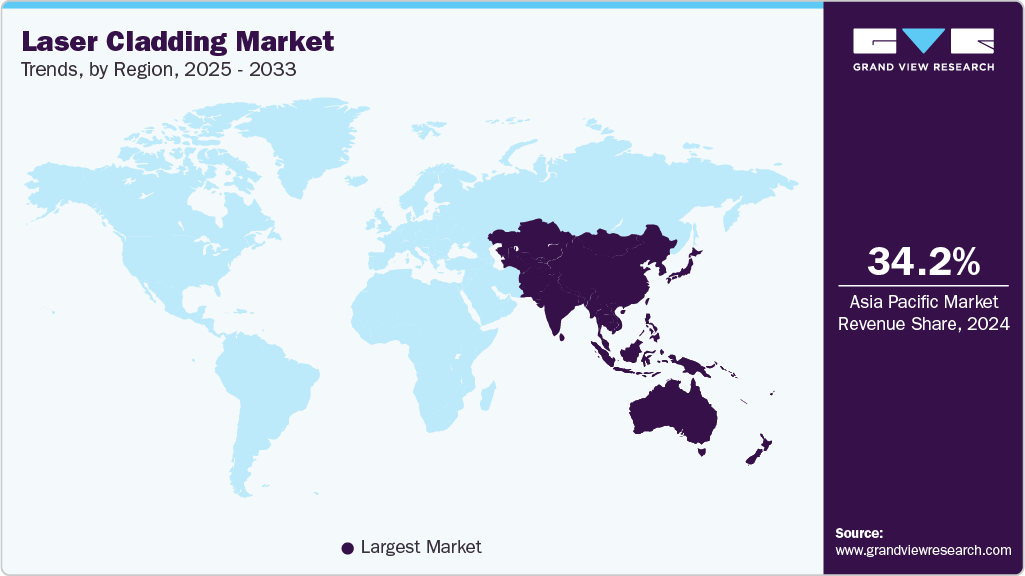
Asia Pacific dominated the laser cladding market with the largest revenue share of 34.5% in 2025, supported by the rapid expansion of the automotive sector, particularly in the shift toward new energy vehicles (NEVs) and electric vehicles (EVs). As automakers across China, Japan, South Korea, and India invest heavily in lightweight, durable, and energy-efficient vehicle components, demand for advanced surface treatment and repair technologies has accelerated.
 To learn more about this report, Download Free Sample Report
 The laser cladding company market in China held the largest share in the Asia Pacific region in 2025. China laser cladding market is witnessing robust growth, fueled by the country’s leadership in producing and selling new energy vehicles (NEVs) and its broader automotive manufacturing strength. As EV production scales rapidly, the demand for high-performance, lightweight, and durable components is rising sharply. Laser cladding is increasingly used to enhance wear resistance, improve corrosion protection, and extend the lifecycle of automotive parts such as engine blocks, transmission systems, and drive shafts.
India’s laser cladding market is gaining strong momentum, supported by the rapid growth of the automotive sector. With passenger vehicle sales projected to reach USD 54.84 million by 2027 and the country ranking as the largest producer of tractors, the second-largest bus manufacturer, and the third-largest heavy truck producer globally, the demand for high-performance automotive components is accelerating.
Middle East & Africa Laser Cladding Market Trends
The laser cladding market in the Middle East & Africa (MEA) is experiencing notable growth, driven primarily by developments in the automotive sector. Strategic investments in electric vehicles (EVs) and the establishment of local automotive manufacturing facilities are creating increasing demand for high-performance components.
Saudi Arabia laser cladding market held a significant share in 2024. Saudi Arabia’s automotive sector is rapidly transforming with the rise of electric vehicles (EVs) and the establishment of local manufacturing facilities. Initiatives such as Lucid Motors, backed by the Public Investment Fund (PIF), Ceer Motors, a joint venture with Foxconn, and Hyundai’s collaboration with the Saudi Ministry of Industry to build EV and internal combustion engine vehicle plants, are driving the country’s ambitions in clean and autonomous mobility.
Latin America Laser Cladding Market Trends
The laser cladding market in Latin America is experiencing steady growth, primarily driven by the region’s automotive sector. With vehicle production rebounding in Brazil, Mexico, and Argentina, there is rising demand for high-performance materials that enhance component durability, wear resistance, and thermal performance.
Brazil laser cladding market is being driven strongly by the resurgence of its automotive industry. Vehicle production surged 24.7% in October 2024 compared to the previous year, creating a heightened demand for high-performance components that require enhanced wear resistance, durability, and thermal efficiency.
Key Laser Cladding Company Insights
Some of the key players operating in the market include TRUMPF, OC Oerlikon Management AG, Höganäs AB, IPG Photonics Corporation, and Swanson Industries.
-
TRUMPF operates across several focused industrial verticals. Its machine tool division specializes in sheet-metal fabrication with bending, punching, laser cutting, welding, and additive manufacturing solutions. The laser technology unit delivers fiber, disk, CO₂, ultrashort-pulse, high-power lasers, and amplifiers used in semiconductor EUV lithography.
-
Oerlikon operates across several advanced technology verticals, including Surface Solutions, which offers PVD, CVD, and thermal spray coatings to enhance component performance in aerospace, automotive, and tooling industries.
Key Laser Cladding Companies
The following key companies have been profiled for this study on the laser cladding market.
-
TRUMPF
-
OC Oerlikon Management AG
-
Höganäs AB
-
Coherent Corp
-
Jenoptik
-
IPG Photonics Corporation
-
Hayden Corp
-
Titanova, Inc
-
Swanson Industries
-
American Cladding Technologies
-
Alabama Laser
-
Kondex Corporation U.S.A.
-
HORNET LASER CLADDING
-
TopClad
-
Laserline GmbH
Competitive Benchmarking
Category
Operating Strategies
Competitive Edge
Weakness
Established Players (e.g., TRUMPF; OC Oerlikon Management AG; Höganäs AB; Coherent Corp; Jenoptik; IPG Photonics Corporation; Laserline GmbH.)
- Strong investments in advanced laser processing, additive manufacturing, and surface engineering technologies
- Expansion of high-power laser cladding systems integrated with automation and robotic solutions
- Focus on aerospace, automotive, energy, and industrial repair applications
- Strong global brand recognition and advanced technological expertise
- High precision, process reliability, and superior metallurgical coating capabilities
- Extensive global sales, service, and technical support networks
- High equipment and implementation costs compared to conventional coating technologies
- Dependence on industrial capital expenditure and advanced manufacturing investments
- Complex integration and operator skill requirements
Emerging & Regional Players (e.g., Hayden Corp; Titanova, Inc.; Swanson Industries; American Cladding Technologies; Alabama Laser, regional players)
- Focus on customized laser cladding services and niche industrial repair applications
- Expansion into regional manufacturing and component refurbishment markets
- Increasing emphasis on application-specific coating solutions and flexible production capabilities
- Competitive pricing and flexibility in customized laser cladding applications
- Strong responsiveness to customer-specific repair and surface enhancement requirements
- Growing adoption in mining, oil & gas, heavy machinery, and industrial maintenance sectors
- Comparatively lower global market penetration and brand visibility
- Limited financial scale for large R&D and international expansion investments
- Lower diversification compared to multinational laser technology providers
Recent Developments
-
In June 2025, Coherent launched the ACE FL Series, a Thulium Fiber Laser (TFL) designed for medical therapies such as lithotripsy and Benign Prostatic Hyperplasia (BPH) treatments. Compared to older Holmium: YAG systems, the two-micron laser offers high precision, improved patient outcomes, and greater procedural efficiency.
-
In June 2025, TRUMPF launched the TruMicro 9010, a 1 kW ultra-short pulse laser built for large-area material processing. It supports high-speed tasks such as drilling, contour cutting, cleaning, and marking within one compact system. With 10 mJ pulse energy, it enables efficient, scalable use in electronics and metal fabrication industries.
Laser Cladding Market Report Scope
Report Attribute
Details
Market size in 2025
USD 621.4 million
Estimated market size in 2026
USD 679.4 million
Projected market size by 2033
USD 1,403.9 million
Growth rate
CAGR of 10.9% from 2026 to 2033
Base year for estimation
2025
Historical data
2021 - 2024
Forecast period
2026 - 2033
Quantitative units
Revenue in USD million and CAGR from 2026 to 2033
Report coverage
Revenue forecast, company ranking, competitive landscape, growth factors, and trends
Segments covered
End User, region
Regional scope
North America; Europe; Asia Pacific; Latin America; Middle East & Africa
Country scope
U.S.; Canada; Mexico; UK; Germany; France; Spain; Italy; China; Japan; India; Australia; South Korea; Brazil; Argentina; Saudi Arabia; South Africa; UAE
Key companies profiled
TRUMPF; OC Oerlikon Management AG; Höganäs AB; Coherent Corp.; Jenoptik; IPG Photonics Corporation; Hayden Corp.; Titanova, Inc.; Swanson Industries; American Cladding Technologies; Alabama Specialty Products, Inc.; Kondex Corporation U.S.A.; Hornet Laser Cladding; Topclad B.V.; Laserline GmbH
Customization scope
Free report customization (equivalent up to 8 analysts' working days) with purchase. Addition or alteration to country, regional & segment scope.
Pricing and purchase options
Avail customized purchase options to meet your exact research needs. Explore purchase options
Global Laser Cladding Market Report Segmentation
This report forecasts revenue growth at global, regional, and country levels and provides an analysis of the latest industry trends in each of the sub-segments from 2021 to 2033. For this study, Grand View Research has segmented the global laser cladding market report based on end user and region:
 To learn more about this report, Download Free Sample Report
 -
End User Outlook (Revenue, USD Million, 2021 - 2033)
-
OEM
-
Aerospace & Defense
-
Equipment
-
Material
-
Services
-
-
Oil & gas
-
Equipment
-
Material
-
Services
-
-
Automotive
-
Equipment
-
Material
-
Services
-
-
Power Generation
-
Equipment
-
Material
-
Services
-
-
Medical
-
Equipment
-
Material
-
Services
-
-
Mining
-
Equipment
-
Material
-
Services
-
-
Others
-
Equipment
-
Material
-
Services
-
-
-
SMEs
-
Equipment
-
Material
-
Services
-
-
-
Regional Outlook (Revenue, USD Million, 2021 - 2033)
-
North America
-
U.S.
-
Canada
-
Mexico
-
-
Europe
-
Germany
-
UK
-
France
-
Italy
-
Spain
-
-
Asia Pacific
-
China
-
India
-
Japan
-
Australia
-
South Korea
-
-
Latin America
-
Brazil
-
Argentina
-
-
Middle East and Africa
-
UAE
-
Saudi Arabia
-
South Africa
-
-
Research Methodology
The laser cladding market figures in this report are based on a proven research process that combines executive interviews with secondary research from proprietary databases, company filings, and recognized regulatory and institutional sources. Market size is built through value-chain sizing-reconciling supply-side and demand-side estimates-and triangulated with bottom-up and top-down approaches. Every estimate passes multiple levels of expert validation before publication, with each laser cladding segment quantified using the revenue-capture definitions in the table below.
Segment Definition
Segment - End Use
Revenue Capture Definition
OEM
Revenue generated from the sale of laser cladding equipment, materials, and related services to original equipment manufacturers (OEMs) for the production of new components and equipment across aerospace & defense, oil & gas, automotive, power generation, medical, mining, and other industries. This includes revenue from laser cladding equipment (laser systems, cladding heads, automation systems, and integrated workstations), cladding materials (metal powders, alloys, and consumables), and associated services such as installation, commissioning, process development, maintenance, training, and technical support.
SMEs
Revenue generated from the sale of laser cladding equipment, materials, and related services to small and medium-sized enterprises (SMEs) operating as contract manufacturers, component repair specialists, remanufacturing companies, and independent laser cladding service providers across aerospace & defense, oil & gas, automotive, power generation, medical, mining, and other industries. This segment includes revenue from laser cladding equipment (laser systems, cladding heads, automation solutions, and integrated workstations), cladding materials (metal powders, alloys, and consumables), and associated services such as installation, commissioning, process development, maintenance, operator training, technical support, and aftermarket services.
Estimation Model
Layer No.
Layer Name
Key Question
Description
01
Surface Engineering Demand Layer
Where is laser cladding required?
Analyze demand across aerospace, automotive, oil & gas, mining, power generation, heavy machinery, and industrial manufacturing.
02
Industrial Manufacturing & MRO Investment Layer
Where is new demand being created?
Evaluate investments in aerospace manufacturing, automotive production, industrial equipment refurbishment, mining machinery, energy infrastructure, and maintenance, repair, and overhaul (MRO) activities.
03
Technology Adoption Layer
Which laser cladding technologies are being deployed?
Segment demand by end user, laser source, material type, and application. Apply adoption rates based on coating performance, process precision, automation requirements, operating costs, and component lifecycle benefits.
04
Revenue Generation Layer
How much market revenue is generated?
Estimate annual demand by end user, application, and region. Quantify revenues generated from laser cladding systems, laser cladding services, and consumable materials supplied to OEMs, industrial manufacturers, and MRO providers.
Delivered Customizations
This report has been delivered with the following In-depth customizations
Client Request
Customization Delivered
Value Adds
Regional Segmentation
Detailed market estimates and forecasts for the Laser Cladding Market across North America, Europe, Asia Pacific, Latin America, and the Middle East & Africa. Country-level demand analysis covering aerospace, automotive, oil & gas, mining, power generation, and industrial manufacturing sectors.
Identify high-growth regional markets and advanced manufacturing investment hotspots. Support regional expansion planning, distributor network optimization, and demand forecasting.
Competitive Benchmarking
Detailed benchmarking of leading laser cladding solution providers based on laser technology capabilities, automation integration, coating precision, material compatibility, regional presence, and strategic initiatives.
Enable competitive intelligence and technology benchmarking. Support product positioning, partnership evaluation, and innovation strategy development.
Opportunity assessment
Identification of emerging growth opportunities driven by additive manufacturing expansion, industrial component refurbishment demand, aerospace modernization, renewable energy infrastructure development, and increasing focus on sustainable manufacturing practices.
Prioritize high-growth applications and investment opportunities. Support the development of the innovation roadmap and long-term strategic planning.
Frequently Asked Questions About This Report
The OEM segment led the market with the largest revenue share of 58.9% in 2025.
Asia Pacific dominated the laser cladding market with the largest revenue share of 34.5% in 2025.
The global laser cladding market size was estimated at USD 621.4 million in 2025 and is expected to be USD 679.4 million in 2026.
Key factors driving the global laser cladding market include increasing demand for wear-resistant and corrosion-resistant coatings, growing use in aerospace and automotive industries, advancements in laser technology, and the need for cost-effective, high-performance surface enhancement and repair solutions.
Some of the key players operating in the global laser cladding market include TRUMPF, OC Oerlikon Management AG, Höganäs AB, Coherent Corp., Jenoptik, IPG Photonics Corporation, Hayden Corp., Titanova, Inc, Swanson Industries, American Cladding Technologies, Alabama Specialty Products, Inc., Kondex Corporation U.S.A., Hornet Laser Cladding, Topclad B.V., Laserline GmbH
The global laser cladding market, in terms of revenue, is expected to grow at a compound annual growth rate of 10.9% from 2026 to 2033 to reach USD 1,403.9 million by 2033.
About the Author(s)
Advanced Interior Materials Research Team
Advanced Materials · Advanced Interior MaterialsThis report was authored by the advanced interior materials research team at Grand View Research - comprising two research analysts, one senior research analyst, and one industry expert - with specialized expertise in the advanced interior materials segment of the advanced materials industry. All findings are based on proprietary advanced materials databases, executive interviews, and regulatory analysis, subject to internal peer review prior to publication.
Last Updated:
Speak to Analyst

Customize this report to your needs - add regions, segments, or data points, with 20% free customization.
Or view our licence options:


ISO 9001:2015 & 27001:2022 Certified
We are GDPR and CCPA compliant! Your transaction & personal information is safe and secure. For more details, please read our privacy policy.


