
- Home
- »
- Drilling & Extraction Equipments
- »
-
Pumps Market Size, Share And Growth Report, 2026-2033GVR Report cover

Pumps Market (2026 - 2033)
Size, Share & Trends Analysis Report By Type (Centrifugal Pumps, Positive Displacement Pumps), By End-use (Agriculture, Water & Wastewater, Oil & Gas, Mining, Infrastructure Application (HDD)), By Region, And Segment Forecasts
Market Size, 2025
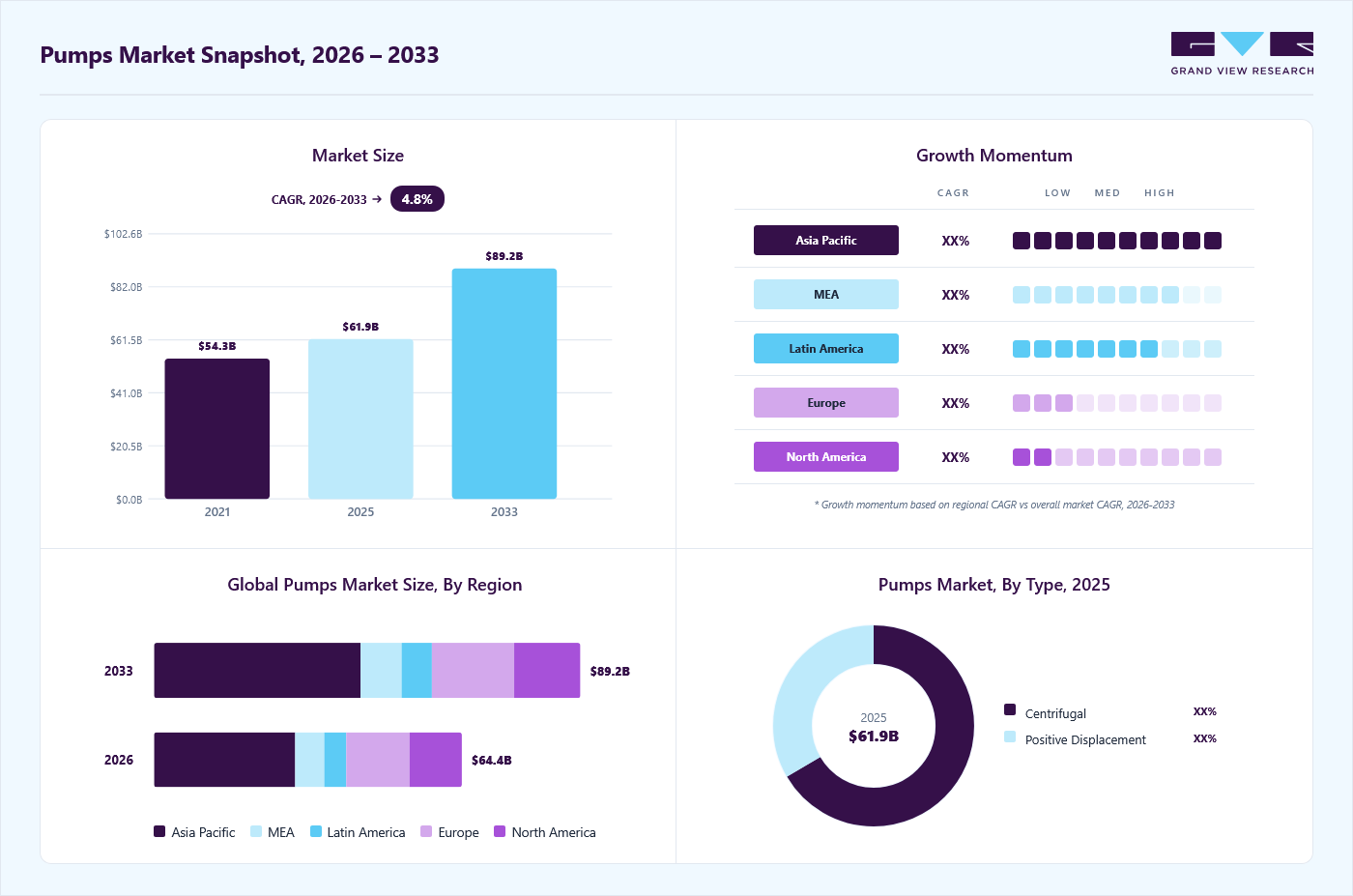
$61.9BMarket Estimate, 2026
$64.4BMarket Forecast, 2033
$89.2BCAGR, 2026–2033
4.8%Pumps Market Summary
The global pumps market size was valued at USD 61.9 billion in 2025 and is projected to grow from USD 64.4 billion in 2026 to USD 89.2 billion by 2033, at a CAGR of 4.8% from 2026 to 2033. Asia Pacific dominated the market, accounting for a revenue share of 45.4% in 2025, supported by rapid industrialization, expanding infrastructure, rising investments in water and wastewater management, and the development of manufacturing and energy-intensive industries across the region. Pumps play a critical role in fluid handling operations by increasing fluid pressure, maintaining consistent flow rates, and facilitating the efficient transfer of liquids across industrial and commercial applications.
 Source: Grand View Research, IR Documents, Primary Interviews, Paid DatabasesTo learn more about this report,
 Download Free Sample Report
Key Market Trends & Insights
- By type: Centrifugal pumps held the largest market share of 66.5% in 2025.
- By end use: Water & wastewater segment held the largest market share of 24.6% in 2025.
Regional Highlights
- Largest regional market: Asia Pacific (45.4% revenue share, 2025)
- By country: China held the largest revenue share in 2025
Market Size & Forecast
- Market size in 2025: USD 61.9 Billion
- Estimated market size in 2026: USD 64.4 Billion
- Projected market size by 2033: USD 89.2 Billion
- CAGR (2026-2033): 4.8%
Three ways to get this report
Buy it, customize it, or ask a question.Ask an Analyst
Analyst response in 1 business day
- AccessReport author, directly
- Reply timeWithin 1 working day
- No sales callDirect answer only
- FormatEmail reply
- CostFree, no cost
Get the Full Report
What the study covers
- FormatsPDF · Excel · Dashboard
- Timeline2026–2033 annual, 2025 base
- Coverage20+ countries, 5 regions
- Companies10+ key players profiled
Customize the Report
20% free customization
- IncludeCountries, segments, points
- TailorTo your product definition
- ExtendDeeper competitor detail
- OrA fully bespoke study
- Turnaround5–10 working days
Their essential role in fluid management makes them integral to industries such as oil & gas, mining, chemicals, power generation, construction, agriculture, and water & wastewater treatment. In oil & gas exploration and mining operations, pumps are used for fluid transfer, pressure management, dewatering, slurry handling, and chemical or reagent dosing, supporting complex and continuous processing activities.The market is benefiting from growing fluid management requirements driven by industrial expansion, infrastructure development, and urbanization. Growing investments in power generation and construction are creating demand for pumps across cooling, circulation, water supply, and process-fluid applications. At the same time, rising agricultural investments and the expansion of irrigation infrastructure are supporting the adoption of pumps for water extraction and distribution. Increasing urban populations and the need to improve water supply, sewage management, and wastewater treatment infrastructure are further contributing to market growth.
 To learn more about this report, Download Free Sample Report
Furthermore, technological advancements in pump design, energy efficiency, automation, condition monitoring, and smart pumping systems are creating opportunities for market expansion. The continued development of water & wastewater treatment, chemical processing, power generation, agriculture, and other process industries is expected to sustain demand for efficient and reliable pumping solutions throughout the forecast period.
Market Dynamics
The pumps market is driven by increasing investments in water and wastewater infrastructure and expanding fluid-handling requirements across major industries. However, high energy consumption and lifecycle operating costs can limit adoption and extend equipment replacement cycles. Meanwhile, the growing shift toward smart, connected, and energy-efficient pumping solutions is creating opportunities for manufacturers to differentiate their offerings and capture higher-value applications.
Increasing investments in water supply, wastewater treatment, and sewage infrastructure are driving global demand for pumps. Rapid urbanization, population growth, industrial expansion, and growing concerns over water scarcity are prompting governments and utilities to expand and modernize water management infrastructure. Pumps are integral to water intake, distribution, pressure boosting, circulation, sewage transfer, sludge handling, and wastewater treatment processes.
The increasing emphasis on water reuse, recycling, and network efficiency is further expanding pumping requirements. For instance, Xylem continues to expand its water and wastewater solutions portfolio, including pumps, packaged pumping systems, and digital water-management technologies, while highlighting increasing demand for smarter water infrastructure amid rising requirements from data centers, semiconductor manufacturing, and energy systems.
High energy consumption and associated lifecycle costs remain key challenges for pump users, particularly in applications involving continuous or high-load operation. Pumping systems can account for a substantial portion of the energy consumed in industrial processes, water utilities, irrigation systems, and building services. Inefficient pump selection, oversizing, throttling, leakage, and inadequate maintenance can further increase power consumption and operating expenses. These cost considerations sometimes discourage investments in new equipment, particularly among price-sensitive end users, and may extend replacement cycles. Consequently, the need to balance initial equipment costs with long-term energy efficiency remains a constraint to market adoption.
The transition toward smart, connected, and energy-efficient pumping systems presents a significant opportunity for market participants. The integration of variable frequency drives, sensors, IoT connectivity, automated controls, and real-time performance monitoring enables users to optimize flow and pressure, reduce energy consumption, and improve equipment reliability. Predictive maintenance capabilities can also help identify abnormal operating conditions and potential equipment failures before they result in unplanned downtime. As industrial facilities, utilities, commercial buildings, and agricultural operations increasingly prioritize energy optimization and digital asset management, manufacturers have opportunities to generate higher-value revenues through intelligent pumping systems, connected services, and lifecycle-based solutions.
Analyst Perspective
The global pumps market is expected to experience steady growth as pumps remain essential components of fluid-handling systems across water & wastewater, oil & gas, chemicals, power generation, agriculture, mining, and construction. Demand is increasingly shifting from conventional pumping equipment toward energy-efficient, automated, and digitally monitored systems as end users seek to reduce lifecycle costs and improve operational reliability. Water infrastructure development is expected to remain a particularly important source of demand, supported by urbanization, industrialization, water scarcity, and increasing wastewater treatment requirements. At the same time, manufacturers are likely to differentiate their offerings through energy efficiency, variable-speed operation, condition monitoring, predictive maintenance, and customized solutions for application-specific requirements. Overall, the market is expected to remain relatively resilient, with replacement demand and infrastructure investments providing a stable base while smart pumping technologies create additional avenues for value growth.
Type Insights
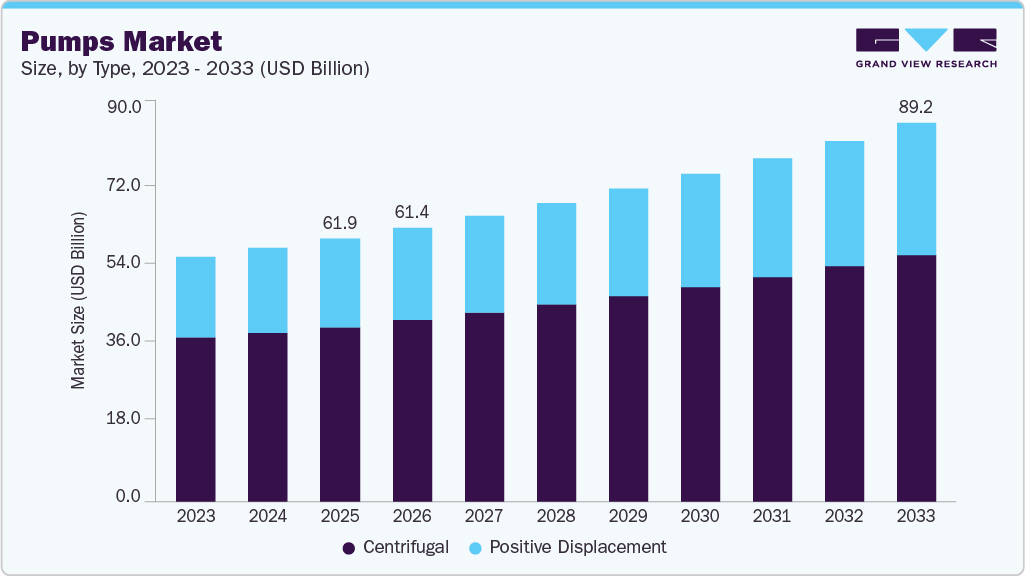
The centrifugal pumps segment dominated the global pumps market, accounting for 66.5% of revenue in 2025. The segment's dominance is attributed to the simple construction, relatively low maintenance requirements, operational reliability, and ability of centrifugal pumps to handle high flow rates efficiently. These characteristics make them suitable for a broad range of applications, including water supply and distribution, water and wastewater treatment, HVAC systems, power generation, oil & gas, chemicals, and general industrial processes. Centrifugal pumps are particularly well-suited for applications requiring continuous fluid movement at relatively consistent flow rates. Their scalability and availability across a wide range of configurations enable deployment in residential, commercial, municipal, and industrial facilities. In water and wastewater applications, they are extensively used for water transfer, circulation, pressure boosting, sewage handling, and treatment processes. Similarly, increasing investments in industrial facilities and infrastructure projects are supporting demand for centrifugal pumps for process-fluid transfer and cooling applications.
The positive displacement pumps are expected to register the fastest CAGR of 5.3% from 2026 to 2033. Positive displacement pumps are gaining traction for their ability to handle high-viscosity fluids and provide precise, consistent flow control. These characteristics make them well-suited for applications in chemical processing, pharmaceuticals, food & beverage, and other industries requiring accurate fluid transfer and metering. Their ability to operate effectively under high-pressure conditions further supports their adoption. In addition, growing emphasis on process efficiency, precise dosing, and energy optimization is expected to accelerate demand for positive displacement pumps during the forecast period
End Use Insights
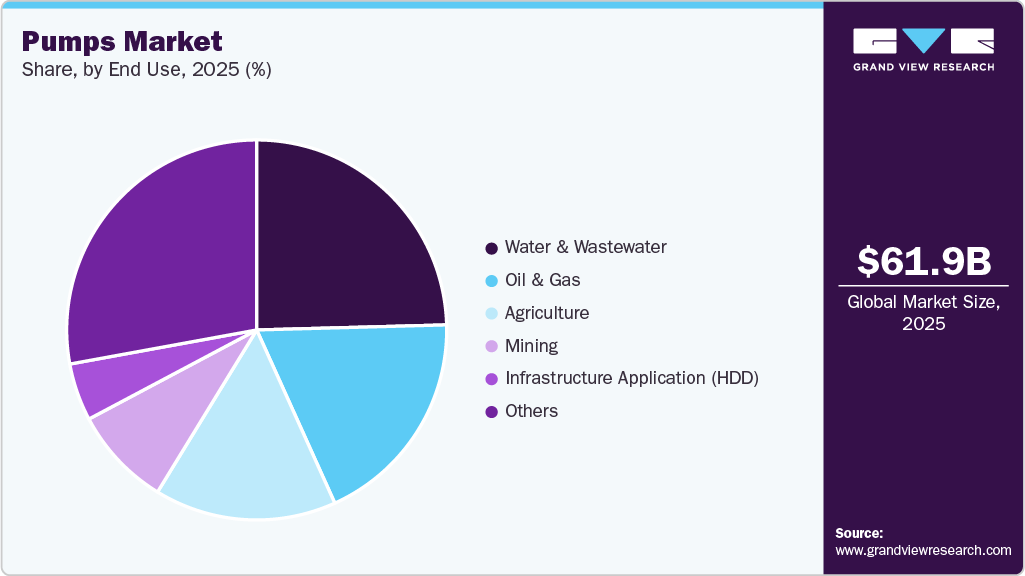
Water & wastewater was the largest end-use segment in 2025, accounting for 24.6% of revenue. The segment's dominance is supported by growing concerns regarding water scarcity, pollution, and the need to expand and modernize water and wastewater infrastructure. Government initiatives, investments in treatment facilities, and upgrades to aging water networks are supporting the installation of pumps across municipal and industrial applications. Rapid urbanization and increasing industrial wastewater generation are further increasing the need for efficient water management solutions. In addition, the growing adoption of energy-efficient and automated pumping systems is supporting segment growth.
 To learn more about this report, Download Free Sample Report
The oil & gas segment is expected to register a CAGR of 5.4% from 2026 to 2033, owing to the continuous requirement for fluid transfer, pressure management, and process operations across drilling, production, refining, and transportation activities. Pumps are critical for maintaining pressure, transferring crude oil and refined products, and supporting various upstream and downstream processes. Continued investments in exploration and production activities, particularly in regions with expanding hydrocarbon production, are expected to sustain demand for advanced pumping systems. The large-scale, continuous nature of oil & gas operations further supports the consistent demand for reliable, high-performance pumps.
Regional Insights
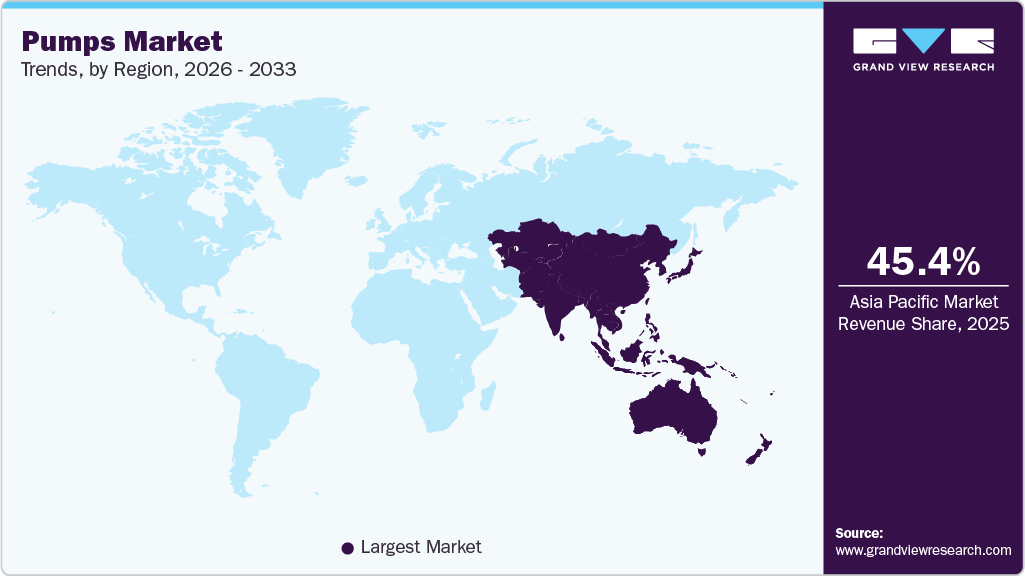
Asia Pacific dominated the global pumps market, accounting for 45.4% of revenue in 2025. The region's dominance is supported by rapid industrialization, urbanization, infrastructure development, and growing demand for efficient fluid management and access to safe water in countries such as China and India. Growing investments in agriculture, construction, manufacturing, power generation, and water and wastewater treatment are creating substantial demand for pumping equipment. The increasing water requirements of rapidly expanding industries are creating additional opportunities for pump manufacturers. Xylem, for instance, highlights rising water demand associated with data centers, semiconductor manufacturing, and energy systems and emphasizes water reuse, network efficiency, and smarter water infrastructure as solutions to these emerging requirements. This trend is particularly relevant to the Asia Pacific, where industrial expansion and urban development are increasing requirements for water transfer, treatment, circulation, and process-fluid management.
 To learn more about this report, Download Free Sample Report
China accounted for 37.3% of the regional market revenue in 2025, driven by rapid industrialization and urbanization, as well as substantial investments in water supply, wastewater treatment, and infrastructure development. The country's continued focus on upgrading manufacturing capabilities and strengthening environmental management is driving demand for advanced, efficient pumping systems. Expansion of the chemical processing, power generation, and industrial manufacturing sectors is further increasing the requirement for specialized pumps capable of handling demanding process conditions. Investments in water conservation and pollution control are also expected to support demand across municipal and industrial applications.
North America Pumps Market Trends
North America accounted for 17.2% of the global pumps market in 2025 and is expected to experience steady growth during the forecast period. The growth in the North America pumps market is primarily supported by ongoing investments in infrastructure development, water and wastewater management, and oil & gas activities. The region demonstrates strong demand for energy-efficient and technologically advanced pumping systems, particularly in the U.S. and Canada. Increasing industrial automation, stringent environmental requirements, and the modernization of aging water infrastructure are further supporting market growth. The U.S. Environmental Protection Agency (EPA) continues to allocate substantial funding toward water infrastructure modernization; in 2026, the agency reported that its Drinking Water and Clean Water State Revolving Fund programs had provided more than USD 265 billion to support approximately 76,000 drinking water and water-quality infrastructure projects. Such investments are expected to generate sustained requirements for pumps used in water intake, distribution, treatment, wastewater handling, and related infrastructure applications.
The U.S. accounted for 62.6% of the regional market revenue in 2025, supported by infrastructure modernization, environmental requirements, and increasing adoption of energy-efficient pumping technologies. According to the U.S. EPA's Drinking Water Infrastructure Needs Survey and Assessment, U.S. drinking water systems require approximately USD 625 billion in investment over 20 years for pipe replacement, treatment plant upgrades, storage tanks, and other critical infrastructure. The scale of these infrastructure requirements provides a substantial long-term demand base for pumps used in water treatment, distribution, pressure management, and related applications.
Europe Pumps Market Trends
Europe was the second-largest pumps market worldwide, accounting for 20.7% of market revenue in 2025. The Europe pumps market is supported by the modernization of water and wastewater infrastructure, increasing emphasis on energy efficiency, and the transition toward more sustainable industrial and building systems. The European Commission's Water Resilience Strategy, adopted in June 2025, emphasizes reducing water consumption, improving water efficiency, modernizing water infrastructure, reducing network leakage, and increasing the adoption of digital solutions. These priorities are expected to support demand for efficient pumping equipment across municipal water networks, wastewater treatment facilities, industrial applications, and water reuse systems. The region's broader focus on energy efficiency and decarbonization is also encouraging the adoption of high-efficiency pumping technologies and digitally enabled systems.
Germany accounted for 21.5% of the regional market revenue in 2025. The market in Germany benefits from the country's strong engineering and manufacturing base and its focus on high-quality, energy-efficient industrial equipment. Demand is supported by investments in advanced manufacturing, chemicals, water management, and energy infrastructure, where specialized pumping systems are required for demanding process applications. The country's emphasis on energy efficiency, industrial automation, and the transition toward renewable energy is further encouraging the adoption of technologically advanced pumps.
Latin America Pumps Market Trends
The pumps market in Latin America is expected to grow at a CAGR of 4.7% during the forecast period. The steady growth in the region is primarily attributed to the gradually growing investments in water infrastructure amid challenges related to limited access to clean water, aging infrastructure, and inadequate service quality in several countries. Investments in water supply and wastewater treatment systems are creating demand for pumps required for water transfer, distribution, treatment, and sewage management. Improving water infrastructure is also becoming increasingly important for addressing public health concerns, supporting urban development, and improving the reliability of essential services across the region.
Middle East & Africa Pumps Market Trends
The Middle East & Africa pumps market is expected to grow at a CAGR of 5.0% during the forecast period, supported by expanding oil & gas activities, investments in water and wastewater infrastructure, and large-scale construction and industrial projects in the region. The Middle East remains a major oil & gas production hub, generating sustained demand for pumps across extraction, processing, refining, and transportation applications. At the same time, severe water scarcity is driving investment in desalination and water treatment infrastructure, creating demand for pumps for seawater intake, reverse osmosis, water distribution, and brine management. The region's continued focus on expanding desalination capacity and improving water security is expected to provide a structural source of demand for high-efficiency pumping systems.
Key Pumps Company Insights
The global pumps market is characterized by the presence of established multinational manufacturers and specialized regional players. Leading companies compete through broad product portfolios, application-specific engineering, energy-efficient technologies, digital pumping solutions, global distribution networks, and aftermarket services. Market participants are increasingly focusing on smart, connected pumping systems, predictive maintenance, and lifecycle cost optimization to enhance customer value and differentiate their offerings. Strategic initiatives, including acquisitions, portfolio expansion, product innovation, and investments in digital technologies, remain key approaches adopted by leading players to strengthen their market presence.
Key Pumps Companies
The following key companies have been profiled for this study on the pumps market.
-
SLB
-
Ingersoll Rand
-
The Weir Group PLC
-
Vaughan Company
-
KSB SE & Co. KGaA
-
Pentair
-
Grundfos Holding A/S
-
Xylem
-
Flowserve Corporation
-
ITT Inc. (Flow Technologies, formerly SPX FLOW)
-
EBARA CORPORATION
-
IWAKI CO., LTD.
-
Sulzer Ltd.
Recent Developments
-
In July 2026, Pentair announced a definitive agreement to acquire Taco Group Holdings for approximately USD 1.4 billion. Taco brings a portfolio of pumps, valves, tanks, heat exchangers, and advanced controls, with strong exposure to HVAC and data centers. The transaction expands Pentair's pump and water-management portfolio and increases exposure to high-growth HVAC and data-center infrastructure.
-
In May 2026, Ingersoll Rand acquired Fox s.r.l., adding hydropneumatic accumulators, pulsation dampeners, calibration pots, and instrumentation to its metering and dosing portfolio. The technologies are designed to improve pump performance, durability, and reliability in dosing systems. This development helped the company to expand its metering and dosing pump capabilities and thereby strengthen its position in specialized fluid-management applications.
-
In March 2026, SLB OneSubsea secured a multi-well integrated EPC contract from CNOOC for the Kaiping 18-1 deepwater development in the South China Sea. The scope includes dual electric submersible pumps (ESPs) along with other subsea production equipment. This development strengthens SLB's positioning in advanced ESP and subsea pumping applications and demonstrates continued demand for pumping technologies in offshore oil & gas production.
Pumps Market Report Scope
Report Attribute
Details
Market size in 2025
USD 61.9 billion
Estimated market size in 2026
USD 64.4 billion
Projected market size by 2033
USD 89.2 billion
Growth rate
CAGR of 4.8% from 2026 to 2033
Base year for estimation
2025
Historical data
2021 - 2024
Forecast period
2026 - 2033
Quantitative units
Revenue in USD billion and CAGR from 2026 to 2033
Report coverage
Revenue forecast, company market position analysis, competitive landscape, growth factors, and trends
Segments covered
Type, end use, region
Region Scope
North America; Europe; Asia Pacific; Latin America; Middle East & Africa
Country scope
U.S.; Canada; Mexico; Germany; UK; France; Italy; Spain; China; India; Japan; South Korea; Australia; Brazil; Argentina; South Africa; UAE; Saudi Arabia
Key companies profiled
SLB; Ingersoll Rand; The Weir Group PLC; Vaughan Company; KSB SE & Co. KGaA; Pentair; Grundfos Holding A/S; Xylem; Flowserve Corporation; ITT Inc. (Flow Technologies, formerly SPX FLOW); EBARA CORPORATION; IWAKI CO., LTD.; Sulzer Ltd.
Customization scope
Free report customization (equivalent to 8 analyst working days) with purchase. Addition or alteration to country, regional & segment scope.
Pricing and purchase options
Avail customized purchase options to meet your exact research needs. Explore purchase options
Global Pumps Market Report Segmentation
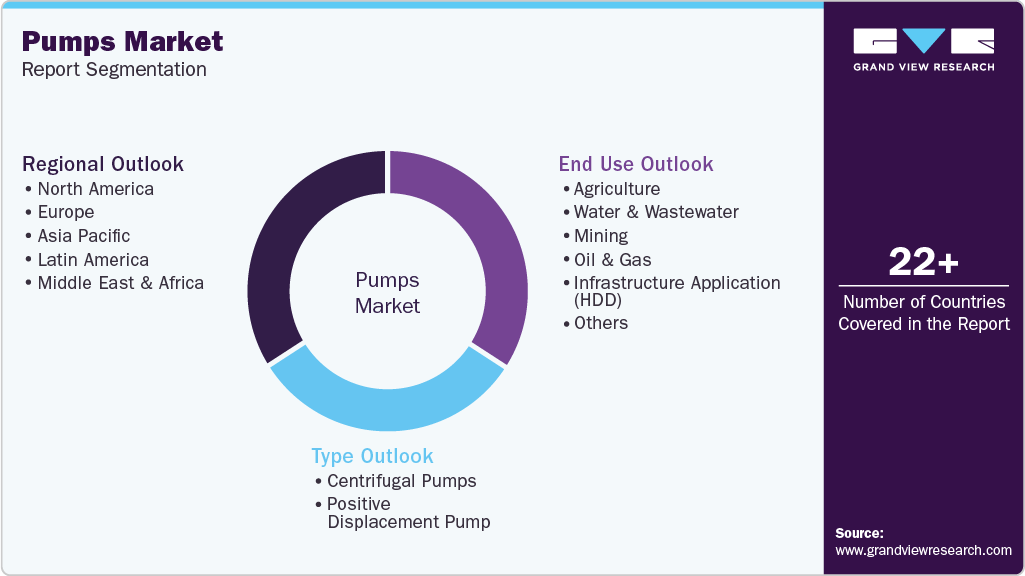
This report forecasts revenue growth at global, regional, and country levels and provides an analysis of the latest industry trends in each of the sub-segments from 2021 to 2033. For this study, Grand View Research, Inc has segmented the global pumps market report based on type, end use, and region:
 To learn more about this report, Download Free Sample Report
-
Type Outlook (Revenue, USD Million, 2021 - 2033)
-
Centrifugal Pumps
-
Centrifugal Pumps By Configuration
-
Single Stage
-
Multistage
-
-
Centrifugal Pumps By Design
-
Radial Flow Pumps
-
Mixed Flow Pumps
-
Axial Flow Pumps
-
-
-
Positive Displacement Pumps
-
Rotary Pump By Type
-
Gear Pumps
-
Screw Pumps
-
Vane Pumps
-
Lobe Pumps
-
Others
-
-
Reciprocating Pump By Type
-
Diaphragm Pumps
-
Piston Pumps
-
Plunger Pumps
-
-
-
-
End Use Outlook (Revenue, USD Million, 2021 - 2033)
-
Agriculture
-
Water & Wastewater
-
Mining
-
Oil & Gas
-
Infrastructure Application (HDD)
-
Others
-
-
Regional Outlook (Revenue, USD Billion, 2021 - 2033)
-
North America
-
U.S.
-
Canada
-
Mexico
-
-
Europe
-
Germany
-
UK
-
France
-
Italy
-
Spain
-
-
Asia Pacific
-
China
-
Japan
-
India
-
South Korea
-
Australia
-
-
Latin America
-
Brazil
-
Argentina
-
-
Middle East and Africa (MEA)
-
Saudi Arabia
-
UAE
-
South Africa
-
-
Frequently Asked Questions About This Report
The water & wastewater segment led with a 24.6% revenue share in 2025.
Asia Pacific dominated the market, accounting for 45.4% of revenue in 2025.
Key players include SLB, Ingersoll Rand, The Weir Group PLC, Vaughan Company, KSB SE & Co. KGaA, Pentair, Grundfos Holding A/S, Xylem, Flowserve Corporation, ITT Inc. (Flow Technologies, formerly SPX FLOW), EBARA CORPORATION, IWAKI CO., LTD., and Sulzer Ltd.
The global pumps market size was valued at USD 61.9 billion in 2025 and is estimated at USD 64.4 billion for 2026.
The global pumps market is expected to grow at a CAGR of 4.8% from 2026 to 2033, reaching USD 89.2 billion by 2033.
Increasing fluid-handling requirements across industries such as water & wastewater treatment, chemicals, and power generation have been supporting market growth.
Centrifugal pumps segment led with a 66.5% revenue share in 2025, while positive displacement pump is the fastest-growing type.
About the Author(s)
Drilling & Extraction Equipments Research Team
Bulk Chemicals · Drilling & Extraction EquipmentsThis report was authored by the drilling & extraction equipments research team at Grand View Research - comprising two research analysts, one senior research analyst, and one industry expert - with specialized expertise in the drilling & extraction equipments segment of the bulk chemicals industry. All findings are based on proprietary bulk chemicals databases, executive interviews, and regulatory analysis, subject to internal peer review prior to publication.
Last Updated:
Speak to Analyst

Customize this report to your needs - add regions, segments, or data points, with 20% free customization.
Or view our licence options:


ISO 9001:2015 & 27001:2022 Certified
We are GDPR and CCPA compliant! Your transaction & personal information is safe and secure. For more details, please read our privacy policy.


