
- Home
- »
- Clothing, Footwear & Accessories
- »
-
Licensed Football Merchandise Market Report, 2026-2033GVR Report cover

Licensed Football Merchandise Market (2026 - 2033)
Size, Share & Trends Analysis Report By Product (Sports Apparel, Sports Footwear), By Distribution Channel (Online, Offline), By Region (North America, Europe; Asia Pacific, Latin America, MEA), And Segment Forecasts
Market Size, 2025
$11.9BMarket Estimate, 2026
$12.5BMarket Forecast, 2033
$19.4BCAGR, 2026–2033
6.5%Licensed Football Merchandise Market Summary
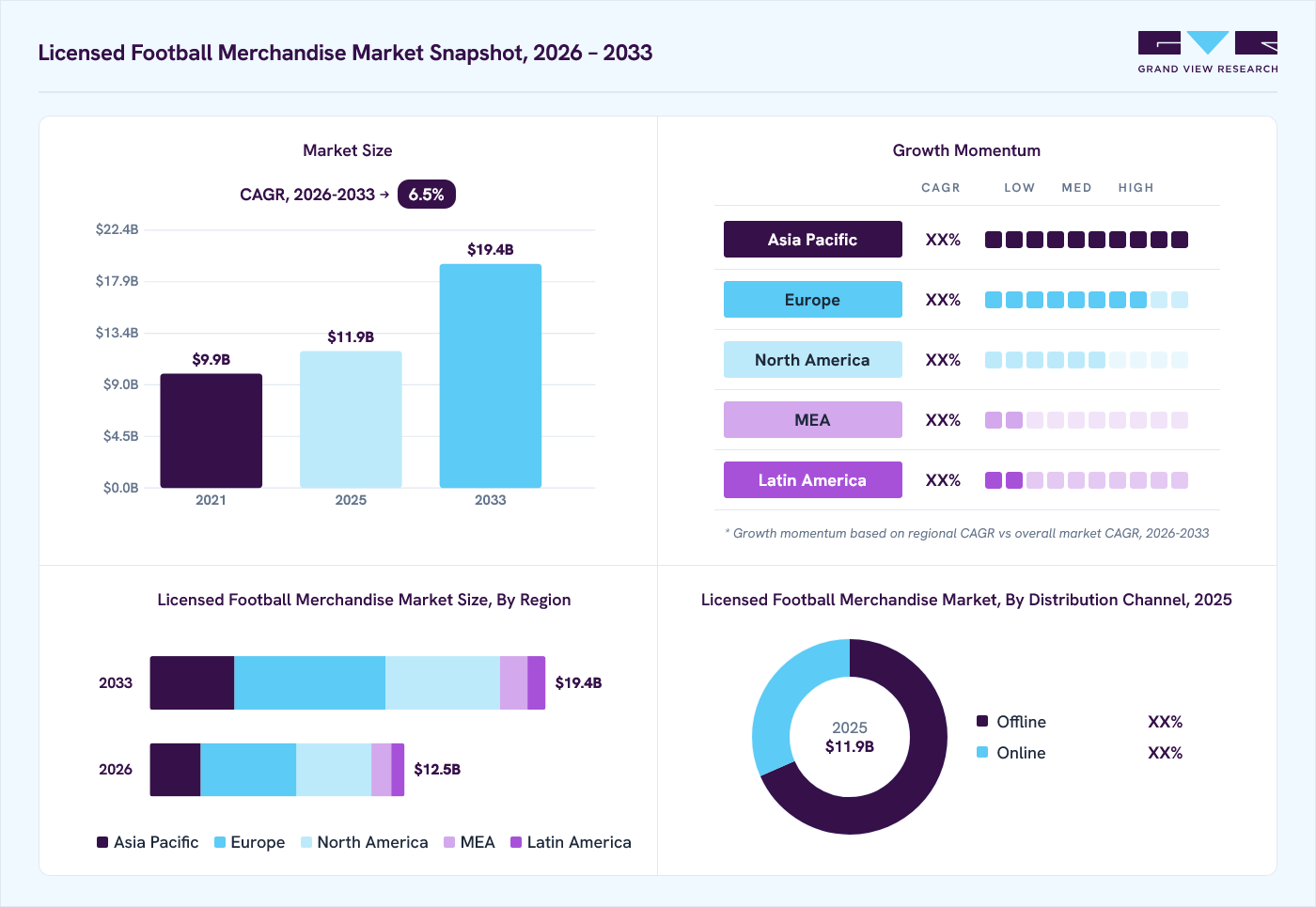
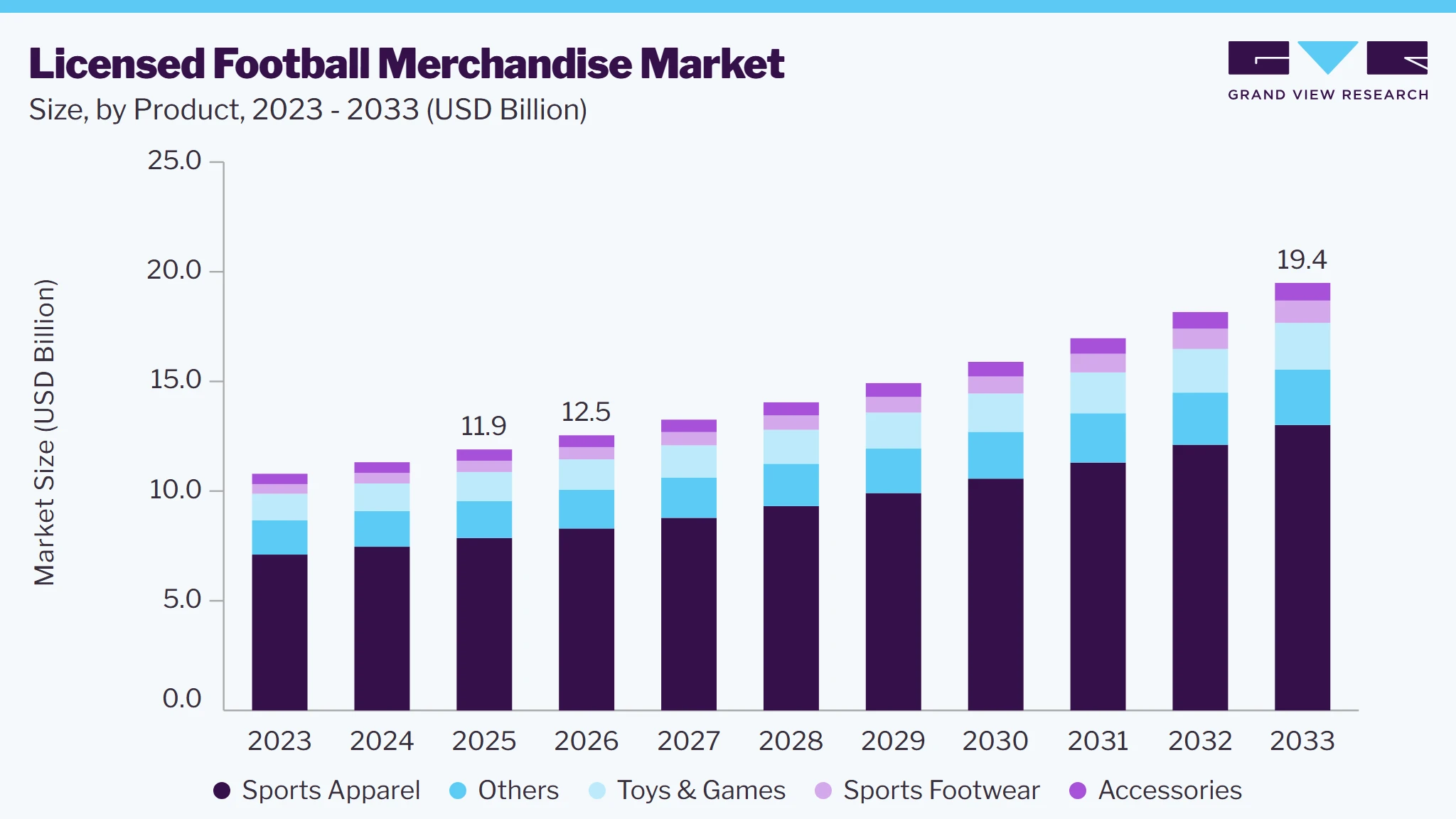
The global licensed football merchandise market size was valued at USD 11.9 billion in 2025 and is projected to grow from USD 12.5 billion in 2026 to USD 19.4 billion by 2033, at a CAGR of 6.5% from 2026 to 2033. Europe dominated the market, accounting for a revenue share of 37.6% in 2025. One of the primary drivers is the growing global popularity of football.
 Source: Grand View Research, IR Documents, Primary Interviews, Paid DatabasesTo learn more about this report,
 Download Free Sample Report
Key Market Trends & Insights
- By product: Sports apparel segment dominated the market, with a revenue share of 66.8% in 2025.
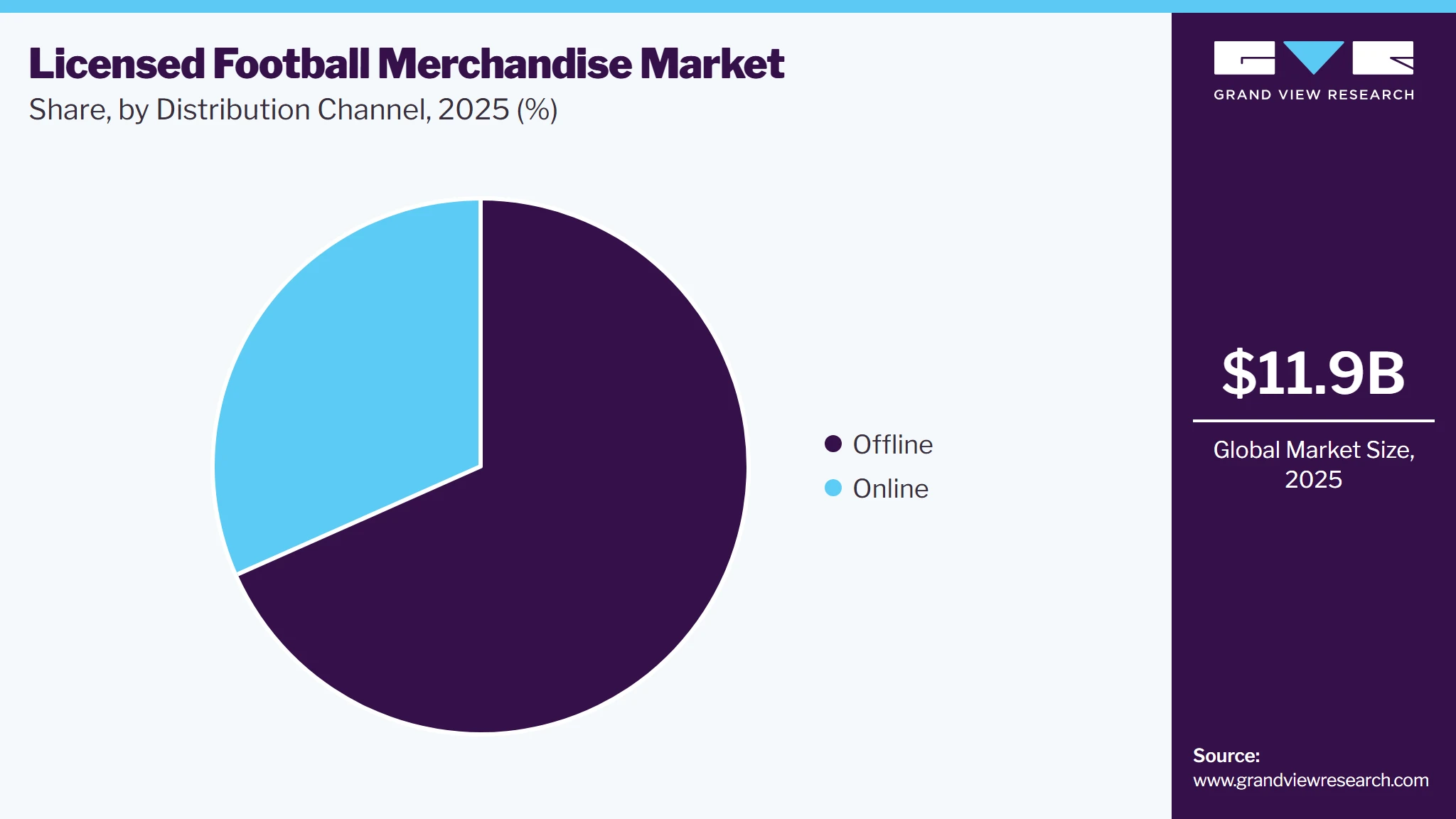
- By distribution channel: Offline segment held the largest market share of 67.5% in 2025.
Regional Highlights
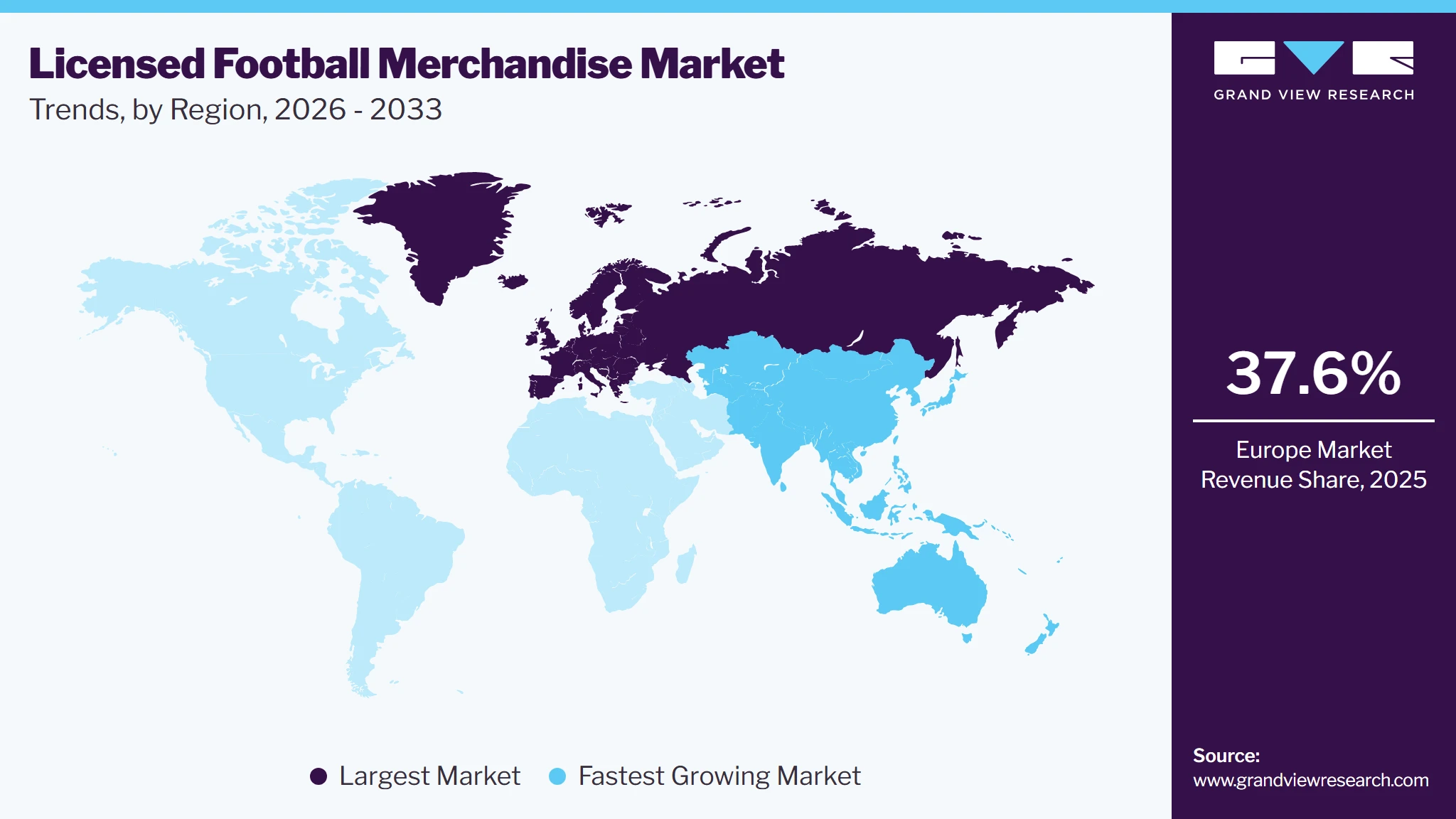
- Largest regional market: Europe (37.6% revenue share, 2025)
- Fastest-growing regional market: Asia Pacific (highest CAGR, 2026-2033)
- By country: Germany held the largest market share in 2025.
Market Size & Forecast
- Market size in 2025: USD 11.9 Billion
- Estimated market size in 2026: USD 12.5 Billion
- Projected market size by 2033: USD 19.4 Billion
- CAGR (2026-2033): 6.5%
Three ways to get this report
Buy it, customize it, or ask a question.Ask an Analyst
Analyst response in 1 business day
- AccessReport author, directly
- Reply timeWithin 1 working day
- No sales callDirect answer only
- FormatEmail reply
- CostFree, no cost
Get the Full Report
What the study covers
- FormatsPDF · Excel · Dashboard
- Timeline2026–2033 annual, 2025 base
- Coverage20+ countries, 5 regions
- Companies10+ key players profiled
Customize the Report
20% free customization
- IncludeCountries, segments, points
- TailorTo your product definition
- ExtendDeeper competitor detail
- OrA fully bespoke study
- Turnaround5–10 working days
As the world's most popular sport, football attracts millions of fans worldwide, creating a significant market for merchandise associated with the sport. High-profile events such as the FIFA World Cup and UEFA Champions League further amplify interest, drawing in even more fans eager to show their support through official merchandise.The expansion of football leagues and tournaments also plays a crucial role in this growth. The proliferation of domestic and international football competitions increases the fan base and generates additional opportunities for merchandise sales. As new leagues and clubs emerge and existing ones grow in prominence, the range of licensed products expands, catering to a wider audience of fans eager to buy memorabilia associated with their favorite teams and players.
 To learn more about this report, Download Free Sample Report
Media and social media influence significantly contribute to the rising demand for football merchandise. Comprehensive media coverage and football-related content on social media platforms keep fans engaged and excited about the sport. Influencers, players, and clubs often showcase merchandise, promoting products and creating a sense of connection and involvement for fans. This visibility helps drive consumer interest and boosts sales.
Enhancing fan engagement through exclusive merchandise releases and special events is another key factor driving market growth. Football clubs increasingly focus on creating unique and limited-edition items that generate excitement among fans. This approach boosts sales and fosters a deeper connection between fans and their teams. The availability of special merchandise releases often increases demand as fans seek to own exclusive items.
In addition, rising disposable incomes and spending power contribute to market growth. As people's financial conditions improve, they are more willing to spend on discretionary items such as football merchandise. This increased purchasing power allows fans to invest in high-quality and premium items, further fueling market expansion.
The growth of e-commerce has also made it easier for fans to access licensed merchandise from anywhere in the world. Online shopping platforms offer a wide range of football products and provide a convenient shopping experience, leading to higher sales. Retail channels, including dedicated football merchandise stores and sections in major retail outlets, also support the market's growth.
Consumers' increasing focus on authenticity and quality has also influenced the market. Fans are now more discerning about the products they buy, preferring officially licensed, genuine, high-quality merchandise. This shift towards valuing authenticity ensures that licensed merchandise remains in high demand as consumers seek to avoid counterfeit or unofficial items.
Market Dynamics
The licensed football merchandise market is experiencing steady growth, driven by the expanding global fan base of football clubs, national teams, and international tournaments. Rising viewership of competitions such as the FIFA World Cup, UEFA Champions League, and domestic leagues has significantly increased demand for officially licensed jerseys, footwear, accessories, and collectibles. The growing popularity of e-commerce, direct-to-consumer sales channels, and product personalization is further enhancing merchandise accessibility and consumer engagement. Additionally, strategic licensing agreements between football organizations, sportswear brands, and retailers continue to strengthen product innovation and global market penetration.
The rising global popularity of football and the expanding fan base of clubs, leagues, and national teams are key drivers of the licensed football merchandise market. Major sporting events such as the FIFA World Cup, UEFA Champions League, UEFA European Championship, and leading domestic leagues generate significant demand for officially licensed jerseys, apparel, footwear, scarves, and collectibles. Increasing fan engagement through social media, digital platforms, and club membership programs has further strengthened merchandise sales. Additionally, the growing commercialization of football through sponsorships, licensing agreements, and collaborations between clubs and sportswear brands has expanded the availability of authentic merchandise across both online and offline retail channels.
The widespread availability of counterfeit football merchandise remains a significant challenge for market growth. Unauthorized replicas of jerseys, apparel, and accessories are often sold at substantially lower prices through informal retail channels and online marketplaces, reducing sales of officially licensed products. Counterfeit merchandise not only impacts the revenues of clubs, leagues, and licensed manufacturers but also undermines brand reputation and consumer confidence. Furthermore, enforcing intellectual property rights across multiple countries remains complex due to varying regulatory frameworks and the rapid expansion of cross-border e-commerce, limiting the market potential for authentic licensed football merchandise.
The rapid expansion of e-commerce platforms and direct-to-consumer sales channels presents substantial growth opportunities for the licensed football merchandise market. Football clubs and sports brands are increasingly offering personalized products, including customized jerseys featuring player names, numbers, and fan-selected designs, enhancing consumer engagement and brand loyalty. In addition, limited-edition collections, collaborations with fashion and lifestyle brands, and the growing popularity of women's football are expanding the consumer base. Rising smartphone penetration, digital payment adoption, and increasing demand for sustainable and premium-quality merchandise are expected to further accelerate online sales and create new revenue opportunities for licensed football merchandise manufacturers and retailers.
Analyst Perspective
The licensed football merchandise market benefits from a unique combination of structural growth drivers, including football's expanding global fan base, rising commercialization of clubs and leagues, and the increasing digitalization of retail. The strongest competitive advantage will belong to brands and clubs that build direct-to-consumer ecosystems by combining official merchandise with personalized products, exclusive member benefits, and omnichannel shopping experiences. This strategy transforms merchandise purchases from event-driven transactions into recurring fan engagement opportunities.
Product Insights
Based on product, the sports apparel segment led the market with the largest revenue share of 66.8% in 2025 and is expected to grow at the fastest CAGR over the forecast period. There is a growing demand for high-quality, performance-driven sports apparel among consumers. Licensed football merchandise is designed for fans and athletic performance, offering features like moisture-wicking fabric, breathability, and durability. As more consumers engage in sports and physical activities, they seek apparel that combines style and functionality. Licensed football apparel meets these needs, making it a popular choice for sports and everyday use. Furthermore, football clubs frequently release new kits and special edition jerseys, which fuels consumer demand. These releases are often tied to new seasons, anniversaries, or special events, creating a sense of urgency and excitement among fans. The sports apparel is further segmented into T-shirts & tops, sweatshirts and hoodies, jackets, caps & hats, and others.
Sports footwear is expected to grow at a CAGR of 7.4% from 2026 to 2033. Modern sports footwear, particularly in football, incorporates advanced technology and design features to enhance performance. Innovations like improved grip, better ankle support, lighter materials, and enhanced cushioning cater to both professional athletes and recreational players. These advancements make licensed football footwear more appealing to consumers looking for high-quality, performance-oriented shoes to improve their game. Also, the appeal of licensed football footwear is not only in its functionality but also in its style and brand prestige, making it a popular choice for those looking to combine comfort, sports culture, and fashion in their daily lives.
Distribution Channel Insights
Based on distribution channel, the offline led the market with the largest revenue share of 67.5% in 2025. One of the main advantages of offline stores is the ability for consumers to see, touch, and try on merchandise before purchasing. This tangible experience allows customers to firsthand assess the products' quality, fit, and design. For licensed football merchandise, where authenticity and quality are crucial, being able to verify these aspects in person provides reassurance and encourages immediate purchase. Many offline stores offer exclusive promotions, discounts, and special events related to licensed football merchandise. These could include player meet-and-greets, live match screenings, or exclusive product launches. Such events create a buzz and drive foot traffic to stores, enhancing the shopping experience and fostering a sense of community among fans.
 To learn more about this report, Download Free Sample Report
Sales through online channels are expected to grow with a CAGR of 6.1% from 2026 to 2033. Online retailers often offer a broader range of licensed football merchandise, including niche brands and specialized products that may not be available in local stores. This extensive selection enables customers to find exactly what they are looking for, whether it’s a specific type of bow, arrow, or unique accessories. These stores frequently provide competitive pricing, discounts, and promotions that are not always available at brick-and-mortar retailers. Customers can easily compare prices across multiple websites to find the best deals, which can be a significant incentive for buying licensed football merchandise online.
Regional Insights
North America licensed football merchandise market is expected to grow at a CAGR of 5.6% from 2026 to 2033. There has been significant growth in youth soccer programs and grassroots initiatives across North America. Soccer is now one of the most played sports among children and teenagers in the region, fostering a new generation of soccer enthusiasts. As young players develop a passion for the sport, they are more likely to purchase licensed merchandise to represent their favorite teams, both local and international. This enthusiasm among younger demographics helps fuel the market for licensed football merchandise.
U.S. Licensed Football Merchandise Market Trends
The licensed football merchandise market in the U.S. is growing. The diverse population in the U.S., with a significant number of immigrants and communities with strong soccer traditions, has also driven the demand for licensed football merchandise. Many of these communities have long-standing affiliations with football clubs from their home countries and continue to support them, creating a demand for related merchandise. In addition, the cultural influence of soccer from these communities helps promote the sport among a broader audience, further boosting interest in purchasing licensed merchandise.
Asia Pacific Licensed Football Merchandise Market Trends
The licensed football merchandise market in Asia Pacific is expected to grow at a CAGR of 6.5% from 2026 to 2033. The influence of social media and endorsements by popular football players has significantly boosted the appeal of licensed merchandise. Many football clubs and players have large followings on platforms like Instagram, Twitter, and Facebook, where they frequently showcase official merchandise. This visibility encourages fans to purchase licensed products to emulate their idols.
Europe Licensed Football Merchandise Market Trends
Europe dominated the licensed football merchandise market with the largest revenue share of 37.5% in 2025. The licensed football merchandise market in the Germany held the largest share in the Europe region in 2025. Europe is home to some of the world's most historic and prestigious football clubs and leagues, such as the English Premier League, La Liga, Serie A, and the Bundesliga. Football is deeply ingrained in many Europeans' culture and daily lives, leading to a highly passionate fanbase that consistently seeks ways to show support for their teams. This cultural significance drives the demand for licensed football merchandise, including jerseys, scarves, and other fan gear that allows supporters to display their allegiance and pride.
 To learn more about this report, Download Free Sample Report
Germany Licensed Football Merchandise Market Trends
The licensed football merchandise market in Germany held the largest share in the Europe region in 2025, driven by strong fan loyalty toward Bundesliga clubs and the German national football team. Demand for official jerseys, training apparel, scarves, and accessories is fueled by supporters seeking to express team identity and support their favorite players. Personalized merchandise, club-specific collections, and online official stores further encourage purchases beyond matchdays, strengthening sales opportunities for licensed merchandise manufacturers and retailers.
Key Licensed Football Merchandise Company Insights
The market is characterized by dynamic competitive dynamics shaped by a combination of factors, including product innovation, regional production capabilities, and evolving consumer preferences. Leading manufacturers invest in R&D and technological advancements to provide cost-effective, quality products. Market players are entering into joint ventures, partnerships, mergers, agreements, and acquisitions to strengthen their market position and expand their geographical reach. Companies also focus on raising consumer awareness of the ambiguity of the types used while strictly adhering to international regulatory standards.
Key Licensed Football Merchandise Companies:
The following key companies have been profiled for this study on the licensed football merchandise market.
-
Nike, Inc.
-
Adidas AG
-
Under Armour, Inc.
-
Puma SE
-
New Balance Athletics, Inc.
-
Fanatics, Inc.
-
Mitchell & Ness Nostalgia Co
-
Umbro Ltd.
-
Kappa S.p.A.
-
Hummel Sport A/S
Competitive Benchmarking
Category
Operating Strategies
Competitive Edge
Weakness
Established Players (Fanatics, Inc.; Nike, Inc.; adidas AG; Puma SE; New Era Cap, LLC; JD Sports Fashion Plc; Sports Direct International Plc; FIFA; UEFA; Manchester United plc; FC Barcelona; Real Madrid C.F.)
- Expand licensed product portfolios through long-term club and league licensing agreements, strengthen omnichannel distribution across brand stores, e-commerce, and sporting goods retailers, invest in exclusive collections, player collaborations, and digital merchandising, and expand into high-growth football markets.
- Strong global brand recognition, exclusive licensing rights with clubs and tournaments, extensive retail and distribution networks, diversified product portfolios, and high consumer loyalty driven by official authenticity.
- High royalty and licensing costs, dependence on team performance and tournament cycles, vulnerability to counterfeit products, and higher operational costs associated with global supply chains.
Emerging Players (Foudys Ltd.; Icon Sports Group; COPA Football; Forever Collectibles (FOCO); The Terrace Store; Classic Football Shirts Ltd.)
- Focus on niche fan segments through retro jerseys, limited-edition collections, direct-to-consumer (DTC) sales, leverage social media and influencer marketing, and expand via online marketplaces and club partnerships.
- Agile product development, ability to quickly capitalize on football trends, strong digital presence, differentiated vintage and fan-centric product offerings, and closer engagement with football communities.
- Limited financial resources, smaller global distribution networks, dependence on online sales, lower brand recognition compared to established sportswear companies, and challenges in securing premium licensing agreements.
Recent Developments
-
In June 2024, Adidas unveiled the new Jamaica home, away, and prematch jerseys for the 2024/25 season, drawing inspiration from the island's heritage, culture, and natural beauty. The designs feature a unique, hand-drawn, and wax-painted motif reminiscent of traditional graphic styles, paying tribute to Jamaican nature with symbols of the national bird (doctor bird) and national flower (lignum vitae). The home jersey presents the country's rich national colors of black, gold, and green, with gold as the primary color.
-
In March 2023, Adidas unveiled the latest iteration of its Football Icons Jersey Collection, featuring designs inspired by legendary football players such as David Beckham, Zinedine Zidane, and Franz Beckenbauer. The collection aims to celebrate the heritage of football while incorporating modern elements. The jerseys are crafted using sustainable materials, reflecting Adidas's commitment to environmental responsibility. They are designed for both on-field performance and off-field style, appealing to fans and players alike. The launch is part of Adidas's ongoing efforts to connect with football enthusiasts and honor the sport's rich history.
Licensed Football Merchandise Market Report Scope
Report Attribute
Details
Market size in 2025
USD 11.9 billion
Estimated market size in 2026
USD 12.5 billion
Projected market size by 2033
USD 19.4 billion
Growth rate
CAGR of 6.5% from 2026 to 2033
Base year for estimation
2025
Historical data
2021 - 2024
Forecast period
2026 - 2033
Quantitative units
Revenue in USD million/billion and CAGR from 2026 to 2033
Report coverage
Revenue forecast, company ranking, competitive landscape, growth factors, and trends
Segments covered
Product, distribution channel, region
Regional scope
North America; Europe; Asia Pacific; Latin America; MEA
Country scope
U.S.; Canada; Mexico; Germany; UK; France; Italy; Spain; China; Japan; India; South Korea; Australia; Brazil; South Africa;
Key companies profiled
Nike, Inc.; Adidas AG; Under Armour, Inc.; Puma SE; New Balance Athletics, Inc.; Fanatics, Inc.; Mitchell & Ness Nostalgia Co; Umbro Ltd.; Kappa S.p.A.; Hummel Sport A/S
Customization scope
Free report customization (equivalent up to 8 analysts' working days) with purchase. Addition or alteration to country, regional & segment scope.
Pricing and purchase options
Avail customized purchase options to meet your exact research needs. Explore purchase options
Global Licensed Football Merchandise Market Report Segmentation
This report forecasts revenue growth at the global, regional, and country levels and provides an analysis of the latest industry trends and opportunities in each of the sub-segments from 2021 to 2033. For this study, Grand View Research has segmented the global licensed football merchandise market report based on product, distribution channel, and region:
 To learn more about this report, Download Free Sample Report
-
Product Outlook (Revenue, USD Million, 2021 - 2033)
-
Sports Apparel
-
T-Shirts & Tops
-
Sweatshirts & Hoodies
-
Jackets
-
Caps & Hats
-
Others
-
-
Sports Footwear
-
Toys & Games
-
Accessories
-
Others
-
-
Distribution Channel Outlook (Revenue, USD Million, 2021 - 2033)
-
Online
-
Offline
-
Supermarkets And Hypermarkets
-
Specialty Stores
-
Campus Bootstores
-
Others
-
-
-
Regional Outlook (Revenue, USD Million, 2021 - 2033)
-
North America
-
U.S.
-
Canada
-
Mexico
-
-
Europe
-
Germany
-
UK
-
France
-
Italy
-
Spain
-
-
Asia Pacific
-
China
-
Japan
-
India
-
Australia & New Zealand
-
South Korea
-
-
Latin America
-
Brazil
-
-
Middle East & Africa
-
South Africa
-
-
Research Methodology
The licensed football merchandise market figures in this report are based on a proven research process that combines executive interviews with secondary research from proprietary databases, company filings, and recognized regulatory and institutional sources. Market size is built through value-chain sizing - reconciling supply-side and demand-side estimates - and triangulated with bottom-up and top-down approaches. Every estimate passes multiple levels of expert validation before publication, with each licensed football merchandise segment quantified using the revenue-capture definitions in the table below.
Segment Definition
Segment
Revenue capture definition
Sports Apparel
This segment covers the revenues generated through the sales of licensed football sports apparel, including official match jerseys, replica kits, training wear, T-shirts, hoodies, jackets, tracksuits, shorts, and socks featuring the branding of football clubs, leagues, or national teams. These products are manufactured under official licensing agreements and are designed for both athletic use and fan wear. Examples include: Manchester United home jersey, Real Madrid training jacket, FC Barcelona hoodie, Liverpool replica kit, and Brazil national team jersey.
Sports Footwear
This segment covers the revenues generated through the sales of licensed football sports footwear, including football boots, turf shoes, indoor football shoes, sneakers, and lifestyle footwear officially associated with football clubs, leagues, players, or tournaments. These products often feature club colors, logos, or player-inspired designs. Examples include: Adidas Predator Real Madrid edition, Nike Mercurial CR7 boots, Puma Future Manchester City edition, and Adidas Samba Inter Miami CF shoes.
Toys & Games
This segment covers the revenues generated through the sales of licensed football-themed toys, games, and collectibles developed under official licensing agreements. The category includes action figures, board games, trading card games, puzzles, plush toys, miniature stadium sets, and football video games featuring licensed clubs, leagues, and players. Examples include: EA Sports FC video game, Panini FIFA trading cards, LEGO football stadium sets, Topps Match Attax cards, and club mascot plush toys.
Accessories
This segment covers the revenues generated through the sales of licensed football accessories, including caps, scarves, backpacks, keychains, wallets, phone cases, water bottles, flags, watches, and other fan merchandise carrying official club or national team branding. These products are designed to enhance fan engagement and everyday brand visibility. Examples include: Arsenal scarf, Chelsea cap, FC Barcelona backpack, Juventus keychain, Manchester City water bottle, and FIFA World Cup commemorative mug.
Others
This segment covers the revenues generated through the sales of other licensed football merchandise not classified under sports apparel, sports footwear, toys & games, or accessories. It includes home décor products, stationery, drinkware, bedding, luggage, electronic accessories, souvenirs, and limited-edition memorabilia. Examples include: Manchester United bedding sets, Real Madrid coffee mugs, UEFA Champions League wall art, FC Bayern Munich notebooks, signed footballs, and commemorative trophies.
Estimation Model
Epidemiology Layer
Digital Access Layer
Behavioural Layer
Monetisation Layer
Key Question: Who purchases licensed football merchandise?
Key Question: Who can be reached through sales channel?
Key Question: Who actively buys licensed merchandise?
Key Question: How is revenue generated?
Identify football fans across all age groups, club supporters, national team followers, collectors, and sports enthusiasts to define the addressable consumer base.
Apply region-specific internet penetration, retail accessibility, stadium stores, sporting goods retailers, brand outlets, and e-commerce reach to estimate the addressable market.
Apply merchandise purchase rates influenced by club loyalty, major football tournaments, player popularity, new kit launches, and collectible demand to estimate active buyers.
Multiply active buyers by the average annual spending on jerseys, footwear, accessories, toys, collectibles, and other licensed football merchandise across online and offline channels.
Delivered Customizations
This report has been delivered with the following In-depth customizations
Client Request
Customization Delivered
Value Adds
Fan Engagement, Club Loyalty & Merchandise Demand Trends
Conducted a focused analysis of licensed football merchandise covering fan purchasing behavior, club and national team loyalty, player-driven merchandise sales, tournament-led demand, personalization trends, and the growing influence of digital fan engagement and social media on merchandise consumption.
Helps stakeholders identify high-growth merchandise categories, evaluate evolving fan purchasing patterns, and assess commercialization opportunities across clubs, leagues, and international football tournaments.
Retail, E-commerce & Omnichannel Distribution Trends
Evaluated sales trends across official club stores, brand websites, e-commerce marketplaces, sporting goods retailers, supermarkets & hypermarkets, and specialty stores, with focus on omnichannel strategies, direct-to-consumer (DTC) expansion, limited-edition launches, and regional demand patterns.
Provides insights into emerging distribution channels, consumer buying preferences, and retail expansion opportunities to support market penetration, pricing strategies, and channel optimization.
Licensing Strategy, Product Innovation & Competitive Landscape Assessment
Assessed demand across licensed football apparel, footwear, accessories, toys & games, collectibles, and lifestyle products, along with licensing partnerships, sustainability initiatives, customization, anti-counterfeiting measures, and competitive benchmarking of leading sports brands, clubs, and licensors.
Supports investment and expansion strategies by identifying licensing opportunities, innovation trends, competitive differentiation, and long-term growth potential in the global licensed football merchandise market.
Frequently Asked Questions About This Report
The global licensed football merchandise market size was valued at USD 11.9 billion in 2025 and is estimated at USD 12.5 billion in 2026.
The global licensed football merchandise market is expected to grow at a CAGR of 6.5% from 2026 to 2033, reaching USD 19.4 billion by 2033.
Some key players operating in the licensed football merchandise market include Nike, Inc., Adidas AG, Under Armour, Inc., Puma SE, New Balance Athletics, Inc., and others.
Key factors that are driving the market growth include rising purchasing power and disposable income and growing football participation and tournaments
Europe dominated with a 37.6% revenue share in 2025.
The sports apparel segment led the market with the largest revenue share of 66.8% in 2025 and sports footwear segment is second fastest growing market.
The offline led the market with the largest revenue share of 67.5% in 2025. One of the main advantages of offline stores is the ability for consumers to see, touch, and try on merchandise before purchasing.
Asia Pacific is the fastest-growing region over the forecast period.
About the Author(s)
Clothing, Footwear & Accessories Research Team
Consumer Goods · Clothing, Footwear & AccessoriesThis report was authored by the clothing, footwear & accessories research team at Grand View Research - comprising two research analysts, one senior research analyst, and one industry expert - with specialized expertise in the clothing, footwear & accessories segment of the consumer goods industry. All findings are based on proprietary consumer goods databases, executive interviews, and regulatory analysis, subject to internal peer review prior to publication.
Last Updated:
Speak to Analyst

Customize this report to your needs - add regions, segments, or data points, with 20% free customization.
Or view our licence options:


ISO 9001:2015 & 27001:2022 Certified
We are GDPR and CCPA compliant! Your transaction & personal information is safe and secure. For more details, please read our privacy policy.


