
- Home
- »
- Specialty Glass, Ceramic & Fiber
- »
-
Lignosulfonates Market Size & Share Report, 2026-2035GVR Report cover
![Lignosulfonates Market (2026 - 2035)Report]()
Lignosulfonates Market (2026 - 2035)
Size, Share & Trends Analysis Report By Product (Sodium Lignosulfonate, Calcium Lignosulfonate, Magnesium Lignosulfonate), By Application (Oil Well Additives, Concrete Additives), By Region, And Segment Forecasts
Market Size, 2025
$1.5BMarket Estimate, 2026
$1.6BMarket Forecast, 2035
$2.1BCAGR, 2026–2035
3.2%Lignosulfonates Market Summary
The global lignosulfonates market was valued at USD 1.5 billion in 2025 and is projected to grow from USD 1.6 billion in 2026 to USD 2.1 billion in 2035, at a CAGR of 3.2% from 2026 to 2035. Asia Pacific dominated the market, accounting for a revenue share of 45.0% in 2025. The market is experiencing steady growth, driven by the increasing demand for sustainable bio-based additives in construction, oil & gas, animal feed, and agricultural applications, along with the rising adoption of lignosulfonates as environmentally friendly dispersants, binders, and concrete admixtures.
Key Market Trends & Insights
- By product: The calcium lignosulfonate segment held the largest market share of approximately 40.0% in 2025.
- By application: The concrete additives segment held the largest market share in 2025.
Regional Highlights
- Largest regional market: Asia Pacific (45.0% revenue share, 2025)
- Fastest-growing regional market: North America (highest CAGR, 2026-2035)
Market Size & Forecast
- Market size in 2025: USD 1.5 Billion
- Estimated market size in 2026: USD 1.6 Billion
- Projected market size by 2035: USD 2.1 Billion
- CAGR (2026-2035): 3.2%
The lignosulfonates market is primarily driven by the increasing demand for sustainable and bio-based chemicals across construction, oil & gas, agriculture, and animal feed industries. As a renewable by-product of the sulfite pulping process, lignosulfonates are gaining widespread adoption as environmentally friendly dispersants, binders, and plasticizers, supporting the shift toward greener industrial practices. Rising infrastructure development and construction activities are further boosting the demand for lignosulfonate-based concrete admixtures, while expanding oil and gas exploration activities continue to support their use as drilling fluid additives. In addition, growing awareness regarding low-carbon and biodegradable materials is encouraging manufacturers to replace synthetic chemical additives with lignosulfonate-based alternatives.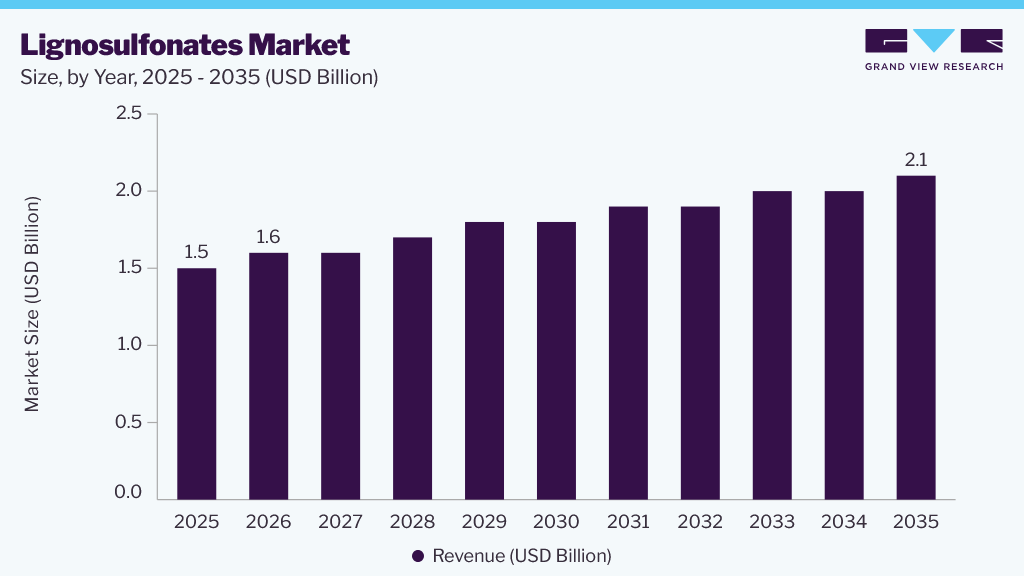
Despite favorable market prospects, the industry faces challenges such as fluctuations in raw material availability due to its dependence on the pulp and paper industry, along with performance limitations compared to certain synthetic additives in high-performance applications. Variations in product quality and increasing competition from alternative bio-based and chemical dispersants may also restrain market growth. However, rising investments in lignin valorization, continuous advancements in bio-refining technologies, and increasing research into high-value lignin-derived products are creating significant growth opportunities. The expanding use of lignosulfonates in dust suppression, battery materials, specialty chemicals, and sustainable agricultural formulations is expected to further strengthen market growth over the forecast period.
Analyst Perspective
The lignosulfonates market is expected to witness steady growth over the forecast period, driven by the increasing transition toward renewable, bio-based chemicals and sustainable industrial processes. Growing demand from the construction, oil & gas, agriculture, and animal feed industries is encouraging manufacturers to expand production capacities and develop high-performance lignosulfonate formulations. Technological advancements in lignin processing and bio-refining are improving product quality and broadening application areas beyond traditional end uses. In addition, rising investments in circular economy initiatives and value-added lignin products are expected to create new growth opportunities. Companies focusing on innovation, sustainable production, and strategic collaborations are likely to strengthen their competitive position and capitalize on the increasing global demand for environmentally friendly industrial additives.
Product Insights
The calcium lignosulfonate segment dominated the market and accounted for the largest revenue share of approximately 40.5% in 2025. This segment is driven by its increasing adoption in animal feed binders, agriculture, dust control, and construction applications. Its biodegradability, strong binding capability, and environmentally friendly characteristics are encouraging its use as an alternative to conventional chemical additives. Growing emphasis on sustainable agricultural practices, renewable materials, and the development of bio-based chemical solutions is expected to create new growth opportunities for calcium lignosulfonate applications. Rising demand for soil conditioning products, pelletizing agents, and eco-friendly dust suppression solutions is further supporting segment expansion. Moreover, increasing focus on sustainable industrial practices is expected to accelerate the adoption of calcium lignosulfonate-based formulations across emerging applications.
The sodium lignosulfonate segment is expected to register the fastest CAGR during the forecast period. The segment's growth is attributed to its widespread use as a dispersant, plasticizer, and water-reducing agent across construction, oil well additives, ceramics, and industrial applications. Its excellent binding properties, cost-effectiveness, and compatibility with various formulations make it a preferred choice among end users. Increasing demand for sustainable and bio-based additives, along with rising infrastructure development activities, is expected to support the continued growth of sodium lignosulfonate during the forecast period. The growing use of sodium lignosulfonate in concrete admixtures and industrial processing applications is further strengthening its market position. Additionally, its ability to improve product performance while reducing dependence on synthetic chemicals is contributing to increased adoption across multiple industries.
Application Insights
The concrete additives segment dominated the market and accounted for the largest revenue share in 2025. The segment's dominance is attributed to the widespread use of lignosulfonates as water reducers, plasticizers, and dispersing agents in concrete formulations. Their ability to improve concrete workability, reduce water requirements, enhance strength, and support cost-efficient construction processes has increased their adoption across infrastructure and building projects. Rising urbanization, infrastructure development, and growing demand for sustainable construction materials are further driving the use of lignosulfonate-based concrete additives. Additionally, the shift toward environmentally friendly construction chemicals is encouraging the adoption of bio-based admixtures as alternatives to conventional synthetic additives.
The oil well additives segment is expected to register the fastest CAGR during the forecast period. The segment's growth is driven by the increasing application of lignosulfonates in drilling fluids, where they function as dispersants, viscosity modifiers, and filtration control agents. Their ability to maintain drilling fluid stability, improve drilling efficiency, and perform under demanding well conditions is supporting their adoption in oil and gas exploration activities. Increasing energy demand, ongoing exploration activities, and the need for efficient drilling solutions are expected to create new growth opportunities for lignosulfonate-based oil well additives.
Alongside industrial applications, lignosulfonates are also gaining importance in animal feed binders, where they are used as pelletizing aids to improve feed quality and durability. For instance, in March 2024, Borregaard received reauthorization from the European Food Safety Authority (EFSA) and the European Commission for its lignosulfonate products as technological feed additives (functional group: binders) for all animal species. The approval validated the safety and effectiveness of lignosulfonates in animal nutrition applications, strengthening their adoption as sustainable feed additives.
Regional Insights
Asia Pacific dominated the lignosulfonates market and accounted for the largest revenue share of approximately 45.0% in 2025. The region's dominance is attributed to the strong presence of pulp and paper industries, expanding construction activities, and increasing demand for sustainable additives across agriculture, animal feed, and industrial applications. Countries such as China, India, Japan, and South Korea are witnessing rising adoption of lignosulfonates due to infrastructure development, growing manufacturing activities, and increasing focus on renewable and bio-based chemical solutions. The availability of raw materials, expanding industrial base, and increasing investments in sustainable production processes are further supporting regional market growth.

North America Lignosulfonates Market Trends
North America is expected to register the fastest CAGR during the forecast period. The regional growth is driven by increasing demand for environmentally friendly additives across construction, oil & gas, agriculture, and industrial applications. North America has a well-established lignin and specialty chemical innovation ecosystem, including companies investing in lignin valorization, dispersants, concrete admixtures, and oilfield chemicals. Mentioning higher-value applications would strengthen the analyst perspective. Growing emphasis on sustainable materials, rising adoption of bio-based chemicals, and advancements in lignin-derived solutions are encouraging market expansion. The presence of established chemical manufacturers, strong research and development capabilities, and increasing focus on reducing dependence on fossil-based products are further supporting the adoption of lignosulfonates. Additionally, rising demand for renewable and biodegradable alternatives across multiple industries is expected to create new growth opportunities for market participants in North America.
Key Lignosulfonates Company Insights
The lignosulfonates market is highly competitive, with companies focusing on sustainable product development, application diversification, and expansion of lignin-based solutions across various industries. Market participants are increasingly investing in advanced processing technologies, bio-based chemical innovations, and environmentally friendly formulations to address the growing demand for renewable additives. Strategic initiatives such as product approvals, research collaborations, capacity enhancements, and regional expansion are shaping the competitive landscape. Companies are also focusing on improving product performance and developing customized solutions for applications including construction, agriculture, animal feed, oil & gas, and industrial formulations to strengthen their market presence.
Key Lignosulfonates Companies
The following key companies have been profiled for this study on the lignosulfonates market:
-
Borregaard AS
-
RYAM
-
Sappi Ltd
-
Domsjö Fabriker Aktiebolag
-
Nippon Paper Industries Co., Ltd.
-
Ingevity Corporation
-
Burgo Group S.p.A.
-
The Dallas Group of America
-
Green Agrochem
-
Tokyo Chemical Industry Co., Ltd.
Recent Developments
-
In May 2025, Södra began construction of a new kraft lignin extraction and drying plant at its Mönsterås pulp mill in Sweden. The facility is expected to become one of the largest kraft lignin production sites globally, supporting the development of renewable lignin-based materials and sustainable chemical solutions.
-
In September 2025, Borregaard and Kiilto introduced a laundry powder solution containing LignoBrite, a lignin-based ingredient developed as a sustainable alternative to fossil-based components. The launch highlights the expanding application potential of lignin-derived products and supports the shift toward renewable and bio-based chemical solutions.
Lignosulfonates Market Report Scope
Report Attribute
Details
Market size in 2025
USD 1.5 billion
Estimated market size in 2026
USD 1.6 billion
Projected market size by 2035
USD 2.1 billion
Growth rate
CAGR of 3.2% from 2026 to 2035
Base year for estimation
2025
Historical data
2021 – 2024
Forecast period
2026 – 2035
Quantitative units
Revenue in USD billion, and CAGR from 2026 to 2035
Report coverage
Revenue forecast, company ranking, competitive landscape, growth factors, and trends
Segments covered
Product, application, region
Regional Scope
North America; Europe; Asia Pacific; Latin America; Middle East & Africa
Country Scope
U.S.; Canada; Mexico; UK; Germany; France; Italy; Spain; China; Japan; India; Australia; South Korea; Brazil; Argentina; South Africa; Saudi Arabia; UAE
Key companies profiled
Borregaard AS; RYAM; Sappi Ltd; Domsjö Fabriker Aktiebolag; Nippon Paper Industries Co., Ltd.; Ingevity Corporation; Burgo Group S.p.A.; The Dallas Group of America; Green Agrochem; Tokyo Chemical Industry Co., Ltd.
Customization scope
Free report customization (equivalent to 8 analyst working days) with purchase. Addition or alteration to country, regional & segment scope.
Pricing and purchase options
Avail of customized purchase options to meet your exact research needs. Explore purchase options
Global Lignosulfonates Market Report Segmentation
This report forecasts revenue growth at the global, regional, and country levels and provides an analysis of the latest industry trends and opportunities across each sub-segment from 2021 to 2035. For the purpose of this study, Grand View Research has segmented the global lignosulfonates market report based on product, application, and region:
-
Product Outlook (Revenue, USD Billion, 2021 - 2035)
-
Sodium Lignosulfonate
-
Calcium Lignosulfonate
-
Magnesium Lignosulfonate
-
Others
-
-
Application Outlook (Revenue, USD Billion, 2021 - 2035)
-
Oil Well Additives
-
Concrete Additives
-
Animal Feed Binders
-
Dust Control
-
Others
-
-
Regional Outlook (Revenue, USD Billion, 2021 - 2035)
-
North America
-
U.S.
-
Canada
-
Mexico
-
-
Europe
-
UK
-
Germany
-
France
-
Italy
-
Spain
-
-
Asia Pacific
-
China
-
Japan
-
India
-
Australia
-
South Korea
-
-
Latin America
-
Brazil
-
Argentina
-
-
Middle East and Africa (MEA)
-
South Africa
-
Saudi Arabia
-
UAE
-
-
Frequently Asked Questions About This Report
The global lignosulfonates market is expected to grow at a CAGR of 3.2% from 2026 to 2035, reaching USD 2.1 billion.
The global lignosulfonates market size was valued at USD 1.5 billion in 2025 and is estimated at USD 1.6 billion for 2026.
Asia Pacific dominated with an approximately 45.0% revenue share in 2025.
The sodium lignosulfonate segment accounted for the largest revenue share of approximately 40.0% in 2025.
Key players in the market include Borregaard AS, RYAM, Sappi Ltd, Domsjö Fabriker Aktiebolag, Nippon Paper Industries Co., Ltd., Ingevity Corporation, Burgo Group S.p.A., The Dallas Group of America, Green Agrochem, Tokyo Chemical Industry Co., Ltd., and others.
About the Author(s)
Specialty Glass, Ceramic & Fiber Research Team
Advanced Materials · Specialty Glass, Ceramic & FiberThis report was authored by the specialty glass, ceramic & fiber research team at Grand View Research - comprising two research analysts, one senior research analyst, and one industry expert - with specialized expertise in the specialty glass, ceramic & fiber segment of the advanced materials industry. All findings are based on proprietary advanced materials databases, executive interviews, and regulatory analysis, subject to internal peer review prior to publication.
Last Updated:
Speak to Analyst


Customize this report to your needs — add regions, segments, or data points, with 20% free customization.
Or view our licence options:


ISO 9001:2015 & 27001:2022 Certified
We are GDPR and CCPA compliant! Your transaction & personal information is safe and secure. For more details, please read our privacy policy.


