
- Home
- »
- Power Generation & Storage
- »
-
Liquid Biofuels Market Size, Global Industry Report, 2020-2027GVR Report cover
![Liquid Biofuels Market Size, Share & Trends Report]()
Liquid Biofuels Market (2020 - 2027) Size, Share & Trends Analysis Report By Product (Biodiesel, Bioethanol), By Application (Transportation Fuel, Power Generation, Thermal Heating), And Segment Forecasts
Liquid Biofuels Market Summary
The global liquid biofuels market size was valued at USD 65.4 billion in 2019 and is expected to reach USD 107.5 billion by 2027, growing at a compound annual growth rate (CAGR) of 6.4% from 2020 to 2027. It is anticipated to witness moderately fast growth and 141,592.2 thousand tons of oil equivalent in terms of demand by 2027.
Key Market Trends & Insights
- North America has dominated the global market over the past few years.
- By product, bioethanol demand in Asia Pacific was 6,258.1 thousand TOE in 2019 and is expected to reach 10,681.7 thousand TOE by 2027.
- By product, bioethanol demand in North America was 32,562.7 thousand TOE in 2019 and is estimated to expand at a CAGR of 5.9% from 2020 to 2027.
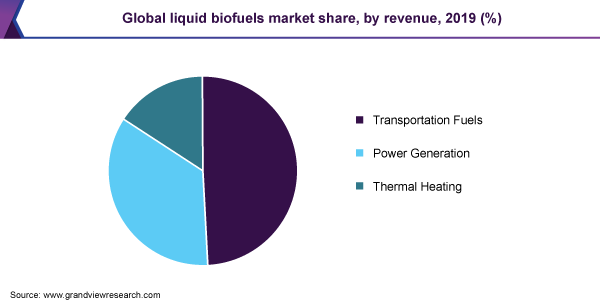
- By application, transportation fuels share was valued at over USD 31790.5 million till 2019.
Market Size & Forecast
- 2019 Market Size: USD 65.4 Billion
- 2027 Projected Market Size: USD 107.5 Billion
- CAGR (2020-2027): 6.4%
- North America: Largest market in 2019
Biofuels are expected to observe a growth in demand on account of their potential to reduce or eliminate dependency on fossil fuels. These are cleaner energy alternatives, which result in zero carbon dioxide emissions on combustion and make use of the plant-based raw materials for their production.Diminishing fossil fuel-based resources and rising awareness regarding environment protection are factors likely to drive the market. Furthermore, the presence of various regulatory policies and tax incentives across the world is anticipated to compel biofuel manufacturers to invest more in R&D activities to achieve commercialization of the latest second- and third-generation technologies.
Diminishing fossil fuel-based resources and rising awareness regarding environment protection are factors likely to drive the market. Furthermore, the presence of various regulatory policies and tax incentives across the world is anticipated to compel biofuel manufacturers to invest more in R&D activities to achieve commercialization of the latest second- and third-generation technologies.
Liquid biofuel is an energy-efficient alternative and helps reduce energy security risks and pollution levels associated with the combustion of fossil fuels. Hence it can be blended in large quantities with traditional fossil fuels for use in applications such as transportation. Although biodiesel has the ability to replace conventional fuel, its production capacity is not enough to meet the current demand. Thus, the market is highly regulated with various tax incentives in different countries.
Governments across the world have introduced numerous policies and strategies to mitigate the concerns associated with climate change. Energy security, rural development, and climate change mitigation are some of the crucial parameters responsible for such policy goals.
The demand for fatty acids bio jet fuel, hydro processed esters, and renewable diesel, also known as hydrotreated vegetable oil (HVO), is expected to ascend over the forecast period. This growth in demand can be attributed to their potential properties of being used unblended without maintenance regimes, modification to engines in transportation, and fuel supply infrastructure.
Emerging economies such as Brazil, China, India, and some of the European countries aim to replace 5% to 20% of the total fossil-based fuels with biodiesel in applications such as transportation. However, there is substantial potential for facilities with low economies of scale by producing biodiesel at a smaller size, with more significant potential to benefit small-scale farmers in the raw material stage and contribute to rural development.
Product Insights
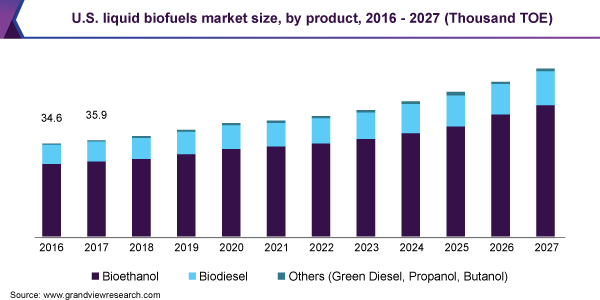
Biofuel demand has increased over the last few years owing to rising focus towards energy security and the application of flex-fuel vehicles. Bioethanol demand in North America was 32,562.7 thousand TOE in 2019 and is estimated to expand at a CAGR of 5.9% from 2020 to 2027.
The North America liquid biofuels market is rapidly growing for bioethanol & biodiesel. Significant factors influencing the growth include favorable regulatory and political support, innovation support (for second and third generation biofuels), environmental support, customer support, geopolitical support, and agricultural and economic support.
Major factors fueling the regional market growth include high demand for green fuels, stringent environmental regulations, and high investment for the development of biofuel refineries. Factors, such as technological advancement and rising awareness regarding biofuel being a clean fuel are anticipated to further drive regional growth. In the U.S., 49 states have implemented ASTM D6751 as state law and now been mandated to enforce the ASTM D6751 biodiesel standard.
In Asia Pacific, the demand for bioethanol was 6,258.1 thousand TOE in 2019 and is expected to reach 10,681.7 thousand TOE by 2027. The Asia Pacific market for bioethanol is estimated to expand at a CAGR of 6.9% over the forecast period.
Polish bioethanol consumption witnessed a rise in 2018 as mandates gradually escalated slightly, and a limited share had been fulfilled through the use of biodiesels. During the same year in the Netherlands, biofuel consumption grew because of increased taxes and higher mandates on diesel cars. In Sweden, bioethanol consumption has been dropping, prominently owing to the dip in E85 sales as government energy taxes for flex-fuel cars paved hurdle for the biofuel application.
Application Insights
Transportation biofuel consumption is needed to triple by 2030 and has to be on the trail with the Sustainable Development Scenario (SDS). This compares the 10% of global transportation fuel demand, to be compared with the current level which is around 3.5%.
Stronger policy support and invention that will reduce costs are required to balance up with both the adoption of biofuels and advanced biofuel consumption in the various transportation sectors, as foreseen in the sustainable development scenario. As sustainable biofuels have a place in the sustainable development scenario, more prevalent sustainability governance must be paired to provide higher biofuel output.
Transportation fuel demand in the Asia Pacific was 4,080.4 thousand TOE in 2019 and is expected to reach 7,026.3 thousand TOE by 2027. The Asia Pacific market for transportation is estimated to expand at a CAGR of 7% over the forecast period.
India and Brazil are estimated to witness a rise in liquid biofuel production as both countries have recorded the highest production levels across their region. This factor is anticipated to accelerate the market further which is yet to achieve sustainable development scenario volume for 2030. In terms of bioethanol production, Brazil recorded the highest production levels across Central and South America. Brazil has also announced its plans to scale up and mandate the usage of biodiesel from 10% to 15%.
Regional Insights
North America has dominated the global market over the past few years, owing to the abundance of feedstock and arable area for biofuel production. U.S., Brazil, the European Union, and China are anticipated to be some of the major regions driving the demand for liquid biofuels. However, other economies such as Thailand, Indonesia, Canada, Australia, and Philippines are anticipated to create significant opportunities for the biofuel industry. Concerning the long-term global impact of biofuel potential, growth of the bioethanol and biodiesel markets is primarily based on the availability of agricultural land for non-food production.
The Canadian Clean Fuels Standard (CFS) has anticipated to apply various norms for gaseous, liquid, and solid fuels combusted for energy production coupled with the transportation sector. The Canadian government has been focusing on the achievement of annual reductions by 30 Mt in Greenhouse Gas (GHG) emissions by 2030, contributing to the country’s effort to achieve an overall GHG emission reduction of 30% by 2030.
Central and South America market have been propelled owing to rising government initiatives and increasing focus on energy security and independence. Furthermore, the high dependence on fossil fuels is compelling the distinct governments in the region to look for alternatives. Moreover, bio-fuels provide an excellent solution to the crisis of depleting fossil fuels in countries such as Brazil, Venezuela and others.
Key Companies & Market Share Insights
Top market players have adopted sustainable sourcing strategies in view of the long-term benefits and current regulatory scenario. Companies are focusing on delivering long-term value to shareholders to grow and sustain in the market. The key players are building a robust and low-risk strategy that has been anticipated to provide a strong foundation for the shareholders. For instance, in August 2018 Archer Daniels Midland Company (ADM) launched a new oilseeds facility in Egypt in collaboration Cargill Inc. to gain a prominent presence in the Middle East and Europe markets.
The companies have started expanding their business through various mergers and acquisitions in order to cater to this rise in demand. For instance, ADM; Green Plains; Valero Energy Corporation; Pacific Ethanol Inc.; Butamax; and Renewable Energy Group, Inc. (REG) have acquired various regional companies across the globe to gain and maintain market dominance. Some of the prominent players in the liquid biofuels market include:
-
Archer Daniels Midland Company
-
Gevo
-
Green Plains
-
Wilmar International
-
Algenol
-
Pacific Ethanol Inc.
-
Valero Energy Corp.
-
Petrobras; Butamax
-
Renewable Energy Corp.
-
Bunge North America Inc.
Liquid Biofuels Market Report Scope
Report Attribute
Details
Market size value in 2020
USD 70.75 billion
Revenue forecast in 2027
USD 107.50 billion
Growth Rate
CAGR of 6.4% from 2020 to 2027
Base year for estimation
2019
Historical data
2016 – 2018
Forecast period
2020 – 2027
Quantitative units
Revenue in USD million/billion and CAGR from 2020 to 2027
Report coverage
Revenue forecast, company ranking, competitive landscape, growth factors, and trends
Segments covered
Product, application, and region
Regional scope
North America; Europe; Asia Pacific; MEA; and Central & South America
Country scope
U.S.; Canada; Mexico; U.K.; Germany; France; China; India; Thailand; Indonesia; Saudi Arabia; Brazil
Key companies profiled
Archer Daniels Midland Company; Gevo; Green Plains; Wilmar International; Algenol; Pacific Ethanol Inc.; Valero Energy Corp.; Petrobras; Butamax; Renewable Energy Corp.; and Bunge North America Inc
Customization scope
Free report customization (equivalent up to 8 analysts working days) with purchase. Addition or alteration to country, regional & segment scope.
Pricing and purchase options
Avail customized purchase options to meet your exact research needs. Explore purchase options
Segments Covered in the ReportThis report forecasts volume and revenue growth at global, regional, and country levels and provides an analysis of the latest industry trends in each of the sub-segments from 2016 to 2027. For the purpose of this report, Grand View Research has segmented the global liquid biofuels market report on the basis product, application, and region:
-
Product Outlook (Volume, Thousand TOE; Revenue, USD Million, 2016 - 2027)
-
Biodiesel
-
Bioethanol
-
Others
-
-
Application Outlook (Volume, Thousand TOE; Revenue, USD Million, 2016 - 2027)
-
Transportation Fuel
-
Power Generation
-
Thermal Heating
-
-
Regional Outlook (Volume, Thousand TOE; Revenue, USD Million, 2016 - 2027)
-
North America
-
U.S.
-
Canada
-
Mexico
-
-
Europe
-
U.K.
-
Germany
-
France
-
-
Asia Pacific
-
India
-
China
-
Thailand
-
Indonesia
-
-
Middle East and Africa
-
Saudi Arabia
-
-
Central and South America
-
Brazil
-
-
Frequently Asked Questions About This Report
The liquid biofuels market size was estimated at USD 65.43 billion in 2019 and is expected to reach USD 70.75 billion in 2020.
The liquid biofuels market is expected to witness a compound annual growth rate of 6.4% from 2020 to 2027 to reach USD 107.52 billion by 2027.
Bioethanol captured a market share of nearly 73.0% in 2019 due rising adoption for propulsion and easy availability.
Some key players operating in the liquid biofuels market Green Plains, ADM, Petrobras, Pacific Ethanol Inc., Gevo, Wilmar International Ltd.
Key factors that are driving the market growth include government support through programmes, policies and low GHG emissions.
About the Author(s)
Power Generation & Storage Research Team
Energy & Power · Power Generation & StorageThis report was authored by the power generation & storage research team at Grand View Research - comprising two research analysts, one senior research analyst, and one industry expert - with specialized expertise in the power generation & storage segment of the energy & power industry. All findings are based on proprietary energy & power databases, executive interviews, and regulatory analysis, subject to internal peer review prior to publication.
Last Updated:
Speak to Analyst


Customize this report to your needs — add regions, segments, or data points, with 20% free customization.
Or view our licence options:


ISO 9001:2015 & 27001:2022 Certified
We are GDPR and CCPA compliant! Your transaction & personal information is safe and secure. For more details, please read our privacy policy.


