
- Home
- »
- Advanced Interior Materials
- »
-
Liquid Cooling Systems Market Size Report, 2026-2033GVR Report cover

Liquid Cooling Systems Market (2026 - 2033)
Size, Share & Trends Analysis Report By Type (Liquid Heat Exchanger Systems, Water Cooled Chillers, Immersion Cooling, Direct-to-Chip Liquid Cooling), By Capacity, By End Use, By Region, And Segment Forecasts
Market Size, 2025
$13.4BMarket Estimate, 2026
$14.4BMarket Forecast, 2033
$28.8BCAGR, 2026–2033
10.4%Liquid Cooling Systems Market Summary
The global liquid cooling systems market size was valued at USD 13.4 billion in 2025 and is projected to grow from USD 14.4 billion in 2026 to USD 28.8 billion by 2033, at a CAGR of 10.4% from 2026 to 2033. Asia Pacific dominated the market with the largest revenue share of 37.9% in the global market in 2025. The market is expected to grow significantly as demand for high-performance computing, data centers, electric vehicles, and advanced electronics continues to rise.
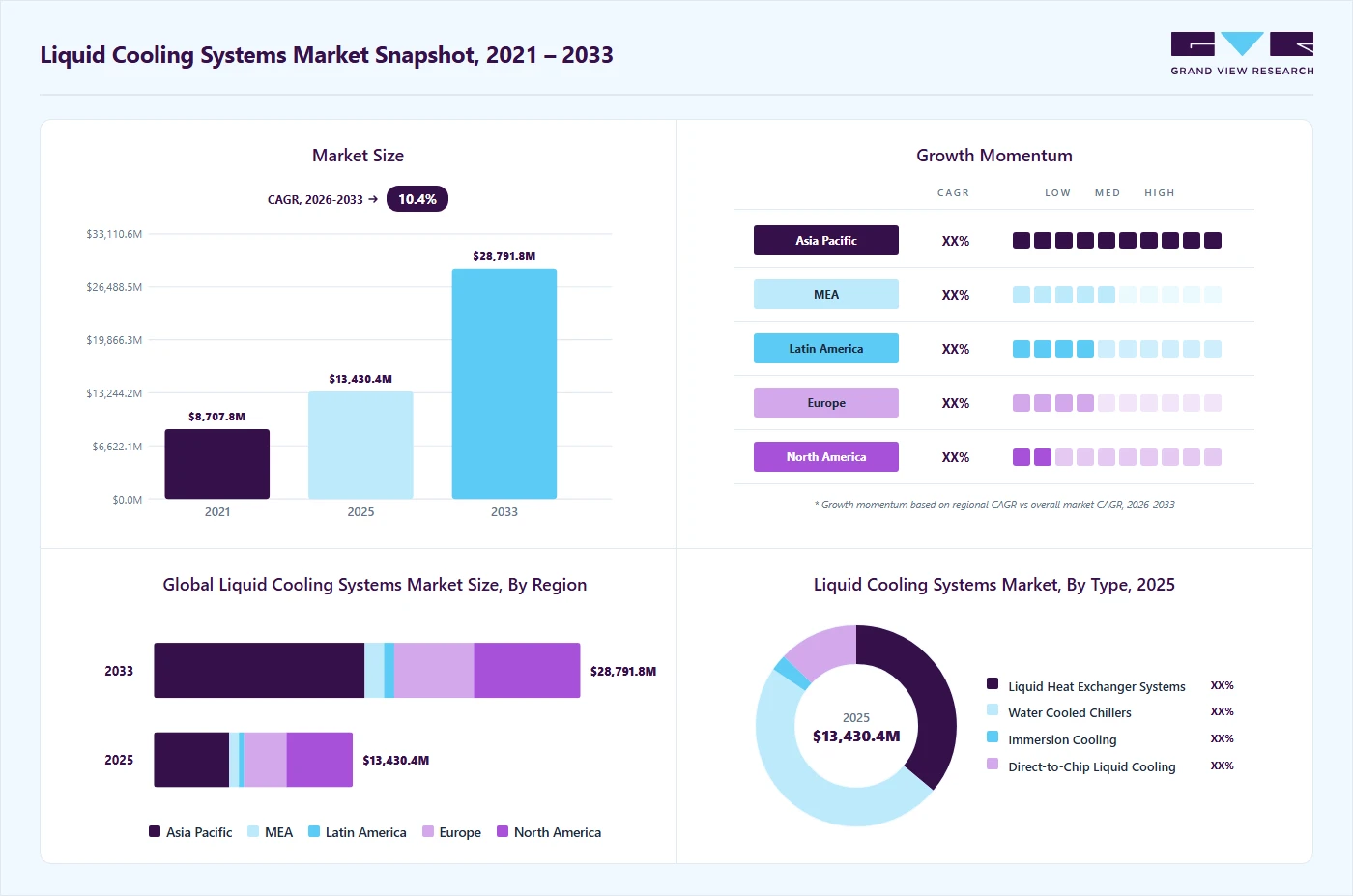 Source: Grand View Research, IR Documents, Primary Interviews, Paid DatabasesTo learn more about this report,
 Download Free Sample Report
 Key Market Trends & Insights
- By type: The water-cooled chillers segment held the largest market share of 48.4% in 2025.
- By capacity: The above 1 MW segment held the largest market share of 31.5% in 2025.
- By end use: The data centers segment held the largest market share of 34.2% in 2025.
Regional Highlights
- Largest regional market: Asia Pacific (37.9% revenue share, 2025)
- Fastest-growing regional market: Asia Pacific (highest CAGR, 2026-2033)
- By country: The U.S. held the largest market share in 2025.
Market Size & Forecast
- Market size in 2025: USD 13.4 Billion
- Estimated market size in 2026: USD 14.4 Billion
- Projected market size by 2033: USD 28.8 Billion
- CAGR (2026-2033): 10.4%
Three ways to get this report
Buy it, customize it, or ask a question.Ask an Analyst
Analyst response in 1 business day
- AccessReport author, directly
- Reply timeWithin 1 working day
- No sales callDirect answer only
- FormatEmail reply
- CostFree, no cost
Get the Full Report
What the study covers
- FormatsPDF · Excel · Dashboard
- Timeline2026–2033 annual, 2025 base
- Coverage20+ countries, 5 regions
- Companies10+ key players profiled
Customize the Report
20% free customization
- IncludeCountries, segments, points
- TailorTo your product definition
- ExtendDeeper competitor detail
- OrA fully bespoke study
- Turnaround5–10 working days
Increasing heat generation from AI workloads, cloud computing, and edge infrastructure is pushing companies to adopt more efficient cooling solutions than traditional air systems. Liquid cooling systems offer higher thermal efficiency, reduced energy consumption, and better space optimization, making it attractive for hyperscale data centers and industrial applications.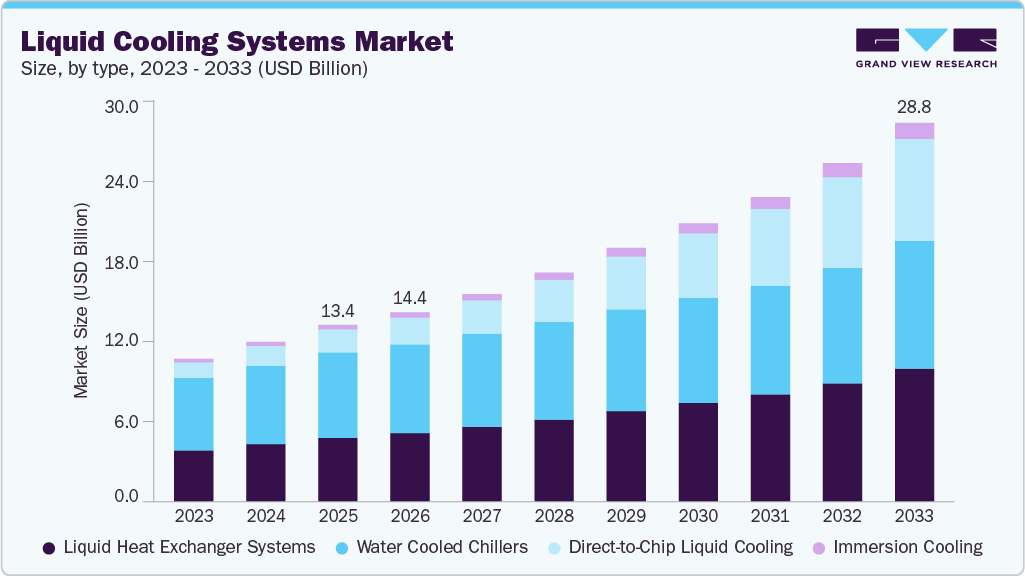 To learn more about this report, Download Free Sample Report
 Sustainability goals and stricter energy regulations are also encouraging adoption, as organizations aim to lower carbon footprints and operational costs. In addition, technological advancements such as immersion cooling and cold plate solutions are expanding use across sectors, while government investments in digital infrastructure and semiconductor manufacturing further support long-term market expansion.
Market Concentration & Characteristics
The liquid cooling systems industry is moderately fragmented, with a mix of established global companies and emerging specialized players competing across different technologies and applications. Large firms offer comprehensive cooling infrastructure for data centers and industrial systems, while smaller innovators focus on niche solutions such as immersion cooling and cold plates. Continuous technological advancements, regional manufacturers, and growing demand across sectors encourage new entrants, creating competitive pricing, diverse product portfolios, and ongoing partnerships and collaborations.
Innovation in the liquid cooling systems industry is accelerating as companies develop advanced technologies to manage rising heat loads from AI, HPC, and dense electronics. New solutions such as immersion cooling, cold plate designs, and hybrid cooling architectures improve thermal efficiency and energy savings. Smart monitoring, AI-driven temperature control, and modular systems are also gaining traction. Continuous R&D investments and collaborations with chipmakers and data center operators are driving rapid product evolution and differentiation.
 To learn more about this report, Download Free Sample Report
 Established players are acquiring niche startups specializing in immersion cooling, thermal management software, or advanced materials to accelerate innovation. Strategic partnerships and joint ventures are also common, helping companies enter new geographic markets and customer segments. These activities aim to build integrated solutions, enhance product portfolios, and address growing global demand.
Regulations focused on energy efficiency, carbon emissions, and sustainable data center operations are significantly influencing the liquid cooling systems industry. Governments and industry bodies are setting stricter environmental standards, encouraging the adoption of energy-efficient cooling technologies over traditional air systems. Compliance requirements for thermal management, safety, and refrigerant usage also shape product design and innovation. In addition, policies supporting green infrastructure and digital transformation are accelerating investments in advanced cooling solutions across regions.
Drivers, Opportunities & Restraints
The rapid growth of high-performance computing, artificial intelligence, and hyperscale data centers, which generate significant heat loads, is driving the market. Traditional air cooling struggles to efficiently manage dense server environments, underscoring the need for advanced thermal solutions. Liquid cooling offers superior heat dissipation, improved energy efficiency, and lower operational costs, encouraging adoption among technology companies seeking reliable performance, sustainability, and long-term infrastructure scalability.
Expansion of edge computing, electric vehicles, and next-generation semiconductor manufacturing, all requiring efficient heat management solutions, is creating significant opportunity in the market. As industries digitize and deploy compact, high-power electronics, demand for innovative cooling technologies continues to rise. Emerging markets investing in digital infrastructure and smart manufacturing also create new avenues for growth. Companies that develop modular, cost-effective, and sustainable liquid cooling systems can tap into diverse applications beyond traditional data centers.
One of the key challenges is the high initial investment and complexity associated with installing liquid cooling infrastructure compared to traditional air cooling systems. Many organizations hesitate due to concerns about system integration, maintenance requirements, and potential leakage risks. Limited technical expertise and a lack of standardized designs can also slow adoption. In addition, compatibility issues with existing data center layouts and equipment create operational hurdles, prompting some businesses to be cautious about transitioning to advanced liquid-cooling technologies.
Type Insights
The water-cooled chillers segment led the market with the largest revenue share of 48.4% in 2025, as large data centers, industrial facilities, and commercial buildings seek efficient thermal management for high-density equipment. These systems offer reliable cooling capacity, energy efficiency, and scalability for continuous operations. Increasing investments in hyperscale data centers and smart manufacturing are driving adoption. In addition, sustainability goals and rising electricity costs are encouraging organizations to deploy water-cooled chillers to reduce energy consumption and maintain optimal performance.
The direct-to-chip liquid cooling segment is projected to grow at the fastest CAGR during the forecast period, due to increasing demand from AI servers, high-performance computing, and advanced processors that generate intense heat. This technology delivers targeted cooling directly to components, improving thermal efficiency and enabling higher processing power within compact server designs. As chip densities continue to rise and energy efficiency becomes critical, data center operators and technology firms are adopting direct-to-chip solutions to enhance performance and reduce operational costs.
Capacity Insights
The above 1 MW segment led the market with the largest revenue share of 31.5% in 2025, as hyper-scale data centers, AI training facilities, and large industrial operations demand high-capacity cooling solutions for dense computing environments. Rising deployment of high-performance servers and advanced processors increases thermal loads, making large-scale liquid cooling essential. Companies are investing in scalable infrastructure to handle massive workloads efficiently, while sustainability targets and energy-optimization goals further drive the adoption of high-capacity liquid-cooling systems.
The below 100 kW capacity segment is projected to grow at the fastest CAGR during the forecast period, due to increasing adoption in small data centers, edge computing sites, telecom infrastructure, and compact industrial applications. As organizations deploy localized computing and IoT devices, demand for efficient, space-saving cooling solutions rises. Liquid cooling systems in this range offer flexibility, reduced noise, and improved energy efficiency. Growing digitalization among small and medium enterprises also supports the expansion of this lower-capacity segment.
End Use Insights
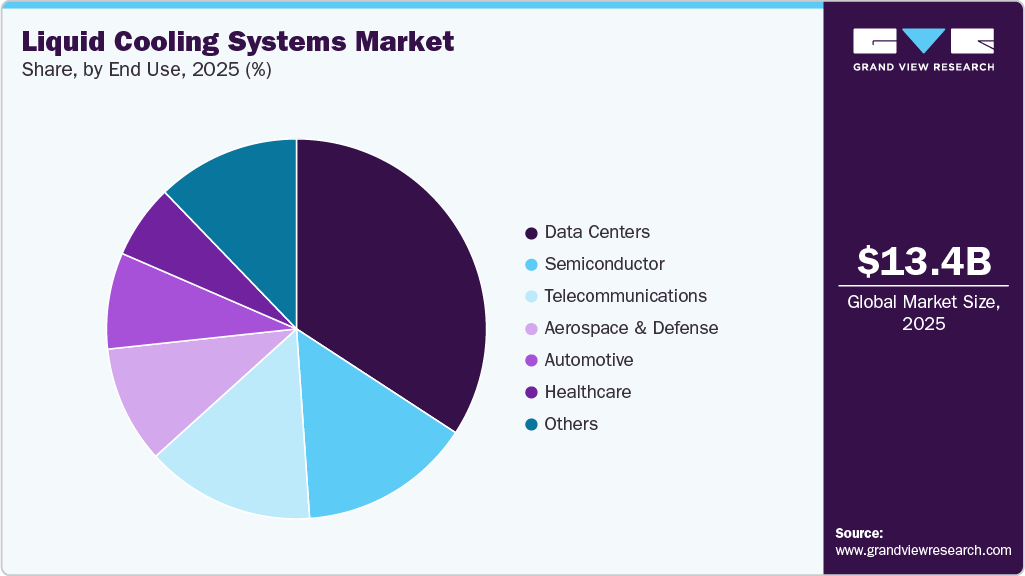
The data centers segment led the market with the largest revenue share of 34.2% in 2025, as AI workloads, cloud computing, and hyperscale infrastructure expand rapidly. Increasing server density and rising heat generation are driving operators to adopt efficient liquid-cooling solutions to improve thermal management and reduce energy consumption. Sustainability targets and the need to lower operational costs also support adoption. Advanced cooling technologies help data centers improve performance, enable high-density deployments, and maintain reliable operations.
 To learn more about this report, Download Free Sample Report
 The telecommunications segment is projected to grow at the fastest CAGR during the forecast period, with the expansion of 5G networks, edge computing, and high-capacity telecom infrastructure. Increased data traffic and compact network equipment generate higher heat levels, encouraging the adoption of efficient liquid cooling solutions. Telecom operators are investing in energy-efficient systems to enhance performance, maintain uptime, and reduce operational expenses. The shift toward decentralized network architecture and digital connectivity is further driving demand for advanced cooling technologies.
Regional Insights
Asia Pacific Liquid Cooling Systems Trends
Asia Pacific dominated the global liquid cooling systems market with the largest revenue share of 37.9% in 2025 and is expected to grow at the fastest CAGR during the forecast period,due to rapid digitalization, expanding data center construction, and strong electronics manufacturing industries. Countries across the region are investing heavily in AI, cloud computing, and 5G networks, increasing demand for efficient thermal management systems. Rising urbanization and smart infrastructure projects also support market growth. In addition, government initiatives promoting technological advancement and energy efficiency, along with the presence of major semiconductor manufacturers, continue to drive widespread adoption of liquid cooling technologies.
 To learn more about this report, Download Free Sample Report
 The liquid cooling systems market in China is expanding rapidly, driven by large-scale investments in hyperscale data centers, artificial intelligence, and advanced semiconductor manufacturing. The country’s strong electronics production and digital economy growth are increasing demand for efficient cooling solutions. Government policies supporting green technology and energy-efficient infrastructure further encourage adoption. Many China-based companies are also developing innovative immersion and direct-to-chip cooling solutions, while expanding cloud services and high-performance computing deployments continue to drive strong market momentum.
The India liquid-cooling systems market is emerging as the fastest-growing due to rising data center investments, increasing internet penetration, and rapid digital transformation across industries. Government initiatives supporting digital infrastructure and domestic semiconductor manufacturing are boosting demand for efficient cooling systems. The expansion of cloud computing, fintech platforms, and telecom networks is driving the deployment of high-density servers that require advanced thermal management. In addition, the focus on energy-efficient technologies and sustainable operations is encouraging organizations to adopt liquid cooling solutions in modern facilities.
The liquid cooling systems market in North America is experiencing strong, due to the rapid expansion of hyperscale data centers, artificial intelligence infrastructure, and high-performance computing. Major cloud providers and technology companies are investing heavily in advanced thermal management to support dense server environments. Increasing sustainability goals and stringent energy-efficiency standards are driving the adoption of liquid-cooling solutions. In addition, innovation from leading hardware manufacturers and supportive investments in digital infrastructure continue to strengthen regional market expansion.
U.S. Liquid Cooling Systems Market Trends
The liquid cooling systems market in the U.S. accounted for the largest market revenue share in North America in 2025, as tech giants and colocation providers deploy advanced data centers requiring efficient cooling technologies. Rising demand for AI, machine learning, and semiconductor manufacturing drives the adoption of direct-to-chip and immersion cooling systems. Government incentives for domestic chip production and green data center operations also support growth. Continuous innovation from U.S.-based startups and established technology firms enhances product development, while increasing focus on reducing operational costs and improving energy efficiency accelerates market penetration.
The Mexico liquid cooling systems market is growing steadily with rising investments in data centers, manufacturing, and telecommunications infrastructure. The country’s expanding role as a nearshoring hub is driving deployment of advanced computing systems that require efficient thermal management. Growth in cloud adoption and digital transformation initiatives further increases demand for cooling solutions. In addition, government support for industrial modernization and smart manufacturing is driving the adoption of energy-efficient technologies, while regional partnerships with North American tech firms are enhancing market development.
Europe Liquid Cooling Systems Trends
Europe liquid cooling systems market is expanding due to strict environmental regulations, increasing focus on sustainable data center operations, and growing adoption of high-performance computing. Governments across the region are promoting energy-efficient technologies to meet climate targets, encouraging companies to transition away from traditional air conditioning. Investments in digital transformation, smart cities, and advanced manufacturing also support growth. Collaboration among technology providers, research institutions, and cloud service companies is accelerating innovation and enabling broader adoption of liquid-cooling solutions.
The liquid cooling systems market in Germany is witnessing steady growth, driven by its strong industrial base, advanced manufacturing sector, and expanding data center infrastructure. Industry 4.0 initiatives and automation technologies are driving demand for efficient cooling solutions to manage the heat generated by high-performance equipment. Strict energy-efficiency regulations and sustainability commitments encourage the adoption of liquid-cooling technologies. In addition, Germany’s focus on research and development, along with increasing investments in semiconductor manufacturing and industrial digitalization, supports ongoing market expansion.
The UK liquid cooling systems market is growing with the expansion of cloud computing, fintech infrastructure, and edge data centers supporting digital services. Rising electricity costs and sustainability targets are pushing organizations to adopt energy-efficient cooling technologies. Investments in AI research and high-performance computing facilities are also contributing to increased adoption. Government initiatives promoting green data centers and carbon reduction further encourage innovation, while partnerships between telecom providers and technology firms help drive the deployment of advanced cooling solutions.
Middle East & Africa Liquid Cooling Systems Trends
The liquid cooling systems market in the Middle East and Africa region is growing at a significant CAGR of 9.5% during the forecast period, as governments invest in smart cities, digital infrastructure, and advanced telecommunications networks. Rising demand for data storage and cloud services is driving the construction of modern data centers that require efficient cooling solutions. Harsh climatic conditions also make liquid cooling attractive for maintaining system reliability and performance. Increasing investments in industrial automation, renewable energy projects, and technology hubs are further supporting the adoption of advanced thermal management systems.
The Saudi Arabia liquid cooling systems market is expected to grow significantly due to rising investments in hyperscale data centers, cloud computing, and advanced telecommunications infrastructure. Increasing demand for AI processing and high-density computing is driving the need for efficient thermal management solutions. The country’s hot climate also encourages the adoption of liquid cooling technologies to maintain system performance, improve energy efficiency, and support reliable operations across expanding digital and industrial sectors
Latin America Liquid Cooling Systems Trends
The liquid cooling systems market in Latin America is expanding gradually, driven by increasing data center investments, the digitalization of businesses, and the growth of e-commerce platforms. Countries across the region are upgrading telecom networks and adopting cloud computing services, driving demand for efficient cooling solutions. Energy efficiency concerns and rising operational costs are encouraging organizations to explore advanced thermal management technologies. Regional governments promoting technological innovation and smart infrastructure are also supporting the gradual adoption of liquid-cooling systems.
The Brazil liquid-cooling systems market is a key contributor to regional growth, driven by expanding cloud infrastructure, fintech services, and growing internet usage. Investments in hyperscale and colocation data centers are increasing demand for efficient cooling technologies capable of managing high-density computing environments. Rising electricity costs and sustainability concerns are driving the adoption of energy-efficient liquid-cooling solutions. In addition, government initiatives supporting digital transformation and industrial modernization, along with partnerships between local operators and global technology providers, continue to boost market expansion.
Key Liquid Cooling Systems Company Insights
Some of the key players operating in the market include MITSUBISHI HEAVY INDUSTRIES, LTD., Submer, among others.
-
Stulz is a global provider of precision cooling solutions specializing in mission-critical environments such as data centers, telecommunications facilities, and industrial applications. The company offers advanced air and liquid cooling systems designed to improve thermal efficiency and operational reliability. With a strong focus on innovation, Stulz develops energy-efficient technologies that support high-density computing and sustainable infrastructure. Its global presence, customized engineering capabilities, and service network enable it to deliver tailored cooling solutions for diverse customer requirements.
-
Schneider Electric provides integrated liquid cooling solutions as part of its broader data center infrastructure and energy management portfolio. The company focuses on efficient thermal management technologies that support AI workloads, high-performance computing, and hyperscale facilities. Its liquid-cooling offerings emphasize sustainability, energy efficiency, and scalable system design. Through digital monitoring tools and smart automation platforms, Schneider Electric helps organizations improve operational efficiency, reduce power consumption, and enhance performance while meeting evolving environmental and regulatory standards.
Key Liquid Cooling Systems Companies:
The following key companies have been profiled for this study on the liquid cooling systems market.
- Stulz
- Schneider Electric liquid
- Submer
- DCX
- Boyd
- MITSUBISHI HEAVY INDUSTRIES, LTD
- Chilldyne
- ALFA LAVAL
- FläktGroup
- LiquidStack Holding B.V.
- ZutaCore, Inc.
- Lytron Inc.
- LiquidCool Solutions, Inc.
- Rittal GmbH & Co. KG
- Asperitas
Recent Developments
-
In January 2026, Schneider Electric launched the MCDU-70, a 2.5MW liquid cooling unit designed for high-density data centers handling AI and advanced computing workloads. The solution delivers scalable and reliable thermal management to support increasing server power demands while improving energy efficiency. Its modular design enables flexible deployment and easier integration into modern infrastructure, helping operators maintain performance, reduce downtime risks, and support sustainable data center operations.
-
In July 2025, STULZ GmbH expanded its manufacturing capabilities by launching a new production facility in Hamburg dedicated to advanced liquid cooling solutions for data centers. The facility focuses on developing high-efficiency thermal management systems to support growing demand from high-density computing and AI-driven infrastructure.
Liquid Cooling Systems Market Report Scope
Report Attribute
Details
Market size in 2025
USD 13.4 billion
Estimated Market size in 2026
USD 14.4 billion
Projected Market size by 2033
USD 28.8 billion
Growth rate
CAGR of 10.4% from 2026 to 2033
Base year for estimation
2025
Historical data
2021 - 2024
Forecast period
2026 - 2033
Quantitative units
Revenue in USD million/billion, and CAGR from 2026 to 2033
Report coverage
Revenue forecast, company market position analysis, competitive landscape, growth factors, and trends
Segments covered
Type, capacity, end use, region
Regional scope
North America; Europe; Asia Pacific; Latin America; and Middle East & Africa
Country Scope
U.S.; Canada; Mexico; Germany; UK; Italy; Spain; France; China; Japan; India; Australia; South Korea; Brazil; Argentina; Saudi Arabia; UAE; South Africa
Key companies profiled
Stulz; Schneider Electric Liquid; Submer; DCX; Boyd; Mitsubishi Heavy Industries Ltd.; Chilldyne; Alfa Laval; FläktGroup; LiquidStack Holding B.V.; ZutaCore Inc.; Lytron Inc.; LiquidCool Solutions Inc.; Rittal GmbH & Co. KG; Asperitas.
Customization scope
Free report customization (equivalent up to 8 analysts working days) with purchase. Addition or alteration to country, regional & segment scope.
Pricing and purchase options
Avail customized purchase options to meet your exact research needs. Explore purchase options
Global Liquid Cooling Systems Market Report Segmentation
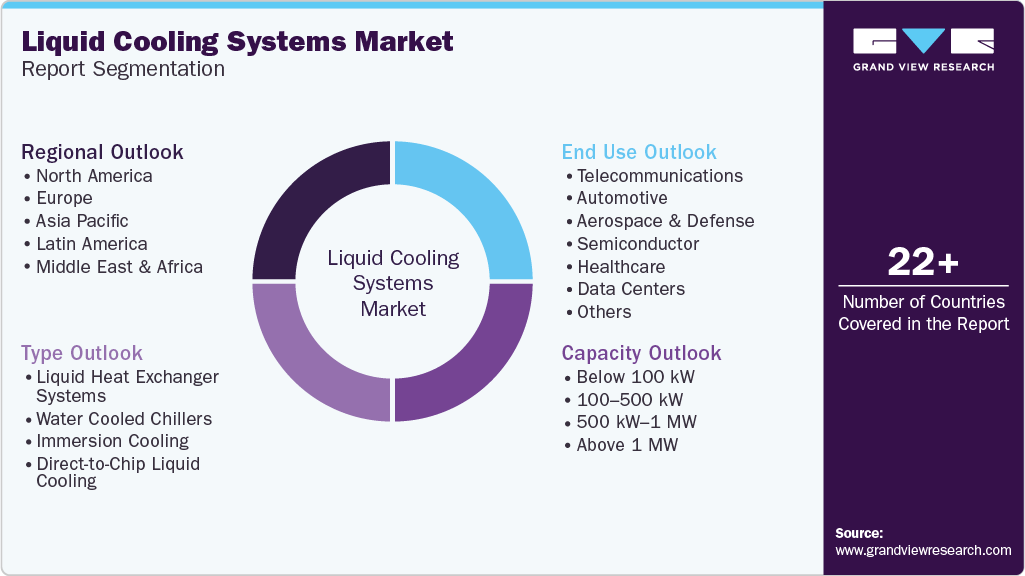
This report forecasts revenue growth at global, regional & country levels and provides an analysis on the industry trends in each of the sub-segments from 2021 to 2033. For this study, Grand View Research has segmented the global liquid cooling systems market report based on the type, capacity, end use, and region:
 To learn more about this report, Download Free Sample Report
 -
Type Outlook (Revenue, USD Million, 2021 - 2033)
-
Liquid Heat Exchanger Systems
-
Water Cooled Chillers
-
Immersion Cooling
-
Direct-to-Chip Liquid Cooling
-
-
Capacity Outlook (Revenue, USD Million, 2021 - 2033)
-
Below 100 kW
-
100-500 kW
-
500 kW-1 MW
-
Above 1 MW
-
-
End Use Outlook (Revenue, USD Million, 2021 - 2033)
-
Telecommunications
-
Automotive
-
Aerospace & Defense
-
Semiconductor
-
Healthcare
-
Data Centers
-
Others
-
-
Regional Outlook (Revenue, USD Million, 2021 - 2033)
-
North America
-
U.S.
-
Canada
-
Mexico
-
-
Europe
-
Germany
-
France
-
UK
-
Spain
-
Italy
-
-
Asia Pacific
-
China
-
India
-
Japan
-
South Korea
-
Australia
-
-
Latin America
-
Brazil
-
Argentina
-
-
Middle East & Africa
-
Saudi Arabia
-
UAE
-
South Africa
-
-
Frequently Asked Questions About This Report
Asia Pacific is the fastest-growing region over the forecast period.
The water-cooled chillers segment held the market with the largest revenue share of 48.4% in 2025, while direct-to-chip liquid cooling is the fastest-growing segment.
The above 1 MW segment held the market with the largest revenue share of 31.5% in 2025, while below 100 kW capacity is the fastest-growing segment.
The data centers segment held the market with the largest revenue share of 34.2% in 2025, while telecommunications is the fastest-growing segment.
The global liquid cooling systems market size was valued at USD 13.4 billion in 2025 and is expected to reach USD 14.4 billion in 2026.
The global liquid cooling systems market is expected to grow at a CAGR of 10.4% from 2026 to 2033, reaching USD 28.8 billion by 2033.
Asia Pacific dominated with a revenue share of 37.9% in 2025.
Some of the key players operating in the liquid cooling systems include Stulz, Schneider Electric Liquid, Submer, DCX, Boyd, Mitsubishi Heavy Industries Ltd., Chilldyne, Alfa Laval, FläktGroup, LiquidStack Holding B.V., ZutaCore Inc., Lytron Inc., LiquidCool Solutions Inc., Rittal GmbH & Co. KG, Asperitas.
Key factors driving the liquid cooling systems market include the rapid growth of AI, cloud computing, and high-performance computing, which generate intense heat and require efficient thermal management. Rising data center density and energy consumption are pushing operators toward more efficient cooling technologies. Increasing sustainability goals and stricter energy regulations also encourage adoption.
About the Author(s)
Advanced Interior Materials Research Team
Advanced Materials · Advanced Interior MaterialsThis report was authored by the advanced interior materials research team at Grand View Research - comprising two research analysts, one senior research analyst, and one industry expert - with specialized expertise in the advanced interior materials segment of the advanced materials industry. All findings are based on proprietary advanced materials databases, executive interviews, and regulatory analysis, subject to internal peer review prior to publication.
Last Updated:
Speak to Analyst

Customize this report to your needs - add regions, segments, or data points, with 20% free customization.
Or view our licence options:


ISO 9001:2015 & 27001:2022 Certified
We are GDPR and CCPA compliant! Your transaction & personal information is safe and secure. For more details, please read our privacy policy.


