
- Home
- »
- Medical Devices
- »
-
Liquid Oxygen Devices Market Size Report, 2026-2033GVR Report cover
![Liquid Oxygen Devices Market (2026 - 2033)Report]()
Liquid Oxygen Devices Market (2026 - 2033)
Size, Share & Trends Analysis Report By End Use (Hospitals, Outpatient Facilities, Homecare), By Region (North America, Europe, Asia Pacific, Latin America, Middle East & Africa), And Segment Forecasts
Market Size, 2025
$1.8BMarket Estimate, 2026
$1.9BMarket Forecast, 2033
$2.9BCAGR, 2026–2033
5.8%Liquid Oxygen Devices Market Summary
The global liquid oxygen devices market size was valued at USD 1.8 billion in 2025 and is projected to grow from USD 1.9 billion in 2026 to USD 2.9 billion by 2033, growing at a CAGR of 5.8% from 2026 to 2033. North America dominated the market, accounting for a revenue share of 44.0% in 2025. Liquid oxygen is a crucial medical resource used for various medical applications, especially in respiratory care and critical care settings.
Key Market Trends & Insights
- By end use: The homecare segment dominated the market, with a revenue share of about 46.0% in 2025.
Regional Highlights
- Largest regional market: North America (44.0% revenue share, 2025)
- Fastest-growing regional market: Asia Pacific (highest CAGR, 2026-2033)
Market Size & Forecast
- Market size in 2025: USD 1.8 Billion
- Estimated market size in 2026: USD 1.9 Billion
- Projected market size by 2033: USD 2.9 Billion
- CAGR (2026-2033): 5.8%
The rising prevalence of respiratory disorders such as chronic obstructive pulmonary disease (COPD), pneumonia, asthma, and acute respiratory distress syndrome (ARDS) leads to a consistent need for oxygen therapy and support, thereby driving the market.

Liquid oxygen is a crucial medical resource used for various medical applications, especially in respiratory care and critical care settings. The rising prevalence of respiratory disorders such as chronic obstructive pulmonary disease (COPD), pneumonia, asthma, and acute respiratory distress syndrome (ARDS) leads to a consistent need for oxygen therapy and support, thereby driving the market.
Technological advancements have led to the development of more efficient and user-friendly oxygen concentrators. One of the key advancements is making liquid oxygen concentrators more portable and lightweight. Also, newer models are designed to be easily carried by patients, allowing them to maintain an active lifestyle while receiving oxygen therapy. In addition, advancements in molecular sieve technology, which is used to extract oxygen from the air, have led to more efficient and effective oxygen concentration. This allows patients to receive higher levels of oxygen while still using compact devices. Furthermore, the development of compact and lightweight liquid oxygen concentrators allows patients to carry their oxygen therapy devices with them wherever they go. This level of portability is especially important for maintaining patient mobility and independence. This is expected to drive the market over the forecast period.
The outbreak of the COVID-19 pandemic accelerated the demand for liquid oxygen, thereby impelling the market growth. As hospitals faced capacity challenges, there was a growing preference for treating less severe cases at home to minimize the risk of exposure. This drove the demand for liquid oxygen therapy devices that could be used safely and effectively outside of healthcare facilities. Moreover, various initiatives undertaken to boost the production of liquid oxygen positively impacted the market. For instance, in August 2021, the Delhi Government notified and approved the Medical Oxygen Production Promotion Policy of Delhi, 2021 to ensure there is no shortage of medical oxygen in the wake of Covid 19. This policy aimed to ensure time-bound fulfillment of the targets such as setting up liquid oxygen (LOX) manufacturing facilities, non-captive & captive oxygen generation plants, and others, thereby boosting the market.
Market Dynamics
The market is expected to experience significant growth over the forecast period, owing to factors such as the prevalence of chronic respiratory diseases, the growing number of patients with ongoing Long-Term Oxygen Therapy (LTOT), facility expansions initiated by multiple care providers, and increasing use in specialized drug production processes. The rising demand for portable and at-home oxygen services and the development of innovative oxygen concentrators also contribute to the growth. The advanced home healthcare expansion and telemedicine integrations present lucrative opportunities for this market. However, stringent regulatory frameworks and severe safety hazards may hinder the pace of growth. Key players have been focusing on the inclusion of technology features in a variety of products, such as integrated Bluetooth, IoT sensors, and telehealth modules.
The growing prevalence of chronic respiratory diseases and increasing demand for home healthcare service devices primarily contribute to the growth experienced by this market. Some of the patients with ongoing treatments for respiratory diseases and related co-morbidities rely on the continuous access to oxygen therapy. In addition, other chronic conditions such as COPD and Asthma also require support from liquid oxygen devices during treatments.
Patients are relying on the use of oxygen therapy for managing their everyday health needs and maintaining a good quality of life, hence boosting the demand for highly efficient and long-lasting liquid oxygen devices. Doctors also recommend the use of oxygen therapy at home, as it is less expensive and much more feasible than prolonged stays in the hospital. Hospitals have started to provide outpatient respiratory care facilities, which has led to the widespread use of portable liquid oxygen devices. Technology innovations like the storage of compact devices and an improvement in oxygen delivery efficiency are helping to grow demand in both developed and emerging economies. For instance, in June 2025, Inogen launched the Voxi 5 stationary oxygen concentrator, expanding access to affordable long-term oxygen therapy and strengthening homecare oxygen delivery systems for chronic respiratory patients.
The high cost of storage, transportation, and maintenance of cryogenic devices is also becoming an impediment to the liquid oxygen devices market. Storing and transporting liquid oxygen require highly insulated vacuum tanks and cold-chain maintenance, making distribution and storage capital-intensive. As a result, hospital and home-care facilities, especially in price-sensitive areas, face significant difficulties in using oxygen devices. Even smaller hospitals and developing countries find it more challenging to set up adequate storage and refilling facilities, which limits the spread of oxygen devices that use liquid oxygen compared to concentrators. However, the costs and complexities are impacting the pace of market development, even with rising demand in both developed and developing countries for respiratory devices; these restrictions still remain a hurdle, especially in developing regions, which have inadequate medical gas supply infrastructure.
The increasing trend toward home respiratory care provides ample opportunities for growth of the liquid oxygen devices market. Patients are increasingly opting for portable, user-friendly oxygen devices, which allow them to take care of respiratory disorders in the comfort of their homes rather than make frequent hospital visits. This is stimulating the demand for smaller and more robust, less maintenance-intensive storage and oxygen concentrator units.
The development of improved oxygen device designs that are smaller, lighter, and more user-friendly by incorporating cooling systems that operate more efficiently and longer battery life is further aiding in the wider acceptance of these devices in hospitals, outpatient clinics, and in-home settings. Growing instances of patients suffering from conditions like COPD and asthma will also stimulate manufacturers to develop user-friendly, highly comfortable devices for chronic usage. Increased demand for portable, easy-to-use devices that aid the patient's quality of life and enhance their ability to live life with independence is expected to drive the growth of companies developing such products in the future. In January 2026, VARON introduced the VP-8 Lite Portable Oxygen Concentrator, an innovative, ultra-lightweight system designed with intelligent pulse flow, a 7.5-hour battery life, and whisper-quiet operation to facilitate oxygen therapy during an active lifestyle and while traveling.
Analyst Perspective
The liquid oxygen devices industry is witnessing stable growth driven by increasing incidence of respiratory disease, growing elderly population and increasing inclination toward home healthcare. The penetration of liquid oxygen devices is restricted in developing markets owing to high infrastructure and storage costs. However, the industry offers lucrative opportunities to manufacturers who are concentrating on the development of portable and energy-efficient liquid oxygen devices. Investment in compact oxygen concentrator technology and an increase in healthcare availability are expected to influence the future growth of the industry.
End-use Insights
Based on end-use, the homecare segment accounted for the largest revenue share in 2025. There has been a growing trend toward providing healthcare services at home, driven by patient preference, cost-effectiveness, and advancements in medical technology. Liquid oxygen devices enable patients to receive oxygen therapy in the comfort of their homes, reducing the need for frequent hospital visits. Liquid oxygen devices, especially portable models, allow patients to move around more freely while still receiving their prescribed oxygen therapy. This increased mobility enhances patients' ability to engage in daily activities and maintain a more active lifestyle. Also, the pandemic emphasized the importance of home-based care to reduce the risk of exposure in healthcare settings. This accelerated the adoption of homecare solutions, including liquid oxygen devices, for patients requiring oxygen therapy.
The outpatient facilities segment is expected to grow at the fastest CAGR over the forecast period. Liquid oxygen devices play a crucial role in delivering oxygen therapy to patients with conditions such as COPD, asthma, and interstitial lung diseases. Integrating liquid oxygen devices into outpatient settings allows for a seamless transition of care for patients who require ongoing oxygen therapy. This continuum of care supports patients' needs from acute care to recovery and long-term management. Also, patients can receive oxygen therapy in outpatient facilities without the need for hospitalization. This convenience is especially beneficial for individuals who do not require intensive inpatient care but still need oxygen support. Furthermore, outpatient facilities equipped with liquid oxygen devices can help prevent unnecessary hospital admissions for patients who only need oxygen therapy. This reduces the burden on hospitals and ensures that beds are available for more critical cases.
Regional Insights
North America accounted for the largest market share of more than 44.0% in 2025 and is anticipated to grow at the fastest CAGR over the forecast period. The key factors responsible for this are the presence of an aging population, the increasing prevalence of respiratory conditions, and advancements in medical technology. Technological innovation has driven the development of more efficient, portable, and user-friendly liquid oxygen concentrators. These advancements have contributed to higher adoption rates and increased patient satisfaction.

Many patients in North America prefer home-based care over hospital stays. Liquid oxygen devices have gained popularity as they enable patients to receive oxygen therapy in the comfort of their homes, supporting the trend of home-based healthcare. In addition, well-established regulatory frameworks for medical devices, ensuring safety and quality standards, foster trust among patients and healthcare providers in adopting liquid oxygen devices, thereby driving the market.
Asia Pacific Liquid Oxygen Devices Market
The liquid oxygen devices market in Asia Pacific is expected to witness significant growth over the forecast period. The region is home to a range of manufacturers and suppliers of medical devices, which contribute to market competition and potentially drive innovation. This factor is expected to fuel the regional industry's growth. According to the review article "Respiratory Diseases in India and the Roles of Government and Public Health Authorities for Its Control," published in the Indian Journal of Respiratory Care in January 2026, India is facing a severe respiratory health crisis. The country accounts for an estimated 34.3 million cases of Asthma and COPD combined.
Key Liquid Oxygen Devices Companies Insights
Competition among companies is expected to be intense in the global liquid oxygen devices market, primarily due to the presence of numerous players. In response to changing consumer trends, several companies are expanding their product portfolios to gain a competitive advantage.
Key Liquid Oxygen Devices Companies
The following key companies have been profiled for this study on the liquid oxygen devices market
-
CAIRE
-
CRYOFAB
-
Philips
-
Airliquide
-
Inogen
Recent Developments
-
In February 2026, a commercial-stage digital health organization, Profusa, entered in know-how agreement with Mayo Clinic. The collaboration aimed at advancing the clinical use of continuous oxygen monitoring technologies.
-
In February 2026, Unitai, an international, hosted partnership among Brazil, Chile, France, Norway, and the the UK within the WHO and a global nonprofit, PATH, launched a four-year initiative, Innovations for Enhanced Access to Oxygen (INNOVATE)
-
In September 2025, The Sapio Group, Groupe Bastide acquired UK respiratory care market participant Baywater Healthcare from the French group Bastide. This is expected to add significant strength to its portfolio.
Liquid Oxygen Devices Market Report Scope
Report Attribute
Details
Market size in 2025
USD 1.8 billion
Estimated market size in 2026
USD 1.9 billion
Projected market size by 2033
USD 2.9 billion
Growth rate
CAGR of 5.8% from 2026 to 2033
Base year for estimation
2025
Historical data
2021 - 2024
Forecast period
2026 - 2033
Quantitative units
Revenue in USD billion, and CAGR from 2026 to 2033
Report coverage
Revenue forecast, company ranking, competitive landscape, growth factors, and trends
Segments covered
End use, region
Regional scope
North America; Europe; Asia Pacific; Central & South America; Middle East & Africa
Country scope
U.S.; Canada; Germany; UK; France; Italy; Spain; Sweden; Denmark; Norway; Japan; India; China; Australia; South Korea; Thailand; Brazil; Mexico; Argentina; South Africa; Saudi Arabia; UAE; Kuwait
Key companies profiled
CAIRE; CRYOFAB; Philips; Airliquide; Inogen
Customization scope
Free report customization (equivalent up to 8 analysts working days) with purchase. Addition or alteration to country, regional & segment scope.
Pricing and purchase options
Avail of customized purchase options to meet your exact research needs. Explore purchase options
Liquid Oxygen Devices Market Report Segmentation
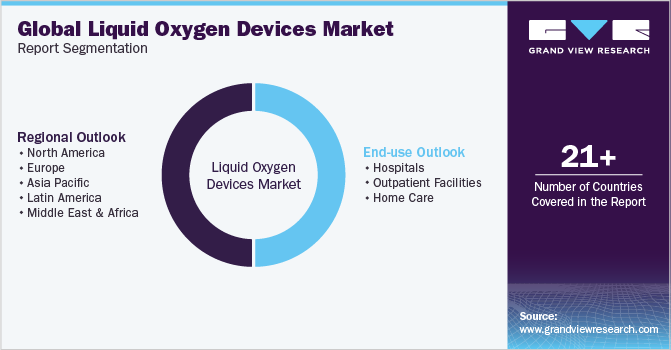
This report forecasts revenue growth at global, regional, and country levels and provides an analysis of the latest trends in each of the sub-segments from 2021 to 2033. For this study, Grand View Research, Inc. has segmented the global liquid oxygen devices market report based on end-use and region:
-
End-use Outlook (Revenue, USD Billion, 2021 - 2033)
-
Hospitals
-
Outpatient Facilities
-
Home Care
-
-
Regional Outlook (Revenue, USD Billion, 2021 - 2033)
-
North America
-
U.S.
-
Canada
-
-
Europe
-
Germany
-
U.K.
-
Italy
-
Spain
-
France
-
Sweden
-
Denmark
-
Norway
-
-
Asia Pacific
-
China
-
India
-
Japan
-
Thailand
-
South Korea
-
Australia
-
-
Latin America
-
Brazil
-
Mexico
-
Argentina
-
-
MEA
-
South Africa
-
Saudi Arabia
-
UAE
-
Kuwait
-
-
Frequently Asked Questions About This Report
Key players include CAIRE; CRYOFAB; Philips; Airliquide; Inogen
North America dominated with a 44.0% revenue share in 2025.
Homecare dominated the liquid oxygen devices market with a share of about 46.0% in 2025.
The global liquid oxygen devices market size was valued at USD 1.8 billion in 2025 and is estimated at USD 1.9 billion for 2026.
The global liquid oxygen devices market is expected to grow at a CAGR of 5.8% from 2026 to 2033, reaching USD 2.9 billion.
About the Author(s)
Medical Devices Research Team
Healthcare · Medical DevicesThis report was authored by the medical devices research team at Grand View Research - comprising two research analysts, one senior research analyst, and one industry expert - with specialized expertise in the medical devices segment of the healthcare industry. All findings are based on proprietary healthcare databases, executive interviews, and regulatory analysis, subject to internal peer review prior to publication.
Last Updated:
Speak to Analyst


Customize this report to your needs — add regions, segments, or data points, with 20% free customization.
Or view our licence options:


ISO 9001:2015 & 27001:2022 Certified
We are GDPR and CCPA compliant! Your transaction & personal information is safe and secure. For more details, please read our privacy policy.


