
- Home
- »
- Consumer F&B
- »
-
Low Sugar Fruit Snacks Market Size Report, 2026-2033GVR Report cover

Low Sugar Fruit Snacks Market (2026 - 2033)
Size, Share & Trends Analysis Report By Product (Fruit Bars, Fruit Roll-ups), By Distribution Channel (Hypermarkets & Supermarkets, Online), By Region, And Segment Forecasts
Market Size, 2025
$3.1BMarket Estimate, 2026
$3.4BMarket Forecast, 2033
$6.0BCAGR, 2026–2033
8.6%Low Sugar Fruit Snacks Market Summary
The global low sugar fruit snacks market size was valued at USD 3.1 billion in 2025 and is projected to grow from USD 3.4 billion in 2026 to USD 6.0 billion by 2033, at a CAGR of 8.6% from 2026 to 2033. The market in North America dominated with a revenue share of 32.6% in 2025. Rising global awareness regarding the impact of excess sugar consumption on health, coupled with government policies aimed at reducing sugar intake in people’s diets, have positively influenced the growth of the low sugar fruit snacks industry.
 Source: Grand View Research, IR Documents, Primary Interviews, Paid DatabasesTo learn more about this report,
 Download Free Sample Report
 Key Market Trends & Insights
- By product: Fruit bars segment held the largest market share of 37.3% in 2025.
- By distribution channel: Supermarkets/hypermarkets segment held the largest market share of 35.4% in 2025.
Regional Highlights
- Largest regional market: North America (32.6% revenue share, 2025)
- Fastest-growing regional market: Asia Pacific (highest CAGR, 2026-2033)
- By country: The U.S. held the largest market share in 2025
Market Size & Forecast
- Market size in 2025: USD 3.1 Billion
- Estimated market size in 2026: USD 3.4 Billion
- Projected market size by 2033: USD 6.0 Billion
- CAGR (2026-2033): 8.6%
Three ways to get this report
Buy it, customize it, or ask a question.Ask an Analyst
Analyst response in 1 business day
- AccessReport author, directly
- Reply timeWithin 1 working day
- No sales callDirect answer only
- FormatEmail reply
- CostFree, no cost
Get the Full Report
What the study covers
- FormatsPDF · Excel · Dashboard
- Timeline2026–2033 annual, 2025 base
- Coverage20+ countries, 5 regions
- Companies10+ key players profiled
Customize the Report
20% free customization
- IncludeCountries, segments, points
- TailorTo your product definition
- ExtendDeeper competitor detail
- OrA fully bespoke study
- Turnaround5–10 working days
Consumers, on their part, are increasingly looking for products that contain simple and nutritional ingredients, avoiding products with artificial additives or preservatives. Low sugar fruit snacks are generally perceived as more natural and healthier options because they tend to have fewer added ingredients and use natural sweeteners or whole fruits, appealing to consumers who prioritize clean labels.
 To learn more about this report, Download Free Sample Report
 The increasing prevalence of lifestyle disorders such as obesity, hypertension, and diabetes among the global population has highlighted the need to lower the consumption of unhealthy processed food items. According to the World Health Organization (WHO), in 2022, around 13% of the global population was living with obesity, with adult obesity rates having increased by more than two times since 1990. Furthermore, adolescent obesity rates have quadrupled during this period, with sugary beverages and processed snacks considered to be major contributors to this sharp growth. As a result, governments and health organizations are increasingly initiating public health campaigns to educate adolescents and their families about the dangers of excessive sugar consumption and its link to obesity. These campaigns often focus on promoting healthy eating habits, increasing physical activity, and reducing sugary beverage intake.
The increasingly busy lifestyles of consumers due to urbanization and industrialization have led them to seek convenient snacking options that are both healthy and easy to consume. Low sugar fruit snacks offer a healthy and viable snacking solution that can fit into the hectic routines of consumers. Brands are increasingly developing new and innovative formats for low sugar fruit snacks, such as fruit chips, dried fruit with no added sugar, fruit-based gummies, and fruit bars. These innovations cater to diverse consumer preferences and make low sugar fruit snacks more appealing to a broader audience. Furthermore, to appeal to a wide range of taste preferences, manufacturers are offering various flavors and textures of low sugar fruit snacks, from sweet and tangy fruit chips to chewy fruit bars. These innovations have helped expand the consumer base and substantially increased the demand for low sugar fruit snacks.
Products that are portable, require minimal to no preparation efforts and can be consumed on the go are in high demand among busy professionals, students, and working parents. Companies are additionally focusing on the packaging aspect to appeal to prospective buyers and ensure strong product sales. For instance, in January 2023, Wallaroo Foods, a UK-based producer of organic tropical fruit snacks, announced its partnership with Sappi to develop sustainable packaging using the latter’s Guard Gloss 4-OHG high-barrier paper. This collaboration aims to meet Wallaroo's commitment to sustainability by providing recyclable, paper-based packaging that avoids the use of synthetic materials.
Market Dynamics
Low-sugar fruit snacks are witnessing increasing consumer adoption as demand grows for healthier snacking alternatives that offer nutritional value without excessive sugar content. These products, including fruit bars, dried fruit snacks, fruit bites, and fruit-based gummies, provide convenient on-the-go options while addressing consumer preferences for clean-label ingredients, natural formulations, and balanced nutrition. The rising focus on healthy eating habits, coupled with growing awareness of sugar reduction and preventive wellness, is expected to support continued growth in the low-sugar fruit snacks market.
Growing awareness regarding the adverse health effects associated with excessive sugar consumption is a key factor driving demand for low-sugar fruit snacks. Consumers are increasingly seeking healthier snack alternatives that support weight management, blood sugar control, and overall wellness without compromising on taste and convenience. The increasing prevalence of obesity, diabetes, and other lifestyle-related disorders has accelerated the shift toward products with reduced sugar content and improved nutritional profiles. As a result, low-sugar fruit snacks are gaining traction among health-conscious consumers as a better-for-you snacking option.
In April 2026, That's it. introduced its Fiber Mini Fruit Bars Variety Pack in the U.S. market, featuring fruit-based snacks formulated with no added sugar and enhanced fiber content. The launch underscores the growing industry focus on developing nutritionally balanced snack options that align with consumer preferences for sugar reduction, digestive wellness, and clean-label ingredients. Such product innovations highlight manufacturers' efforts to capitalize on the increasing demand for preventive health-oriented snacking solutions.
One of the key restraints affecting the growth of the low-sugar fruit snacks market is the higher production cost and technical complexity involved in developing products with reduced sugar content while maintaining taste, texture, and shelf stability. Sugar performs multiple functional roles in fruit snacks, including sweetness enhancement, moisture retention, preservation, and texture development. Reducing or eliminating sugar often requires manufacturers to incorporate alternative sweeteners, fibers, or specialized ingredients, which can increase formulation costs and extend product development timelines. As a result, low-sugar fruit snacks are frequently positioned at a premium price point, limiting adoption among price-sensitive consumers and constraining market penetration in developing economies. Additionally, manufacturers face challenges in delivering the same sensory experience as conventional fruit snacks, which can affect repeat purchases and consumer acceptance.
The largest opportunity in the market lies in combining sugar reduction with functional health benefits. Consumers are increasingly seeking snacks that not only contain less sugar but also support digestive health, satiety, immunity, and overall wellness. This creates demand for fruit snacks fortified with fiber, probiotics, prebiotics, and other functional ingredients. As preventive healthcare becomes a key purchasing consideration, manufacturers that position low-sugar fruit snacks as functional nutrition products are likely to gain a competitive advantage.
In May 2026, Welch's Fruit Snacks introduced Probiotic Yogofruits and reformulated Absolute Fruitfuls Fruit Strips with added fiber and no added sugar, targeting digestive health-conscious consumers.
Analyst Perspective
The low-sugar fruit snacks market is transitioning from a sugar-reduction category into a broader functional nutrition segment, where competitive differentiation will increasingly depend on delivering measurable health benefits rather than simply lowering sugar content. The next phase of value creation is likely to be captured by brands that successfully combine clean-label fruit ingredients with fiber, gut health, protein, or blood sugar management claims while maintaining taste parity with conventional snacks. As consumer scrutiny shifts from "no added sugar" to overall nutritional quality, companies capable of establishing credibility around both health outcomes and ingredient transparency will be best positioned to command premium pricing and secure long-term consumer loyalty.
Product Insights
Based on product, the fruit bars segment led the market with the largest revenue share of 37.3% in 2025 and is expected to grow at a CAGR of 8.1% from 2026 to 2033. Increasing sales of nutritional snack bars and growing health and wellness trends among modern consumers have enabled strong sales of these products. The high concentration of nutrients in fruit bars and growing availability of diverse flavors such as orange, mango, and strawberry further drive segment expansion. Buyers prefer fruit bars that are flavorful and offer suitable textures, which can be achieved by balancing various components, controlling the ultimate moisture level of the product, and following optimal manufacturing processes. Brands that focus on sustainability in their sourcing, packaging, and production practices are witnessing an increased demand. Low sugar fruit bars, particularly those made with organic or sustainably sourced ingredients, cater to this growing trend.
Meanwhile, the dried tropical fruit segment is anticipated to advance at the fastest CAGR during the forecast period. These products are free from molds, insects, blemishes, and damage without requiring any added preservatives or sugars. Tropical fruits offer a unique and exotic flavor profile that sets them apart from other dried fruits, such as apples or raisins. Fruits such as mango, pineapple, coconut, and dragon fruit are becoming highly popular for their distinctive tastes and vibrant colors. As demand for dried tropical fruit snacks expands, retailers are increasingly adding these products to their shelves. Dried tropical fruit snacks are becoming more widely available in a range of stores, from large grocery chains to health food stores and convenience stores.
Distribution Channel Insights
The online retailers’ segment is expected to witness the fastest CAGR from 2026 to 2033. The extensive presence of major retail chains such as Walmart, Target, and ASDA have enabled manufacturers of fruit snacks to ensure better visibility for their products while also offering a wider variety of options. The high customer traffic witnessed in such outlets creates a better opportunity for brands to promote the nutritional value of their offerings, which can drive potential sales. Supermarkets and hypermarkets extensively leverage pricing strategies, such as discounts, bundled offers, and loyalty programs, to encourage customers to purchase low-sugar fruit snacks. These promotions help increase sales and make healthier options more accessible to a broader range of consumers.
 To learn more about this report, Download Free Sample Report
 The online retailers’ segment is expected to witness the fastest CAGR from 2025 to 2033. Online platforms present a major opportunity for both emerging and well-known brands to boost awareness regarding their products among buyers and keep them updated about new launches. The shift towards health-conscious lifestyles among consumers, combined with the convenience offered by online shopping, has created promising growth opportunities for market players in this segment. The ease of product comparison, bulk buying options, availability of product variety, and the ability to access healthy snacks that meet specific dietary needs further aid the expansion of the low sugar fruit snacks industry.
Regional Insights
North America dominated the low sugar fruit snack market with the largest revenue share of 32.6% in 2025. The regional demand is driven by several factors, such as growing health consciousness, the rise of health and wellness trends, and a shift toward more nutritious snack options. Consumers in the U.S. and Canada have become increasingly aware of the negative health impacts of high sugar consumption, such as obesity, diabetes, and heart disease. For instance, in Canada, as per government data, around 3.7 million people, or around 9.4% of the population, were living with diagnosed diabetes in 2020-21. As a result, the rising demographic of diabetes-affected individuals is expected to offer a major growth avenue for manufacturers of low sugar fruit snacks, which are considered healthier snacking options.
 To learn more about this report, Download Free Sample Report
 U.S. Low Sugar Fruit Snacks Market Trends
The low sugar fruit snacks market in the U.S. held the largest share in the North America region in 2025, on account of a combination of factors, including health-focused consumer behavior, improving dietary trends, and an increasing preference for more natural and clean-label foods. Consumers are actively seeking healthier snack products that are low in sugar, high in nutrients, and made with natural ingredients. This shift is supported by innovations in product offerings, increased product availability across various retail channels, and the use of marketing strategies that emphasize health benefits. Products are being sold through both online and offline channels in the country, while the localized presence of several major global manufacturers further aids market expansion in the economy.
Europe Low Sugar Fruit Snacks Market Trends
Europe low sugar fruit snacks market accounted for a substantial revenue share in the global market for low sugar fruit snacks in 2024. Consumers in this region have become highly aware of the various health risks posed by consumption of food items with high sugar content as a result of continuous initiatives by health authorities and private health organizations. This has led to the increased sales of products such as fruit bars and fruit roll-ups that have minimal amounts of sugar in them. The emergence of regulations such as Breakfast Directives in the region and various nationalized strategies, such as the sugar tax in the UK, are expected to influence manufacturers of high-sugar food items to launch low-sugar alternatives in the coming years. As a result, the market is well-positioned to show promising expansion in regional economies.
Asia Pacific Low Sugar Fruit Snacks Market Trends
The Asia Pacific region is expected to witness the fastest CAGR during the forecast period in the low sugar fruit snacks market. Growing prevalence of lifestyle disorders such as diabetes and obesity have made consumers in regional economies such as India, China, and Japan highly aware of the drawbacks of consuming food items with high amounts of sugar. Low sugar fruit snacks are viewed as a healthier option for individuals seeking to prevent or manage such conditions, contributing to their rising popularity in the region. Furthermore, in several countries, snacking has become an integral part of the daily lifestyle, particularly with the evolution of work culture and the rising demand for flexible eating habits. Low sugar fruit snacks are considered a healthier alternative to traditional sugary options in this regard.
China low sugar fruit snacks market accounted for the largest revenue share in the Asia Pacific market for low sugar fruit snacks in 2024. The younger generations in the country, particularly the millennial and Generation Z demographics, are increasingly prioritizing health and wellness. These consumers are more likely to choose low sugar, nutritious snacks that align with their desire for a healthier lifestyle. The concept of functional foods has also gained significant traction in China, which is expected to positively shape market growth in the coming years. Low sugar fruit snacks are marketed as functional items that provide fiber, vitamins, antioxidants, and other nutrients that support overall health. The Chinese government is focusing on improving the nutritional quality of food products to address health issues such as obesity and diabetes among citizens. Policies to reduce sugar consumption and improve food labeling standards have indirectly contributed to the demand for low sugar products, including fruit snacks, in the economy.
Key Low Sugar Fruit Snacks Company Insights
Some major companies involved in the global low sugar fruit snacks industry include Welch’s, Chaucer Foods, and WALLAROO, among others.
-
Welch's Fruit Snacks is an American company that specializes in the manufacturing and sales of fruit-based products such as snacks, juices, and jellies & jams. Under the snacks section, the company is known for its Fruit Snacks, Fresh Fruit, Organic Juice Ice Bar, and Sparkling Soda products. The Welch's Fruit Snacks division has a wide range of offerings, including Welch’s Fruit Snacks, Welch’s Fruit ‘n Yogurt Snacks, Welch’s Juicefuls Juicy Fruit Snacks, Welch’s Absolute Fruitfuls Fruit Strips, and Welch’s Fruit Rolls, among others.
-
Chaucer Foods is a UK-based food company specializing in the manufacturing of baked ingredients and freeze-dried products. Its freeze-dried offerings include fruits, vegetables, cheese, powders, and freeze-dried melts. Under the baked products section, Chaucer Foods provides snacking items, platter companions, sprinkles and toppings, soup croutons, and salad companions.
Key Low Sugar Fruit Snacks Companies
The following key companies have been profiled for this study on the low sugar fruit snacks market.
-
Calbee Harvest Snaps
-
Tyson Foods, Inc.
-
Danone
-
Welch's
-
Kellanova
-
Del Monte Foods Corporation II Inc.
-
Chaucer Foods Ltd
-
Nestlé
-
WALLAROO
-
BEAR
Competitive Benchmarking
Operating Strategies
Competitive Edge
Weaknesses
Established Players (Tyson Foods, Inc., Danone, Welch's, Kellanova)
- Expand portfolios through portion-controlled fruit snacks, no-added-sugar formulations, and functional ingredient integration to address health-conscious consumer demand.
- Strengthen market presence through large-scale retail distribution, brand extensions, strategic acquisitions, and continuous product innovation.
- Benefit from strong brand recognition, extensive shelf presence, and established relationships across supermarkets, convenience stores, and online channels.
- Leverage scale advantages in sourcing, manufacturing, and marketing to accelerate product commercialization and category expansion.
- Large product portfolios can reduce responsiveness to emerging health trends and niche consumer preferences.
- Dependence on mass-market distribution may limit differentiation against premium and clean-label challenger brands.
Emerging Players (BEAR, WALLAROO, Chaucer Foods Ltd)
- Focus on clean-label ingredients, organic fruit-based products, low-sugar formulations, and premium snack positioning.
- Utilize direct-to-consumer channels, digital marketing, and targeted wellness-focused campaigns to build consumer awareness.
- Demonstrate greater agility in launching innovative products aligned with evolving nutritional and dietary preferences.
- Differentiate through transparent sourcing, minimal ingredients, and specialized health-oriented product offerings.
- Limited retail penetration and lower brand visibility can constrain large-scale market expansion.
- Smaller operational scale may impact production efficiency, procurement leverage, and pricing competitiveness.
Recent Developments
-
In July 2024, Welch’s Fruit Snacks announced the launch of Welch's Absolute Fruitfuls Fruit Strips, a product range that makes use of whole fruits and offers high nutritional value. The products launched in Strawberry, Berry Medley, and Mango-Peach varieties, have been designed as an on-the-go snacking option that are also suitable for school lunch and after-school activities. The new offerings are gluten-free, non-GMO, and vegan, and they are rich in Vitamin C. They have been launched across several major U.S. retailers, including Walmart, Albertsons, H-E-B, Publix, and Kroger, among others.
-
In March 2024, Calbee America introduced ‘Harvest Snaps Kids Freeze-Dried Fruit Snacks’ at the Natural Products Expo West event in California. Through this launch, the company entered into the development of kid-focused snacking products, presenting another major sales avenue. The single-serve snacks developed by Calbee utilize only whole-fruit ingredients and are available in four flavors - Grapes, Apples, Bananas, and Strawberries. The products are certified gluten-free, non-GMO, and are free of artificial colors, flavors, added sugar, and preservatives.
Low Sugar Fruit Snacks Market Report Scope
Report Attribute
Details
Market size in 2025
USD 3.1 billion
Estimated market size in 2026
USD 3.4 billion
Projected market size by 2033
USD 6.0 billion
Growth rate
CAGR of 8.6% from 2026 to 2033
Base year for estimation
2025
Historical data
2021 - 2024
Forecast period
2026 - 2033
Quantitative units
Revenue in USD million/billion and CAGR from 2026 to 2033
Report coverage
Revenue forecast, company ranking, competitive landscape, growth factors, and trends
Segments covered
Product, distribution channel, region
Regional scope
North America; Europe; Asia Pacific; Central & South America; MEA
Country scope
U.S.; Canada; Mexico; Germany; UK; France; Italy; Spain; China; Japan; India; Australia & New Zealand; Brazil; South Africa
Key companies profiled
Calbee Harvest Snaps; Tyson Foods, Inc.; Danone; Welch's; Kellanova; Del Monte Foods Corporation II Inc.; Chaucer Foods Ltd; Nestlé; WALLAROO; BEAR
Customization scope
Free report customization (equivalent up to 8 analysts' working days) with purchase. Addition or alteration to country, regional & segment scope.
Pricing and purchase options
Avail customized purchase options to meet your exact research needs. Explore purchase options
Global Low Sugar Fruit Snacks Market Report Segmentation
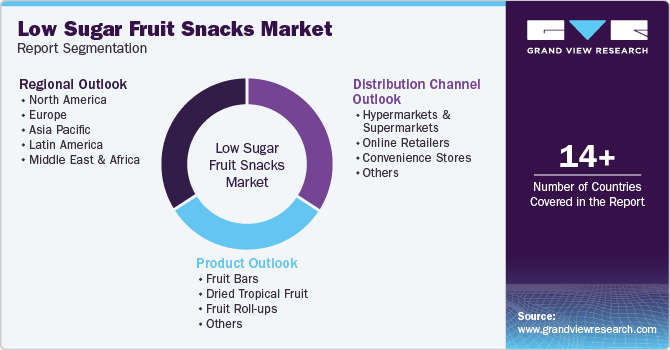
This report forecasts revenue growth at the global, regional, and country levels and provides an analysis of the latest industry trends in each of the sub-segments from 2021 to 2033. For this study, Grand View Research has segmented the global low sugar fruit snacks market report based on product, distribution channel, and region:
 To learn more about this report, Download Free Sample Report
 -
Product Outlook (Revenue, USD Million, 2021 - 2033)
-
Fruit Bars
-
Dried Tropical Fruit
-
Fruit Roll-ups
-
Others
-
-
Distribution Channel Outlook (Revenue, USD Million, 2021 - 2033)
-
Hypermarkets & Supermarkets
-
Online Retailers
-
Convenience Stores
-
Others
-
-
Regional Outlook (Revenue, USD Million, 2021 - 2033)
-
North America
-
U.S.
-
Canada
-
Mexico
-
-
Europe
-
Germany
-
U.K.
-
France
-
Spain
-
Italy
-
-
Asia Pacific
-
China
-
India
-
Japan
-
Australia & New Zealand
-
South Korea
-
-
Latin America
-
Brazil
-
-
MEA
-
South Africa
-
-
Research Methodology
The pre-workout supplements market figures in this report are based on a proven research process that combines executive interviews with secondary research from proprietary databases, company filings, and recognized regulatory and institutional sources. Market size is built through value-chain sizing-reconciling supply-side and demand-side estimates-and triangulated with bottom-up and top-down approaches. Every estimate passes multiple levels of expert validation before publication, with each cryptocurrency payment apps segment quantified using the revenue-capture definitions in the table below.
Segment Definition
Segment - Product
Revenue capture definition
Fruit Roll-Ups
This segment includes the sales of low-sugar fruit roll-ups manufactured from fruit purées, fruit concentrates, or whole fruit ingredients with reduced or no added sugar content. Revenue is generated through retail and online sales of portable, shelf-stable fruit snacks targeted toward children and health-conscious consumers seeking convenient alternatives to conventional sugary confectionery products.
Fruit Bars
This segment includes the sales of low-sugar fruit bars formulated using fruits, nuts, seeds, fibers, and other functional ingredients while maintaining reduced sugar levels. Revenue is generated through supermarkets, convenience stores, specialty health food retailers, and e-commerce channels, driven by consumer demand for nutritious on-the-go snacks that support healthy lifestyles and preventive wellness.
Dried Tropical Fruit
This segment includes the sales of low-sugar dried tropical fruit products such as mango, pineapple, papaya, coconut, banana, and other tropical fruit varieties processed with limited or no added sugars. Revenue is generated through packaged snack sales across retail and foodservice channels, supported by increasing consumer preference for natural, minimally processed, and clean-label fruit-based snacks.
Others
This segment includes the sales of other low-sugar fruit snack products such as fruit bites, fruit clusters, freeze-dried fruits, fruit gummies, fruit chips, and mixed fruit snack formats. Revenue is generated through both conventional and specialty distribution channels, supported by ongoing product innovation, flavor diversification, and the growing demand for healthier snacking alternatives with reduced sugar content.
Segment – Distribution Channel
Revenue capture definition
Supermarkets/Hypermarkets
This segment includes the sales of low-sugar fruit snacks through supermarkets and hypermarkets. Revenue is generated from a wide product selection, high consumer footfall, and growing demand for healthier snack options.
Convenience Stores
This segment includes the sales of low-sugar fruit snacks through convenience stores. Revenue is generated from on-the-go purchases and easy product accessibility.
Online Retailers
This segment includes the sales of low-sugar fruit snacks through e-commerce platforms and brand websites. Revenue is generated through direct-to-consumer sales, home delivery services, and expanding online shopping adoption.
Others
This segment includes the sales of low-sugar fruit snacks through specialty stores, pharmacies, warehouse clubs, and foodservice channels. Revenue is generated from consumers seeking premium, organic, and health-focused snack products.
Estimation Model
Layer Name
Key Question
Description
Consumer Base Layer
Who consumes packaged snacks?
Identify the global population consuming packaged snacks, with a focus on health-conscious consumers, families with children, fitness-oriented individuals, and consumers actively reducing sugar intake. This establishes the total potential consumer pool for healthier snacking alternatives.
Accessibility Layer
Who can access low-sugar fruit snacks?
Apply region-specific modern retail penetration, e-commerce accessibility, and distribution coverage across supermarkets, convenience stores, specialty retailers, and online channels to derive the addressable consumer base.
Adoption Layer
Who actively purchases low-sugar fruit snacks?
Apply healthy snack adoption rates, clean-label preferences, and sugar-reduction purchasing behavior to convert the addressable consumer base into active low-sugar fruit snack buyers across key markets.
Revenue Layer
How much revenue is generated?
Multiply active consumers by average annual spending on low-sugar fruit snacks and incorporate sales generated through retail, e-commerce, specialty stores, and foodservice channels to estimate total market revenue.
Delivered Customizations
This report has been delivered with the following In-depth customizations
Client Request
Customization Delivered
Value Adds
Functional Ingredient Positioning & Product Differentiation Assessment
Evaluated product innovation trends across fiber-enriched, probiotic, protein-fortified, and clean-label low-sugar fruit snacks, including competitive positioning strategies.
Helps stakeholders identify high-growth innovation areas, strengthen product differentiation, and capture emerging health-conscious consumer demand.
Strategic Partnerships, M&A Activity & Competitive Expansion Analysis
Assessed partnership activity, acquisitions, investment trends, and expansion strategies adopted by leading snack manufacturers and emerging brands.
Supports market entry, investment, and expansion decisions by identifying consolidation opportunities and competitive growth strategies.
Fruit Sourcing, Ingredient Cost Volatility & Supply Chain Resilience Assessment
Analyzed sourcing patterns, raw material cost fluctuations, supplier networks, and procurement risks across key fruit and functional ingredients.
Enables stakeholders to optimize sourcing strategies, mitigate supply chain risks, and improve long-term operational resilience.
Frequently Asked Questions About This Report
Asia Pacific is the fastest growing regional market over the forecast period.
The supermarkets/hypermarkets segment led with a 35.4% revenue share in 2025, while the online retailers segment is the fastest-growing channel.
The fruit bars segment led with a 37.3% revenue share in 2025, while the dried tropical fruit segment is the fastest-growing product.
Some key players operating in the low sugar fruit snacks market include Calbee, Inc., Tyson Foods, Inc., Danone S.A., Welch's, Kellogg NA Co., and PepsiCo.
The growing demand for healthy eating among consumers is anticipated to drive the low sugar fruit snacks market over the forecast period. Furthermore, rising health and wellness concerns, combined with busy lives, are expected to fuel these altering dietary preferences and amplify industry growth throughout the projected period.
The global low sugar fruit snacks market size was valued at USD 3.1 billion in 2025 and is estimated at USD 3.4 billion for 2026.
The global low sugar fruit snacks market is expected to grow at a CAGR of 8.6% from 2026 to 2033, reaching USD 6.0 billion by 2033.
North America dominated the low sugar fruit snacks market with a share of 32.6% in 2025. The increasing inclination of millennials towards low sugar convenience foods that have a high nutritional portfolio will drive the market growth in this region. The rise of the sector will be aided by advancements in technology, well-established cold chains, and distribution channels.
About the Author(s)
Consumer F&B Research Team
Consumer Goods · Consumer F&BThis report was authored by the consumer f&b research team at Grand View Research - comprising two research analysts, one senior research analyst, and one industry expert - with specialized expertise in the consumer f&b segment of the consumer goods industry. All findings are based on proprietary consumer goods databases, executive interviews, and regulatory analysis, subject to internal peer review prior to publication.
Last Updated:
Speak to Analyst

Customize this report to your needs - add regions, segments, or data points, with 20% free customization.
Or view our licence options:


ISO 9001:2015 & 27001:2022 Certified
We are GDPR and CCPA compliant! Your transaction & personal information is safe and secure. For more details, please read our privacy policy.


