
- Home
- »
- Power Distribution
- »
-
Low Voltage Molded Case Circuit Breaker Market Report 2033GVR Report cover

Low Voltage Molded Case Circuit Breaker Market (2026 - 2033)
Size, Share & Trends Analysis Report By Current Rating (Up to 415V, 416V–690V), By Voltage Rating, By Mounting Type (Fixed, Plug-in, Draw-out), By Application, By Region, And Segment Forecasts
Market Size, 2025
$1.2BMarket Estimate, 2026
$1.3BMarket Forecast, 2033
$2.2BCAGR, 2026–2033
6.9%Low Voltage MCCB Market Summary
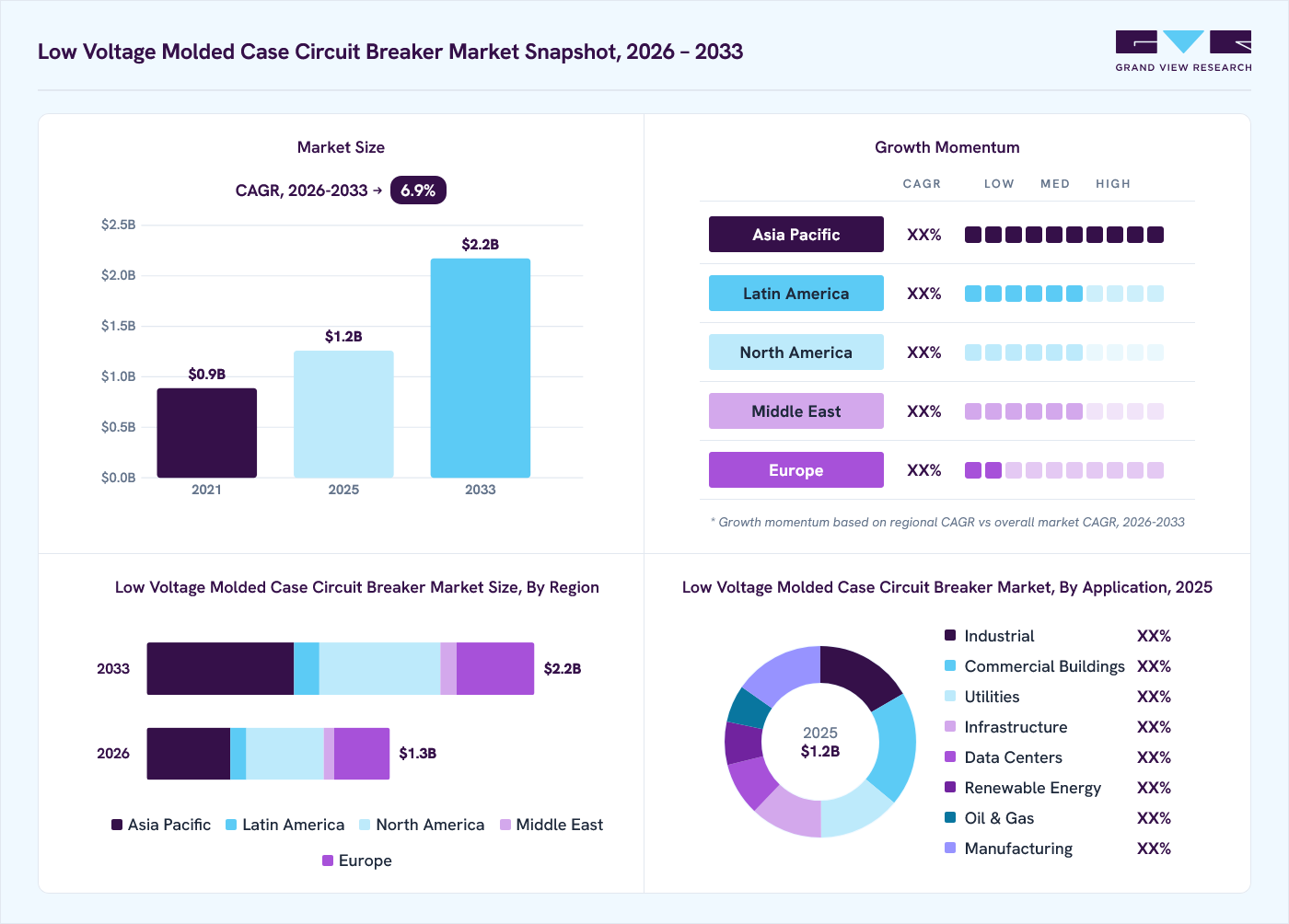
The global low voltage molded case circuit breaker market size was valued at USD 1.2 billion in 2025 and is projected to grow from USD 1.3 billion in 2026 to USD 2.2 billion by 2033, at a CAGR of 6.9% from 2026 to 2033. Asia Pacific dominated the market, accounting for a revenue share of 34.2% in 2025. The market is driven by increasing electrification, grid modernization, rising investments in industrial automation, expansion of data centers and commercial infrastructure, growing renewable energy installations, and the need for reliable electrical protection against overloads and short circuits.
 Source: Grand View Research, IR Documents, Primary Interviews, Paid DatabasesTo learn more about this report,
 Download Free Sample Report
Key Market Trends & Insights
- By current rating: 251A-630A held the largest revenue share of 32.4% in 2025.
- By voltage rating: Up to 415V held the largest revenue share of 61.4% in 2025.
- By mounting type: Fixed segment held the largest revenue share of 58.5% in 2025.
- By application: Commercial buildings dominated the market with a revenue share of 19.4% in 2025.
Regional Highlights
- Largest regional market: Asia Pacific (34.2% revenue share, 2025).
- By country: China held the largest market share in 2025.
Market Size & Forecast
- Market size in 2025: USD 1.2 Billion
- Estimated market size in 2026: USD 1.3 Billion
- Projected market size by 2033: USD 2.2 Billion
- CAGR (2026-2033): 6.9%
Prism AI by Grand View Research Free to tryAsk a question about the low voltage molded case circuit breaker marketTry asking✓Every figure cited from GVR research Prefer the report? Download free sample →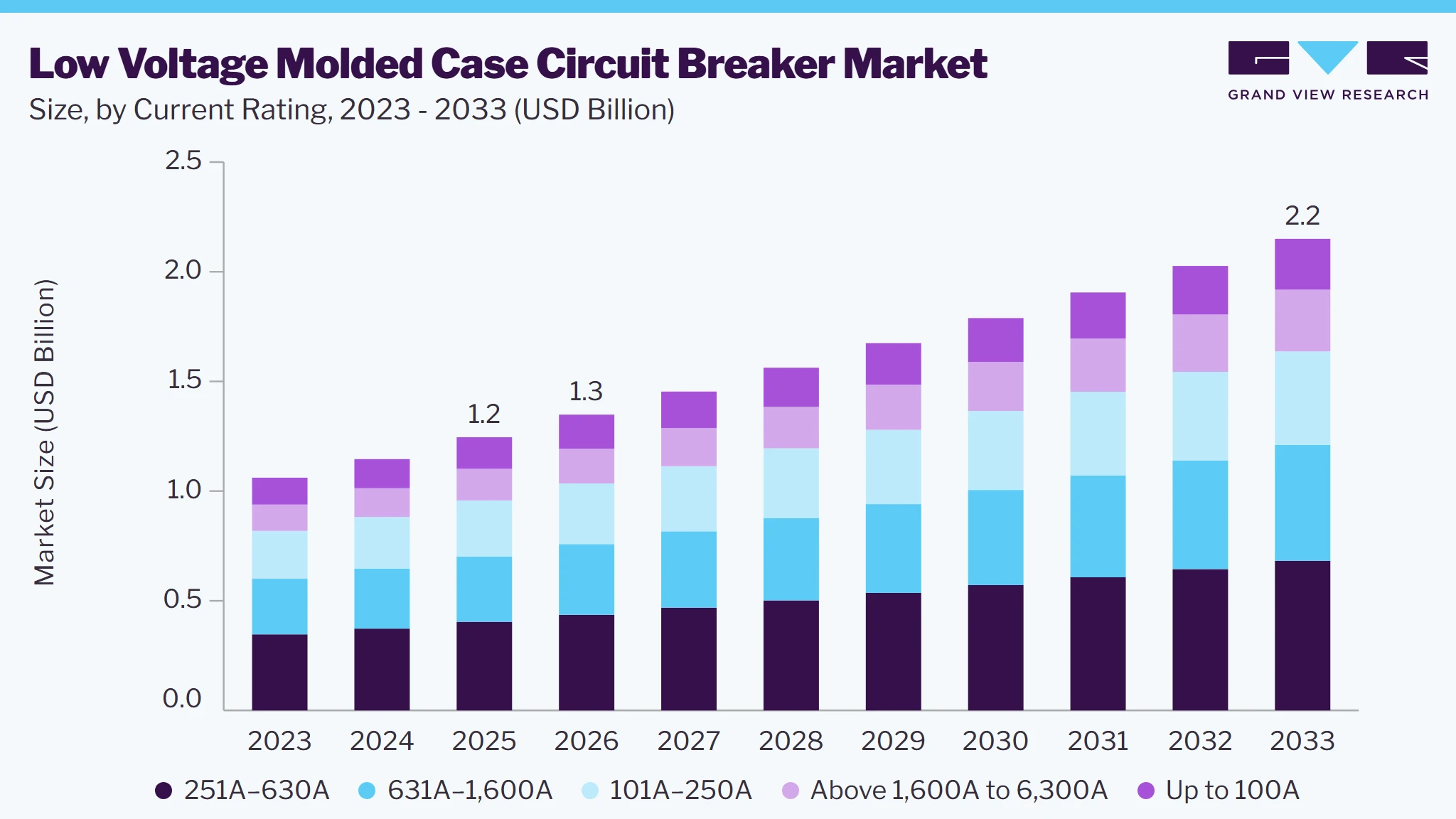 To learn more about this report, Download Free Sample Report
Market Dynamics
The low-voltage molded case circuit breaker (MCCB) market is influenced by evolving electrical safety requirements and the growing complexity of power distribution systems. Increasing adoption of smart protection technologies is encouraging manufacturers to enhance product monitoring and fault detection capabilities. However, fluctuations in copper and other raw material prices can affect manufacturing costs and product pricing. Maintenance requirements and replacement of aging equipment also influence purchasing decisions. Competition among established manufacturers further drives improvements in product reliability, performance, and cost efficiency.
Rapid urbanization, commercial construction, and industrial expansion are increasing electricity consumption and the need for dependable power distribution infrastructure. As utilities and businesses expand networks and upgrade aging electrical systems, demand for low-voltage MCCBs is rising to protect circuits against overloads and short circuits. These breakers are essential across industrial facilities, commercial buildings, and infrastructure projects, where reliable electrical protection supports operational safety and continuity.
In its World Energy Investment 2025 report, the International Energy Agency (IEA) estimated that global investment in electricity grid infrastructure would exceed USD 400 billion in 2025, reflecting continued spending on grid expansion, upgrades, and digitalization. Further, the IEA’s Electricity 2026 report stated that global electricity demand grew by 3% in 2025 and is forecast to increase by an average of 3.6% annually from 2026 to 2030. These developments reinforce the need for power distribution and protection equipment, including MCCBs, across expanding and modernizing electrical networks.
The high upfront cost of advanced low-voltage MCCBs, particularly models with electronic trip units, communication capabilities, and remote monitoring features, can limit adoption among cost-conscious buyers. In price-sensitive emerging markets, small and medium-sized businesses may prioritize initial purchase cost over advanced functionality, delaying equipment upgrades or opting for lower-cost alternatives where technically suitable. These cost considerations can slow the adoption of premium MCCBs, particularly in projects with limited budgets, despite their potential benefits in protection, monitoring, and operational reliability.
The shift toward IoT-enabled MCCBs creates opportunities for manufacturers to develop intelligent breakers with digital trip units, real-time thermal monitoring, event logging, remote diagnostics, and predictive maintenance capabilities. Growing demand from data centers, smart commercial buildings, renewable energy installations, and automated industrial facilities creates scope for premium products that improve equipment reliability and reduce unplanned downtime. Additional opportunities exist in retrofit solutions that integrate communication modules into existing electrical systems, as well as software platforms for energy monitoring, fault analytics, and asset management. Manufacturers that combine advanced protection with interoperable digital solutions can differentiate their offerings and capture higher-value market opportunities.
Analyst Perspective
The low-voltage MCCB market is expected to experience steady growth, supported by electrification, infrastructure expansion, and rising investments in industrial and commercial power distribution. Key trends include the adoption of smart breakers with digital trip units, remote monitoring, and predictive maintenance capabilities, alongside growing demand for compact, high-performance protection solutions. Expansion of data centers, renewable energy installations, and automated industrial facilities is creating opportunities for advanced circuit protection equipment. However, high initial costs and raw material price volatility may constrain adoption in price-sensitive markets. Manufacturers that combine reliable protection, digital functionality, and cost competitiveness are likely to strengthen their market position.
Current Rating Insights
The 251A-630A segment held the largest revenue share of 32.4% in 2025, driven by its widespread use in industrial facilities, commercial buildings, and infrastructure projects requiring reliable protection for medium-to-high current electrical circuits. Increasing investments in industrial automation, data centers, and power distribution infrastructure are supporting demand for MCCBs within this current range. Their suitability for protecting motors, machinery, and distribution panels makes them an important choice for applications requiring dependable overload and short-circuit protection.
The above 1,600A to 6,300A segment is anticipated to register the fastest CAGR of 8.5% during the forecast period. This growth is driven by increasing demand for high-capacity circuit protection in large industrial facilities, data centers, and critical infrastructure projects. Rising electricity consumption and expanding power distribution networks are increasing the need for breakers capable of handling high current loads. Investments in heavy manufacturing, large commercial complexes, and energy-intensive operations are further supporting adoption. The growing complexity of electrical systems is encouraging the use of robust protection equipment to improve operational safety and minimize power disruptions.
Voltage Rating Insights
The up to 415V segment dominated the market with a revenue share of 61.4% in 2025, supported by its widespread use across commercial buildings, residential infrastructure, and light industrial applications. The extensive installation of low-voltage electrical distribution systems in offices, retail facilities, and small manufacturing units sustains demand for MCCBs within this voltage range. Increasing urbanization, commercial construction, and electrification are further contributing to segment growth. Additionally, the need for reliable overload and short-circuit protection in everyday electrical installations supports the continued adoption of up to 415V MCCBs.
The above 690V to 1,000V segment is expected to register the fastest CAGR of 8.8% from 2026 to 2033. This growth is driven by increasing demand for higher-voltage low-voltage protection solutions in industrial facilities, renewable energy installations, and large-scale power distribution systems. The expansion of solar PV installations, battery energy storage systems, and industrial automation is increasing the need for breakers capable of operating at elevated voltage levels. Investments in data centers and energy-intensive infrastructure are supporting demand for advanced circuit protection.
Mounting Type Insights
The fixed segment held the largest revenue share of 58.5% in 2025. This is due to its cost-effectiveness, simple installation, and suitability for electrical distribution systems that do not require frequent breaker removal or replacement. Fixed MCCBs are widely used across industrial facilities, commercial buildings, and infrastructure projects for dependable overload and short-circuit protection. Their lower installation complexity and limited maintenance requirements make them a practical choice for many applications. Continued investment in power distribution infrastructure is expected to support demand for fixed MCCBs throughout the forecast period.
The plug-in segment is anticipated to register the fastest CAGR of 7.6% during the forecast period, supported by increasing demand for flexible and easily replaceable circuit protection solutions across industrial and commercial facilities. Plug-in MCCBs allow breakers to be removed and replaced without extensive disassembly of the electrical distribution assembly, reducing maintenance time and simplifying equipment upgrades. Growing investments in industrial automation, commercial infrastructure, and modern power distribution systems are expected to support adoption. Their suitability for applications requiring easier servicing and reduced downtime further strengthens segment growth.
Application Insights
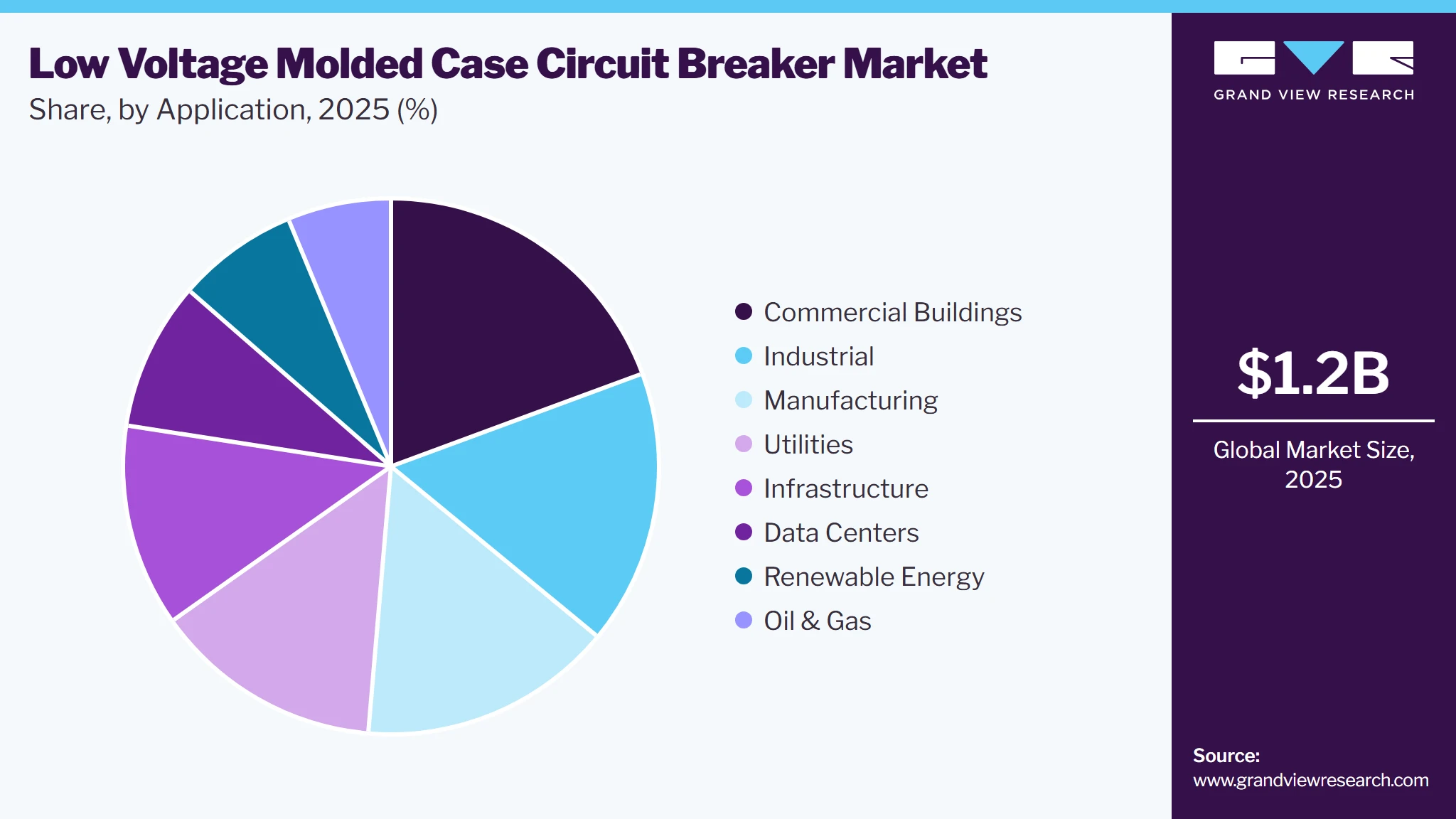
Commercial buildings dominated the market with a revenue share of 19.4% in 2025, driven by increasing construction of office complexes, shopping malls, hotels, and other commercial facilities. These buildings require reliable electrical distribution and protection systems to manage power loads across lighting, HVAC, elevators, and other electrical equipment. Growing investments in commercial infrastructure and modernization of existing buildings are supporting demand for low-voltage MCCBs. Stringent electrical safety requirements and the need to minimize power disruptions are encouraging the installation of dependable circuit protection devices.
 To learn more about this report, Download Free Sample Report
Data centers are expected to register the fastest CAGR of 9.7% from 2026 to 2033. This growth is driven by increasing investments in cloud computing, artificial intelligence (AI), and digital infrastructure, which are raising electricity demand and the need for reliable power distribution. MCCBs play a critical role in protecting power distribution panels, cooling systems, and supporting electrical equipment against overloads and short circuits. The expansion of hyperscale data centers and colocation facilities is further increasing demand for dependable circuit protection solutions. The need to minimize downtime and maintain continuous operations is encouraging investments in advanced electrical protection systems.
Regional Insights
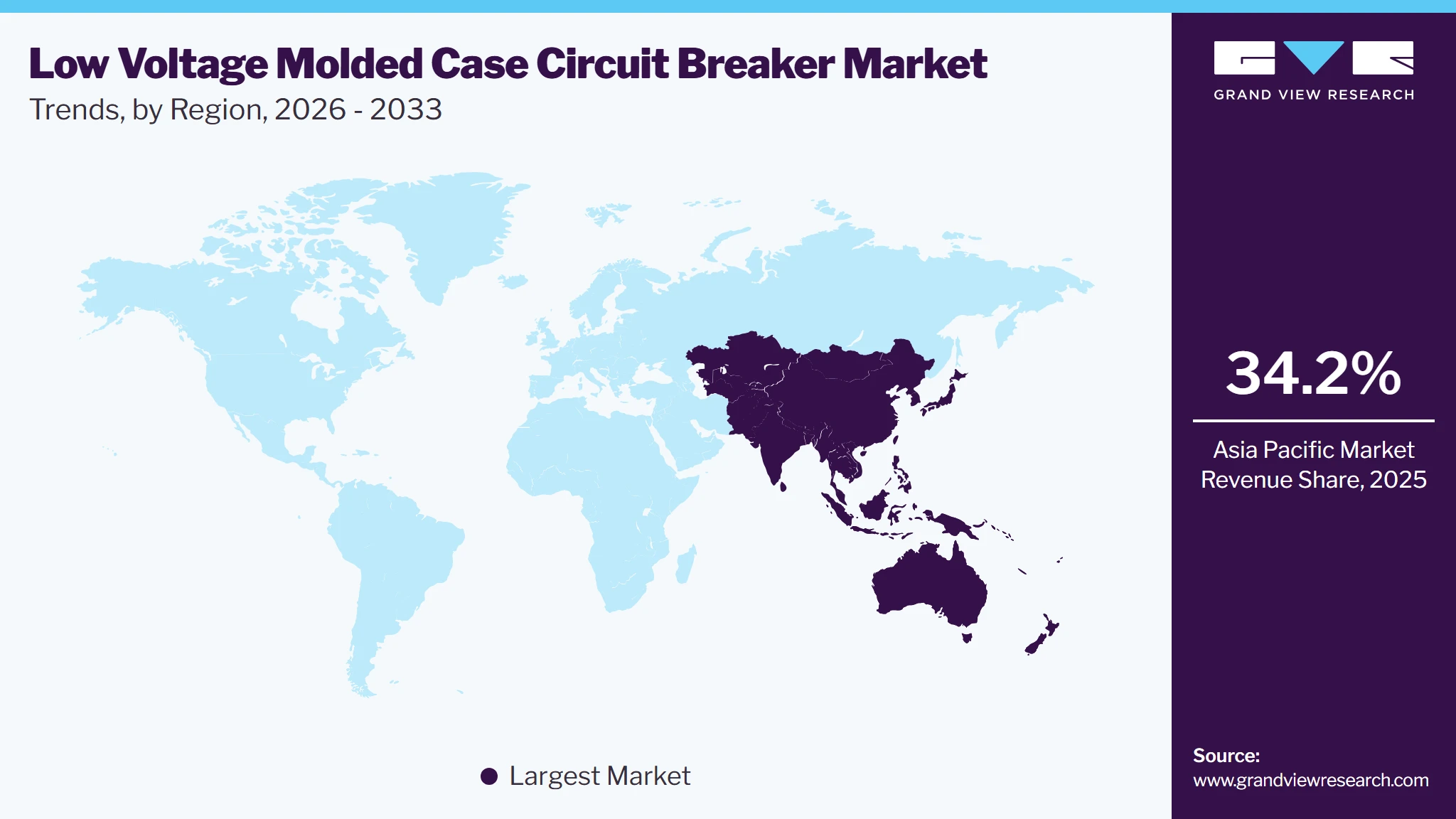
The Asia Pacific region dominated the global market with a revenue share of 34.2% in 2025. This is supported by rapid industrialization and urbanization, rising electricity demand, and the expansion of power distribution infrastructure across major economies such as China and India. Increasing investments in renewable energy projects, data centers, and industrial facilities are further driving demand for reliable low-voltage circuit protection equipment. Additionally, ongoing grid modernization and the growth of advanced manufacturing facilities across Japan, South Korea, and other Southeast Asian countries are strengthening regional demand for MCCBs.
 To learn more about this report, Download Free Sample Report
China Low Voltage Molded Case Circuit Breaker Market Trends
China low-voltage MCCB market is supported by the country’s extensive power distribution network, large industrial base, and continued investments in electrical infrastructure. According to the shared report, China’s power grid investment reached approximately USD 89.5 billion in 2025, including around USD 45.05 billion allocated to distribution networks operating at 110 kV and below. These investments support the expansion and modernization of electrical systems serving industrial facilities, commercial buildings, and other power consumers. Growth in manufacturing, data centers, renewable energy installations, and advanced industrial facilities is expected to strengthen demand for MCCBs used in overload and short-circuit protection.
Europe Low Voltage Molded Case Circuit Breaker Market Trends
The Europe low-voltage MCCB market is supported by investments in grid modernization, renewable energy integration, and industrial automation. The region’s focus on energy efficiency, electrical safety, and upgrading aging power infrastructure is driving demand for reliable circuit protection solutions. The expansion of data centers, commercial buildings, electric vehicle charging infrastructure, and renewable energy installations is further supporting MCCB adoption across industrial and commercial applications.
North America Low Voltage Molded Case Circuit Breaker Market Trends
The North America low-voltage molded case circuit breaker market is driven by investments in electrical infrastructure modernization, data center development, and industrial expansion. Growing electricity demand from digital infrastructure, manufacturing facilities, and commercial buildings is increasing the need for reliable power distribution and circuit protection. Additionally, the integration of renewable energy systems, battery energy storage, and electric vehicle charging infrastructure is supporting demand for MCCBs that provide overload and short-circuit protection.
The Canada low-voltage molded case circuit breaker market is supported by investments in power infrastructure, commercial construction, and industrial electrification. The development of data centers, mining facilities, manufacturing operations, and renewable energy projects is increasing the need for dependable low-voltage electrical distribution systems. Furthermore, modernization of aging electrical equipment and growing adoption of electrification technologies are expected to support demand for MCCBs across industrial, commercial, and infrastructure applications.
Latin America Low Voltage Molded Case Circuit Breaker Market Trends
The Latin America region is expected to grow at the second-fastest CAGR of 6.7% from 2026 to 2033. The growth is driven by increasing investments in power distribution infrastructure, rising industrialization and urbanization, and the modernization of aging electrical networks across countries such as Brazil. Expanding commercial construction, renewable energy installations, and data center infrastructure are also expected to increase demand for MCCBs to provide reliable overload and short-circuit protection.
Middle East Low Voltage Molded Case Circuit Breaker Market Trends
The Middle East low-voltage molded case circuit breaker market is driven by expanding urban infrastructure, commercial construction, and investments in industrial diversification. Large-scale developments in the UAE and Saudi Arabia, including commercial complexes, industrial facilities, data centers, and infrastructure projects, are increasing demand for reliable electrical distribution and protection equipment. Investments in solar power, energy storage, and smart infrastructure are further supporting MCCB adoption across new installations and electrical system upgrades.
Key Low Voltage Molded Case Circuit Breaker Company Insights
Some of the key players operating in the global low-voltage molded case circuit breaker market include Legrand and Fuji Electric, among others.
-
Legrand offers low-voltage molded case circuit breakers through its DPX³ product range, serving commercial buildings, industrial facilities, and power distribution installations. The portfolio includes DPX³ 160, DPX³ 250, DPX³ 630, and DPX³ 1600 models, with rated current options extending up to 1,600 A and breaking capacities ranging from 16 kA to 100 kA, depending on the model. Features such as thermal-magnetic and electronic protection, adjustable trip settings, auxiliary contacts, and optional earth-leakage protection support circuit safety and operational flexibility. These product configurations enable Legrand to address varied protection requirements across low-voltage electrical distribution systems.
-
Fuji Electric offers low-voltage molded case circuit breakers through its G-TWIN, BX, and BW0 product series, serving industrial facilities, commercial buildings, control panels, and power distribution applications. Its G-TWIN portfolio includes standard and global series designed to comply with major international standards, while the BX series provides compact, full-featured protection and the BW0 series addresses more economical applications. The portfolio includes different frame sizes, current ratings, and breaking capacities, along with specialized variants for motor protection and DC applications such as photovoltaic power generation. These offerings enable Fuji Electric to serve diverse electrical protection requirements across industrial and commercial installations.
Key Low Voltage Molded Case Circuit Breaker Companies
The following key companies have been profiled for this study on the low-voltage molded case circuit breaker market.
-
ABB
-
Schneider Electric
-
Siemens
-
Eaton
-
Mitsubishi Electric
-
Legrand
-
Fuji Electric
-
LS Electric
-
TERASAKI ELECTRIC CO., LTD.
-
CHINT
Competitive Benchmarking
Category
Operating Strategies
Competitive Edge
Weakness
Established Players (ABB, Schneider Electric, Siemens, Eaton, Mitsubishi Electric)
- Develop advanced MCCBs with electronic trip units, digital monitoring, remote operation, and predictive maintenance capabilities.
- Integrate circuit breakers with complete low-voltage switchgear, power distribution, and energy management systems.
- Strengthen global manufacturing, distribution, and after-sales service networks to serve industrial, commercial, and critical infrastructure customers.
- Strong global brand recognition, established customer relationships, and extensive distribution networks.
- Broad product portfolios that support integrated electrical protection and power management solutions.
- Advanced technology capabilities, engineering expertise, and established product certifications across major markets.
- Higher product prices and development costs associated with advanced technologies and premium positioning.
- Large organizational structures may limit flexibility in responding to specific regional requirements.
- Dependence on complex supply chains and international operations can expose companies to cost fluctuations and delivery challenges.
Emerging Players (Legrand, TERASAKI ELECTRIC CO., LTD., Fuji Electric, LS Electric, CHINT)
- Expand regional distribution networks and strengthen partnerships with local distributors, panel builders, and electrical contractors.
- Offer competitively priced MCCBs across different current ratings, breaking capacities, and application requirements.
- Expand product portfolios and improve compliance with international standards to increase penetration in industrial and commercial markets.
- Competitive pricing and flexible product offerings for cost-sensitive customers.
- Strong regional presence and familiarity with local customer requirements and electrical standards.
- Opportunities to leverage specialized product ranges and complementary low-voltage electrical equipment.
- Comparatively limited global brand visibility and distribution reach in some international markets.
- Lower pricing can place pressure on profit margins and available resources for product development.
- Limited access to large project opportunities where customers prioritize extensive global service coverage, established supplier credentials, and integrated solutions.
Recent Developments
- In July 2026, Schneider Electric launched its EasyPact CVS C4 MCCB range in South Africa, expanding its Easy Series portfolio with a cost-effective solution for non-critical low-voltage applications. The product range extends current ratings up to 1,600 A, providing additional options for contractors, consultants, and end users across commercial, industrial, and utility applications. This development highlights the growing importance of affordable, standards-compliant circuit protection solutions in the global low-voltage MCCB market, as customers seek to balance electrical safety, reliable performance, and upfront equipment costs.
Low Voltage Molded Case Circuit Breaker Market Report Scope
Report Attribute
Details
Market Definition
The market represents the annual revenues generated from the sale of MCCBs rated up to 1,000 V and 6,300 A, used across industrial, commercial, infrastructure, and other low-voltage electrical applications.
Market size value in 2025
USD 1.2 billion
Market size value in 2026
USD 1.3 billion
Revenue forecast in 2033
USD 2.2 billion
Growth Rate
CAGR of 6.9% from 2026 to 2033
Base year for estimation
2025
Historical data
2021 - 2024
Forecast period
2026 - 2033
Quantitative Units
Revenue in USD million, volume in thousand units, and CAGR from 2026 to 2033
Report coverage
Revenue forecast, competitive landscape, growth factors, and trends
Segments covered
Current rating, voltage rating, mounting type, application, region
Regional scope
North America, Europe, Asia Pacific, Latin America, Middle East
Country scope
Canada, Mexico, UK, Ireland, Spain, Portugal, China, India, Indonesia, Japan, Malaysia, Philippines, Singapore, South Korea, Taiwan, Thailand, Vietnam, Brazil, UAE, Saudi Arabia
Key companies profiled
ABB, Schneider Electric, Siemens, Eaton, Mitsubishi Electric, Legrand, Fuji Electric, LS Electric, TERASAKI ELECTRIC CO., LTD., CHINT
Customization scope
Free report customization (equivalent up to 8 analysts working days) with purchase. Addition or alteration to country, regional & segment scope.
Pricing and purchase options
Avail customized purchase options to meet your exact research needs. Explore purchase options
Low Voltage Molded Case Circuit Breaker Market Report Segmentation
This report forecasts revenue growth at global, regional, and country levels and provides an analysis of the latest industry trends in each of the sub-segments from 2021 to 2033. For the purpose of this study, Grand View Research has segmented the global low-voltage molded case circuit breaker market report on the basis of current rating, voltage rating, mounting type, application, and region:
-
Current Rating Outlook (Revenue, USD Million; Volume, Thousand Units; 2021 - 2033)
-
Up to 100A
-
101A-250A
-
251A-630A
-
631A-1,600A
-
Above 1,600A to 6,300A
-
-
Voltage Rating Outlook (Revenue, USD Million; Volume, Thousand Units; 2021 - 2033)
-
Up to 415V
-
416V-690V
-
Above 690V to 1,000V
-
-
Mounting Type Outlook (Revenue, USD Million; Volume, Thousand Units; 2021 - 2033)
-
Fixed
-
Plug-in
-
Draw-out
-
-
Application Outlook (Revenue, USD Million; Volume, Thousand Units; 2021 - 2033)
-
Industrial
-
Commercial Buildings
-
Utilities
-
Infrastructure
-
Data Centers
-
Renewable Energy
-
Oil & Gas
-
Manufacturing
-
-
Regional Outlook (Revenue, USD Million; Volume, Thousand Units; 2021 - 2033)
-
North America
-
Canada
-
Mexico
-
-
Europe
-
UK
-
Ireland
-
Spain
-
Portugal
-
-
Asia Pacific
-
China
-
India
-
Indonesia
-
Japan
-
Malaysia
-
Philippines
-
Singapore
-
South Korea
-
Taiwan
-
Thailand
-
Vietnam
-
-
Latin America
-
Brazil
-
-
Middle East
-
UAE
-
Saudi Arabia
-
-
Research Methodology
The low voltage molded case circuit breakermarket figures in this report are based on a proven research process that combines executive interviews with secondary research from proprietary databases, company filings, and recognized regulatory and institutional sources. Market size is built through value-chain sizing-reconciling supply-side and demand-side estimates-and triangulated with bottom-up and top-down approaches. Every estimate passes multiple levels of expert validation before publication, with each low voltage molded case circuit breaker segment quantified using the revenue-capture definitions in the table below.
Segment Definition
Segment - Current Rating
Revenue capture definition
Up to 100A
Revenue from MCCBs rated up to 100 A, used for lower-current circuit protection in commercial buildings, control panels, and light industrial applications.
101A-250A
Revenue from MCCBs rated between 101 A and 250 A, used for feeder protection, distribution panels, and electrical equipment in commercial and industrial facilities.
251A-630A
Revenue from MCCBs rated between 251 A and 630 A, used for higher-current feeders, main distribution panels, and industrial machinery protection.
631A-1,600A
Revenue from MCCBs rated between 631 A and 1,600 A, used for high-current distribution, main incomers, and large industrial and commercial electrical installations.
Above 1,600A to 6,300A
Revenue from MCCBs rated above 1,600 A and up to 6,300 A, used in high-capacity power distribution systems, subject to product-level validation that the breakers fall within the MCCB category rather than the ACB category.
Segment - Voltage Rating
Revenue capture definition
Up to 415V
Revenue from MCCBs rated up to 415 V, used in conventional low-voltage power distribution, main incomers, and feeder protection applications.
416V-690V
Revenue from MCCBs rated between 416 V and 690 V, used in industrial facilities, motor applications, and higher-voltage low-voltage distribution systems.
Above 690V to 1,000V
Revenue from MCCBs rated above 690 V and up to 1,000 V, used in specialized industrial and energy applications, subject to product-specific ratings and availability.
Segment - Mounting Type
Revenue capture definition
Fixed
Revenue from fixed-mounted MCCBs permanently installed in switchgear assemblies and electrical distribution panels for main incomer, feeder, and power distribution protection.
Plug-in
Revenue from MCCBs designed with plug-in mounting arrangements that allow installation and removal from compatible electrical assemblies with reduced disconnection and servicing effort.
Draw-out
Revenue from withdrawable MCCBs designed for removal or movement within compatible electrical assemblies to facilitate inspection, testing, maintenance, and replacement without dismantling the entire assembly.
Segment - Application
Revenue capture definition
Industrial
Revenue from MCCBs used in general industrial facilities for power distribution, feeder protection, and electrical equipment protection, excluding separately classified manufacturing and oil and gas applications.
Commercial Buildings
Revenue from MCCBs installed in offices, retail complexes, hotels, hospitals, and educational facilities for main distribution, feeder protection, and electrical safety.
Utilities
Revenue from MCCBs used in utility-owned low-voltage auxiliary systems, substations, and power distribution facilities.
Infrastructure
Revenue from MCCBs deployed in airports, railways, tunnels, transportation facilities, and water treatment plants, excluding applications classified under other segments.
Data Centers
Revenue from MCCBs used in data center power distribution systems, main switchboards, backup power infrastructure, and protection of critical electrical loads.
Renewable Energy
Revenue from MCCBs used in solar power, wind power, and battery energy storage installations for low-voltage power collection, distribution, and circuit protection.
Oil & Gas
Revenue from MCCBs used in low-voltage electrical distribution systems at oil and gas production sites, processing plants, refineries, pipelines, and terminals.
Manufacturing
Revenue from MCCBs installed in manufacturing plants for production-line power distribution, machinery protection, and electrical system protection, excluding facilities classified under other application segments.
Estimation Model
Layer Name
Key Question
Description
Demand Layer
Which factors generate demand for low-voltage molded case circuit breakers?
Assess demand using indicators such as electricity consumption, industrial and commercial construction, manufacturing activity, data center capacity additions, electrical infrastructure investments, renewable energy deployment, and modernization of aging power distribution systems.
Product Layer
Which products generate market revenue?
Evaluate revenue from low-voltage molded case circuit breakers rated up to 1,000 V, considering their current ratings, rated voltage, breaking capacity, mounting configurations, and circuit protection capabilities. Include only products that meet the market scope and qualify as MCCBs.
Application Layer
Which ratings, mounting configurations, and end-use applications generate market revenue?
Assess revenue across current ratings (Up to 100 A, 101 A-250 A, 251 A-630 A, 631 A-1,600 A, and Above 1,600 A to 6,300 A), voltage ratings (Up to 415 V, 416 V-690 V, and Above 690 V to 1,000 V), and mounting types (Fixed, Plug-in, and Draw-out). Revenue is further analyzed across Industrial, Commercial Buildings, Utilities, Infrastructure, Data Centers, Renewable Energy, Oil & Gas, and Manufacturing applications. Validate the availability of MCCBs in each rating and mounting category and avoid double counting across applications.
Revenue Layer
How is market revenue generated?
Market revenue is quantified through annual sales of qualifying low-voltage MCCBs used for overload and short-circuit protection in electrical distribution systems. Revenue is assessed based on manufacturer sales value and differentiated by current rating, voltage rating, breaking capacity, mounting configuration, protection features, and end-use application. Products classified as ACBs or other circuit breaker types are excluded from MCCB revenue.
Delivered Customizations
This report has been delivered with the following In-depth customizations
Client Request
Customization Delivered
Value Adds
Competitive Benchmarking
Conducted a detailed assessment of established and regional low-voltage MCCB manufacturers based on product portfolios, current and voltage ratings, breaking capacity, mounting configurations, electronic protection features, digital monitoring capabilities, end-use applications, geographic presence, and market positioning.
Helps the client benchmark its product portfolio against key competitors, identify technology and product gaps, and evaluate opportunities for differentiation across low-voltage circuit protection applications.
Application-Specific Demand Analysis
Assessed MCCB demand across industrial, commercial buildings, utilities, infrastructure, data centers, renewable energy, oil and gas, and manufacturing applications, considering electrical protection requirements and the characteristics of each end-use sector.
Helps the client identify promising customer industries, align product specifications with application needs, and target sectors with growing requirements for reliable low-voltage circuit protection.
Regional Opportunity Assessment
Evaluated low-voltage MCCB market opportunities across key regions and countries by analyzing industrial development, commercial construction, grid modernization, data center expansion, renewable energy integration, electrification, and investments in power distribution infrastructure.
Helps identify high-potential geographic markets, understand regional demand drivers, and prioritize expansion strategies, distribution partnerships, and market-entry opportunities.
About the Author(s)
Power Distribution Research Team
Energy & Power · Power DistributionThis report was authored by the power distribution research team at Grand View Research - comprising two research analysts, one senior research analyst, and one industry expert - with specialized expertise in the power distribution segment of the energy & power industry. All findings are based on proprietary energy & power databases, executive interviews, and regulatory analysis, subject to internal peer review prior to publication.
Last Updated:
Speak to Analyst

Customize this report to your needs - add regions, segments, or data points, with 20% free customization.
Or view our licence options:


ISO 9001:2015 & 27001:2022 Certified
We are GDPR and CCPA compliant! Your transaction & personal information is safe and secure. For more details, please read our privacy policy.


