
- Home
- »
- Alcohol & Tobacco
- »
-
Luxury Wines And Spirits Market Size Report, 2026-2033GVR Report cover

Luxury Wines And Spirits Market (2026 - 2033)
Size, Share & Trend Analysis Report By Product (Wine, Spirits), By Price Tier (Super-premium, Ultra-premium, Luxury/Prestige), By Distribution Channel (On-trade, Off-trade), By Region (North America), And Segment Forecasts
Market Size, 2025
$223.6BMarket Estimate, 2026
$232.0BMarket Forecast, 2033
$334.2BCAGR, 2026–2033
5.4%Luxury Wines And Spirits Market Summary
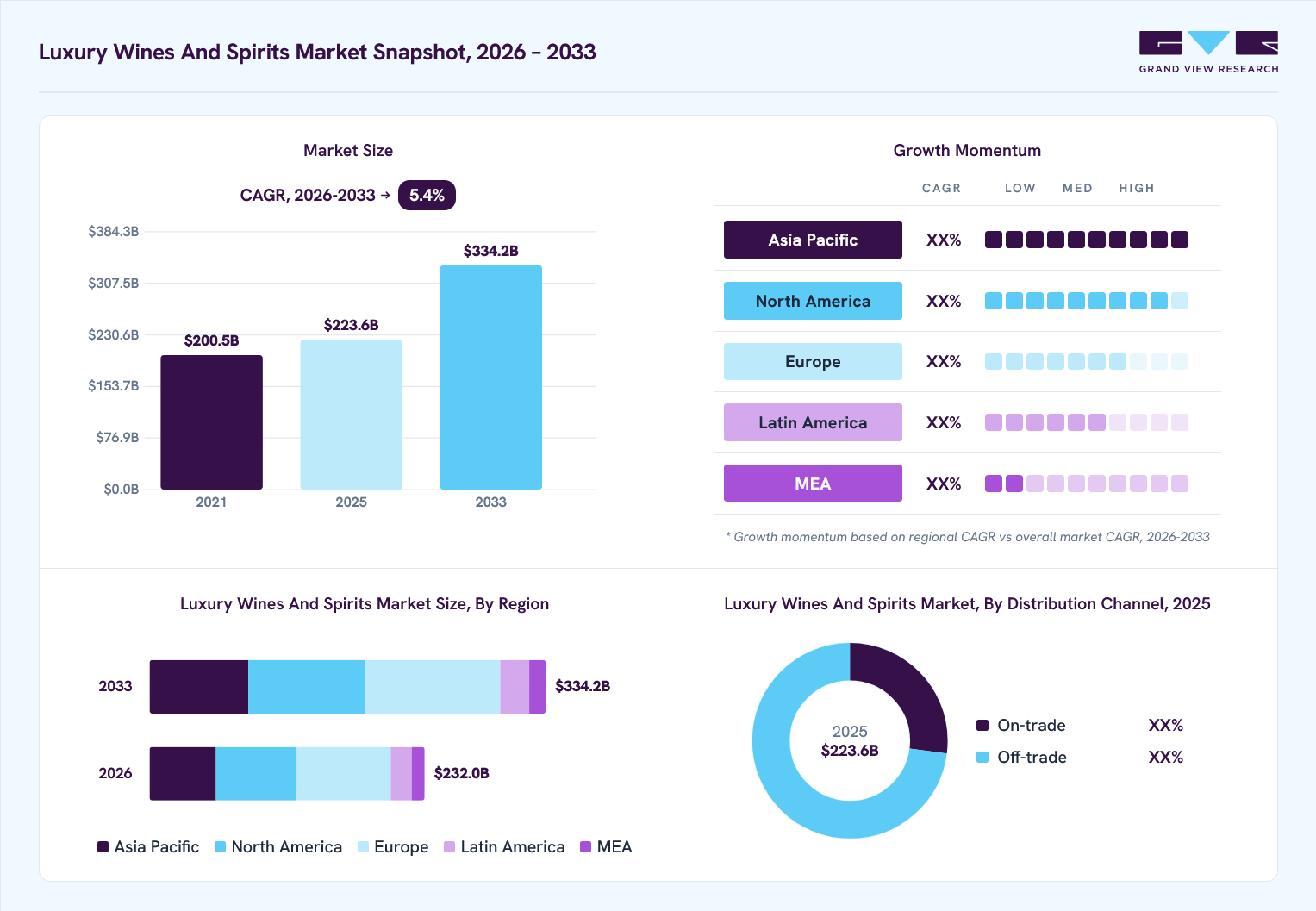
The global luxury wines and spirits market was valued at USD 223.6 billion in 2025 and is projected to grow from USD 232.0 billion in 2026 to USD 334.2 billion by 2033, at a CAGR of 5.4% from 2026 to 2033. Europe dominated the market, accounting for a revenue share of 34.5% in 2025. The industry is driven by increasing consumer preference for premium brands and high-end alcoholic beverages, supported by the growing popularity of sophisticated products and curated drinking experiences that offer luxury and exclusivity.
 Source: Grand View Research, IR Documents, Primary Interviews, Paid DatabasesTo learn more about this report,
 Download Free Sample Report
 Key Market Trends & Insights
- By product: Luxury spirits led the market and accounted for a share of 59.2% in 2025.
- By price tier: Super-premium dominated the market with a share of 42.4% in 2025.
- By distribution channel: Off-trade channel held the largest share of 73.0% in 2025.
Regional Highlights
- Largest regional market: Europe (34.5% revenue share, 2025)
- Fastest-growing regional market: Asia Pacific (highest CAGR, 2026-2033)
- By country: France held the largest market share in 2025.
Market Size & Forecast
- Market size in 2025: USD 223.6 Billion
- Estimated market size in 2026: USD 232.0 Billion
- Projected market size by 2033: USD 334.2 Billion
- CAGR (2026-2033): 5.4%
Three ways to get this report
Buy it, customize it, or ask a question.Ask an Analyst
A direct answer, usually in 1 working day
- AccessReport author, directly
- Reply timeWithin 1 working day
- No sales callDirect answer only
- FormatEmail reply
- CostFree, no cost
Get the Full Report
What the study covers
- FormatsPDF · Excel · Dashboard
- Timeline2026–2033 annual, 2025 base
- Coverage20+ countries, 5 regions
- Companies10+ key players profiled
Customize the Report
20% free customization
- IncludeCountries, segments, points
- TailorTo your product definition
- ExtendDeeper competitor detail
- OrA fully bespoke study
- Turnaround5–10 working days
In addition, the market is supported by the growing influence of social media, celebrity endorsements, and premium brand storytelling. Consumers are increasingly attracted to limited-edition releases, heritage labels, and products offering distinctive craftsmanship and authenticity. The expansion of luxury hospitality, fine-dining establishments, and exclusive retail channels is further creating opportunities for market growth. For instance, in July 2025, Meghan Markle expanded her ‘As Ever’ lifestyle brand into wine, launching a 2023 Napa Valley rosé, with sparkling wine and other varieties planned.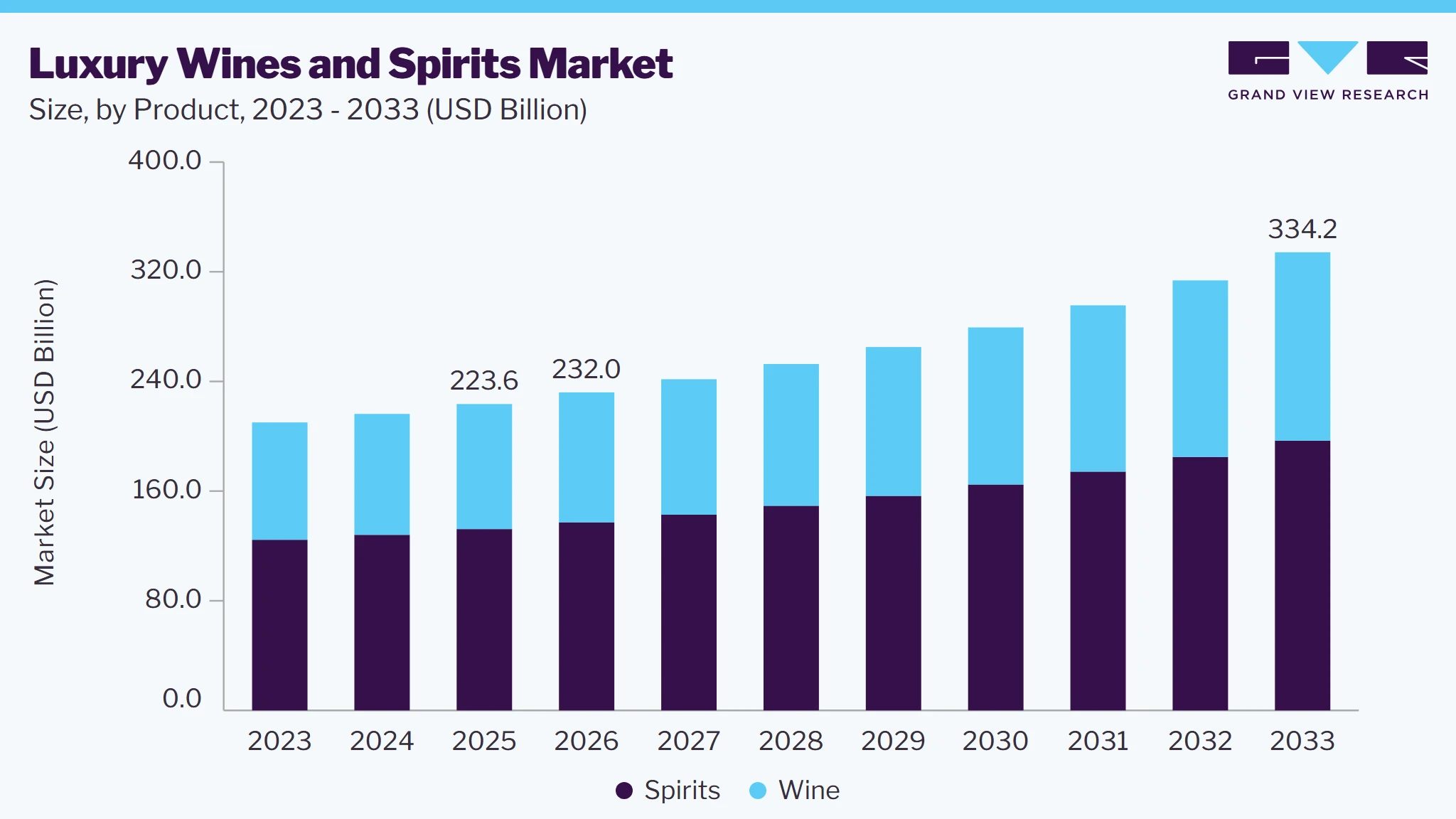 To learn more about this report, Download Free Sample Report
 Furthermore, product innovation is creating new opportunities as producers introduce distinctive blends, rare vintages, and innovative packaging formats. Additionally, expanding international trade and improved distribution networks are increasing the availability of premium products across emerging markets. The growing interest in wine tourism and immersive tasting experiences is also strengthening consumer engagement with luxury brands. In June 2026, Chapel Down unveiled The Hythe, a new premium tasting room in Kent offering panoramic vineyard views and luxury wine experiences. It also launched the Kit’s Coty Collection Experience, featuring behind-the-scenes winemaking access and tastings of its flagship wines, priced at USD 67.0 (£50) per person.
Market Dynamics
Growing consumer preference for premium and rare beverages is encouraging demand for distinctive products with unique taste profiles and a sense of exclusivity. Consumers are showing greater interest in provenance, craftsmanship, and heritage, particularly when selecting specialized beverages. Collectors and enthusiasts are also supporting demand for scarce vintages and specialty spirits. Premium consumption across social and celebratory occasions is further encouraging experimentation with higher-end offerings. This shift toward differentiated consumption is strengthening the overall luxury beverage segment.
Strict government regulations and taxation can create operational and financial challenges for luxury wine and spirits producers. Requirements related to production, labeling, distribution, and advertising may increase compliance responsibilities. Differences in alcohol regulations across countries can further complicate international operations. Higher duties and excise taxes may increase retail prices and influence purchasing behavior. In March 2025, Trump proposed imposing a 200% tariff on European wine, Champagne and spirits in retaliation for the EU’s proposed 50% tariff on American whiskey. The escalation highlights how higher duties can raise consumer prices, disrupt exports, and squeeze wine and spirits businesses, demonstrating the financial risks of government trade policies. In addition, advertising restrictions can also limit brand visibility and consumer outreach in certain markets.
Expansion into emerging markets presents significant opportunities for luxury wine and spirits companies seeking new consumer bases. Urbanization and improving premium retail, hospitality, and dining infrastructure are supporting access to high-end beverages. Greater exposure to international lifestyle trends is encouraging consumers to explore global wine and spirits brands. Partnerships with local distributors and hospitality businesses can assist companies establish stronger market positions. The GlenJourneys, in partnership with Ajay Devgn, is expanding India’s luxury spirits landscape with a premium 21-year-old Highland single malt Scotch whisky. Its premium positioning and celebrity partnership can tap India’s growing affluent consumer base and strengthen brand visibility in the emerging luxury spirits market. These markets offer potential for long-term brand development and revenue diversification.
Analyst Perspective
The global luxury wines and spirits market is positioned for steady development as consumers increasingly value premium experiences and distinctive product offerings. Competition is expected to remain strong, with established brands leveraging heritage while newer players introduce differentiated products. Distribution through luxury hospitality, specialty retail, and digital channels will remain important for market expansion. Product innovation, exclusive collections, and experiential marketing are likely to shape future competitive strategies. Emerging consumer markets also present attractive avenues for companies seeking to broaden their geographic presence.
Consumer Insights for the Luxury Wines & Spirits
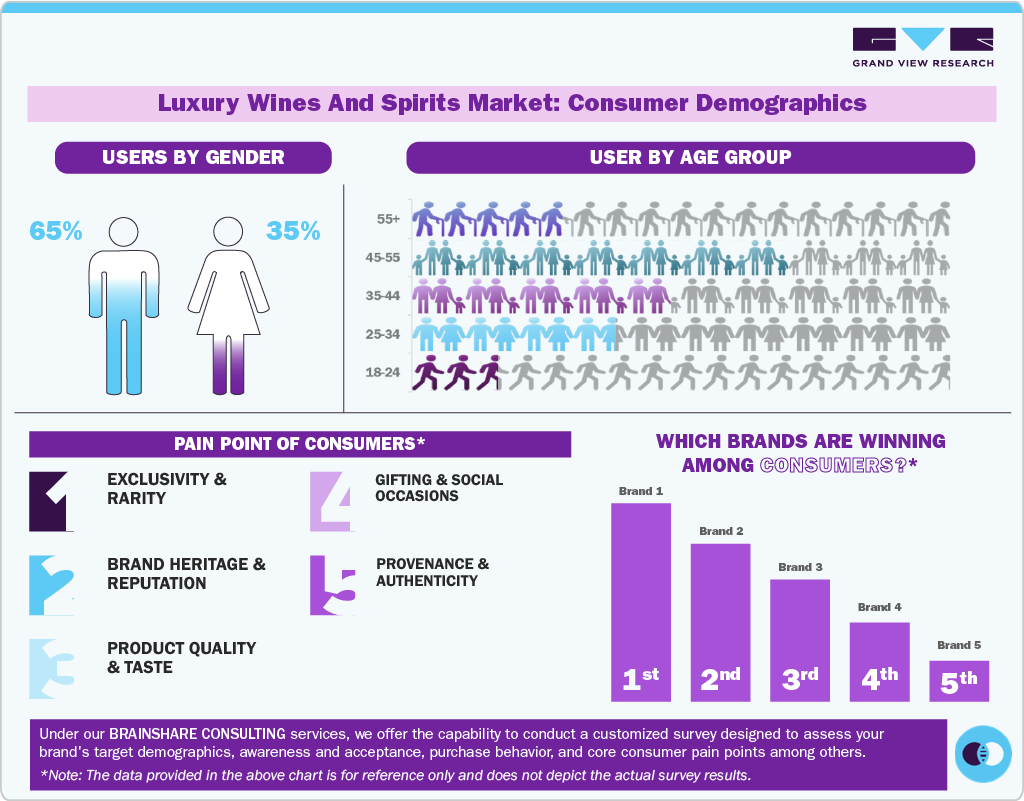
Luxury wine and spirits consumers prioritize exclusivity, quality, and authenticity when making purchasing decisions. Brand heritage, craftsmanship, and reputation are key to attracting premium customers. Attractive packaging, limited editions, and personalized experiences further enhance the appeal of luxury products. Consumers are increasingly mindful of sustainability and ethical sourcing. Overall, luxury buyers seek products that deliver exceptional quality and a unique, memorable experience.
 To learn more about this report, Download Free Sample Report
 Product Insights
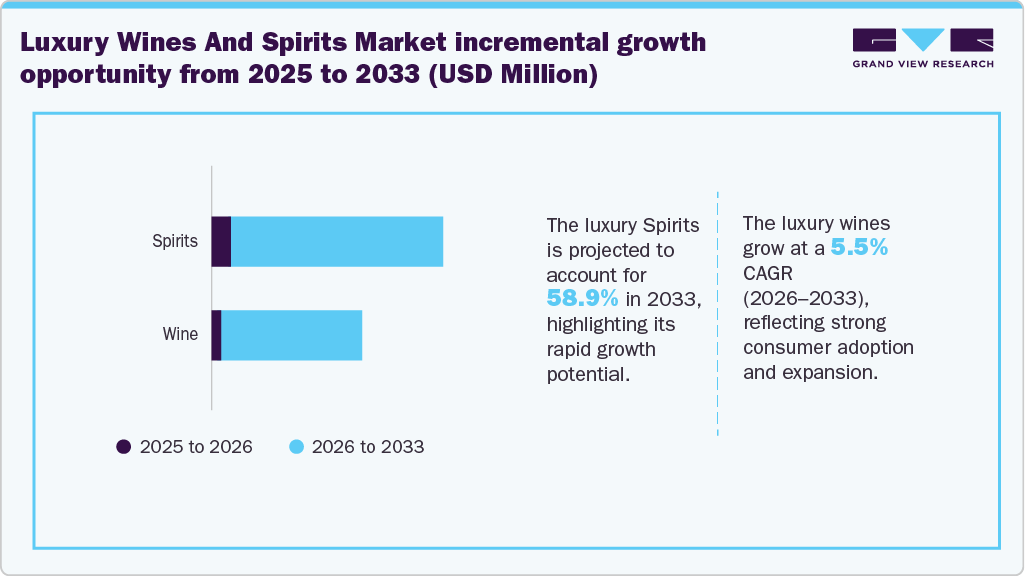
The luxury spirits segment accounted for the largest share, accounting for 59.2% in 2025, supported by the growing popularity of craft and small-batch distilleries offering distinctive flavor profiles. Premium cocktail culture is encouraging consumers to explore specialized spirits across bars, restaurants, and home settings. The introduction of aged, single-origin, and barrel-finished varieties is attracting enthusiasts seeking differentiated products. Brand collaborations and innovative flavor combinations are also expanding consumer interest in the category. According to the data published in February 2026, several luxury liquor brands launched limited-edition bottles to celebrate the Year of the Fire Horse, designed around themes of energy, courage, and prosperity. The releases include Kavalan, Don Julio 1942, Rémy Martin XO, Johnnie Walker Blue Label, and Hennessy, with Hennessy’s ultra-luxury edition priced at USD 40,000.
 To learn more about this report, Download Free Sample Report
 The luxury wines segment is projected to grow at the fastest CAGR of 5.5% from 2026 to 2033. The segment is benefiting from increasing interest in regional varieties and wines with distinctive terroir characteristics. Wine-tasting events, vineyard visits, and educational experiences are encouraging deeper consumer engagement with the category. Advancements in viticulture and winemaking are enabling producers to develop distinctive and high-quality offerings. Growing interest in food-and-wine pairing is supporting consumption across restaurants, hotels, and private occasions. The availability of curated collections and specialty wines through dedicated channels is further supporting segment development.
Price Tier Insights
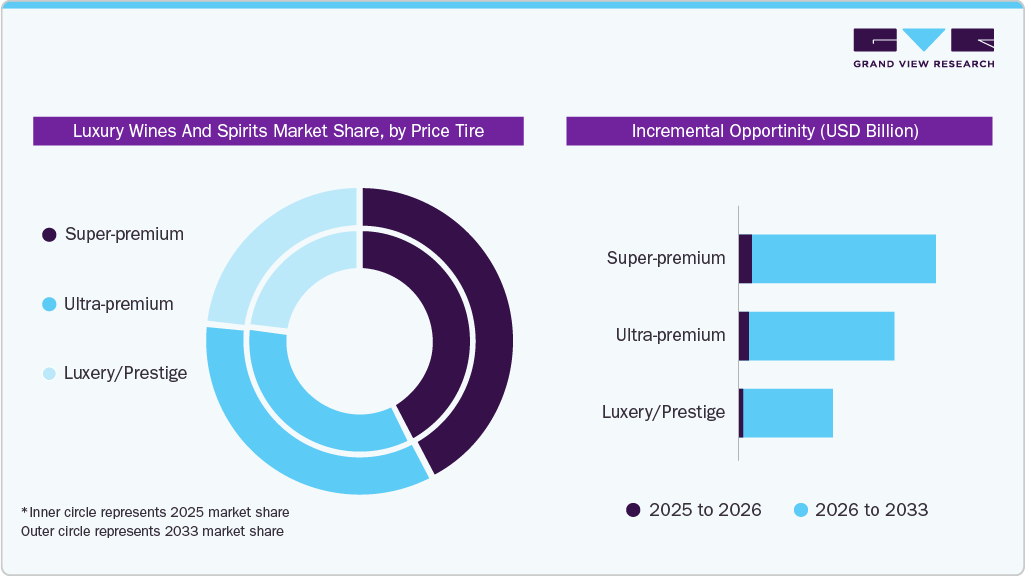
The super-premium price tiered wines and spirits market accounted for the largest share of 42.4% of the revenue in 2025. The super-premium tier is driven by consumers seeking refined products that offer higher quality and distinctive sensory characteristics. Growing interest in specialized labels and carefully produced beverages is encouraging purchases within this tier. Premium gifting occasions are also supporting demand for products with elevated presentation and perceived exclusivity. Restaurants, upscale bars, and luxury hotels are expanding their selection of super-premium offerings. Greater consumer awareness of production techniques and product provenance is further supporting this segment.
 To learn more about this report, Download Free Sample Report
 The luxury/prestige price tiered wines and spirits market is projected to grow at a CAGR of 5.5% from 2026 to 2033, supported by demand for highly exclusive products associated with heritage, craftsmanship, and exceptional production standards. Limited availability and collectible characteristics can increase the appeal of prestigious labels among affluent consumers and collectors. Luxury packaging and presentation further enhance the perceived value of these products. Exclusive launches, private tastings, and high-end hospitality experiences are strengthening consumer engagement. Strong brand heritage and reputation remain important factors influencing purchasing decisions in this tier.
Distribution Channel Insights
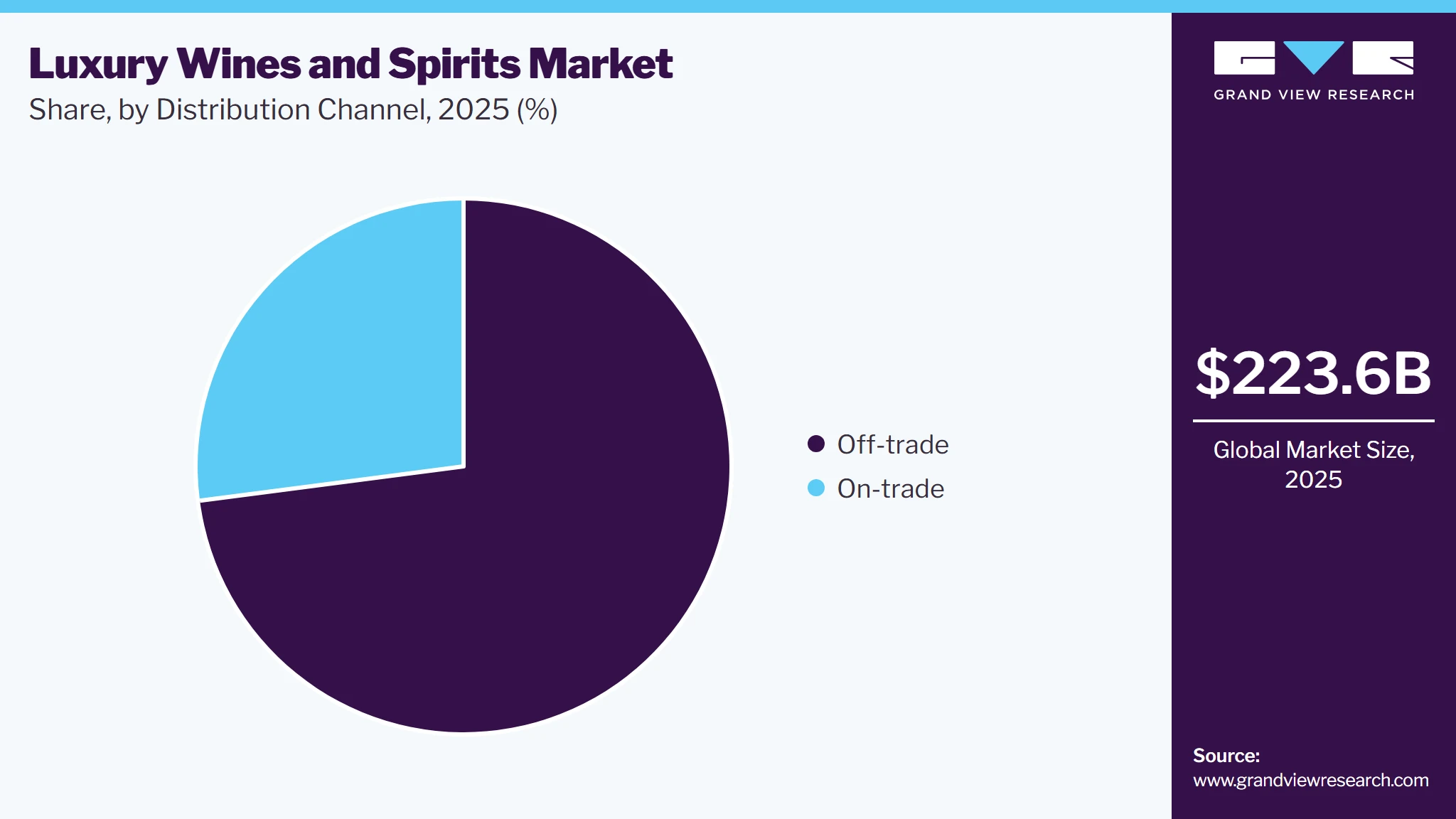
The sale of luxury wines and spirits through the off-trade channel accounted for the largest share of 73.0% in 2025, supported by the increasing availability of luxury wines and spirits through specialty stores, premium supermarkets, and dedicated retail outlets. Consumers value the convenience of purchasing products for private celebrations, gifting, and home consumption. Attractive shelf presentation and knowledgeable retail assistance can influence purchasing decisions. Curated selections and personalized recommendations are also helping retailers appeal to premium beverage buyers. The development of convenient purchasing channels is further strengthening off-trade sales.
 To learn more about this report, Download Free Sample Report
 The sale of luxury wines and spirits through the on-trade channel is projected to grow at a CAGR of 5.8% from 2026 to 2033. The on-trade segment is driven by the expansion of upscale restaurants, luxury hotels, cocktail lounges, and exclusive bars. Consumers are increasingly seeking premium beverage experiences while dining or socializing outside the home. Professional sommeliers and bartenders can encourage customers to discover unfamiliar labels and specialty selections. Premium pairing menus and curated beverage programs are also enhancing the visibility of high-end products. Growth in fine dining and experiential hospitality is creating additional opportunities for on-trade consumption.
Regional Insights
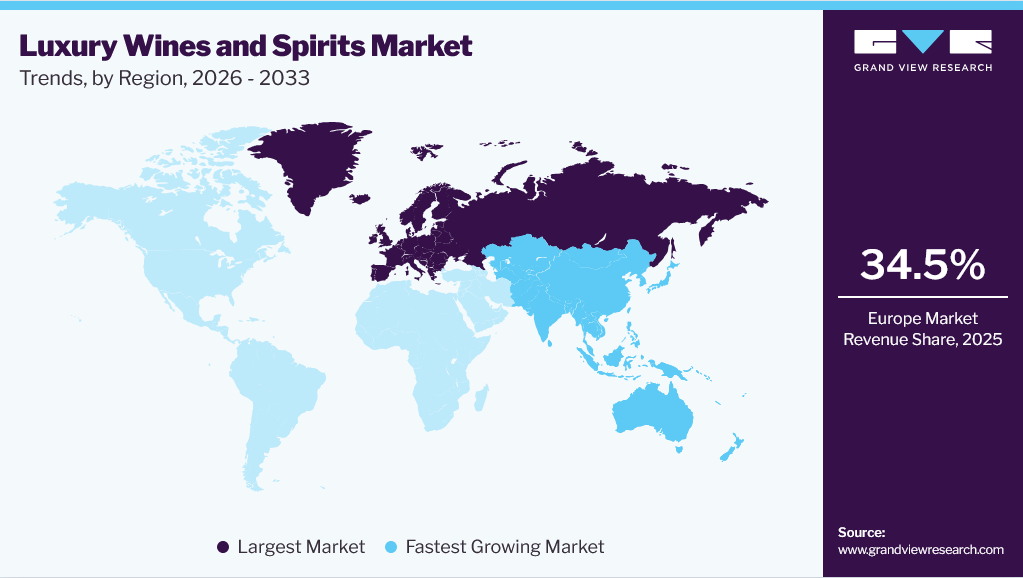
Europe luxury wines and spirits market led the global market, accounting for the largest revenue share of 34.5% in 2025, driven by its long-established wine and spirits heritage and the presence of numerous renowned production regions. Culinary tourism encourages visitors to discover regional beverages and specialized producers. Fine-dining establishments and luxury hospitality venues provide strong channels for premium consumption. Traditional craftsmanship and established production practices enhance the perceived value of European beverages. Cross-border tourism also increases exposure to prestigious regional products.
 To learn more about this report, Download Free Sample Report
 France Luxury Wines and Spirits Market Trends
Luxury wines and spirits market in France led the European luxury wines and spirits market in 2025, holding the largest market share with 24.8% of the region’s total revenue. The market in France benefits from its global reputation for wine excellence, renowned appellations, and generations of specialized production expertise. Prestigious wine regions attract collectors and visitors interested in distinctive regional offerings. The country's sophisticated gastronomy sector provides extensive opportunities for premium wines to be served alongside fine cuisine. Vineyard tourism enables consumers to engage directly with producers and understand regional characteristics. The strong association between French beverages and luxury further reinforces their international appeal.
North America Luxury Wines and Spirits Market Trends
The luxury wines and spirits market in North America held the share of 29.0% in 2025, supported by a strong premium beverage culture across upscale hospitality and retail channels. Consumers increasingly seek distinctive products that complement sophisticated dining and social experiences. The region's developed specialty retail infrastructure provides access to curated and hard-to-find selections. Growth in luxury hotels, restaurants, and private clubs is creating additional consumption occasions. Strong consumer awareness of international brands further supports regional demand.
The U.S. led the North American luxury wines and spirits market in 2025, holding the largest market share with 83.9% of the region’s total revenue. The market benefits from a broad and dynamic spirits landscape, supported by growing interest in craft and specialty distillations. Consumers are increasingly exploring unique expressions, premium cocktails, and products with distinctive production characteristics. Upscale restaurants, cocktail lounges, and private clubs provide important platforms for high-end brands. According to the data published in August 2026, Beyoncé became the sole owner of SirDavis American Whisky after acquiring Moët Hennessy’s stake in the brand. The move gives her full control of the premium whisky brand, which she co-launched with Moët Hennessy in 2024.
Asia Pacific Luxury Wines and Spirits Market Trends
The Asia Pacific luxury wines and spirits market is projected to grow at the fastest CAGR of 5.8% from 2026 to 2033. The market in APAC is expanding as consumers become more familiar with international wine and spirits categories. Rising development of luxury hotels, restaurants, and premium entertainment venues is creating new consumption opportunities. Western-style dining is also increasing interest in wine and premium spirits among urban consumers. Improvements in specialty retail and distribution are making imported products more accessible. Luxury events and curated tasting programs are further increasing consumer exposure to premium beverage brands. In June 2026, Alcobrew Distilleries entered the luxury spirits segment with Gamber Valley Indian Single Malt Whisky, produced and matured in Solan, Himachal Pradesh. The launch includes premium expressions priced at USD 73- USD 167 (INR 7,000-INR 16,000), targeting India’s growing affluent and globally exposed whisky consumer base.
Luxury wines and spirits market in China led the Asia Pacific market with the largest share of 42.2% in 2025. The market is supported by demand for premium beverages in business entertainment, gifting, and upscale social occasions. Increasing sophistication among urban consumers is encouraging greater exploration of international wine and spirits brands. Luxury hotels, fine-dining restaurants, and premium clubs provide key environments for consumption. Specialized retail and distribution networks are improving access to high-end products in major cities. Interest in provenance, brand reputation, and distinctive product characteristics is also shaping consumer choices.
Central & South America Luxury Wines and Spirits Market Trends
The luxury wines and spirits market in Central & South America is projected to grow at a CAGR of 4.8% from 2026 to 2033. The growth is driven by established social and culinary traditions that encourage beverage consumption during gatherings and dining occasions. Expansion of tourism and premium hospitality is creating greater exposure to higher-value wines and spirits. Regional producers are attracting attention through distinctive grape varieties and locally influenced production styles. Upscale restaurants and hotels are expanding their premium beverage selections. Increasing availability of international brands is also broadening consumer choices across major urban markets.
Middle East & Africa Luxury Wines and Spirits Market Trends
The luxury wines and spirits market in Middle East & Africa is expected to grow at a CAGR of 3.5% from 2026 to 2033. The MEA market is largely supported by luxury tourism and the development of high-end hospitality destinations. Premium hotels, resorts, restaurants, and licensed venues provide important channels for luxury wine and spirits consumption. International visitors are creating demand for familiar global brands and sophisticated beverage experiences. Investment in luxury tourism infrastructure is expanding the availability of premium offerings in key destinations. The growth of international business and travel hubs is further supporting demand within permitted markets. For instance, in May 2025, Penfolds and Domaine de La Chapelle launched Grange La Chapelle 2021, a limited-edition blend of Australian Shiraz and French Syrah in the UAE. Available exclusively through private sale, the collector-focused wine targets discerning luxury wine enthusiasts and collectors.
Key Luxury Wines and Spirits Company Insights
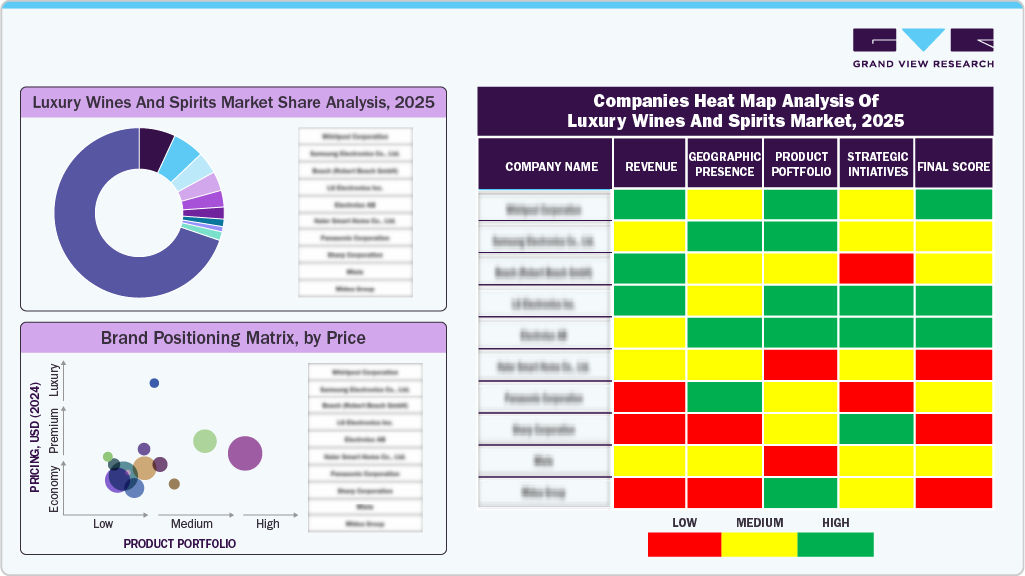
The luxury wines and spirits industry is characterized by the presence of well-established global brands alongside specialized regional producers. Market share is influenced by brand heritage, product exclusivity, distribution reach, and the ability to maintain strong relationships with premium retail and hospitality channels.
Leading companies are increasingly focusing on product innovation, portfolio diversification, and selective brand positioning to strengthen their competitive standing. Partnerships with luxury hotels, restaurants, and specialty retailers are also helping companies expand their market presence. The competitive landscape remains dynamic as established players and emerging premium brands compete for consumer attention across international markets.
 To learn more about this report, Download Free Sample Report
 Key Luxury Wines and Spirits Companies
The following key companies have been profiled for this study on the luxury wines and spirits market.
-
LVMH (Moët Hennessy Louis Vuitton)
-
Pernod Ricard
-
Diageo.
-
Rémy Cointreau
-
Brown-Forman Corporation.
-
Campari Group Ingredients
-
SUNTORY HOLDINGS LIMITED
-
Edrington Group
-
Laurent-Perrier Group
-
Constellation Brands
Competitive Benchmarking
Category
Operating Strategies
Competitive Edge
Weakness
Established Players (LVMH, Pernod Ricard, Brown-Forman Corporation)
- Expand premium portfolios, strengthen luxury brand positioning, and deepen presence in high-end hospitality and retail.
- Strong brand heritage, global distribution, extensive portfolios, and established customer relationships.
- Complex portfolios, higher operating overheads, and exposure to regulatory and market fluctuations.
Emerging Players (Laurent-Perrier Group)
- Develop distinctive products, target specialized consumer segments, and leverage digital channels for market penetration.
- Agility, product uniqueness, focused branding, and ability to respond quickly to emerging preferences.
- Limited international reach, lower production scale, and comparatively weaker brand recognition.
Recent Developments
-
In October 2025, The Dalmore’s 2025 Cask Curation Series features three single malts aged 24, 34, and 43 years, finished in Château Mont Redon Châteauneuf-du-Pape red wine casks. Limited to 150 sets worldwide and priced at USD 44,450, the collection targets luxury whisky collectors with rich, fruit-forward flavor profiles.
-
In May 2025, Penfolds and Domaine de La Chapelle launched Grange La Chapelle 2021, a limited-edition blend of Australian Shiraz and French Syrah in the UAE. Available exclusively through private sale, the collector-focused wine targets discerning luxury wine enthusiasts and collectors.
Luxury Wines and Spirits Market Report Scope
Report Attribute
Details
Market value size in 2025
USD 223.6 billion
Estimated market size in 2026
USD 232.0 billion
Projected market size by 2033
USD 334.2 billion
Growth rate (Revenue)
CAGR of 5.4% from 2026 to 2033
Actual data
2021 - 2025
Forecast period
2026 - 2033
Quantitative (Revenue) units
Revenue in USD billion, and CAGR from 2026 to 2033
Report coverage
Revenue forecast, company ranking, competitive landscape, growth factors, and trends
Segments covered
Product, price tier, distribution channel, region
Regional scope
North America; Europe; Asia-Pacific; Central & South America; Middle East & Africa
Country scope
U.S.; Canada; Mexico; UK; Germany; France; Italy; Spain; China; Japan; India; Australia & New Zealand; South Korea; Brazil; South Africa
Key companies profiled
LVMH (Moët Hennessy Louis Vuitton); Pernod Ricard; Diageo; Rémy Cointreau; Brown-Forman Corporation; Campari Group; SUNTORY HOLDINGS LIMITED; Edrington Group; Laurent-Perrier Group; Constellation Brands
Customization scope
Free report customization (equivalent up to 8 analysts’ working days) with purchase. Addition or alteration to country, regional & segment scope.
Pricing and purchase options
Avail customized purchase options to meet your exact research needs. Explore purchase options
Global Luxury Wines and Spirits Market Report Segmentation
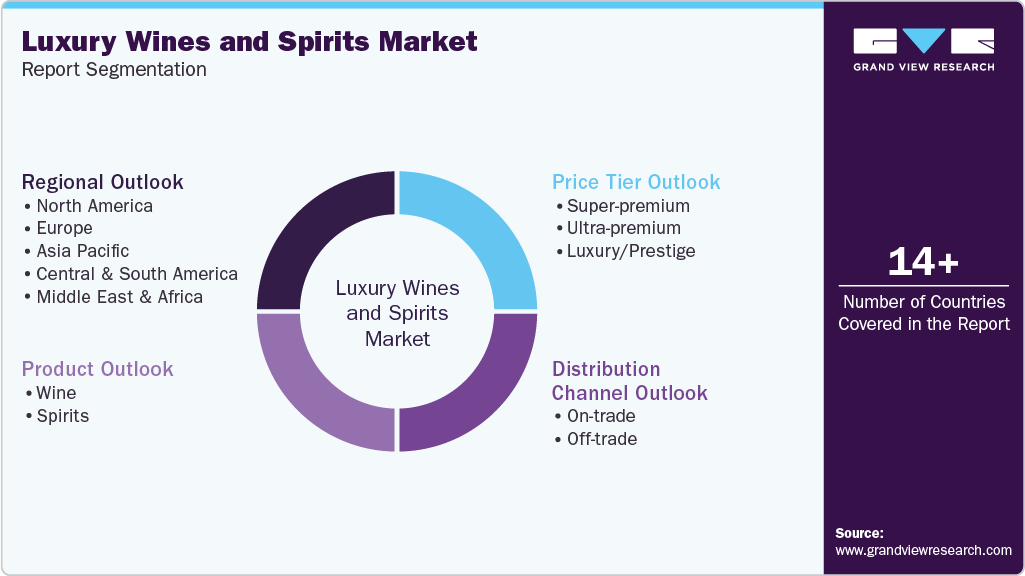
This report forecasts revenue growth at the global, regional, and country levels and provides an analysis of the latest industry trends and opportunities in each of the sub-segments from 2021 to 2033. For this study, Grand View Research has segmented the luxury wines and spirits market report based on product, price tier, distribution channel, and region.
 To learn more about this report, Download Free Sample Report
 -
Product Outlook (Revenue, USD Billion, 2021 - 2033)
-
Wine
-
Spirits
-
Whiskey
-
Cognac
-
Brandy
-
Others
-
-
-
Price tier Outlook (Revenue, USD Billion, 2021 - 2033)
-
Super-premium
-
Ultra-premium
-
Luxury/Prestige
-
-
Distribution Channel Outlook (Revenue, USD Billion, 2021 - 2033)
-
On-trade
-
Off-trade
-
-
Regional Outlook (Revenue, USD Billion, 2021 - 2033)
-
North America
-
U.S.
-
Canada
-
Mexico
-
-
Europe
-
UK
-
Germany
-
France
-
Italy
-
Spain
-
-
Asia Pacific
-
China
-
Japan
-
India
-
Australia & New Zealand
-
South Korea
-
-
Central & South America
-
Brazil
-
-
Middle East & Africa
-
South Africa
-
-
Research Methodology
The luxury wines and spirits market figures in this report are based on a proven research process that combines executive interviews with secondary research from proprietary databases, company filings, and recognized regulatory and institutional sources. Market size is built through value-chain sizing-reconciling supply-side and demand-side estimates-and triangulated with bottom-up and top-down approaches. Every estimate passes multiple levels of expert validation before publication, with each luxury wines and spirits segment quantified using the revenue-capture definitions in the table below.
Segment Definition
Distribution Channel
Revenue capture definition
On-trade
On-trade channels generate revenue through the sale of luxury wines and spirits at upscale restaurants, hotels, lounges, clubs, and other hospitality venues. Revenue is captured through individual pours, bottle sales, curated beverage programs, and premium pairing experiences. Pricing typically reflects the service, ambiance, and expertise associated with the venue. These channels also create opportunities for brands to gain visibility through sommelier and bartender recommendations.
Off-trade
Off-trade channels generate revenue through the retail sale of luxury wines and spirits for consumption outside hospitality establishments. Specialty liquor stores, premium retailers, supermarkets, and e-commerce platforms provide consumers with access to bottles, curated collections, and exclusive releases. Revenue is primarily captured through individual bottle purchases, gifting, collector acquisitions, and online orders. Premium shelf placement and personalized retail recommendations can further encourage higher-value purchases.
Estimation Model
Layer
Guiding Question
Description
01 Consumption Universe
Who consumes luxury wine & spirits?
Captures consumers who purchase or consume premium-priced wines and spirits driven by taste, status, craftsmanship, gifting, or special occasions.
02 Access & Availability
Who can access luxury wine & spirits?
Includes consumers reached through specialist retailers, luxury department stores, restaurants, hotels, private clubs, brand boutiques, and curated online channels.
03 Purchase & Usage
Who actively purchases luxury wine & spirits?
Focuses on consumers making recurring or occasion-based purchases for personal enjoyment, entertaining, celebrations, collecting, or gifting.
04 Revenue Conversion
How is revenue generated from luxury wine & spirits consumers?
Measures monetization through bottle sales, limited editions, premium collections, cellar programs, tasting experiences, hospitality, memberships, and high-end foodservice.
Delivered Customizations
This report has been delivered with the following In-depth customizations
Client Request
Customization Delivered
Value Adds
Luxury Wine & Spirit Premiumization & Pricing Landscape
Assessed price tiers, prestige positioning, bottle formats, limited releases, allocation models, and willingness-to-pay dynamics across luxury wine and spirit categories.
Clarifies premiumization opportunities, strengthens price-pack architecture, and supports margin optimization.
Luxury Wine & Spirit Consumer & Occasion Assessment
Examined affluent consumer profiles, purchase motivations, consumption occasions, gifting behavior, collecting tendencies, and experiential preferences across priority markets.
Helps refine target segments, tailor brand propositions, and identify high-value consumption occasions.
Luxury Wine & Spirit Brand, Portfolio & Innovation Landscape
Benchmarked leading maisons and emerging labels across heritage, craftsmanship, provenance, experiential offerings, collaborations, and new product concepts.
Reveals differentiation gaps, supports portfolio development, and identifies opportunities for brand elevation and innovation.
Frequently Asked Questions About This Report
The global luxury wines and spirits market size was valued at USD 223.6 billion in 2025 and is estimated at USD 232.0 billion for 2026.
Key factors include rising disposable incomes, premiumization among affluent and younger consumers, growing demand for exclusive and heritage-led brands, and increasing interest in experiential drinking.
Europe luxury wine & spirits market led with a 34.5% revenue share in 2025.
Asia Pacific is the fastest-growing region over the forecast period.
The global luxury wines and spirits market is expected to grow at a CAGR of 5.4% from 2026 to 2033, reaching USD 334.2 billion by 2033.
The luxury spirits segment led with a 59.2% revenue share in 2025 while luxury wines segment is expected to be the fastest-growing market.
The sale of luxury wines and spirits through the off-trade accounted for the largest share of 73.0% of the revenue in 2025, supported by the increasing availability of luxury wines and spirits through specialty stores, premium supermarkets, and dedicated retail outlets.
Key players include LVMH (Moët Hennessy Louis Vuitton), Pernod Ricard, Diageo, Rémy Cointreau, Brown-Forman Corporation, Campari Group, SUNTORY HOLDINGS LIMITED, Edrington Group, Laurent-Perrier Group, and Constellation Brands.
About the Author(s)
Alcohol & Tobacco Research Team
Consumer Goods · Alcohol & TobaccoThis report was authored by the alcohol & tobacco research team at Grand View Research - comprising two research analysts, one senior research analyst, and one industry expert - with specialized expertise in the alcohol & tobacco segment of the consumer goods industry. All findings are based on proprietary consumer goods databases, executive interviews, and regulatory analysis, subject to internal peer review prior to publication.
Last Updated:
Speak to Analyst

Customize this report to your needs - add regions, segments, or data points, with 20% free customization.
Or view our licence options:


ISO 9001:2015 & 27001:2022 Certified
We are GDPR and CCPA compliant! Your transaction & personal information is safe and secure. For more details, please read our privacy policy.


