
- Home
- »
- Medical Devices
- »
-
Maggot Debridement Market Size & Share Report 2026-2033GVR Report cover
![Maggot Debridement Market (2026 - 2033)Report]()
Maggot Debridement Market (2026 - 2033)
Size, Share & Analysis Report by Administration (Loose Larva, Biobags), By Application (Acute Wounds, Chronic Wounds), By End Use (Hospital, Clinics, By Region, And Segment Forecasts
Market Size, 2025
$15.7MMarket Estimate, 2026
$17.3MMarket Forecast, 2033
$35.0MCAGR, 2026–2033
10.6%Maggot Debridement Market Summary
The global maggot debridement market size was valued at USD 15.7 million in 2025 and is projected to grow from USD 17.3 million in 2026 to USD 35.0 million by 2033, at a CAGR of 10.6% from 2026 to 2033. North America held the largest revenue share of 47.5% in 2025. The demand for maggot debridement therapy (MDT), which involves using disinfected maggots to remove dead tissue and bacteria from wounds, is rising.

Key Market Trends & Insights
- By administration: Biobags held the largest revenue share of 76.9% in 2025.
- By application: Chronic wounds held the largest revenue share of 59.9% in 2025.
- By end use: Hospital held the largest revenue share of 45.5% in 2025.
Regional Highlights
- Largest regional market: North America (47.5% revenue share, 2025)
- Fastest-growing regional market: Asia Pacific (highest CAGR, 2026-2033)
- By country: The U.S. held the largest revenue share of North America in 2025
Market Size & Forecast
- Market size in 2025: USD 15.7 Million
- Estimated market size in 2026: USD 17.3 Million
- Projected market size by 2033: USD 35.0 Million
- CAGR (2026-2033): 10.6%
The increasing prevalence of chronic wounds, a rising geriatric population, and the growing acceptance of bio-based therapies in clinical applications drive market growth. The increasing prevalence of diabetes and obesity is responsible for growing incidences of chronic wounds such as diabetic foot ulcers, venous ulcers, and pressure ulcers, which pose significant challenges to patients worldwide.Maggot debridement therapy promotes healing and has proven to be a safe and effective alternative to traditional surgical removal techniques. An additional driving force for market growth is the aging population, prone to chronic wounds due to age-related physiological changes and comorbidities. MDT offers a less invasive approach as it is particularly useful for elderly patients who find invasive procedures difficult. This demographic shift is expected to significantly impact the market as healthcare providers seek effective treatments that address the specific needs of geriatric patients.

In addition, the adoption of biotherapies has increased in recent years. As awareness of its therapeutic benefits increases, more healthcare providers are implementing MDT in their practices. Clinical studies demonstrating the efficacy of MDT in improving wound healing outcomes and reducing complications have increased its credibility. Furthermore, sustainable, increasingly environmentally friendly treatments align well with the principles of MDT, thereby facilitating its adoption in clinical settings.
The increasing incidence of diabetic foot ulcers (DFUs), pressure ulcers, and venous leg ulcers (VLUs) is a key driver of the maggot debridement industry, as these chronic wounds frequently develop necrotic tissue that requires effective debridement to promote healing and prevent infection. The growing global burden of diabetes, an aging population, obesity, and prolonged hospitalization has significantly increased the number of patients requiring advanced wound care. Maggot debridement therapy (MDT) is gaining wider clinical acceptance due to its ability to selectively remove necrotic tissue, reduce bacterial load and biofilms, and stimulate granulation tissue formation, making it an effective treatment option for complex, non-healing wounds while helping reduce the risk of limb amputation.
Prevalence and Recurrence Rate of VLU in the U.S. (2023)
Country
Population Group
Prevalence
Recurrence Rate (3 Months)
Recurrence Rate (12 Months)
Recurrence Rate (3 Years)
U.S.
People aged 65 and above
4%
22%
57%
78%
Source: Wiley Online Library
Market Dynamics
The maggot debridement market is experiencing steady growth driven by the increasing prevalence of chronic wounds, such as diabetic foot ulcers, pressure ulcers, and venous leg ulcers, and by the growing elderly population requiring advanced wound care. Rising clinical evidence supporting the effectiveness of maggot debridement therapy (MDT) in selective tissue removal, biofilm disruption, and infection control is encouraging its adoption in hospitals and specialized wound care centers. Furthermore, the demand for minimally invasive, cost-effective alternatives to surgical debridement and the growing acceptance of biotherapy are creating new growth opportunities. However, limited awareness, patient reluctance, and reimbursement challenges continue to restrain widespread market penetration.
The rising incidence of diabetic foot ulcers (DFUs) and pressure ulcers is a major driver of the maggot debridement market, as these chronic wounds often require effective removal of necrotic tissue to accelerate healing and prevent complications. The increasing prevalence of diabetes, aging populations, and prolonged hospital stays has significantly expanded the patient pool requiring advanced wound care interventions. Maggot debridement therapy (MDT) has gained clinical acceptance for its ability to selectively debride necrotic tissue, reduce bacterial burden, and promote granulation tissue formation, making it a valuable treatment option for difficult-to-heal chronic wounds. As healthcare providers focus on limb preservation and on reducing amputation rates, the demand for MDT is expected to continue to grow.
Pressure Ulcer Burden and Economic Impact in the UK
Parameter
Value
Total people affected
Over 700,000
Newly diagnosed cases (annual)
180,000
Average treatment cost per ulcer
USD 13,743.56
Daily cost burden
USD 26.30 million per day
Source: Spinal Injuries Association
The maggot debridement market is restrained by low patient acceptance, as many individuals experience psychological discomfort or reluctance toward treatments involving live sterile larvae, despite their proven clinical effectiveness. In addition, the widespread availability of alternative debridement techniques-including surgical, enzymatic, autolytic, and mechanical debridement-offers clinicians multiple established treatment options that are often preferred in routine practice. Limited reimbursement coverage, inadequate awareness among healthcare providers in some regions, and the need for trained wound care specialists further restrict the broader adoption of maggot debridement therapy (MDT), particularly in emerging healthcare markets.
The growing prevalence of chronic wounds, coupled with the expansion of specialized wound care centers and home healthcare services, presents significant opportunities for the maggot debridement market. Increasing clinical recognition of maggot debridement therapy (MDT) as a cost-effective, selective, and antibiotic-sparing approach is encouraging its adoption for complex and non-healing wounds. In addition, rising concerns over antimicrobial resistance and the need for advanced wound management solutions are driving interest in biological debridement therapies. Emerging healthcare markets, improved clinician training, and supportive clinical guidelines are expected to further expand MDT adoption over the coming years.
Market Concentration & Characteristics
The market is characterized by moderate innovation, with advancements focused on improving treatment safety, patient comfort, and clinical outcomes rather than introducing entirely new therapeutic concepts. Manufacturers are developing contained larval delivery systems (biobags), standardized, sterile, medical-grade larvae, and optimized dressing technologies that simplify application, reduce patient discomfort, and maintain effective debridement. Ongoing clinical research is also exploring the antimicrobial peptides, biofilm-disrupting properties, and wound-healing compounds secreted by medicinal larvae, creating opportunities for next-generation biologically derived wound care products. For instance, in January 2025, the Journal of Clinical Medicine reported that innovation in maggot debridement therapy (MDT) is increasingly focused on recombinant proteolytic enzymes (RPEs) derived from larval secretions as a next-generation alternative to live larvae. Early Phase IIa clinical findings showed concentration-dependent reductions in necrotic tissue, increased granulation tissue formation, and minimal pain, highlighting the potential for more patient-friendly biological debridement therapies.
The maggot debridement market currently sees few mergers and acquisitions, owing to its niche nature and the limited number of specialized manufacturers. Market growth is primarily driven by product innovation, clinical research collaborations, regulatory approvals, and distribution partnerships rather than large-scale acquisitions. As the adoption of biologic wound care expands and investment in advanced wound management increases, strategic acquisitions and partnerships are expected to gradually rise over the forecast period.
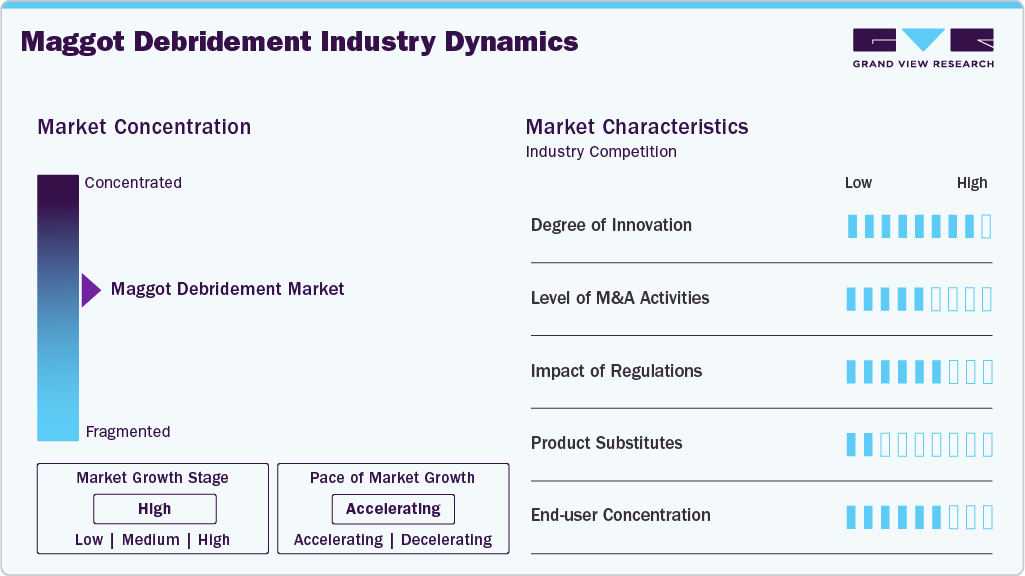
The maggot debridement industry is significantly influenced by stringent regulatory requirements governing the production, sterilization, and clinical use of medicinal larvae, ensuring product safety and treatment efficacy. Regulatory approvals from agencies such as the U.S. FDA and compliance with European quality standards have strengthened clinician confidence and supported wider adoption. However, complex approval pathways and varying reimbursement and regulatory frameworks across countries can delay product commercialization and limit market expansion in emerging regions.
The maggot debridement market exhibits moderate end-use concentration, with most of the demand originating from hospitals and specialized wound care centers, where trained clinicians manage complex chronic wounds requiring advanced debridement. Outpatient clinics and home healthcare settings are gradually emerging as important end users, supported by growing awareness of minimally invasive wound care and increasing adoption of contained larval delivery systems (biobags).
Analyst Perspective
The maggot debridement market is expected to grow significantly over the coming years, driven by the increasing prevalence of chronic wounds, rising diabetes-related complications, and the growing need for effective, tissue-preserving debridement techniques. Maggot debridement therapy (MDT) offers a unique clinical advantage by selectively removing necrotic tissue, reducing bacterial burden, and promoting wound healing, making it a valuable option for complex, non-healing wounds. Although patient acceptance, reimbursement limitations, and the availability of conventional debridement methods remain key challenges, expanding clinical evidence, increasing awareness among wound care specialists, and the growing emphasis on limb preservation are expected to support wider adoption. Continued investments in standardized sterile larval products, clinician training, and integration of MDT into multidisciplinary wound care programs are likely to create sustainable growth opportunities for market participants.
Administration Insights
The biobags segment led the market with the largest revenue share of 76.9% in 2025 and is expected to grow at the fastest CAGR over the forecast period, owing to its ease of use, which has proven effective in promoting wound healing. The popularity of biobags can be attributed to their standardized, controlled environment, which ensures stability and safety in clinical applications. Biobags have become mainstream with the rise in demand for minimally invasive biotherapies. In addition, their pre-packaged design simplifies storage and handling, reducing the need for extensive training and minimizing the risk of contamination.
The loose larva segment is expected to grow significantly over the forecast period, driven by increasing demand for personalized wound care treatments. Loose larvae offer high flexibility; they can be applied directly to wounds and enable healthcare professionals to make precise, treatment-based adjustments to wound size, depth, and severity when treating complex or irregular wounds. The combination of low cost and flexibility increases the appeal of loose larvae in clinical and home care settings. Furthermore, advances in the breeding and sterilization processes of maggots have improved the safety, availability, and vulnerability of loose larvae, further increasing their growing demand and supporting their growth.
Application Insights
The chronic wounds segment led the maggot debridement industry with the largest revenue share of 59.9% in 2025, largely due to a rise in chronic wounds, such as diabetic foot ulcers, arthritis, and pressure ulcers, which are more common in older people and individuals with comorbidities such as diabetes and peripheral vascular diseases. Maggot debridement therapy helps to remove dead tissue, reduce infection, and promote tissue regeneration. The therapy’s ability of the treatment to accelerate healing and reduce the need for surgery has made it desirable in managing chronic wounds, which often require long-term, specialized care.
Acute wounds are expected to grow at the fastest CAGR over the forecast period, driven by the increasing incidence of traumatic injuries and surgical wounds and the growing adoption of advanced wound care technologies. Traumatic wounds, such as accidents or burns, extensive tissue damage, where maggots selectively strip necrotic tissue, leaving healthy tissue intact, thus accelerating the healing process. In addition, MDT is used to treat common surgeries in elective and emergency procedures, largely due to its ability to prevent infection and promote excellent tissue regeneration. Maggot debridement therapy is becoming preferred as healthcare professionals seek alternatives to antibiotics and persistent surgical interventions.
End Use Insights
The hospital segment led the maggot debridement market with the largest revenue share of 45.5% in 2025, driven by their critical role in providing comprehensive wound care for patients with chronic, non-healing wounds and severe tissue damage. Maggot debridement therapy has gained traction in these cases due to its ability to effectively patch up wounds, accelerate healing, and reduce the risk of infection. MDT can debride dead tissue while preserving healthy tissue, making it an essential option for hospital-based wound care, especially in intensive care units (ICUs) and specialized burn units.

Wound care centers are expected to grow at the fastest CAGR over the forecast period, largely due to the increasing prevalence of chronic and complex wounds. These centers specialize in treating non-healing wounds, often requiring advanced therapy for successful management. The specialized focus on comprehensive, personalized treatment programs makes them ideal centers for MDT, leading to increased acceptance of this treatment and the expansion of wound centers with the growing acceptance of conventional biologically based therapies as a more sustainable and less invasive alternative to traditional methods.
Regional Insights
North America dominated the maggot debridement market with the largest revenue share of 47.5% in 2025, driven by the region's advanced healthcare infrastructure and increasing prevalence of chronic diseases. The regulatory environment in North America is favorable for the recognition of MDTs. Moreover, North American healthcare providers recognize MDT's benefits, such as reduced infection and its ability to accelerate wound healing, contributing to faster recovery and lower overall healthcare costs.

U.S. Maggot Debridement Market Trends
The U.S. maggot debridement industry dominated North America, accounting for the largest revenue share in 2025, as the U.S. has one of the largest patient populations seeking specialized wound care and requiring advanced treatments such as maggot debridement. Furthermore, the improved health care system, including hospitals, wound care centers, and the inclusion of outpatient clinics, has facilitated the widespread acceptance of MDT as a reliable solution for non-healing and complex wounds.
Asia Pacific Maggot Debridement Market Trends
The Asia Pacific maggot debridement industry is expected to grow at a faster rate over the forecast period, driven by increasing adoption in healthcare, high diabetes prevalence, and rising awareness of innovative wound treatments, especially in countries such as India and China, where China alone is expected to have more than 140 million diabetics by 2045. Furthermore, regulatory support for MDT, such as the Japanese Ministry of Health, Labor and Welfare, agreed on medical-grade maggots to facilitate its integration into standardized wound care practices. This regulatory approach and the region's growing use of biologics-based therapies expand healthcare infrastructure.
The maggot debridement market in China is expected to grow significantly due to the country’s rapid growth and rising incidence of chronic diseases, especially diabetes. According to the international diabetes federation, China has the highest number of adults with diabetes, with an estimated 116 million people affected by the condition by 2021. As a result, there is a growing demand for alternative wound care products such as maggot debridement therapy (MDT). Under increasing pressure from China’s patient population and healthcare system, MDT is seen as a cost-effective alternative to more invasive procedures, driving its adoption.
Europe Maggot Debridement Market Trends
The growth of the maggot debridement industry in Europe is primarily driven by the high burden of chronic wounds, especially among the elderly and diabetic population. According to the European Diabetes Association, more than 60 million people have diabetes in Europe. The European Medicines Agency (EMA) granted regulatory approval for using medical-grade maggots in wound care, ensuring the treatment is safe and effective. Clinical studies in Europe have demonstrated the effectiveness of MDT, especially in reducing wound size and promoting faster healing in diabetic ulcers and pressure sores.
Key Maggot Debridement Company Insights
The maggot debridement market is highly consolidated, with a small number of specialized manufacturers accounting for a significant share of the global market. Companies such as BioMonde GmbH, Monarch Labs, and ZooBiotic Ltd. maintain strong competitive positions through established regulatory approvals, proprietary sterile medicinal larval production, and extensive collaborations with hospitals and wound care centers. Market competition is primarily driven by product quality, clinical evidence, distribution capabilities, and ongoing innovations in contained larval delivery systems rather than price, while emerging players are focusing on expanding access through improved biobag technologies and regional market expansion.
Key Maggot Debridement Companies
The following key companies have been profiled for this study of the maggot debridement market.
-
BioMonde
-
Monarch Labs
-
MedMagLabs
-
Cuprina Holdings (Cayman) Limited
Competitive Benchmarking
Operating Strategies
Competitive Edge
Weaknesses
Established Players (BioMonde)
- Focus on expanding sterile larval production capacity and maintaining consistent product quality.
- Strengthen partnerships with hospitals, wound care centers, and academic institutions to increase clinical adoption.
- Strong brand recognition and established relationships with healthcare providers.
- Proven clinical evidence supporting product efficacy and safety.
- High manufacturing and quality control costs are associated with sterile larval production.
- Slower innovation cycles due to established regulatory and operational processes.
Emerging Players (Monarch Labs, MedMagLabs, Cuprina Holdings (Cayman) Limited)
- Develop cost-effective and easy-to-use larval delivery systems, including improved biobag technologies.
- Target underserved regions through partnerships with regional distributors and wound care clinics.
- Greater flexibility to introduce innovative delivery technologies.
- Lower operating costs enable competitive pricing.
- Limited brand recognition and a smaller customer base.
- Restricted financial resources for large-scale clinical trials and commercialization.
Recent Developments
-
In June 2026, Cuprina Holdings (Cayman) Limited announced that its wholly owned subsidiary, Cuprina Pte. Ltd., received U.S. FDA 510(k) clearance for MEDIFLY Maggots, a medical-grade Lucilia cuprina larval therapy used in maggot debridement therapy (MDT). The product became the first Lucilia cuprina-based maggot debridement therapy to obtain FDA 510(k) clearance, marking a significant advancement in the commercialization of biological wound debridement products.
“We now hold FDA clearance for both species used in MDT, a position no other company holds. This anchors our wound-care platform in one of the world’s most demanding regulatory markets and gives us a defensible edge as we continue to build our portfolio,” said David Quek, Chief Executive Officer of Cuprina ( CUPR ).
“Maggot debridement therapy has earned its place in modern wound care, and adding a second FDA-cleared species strengthens the entire field,” said Dr. Sherman. “Lucilia cuprina has a meaningful international track record, and brings it under U.S. FDA clearance gives clinicians and their patients more flexibility in how this therapy is delivered.”
-
In July 2024, Cuprina launched MEDIFLY, a bio-dressing that employs maggot debridement therapy for chronic wound treatment. This innovative dressing combines physical debridement from live larvae and chemical action from enzymes to effectively remove necrotic tissue while preserving healthy tissue. Since its introduction, MEDIFLY has gained traction in the Hong Kong market, with several major hospitals adopting the product.
Maggot Debridement Market Report Scope
Report Attribute
Details
Market size in 2025
USD 15.7 million
Estimated market size in 2026
USD 17.3 million
Projected market size by 2033
USD 35.0 million
Growth rate
CAGR of 10.6% from 2026 to 2033
Base year for estimation
2025
Historical data
2021 - 2024
Forecast period
2026 - 2033
Quantitative units
Revenue in USD million and CAGR from 2026 to 2033
Report coverage
Revenue forecast, company ranking, competitive landscape, growth factors, and trends
Segments covered
Administration, application, end use, region
Regional scope
North America; Europe; Asia Pacific; Latin America; MEA
Country scope
U.S.; Canada; Mexico; Germany; UK; France; Italy; Spain; Norway; Denmark; Sweden; Russia; Iceland; Finland; China; Japan; India; South Korea; Australia; Thailand; Singapore; Brazil; Argentina; Saudi Arabia; South Africa; UAE; Kuwait; Israel
Key companies profiled
BioMonde, Monarch Labs; MedMagLabs; Cuprina Holdings (Cayman) Limited
Customization scope
Free report customization (equivalent up to 8 analysts' working days) with purchase. Addition or alteration to country, regional & segment scope.
Pricing and purchase options
Avail customized purchase options to meet your exact research needs. Explore purchase options
Global Maggot Debridement Market Report Segmentation
This report forecasts revenue growth at the global, regional & country levels and analyzes the latest industry trends in each sub-segment from 2021 to 2033. For this study, Grand View Research has segmented the global maggot debridement market report based on administration, application, end use, and region:

-
Administration Outlook (Revenue, USD Million, 2021 - 2033)
-
Loose Larva
-
Biobags
-
-
Application Outlook (Revenue, USD Million, 2021 - 2033)
-
Acute Wounds
-
Surgical & Traumatic Wounds
-
Burns
-
-
Chronic Wounds
-
Diabetic Foot Ulcers
-
Pressure Ulcers
-
Venous Leg Ulcers
-
Other Chronic Wounds
-
-
-
End Use Outlook (Revenue, USD Million, 2021 - 2033)
-
Hospital
-
Clinics
-
Wound Care Centers
-
Others
-
-
Regional Outlook (Revenue, USD Million, 2021 - 2033)
-
North America
-
U.S.
-
Canada
-
Mexico
-
-
Europe
-
UK
-
Germany
-
France
-
Italy
-
Spain
-
Denmark
-
Sweden
-
Norway
-
-
Asia Pacific
-
Japan
-
China
-
India
-
Australia
-
South Korea
-
Thailand
-
-
Latin America
-
Brazil
-
Argentina
-
-
Middle East and Africa (MEA)
-
South Africa
-
Saudi Arabia
-
UAE
-
Kuwait
-
-
Research Methodology
The maggot debridement market figures in this report are based on a proven research process that combines executive interviews with secondary research from proprietary databases, company filings, and recognized regulatory and institutional sources. Market size is built through value-chain sizing-reconciling supply-side and demand-side estimates-and triangulated with bottom-up and top-down approaches. Every estimate passes multiple levels of expert validation before publication, with each maggot debridement segment quantified using the revenue-capture definitions in the table below.
Segment Definition
Segment - Administration
Revenue capture definition
Loose Larva
The loose larva segment includes sterile medical-grade larvae that are applied directly onto the wound bed and secured with a specialized containment dressing. Revenue is generated from the sale of loose larval kits used primarily in hospitals, wound care clinics, and specialized healthcare facilities for the debridement of chronic and necrotic wounds.
Biobags
The biobags segment includes sterile medical-grade larvae enclosed within a permeable mesh pouch that allows larval secretions to debride necrotic tissue while preventing direct contact with the wound. Revenue is generated from the sale of pre-packaged biobag systems used in hospitals, wound care centers, and outpatient settings for controlled, convenient, and patient-friendly maggot debridement therapy.
Estimation Model
Layer Name
Key Question
Description
Bottom-Up
Epidemiological Modeling
Models patient-level demand by analyzing the incidence and prevalence of diabetic foot ulcers, pressure ulcers, venous leg ulcers, burns, traumatic wounds, and post-surgical wounds requiring debridement. Estimates the percentage of patients eligible for maggot debridement therapy (MDT), treatment frequency per patient, and adoption across hospitals, wound care centers, and home healthcare settings to calculate market revenue.
Top-Down
Revenue Triangulation
Aggregates supplier-side revenues by analyzing sales of sterile loose larvae and biobag products from leading MDT manufacturers through annual reports, regulatory filings, distributor networks, and public procurement databases. Validates revenue estimates against the broader advanced wound care and debridement market to determine the share attributable to maggot debridement therapy.
Demand-Side
Care-Setting Modeling
Tracks product utilization across hospitals, specialized wound care clinics, outpatient facilities, long-term care centers, and home healthcare providers. Estimates procedure volumes, clinician adoption rates, purchasing behavior, treatment cycles per patient, and product mix (loose larvae vs. biobags) to validate regional and global market demand for maggot debridement products.
Delivered Customizations
This report has been delivered with the following In-depth customizations
Client Request
Customization Delivered
Value Adds
Comprehensive Epidemiology and Patient Pool Assessment
Delivered detailed analysis of the incidence and prevalence of diabetic foot ulcers, pressure ulcers, venous leg ulcers, and other chronic wounds, along with regional patient pool estimates and treatment adoption trends for maggot debridement therapy (MDT).
Enables accurate market sizing, demand forecasting, identification of high-growth regions, and prioritization of commercial expansion strategies.
Competitive Landscape and Technology Benchmarking
Provided comprehensive profiling of key manufacturers, competitive positioning, product portfolio analysis (loose larvae and biobags), regulatory approvals, recent developments, and innovation trends in biological wound debridement.
Supports competitive intelligence, product differentiation, partnership evaluation, and strategic business planning for market entry or expansion.
Market Access, Reimbursement, and Opportunity Assessment
Delivered country-level analysis of reimbursement scenarios, regulatory frameworks, clinician adoption trends, and emerging opportunities across hospitals, wound care centers, and home healthcare settings.
Helps stakeholders optimize market access strategies, identify reimbursement opportunities, minimize commercialization risks, and maximize revenue potential across developed and emerging markets.
Frequently Asked Questions About This Report
Key factors that are driving the maggot debridement market growth include rising investment in research and development, growing prevalence of chronic diseases, and the increasing number of burn cases.
North America dominated the maggot debridement market with the largest revenue share of 47.5% in 2025.
Asia Pacific is the fastest-growing region over the forecast period.
The hospital segment led the market with the largest revenue share of 45.5% in 2025.
The biobags segment led the market with the largest revenue share of 76.9% in 2025.
The chronic wounds segment led the market with the largest revenue share of 59.9% in 2025.
The global maggot debridement market size was estimated at USD 15.7 million in 2025 and is expected to reach USD 17.3 million in 2026.
The global maggot debridement market is expected to grow at a compound annual growth rate of 10.6% from 2026 to 2033 to reach USD 35.0 million by 2033.
North America dominated the maggot debridement market with a share of 47.5% in 2025. This is attributable to the increasing incidence of sports injuries, the rising number of road accidents, and the presence of several key players in the region.
Some key players operating in the maggot debridement market include BioMonde, Monarch Labs, Cuprina Holdings (Cayman) Limited and Mega Pharma (Pvt) Ltd.
About the Author(s)
Medical Devices Research Team
Healthcare · Medical DevicesThis report was authored by the medical devices research team at Grand View Research - comprising two research analysts, one senior research analyst, and one industry expert - with specialized expertise in the medical devices segment of the healthcare industry. All findings are based on proprietary healthcare databases, executive interviews, and regulatory analysis, subject to internal peer review prior to publication.
Last Updated:
Speak to Analyst

Need a Tailored Report?
Customize this report to your needs — add regions, segments, or data points, with 20% free customization.
Or view our licence options:


ISO 9001:2015 & 27001:2022 Certified
We are GDPR and CCPA compliant! Your transaction & personal information is safe and secure. For more details, please read our privacy policy.












