
- Home
- »
- Agrochemicals & Fertilizers
- »
-
Magnesium Nitrate Market Size & Share Report, 2026-2033GVR Report cover

Magnesium Nitrate Market (2026 - 2033)
Size, Share & Trends Analysis Report By Product (Magnesium Nitrate Hexahydrate, Anhydrous Magnesium Nitrate), By Grade (Agricultural Grade, Industrial Grade), By Application (Fertilizers & Plant Nutrition), By Region, And Segment Forecasts
Market Size, 2025
$560.0MMarket Estimate, 2026
$579.6MMarket Forecast, 2033
$737.4MCAGR, 2026–2033
3.5%Magnesium Nitrate Market Summary
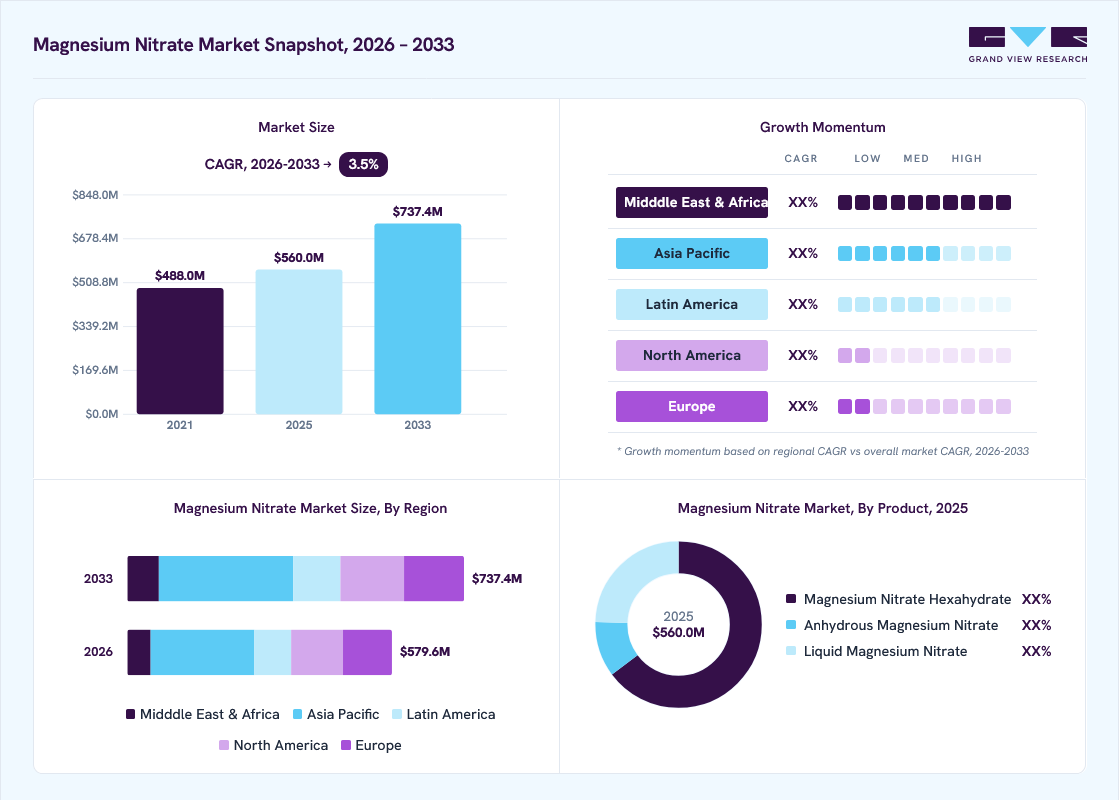
The global magnesium nitrate market size was valued at USD 560.0 million in 2025 and is projected to grow from USD 579.6 million in 2026 to USD 737.4 million by 2033, at a CAGR of 3.5% from 2026 to 2033. The market in Asia Pacific dominated with a revenue share of 39.1% in 2025. Magnesium nitrate market growth is supported by demand for water-soluble nutrient inputs used in specialty fertilizers and precision crop nutrition. Its combination of magnesium and nitrate nitrogen makes it suitable for agricultural formulations requiring readily available nutrients.
 Source: Grand View Research, IR Documents, Primary Interviews, Paid DatabasesTo learn more about this report,
 Download Free Sample Report
Key Market Trends & Insights
- By product: Magnesium nitrate hexahydrate segment held the largest market share of 64.7% in 2025.
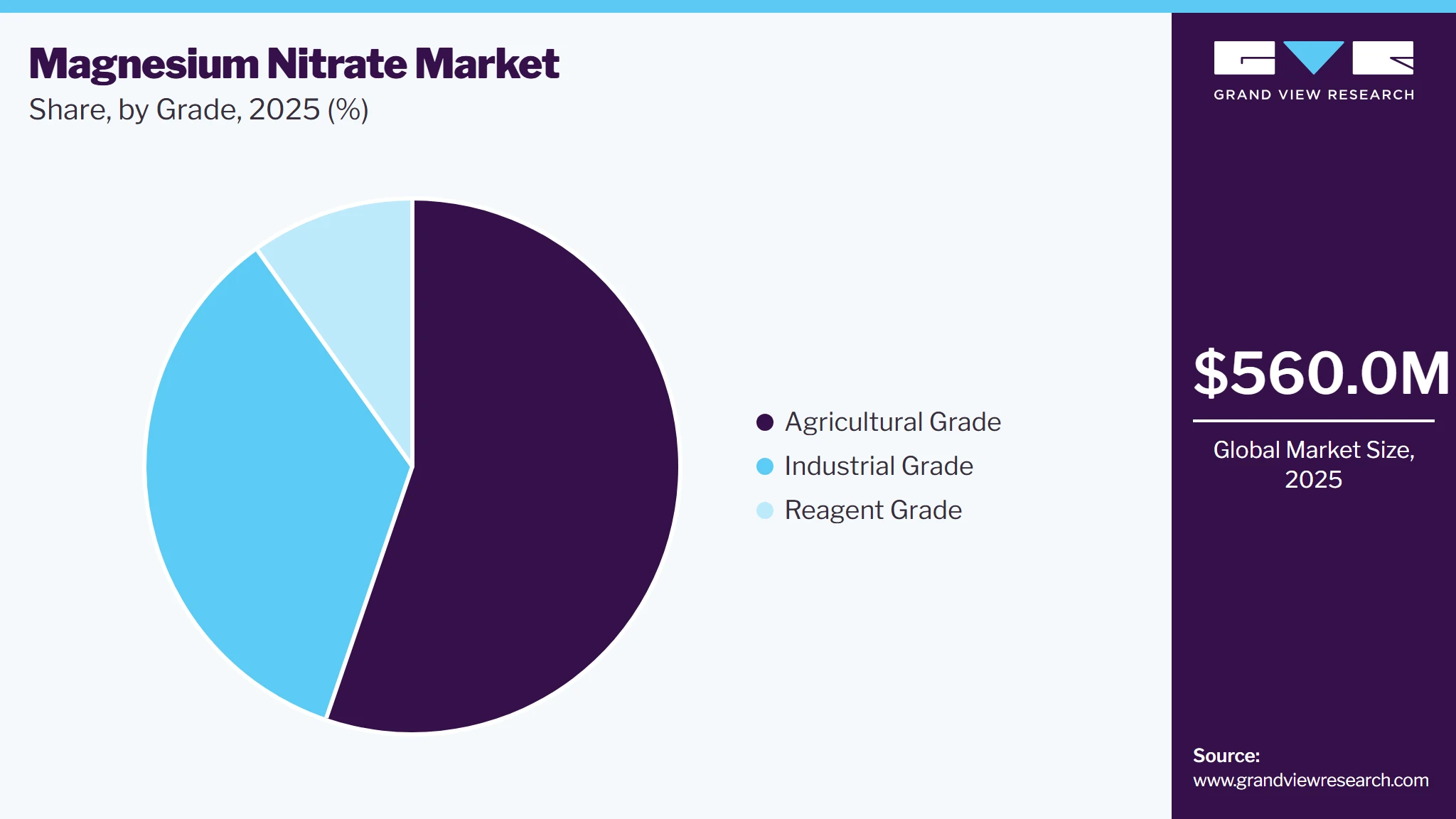
- By grade: Agricultural grade segment held the largest market share of 55.2% in 2025.
- By application: Fertilizers and plant nutrition segment held the largest market share of 45.8% in 2025.
Regional Highlights
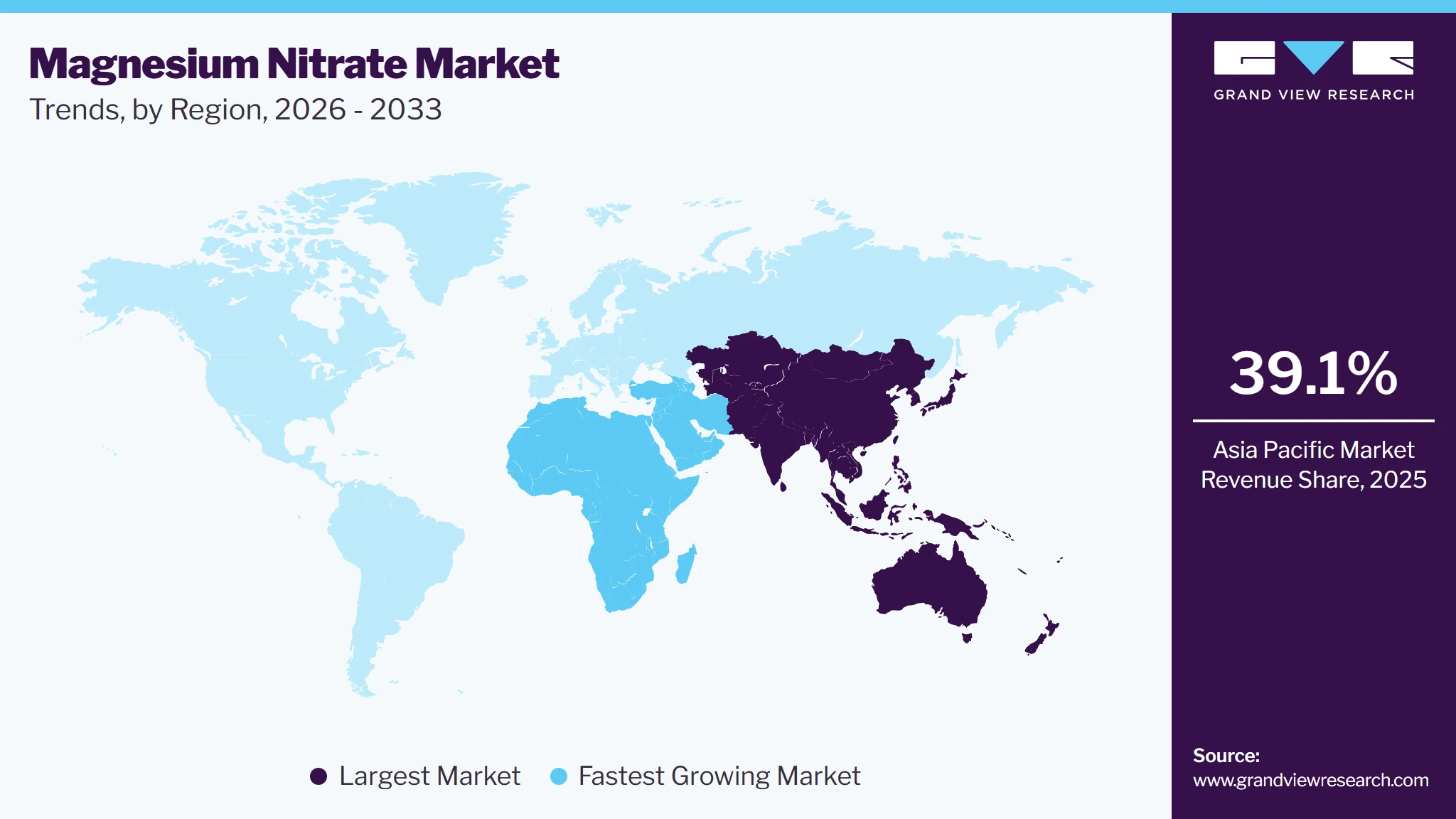
- Largest regional market: Asia Pacific (39.1% revenue share, 2025)
- Fastest-growing regional market: Middle East & Africa (highest CAGR, 2026-2033)
- By country: China held the largest market share in 2025
Market Size & Forecast
- Market size in 2025: USD 560.0 Million
- Estimated market size in 2026: USD 579.6 Million
- Projected market size by 2033: USD 737.4 Million
- CAGR (2026-2033): 3.5%
Three ways to get this report
Buy it, customize it, or ask a question.Ask an Analyst
Analyst response in 1 business day
- AccessReport author, directly
- Reply timeWithin 1 working day
- No sales callDirect answer only
- FormatEmail reply
- CostFree, no cost
Get the Full Report
What the study covers
- FormatsPDF · Excel · Dashboard
- Timeline2026–2033 annual, 2025 base
- Coverage20+ countries, 5 regions
- Companies10+ key players profiled
Customize the Report
20% free customization
- IncludeCountries, segments, points
- TailorTo your product definition
- ExtendDeeper competitor detail
- OrA fully bespoke study
- Turnaround5–10 working days
Demand is further supported by fertigation, hydroponics, and protected cultivation, where soluble nutrient products can be incorporated into controlled irrigation and feeding systems. Commercial products such as Yara’s MAGNITRA L demonstrate the use of liquid magnesium nitrate in these applications.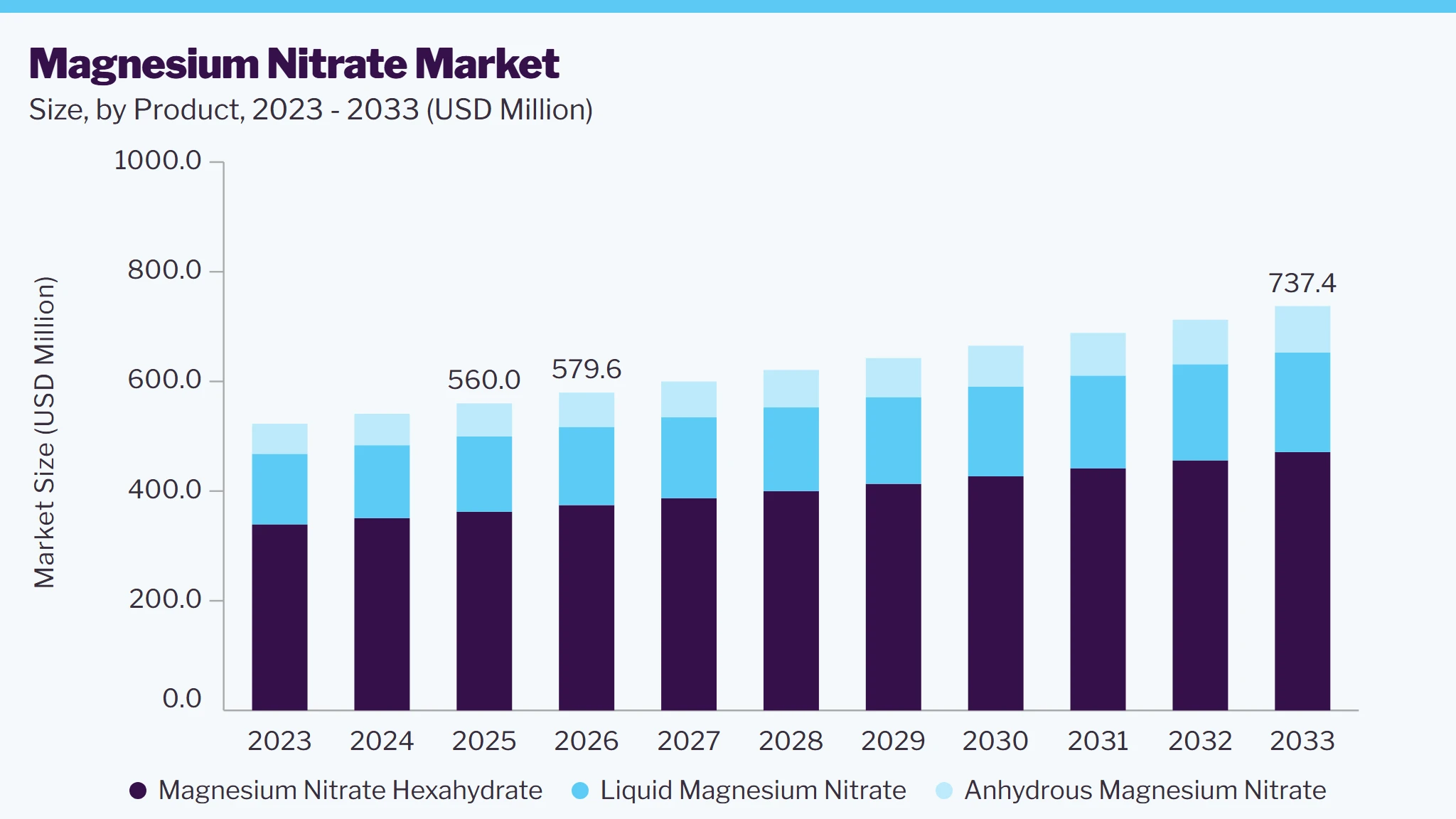 To learn more about this report, Download Free Sample Report
Specialty chemical applications offer opportunities for magnesium nitrate manufacturers to diversify beyond conventional fertilizer demand. High-purity grades, customized concentrations, and application-specific formulations can help manufacturers address laboratory, technical, and industrial requirements. Product differentiation based on purity, consistency, solubility, and packaging may support premium positioning in specialized customer segments.
Market Dynamics
The magnesium nitrate market, alongside the calcium magnesium nitrate market, is shaped by agricultural nutrient requirements, industrial chemical consumption, manufacturing economics, and the availability of suitable grades. Demand varies with crop cycles, fertilizer purchasing patterns, and industrial production activity. Producers must balance commodity-oriented fertilizer volumes with smaller, specification-sensitive applications. Competition depends on product quality, reliable supply, manufacturing costs, and access to target markets.
Specialty fertilizer manufacturers require soluble nutrient ingredients that can be incorporated into customized formulations for different crops, growing conditions, and delivery systems. Magnesium nitrate can serve this need where both magnesium and nitrate nitrogen are required in a single input.
The opportunity extends to fertilizer blenders supplying greenhouse operators, horticultural producers, and commercial growers. Formulation flexibility and compatibility with nutrient-management programs can help manufacturers strengthen relationships with specialty fertilizer customers.
Magnesium nitrate production economics are exposed to changes in the prices and availability of magnesium-bearing feedstocks, nitric acid, energy, and other processing inputs. Cost fluctuations can narrow margins when selling prices cannot be adjusted quickly enough to reflect higher production expenses.
Manufacturers also need to manage moisture sensitivity, storage conditions, packaging integrity, and transportation requirements. These considerations can increase handling costs and complicate inventory management, particularly for products transported over long distances or sold in moisture-sensitive solid forms.
Magnesium nitrate hexahydrate has potential beyond conventional fertilizer and chemical applications because of its phase-change properties. Research on thermal energy storage materials has examined its ability to absorb and release heat around its phase-transition temperature, creating a possible route into specialized energy-management systems.
Commercial expansion in this area depends on material stability, encapsulation, cycling performance, system integration, and cost competitiveness. Suppliers capable of meeting application-specific purity and performance requirements may be better positioned to serve emerging advanced-materials applications.
Market Concentration & Characteristics
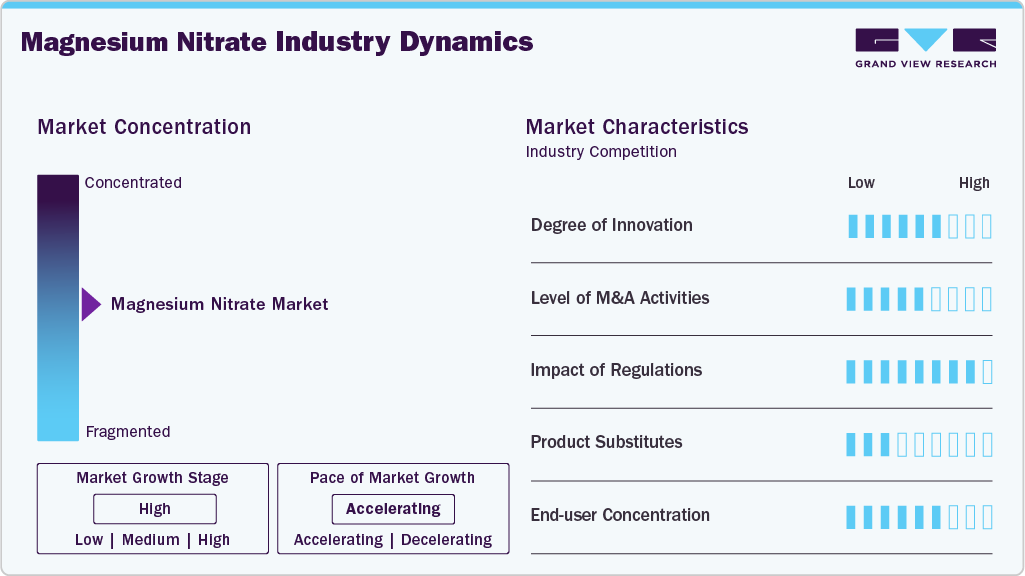
The market includes fertilizer-oriented producers, industrial chemical manufacturers, and specialty-grade suppliers, with competitive positioning varying across the magnesium nitrate hexahydrate market and the broader calcium magnesium nitrate market. Market concentration depends on manufacturer capabilities, production scale, geographic presence, product portfolios, and access to agricultural and industrial customers. A reliable global concentration assessment requires verified company-level revenue or production capacity specific to each market, rather than total corporate chemical sales.
 To learn more about this report, Download Free Sample Report
Product differentiation is influenced by purity, nutrient composition, concentration, physical form, consistency, and end-use suitability. The magnesium nitrate hexahydrate market is supported by demand for water-soluble magnesium and nitrate inputs, while the calcium magnesium nitrate market addresses fertilizer applications requiring both calcium and magnesium nutrients. Agricultural sales are generally volume-oriented, whereas reagent-grade and specialized industrial products compete more heavily on technical specifications, quality assurance, and product consistency.
Analyst Perspective
The magnesium nitrate market combines an established agricultural use base with opportunities in specialized chemical and material applications. Manufacturers should prioritize dependable product quality, cost control, and application-specific development rather than relying exclusively on volume expansion. Market attractiveness will vary according to local production economics, customer qualification requirements, and the ability to secure recurring demand. Emerging uses offer diversification potential but require technical and commercial validation before their contribution can be quantified.
Product Insights
Magnesium nitrate hexahydrate held the largest revenue share of 64.7% in 2025. Magnesium nitrate hexahydrate benefits from established commercial availability and its use as a soluble magnesium and nitrate source in fertilizer formulations. Its crystalline form supports bulk handling and incorporation into water-soluble fertilizer products, underpinning its broad commercial relevance.
Anhydrous magnesium nitrate is the fastest growing form segment, with a CAGR of 4.4% from 2026 to 2033. Anhydrous magnesium nitrate may gain traction in specialized processes where low moisture content and defined chemical specifications are important. Its growth potential depends on the availability of suitable production technology, demand from qualified industrial users, and the economic feasibility of handling a moisture-sensitive product.
Grade Insights
Agricultural grade accounted for 55.2% of the global magnesium nitrate market revenue in 2025. Increasing adoption of soluble nutrient formulations across commercial agriculture strengthens demand for agricultural-grade magnesium nitrate. Its ability to supply readily available magnesium and nitrate nitrogen supports fertilizer blending, fertigation, and crop-specific nutrient management, reinforcing its leading market position.
 To learn more about this report, Download Free Sample Report
Reagent grade is the fastest growing grade segment, with a CAGR of 4.0% from 2026 to 2033, driven by increasing demand for high-purity magnesium nitrate in analytical testing, laboratory experiments, and scientific research. Growing requirements for consistent chemical composition, stringent impurity control, and reliable batch traceability support adoption among research institutions, testing laboratories, and specialized chemical users.
Application Insights
Fertilizers and plant nutrition held the largest revenue share of 45.8% in 2025, because magnesium nitrate provides two useful nutrients in a soluble form. Its suitability for liquid fertilizers, fertigation, and specialty nutrient blends supports adoption across commercial agriculture and controlled-environment cultivation.
Chemical processing is projected to grow with a CAGR of 3.3% from 2026 to 2033, supported by the increasing demand from industrial users requiring magnesium nitrate as a chemical input or functional ingredient in defined processes. Expansion depends on process suitability, technical qualification, and the economics of using magnesium nitrate relative to alternative materials.
Regional Insights
Asia Pacific held the largest revenue share of 39.1% in 2025. Asia Pacific benefits from its extensive fertilizer manufacturing base, large agricultural sector, and established chemical production capabilities. The region also offers access to industrial customers and manufacturing networks that support domestic consumption and cross-border supply.
 To learn more about this report, Download Free Sample Report
China Magnesium Nitrate Market Trends
China is growing with revenue CAGR of 3.8% during forecast period. China’s extensive chemical and fertilizer manufacturing ecosystem supports the availability of nitrate-based chemicals and related industrial inputs. According to the National Bureau of Statistics of China, its Statistical Communiqué of the People’s Republic of China on the 2025 National Economic and Social Development, published on February 28, 2026, value added in the manufacture of raw chemical materials and chemical products increased by 7.8% in 2025, indicating growth in the broader chemical manufacturing sector. This provides an industrial demand indicator for the magnesium nitrate market, although it does not directly measure magnesium nitrate production or consumption.
North America Magnesium Nitrate Market Trends
North America presents opportunities across specialty fertilizers, industrial formulations, and laboratory chemicals. Demand is influenced by commercial agriculture, established chemical manufacturing, and customers that require consistent specifications and dependable supply.
U.S. Magnesium Nitrate Market Trends
The U.S. combines a sizeable agricultural input market with established specialty chemical and laboratory supply chains. Its commercial potential depends on fertilizer formulation requirements, industrial procurement activity, and the ability of domestic producers to compete with imported products.
Europe Magnesium Nitrate Market Trends
Europe offers opportunities for differentiated fertilizer formulations and technically specified industrial chemicals. Product stewardship, documentation, quality standards, and demand for efficient nutrient delivery can influence supplier selection and product positioning.
Latin America Magnesium Nitrate Market Trends
The Latin American magnesium nitrate market is supported by commercial agricultural activities and demand for effective fertilizer solutions. Market growth depends on crop production trends, fertilizer affordability, import costs, and the strength of distribution networks serving key agricultural regions.
Middle East & Africa Magnesium Nitrate Market Trends
Middle East & Africa magnesium nitrate market is expected to grow at the highest CAGR of 4.4% during forecast period. The Middle East and Africa present varied opportunities across fertilizer consumption, chemical manufacturing, and specialized industrial uses. Demand conditions differ substantially by country, with local production capacity, agricultural investment, infrastructure, and import dependence shaping market access.
Key Magnesium Nitrate Company Insights
The global magnesium nitrate market comprises fertilizer manufacturers, specialty chemical producers, and industrial chemical companies competing through product quality, manufacturing capabilities, grade diversity, and geographic reach. Key participants focus on supplying magnesium nitrate hexahydrate, liquid formulations, and specialized grades to agricultural and industrial customers. Competitive differentiation is shaped by production efficiency, reliable supply, application-specific product development, and established customer relationships.
-
Yara International is a global crop nutrition company with a portfolio of fertilizer products designed to support agricultural productivity and nutrient management. In the magnesium nitrate market, its YaraTera MAGNITRA L product contains magnesium nitrate and supplies nitrate nitrogen and magnesium for fertigation, hydroponics, and other crop nutrition applications. The product strengthens Yara’s position in liquid specialty fertilizers serving commercial growers and horticultural producers.
-
Haifa Group is a multinational specialty fertilizer company offering water-soluble plant nutrition products for agricultural and technical applications. Its Magnisal product is magnesium nitrate hexahydrate formulated with 11% nitrogen and 16% magnesium oxide, targeting fertigation, foliar feeding, and magnesium deficiency management. The company also identifies technical applications such as catalyst manufacturing and the ceramic industry, broadening its relevance to the magnesium nitrate market beyond crop nutrition.
Key Magnesium Nitrate Companies
The following key companies have been profiled for the study on the global magnesium nitrate market.
-
Yara International
-
Haifa Group
-
The Shepherd Chemical Company
-
ADOB
-
Van Iperen International
-
Dr. Paul Lohmann
-
Merck KGaA
-
Taskon Industries
-
Acros Organics
-
Ningxia Runguang Material Technology Co., Ltd.
Competitive Benchmarking
Operating Strategies
Competitive Edge
Weaknesses
Mature Players: Yara International, Haifa Group, The Shepherd Chemical Company, ADOB, Van Iperen International, Dr. Paul Lohmann, Merck KGaA
- Mature players focus on leveraging established manufacturing operations, broad fertilizer or specialty chemical portfolios, quality management systems, and established customer relationships. Their strategies include supplying multiple product grades, maintaining consistent specifications, serving agricultural and industrial applications, and strengthening distribution across international markets. For example, Haifa Group offers magnesium nitrate hexahydrate for agricultural and technical uses, while The Shepherd Chemical Company manufactures magnesium nitrate solution for fertilizer and specialized industrial applications.
- Established brand recognition, technical expertise, developed distribution networks, and experience serving regulated or specification-sensitive customers provide competitive advantages. Companies with diversified production capabilities can serve multiple end-use industries and leverage existing customer relationships to support repeat purchases. Their established product portfolios also help them address different concentration, purity, and application requirements.
- Large operating structures and diversified product portfolios can limit flexibility when responding to niche customer requirements or rapid changes in demand. Mature players may also face cost pressures from energy, raw materials, and logistics, while competition from regional producers can challenge pricing in standardized fertilizer-grade products. Companies whose magnesium nitrate business represents a small portion of total revenue may have limited incentive to prioritize product-specific capacity expansion.
Emerging Players: Taskon Industries, Ningxia Runguang Material Technology Co., Ltd.
- Emerging players focus on establishing manufacturing credibility, expanding specialty chemical portfolios, and developing relationships with agricultural and industrial buyers. Their strategies may include strengthening production capabilities, improving product consistency, developing export channels, and targeting underserved regional markets. Taskon Industries, for example, identifies specialty chemicals and water-soluble fertilizers among its manufacturing activities, while Ningxia Runguang Material Technology operates in China's chemical manufacturing sector.
- Regional manufacturing access, focused product portfolios, and opportunities to compete on pricing and supply responsiveness can support market entry. Smaller or more specialized producers may respond quickly to customer-specific requirements and build relationships in markets where established suppliers have limited local coverage. Investment in product quality, dependable delivery, and export readiness can further strengthen their position.
- Emerging players may have less established international distribution, lower brand recognition, and fewer long-standing customer qualification relationships than larger competitors. Limited public disclosure of magnesium nitrate-specific production capacity, sales, and export volumes can also make their competitive position difficult to verify. Expansion into international markets may require additional investment in certifications, technical documentation, logistics, and customer support.
Recent Developments:
- Yara reported that its Egypt operations launched a production line for YaraTera Krista Mag, marking the first magnesium nitrate production line in Yara’s global operations. The investment supports local manufacturing and supply to Egyptian and international markets.
Magnesium Nitrate Market Report Scope
Report Attribute
Details
Market size in 2025
USD 560.0 million
Estimated market size in 2026
USD 579.6 million
Projected market size by 2033
USD 737.4 million
Growth rate
CAGR of 3.5% from 2026 to 2033
Base year for estimation
2025
Historical data
2021 – 2024
Forecast period
2026 – 2033
Quantitative units
Revenue in USD million/billion, volume in kilotons, and CAGR from 2026 to 2033
Report coverage
Revenue forecast, volume forecast, company ranking, competitive landscape, growth factors, and trends
Segments covered
Product, grade, application and region
Regional scope
North America; Europe; Asia Pacific; Latin America; Middle East & Africa
Country scope
U.S.; Canada; Mexico; Germany; UK; France; Italy; Spain; China; India; Japan; South Korea; Brazil; Argentina; Saudi Arabia; South Africa
Key companies profiled
Yara International; Haifa Group; The Shepherd Chemical Company; ADOB; Van Iperen International; Dr. Paul Lohmann; Merck KGaA; Taskon Industries Ltd; Acros Organics; Ningxia Runguang Material Technology Co., Ltd.
Customization scope
Free report customization (equivalent up to 8 analysts’ working days) with purchase. Addition or alteration to country, regional & segment scope.
Pricing and purchase options
Avail customized purchase options to meet your exact research needs. Explore purchase options
Global Magnesium Nitrate Market Report Segmentation
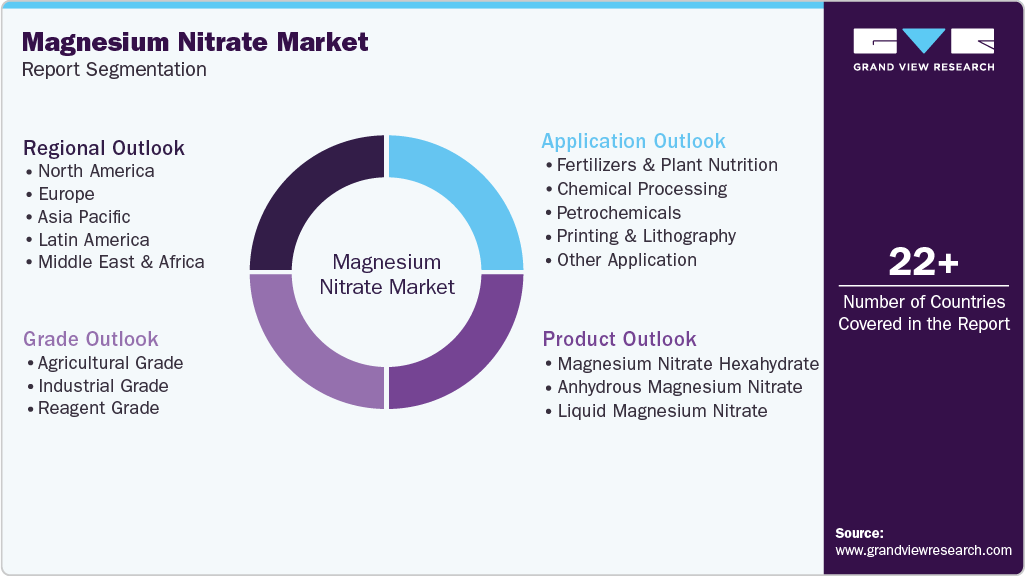
This report forecasts volume & revenue growth at regional and country levels and provides an analysis of the latest industry trends in each of the sub-segments from 2021 to 2033. For this study, Grand View Research has segmented the global magnesium nitrate market report based on product, grade, application and region:
 To learn more about this report, Download Free Sample Report
-
Product Outlook (Volume, Kilotons; Revenue, USD Million, 2021 - 2033)
-
Magnesium Nitrate Hexahydrate
-
Anhydrous Magnesium Nitrate
-
Liquid Magnesium Nitrate
-
-
Grade Outlook (Volume, Kilotons; Revenue, USD Million, 2021 - 2033)
-
Agricultural Grade
-
Industrial Grade
-
Reagent Grade
-
-
Application Outlook (Volume, Kilotons; Revenue, USD Million, 2021 - 2033)
-
Fertilizers & Plant Nutrition
-
Chemical Processing
-
Petrochemicals
-
Printing & Lithography
-
Other Application
-
-
Region Outlook (Volume, Kilotons; Revenue, USD Million, 2021 - 2033)
-
North America
-
U.S.
-
Canada
-
Mexico
-
-
Europe
-
Germany
-
UK
-
France
-
Italy
-
Spain
-
-
Asia Pacific
-
China
-
India
-
Japan
-
South Korea
-
-
Latin America
-
Brazil
-
Argentina
-
-
Middle East & Africa
-
Saudi Arabia
-
South Africa
-
-
Research Methodology
The magnesium nitrate market figures in this report are based on a proven research process that combines executive interviews with secondary research from proprietary databases, company filings, and recognized regulatory and institutional sources. Market size is built through value-chain sizing—reconciling supply-side and demand-side estimates—and triangulated with bottom-up and top-down approaches. Every estimate passes multiple levels of expert validation before publication, with each magnesium nitrate segment quantified using the revenue-capture definitions in the table below.
Segment Definition
Product
Revenue capture definition
Magnesium Nitrate Hexahydrate
Captures revenue generated from the sale of magnesium nitrate hexahydrate, the hydrated crystalline form of magnesium nitrate, supplied primarily for fertilizer formulations, plant nutrition, and industrial applications requiring a water-soluble magnesium and nitrate source.
Anhydrous Magnesium Nitrate
Captures revenue generated from the sale of anhydrous magnesium nitrate, characterized by its low water content and used in specialized chemical processing, industrial formulations, and applications requiring controlled moisture levels.
Liquid Magnesium Nitrate
Captures revenue generated from the sale of liquid magnesium nitrate solutions supplied for fertigation, liquid fertilizer formulations, and industrial processes requiring convenient handling, dosing, and direct integration into liquid systems.
Grade
Revenue capture definition
Agricultural Grade
Captures revenue generated from magnesium nitrate products formulated and supplied for agricultural use, including fertilizer production, fertigation, and plant nutrition applications requiring readily available magnesium and nitrate nutrients.
Industrial Grade
Captures revenue generated from magnesium nitrate products meeting industrial application requirements, including chemical processing, petrochemical operations, and other manufacturing processes where the compound serves as a process chemical or functional ingredient.
Reagent Grade
Captures revenue generated from high-purity magnesium nitrate products supplied for laboratory testing, analytical chemistry, research, and specialized chemical applications requiring controlled impurity levels and consistent product specifications.
Application
Revenue capture definition
Fertilizers & Plant Nutrition
Captures revenue from magnesium nitrate consumed in the manufacture of fertilizers, specialty nutrient blends, and liquid plant nutrition products, including formulations used in fertigation and protected cultivation to supply magnesium and nitrate nitrogen.
Chemical Processing
Captures revenue from magnesium nitrate used as a chemical input, processing agent, or functional ingredient in industrial chemical manufacturing, specialty chemical formulations, and related production processes.
Petrochemicals
Captures revenue from magnesium nitrate supplied for specific petrochemical and oil-and-gas-related processing applications, including specialized process formulations and applications where its chemical properties support operational requirements.
Printing & Lithography
Captures revenue from magnesium nitrate used in printing, lithographic processing, and related specialty formulations where the compound serves a defined process or formulation function.
Other Application
Captures revenue from magnesium nitrate consumed in applications not separately classified above, including laboratory research, analytical uses, specialized manufacturing, and other niche industrial applications.
Estimation Model
Layer No.
Layer Name
Key Question
Description
01
Global Production Baseline
What is the global volume of magnesium nitrate produced?
Establishes the 2025 global magnesium nitrate production baseline in metric tons using government statistics, chemical industry data, trade statistics, manufacturer disclosures, and other credible primary industry sources.
02
Country Production Assessment
How much magnesium nitrate is produced in each country?
Develops country-level magnesium nitrate production estimates by identifying domestic manufacturers, assessing disclosed production capacities and operating activities, and reconciling available national chemical production statistics with industry and trade data.
03
Application Allocation
How is magnesium nitrate consumption distributed across end-use applications?
Allocates the estimated magnesium nitrate market volume across fertilizers and plant nutrition, chemical processing, petrochemicals, printing and lithography, and other applications based on fertilizer consumption patterns, industrial demand indicators, end-use requirements, and available industry data.
04
Product Allocation
What proportion of feed is sold in each physical form?
Splits magnesium nitrate market volume across magnesium nitrate hexahydrate, anhydrous magnesium nitrate, and liquid magnesium nitrate based on manufacturer product portfolios, commercial availability, application requirements, product specifications, and relevant industry supply patterns.
Delivered Customizations
This report has been delivered with the following In-depth customizations
Client Request
Customization Delivered
Value Adds
Cross-Segmentation Analysis
The analysis assessed the relationship between magnesium nitrate product forms, including magnesium nitrate hexahydrate, anhydrous magnesium nitrate, and liquid magnesium nitrate, across agricultural, industrial, and reagent grades. It also evaluated demand distribution across fertilizers and plant nutrition, chemical processing, petrochemicals, printing and lithography, and other applications.
Provides visibility into high-value product, grade, and application combinations, supporting product portfolio optimization, demand assessment, production planning, and segment prioritization.
Competitive Benchmarking
Leading magnesium nitrate manufacturers were benchmarked based on production capacity, product portfolio, grade availability, manufacturing footprint, geographic presence, distribution network, raw material sourcing, vertical integration, sustainability initiatives, and recent strategic developments.
Helps identify competitive strengths, operational advantages, product portfolio gaps, and strategic positioning opportunities. Supports competitive differentiation, partnership assessment, capacity planning, and market entry decisions.
Opportunity Assessment
Growth opportunities were assessed across fertilizers and plant nutrition, chemical processing, petrochemicals, printing and lithography, and other applications. Additional evaluation covered demand for magnesium nitrate hexahydrate, anhydrous magnesium nitrate, and liquid magnesium nitrate across agricultural, industrial, and reagent grades.
Supports the identification of priority growth segments, emerging demand areas, and investment opportunities, enabling informed decisions on capacity expansion, product diversification, grade development, and geographic market development.
About the Author(s)
Agrochemicals & Fertilizers Research Team
Bulk Chemicals · Agrochemicals & FertilizersThis report was authored by the agrochemicals & fertilizers research team at Grand View Research - comprising two research analysts, one senior research analyst, and one industry expert - with specialized expertise in the agrochemicals & fertilizers segment of the bulk chemicals industry. All findings are based on proprietary bulk chemicals databases, executive interviews, and regulatory analysis, subject to internal peer review prior to publication.
Last Updated:
Speak to Analyst

Customize this report to your needs - add regions, segments, or data points, with 20% free customization.
Or view our licence options:


ISO 9001:2015 & 27001:2022 Certified
We are GDPR and CCPA compliant! Your transaction & personal information is safe and secure. For more details, please read our privacy policy.


