
- Home
- »
- Next Generation Technologies
- »
-
Manufacturing Operations Management Software Market Report, 2026-2033GVR Report cover

Manufacturing Operations Management Software Market (2026 - 2033)
Size, Share & Trends Analysis By Component (Software, Services), By Deployment (Cloud, On-premise), By Enterprise Size, By Application, By End Use, By Region, And Segment Forecasts
Market Size, 2025
$19.0BMarket Estimate, 2026
$20.9BMarket Forecast, 2033
$76.7BCAGR, 2026–2033
20.4%Manufacturing Operations Management Software Market Summary
The global manufacturing operations management (MOM) software market size was valued at USD 19.0 billion in 2025 and is projected to grow from USD 20.9 billion in 2026 to USD 76.7 billion by 2033, growing at a CAGR of 20.4% from 2026 to 2033. The market in North America dominated with a revenue share of 31.9% in 2025. This growth is driven by the rapid adoption of Industry 4.0 technologies and smart manufacturing initiatives across industrial sectors. The widespread adoption of Industry 4.0 principles has been a crucial driver for the MOM software market.
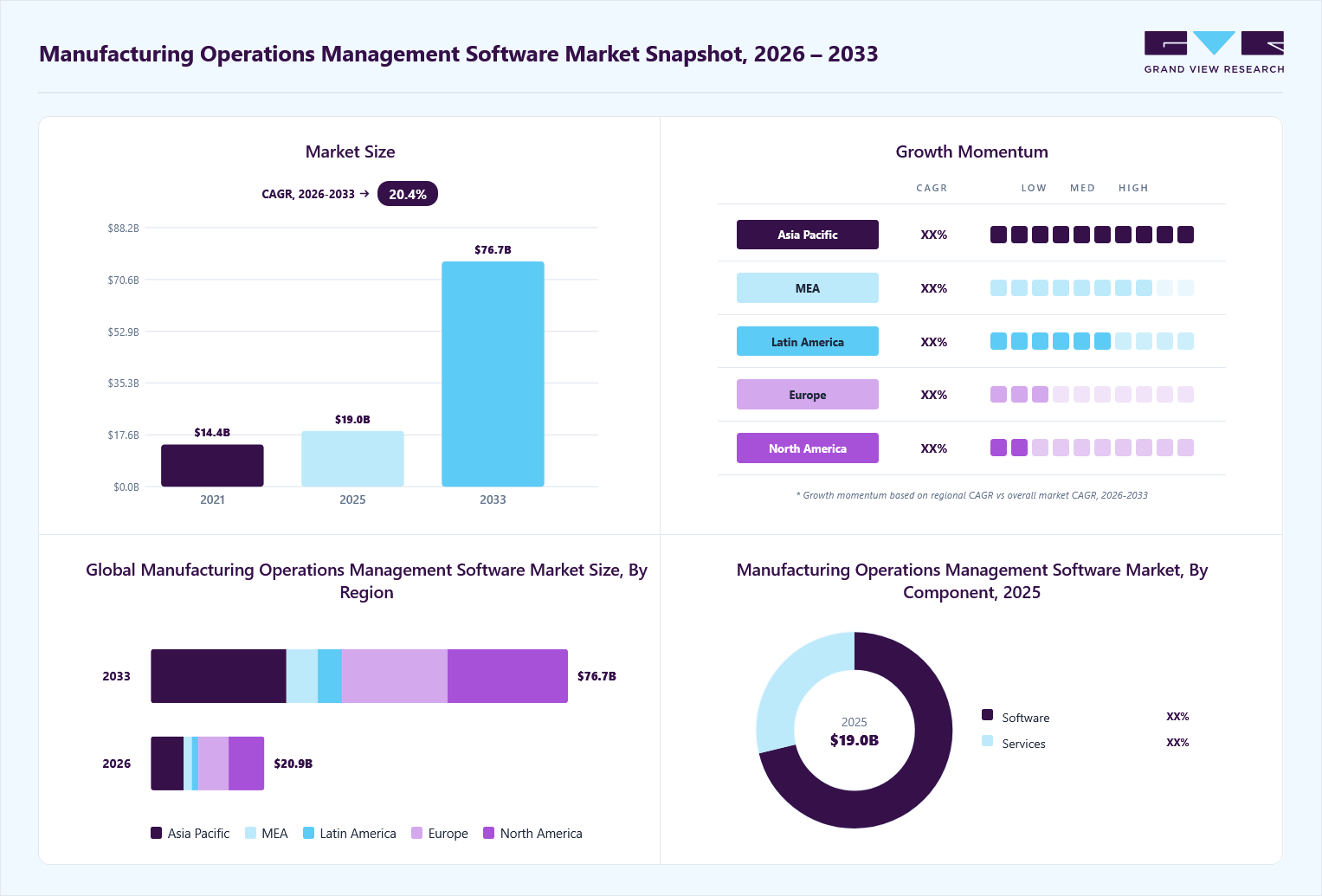 Source: Grand View Research, IR Documents, Primary Interviews, Paid DatabasesTo learn more about this report,
 Download Free Sample Report
 Key Market Trends & Insights
- By component: Software segment dominated the market, with a revenue share of 71.2% in 2025.
- By deployment: Cloud segment held the largest market share of 51.8%in 2025.
- By enterprise size: Large enterprise segment held the largest revenue share in 2025.
Regional Highlights
- Largest regional market: North America (31.9% revenue share, 2025)
- Fastest-growing regional market: Asia Pacific (highest CAGR, 2026-2033)
- By country: The U.S. held the largest market share in 2025.
Market Size & Forecast
- Market size in 2025: USD 19.0 Billion
- Estimated market size in 2026: USD 20.9 Billion
- Projected market size by 2033: USD 76.7 Billion
- CAGR (2026-2033): 20.4%
Three ways to get this report
Buy it, customize it, or ask a question.Ask an Analyst
Analyst response in 1 business day
- AccessReport author, directly
- Reply timeWithin 1 working day
- No sales callDirect answer only
- FormatEmail reply
- CostFree, no cost
Get the Full Report
What the study covers
- FormatsPDF · Excel · Dashboard
- Timeline2026–2033 annual, 2025 base
- Coverage20+ countries, 5 regions
- Companies10+ key players profiled
Customize the Report
20% free customization
- IncludeCountries, segments, points
- TailorTo your product definition
- ExtendDeeper competitor detail
- OrA fully bespoke study
- Turnaround5–10 working days
Manufacturers are increasingly investing in smart factory solutions that integrate real-time data, IoT sensors, AI, and machine learning with manufacturing processes. MOM software plays a vital role in connecting these technologies to streamline production planning, enhance operational visibility, and enable predictive maintenance. As factories aim for greater agility and data-driven decision-making, the demand for integrated MOM platforms continues to increase.The increased adoption of digital twins and simulation technologies drives the growth and evolution of the manufacturing operations management industry. As manufacturers strive to enhance operational efficiency, product quality, and agility, the integration of digital twin capabilities into MOM platforms is becoming a transformative force. A digital twin, essentially a virtual replica of a physical process, product, or system, enables real-time monitoring, scenario testing, and predictive analysis, all of which are crucial for making informed decisions in fast-paced manufacturing environments.
 To learn more about this report, Download Free Sample Report
 The ability to digitally simulate operations and model outcomes before executing them on the shop floor enables companies to reduce errors, optimize resource allocation, and avoid costly downtime, thereby amplifying the value of MOM software solutions. A study conducted by Hexagon in 2024 indicates that the digital twin market grew by 71% from 2020 to 2024. Additionally, 29% of manufacturing companies worldwide have either fully implemented or are in the process of implementing a digital twin strategy for some of their operational assets, while another 63% are actively developing or have already established their digital twin strategy.
Market Dynamics
The manufacturing operations management (MOM) software market is experiencing robust growth as manufacturers increasingly adopt digital technologies to enhance production efficiency, quality control, asset utilization, and supply chain visibility. MOM software integrates critical manufacturing functions such as production planning, quality management, performance analytics, inventory tracking, maintenance management, and workforce coordination into a unified platform. As manufacturers face growing pressure to improve operational agility, reduce production costs, and comply with stringent regulatory requirements, the demand for real-time manufacturing intelligence and data-driven decision-making is accelerating. The increasing adoption of Industry 4.0 technologies, smart factories, Industrial Internet of Things (IIoT), artificial intelligence (AI), and advanced automation systems is further driving investments in MOM solutions across discrete and process manufacturing industries.
The rapid adoption of Industry 4.0 technologies and smart manufacturing strategies is a major driver of the manufacturing operations management software market. Manufacturers are increasingly deploying connected sensors, industrial IoT devices, robotics, AI-powered analytics, and automated production systems to optimize manufacturing performance and gain real-time visibility into operations. MOM software serves as a critical digital layer that integrates shop-floor activities with enterprise systems, enabling improved production scheduling, quality assurance, asset utilization, and operational efficiency. The growing need for predictive maintenance, real-time production monitoring, digital work instructions, and data-driven process optimization is encouraging manufacturers to invest in advanced MOM platforms. As organizations continue their digital transformation journeys and pursue intelligent factory initiatives, the demand for comprehensive manufacturing operations management solutions is expected to increase significantly.
For instance, in April 2026, iBase-t launched Solumina i130, the latest version of its Manufacturing Operations Platform for aerospace and defense manufacturers. The release introduced enhanced intelligence embedded directly into manufacturing execution workflows, enabling greater process control, operational flexibility, production visibility, and faster decision-making across shop-floor operations. The launch demonstrates growing industry demand for advanced manufacturing operations management solutions that support digital manufacturing initiatives and improve operational performance.
The complexity associated with software integration and implementation remains a significant restraint for the Manufacturing Operations Management Software market. Many manufacturing facilities operate with legacy equipment, fragmented IT systems, and diverse automation technologies that require extensive customization and integration efforts when deploying MOM platforms. The implementation process often involves substantial investments in software licensing, system upgrades, employee training, process reengineering, and consulting services.
Additionally, integrating MOM software with enterprise resource planning (ERP), manufacturing execution systems (MES), supply chain management platforms, and industrial control systems can be technically challenging and time-consuming. Small and medium-sized manufacturers, in particular, may face budget constraints and limited technical expertise, slowing adoption rates. Concerns regarding operational disruptions during deployment and lengthy return-on-investment periods further contribute to implementation hesitancy across certain manufacturing sectors.
The increasing adoption of artificial intelligence, advanced analytics, and cloud computing technologies is creating substantial opportunities for the Manufacturing Operations Management Software market. AI-powered MOM platforms enable manufacturers to analyze large volumes of production data, identify operational inefficiencies, predict equipment failures, optimize resource allocation, and improve product quality through intelligent decision-making. These capabilities are becoming increasingly valuable as manufacturers seek to enhance competitiveness and operational resilience.
Furthermore, the growing shift toward cloud-based MOM solutions is enabling organizations to achieve faster deployment, lower infrastructure costs, improved scalability, and remote access to manufacturing data across geographically distributed facilities. The expansion of smart factories, digital twins, industrial IoT ecosystems, and connected manufacturing networks is also generating demand for centralized operational management platforms. As manufacturers continue investing in intelligent production environments and data-driven operations, AI-enabled and cloud-native MOM solutions are expected to present significant long-term growth opportunities for software vendors and technology providers.
Analyst Perspective
The MOM software market sits at the center of several transformative industrial trends, including the adoption of Industry 4.0 technologies, smart factory initiatives, industrial automation, artificial intelligence (AI), and the Industrial Internet of Things (IIoT). As manufacturers increasingly focus on improving production efficiency, quality control, operational visibility, and supply chain resilience, MOM software has become a critical enabler of digital manufacturing transformation. The market also benefits from growing demand for real-time production monitoring, predictive maintenance, regulatory compliance, and data-driven decision-making across discrete and process industries. The central competitive advantage, however, will belong to vendors that can seamlessly integrate AI-powered analytics, cloud-native architectures, digital twin capabilities, industrial IoT connectivity, and end-to-end manufacturing workflows into a unified operational platform.
Component Insights
Based on component, the software segment led the market with the largest revenue share of 71.2% in 2025. The segment’s growth is significantly driven by digital transformation and the adoption of Industry 4.0 technologies. Manufacturers are embracing smart factory initiatives and deploying digital twins to create real-time, data-rich environments that mirror physical operations. These technologies necessitate advanced MOM software capable of managing and optimizing production processes with high precision. Companies are increasingly implementing MOM software across their manufacturing factories to monitor operations and enhance organizational efficiency.
The services segment is anticipated to grow at the fastest CAGR of 20.3% during the forecast period. Manufacturers increasingly require customized MOM software to align with their specific industry workflows, regulatory requirements, and production models. This demand has greatly increased the need for expert configuration and customization services. Off-the-shelf solutions frequently lack the flexibility to manage complex manufacturing environments, particularly in sectors like automotive, pharmaceuticals, and aerospace, where precision, compliance, and traceability are vital.
Deployment Insights
Based on deployment, the cloud segment led the market with the largest revenue share of 51.8% in 2025. Cloud-based software significantly reduces upfront investment by eliminating the need for costly on-premise servers, storage systems, and dedicated IT infrastructure. This makes it particularly appealing to manufacturers seeking to modernize without substantial capital expenditures. Instead of purchasing perpetual licenses, companies can subscribe to scalable, pay-as-you-go models that fit their usage and budget. These subscription-based plans not only enhance cost predictability but also lower the total cost of ownership by incorporating maintenance, updates, and support into the package.
The on-premise segment is expected to grow at a significant CAGR over the forecast period. On-premise Manufacturing Operations Management (MOM) software continues to gain traction in industries that require stringent data security, control, and customization. The on-premise segment is witnessing notable expansion due to the high level of data security and governance it offers. Manufacturers in sectors such as aerospace, defense, and pharmaceuticals often manage highly sensitive intellectual property, trade secrets, and regulated information.
Enterprise Size Insights
Based on enterprise size, the large enterprise segment led the market with the largest revenue share of 60.2% in 2025. Large enterprises typically manage complex manufacturing environments involving multiple products, production lines, and geographically distributed facilities. This complexity demands a high level of operational coordination, consistency, and control to maintain efficiency and meet customer expectations. MOM software plays a vital role in helping these organizations standardize processes, synchronize production across sites, and maintain uniform quality and compliance.
The SMEs segment is expected to grow at a significant CAGR during the forecast period. MOM software boosts operational efficiency for small and medium-sized enterprises (SMEs) by simplifying and organizing complex manufacturing processes. It reduces lead times by enhancing production scheduling, ensuring that resources like labor, materials, and equipment are used effectively. This streamlined coordination helps avoid delays and bottlenecks, resulting in increased production throughput. By minimizing waste and optimizing resource usage, MOM software enables SMEs to lower operational costs and enhance overall productivity.
Application Insights
Based on application, the quality management segment led the market with the largest revenue share of 23.9% in 2025. Manufacturers are increasingly adopting quality management software to meet strict industry standards such as ISO, FDA, and OSHA. These systems support closed-loop corrective and preventive actions (CAPA), enabling companies to quickly identify, address, and prevent quality issues, thereby enhancing product reliability and customer satisfaction. Centralizing quality records and documentation helps ensure ongoing compliance and reduces the risk of regulatory penalties, which is critical in highly regulated industries.
The manufacturing execution systems (MES) segment is expected to grow at a significant CAGR over the forecast period. Manufacturers are increasingly adopting quality management software to comply with strict industry standards, including ISO, FDA, and OSHA. These systems facilitate closed-loop corrective and preventive actions (CAPA), enabling companies to swiftly identify, address, and prevent quality issues, thereby enhancing product reliability and customer satisfaction. Centralizing quality records and documentation ensures ongoing compliance and minimizes the risk of regulatory penalties, which is crucial in highly regulated industries.
End Use Insights
Based on end use, the aerospace & defense segment led the market with the largest revenue share of 21.4% in 2025. The aerospace and defense (A&D) industry is heavily regulated, with strict compliance requirements set by authorities such as the FAA, EASA, and ITAR. These regulations require complete traceability of parts and processes, making Manufacturing Operations Management (MOM) software essential. MOM systems facilitate serialized part tracking and support digital thread integration, ensuring every component can be traced throughout its lifecycle. A&D manufacturers are increasingly prioritizing regulatory compliance and quality assurance.
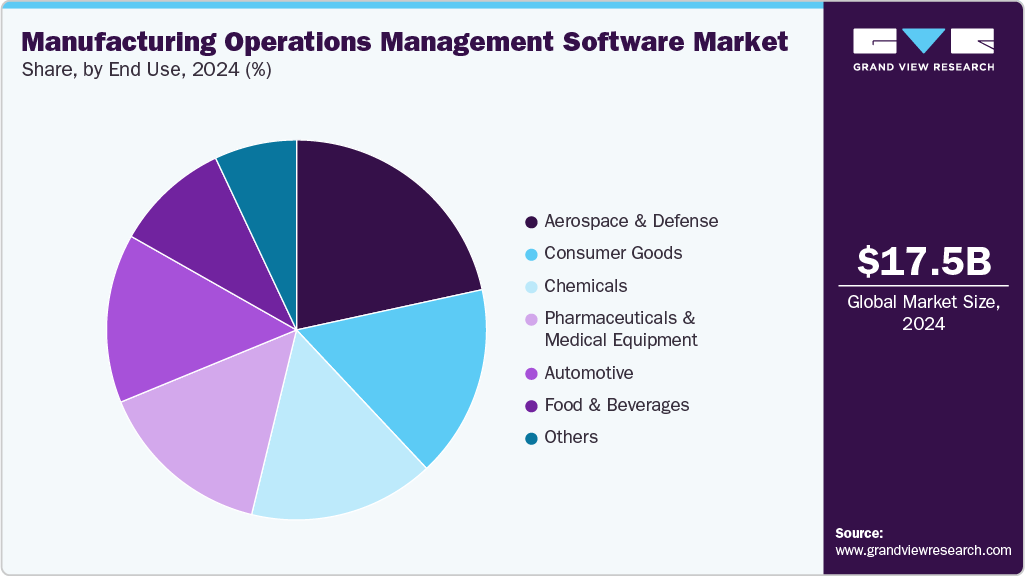 To learn more about this report, Download Free Sample Report
 The automotive segment is expected to grow at a significant CAGR over the forecast period. The automotive sector is undergoing rapid transformation, driven by the adoption of Industry 4.0 technologies. The Integrating of IoT, AI, machine learning, and cloud computing into automotive manufacturing operations enables real-time monitoring and data analysis. These technologies equip manufacturers to make quicker, more informed decisions by providing visibility into production metrics, equipment health, and supply chain dynamics. Consequently, operations can be continuously optimized for efficiency, which reduces waste, minimizes downtime, and enhances overall productivity.
Regional Insights
North America dominated the global manufacturing operations management software market with the largest revenue share of 31.9% in 2025, driven by the region's strong emphasis on Industry 4.0 adoption, with manufacturers investing in smart factory solutions to enhance efficiency. Additionally, stringent regulatory compliance requirements (e.g., FDA, OSHA) push industries like pharmaceuticals and automotive to adopt MOM software for traceability and quality control. The presence of major tech innovators and cloud providers also accelerates digital transformation in manufacturing.
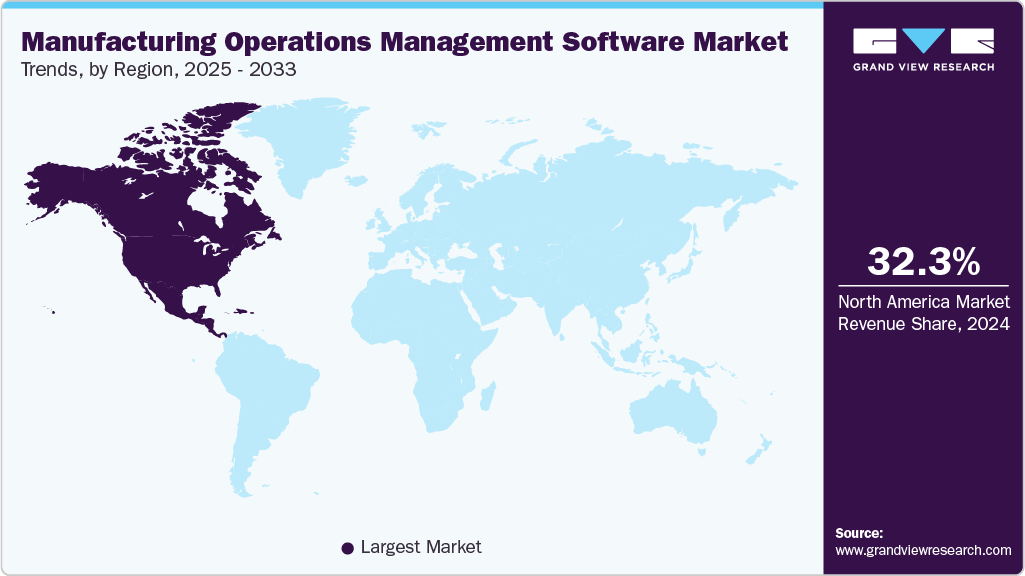 To learn more about this report, Download Free Sample Report
 U.S. Manufacturing Operations Management Software Market Trends
The manufacturing operations management software market in the U.S. held the largest share in the North America region in 2025, driven by the increasing demand for real-time production monitoring and predictive maintenance aimed at reducing downtime. The rise of reshoring initiatives, focused on bringing manufacturing back from overseas, further enhances the need for advanced MOM solutions to optimize domestic production. Additionally, the aerospace and defense sector’s strict compliance requirements drive the adoption of better workflow and documentation management.
Europe Manufacturing Operations Management Software Market Trends
The manufacturing operations management software industry in Europe is anticipated to register considerable growth from 2025 to 2033, driven by strong government support for smart manufacturing initiatives, such as the EU’s Industry 5.0 framework, which emphasizes sustainability and human-centric automation. The region’s commitment to energy-efficient production and circular economy practices also motivates manufacturers to implement MOM solutions for waste reduction and process optimization.
The UK manufacturing operations management software market is expected to grow rapidly in the coming years due to the post-Brexit push for industrial self-sufficiency, prompting manufacturers to invest in MOM software to enhance competitiveness. The automotive and aerospace sectors, crucial to the UK economy, are adopting MOM solutions for supply chain resilience and regulatory compliance (e.g., UKCA marking). Furthermore, the emergence of digital twins and AI-driven analytics fosters smarter manufacturing processes.
The manufacturing operations management software market in Germany held a substantial revenue share in 2024, owing to strong automotive and machinery sectors, which necessitate high-precision production control. The emphasis on cybersecurity in manufacturing IT is driving demand for secure, integrated MOM platforms. Additionally, labor shortages are prompting manufacturers to automate operations, which increases the reliance on MOM software for workforce productivity.
Asia Pacific Manufacturing Operations Management Software Market Trends
Asia Pacific is expected to be the fastest-growing region, registering the fastest CAGR of 21.1% from 2025 to 2033, due to rapid industrialization, particularly in emerging economies. Governments are promoting smart manufacturing policies such as China’s Made in China 2025 and India’s Make in India, which encourage digital adoption. The region’s expanding electronics and semiconductor industries also require MOM solutions for complex production management and yield optimization.
The Japan manufacturing operations management software market is expected to grow rapidly in the coming years, driven by the need for automation in aging factories to counter labor shortages. The country’s robust robotics and electronics manufacturing base requires precise MOM tools for quality assurance. Additionally, government subsidies for digital transformation, such as Society 5.0, support the integration of smart manufacturing technologies.
The manufacturing operations management software market in China held a substantial market share in 2024, due to the manufacturing sector’s shift toward smart factories, supported by state-led initiatives like Industrial Internet. The push for self-sufficiency in semiconductor and EV production increases demand for MOM solutions to enhance yield and supply chain agility. Additionally, rising labor costs are accelerating automation investments.
Key Manufacturing Operations Management Software Company Insights
Key players operating in the manufacturing operations management software industry are ABB; Dassault Systèmes; GE Vernova; iBase-t; and Honeywell International Inc. The companies are focusing on various strategic initiatives, including new product development, partnerships & collaborations, and agreements to gain a competitive advantage over their rivals. The following are some instances of such initiatives.
-
In May 2025, Epicor Software Corporation introduced a new Carbon Cost Rollup feature within Epicor Kinetic, its industry-specific ERP cloud platform tailored for manufacturers. This innovative solution adapts traditional cost rollup methods from standard costing systems to track carbon emissions, effectively treating CO2 as a measurable cost. By integrating emissions data in this way, the tool enhances the accuracy of compliance reporting and supports manufacturers in meeting sustainability goals with greater confidence
-
In April 2025, iBase-t partnered with Articul8 to integrate Articul8’s advanced generative AI capabilities into iBase-t sSolumina Manufacturing Operations Platform. This collaboration brings AI-driven insights and automation to aerospace & defense manufacturing operations. By combining iBase-t’s expertise in simplifying complex manufacturing workflows with Articul8’s autonomous generative AI for data perception and reasoning, the partnership aims to boost data-driven decision-making, streamline processes, and enhance overall productivity for manufacturers in the aerospace & defense sector.
Key Manufacturing Operations Management Software Companies:
The following key companies have been profiled for this study on the manufacturing operations management software market.
-
ABB
-
Aegis Industrial Software Corporation
-
Aspen Technology Inc.
-
AVEVA Solutions Limited
-
Dassault Systèmes
-
DURR Group
-
Epicor Software Corporation
-
GE Vernova
-
Honeywell International Inc.
-
iBase-t
-
Oracle
-
Rockwell Automation
-
SAP SE
-
Schneider Electric
-
Siemens
Competitive Benchmarking
Category
Operating Strategies
Competitive Edge
Weakness
Established Players (Siemens, SAP SE, Rockwell Automation, Honeywell International Inc., Schneider Electric, AVEVA Solutions Limited, Dassault Systèmes, Oracle,)
Invest in Industry 4.0, AI, cloud-based MOM platforms, digital twins, and IIoT integration.
Expand enterprise-wide manufacturing software ecosystems.
Strong global brand recognition and customer base.
Comprehensive manufacturing software portfolios.
High implementation and ownership costs.
Complex deployments and longer implementation timelines.
Emerging Players (ABB, GE Vernova, Epicor Software Corporation, DURR Group)
Focus on industry-specific and mid-market manufacturing solutions.
Enhance cloud-based offerings and industrial analytics capabilities.
Greater flexibility and faster customization.
Strong expertise in industrial automation and operational technologies.
Smaller market presence than leading vendors.
Limited global reach and ecosystem partnerships.
Manufacturing Operations Management Software Market Report Scope
Report Attribute
Details
Market size in 2025
USD 19.0 billion
Estimated market size in 2026
USD 20.9 billion
Projected market size by 2033
USD 76.7 billion
Growth rate
CAGR of 20.4% from 2026 to 2033
Base year for estimation
2025
Historical data
2021 - 2024
Forecast period
2026 - 2033
Quantitative units
Revenue in USD million/billion and CAGR from 2026 to 2033
Report coverage
Revenue forecast, company market share, competitive landscape, growth factors, and trends
Segments covered
Component, deployment, enterprise size, application, end use, region
Regional scope
North America; Europe; Asia Pacific; Latin America; MEA
Country scope
U.S.; Canada; Mexico; U.K.; Germany; France; China; India; Japan; Australia; South Korea; Brazil; UAE; Kingdom of Saudi Arabia; South Africa
Key companies profiled
ABB; Aegis Industrial Software Corporation; Aspen Technology Inc.; AVEVA Solutions Limited; Dassault Systèmes; DURR Group; Epicor Software Corporation; GE Vernova; Honeywell International Inc.; iBase-t; Oracle; Rockwell Automation; SAP SE; Schneider Electric; Siemens
Customization scope
Free report customization (equivalent up to 8 analysts' working days) with purchase. Addition or alteration to country, regional & segment scope.
Pricing and purchase options
Avail customized purchase options to meet your exact research needs. Explore purchase options
Global Manufacturing Operations Management Software Market Report Segmentation
This report forecasts revenue growth at the global, regional, and country levels and provides an analysis of the latest industry trends in each of the sub-segments from 2021 to 2033. For this study, Grand View Research has segmented the manufacturing operations management software market report based on component, deployment, enterprise size, application, end use, and region.
-
Component Outlook (Revenue, USD Billion, 2021 - 2033)
-
Software
-
Services
-
-
Deployment Outlook (Revenue, USD Billion, 2021 - 2033)
-
Cloud
-
On-premise
-
-
Enterprise Size Outlook (Revenue, USD Billion, 2021 - 2033)
-
Large Enterprises
-
SMEs
-
-
Application Outlook (Revenue, USD Billion, 2021 - 2033)
-
Advanced Planning & Scheduling
-
Manufacturing Execution Systems (MES)
-
Labor Management
-
Inventory Management
-
Quality management
-
Laboratory Management
-
Others
-
-
End Use Outlook (Revenue, USD Billion, 2021 - 2033)
-
Aerospace & Defense
-
Automotive
-
Pharmaceuticals & Medical Equipment
-
Chemicals
-
Food & Beverages
-
Consumer Goods
-
Others
-
-
Regional Outlook (Revenue, USD Billion, 2021 - 2033)
-
North America
-
U.S.
-
Canada
-
Mexico
-
-
Europe
-
UK
-
Germany
-
France
-
-
Asia Pacific
-
China
-
India
-
Japan
-
South Korea
-
Australia
-
-
Latin America
-
Brazil
-
-
Middle East & Africa
-
UAE
-
Saudi Arabia
-
South Africa
-
-
Research Methodology
Segment Definition
Segment - Component
Revenue capture definition
Software
As the largest type segment, revenue is generated through subscription-based licensing, perpetual software licenses, cloud-hosted platform fees, user-based pricing models, and add-on module sales for manufacturing execution, quality management, inventory tracking, production scheduling, analytics, and plant performance optimization. Additional revenue is captured through software upgrades, maintenance contracts, and AI-enabled operational intelligence features.
Services
Revenue is generated through consulting, implementation, customization, system integration, training, technical support, managed services, software maintenance, migration, and operational optimization services. Vendors also capture revenue from integrating MOM platforms with ERP, SCADA, PLM, IoT, and automation systems to improve manufacturing efficiency and digital transformation outcomes.
Segment - Deployment
Revenue capture definition
Cloud
As the largest type segment, revenue is primarily generated through recurring subscription fees for cloud-hosted manufacturing operations management platforms that provide real-time production monitoring, analytics, scheduling, quality control, and operational visibility. Additional revenue is derived from storage, advanced analytics, AI capabilities, security services, and multi-site manufacturing management functionalities delivered through Software-as-a-Service (SaaS) models.
On-premise
Revenue is generated through perpetual software licenses, implementation fees, hardware infrastructure investments, customization services, maintenance contracts, technical support, and periodic software upgrades. Large manufacturers often adopt on-premise deployments to maintain greater control over production data, regulatory compliance, and integration with legacy manufacturing systems.
Segment - Enterprise Size
Revenue capture definition
Large Enterprises
The large enterprises segment, with respect to the number of employees, typically comprises organizations employing more than 1,000 employees for multinational corporations.
SMEs
The SMEs segment, with respect to the number of employees, generally includes organizations employing between 10 and 999 employees.
Segment - Application
Revenue capture definition
Advanced Planning & Scheduling
Revenue is generated through software licenses and subscriptions that enable production planning, capacity optimization, resource allocation, demand forecasting, and schedule management to improve manufacturing efficiency and reduce operational bottlenecks.
Manufacturing Execution Systems (MES)
Revenue is generated through software subscriptions, implementation projects, and integration services that facilitate real-time production monitoring, work order management, machine connectivity, traceability, and shop-floor execution control.
Labor Management
Revenue is generated through workforce scheduling, productivity tracking, skill management, labor analytics, attendance monitoring, and workforce optimization software modules designed to improve operational efficiency and labor utilization.
Inventory Management
Revenue is generated through software solutions that enable raw material tracking, warehouse visibility, inventory optimization, demand planning, replenishment automation, and supply chain coordination across manufacturing facilities.
Quality management
As the largest application segment, revenue is captured through software subscriptions, quality assurance modules, compliance management solutions, inspection systems, statistical process control tools, corrective action management, and traceability platforms that help manufacturers reduce defects and maintain regulatory compliance.
Laboratory Management
Revenue is generated through laboratory information management systems (LIMS), testing workflow automation, sample tracking, quality validation, regulatory reporting, and laboratory analytics solutions used across regulated manufacturing environments.
Others
Revenue is generated through modules supporting maintenance management, energy monitoring, asset performance management, sustainability tracking, production analytics, digital work instructions, and operational intelligence applications.
Segment - End Use
Revenue capture definition
Aerospace & Defense
As the largest end-use segment, revenue is captured through software deployments that support production traceability, regulatory compliance, quality assurance, process control, maintenance operations, and complex manufacturing workflows required for highly regulated aerospace and defense manufacturing environments.
Automotive
Revenue is generated through solutions supporting production scheduling, assembly line optimization, supplier coordination, quality management, predictive maintenance, and real-time manufacturing visibility across automotive production facilities.
Pharmaceuticals & Medical Equipment
Revenue is generated through compliance-focused MOM software that enables batch tracking, electronic records management, quality control, validation processes, laboratory integration, and regulatory reporting requirements.
Chemicals
Revenue is generated through software supporting process manufacturing, recipe management, production monitoring, safety compliance, inventory optimization, and operational efficiency across chemical manufacturing operations.
Food & Beverages
Revenue is generated through solutions that facilitate batch traceability, quality assurance, production planning, inventory management, food safety compliance, and supply chain visibility throughout manufacturing processes.
Consumer Goods
Revenue is generated through production optimization, inventory control, demand-driven manufacturing, quality monitoring, workforce management, and operational analytics solutions that improve efficiency and responsiveness to changing consumer demand.
Others
Revenue is generated from manufacturing operations management deployments across industries such as electronics, semiconductor, energy, industrial machinery, paper and pulp, textiles, and metals and mining, where manufacturers seek greater production visibility, automation, and operational control.
Estimation Model
Layer
Question
Analysis
MOM Software Addressable Layer
Who can benefit from MOM software?
Identify manufacturing facilities, production plants, and industrial sites across key industries to define the potential user base for Manufacturing Operations Management (MOM) solutions.
Technology Access Layer
Who can deploy MOM software?
Apply automation maturity, digital infrastructure, cloud readiness, and ERP/MES integration capabilities to determine the operationally reachable market.
Adoption & Capacity Utilization Layer
Who actively uses MOM software?
Apply Industry 4.0 adoption rates, smart factory initiatives, and digital transformation trends to convert reachable manufacturers into active MOM software users.
Monetization Layer
How much revenue is generated?
Assess revenue generated from software subscriptions, licenses, implementation services, maintenance, analytics modules, and recurring support contracts.
Delivered Customizations
This report has been delivered with the following In-depth customizations
Client Request
Customization Delivered
Value Adds
Smart Factory & Industry 4.0 Adoption Trends
Conducted a focused analysis of Industry 4.0 implementation across manufacturing sectors, covering AI-driven production optimization, IIoT connectivity, digital twins, real-time production monitoring, and smart factory transformation initiatives.
Helps stakeholders identify high-growth digital manufacturing opportunities, evaluate technology adoption trends, and assess investment priorities for operational modernization.
Quality Management & Compliance Software Trends
Conducted an assessment of quality management applications, traceability solutions, electronic batch records, regulatory compliance tools, and defect reduction technologies across regulated industries.
Provides insights into compliance-driven software demand and quality-focused investment opportunities.
Digital Twin & Simulation Technology Assessment
Assessed the use of digital twins, process simulation, virtual production environments, and real-time operational modeling within manufacturing facilities.
Identifies next-generation manufacturing technologies driving future MOM software demand.
Frequently Asked Questions About This Report
The software segment led with a 71.2% revenue share in 2025, while the services segment is the fastest-growing segment.
The cloud segment led with a 51.8% revenue share in 2025, while the on-premise segment is the fastest-growing segment.
The large enterprise segment led with a 60.2% revenue share in 2025, while the SMEs segment is the fastest-growing segment.
Key players operating in the manufacturing operations management software market include ABB; Aegis Industrial Software Corporation; Aspen Technology Inc.; AVEVA Solutions Limited; Dassault Systèmes; DURR Group; Epicor Software Corporation; GE Vernova; Honeywell International Inc.; iBase-t; Oracle; Rockwell Automation; SAP SE; Schneider Electric; Siemens
The global manufacturing operations management software market size was estimated at USD 19.0 billion in 2025 and is expected to reach USD 20.9 billion in 2026.
The global manufacturing operations management software market is expected to witness a compound annual growth rate of 20.4% from 2026 to 2033, expected to reach USD 76.7 billion by 2033.
Key factors include the rapid adoption of Industry 4.0 technologies and smart manufacturing initiatives across industrial sectors
North America dominated with 31.9% revenue share in 2025.
Asia Pacific is the fastest-growing region over the forecast period.
About the Author(s)
Next Generation Technologies Research Team
Technology · Next Generation TechnologiesThis report was authored by the next generation technologies research team at Grand View Research - comprising two research analysts, one senior research analyst, and one industry expert - with specialized expertise in the next generation technologies segment of the technology industry. All findings are based on proprietary technology databases, executive interviews, and regulatory analysis, subject to internal peer review prior to publication.
Last Updated:
Speak to Analyst

Customize this report to your needs - add regions, segments, or data points, with 20% free customization.
Or view our licence options:


ISO 9001:2015 & 27001:2022 Certified
We are GDPR and CCPA compliant! Your transaction & personal information is safe and secure. For more details, please read our privacy policy.


